Laparoscopic colorectal surgery for colorectal
polyps: experience of ten years
Correspondence to: Audrius Dulskas, Department of Abdom-inal and General Surgery and Oncology, National Cancer In-stitute, 1 Santariškių St, Vilnius LT-08406, Lithuania. E-mail: [email protected]
Audrius Dulskas1, Žygimantas Kuliešius1,
Narimantas E. Samalavičius1, 2
1 Department of Abdominal and General Surgery and Oncology, National Cancer Institute, Vilnius, Lithuania
2 Clinic of Internal Diseases, Family Medicine and Oncology, Faculty of Medicine, Vilnius University
Vilnius, Lithuania
Background. Laparoscopy or its combination with endoscopy is the next step for “difficult” polyps. The purpose of the paper was to review the outcomes of the laparoscopic approach to the management of “difficult” colorectal polyps.
Materials and methods. From 2006 to 2016, 58 patients who under-went laparoscopic treatment for “difficult” polyps that could not be treat-ed by endoscopy at the National Cancer Institute, Lithuania, were includ-ed. The demographic data, the type of surgery, length of post-operative stay, complications, and final pathology were reviewed prospectively.
Results. The mean patient was 65.9 ± 8.9 years of age. Laparoscop-ic mobilization of the colonLaparoscop-ic segment and colotomy with removal of the polyp was performed in 15 (25.9%) patients, laparoscopic segmental bowel resection in 41 (70.7%) cases: anterior rectal resection with par-tial total mesorectal excision in 18 (31.0%), sigmoid resection in nine (15.5%), left hemicolectomy in seven (12.1%), right hemicolectomies in two (3.4%), ileocecal resection in two (3.4%), resection of transverse colon in two (3.4%), and sigmoid resection with transanal retrieval of specimen in one (1.7%). Two patients (3.4%) underwent laparoscopic- assisted endoscopic polypectomy. The mean post-operative hospital stay was 5.7 ± 2.4 days. There were four complications (6.9%). All pa-tients recovered after conservative treatment. The mean polyp size was 3.5 ± 1.9 cm. Final histopathology revealed hyperplastic polyps (n = 2), tubular adenoma (n = 9), tubulovillous adenoma (n = 31), carcinoma in situ (n = 12), and invasive cancer (n = 4).
Conclusions. For the management of endoscopically unresectable polyps, laparoscopic surgery is currently the technique of choice.
Keywords: laparoscopic surgery, colectomy, colorectal polyp, endo-scopic polypectomy, difficult polyp
INTRODUCTION
Globally, colorectal cancer (CRC) ranked third for cancer incidence and fourth for cancer death
to remove polyps by using either endoscopic, surgical, or combined methods (4). Patients who have known adenomas and refuse removal devel-op colon cancer at the rate of 4% after 5 years and 14% after 10 years, which is higher than that of the general population (5). Endoscopic removal of polyps has been shown to arrest subsequent de-velopment of carcinoma (6).
Most of the polyps can be removed endoscop-ically using well-established principles. However, there is a group of polyps that are challenging even to the most advanced endoscopist. These so-called “difficult polyps” comprise about 10–15% of all polyps (7). They may be difficult to remove because of their size, configuration, and location in the colon. For example, large sessile polyps or polyps spanning two folds present technical chal-lenges (8). Criteria for sessile polyps that can be managed by endoscopic mucosal resection (EMR) is continually evolving with the majority of such lesions being safely and effectively treated through endoscopy (9). Repeat colonoscopy for endoscop-ic resection at expert centres is an appropriate next step and can often result in successful en-doscopic management. However, no matter how skilled the endoscopist or how many different me-thods are used, there remains a subset of polyps that cannot be removed completely using the en-doscopic approach alone. For these polyps surgi-cal treatment is usually the next step. The majority of patients with difficult polyps will undergo seg-mental colon resection even if the polyp appears completely benign. Some patients may historical-ly undergo a colostomy and pohistorical-lypectomy for onhistorical-ly benign polyps (10). There are, however, hybrid methods that combine endoluminal and endocav-itary approaches to offer less radical and minimal-ly invasive resections for the benign-appearing difficult polyp. The use of laparoscopy assistance in dealing with polyps is usually a last-resort ma-noeuvre when all other options are exhausted.
The potential advantages of laparoscopic over open surgery are faster recovery, a low rate of inci-sional hernia, lesser blood loss, improved pulmo-nary function, earlier return of bowel function, decreased post-operative hospital stay, improved quality of life, and the reduction of peritoneal ad-hesions (11). There have been a number of small reports on laparoscopic removal of colorectal polyps (11, 12).
MATERIALS AND METHODS
From April 2006 to August 2016, over 1,500 endo-scopic polypectomies were performed at the De-partment of Abdominal and General Surgery and Oncology of the National Cancer Institute, Lith-uania. During this period more than 450 lapa-roscopic colorectal operations were performed. A prospectively maintained database was used to identify all patients who underwent laparoscopic polypectomy for polyps that could not be removed by endoscopy due to size, location, and/or risk of complications. The exact reasons why the refer-ring endoscopist could not achieve endoscopic polypectomy were not avail able. All consenting patients aged 18 years and older with histologi-cally confirmed adenoma were included in this study. Invasive carcinoma was the criterion for ex-clusion. The demographic data, past surgical his-tory, the type of surgery, length of post-operative stay, complications, final pathology, and the stage of cancer (if present) were analysed prospectively.
The surgical technique
circular stapler was done. Hand-assisted laparo-scopic surgery was performed for polyps local-ized in the descending colon, sigmoid and rectum, which was possible for specimen retrieval through the trans-umbilical incision. If a straight laparos-copy was performed, mobilization of the bow-el was performed using the standard technique. The segment was brought through the incision above the mobilized bowel and colotomy, and pol-ypectomy or small resection and anastomosis were done. If a hybrid laparoscopic-assisted endoscop-ic polypectomy was performed, the laparoscopendoscop-ic part was performed as same previously described technique with the patient in lithotomic position and endoscopist standing between patients legs. The follow-up was performed under our institu-tional guidelines: colonoscopy annually.
Statistical analysis
All statistical analyses were performed using soft-ware (Statistical Package for the Social Sciences, SPSS Inc., Chicago, IL, USA). All data are present-ed as mean ± standard deviation for parametric, and median for nonparametric data.
RESULTS
Patients’ demographics are shown in Table 1. Pa-tients’ body mass index was 28.5 ± 6.3 kg/m2 (range: 22–36 kg/m2). Thirteen patients (22.4%) had multiple polyps (2 or more). 26 (44.8%) pa-tients had comorbidities: 24 of them (41.4%) cardi-ac, two (3.4%) diabetes. Laparoscopic mobilization
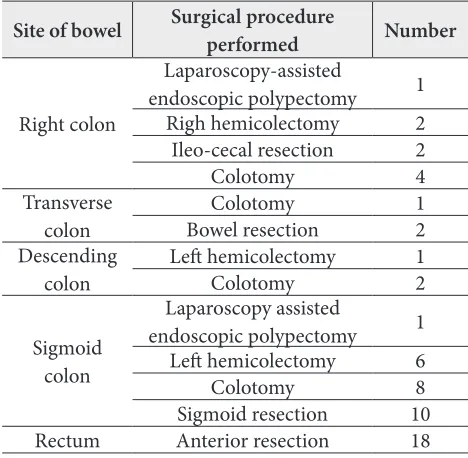
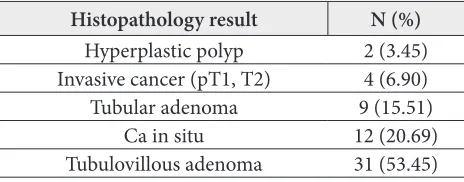
of the colonic segment and colotomy and removal of the polyp were performed on 15 (25.9%) patients (Table 2). Laparoscopic segmental bowel resection was performed in 41 (70.7%) cases (Tables 2 and 3). There were 23 polyps in the sigmoid colon (39.7%), 19 (32.8%) polyps in the rectum, four in ascending colon (6.9%) and cecum (6.9%), three in the trans-verse colon (5.2%), two in the descending colon (3.4%) and left flexure (3.4%), and one in the right flexure (1.7%). Hand-assisted laparoscopic surgery was performed on 37 patients, straight laparosco-py on 19, and laparoscopic-assisted procedure on two patients. The mean post-operative hospital stay was 5.7 ± 2.4 days (range from 1 to 14 days). All patients but four (6.9%) recovered well and had an uneventful post-operative course. Four post-op-erative complications were encountered (periop-erative morbidity – 6.9%): urinary tract infection in two patients, partial ileus in one, and urinary retention in one. All patients recovered after con-servative treatment (Grade II according to Cla-vien-Dindo classification). There were no deaths or conversions in our group. The mean polyp size was 3.5 ± 1.9 cm (range from 1 to 10 cm). Final his-topathology revealed polyps (juvenile and hyper-plastic n = 2), tubular adenoma (n = 9), tubulovil-lous adenoma (n = 31), carcinoma in situ (n = 12) and invasive cancer (n = 4): pT1 in three cases and pT2 neuroendocrine cancer in one (Table 4). Two of these patients underwent laparoscopic left
Table 1. Demographic data of 58 patients who under-went surgical treatment for “difficult” polyps
Variable n (%)
Male 29 (50%)
Female 29 (50%)
Mean age 65.9 ± 8.9 (range: 50 to 83 years) Previous abdominal surgery 2 (3.4%)
Preoperative pathology
Adenoma 50 (86.2%)
Ca in situ 8 (13.8%)
Mean post-operative
hospital stay 5.7 ± 2.4 days (range from 1 to 14 days)
Conversion rate 0
Mortality rate 0
Table 2. Laparoscopic surgical procedures performed on 58 patients with “difficult” polyps
Site of bowel Surgical procedure performed Number
Right colon
Laparoscopy-assisted
endoscopic polypectomy 1 Righ hemicolectomy 2 Ileo-cecal resection 2
Colotomy 4
Transverse
colon Bowel resectionColotomy 12 Descending
colon Left hemicolectomyColotomy 12
Sigmoid colon
Laparoscopy assisted
endoscopic polypectomy 1 Left hemicolectomy 6
Colotomy 8
hemicolectomies 14 and 10 days after laparoscop-ic colotomy and polypectomy. All the patients were followed with colonoscopy for 12 months post-operatively, then yearly thereafter. The mean follow-up was 2 years (range: 6 months – 5 years). There was no incidence of recurrence or any late complications.
DISCUSSION
Adenomatous polyps are known as precursors of colorectal cancer (2, 3). The rate of adenomas con-taining invasive cancer has been estimated as high as almost 10% (7). There are many modalities for treat-ment of difficult polyps. With improved technical tools and techniques endoscopic polyp removal still remains the first line choice for treatment (13). How-ever, even after a complete endoscopic resection of a polyp, the residual malignant disease (in the colon wall or regional lymph nodes) can be as high as 39% in malignant polyps with unfavorable histology (14). So the risks and benefits of laparoscopic surgery versus endoscopic treatment alone favour the lapa-roscopic or hybrid laparoendoscopic approach (13). According to some authors, majority of patients with difficult polyps will undergo segmental colon resec-tion even if the polyp appears completely benign (6).
Surgical options include colotomy with pol-ypectomy in the case of pedunculated polyps and small colectomy in the case of large, broad-base polyps. Polyps that have established or even pos-sible development of malignant transformation require a formal oncologic resection with central vascular ligation and lymphadenectomy (11, 15, 16). In our study, we performed 15 (25.9%) colo-tomies with mobilization of the colon and pol-ypectomy, and 41 (70.7%) bowel resections. Some authors are against colotomy because of the high possibility of exposing the abdominal cavity to cancer cells (17). Two patients underwent lapa-roscopic-assisted endoscopic polypectomy. Only two larger studies assessing this technique have been recently published (18, 19). Authors con-cluded that this technique is safe for benign pol-yps and if malignancy is suspected laparoscopic colectomy can be performed without delay.
In our previous report we showed that a pol-yp larger than 2.0 cm in diameter carries a risk of malignancy (10). Furthermore, Wasif et al. showed that polyps larger than 3 cm could be completely excised only in 67–75% of cases, thus questioning the endoscopic approach (5). In our present study, a large polyp size is the common-est cause for laparoscopic removal of colorectal polyps after a suspected malignancy. The median size of these large polyps was 3.5 ± 1.9 cm (range: 1–10 cm). It is difficult to reliably predict which patients would have invasive cancer after removal. In general, polyps smaller than 2 cm, soft in con-sistency are nonulcerated, and demonstrate regu-lar pit and vascuregu-lar patterns are more likely to be benign (13). The association between the increas-ing polyp size and the possibility of harbourthe increas-ing Table 3. Surgical procedures performed on 58 patients with “difficult” polyps
Procedure n (%)
Colotomy and removal of polyp 15 (25.9%) Laparoscopic bowel resection 41 (70.7%) Anterior rectal resection 18 (31.0%)
Sigmoid resection 9 (15.5%)
Left hemicolectomy 7 (12.1%)
Ileocaecal resection 2 (4.76%)
Right hemicolectomy 2 (3.4%)
Resection of transverse colon 2 (3.4%) Sigmoid resection with transanal retrieval of specimen 1 (1.7%) Laparoscopic-assisted endoscopic polypectomy 2 (3.4%)
Table 4. Final histopathology of 58 resected specimens
Histopathology result N (%)
Hyperplastic polyp 2 (3.45) Invasive cancer (pT1, T2) 4 (6.90) Tubular adenoma 9 (15.51)
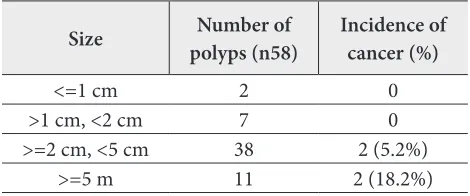
cancer is well known. This is well shown in our study: four of 49 (8.2%) polyps of 2 cm or more in size (two 2 cm and two 5 cm) harboured invasive cancer (Table 5).
Table 5. Cancer risk according to the polyp size
Size polyps (n58)Number of Incidence of cancer (%)
<=1 cm 2 0
>1 cm, <2 cm 7 0
>=2 cm, <5 cm 38 2 (5.2%)
>=5 m 11 2 (18.2%)
In colorectal surgery, we have been using lap-aroscopy for ten years. The results of our study, the post-operative hospital stay, and complications are comparable to those reported in the literature (20–23), with no mortality or conversions docu-mented in our cases.
Straight laparoscopic procedures have known dis-advantages: a lack of tactility and the difficulties in defining the extent of the resection (6, 23). These dis-advantages are overcome by HALS or various com-binations of laparoscopic-endoscopic procedures, including laparoscopically-assisted endoscopic pol-ypectomy, endoscopically-assisted wedge or anatom-ical resections, and, finally, an intraoperative tumour location by colonoscopy for achieving oncological re-section margins in laparoscopic curative rere-sections. All of these combinations allow a minimally invasive approach for lesions that would otherwise necessi-tate a laparotomy (6, 13). In the dawn of laparosco-py, Fleshman with co-authors recommended per-forming a mini laparotomy for colonic polyps (24). However, the authors experienced some difficulties of inability to perform a splenic flexure mobilization through mini laparotomy. In general, compared to mini laparotomy, it is easier to perform an extended mobilization and resection with HALS (25).
CONCLUSIONS
Large colonic polyps unresectable at colonoscopy are associated with a high rate of unsuspected can-cer, and these polyps require a formal oncologic colectomy rather than a trans-colonic polypectomy. Laparoscopic colectomy offers a safe and effective means of eradicating these polyps with the benefits
of early post-operative recovery and should be con-sidered as standard care today.
Conflict of interest
The authors declare no conflict of interest.
Received 8 September 2016 Accepted 14 March 2017
References
1. Global Burden of Disease Cancer Collabo-ration. The Global Burden of Cancer 2013. JAMA Oncol. 2015; 1: 505–27.
2. Sievers CK, Zou L, Pickhardt PJ, Matkows-kyj KA, Albrecht D, Kim DH, et al. Modeling the rise of intratumoral heterogeneity in grow-ing, static, and regressing human colorectal polyps. Cancer Research Supplement. 2016: 151–151.
3. Cho KR, Vogelstein B. Genetic alterations in the adenoma-carcinoma sequence. Cancer. 1992; 70: 1727–31.
4. Monkemuller K, Neumann H, Malferthein-er P, Fry LC. Advanced colon polypectomy. Clin Gastroenterol H. 2009; 7: 641–52.
5. Wasif N, Etzioni D, Maggard MA, Tomlin-son JS, Ko CY. Trends, patterns, and outcomes in the management of malignant colonic pol-yps in the general population of the United States. Cancer. 2011; 117: 931–7.
6. Winter H, Lang RA, Spelsberg FW, Jauch KW, Hüttl TP. Laparoscopic colonoscopic rendez-vous procedures for the treatment of polyps and early stage carcinomas of the colon. Int J Colorectal Dis. 2007; 22: 1377–81.
7. Zhang M, Shin EJ. Successful endoscopic strategies for difficult polypectomy. Curr Opin Gastroenterol. 2013; 29: 489–894.
8. Pishvaian AC, Al-Kawas FH. Retroflexion in the colon: A useful and safe technique in the evaluation and resection of sessile polyps during colonoscopy. Am J Gastroenterol 2006; 101: 1479–83.
10. Dulskas A, Samalavicius NE, Gupta RK, Za-bulis V. Laparoscopic colorectal surgery for colorectal polyps: single institution experi-ence. Videosurgery and Other Miniinvasive Techniques. 2015; 10: 73–8.
11. Hauenschild L, Bader FG, Laubert T, Czymek R, Hildebrand P, Roblick UJ, et al. Laparoscopic colorectal resection for benign polyps not suitable for endoscopic polypecto-my. Int J Colorectal Dis. 2009; 24: 755–9. 12. Pokala N, Delaney CP, Kiran RP, Brady K,
Senagore AJ. Outcome of laparoscopic colec-tomy for polyps not suitable for endoscopic resection. Surg Endosc. 2007; 21: 400–3. 13. Aslani N, Alkhamesi NA, Schlachta CM.
Hy-brid laparoendoscopic approaches to endo-scopically unresectable colon polyps. J Lapa-roendosc Adv Surg Tech A. 2016; 26: 581–90. 14. Bujanda L, Cosme A, Gil I, Arenas-Mirave JI.
Malignant colorectal polyps. World J Gastro-enterol. 2010; 16: 3103–11.
15. Nassiopoulos K, Pavlidis TE, Menenakos E, Chanson C, Zografos G, Petropoulos P. Lap-aroscopic colectomy in the management of large, sessile, transformed colorectal polyps. JSLS 2005; 9: 58–62.
16. Jang JH, Balik E, Kirchoff D, Tromp W, Ku-mar A, Grieco M. Oncologic colorectal resec-tion, not advanced endoscopic polypectomy, is the best treatment for large dysplastic ade-nomas. J Gastrointest Surg. 2012; 16: 165–72. 17. Loungnarath R, Mutch MG, Birnbaum EH,
Read TE, Fleshman JW. Laparoscopic colec-tomy using cancer principles is appropriate for colonoscopically unresectable adenomas of the colon. Dis Colon Rectum. 2010; 53: 1017–22.
18. Franklin ME Jr, Portillo G. Laparoscopic mon-itored colonoscopic polypectomy: long-term follow-up. World J Surg. 2009; 33: 1306–9. 19. Garrett KA, Lee SW. Combined endoscopic
and laparoscopic surgery. Clin Colon Rectal Surg. 2015; 28: 140–5.
20. Church J, Erkan A. Scope or scalpel? A matched study of the treatment of large colorectal polyps. ANZ J Surg 2016 [Epub ahead of print].
21. Schwenk W, Haase O, Neudecker J, Muller JM. Short term benefits for laparoscopic colorectal resection. Cochrane Database Syst Rev. 2005; 20: CD003145.
22. Benedix F, Kockerling F, Lippert H, Scheid-bach H. Laparoscopic resection for endo-scopically unresectable colorectal polyps: analysis of 525 patients. Surg Endosc. 2008; 22: 2576–82.
23. Benlice C, Costedio M, Stocchi L, Abbas MA, Gorgun E. Hand-assisted laparoscop-ic vs open colectomy: an assessment from the American College of Surgeons Nation-al SurgicNation-al QuNation-ality Improvement Program procedure-targeted cohort. Am J Surg. 2016 [Epub ahead of print].
24. Fleshman JW, Fry RD, Birnbaum EH, Kod-ner IJ. Laparoscopic-assisted and minilapa-rotomy approaches to colorectal diseases are similar in early outcome. Dis Colon Rectum. 1996; 39: 15–22.
Audrius Dulskas, Žygimantas Kuliešius, Narimantas Evaldas Samalavičius
LAPAROSKOPINĖ CHIRURGIJA TIESIOSIOS IR GAUBTINĖS ŽARNOS POLIPAMS
ŠALINTI: 10 METŲ PATIRTIS
Santrauka
Įvadas. Laparoskopija ar jos derinimas su en-doskopija yra puiki alternatyva endoskopiškai nepašalinamiems žarnos polipams šalinti. Tyrimo tikslas – apžvelgti šios metodikos taikymo rezul-tatus.
Medžiaga ir metodai. Tyrime dalyvavo 58 pa-cientai, 2006–2016 m. operuoti Nacionaliniame vėžio institute dėl endoskopiškai nepašalinamų polipų. Perspektyviai analizuoti demografiniai rodikliai, operacijos tipas, pooperacinio periodo trukmė, komplikacijos ir galutinis histologijos at-sakymas.
Rezultatai. Vidutinis pacientų amžius buvo 65,9 ± 8,9 metai. Laparoskopinė žarnos mobi-lizacija, kolotomija ir polipo šalinimas atlikta 15 (25,9 %) pacientų, laparoskopinė žarnos se-gmentinė rezekcija – 41 (70,7 %) atveju: priekinė
tiesiosios žarnos rezekcija su daline mezorekta-line ekscizija – aštuoniolikai (31,0 %), riestinės žarnos rezekcija – devyniems (15,5 %), kairioji hemikolektomija – septyniems (12,1 %), dešinioji hemikolektomija – dviems (3,4 %), ileocekalinio kampo rezekcija – dviems (3,4 %), skersinės žar-nos rezekcija – dviems (3,4 %) ir riestinės žaržar-nos rezekcija su preparato šalinimu peranus – vienam (1,7 %) pacientui. Dviems pacientams (3,4 %) atlikta laparoskopiškai asistuojanti endoskopinė polipektomija. Vidutinė pooperacinio periodo trukmė buvo 5,7 ± 2,4 dienos. Keturiems pacien-tams pasireiškė komplikacijos (6,9 %). Nei vienam iš jų neprireikė reintervencijos. Vidutinis polipo dydis 3,5 ± 1,9 cm. Galutinė patologijos diagnozė: hiperplastinis polipas (n = 2), tubulinė adenoma (n = 9), tubuloviliozinė adenoma (n = 31), carci-noma in situ (n = 12) ir vėžys (n = 4).
Išvados. Endoskopiškai nepašalinamų storo-sios ir tiestoro-siosios žarnos polipų atvejais laparosko-pija yra pirmo pasirinkimo metodas.