SHIV SHAKTI
International Journal in Multidisciplinary and Academic Research (SSIJMAR)
Vol. 3, No. 1, February- March -2014 (ISSN 2278 – 5973)
BO-AODV: Buffer Occupancy Based Routing Protocol for
Multi-Hop Wireless Mesh Networks
Pushpender
1Prof. (Dr.) Sohan Garg
2Abstract—
Routing in wireless networks is one of the main issues, the challenges facing WMN makes the subject even more desired. In this paper, we have proposed a routing protocol BO-AODV in wireless mesh networks using fuzzy inference mechanism. In the other words, when a node in network has to send data, the fuzzy mechanism calculates the next- hop which the arrived data must be sent. Here, buffer occupancy of the node is considered to be as a more important variable to calculate the next-hop in routing process. The already existing algorithms for WMNs such as AODV consider only one parameter, for example hop-count to select next-hop path from source to destination. Due to special features of WMNs such as configurable, self-healing and self- organizable, conventional routing schemes found to be unsuitable for routing the data of various types such as real time applications. In our proposed routing protocol called BO-AODV multiple parameters such as buffer occupancy, residual energy, and hop-count are considered using fuzzy mechanism to give multiple stable routes. Nodes in network then forward data on these multiple paths resulting into automatic load balancing. Simulation results indicate that our proposed routing protocol BO-AODV maintains a more stable route and helps in balancing the traffic in the network.
Keywords---Wireless Mesh Network, Fuzzy logic, AODV, Buffer occupancy, Energy residual, FSR
1. Research Scholar, CSE, Shri Venkateshwara University, Gajraula (UP), India,
I. INTRODUCTION
A wireless mesh network is made up of wireless mesh routers, mesh clients, and gateways. Laptops, cell phones etc are examples of mesh clients. Every node in the network is connected to each other through a wireless link. Wireless mesh networks are self-configurable, self-healing, cost-effective, and dynamic high bandwidth networks over a specific coverage area. The data is transmitted hop-by-hop in the network. Routing in the WMN is a complex process. Several routing protocols such as DSR (Dynamic Source Routing), HWMP(Hybrid Wireless Mesh Protocol), MRP(Wireless Routing Protocol), AODV(Ad-Hoc Distance Vector) etc. Since transmission of data in ad-hoc networks is similar to as in wireless mesh networks, therefore the existing routing protocols like AODV and DSR were used. These protocols generally use the shortest path metric for transferring the data. But these protocols are made basically for ad-hoc no longer true for wireless mesh networks. If we use the existing protocols like AODV and DSR, this might load to high collision routes, packet drops in the queue and long delays in waiting at the queues. Also this leads to wastage of the bandwidth. These algorithms do not fulfill up the requirements of wireless mesh network completely and despite their shortcomings, these works lay the foundation for the development of our proposed routing protocol. To overcome these limitations of existing protocols for wireless mesh network is needed. Also to overcome the problems faced in traffic balancing, a fuzzy based protocol BO-AODV is proposed. In this paper we propose a new routing protocol BO-AODV for wireless mesh networks, which is capable of fulfill up of the shortcomings of conventional routing protocols In spite of all these improvements, the protocol is simple as well as having low communication overhead as well as several other characteristics. The protocol has been simulated in MATLAB 7.0 in which we have uses the Fuzzy Logic tool box.
II.LITERATURE SURVEY
to AODV protocol. At last of this work, a performance comparison of proposed algorithm and two other conventional protocols is taken out. Shahram Nourizadeh et. al [4] prpose a distributed clustering algorithm for Mobile wireless networks. Using fuzzy logic, a best cluster head is calculated. In this work, mobility management is subdivided into three parts named as: Zone Head, Cluster Head, and Node. Four parameters mobility, quality of link, and quality of received signal are used as input for fuzzy mechanism. And as a result an output parameter named
„Reliability‟ is found out. Here eighty one rules are applied for implementation of this approach. Arash Dana et. al propose a stable routing algorithm for mobile ad-hoc networks[5] . Based on velocity and location information of the node, a stable route is decided. Here, also a route maintenance mechanism is also explained. Parameters ∆ d (distance between two nodes) and ∆ v (velocity of the node) are used as input. LSC (link stability co-efficient) is calculated using these two inputs. Proposed scheme uses a global positioning system (GPS) for the location information of the node.
III.MEHODOLOGY
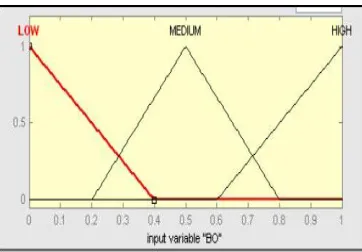
The Fuzzy Logic is an innovative approach to help control non-repeating or unpredictable systems control accuracy. It uses a list of rules rather than complicated mathematical expression. Fuzzy Logic was introduced by L.A. Zadeh in 1965. Fuzzy Logic is also known as fuzzy rule based system and this is a non linear mapping technique of input data into output. In this Paper Fuzzy Logic has been used for routing and management of an wireless mesh network. The proposed fuzzy logic based routing protocol takes into account of three input variables, buffer occupancy, energy residual and hop -count. The absolute value of each of these variables can take a large range at different points on the network. We have considered the normalized values for each variable. Now, “crisp”normalized values are being converted into fuzzy parameters. For this, three fuzzy sets have been defined for each parameter.
The sets, Low (from 0 to 0.4), Medium (from 0.2 to 0.8) and High (from 0.6 to 1.0) have been used for the input parameter buffer occupancy (figure 1)
The sets, Low (from 0 to 0.4), Medium (from 0.2 to 0.8) and High (from 0.6 to 1.0) have been used for input variable Energy Residual (figure 2)
Figure 2. Input variable ‘Residual Energy’
The sets, Low (from 0 to 0.4), Medium (from 0.2 to 0.8) and High (from 0.6 to 1.0) have been used for the input variable Hop Count (figure 3).
Figure 3. Input variable ‘Hop Count’
The Fuzzy Grades (figure 4) are defined as Low (from 0 to 0.4), Medium (from 0.2 to 0.8) and High (from 0.6 to 1.0) between two nodes on the network. The Low fuzzy grade indicates not stable path, the Medium fuzzy grade indicates good route and the High fuzzy grade indicates the best path.
Figure 4. Output variable ‘Fuzzy Grade’
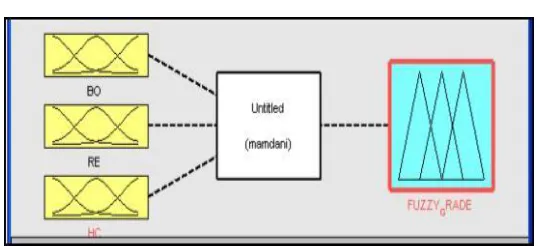
The proposed routing protocol can apply to different routing metrics. These routes have to satisfy the buffer occupancy, energy residual and hop-count requirements of the network. The grade of membership function can be any where between 0 and 1 for each fuzzy set. The defuzzified crisp value for selected variable was calculated from the derived protocol. The proposed fuzzy logic & buffer occupancy based routing protocol for wireless mesh network is classified as “BO-AODV: buffer occupancy based routing protocol for multi-hop wireless mesh networks”. This routing protocol have several the features such as freedom from loops, fast route convergence, distributed implementation, entering/departing nodes and on demand operation.
Figure 5. Fuzzy Inference Mechanism
1) If (Buffer Occupancy is Low and Residual Energy is High and Hop Count is Low) Then Fuzzy Grade is High.
2) If (Buffer Occupancy is Low and Residual Energy is High and Hop Count is medium) Then Fuzzy Grade is medium.
3) If (Buffer Occupancy is Low and Residual Energy is High and Hop Count is High) Then Fuzzy Grade is Medium.
4) If (Buffer Occupancy is Medium and Residual Energy is High and Hop Count is Low) Then Fuzzy Grade is Medium.
5) If (Buffer Occupancy is Medium and Residual Energy is High and Hop Count is Medium) Then Fuzzy Grade is Medium.
6) If (Buffer Occupancy is Medium and Residual Energy is High and Hop Count is High) Then Fuzzy Grade is Low.
7) If (Buffer Occupancy is High and Residual Energy is High and Hop Count is Low) Then Fuzzy Grade is Low.
8) If (Buffer Occupancy is High and Residual Energy is High and Hop Count is Medium) Then Fuzzy Grade is Low.
9) If (Buffer Occupancy is High and Residual Energy is High and Hop Count is High) Then Fuzzy Grade is Low.
10)If (Buffer Occupancy is High and Residual Energy is Low and Hop Count is Medium) Then Fuzzy Grade is Low.
11)If (Buffer Occupancy is High and Residual Energy is Low and Hop Count is High) Then Fuzzy Grade is Low.
12)If (Buffer Occupancy is Low and Residual Energy is Medium and Hop Count is Low) Then Fuzzy Grade is High.
13)If (Buffer Occupancy is Low and Residual Energy is Medium and Hop Count is Medium) Then Fuzzy Grade is High.
14)If (Buffer Occupancy is Low and Residual Energy is Medium and Hop Count is High) Then Fuzzy Grade is Medium.
15)If (Buffer Occupancy is Medium and Residual Energy is Medium and Hop Count is Low) Then Fuzzy Grade is High.
16)If (Buffer Occupancy is Medium and Residual Energy is Medium and Hop Count is Medium) Then Fuzzy Grade is Low.
17)If (Buffer Occupancy is Medium and Residual Energy is Medium and Hop Count is High) Then Fuzzy Grade is Low.
19)If (Buffer Occupancy is High and Residual Energy is Medium and Hop Count is Medium) Then Fuzzy Grade is Low.
IV.IMPLEMENTATION OF PROPOSED BO-AODV PROTOCOL
The working of BO-AODV is approximately same as that of AODV protocol except the way
of route selection using fuzzy logic mechanism. BO-AODV takes three inputs buffer
occupancy, residual energy, and hop count and one output parameter „fuzzy grade‟ is
calculated. When a source wants to maintain a path to a destination, it broadcasts a RREQ
packet throughout the network in order to find a path when intermediate node receives
RREQ, it calculates its fuzzy grade value. Since each node in the network is equipped with a
fuzzy logic mechanism, the fuzzy grade value is calculated using three parameters buffer
occupancy, energy residual, and hop count. After calculating its fuzzy grade value, it adds the
value in the header of the packet. In this way as the RREQ packet travels through the route,
fuzzy grade value gets accumulated at each intermediate node. When RREQ packet is arrived
at the destination, RREP packet will be generated. The RREP packets then forwarded to the
source node. The source node accepts all RREP packets. It then compares the fuzzy grade
values of all the RREP packets. Based on fuzzy grade value, then route is decided.
V. SIMULATION RESULTS AND DISCUSSION
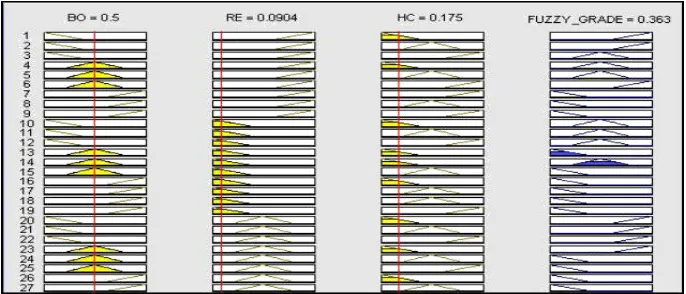
The figure 6 illustrates that when buffer occupancy is medium (0.5), residual energy of the node is low (0.0804) and hop-count is also low (0.175) then in this condition the grading of the node
is low (0.363).
Figure 7
In figure 7 residual energy and buffer occupancy are the fuzzy input parameters for the proposed routing protocol which lies on the horizontal axes and fuzzy grade value is the output parameter which has been shown on the vertical axis.
The figure 8 illustrates that when buffer occupancy is high (0.753), residual energy is high (0.813) and hop count is also low (0.235) then in this condition the fuzzy grading of the node
is medium (0.409).
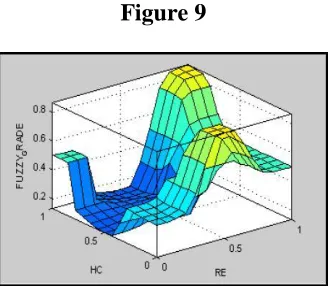
Figure 9
In figure 9 hop count and residual energy are the fuzzy input parameters for the proposed routing protocol which lies on the horizontal axes and fuzzy grade is the output parameter which
has been shown on the vertical axis. Figure 10
The figure 10 illustrates that when buffer occupancy is high (1), residual energy is medium (0.44) and hop count is high (0.633) then in this condition the fuzzy grading of the node is low
(0.149).
In figure 11 buffer occupancy and residual energy are the fuzzy input parameters for the proposed routing protocol which lies on the horizontal axes and fuzzy grade is the output variable which has been shown on the vertical axis.
Simulations results indicates that when value of occupancy is decreasing and hop count is constant, and value of residual energy is increasing continuously, the fuzzy grade value is also updated from low to medium and then high. But at starting, at medium value of buffer occupancy, and at medium value of residual energy, at constant hop count, the fuzzy grade value is high. At the same conditions, the value of the hop count updated from medium to high, the fuzzy grade value is updated from high to low.
At high residual energy, when buffer occupancy is increasing form low to medium and at constant hop count, the fuzzy grading of the node is decreasing form high to medium.
The proposed routing protocol BO-AODV works well at medium residual energy and at medium hop count on the route because at this condition, the fuzzy grading of a node is high ranked.
Simulation results show that proposed routing protocol reduces the congestion in the network and also maintain the load balancing work on the route.
VI.CONLUSION
proposed routing scheme over multiple optimal paths result into automatic load balancing, congestion control-improving overall existing routing protocols. To implement the scheme, each node is integrated with a fuzzy logic mechanism. The simulator results indicates that proposed protocol BO-AODV is very accountable to take care of various uncertainties of wireless mesh networks effectively. The results presents that fuzzy rule based routing protocol outperforms the conventional routing schemes. It always selects a stable route for routing with minimum overhead and maximum throughput. The presented routing approach reduces the possibilities of congestion in the network.
REFERNCES
[1] Mastafa Vakili Fard and S.Majid Mazinani, “Introducing a Routing Protocol Based on Fuzzy Logic in Wireless Sensor Networks”, Journal of Basic and Applied Scientific Research, 2013,pp. 438-442.
[2] M.M.Goswami, V.Rughwani, Mr. A. Anjiker, “A novel fuzzy stochastic routing protocol for mobile ad-hocnetwork”,vol.2, Issue 10,October,2013, pp.98-106.
[3] Mala Chellaih, Siddhartha Sankaran, Shishir Prasad, Nagomaputhur Gopalan, and Balasubramanian Sivaselvan, “Routing for Wireless Mesh Networks with Multiple Constraints Using Fuzzy Logic”, The International Arab Journal of Information Technology, Vol. 9,No. 1, January, 2012.
[4] http://hal.archives-ouvertes.fr/docs/00/19/20/71/PDF/ShahramNourizadeh.pdf