TOURISM INFORMATION SYSTEMS
INTEGRATION AND UTILIZATION WITHIN THE
SEMANTIC WEB
by
Brooke Abrahams
Submitted to Victoria University in Fulfilment of the Degree of:
Doctor of Philosophy
in the School of Information Systems
Faculty of Business and Law
This research was supported by an Australian APA scholarship, ICT top-up scholarship, and CRC top-up scholarship. I gratefully acknowledge this support and thank Lesley Birch for her role in administering these scholarships. In addition I wish to express my thanks to:
My supervisor Professor G Michael McGrath for his guidance and encouragement throughout the course of the PhD and constructive criticism of earlier drafts of the thesis.
Dr Wei Dai for his technical assistance relating to the development of a semantic portal prototype.
Dr Stephen Burgess for his general assistance and feedback on postgraduate presentations.
Professor John Zeleznikow for his role as acting supervisor while my principal supervisor was on leave for one semester.
I Brooke Abrahams declare that the PhD thesis entitled ‘Tourism Information Systems Integration and Utilization within the Semantic Web’ is no more than 100,000 words in length, exclusive of tables, figures, appendices, references and footnotes. This thesis contains no material that has been submitted previously, in whole or in part, for the award of any other academic degree or diploma. Except where otherwise indicated, this thesis is my own work.
SUMMARY
The objective of this research was to generate grounded theory about the extent to which the Semantic Web and related technologies can assist with the creation, capture, integration, and utilization of accurate, consistent, timely, and up-to-date Web based tourism information.
Tourism is vital to the economies of most countries worldwide (developed and less-developed). Advanced Destination Marketing Systems (DMS) are essential if a country’s tourism infrastructure, facilities and attractions are to receive maximum exposure. A necessary prerequisite here is that relevant data must be captured, ‘cleansed’, organized, integrated and made available to key industry parties (e.g. travel agents and inbound tour operators). While more and more tourists are using the Internet for travel planning, the usability of the Internet as a travel information source remains a problem, with travellers often having trouble finding the information they seek as the amount of online travel related information increases. The problem is largely caused by the current Web’s lack of structure, which makes the integration of heterogeneous data a difficult time consuming task.
their words and concepts. It is based on new markup languages such as such as Resource Description Framework (RDF) (Manola & Miller 2004), Ontology Web Language (OWL) (McGuinness & Harmelen 2004), and ontologies which provide a shared and formal description of key concepts in a given domain.
The ontology driven approach to integration advocated here might be considered ‘bottom-up’, since individual enterprises (and parts of the one enterprise) can apply the technology (largely) independently – thereby mirroring the processes by which the Web itself evolved. The idea is that organizations could be provided with a common model (the Semantic Web ontology), and associated (easy-to-use) software could then be employed to guide them in the development of their Websites. As such, because Website production is driven by the common ontology, consistency and convenient integration is almost an automatic by-product (for all companies that take advantage of the technology and approach). In many cases, organizations would not have to change their present data structures or naming conventions, which could potentially overcome many of the change management issues that have led to the failure of previous integration initiatives.
Many researchers (e.g. (El Sawy 2001)) have stressed the necessity to take a holistic view of technology, people, structure and processes in IT projects and, more specifically, Sharma et al. (2000, p. 151) have noted that as significant as DMS technological problems are, they may well pale into insignificance when compared with the managerial issues that need to be resolved. With this in mind, a systems development research approach supported by a survey of tourism operators and secondary interviews was used to generate grounded theory. The systems development and evaluation were designed to uncover technical benefits of using the Semantic Web for the integration and utilization of online tourism information. The survey of tourism operators and secondary data interviews were aimed at providing an understanding of attitudes towards adoption of a radical new online technology among industry stakeholders.
TABLE OF CONTENTS
1 INTRODUCTION... 15
1.1 Research Topic... 15
1.2 Research Background ... 16
1.2.1 The Internet... 16
1.2.2 Search Engines... 17
1.3 Research Problem ... 19
1.3.1 Limitations of the Current Internet ... 19
1.3.2 The Problem of Information Integration... 20
1.3.3 Consequences of Internet Limitations for Tourism ICT Applications ... 22
1.4 Aims of the Study ... 23
1.5 Research Question... 24
1.6 Research Approach ... 25
1.6.1 Grounded Theory... 25
1.6.2 Systems Development and Survey Type Research... 26
1.7 Thesis Outline ... 28
2 LITERATURE REVIEW ... 31
2.1 Chapter 2 Overview ... 31
2.2 The Semantic Web ... 31
2.2.1 The Semantic Web Initiative ... 31
2.2.2 Semantic Web Application Domains... 34
2.2.2.1 Semantic E-Business... 34
2.2.2.2 Semantic Portals... 36
2.2.3 Semantic Web Projects ... 37
2.2.4 Semantic Web Markup Languages ... 41
2.2.4.1 XML and XML Schema ... 41
2.2.4.2 Resource Description Framework (RDF) ... 41
2.2.4.3 RDF Namespaces... 42
2.2.4.4 RDF Schema (RDFS) ... 43
2.2.4.5 DAML + OIL... 44
2.2.4.6 Ontology Web Language (OWL) ... 44
2.2.5 Ontologies... 46
2.2.5.1 Defining Ontologies... 46
2.2.5.2 Types of Ontologies... 47
2.2.5.3 Ontology Application Domains ... 50
2.2.5.4 Ontology Development Process... 51
2.2.5.5 Ontology Development Methodologies... 51
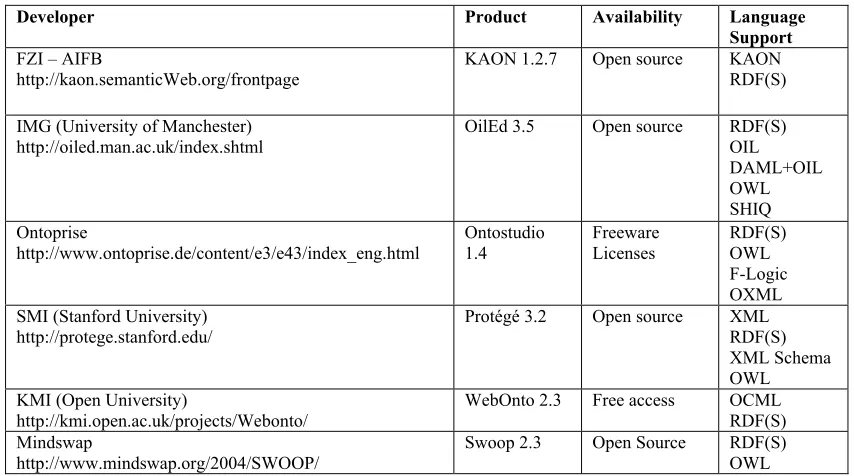
2.2.5.6 Ontology Devlopment Tools... 52
2.2.6 Semantic Search... 56
2.2.6.1 RDF Query Languages ... 56
2.2.6.2 Inference and Reasoning... 58
2.2.6.3 Web Search Agents and Multi-agent Systems... 61
2.2.7 Semantic Web Application Development... 65
2.2.7.1 Client-Side Development (Webpage Annotation) ... 65
2.2.7.2 Server-Side Development ... 67
2.2.7.3 Tools for Creating Semantic Portals ... 69
2.2.8 Ontology Schema Integration ... 71
2.2.8.1 Schema Integration Issues... 72
2.2.8.2 Schema Integration Process ... 72
2.2.9 Semantic Web Services... 75
2.2.10 Challenges and Future Trends ... 77
2.2.10.1 Availability of Content ... 77
2.2.10.2 Ontology Development and Availability... 78
2.2.10.3 Ontology Versioning Issues... 79
2.2.10.4 Scalability of Systems... 80
2.2.10.5 Visualization of Content ... 80
2.2.10.6 Stability of Semantic Web Languages... 81
2.2.10.7 The Challenge of Ontology Mapping, Alignment and Merging... 81
2.2.10.8 The Challenge of Ontology-Based Information Retrieval... 82
2.2.10.9 Change Management Issues... 83
2.2.10.10 Challenges for Implementing Semantic Web Services... 84
2.2.10.11 Application Design Issues... 84
2.3 Tourism E-Commerce and the Semantic Web... 85
2.3.1 World Tourism Industry ... 85
2.3.3 Australian Tourism Accommodation Sector ... 88
2.3.4 Tourism E-Commerce... 89
2.3.5 Australian Tourism Online ... 90
2.3.6 Semantic Web in Tourism ... 93
2.4 Chapter 2 Summary ... 96
3 METHODOLOGY ... 99
3.1 Chapter 3 Overview ... 99
3.2 Research Philosophy... 99
3.3 Research Phases ... 101
3.4 Experimental Design... 107
3.4.1 Query Evaluation Model... 107
3.4.2 Conjunctive Queries... 108
3.4.3 Measuring Query Complexity... 114
3.4.4 Experimental Queries... 118
3.5 Survey Design ... 119
3.5.1 Sample Group ... 119
3.5.2 Pilot Survey... 120
3.5.3 Survey Questions and Data Analysis... 121
3.6 Secondary Data and Analysis ... 122
3.7 Research Limitations and Threats to External Validity ... 123
3.8 Chapter 3 Summary ... 125
4 ACONTOWEB... 127
4.1 Chapter 4 Overview ... 127
4.2 Software Requirement Specification (SRS)... 127
4.2.1 SRS Introduction... 127
4.2.1.1 Statement of Purpose ... 128
4.2.1.2 Scope of the System... 128
4.2.1.3 Overall Description... 128
4.2.1.4 Product Perspective... 131
4.2.1.5 Development Team... 131
4.2.2 Functional Requirements ... 131
4.2.2.1 Event List... 131
4.2.2.2 Data Flow Diagrams ... 132
4.2.2.4 Semantic Web Components... 135
4.2.2.5 Screen Designs... 136
4.2.2.6 System Usability ... 140
4.3 AcontoWeb Experiment... 145
4.4 Chapter 4 Summary ... 160
5 SURVEY OF TOURISM OPERATORS... 163
5.1 Chapter 5 Overview ... 163
5.2 General Information Concerning Participant Websites ... 164
5.3 Attitudes Towards Adoption of New Online Technology ... 169
5.4 Implementation Preferences for New Online Technology ... 173
5.5 Chapter 5 Summary ... 175
6 CONCLUSION ... 177
6.1 Chapter 6 Overview ... 177
6.2 Answers to Minor Research Questions... 177
6.2.1 Ease of Ontology Development, Availability and Website Annotation . 177 6.2.2 Level of Ontology and Annotation Richness that can be Obtained... 179
6.2.3 Maturity and Ease of Use of Semantic Web Development Tools ... 180
6.2.4 Robustness of Semantic Web Operational Environments ... 181
6.2.5 How the Semantic Web Can Best be Queried ... 182
6.2.6 Potential Query Results and Accuracy ... 183
6.2.7 How Ontology Based Query Results Compare to those of Conventional Database Systems... 184
6.2.8 Usefulness and Limitations of the Semantic Web ... 184
6.2.9 Managerial Issues Faced in Gaining User Acceptance of the Semantic Web in the Tourism Industry ... 185
6.2.10 How Successfully Tourism Information can be Integrated on the Semantic Web ... 186
6.3 Answer to the Major Research Question and Proposition of a Grounded Hypothesis... 187
6.4 Findings in Relation to Research Aims... 189
6.5 Future Research Directions... 190
6.6 Chapter 6 Summary ... 191
REFERENCES... 195
APPENDIX B – Tourism Market Segment Characteristics ... 211
APPENDIX C - Logic Notation ... 213
APPENDIX D – Accommodation ER Diagram ... 215
APPENDIX E – Accommodation Ontology ... 217
APPENDIX F – Accommodation Web Survey ... 219
APPENDIX G – Survey Results ... 223
APPENDIX H - AcontoWeb Queries... 229
APPENDIX I – Experimental Queries SQL Syntax... 233
APPENDIX J – Experimental Queries SPARQL Syntax ... 235
APPENDIX K – Annotated Webpages ... 237
APPENDIX L - Publications Attributable to Thesis ... 239
LIST OF FIGURES ... 241
LIST OF TABLES ... 245
1 INTRODUCTION
Chapter 1 commences with an introduction to the research topic. Some background information about the topic is provided, which includes a brief history of the Internet and search engines. The research problem is then introduced along with the aims, methodology and research approach. The chapter concludes with an outline of the thesis.
1.1 Research
Topic
The World Wide Web (WWW) has evolved to become a major source of information and services. It is decentralized, gigantic with unchecked growth, and constantly changing in its structure. The full potential of the current Web, however, remains untapped because information is rendered to be processed by machines, but understandable to humans only. Hypertext Markup Language (HTML) offers the freedom to present anything about any subject and make it available over the Web. This freedom has created a major problem of heterogeneity making the integration and utilization of information a difficult task. Traditional solutions for information interoperability are essentially top-down, and involve the development of interfaces between pairs of communication systems built around a single common set of enterprise wide databases. These approaches are too expensive and inflexible for many sectors including e-tourism, which is the leading application field in business-to-consumer (b2c) e-commerce (Werthner 2003).
1.2 Research
Background
This section provides a brief history of the Internet and search engines.
1.2.1 The Internet
The origins of the Internet, which are summarized by Howe (2005), trace back to a group of people in 1960’s who saw great potential value in allowing computers to share information on research and development in scientific and military fields. In 1962 J.C.R. Licklider of MIT first proposed a global network of computers. Later that year he moved to the Defense Advanced Research Projects Agency (DARPA) to lead development of this network. Leonard Kleinrock of MIT and later UCLA developed the theory of packet switching, which was to form the basis of Internet connections. Lawrence Roberts of MIT connected a Massachusetts computer with a California computer in 1965 over dial-up telephone lines. This showed the feasibility of wide area networking, but also showed that existing telephone switching technology was inadequate. Roberts moved to DARPA in 1966 and developed his plan for ARPANET, which as Alesso & Smith (2004e) explain was an initiative intended to promote sharing of super computers among scientists and military researchers in the USA. According to Howe (op. cit), these visionaries (and many more left unnamed here) are the real founders of the Internet. In the 1970’s software protocols began to emerge to facilitate file transfer and email. In 1978 Bob Kahn and Vint Cerf along with other project members created TCP/IP, which is a common set of protocols for information exchange on the Internet that are still in use to the present day. Throughout the 1980’s corporations increasingly began communicating with each other via the Internet as well as with customers who owned personal computers (PC’s).
Originally, commercial efforts consisted mainly of vendors providing basic networking products, and service providers offering the connectivity and basic Internet services. The Internet has now become almost a "commodity" service, and much of the latest attention has been on the use of this global information infrastructure for support of other commercial services. Leiner et al. (2003) state that this has been tremendously accelerated by the widespread and rapid adoption of browsers and the World Wide Web technology, allowing users easy access to information linked throughout the globe. The widespread growth of Internet usage is highlighted by Neilson Net Ratings1 whose
Internet usage statistics show that in the year ending December 31 2005, there were approximately one billion Internet users. This equates to 15.7% of the estimated world population of 6.5 billion. New products increasingly facilitate provisioning Web-based information and many of the latest developments in technology have been aimed at providing increasingly sophisticated information services on top of basic Internet data communications. The Internet continues to change and evolve. It is now beginning to provide new services such as real time transport in order to support, for example, audio and video streams, and services such as dynamic product packaging, as in the case of advanced Destination Marketing Systems (DMS).
1.2.2 Search Engines
Search engines are tools that provide users with a graphical user interface (GUI) to assist locating Websites containing specific categories of information. They exploit both the content of Web documents and the structure implicit in the hyperlinks connecting one document to another (Sheth et al. 2005, p. 11). Alesso & Smith (2004d) classify search engines according to the following two implementation types:
• Individual – Individual search engines compile their own searchable databases on the Web (e.g. Google2).
• Meta – Metasearchers do not compile databases. Instead, they search the databases of multiple sets of individual engines simultaneously (e.g. Yahoo!3).
1 http://www.nielsen-netratings.com/
2 www.google.com
Alesso & Smith (op. cit) categorize search engines according to the following functionality types:
• Lexical – searches for a word or a set of words, with Boolean operations (AND, OR, EXCEPT).
• Linguistic – allows words to be found in whatever form they take, and enables the search to be extended to synonyms.
• Semantic – the search can be carried out on the basis of the meaning of the query.
• Mathematical – semantic search operates in parallel with a statistical model adapted to it.
• Metasearch – searches the database of multiple sets of individual search engines simultaneously. Metasearchers provide a quick way of finding out which search engines are retrieving the best results for your search.
• Structured Query Languages (SQL) - a search through a sub-set of documents of a database defined by SQL (widely used by Web portals4).
• XML structured query – the initial structuring of a document is preserved and the request is formulated in Xpath5.
Figure 1 illustrates a breakdown of search engine usage on the Web for the year 2005.
4 An SQL search engine type from a conventional portal will be used as the bases for comparison of Semantic Web search and conventional Web search methods in Chapter 4.
5 http://www.w3.org/TR/xpath
Statistics show that the most widely used search engine at present is Google. At the heart of Google’s search software is a system for ranking Web pages known as PageRank. PageRage, which was developed at Stanford University by Larry Page and Sergey Brin, uses the Internet’s vast link structure as an indicator of the importance of a Web page in relation to the search. The PageRank algorithm combined with sophisticated text-matching techniques measures all aspects of a page’s content to determine an importance ranking which Google remembers. Although search engines such as Google are very effective at ranking relevant content, they are still limited by the fact that the ranking analysis is based on keywords rather than the underlying concepts associated with a Web page.
1.3 Research
Problem
The research problem is categorized into three distinct parts and should be viewed as follows: 1) there are a number of limitations associated with the current Internet; that 2) create significant challenges for information systems integration; which 3) have negative consequences for tourism ICT applications.
1.3.1 Limitations of the Current Internet
Today, search engines such as Google and Yahoo! dominate the Web’s infrastructure and largely define Web users’ experience. Ding et al. (op. cit) contend that conventional search engines have limited indexing capabilities, since they cannot infer meaning. For example, does an occurrence of the word “raven” refer to the bird or to Baltimore’s football team? A search relying purely on the keyword “raven” is unable to definitively return answers that relate to the correct context. The ambiguity associated with current search engines is also highlighted by Alesso (2004), who states that because Web search engines use keywords for indexing concepts, they are subject to the two well-known linguistic phenomena that strongly degrade a query's precision and recall; 1) Polysemy (one word might have several meanings); and 2) Synonymy (several words or phrases might designate the same concept). These limitations have resulted in a number of significant problems for accessing reliable up-to-date information that urgently need to be solved. One of the most significant problems, which is described in detail by Stuckenschmidt & Harmelen (2005b), is Information Integration – i.e. even when it is possible to find any particular piece of information, it is very hard to combine it with other information that may already be known.
1.3.2 The Problem of Information Integration
The problem of accessing online information has in the most part been solved by the invention of large-scale computer networks such as the World Wide Web. The problem of combining, interpreting, and processing retrieved information (in other words information integration), however, remains an important research topic. The difficulties of integrating heterogeneous data are well known within the distributed database systems community. Stuckenschmidt & Harmelen (2005b) say that in general, heterogeneity can be divided into three categories6:
1. Syntax (e.g. data and format heterogeneity).
2. Structure (e.g. homonyms, synonyms or different attributes in database tables). 3. Semantics (e.g. intended meaning of terms in a special context or application).
Stuckenschmidt (2005b) explains that the existence of standardized Web markup languages enables data to be represented and structured on the World Wide Web in a uniform way. According to Stuckenschmidt, this uniformity makes it easier to automatically process not only local data, but also information obtained from other sources. Syntactic homogeneity is an important enabler of information sharing. Experiences from the database area, however, have shown that the existence of syntactic standards is not enough. Even in almost completely homogeneous environments such as relational databases, the exchange of information is a problem, because heterogeneity in the way information is structured and interpreted lead to conflicts when information from different sources needs to be combined. To meet integration requirements, two broad approaches are possible:
• Top-down: the data warehousing approach – for example, where consortia of
government bodies, trade organizations and larger tourism industry companies establish a shared data repository, define common metadata standards, coopt key (large) content providers and when “critical mass” is reached use this as a lever to bring smaller enterprises on-board (Sharma, Carson & DeLacy 2000). An example of this approach is the Australian Tourism Data Warehouse (ATDW) (Daniele, Misitilis & Ward 2000). Other prominent examples are the destination and product marketing Websites of the Australian state tourism authorities.
• Bottom-up: Websites of customers and suppliers are annotated with metadata
describing site contents, consistent with a common ontology (a consensual, shared and formal description of key concepts in a given domain – in this case, tourism). Intelligent agents can then reason about services offered at particular locations through direct access to the relevant Websites. This approach utilizes Semantic Web technologies, tools and frameworks.
obstacles, overoptimistic cost and schedule estimates, lack of senior management support, poor communication and change management, inappropriate IT department structures and failure to address people-related issues. The bottom-up Semantic Web approach on the other hand, remains largely untried. A significant exception here is the high-profile, EU-funded ‘Harmo-TEN’ project formally known as ‘Harmonise’ (Dell'Erbra et al. 2005).
1.3.3 Consequences of Internet Limitations for Tourism ICT Applications
The use and application of Internet based technologies in commerce, government, and education, is undergoing extraordinary growth, with the World Wide Web significantly altering the way in which traditional business is conducted (Sandy & Burgess 2003). The travel and tourism industry is no exception, where according to Werthner (2003), the industry’s acceptance of e-commerce has created a new type of tourism customer that now become their own travel agents and build travel packages themselves. Staab (2005) believes that what is most impressive about today’s information systems, is the complexity and the intricate ways that different systems interact with each other in a useful manner. Internationally, perhaps one of the major thrusts of tourism ICT systems research over the past five years has been the development and maturation of intelligent 'Travel Recommender Systems' (TRS). Broadly speaking, TRS aim to: 1) match tourism customers needs to suppliers' offerings; and 2) promote the offerings (destinations) themselves (together with all their delights, features and facilities) through wider and, perhaps, more targeted exposure. These systems make it possible to book services such as air travel or accommodation at any time from virtually anywhere in the world.
precisely and unambiguously so that its meaning is absolutely clear. In short, distributed, disparate and heterogeneous data sources must be integrated.
The unstructured nature of the Internet as described in section 1.3.1, and lack of global schemas means that much of the available tourism information is meaningful to humans only - and not machines. As a consequence, the success of handling transactions involving heterogeneous data on disparate systems depends on the foresight and analytical capability of the individual software developer to program a system to perform the required integrative tasks. The programmer’s capabilities are restricted by the available software and data structures at their disposal, which at present makes the task of integrating tourism information difficult, costly, and time consuming (Staab 2005, p. 181). A better solution for tourism information integration may lie with a bottom-up Semantic Web approach. It is the benefits and limitations of this approach that were investigated by conducting the research.
1.4 Aims of the Study
At a theoretical level, the research attempted to provide a comprehensive understanding, from a tourism ICT systems perspective, of the benefits and limitations associated with a novel approach to tackling one of the more critical problems currently confronting information systems researchers (systems and data integration). At a physical level, the research investigated state of-the-art tools, development techniques, applications, standards, limitations, and likely future trends associated with the Semantic Web and its application to tourism. On the social side, the study attempted to build on previous research into online technology acceptance among small-to-medium tourist enterprises (SMTEs) (e.g. Morrison & King 2002), and provide an understanding of the managerial issues faced, and possible solutions for gaining wider industry acceptance as a practical means for tourism information integration and utilization. Specific aims of the research were to:
• Specify a theoretical and conceptual solution to these data-related problems that addresses technical limitations with existing integration approaches and takes into account the critical social dimension.
• Develop a proof of concept DMS prototype (based on the conceptual model discussed above), restricted to matching tourism customers accommodation needs to suppliers’ offerings. This prototype (titled AcontoWeb) will be ‘ontology-driven’.
• Demonstrate the effectiveness of the DMS with regard to usability and value-adding potential for tourism industry customers and service providers – via a survey and experiment.
• Gain an insight into the attitudes towards the adoption of semantic technology by SMTEs and their requirements and preferences in relation to implementation and usability of such systems.
• Generate a grounded hypotheses that can be tested in further research.
It is important to note here that the focus of this study was on information integration via the Semantic Web. Thus, while acknowledging the importance of integration theory in areas such as integration methodologies, data mapping algorithms and approaches, data integration in the absence of commonly-accepted international standards, and the implications of information loss during data mappings, a systematic evaluation of all types of possible model differences using for example, the metadata categorization scheme presented by Hsu (1996), was not undertaken. A rigorous investigation of this is beyond the scope of the study, but has been identified as a promising area for further research, that indeed could build upon the framework established here.
1.5 Research
Question
essentially exploratory, study are tentative hypothesis to be validated in later research. The major research question is therefore defined as:
To what extent can the Semantic Web and related technologies assist with the creation, capture, integration, and utilization of accurate, consistent, timely, and up-to-date Web based tourism information?
The following minor research questions will also be investigated:
• What is the ease of ontology development, availability, and Website annotation?
• What level of ontology and Website annotation richness can be obtained?
• What is the maturity and ease of use of Semantic Web development tools?
• How robust are Semantic Web operational environments at present?
• How can the Semantic Web best be queried?
• What are the potential query results and accuracy?
• How do query results compare to that of conventional database systems?
• How useful is the Semantic Web and what are its limitations?
• How successfully can tourism information be integrated on the Semantic Web?
• What are the managerial issues faced in gaining user acceptance of Semantic Web technology in the tourism industry?
1.6 Research
Approach
This section outlines the research approach, which was to formulate grounded theory through a systems development research method, supported by a survey and secondary data analysis.
1.6.1 Grounded Theory
concepts and categories used by social actors themselves to interpret and organize their worlds. In the generation of theory, the researcher approaches the data with no pre-formed notions in mind, instead seeking to uncover patterns and contradictions through intuition and feelings. To achieve this, the researcher needs to be very familiar with the data, the subjects and the cultural context of the research. The process is a complex and personal one, as described in Strauss (1987) and Strauss and Corbin (1994).
Although a detailed review of grounded theory is outside the scope of this thesis, the theory is briefly described above to provide an understanding of the underlying philosophy of the research that was undertaken. A grounded theory approach was applied because it was best suited to the exploratory nature of the study, where notably the overarching aim was to observe and evaluate the implications or any other effects of introducing a new technology for the integration and utilization of Web based tourism information. In this case, the grounded hypothesis expresses a viewpoint as to the extent that the Semantic Web and related technologies are likely to assist with the creation, capture, integration, and utilization of accurate, consistent, timely, and up-to-date Web based tourism information.
1.6.2 Systems Development and Survey Type Research
Burstein (2002) explains that systems development denotes a way to perform research through the exploration and integration of available technologies to produce an artefact, system or system prototype. The design of such a system needs to be justified by some preliminary research undertaken to identify a problem and predict the likely success or failure of such a design for addressing the problem. Once the theory is proposed it needs to be tested to show its validity and to recognize its limitations, as well as to make appropriate refinements according to new facts and observations made during its application (Burstein 2002, p. 151).
In consideration of the available resources and the large scale of the tourism industry itself, it was decided that it would be more informative from a research perspective to focus on a specific sector of the tourism industry. Accommodation services represent the largest single economic sector of the Australian tourism industry7. It is for this reason, as
well as geographical convenience, that data was collected and analysed from within the Accommodation Services domain of the Australian Tourism Industry. To provide the required holistic view of technology, people, structure and processes within this domain,
systems development and an experiment were combined with a survey of tourism
operators and analysis of secondary data interviews designed to provide insight into attitudes towards the adoption of a radical new Internet technology. These components of the research were conducted in the following two largely concurrent phases:
Phase 1: Development of a proof-of-concept DMS prototype called AcontoWeb, with the aim of evaluating and demonstrating the efficiency, benefits and limitations of the bottom-up (Semantic Web) approach to DMS development and implementation. The DMS prototype was in the form of a semantic portal, based on the layout, functionality, and data structure of the RACV (AAA tourism) accommodation portal. The system also contained an annotation module to allow tourism operators to add RDF metadata automatically to their Websites. The scope of the system was limited to the bare minimum, consistent with research objectives. An evaluation was made of perceived advantages for information integration of a portal based on Semantic Web standards, where a collection of resources is indexed using a rich domain ontology and a semantic search tool is applied, as opposed to a
conventional portal where information is indexed using a flat keyword list backed by a relational database and an SQL search engine. The SQL type search engine that the RACV portal uses (briefly described in section 1.2.2) is one of the main categories of search engines identified by Alesso & Smith (2004d).
Phase 2: An investigation into the issues affecting attitudes towards adoption of new on-line technologies among tourism operators, as well as the needs and preferences that operators have for implementation of such technologies. This investigation was designed to
produce results that indicate potential interest in Semantic Web-based DMS, and may also be used to enhance SME take-up of the technology. To maintain a level of consistency with phase 1, a survey was conducted of accommodation providers listed on the RACV8 (AAA
tourism) portal. The survey included the following categories of accommodation:
• Hotel/Motels
• Apartment/Holiday Units
• Caravan Park/Camping Areas
• Chalet/Cottages
• Backpacker/Hostels
• Bed and Breakfast/Guesthouses
• Houseboat/Cruisers
The survey was supported by secondary data obtained from a research project documented in McGrath et al. (2005c), where semi-structured interviews were conducted about attitudes to adoption of online technology in the Australian tourism industry.
1.7 Thesis Outline
The thesis commences in Chapter one by providing background to the research topic. A brief history of the Internet and search engines is followed by a description of the integration problem, which is largely caused by the limitations of the current Internet. The research aims, questions, and approach are also discussed in Chapter 1.
In Chapter 2 the Semantic Web, tourism, and tourism ICT literature is reviewed. This provides an overview of previous work undertaken in the areas of the Semantic Web and
tourism ICT, including the current state of tools, standards, applications, projects, managerial, and other issues.
Chapter 3 presents the research methodology. The chapter describes the research philosophy and phases, followed by designs for the query experiment and survey of tourism operators. Research limitations and threats to external validity are also discussed.
Chapter 4 presents a detailed software requirement specification (SRS) of the AcontoWeb semantic portal, and documents the results of the query experiment.
Chapter 5 discusses the findings of the tourism operator survey, with secondary interview data used to support the findings.
2 LITERATURE
REVIEW
2.1 Chapter 2 Overview
The purpose of the literature review is to provide an in-depth analysis of previous research and industry work undertaken in both the fields of Semantic Web and tourism ICT. The chapter commences with an overview of the Semantic Web. This includes a discussion about existing and potential future application areas, markup languages associated with the Semantic Web, and a comprehensive introduction and overview of ontologies. Semantic search is introduced to provide background to the application development and experimental part of the thesis (Chapter 4). The benefits that can be achieved for integration and utilization of information through the use of semantics and inference are also demonstrated.
The chapter then focuses on state-of-the-art art applications and techniques available to assist with Semantic Web application development. This is to show the options that were available for developing the prototype semantic portal, as well as to help evaluate and report on Semantic Web applications and technologies in the thesis conclusion (Chapter 6). In order to provide a broad view of the Semantic Web, other important areas are covered including ontology merging and alignment techniques, Semantic Web services, and future trends and challenges associated with the technology. The other major topic area covered by the literature review is tourism ICT. The second part of the chapter focuses on this as well as the use of Semantic Web technologies in tourism.
2.2 The Semantic Web
This section reviews key aspects of the Semantic Web - including applications, markup languages, ontologies, semantic search, application development, Semantic Web services, ontology integration, challenges and future trends.
2.2.1 The Semantic Web Initiative
et al. (2001) as an extension of the current Web in which information is given well-defined meaning, better enabling computers and people to work in cooperation. Van Harmelen et al. (2000) describe the Semantic Web as a range of standards, modelling languages and tool development initiatives aimed at annotating Web pages with well-defined metadata, so that intelligent agents can reason more effectively about services offered at particular sites. Alesso & Smith (2004a) state that the goal of the initiative is to provide a machine-readable intelligence that would come from hyperlinked vocabularies that Web authors could use to explicitly define their words and concepts. and that the idea allows software agents to analyse the Web on our behalf, making smart inferences that go beyond the simple linguistic analysis performed by today’s search engines. The foundations of the Semantic Web are based on powerful new markup languages such as Resource Description Framework (RDF) (Manola & Miller 2004), Ontology Web Language (OWL) (McGuinness & Harmelen 2004), and ontologies. Berners-Lee et al. (op. cit) identified the following three components as essential for the Semantic Web to function:
1. Knowledge Representation - Structured collections of information and sets of
inference rules that can be used to conduct automated reasoning. Knowledge representation must be linked into a single system.
2. Ontologies - A document that formally describes classes of objects and defines the relationships among them.
3. Agents - Programs that have the ability to act autonomously by collecting content from diverse sources and exchange the results with other programs.
The following special research groups, which are listed on the W3C Website9 as charted
and part of the Semantic Web Activity, have formed to lead work on the creation of standards, as well as technology development:
• Rules Interchange Working Group10 - is chartered to produce a core rule language
with extensions that together allow rules to be translated between rule languages and rule systems. The group has to balance diverse community needs including business
9 http://www.w3.org/2001/sw/
rules, and a semantic users Web specifying extensions that can be used to articulate a consensus design sufficiently motivated by use cases.
• RDF Data Access Working Group11 – has the task of evaluating the requirements
for a query language and network protocol for RDF. The group also defines formal specifications and test cases for supporting such requirements.
• The Semantic Web Coordination Group12 - is tasked to provide a forum to manage
interrelationships and interdependencies among groups. The focus here is on standards and technologies relating to the goals of Semantic Web Activity. The group aims to avoid duplication of effort and fragmentation of the Semantic Web by way of incompatible standards and technologies through coordination, facilitation, and (where possible) helping to shape the efforts of other related groups.
• Semantic Web Best Practices and Deployment (SWBPD) Working Group13 - this
group provides hands-on support for developers of Semantic Web applications.
• Semantic Web Interest Group14 - is a forum for W3C Members and non-Members
for discussing innovative new Semantic Web applications. The group also initiates discussion about potential future work items for enabling technologies to support the Semantic Web, as well as the relationship of that work to other activities of the broader social and legal context in which the Web and the W3C are situated.
• Semantic Web Services Interest Group15 - provides an open forum for W3C
members and non-members to discuss Web services topics oriented towards the integration of Semantic Web technology into the ongoing Web services work at the W3C.
• Semantic Web Health Care and Life Sciences Interest Group16 - aims to improve
research and development, collaboration, and innovation adoption in the life science
11 http://www.w3.org/2001/sw/DataAccess/
12 http://www.w3.org/2001/sw/CG/
13 http://www.w3.org/2001/sw/BestPractices/
14 http://www.w3.org/2001/sw/interest/
15 http://www.w3.org/2002/ws/swsig/
and health care industries. The group aids decision making in clinical research, so that Semantic Web technologies will one day be capable of bridging many forms of biological and medical information across institutions.
2.2.2 Semantic Web Application Domains
This sub-section provides an overview of the various Semantic Web application domains that exist today, as well as potential future application areas.
2.2.2.1 Semantic E-Business
The following areas of e-business are widely reported in the Artificial Intelligence (AI) literature as most likely to benefit by future adoption of Semantic Web technologies:
• Supply Chain Management (SCM) - Described by Poirer & Bauer (2001), as a
common strategy employed by businesses to improve organizational processes to optimize the transfer of goods, information and services between buyers and suppliers in the value chain. Singh, Lakshmi et al. (2005) believe that a standard ontology for trading partners is necessary for seamless transformation of information, and that knowledge is essential for supply chain collaboration.
• E-Marketplaces – in these environments intermediaries perform a critical role in bringing together buyers and suppliers in an e-marketplace and facilitating transactions between them. Singh & Iyer (2003) contend that the integration of intelligence and knowledge within and across e-marketplaces can enhance the coordination of activities among collaborating firms.
• Healthcare - Pollard (2004) states that knowledge management activities in
• E-government - refers to the use of Internet technologies for the delivery of government services to citizens and businesses. The aim of e-government is to streamline processes and improve interactions with business and industry, empower citizens with the right information, and improve the efficiency of e-government management (Teswanich, Anutariya & V 2002, p. 30). Teswanich et al. (op. cit) state that there is a critical need to manage the knowledge and information resources stored in these disparate systems, and that emerging Semantic Web technologies can enable transparent information and knowledge exchange to enhance e-government processes. After comprehensively examining the use of Semantic Web based e-commerce applications for e-government services, Klischewski & Jeenicke (2004) concluded that although such applications and functions are integral, at present it is very difficult to recommend technical solutions and identify best practices in this area, and that further research is therefore required.
• E-Learning - Semantic Web technologies are widely used in e-learning because they meet the most important e-learning requirements: quickness, just-in-time learning, and pertinence (Castellanos & Fernández 2004, p. 61). Learning materials can be efficiently semantically annotated so these materials can be reused in different courses. Moreover, access to content can be customized according to student needs and preferences. The adjustment of the Semantic Web to e-learning needs is illustrated by Stojanovic (2001). There, the following issues concerning the Semantic Web were considered: 1) knowledge items are distributed on the Web and they are linked to consensus ontologies; 2) the user makes semantic searches for desired materials; 3) the Semantic Web has the potential to become an integration platform for business processes; 4) there is active information delivery to create a dynamic learning environment; 5) authority is as decentralized as possible; 6) users search for material suited to their needs; 7) the Semantic Web allows for using the knowledge provided in different forms through the semantic annotation of materials; and 8) each user has a personalized agent that communicates with other agents to obtain materials.
2.2.2.2 Semantic Portals
Web portals are entry points for information presentation and exchange over the Internet used by a community of interest. Hence, they require efficient support for communication and information sharing. Lara et al. (2004) state that current Web technologies present serious limitations regarding information search, access, extraction, interpretation and processing, and that these limitations are naturally inherited by existing Web portals, thus hampering the communication and information sharing process between community members. The application of Semantic Web technologies has the potential to overcome these limitations and, therefore, used to evolve current Web portals into semantically enhanced Web portals.
The notion of semantic portals is that a collection of resources is indexed using a rich domain ontology, as opposed to say, a flat keyword list. Search and navigation of the underlying resources then occur by exploiting the structure of this ontology. Reynolds (2001) explains that this allows search to be tied to specific facets of the descriptive metadata and to exploit controlled vocabulary terms – leading to much more precise searches. There are several advantages inherent in using Semantic Web standards for portal design compared to traditional portals. Lara et al. (op. cit) believe that a main benefit is the ability to model a portal’s structure using ontologies as the starting point. Ontologies are best suited to represent consensus knowledge and its structure. According to Lara et al. (op. cit), this is exactly what is needed to exchange information within a community of interest and to enable automated processing of information items.
responsibility for publishing their own information, provided it is annotated in accordance with the correct domain ontology.
An example of this decentralized approach is the ARKive portal17, which publishes
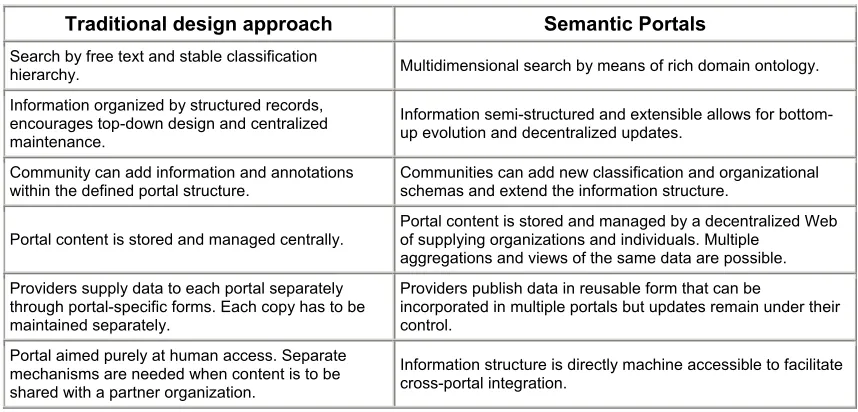
multimedia objects depicting endangered species. ARKive just provides the backbone structure of resources by making its ontology available for use. Individual communities of interest then supply the additional classifications, annotations, and navigational interfaces to suit their needs. The application of Semantic Web technologies also makes it easier to integrate data across portals by applying mapping and merging techniques to shared or compatible ontologies. Techniques for ontology integration are discussed in sub-section 2.2.8. Table 1 shows a comparison of traditional and semantic portals.
2.2.3 Semantic Web Projects
The following are examples of real world Semantic Web project initiatives:
•
The DARPA Virtual Soldier Project18–
aims to enhance diagnosis and prognosisof battlefield injuries by using an OWL ontology. The goal is to investigate methods that will revolutionize medical care for the soldier. The project is integrated into the
17 http://www.arkive.org/
18 http://www.virtualsoldier.net/
Traditional design approach Semantic Portals
Search by free text and stable classification
hierarchy. Multidimensional search by means of rich domain ontology.
Information organized by structured records, encourages top-down design and centralized maintenance.
Information semi-structured and extensible allows for bottom-up evolution and decentralized bottom-updates.
Community can add information and annotations within the defined portal structure.
Communities can add new classification and organizational schemas and extend the information structure.
Portal content is stored and managed centrally.
Portal content is stored and managed by a decentralized Web of supplying organizations and individuals. Multiple
aggregations and views of the same data are possible. Providers supply data to each portal separately
through portal-specific forms. Each copy has to be maintained separately.
Providers publish data in reusable form that can be
incorporated in multiple portals but updates remain under their control.
Portal aimed purely at human access. Separate mechanisms are needed when content is to be shared with a partner organization.
Information structure is directly machine accessible to facilitate cross-portal integration.
protégé general framework and uses ontology reasoning to produce complex mathematical models that create physiological representations of individual soldiers. These holographic medical representations (known as Holomers) can be used to improve medical diagnosis on and off the battlefield. The Holomers coupled with predictive OWL reasoning, facilitate a new level of integration in medical procedures. The Virtual Soldier provides multiple capabilities, including automatic diagnosis of battlefield injuries, prediction of soldier performance, evaluation of non-lethal weapons, and virtual clinical trials.
• CS AKTive Space (CAS)19
-
winner of the 2003 Semantic Web challenge20, this isan integrated Semantic Web application that provides a way to explore the UK Computer Science research domain across multiple dimensions for multiple stakeholders, from funding agencies to individual researchers. One of the challenges for the Semantic Web is to represent large ontological spaces in meaningful ways to people who wish to explore them. The goal of the interaction design for CS AKTive Space has been to explore this Semantic Web challenge by providing a user interface to millions of triples from multiple heterogeneous sources that represent the UK Computer Science domain. The project uses an ontology to provide seamless integration and on-demand semi-automatic content harvesting from multiple semantically heterogeneous data sources to provide information access.
• Swoogle21 - is a search engine / Web crawler-based indexing and retrieval system for
Semantic Web documents in RDF or OWL. It is being developed by the Computer Science and Electrical Engineering Department of the University of Maryland Baltimore County. It extracts metadata and computes relations between documents. Discovered documents are also indexed by an information retrieval system to compute the similarity among a set of documents and to compute rank as a measure of the importance of a Semantic Web document. Swoogle facilitates the development of the Semantic Web by finding appropriate ontologies, and helping users specify
19 http://cs.aktivespace.org/
20 http://www.informatik.uni-bremen.de/agki/www/swc/swc2003submissions.html
terms and qualify types (class or property). In addition, the ranking mechanism sorts ontologies by their importance.
In order to help users integrate Semantic Web data (SWD) distributed on the Web, Swoogle enables querying SWDs with constraints on the classes and properties. By collecting meta-data about the Semantic Web, Swoogle reveals interesting structural properties such as how the Semantic Web is connected, how ontologies are referenced, and how an ontology is modified externally. Swoogle is designed as a system that will scale up to handle millions of documents. Moreover, Swoogle also enables rich query constraints on semantic relations. The Swoogle architecture consists of a database that stores metadata about SWDs. Two distinct Web crawlers discover SWDs and components to compute semantic relationships among the SWDs. Also, an indexing and retrieval engine and simple user interface for query and agent Web service APIs provide useful services.
• MUSEUMFINLAND22 - is a semantic portal that was built by the Museum of
Finland using the Ontoviews tool (see sub-section 2.2.7.3). In MUSEUMFINLAND, the content consists of collections of cultural artefacts and historical sites in RDF format consolidated from several heterogeneous Finnish museum databases (Hyv¨onen, Salminen & Kettula 2004). M¨akel¨a et al. (2004) explain that the RDF content is annotated using a set of seven ontologies. From the seven ontologies, nine view-facets are created. The ontologies underlying the application consist of some 10,000 RDF(S) classes and individuals, half of which are in use in the current version on the Web. There are some 7,600 categories in the views. Search for museum content can be done via keywords which return a list of semantically related categories displayed as hyperlinks. Searches may also be performed by navigating hyperlinks alone without entering keywords.
• INWISS knowledge portal prototype23 - is a semantic portal that demonstrates an
approach for communicating user context (revealing the user's information need) among portlets (components of a Web portal) utilizing Semantic Web technologies. For example, the query context of an OLAP portlet, which provides access to
22 http://www.museosuomi.fi/
structured data stored in a data warehouse, can be used by a search portlet to automatically provide the user with related intranet articles or documents in an organization's document management system.
• The ARTENIS project24 - is a peer-to-peer network based on Semantic Web
services and suitable domain ontologies. The project, which is funded by the European Union, aims at improving interoperability among different health organizations. Organizations can join the ARTEMIS network and advertise electronic services, such as access to a patient’s health care record (with appropriate authorization), as well as access to different subsystems such as patient admission or laboratory information systems. The network also allows other services to be invoked dynamically. One such example is the possibility to dynamically map different representations of health care information. ARNENIS’ participating partners originate from Turkey, Greece, Germany, and the United Kingdom.
• The DartGrid25 - is a Semantic Web based toolkit that mainly aims to resolve the
problem of heterogeneous database integration in a specific VO (virtual organization). The system combines Grid and Semantic Web technologies together to provide a uniform semantic query interface to sets of distributed and heterogeneous relational data sources. What the DartGrid project contributes is at the semantic service level. The services at this level are designed for semantic-based relational schema mediation and semantic query processing by using the semantics of an RDFS ontology.
• The Bioinformatics project for Glycan Expression26 - has the overarching
objective of building a semantic framework for integration, sharing, storage, and retrieval of vast amounts of data generated by high-throughput glycomics experiments. Glycomics is the study of glycans (modifications of sugar molecules) expressed by an organism, which plays a critical role in the life functions of organisms. The project, which is explained in more detail by Sheth (2005), forms the bioinformatics component of the Biomedical Glycomics Research Resource Centre at the Complex Carbohydrate Research Centre (CCRC). As part of the semantic
24 http://www.srdc.metu.edu.tr/Webpage/projects/artemis/
25 http://ccnt.zju.edu.cn/projects/dartgrid/
framework, two large ontologies were developed, namely GlycO (a glycoproteomics domain ontology with extremely fine granularity) and ProPreO (a process ontology with comprehensive modelling of glycoproteomics experimental lifecycle). An XML-based standard for representation of glycan structures called GLYDE (Glycan Data Exchange) has been proposed and implemented. GLYDE is now being seriously considered for adoption by the international glycomics community for data exchange.
2.2.4 Semantic Web Markup Languages
This sub-section describes the evolution and capabilities of mainstream Semantic Web markup languages.
2.2.4.1 XML and XML Schema
XML (Bray et al. 2004) was developed by the W3C XML working group in the late 1990’s to provide rules for creating vocabularies that can structure both documents and data on the Web. The aim of XML was to overcome some of the drawbacks of HTML, which was designed for information presentation rather than machine processing. XML provides clear rules for syntax, while XML schemas extend these capabilities by serving as a method for composing XML vocabularies against which documents can be validated. XML is a powerful, flexible surface syntax for structured documents, but imposes no semantic constraints on the meaning of these documents. It is not possible for example, to deduce new knowledge from an XML statement. More powerful Web markup languages are required to perform sophisticated information processing tasks.
2.2.4.2 Resource Description Framework (RDF)27
RDF (Manola & Miller 2004), which stands for Resource Description Framework, is a data model and syntax specification for representing information about Web resources. An RDF Model is a set of statements, each consisting of a triple (i.e. subject, predicate, object). RDF statements can either be represented as a graph or in an XML format known as RDF/XML serialization. Figure 2 is an example of a simple RDF graph which is demonstrated in an RDF tutorial by Decker et al. (2000). The resource
“http://www.daml.org/projects/#11” is a subject with a property “http://www.SemanticWeb.org/schema-daml-01/#hasHomepage.” The value of the property is the object “http://wwwdb.stanford.edu/OntoAgents.” The property “http://purl.org/DC/#Creator” with value “Stefan Decker” (a literal) is joined to form the graph.
An RDF graph is not the most efficient means of storing and retrieving data. RDF/XML serialization is a process that converts the graph into an XML format that is machine processable. The Figure 2 graph is represented in Figure 3 using RDF/XML serialization.
2.2.4.3 RDF Namespaces
To ensure that RDF/XML data from various documents can be successfully merged, namespaces are added to RDF specifications. Namespace declarations act as a prefix for identifying the vocabulary in a document, as well as pointing to the URI of any external RDF vocabulary that is used. Figure 4 is an example RDF namespace declaration presented by Manola & Miller (op. cit).
Figure 2: RDF graph (Decker, Mitra & Melnik 2000).
2.2.4.4 RDF Schema (RDFS)
RDF is limited to descriptions about individual resources, and does not provide any modelling primitives for defining the relationships between properties and resources. To demonstrate this, Gomes-Perez et al. (2004b) provide the example that a relation arrivalPlace expressed in RDF can only hold between instances of the classes Travel and Location. This limitation is solved by RDFS (Brickley & Guha 2003), which extends RDF by providing a vocabulary by which classes and their subclass relationships can be expressed, and properties defined and associated with classes. RDFS achieves this by adding 16 new modelling primitives for organizing Web objects into hierarchies. This allows objects to be grouped together into classes, making it possible to link together instances of these classes. For example, a class called Accommodation could be linked to a class called Location via a predicate relation (property) called hasLocation. This means that any instance of the Accommodation class could be defined as having a particular location which would be an instance of the Location class.
It is also demonstrated by Antoniou et al. (2005), that the application of predicates can be restricted with RDFS through the use of domain and range restrictions. For example, it becomes possible to restrict the property hasLocation to apply only to instances of the class Accommodation, and have only instances of the class Location as values. This way, nonsensical statements (e.g. Accommodation has the Location of Five Star Rating) due to user errors can be automatically detected. Even though RDF and RDFS are building blocks for defining a Semantic Web, they still lack sufficient expressive power for building sophisticated ontologies. They are not capable for example, of defining properties of properties, equivalence and disjointness of classes. Even more expressive markup languages are therefore required.
Figure 4:RDF namespace (Manola & Miller 2004). <?xml version="1.0"?>
<rdf:RDF xmlns:rdf="http://www.w3.org/1999/02/22-rdf-syntax-ns#" xmlns:exterms="http://www.example.org/terms/">
<rdf:Description rdf:about="http://www.example.org/index.html"> <exterms:creation-date>August 16, 1999</exterms:creation-date>
2.2.4.5 DAML + OIL
Ontology Interchange Language (OIL) (Horrocks 2000), was developed by Dr Ian Horrocks at the University of Manchester as an extension to RDFS. OIL added more frame based KR primitives and used description logics to give clear semantics to these primitives. At the same time that OIL was being developed, the Defense Advanced Research Agency (DARPA) began working on DARPA Agent Markup Language (DAML) (Horrocks & Harmelen 2001). Similar to OIL, DAML was designed with a greater capacity than RDF and RDFS for describing objects and the relationships between them. DARPA developed DAML as a technology with semantics built into the language to assist the capabilities of Web agents, which are programs that can dynamically identify and comprehend sources of Information (see 2.2.5.10). Soon efforts were underway around the world to unify the various ontology languages. These efforts led to a new language called DAML+OIL, which consolidated the capabilities of DAML and OIL to further overcome many of the expressive capability inadequacies of RDFS. DAML+OIL was soon to be superseded, however, by another language known as OWL.
2.2.4.6 Ontology Web Language (OWL)28
The OWL language, which was created by the W3C Web Ontology (WebOnt)29 Working
group derive from DAML+OIL. Like DAML+OIL, OWL builds on RDF and RDF Schema and adds more vocabulary for describing properties and classes: among others, relations between classes (e.g. disjointness), cardinality (e.g. "exactly one"), equality, richer typing of properties, characteristics of properties (e.g. symmetry), and enumerated classes (McGuinness & Van Harmelen 2004). OWL ontologies have three species or sub-languages: OWL-Lite, OWL-DL and OWL-Full. A defining feature of each sub-language is its expressiveness. OWL-Lite is the least expressive sub-language. It is intended to be used in situations where only a simple class hierarchy and simple constraints are needed. OWL-Full is the most expressive sub-language. It is intended to be used in situations where very high expressiveness is more important than being able to guarantee the decidability or computational completeness of the language. OWL-DL was designed to be processed by description logic reasoners. The expressiveness of OWL-DL falls
28 The OWL language and abstract syntax specification can be found at: http://www.w3.org/TR/owl-absyn/
between that of OWL-Lite and OWL-Full. OWL-DL is an extension of OWL-Lite, and OWL-Full an extension of OWL-DL. Horridge (2004) contends that there are simple rules of thumb that should be considered when deciding which language to use when building an ontology. For example, the choice between OWL-Lite and OWL-DL may be based upon whether the simple constructs of OWL-Lite are sufficient or not. Also, the choice between OWL-DL and OWL-Full may be based upon whether it is important to carry out automated reasoning on the ontology, or whether it is important to be able to use highly expressive and powerful modelling facilities such as meta-classes (classes of classes).
2.2.4.7 Markup Language Pyramid
Figure 5 represents the stack of mainstream markup languages for the Semantic Web starting from XML and XML Schema, followed by RDF and RDFS. On top of the pyramid sits OWL. The languages offer an increasing degree of expressiveness with lower lever languages syntactically compatible with those at the upper levels. Their development is based on a history of different languages which have all to some degree, contributed to the final W3C standards that now form a stable basis for Semantic Web development (Stuckenschmidt & Harmelen 2005a, p. 61).
The language pyramid is sometimes presented in a more generalized manner based on logical classifications at the upper levels. The Semantic Web tower by Antoniou et al. (2005) (see Figure 6) presents four logical levels on top of RDFS.
1. The ontology language layer - expands RDFS and allows the representation of more complex relationships between Web objects. Languages such as DAML + OIL and OWL fit into this category.
Figure 5: Markup language pyramid (Alesso, PH & Smith, CF 2004). XML – Structured Documents
XML Schema
Resource Description Framework RDF Schema
2. The logic layer - is used to enhance the ontology language further, and to allow the writing of application specific declarative knowledge.
3. The proof layer - involves the actual deductive process, as well as the representation of proofs in Web languages and proof validation.
4. Trust layer - will emerge through the use of digital signatures, and other kind of knowledge based on recommendations by agents and consumer bodies.
2.2.5 Ontologies
This sub-section provides a detailed description of ontologies, including their various definitions, purposes, application areas, and issues concerning their development.
2.2.5.1 Defining Ontologies
The word ontology stems from philosophy where it means a systematic explanation of being (Gomes-Perez, Fernandez-Lopez & Corcho 2004c, p. 6). Since the late 1990’s the word has become relevant in the information systems and artificial intelligence community. It is within this context that Neches et al. (1991) defines ontology as: The basic terms and relations comprising the vocabulary of a topic area as well as the rules for combining terms and relations to define extensions to the vocabulary. This definition identifies that an ontology consists of basic terms, relations between terms and rules that combine terms. Neches et al. (op. cit) also contend that an ontology includes both explicitly defined terms and the knowledge that can be inferred from it.