R E S E A R C H
Open Access
Finite-time synchronization of delayed
complex dynamical network via pinning
control
Feng Xiao and Qintao Gan
**Correspondence:
[email protected] Department of Basic Science, Shijiazhuang Mechanical Engineering College, Shijiazhuang, 050003, P.R. China
Abstract
We investigate a finite-time synchronization problem of hybrid-coupled delayed dynamical network via pinning control. According to linear feedback principle and finite-time control theory, the finite-time synchronization can be achieved by pinning control with suitable continuous finite-time controller. Some sufficient conditions are given for finite-time synchronization of undirected and directed complex network by applying finite-time stability lemma. Numerical simulations are finally presented to demonstrate the effectiveness of the theoretical results.
Keywords: undirected and directed complex network; finite time; pinning synchronization; time delay
1 Introduction
Complex networks are commendably in a position to describe many complex models of connection by natural science, social science, management science, engineering technol-ogy, and other fields. It depends on mathematics, statistical physics, computer, and other science as tools and aims at complex systems. Therefore, complex networks are an inter-discipline that develops rapidly in the st century []. In the past decades, with the gradual deepening research of the theory and application of complex networks, people start trying to investigate different large complex systems in the real world by this novel theory tools [–], such as Internet, ecological systems, biological neural networks, social networks, and world wide web. Synchronization is a kind of phenomena that exists extensively in the nature and human society. In the meantime, it is one of dynamic behaviors of com-plex networks. Nowadays, synchronization of comcom-plex networks has been an significant research orientation in the network science [].
In recent years, the synchronization problem of complex networks has attracted more and more attention from different areas, such as mathematics, physical science, commu-nication, engineering, and so on. There are some control schemes to accomplish the syn-chronization of a complex network, such as pinning control [–], adaptive control [, ], impulsive control [, ], and the like. Pinning control is one of the effective methods in the synchronization control of a complex network, and this way is simple, practical, and economic. Because pinning controllers are applied to merely need a small part of nodes to
drive the system in order to achieve the synchronization of complex network, and it is im-possible to achieve synchronization by controlling all nodes in the reality. In the pinning control of a complex network, it is common knowledge that one of the most challenging problems is how to select pinned nodes to guarantee the convergence of the pinning pro-cess. In [], the authors have proved that a class of linear coupled complex networks can achieve synchronization when the coupling strength is sufficiently large by pinning a part of nodes.
As everyone knows, time delay is a very common phenomenon in real complex systems. On account of the speeds of transmission, spreading, and traffic congestion, a signal trav-eling through a complex network is often united with time delay. That is, there is some information communication of nodes not only at timetbut also at timet–τ. In realistic situations, moreover, there exists much more complex and uncertain information com-munication in complex networks, and time delay is not simple just likexi(t–τ) but much more likexi(t–τ(t)),xi(t–τ(t)), andxi(t–τ(t)). They are called multitime delay and
time-varying delay. Consequently, it is necessary to investigate the influence of time delay on the synchronization of a complex network. In some of the previous literature, such as Refs. [–, , ], they established some complex models with either no time delay or only single time delayxi(t–τ), which is significantly different from complex systems of real world.
Throughout this paper, the network model comes from [], where pinning synchroniza-tion of directed delayed dynamical networks via intermittent control was investigated. There are two types of time delay, coupling delay and internal delay. Furthermore, cou-pling delay is caused by exchange of information between nodes, and internal delay occurs inside the system. In addition, the coupling terms are including transmission delay and self-feedback delay. To our best knowledge, delay is likely to influence the own state of a node and neighboring state. In realistic situations, the transmission delay is different from the self-feedback delay. In [], the coupling term is written as(xj(t–τ(t)) –xi(t–σ(t))). Therefore, both the coupling and internal delays should be taken into account in a realis-tic system of complex network. However, the synchronization of a complex network with time delay is often achieved for finite time [, , –] in practical applications. In other words, people are looking forward to achieving the synchronization of a complex network as fast as possible in reality, and the finite-time synchronization means the improved con-vergence rate in a complex network. It is significant to investigate the finite-time synchro-nization of a complex network in practice. Nevertheless, in [], the asymptotic stability or exponential stability of the synchronization error is just investigated. Hence, the main purpose of this paper is to achieve the finite-time synchronization of a complex network with multitime delay and time-varying delay by pinning control. Furthermore, in the pa-per, the finite-time synchronization problem is described from two aspects, undirected network [] and directed network [, ].
from the proposed conditions. Numerical simulations are described to display the effec-tiveness of the theoretical results.
The paper is structured as follows. Section provides some mathematical preliminaries and formulates a model with a finite-time synchronization of a delayed complex network. In Section , we give some sufficient finite-time synchronization conditions and propose pinned-node schemes that include undirected network and directed network. Numerical simulations are given in Section to verify the effectiveness of the theoretical results. Finally, the paper is concluded in Section .
2 Problem description
In this section, we consider a complex network consisting ofNnodes with each being an
n-dimensional dynamical system. The complex network is described by
˙
xi(t) =ft,xi(t),xi
t–τ(t)
+c
N
j=,j=i
bijxj(t) –xi(t)
+cτ N
j=,j=i
bijτ
xj
t–τ(t)
–xi
t–τ(t)
, (.)
where i= , , . . . ,N, xi(t) = (xi(t),xi(t), . . . ,xin(t))T ∈Rn is the state vector of node i, f : R×Rn×Rn→Rnis a continuous vector-valued function controlling the dynamics of isolated nodes, the time-varying delaysτ(t),τ(t), andτ(t) are bounded by known
constants, that is, ≤τ(t)≤τ, ≤τ(t)≤τ, and ≤τ(t)≤τ, in whichτ(t) denotes
the internal delay occurring inside the nodes,τ(t) represents the transmission delay for
signal sent from nodejto nodei, andτ(t) is the self-feedback delay. The positive constants candcτ are the coupling strengths,= (γij)n×nandτ = (γijτ)n×nare the inner connect-ing matrices, andB= (b
ij)N×N andB= (bij)N×N are the outer coupling matrices between the nodes. The most difference between undirected and directed networks is their outer coupling matrices.
In the undirected network, the outer coupling matrices are defined to satisfy the follow-ing conditions:
If there exists a connection between nodesiandj, thenbk
ij=bkji> , and otherwisebkij=
bk
ji= (i=j),k= , . Moreover,bkii= –
j=,j=ibkij,k= , .
In the directed network, the outer coupling matrices are defined to satisfy the following conditions:
bkij≥, i=j, bkii= – j=,j=i
bkij, k= , .
Based on the above two conditions, we can rewrite the network model (.) as follows:
˙
x(t) =ft,xi(t),xi
t–τ(t)
+c
N
j=
bijxj(t) +cτ N
j= bijτxj
t–τ(t)
–cτbiiτ
xi
t–τ(t)
–xi
t–τ(t)
, i= , , . . . ,N. (.)
There exists a timet∗> such that, for all i,j andt≥t∗, we havexi(t) –s(t)= ,
i= , , . . . ,N. Here,s(t) may be an equilibrium point, a periodic orbit, or a chaotic or-bit. Then, the network (.) reaches complete synchronization in finite time, and we have the following synchronized state equation:
˙
s(t) =ft,s(t),st–τ(t)
–cτbiiτ
st–τ(t)
–st–τ(t)
, i= , , . . . ,N. (.)
Obviously, the synchronized state s(t) is uniform. Hence, to achieve the complete syn-chronization of network (.) in finite-time, letb
=b=· · ·=bNN= –a< . Under this condition, the synchronized state equation (.) can be written as
˙
s(t) =ft,s(t),st–τ(t)
+acττ
st–τ(t)
–st–τ(t)
. (.)
In this paper, to achieve synchronization in finite time, we take advantage of the scheme of pinning control [, –], finite-time controllersui(t), and synchronized solutions(t) of complex network (.), that is,
lim t→t∗
xi(t) –s(t)= , i= , , . . . ,N. (.)
To reach the control target, some controllers are added to partial nodes of network (.). Without loss of generality, let the firstl(≤l<N) nodes to be selected and pinned. Then we have the following controlled delayed network:
⎧ ⎪ ⎪ ⎪ ⎪ ⎪ ⎨ ⎪ ⎪ ⎪ ⎪ ⎪ ⎩ ˙
xi(t) =f(t,xi(t),xi(t–τ(t))) +acττ(xi(t–τ(t)) –xi(t–τ(t)))
+cNj=b
ijxj(t)+cτ N
j=bijτxj(t–τ(t))+ui(t), ≤i≤l,
˙
xi(t) =f(t,xi(t),xi(t–τ(t))) +acττ(xi(t–τ(t)) –xi(t–τ(t)))
+cNj=b
ijxj(t)+cτ N
j=bijτxj(t–τ(t)), l+ ≤i≤N,
(.)
whereui(t) are controllers defined as follows:
ui(t) = –diei(t) –k
k
N
i=
t
t–τ(t)
eTi(s)ei(s)ds
ei(t) e(t)
–k signei(t)
–k
k
N
i=
t
t–τ(t)
eTi(s)ei(s)ds
ei(t) e(t)
–k
k
N
i=
t
t–τ(t)
eTi(s)ei(s)ds
ei(t)
e(t), ≤i≤l, (.)
where,di> is a positive constant called the control gain,k,k,k, andkare positive
constants. Let ei(t) =xi(t) –s(t), ≤i≤N, be synchronization errors. LetBˆs= (Bˆ+
ˆ
of the control laws (.), the error system is governed as follows:
⎧ ⎪ ⎪ ⎪ ⎪ ⎪ ⎨ ⎪ ⎪ ⎪ ⎪ ⎪ ⎩ ˙
ei(t) =f˜(t,xi,s,xτ
i ,sτ) +acττ(ei(t–τ(t)) –ei(t–τ(t))) +c
N
j=bijej(t) +cτ
N
j=bijτej(t–τ(t)) +ui(t), ≤i≤l,
˙
ei(t) =f˜(t,xi,s,xτ
i ,sτ) +acττ(ei(t–τ(t)) –ei(t–τ(t))) +c
N
j=bijej(t) +cτ
N
j=bijτej(t–τ(t)), l+ ≤i≤N,
(.)
wheref˜(t,xi,s,xτ
i ,sτ) =f(t,xi(t),xi(t–τ(t))) –f(t,s(t),s(t–τ(t))).
The following assumptions and lemmas are needed to derive our main results.
Assumption ([]) The vector-valued functionf(t,xi(t),xi(t–τ(t))) satisfies the uniform
semi-Lipschitz condition with respect timet, that is, for anyx(t),y(t)∈Rn, there exist positive constantsL> andL> such that
x(t) –y(t)Tft,x(t),xt–τ(t)
–ft,y(t),yt–τ(t)
≤L
x(t) –y(t)Tx(t) –y(t)+L
xt–τ(t)
–yt–τ(t)
T
×xt–τ(t)
–yt–τ(t)
. (.)
Assumption The time-varying delaysτi(t) (i= , , ) are differentiable functions, and ≤ ˙τi(t)≤ψi≤, whereψi(i= , , ) are constants.
Lemma ([]) If Y and Z are real matrices of appropriate dimensions,then there exists a positive constantξ> such that
YTZ+ZTY≤ξYTY+ ξZ
TZ. (.)
Lemma ([]) Assume that Q= (qij)N×N is symmetric. Let D=diag(d, . . . ,dl,
N–l , . . . , ),
Q–D=ES–TD S˜ Q l
,and d=min≤i<l{di},where≤l<N,di> ,i= , . . . ,l,Qlis the minor
matrix of Q by removing its first l(≤l<N)row-column pairs,E and S are matrices of appropriate dimensions, D˜ =diag(d, . . . ,dl).If d>λmax(E–SQ–l ST), then Q–D< is
equivalent to Ql< .
Lemma ([]) For x,x, . . . ,xn∈Rn,
x+x+· · ·+xn ≥
x+x+· · ·+xn. (.)
Lemma ([, , ]) Suppose that a continuous and positive definite function V(t) sat-isfies the inequality
˙
V(t)≤–pVξ(t), ∀t≥t
, V(t)≥, (.)
where p> and <ξ< are two constants.For any given time t,V(t)satisfies the following inequality:V–ξ(t)≤V–ξ(t
3 Main results
3.1 Finite-time synchronization problem of undirected network
Theorem Suppose that Assumptionholds.Suppose that there exist positive constants
ς,ς,ς,q,and di,i= , . . . ,l,such that
Proof Construct a Lyapunov-Krasovskii functional as follows:
V(t) =
Taking the derivative ofV(t) with respect to timetalong the solution of network (.), we obtain
Using Assumption , we have
Then we get
≤ς
Substituting (.)-(.) into (.) gives
Then, from (.) we have
According to Theorem , Assumption , and Lemma , it follows from (.) that
+
According to Lemma , the complex network (.) can achieve synchronization in finite time
Therefore, the proof is completed.
Remark LetQ= (p+q)IN+cρBˆ, (p+q)IN +cρBˆ–D=Q–D=
Corollary We discuss about how to select pinned nodes and how many nodes are pinned at least in an undirected network.Let C=Q–D= (p+q)IN+cρminB–D,C= (Cij)N×N.
Let gi= N
the degree of node i.To satisfy C=Q–D< ,the necessary conditions are as follows:
Cii= (p+q) –cρmingi–di< , ≤i≤l,
Cii= (p+q) –cρmingi< , l+ ≤i≤N.
(.)
From (.) we can see that, for the nodes without pinning controllers. it is necessary to make their degreesgi>cρp+minq . When the coupling strengthcis very large, the pinning condition is easily to be arrived. In other words, the degree of each node satisfiesC< []. But, ifcis not very large, then the nodes with low degrees should be controlled by controllers. As we all know, the nodes with low degrees receive a little information from other nodes, which need to be synchronized by controllers because of the nonlinearity of single node. Similarly, the nodes with high degrees receive more information from other nodes, that is, controlling one node with high degrees is equivalent to controlling some or dozens of nodes. Therefore, we should choose two kinds of nodes with low and high degrees in the undirected network. Firstly, we rearrange the nodes by size of degree in descending order. Then, we select pinned nodes from both sides to the middle. In this way, the nodes with low and high degrees can be taken into consideration.
According to Remark , for the sake of achieving the synchronization in finite-time, the conditionQ–D< needs to be satisfied, and whendis sufficiently large,Q–D< is equivalent toQl< , that is, (p+q)IN–l+cρBˆl < . We can certainly assume that at least
lnodes need to be pinned so as to accomplish conditionQl< , wherelpinned-nodes
satisfy
λmax ˆ
Bl–≥–(p+q)
cρ
and λmax ˆ
Bl< –(p+q)
cρ
, (.)
where ≤l≤l. We project to selectlnodes and rearrange nodes of the complex network.
Next, the value ofλmax(Bˆ
l) is calculated, and whenl=l– andl=lsatisfy (.), the
number of pinned nodes is presented, that is, at leastl=l.
3.2 Finite-time synchronization problem of directed network
Theorem Suppose that Assumptionholds.Suppose that there exist positive constants
ς,ς,ς,q,and di,i= , . . . ,l,such that () (p+q)IN+cρBˆs–D< , () L––ψk< ,
() acτλmax( T
ττ)
ς +
ς –
–ψ
k< ,
() acτ
λmax(Tττ)
ς –
–ψ
k< , () t∗=t+
√
k V (t).
Theorem is similar to Theorem , except condition (). To construct symmetrical outer coupling matrices, we change the outer coupling matrixBl byBˆls. The proving process of a directed network is similar to that of an undirected network. Thus we omit it here. According to Lemma , the complex network (.) can achieve the synchronization in finite time
t≤t∗=t+
√
k V
Corollary Comparing a directed network with an undirected network,the difference is in selection of pinned nodes.For a directed network,the degrees of one node are divided into two classes,out-degree and in-degree.Out-degree denotes that the quantity of a node point to other nodes,and in-degree represents that the quantity of other nodes points to the node.
In this paper,letDegout(i)andDegin(i)denote,respectively,the in-degree and out-degree of node i,that is,Degout(i) =Nj=,j=ibjiandDegin(i) =Nj=,j=ibij.The difference between out-degree and in-out-degree is called the out-degree-difference of nodes expressed byDegdiff(i).Hence, Degdiff(i) =Degout(i) –Degin(i).
The pinned-nodes are selected in terms of the degree-difference of nodes. Rearrange the nodes in descending order according to their degree-differences and the nodes with same degree-differences rearrange in descending order according to their out-degrees.
For achieving the synchronization of a complex network in finite time, how many nodes need to be pinned at least? The method is similar to that for undirected networks. That is, conditionQ–D< needs to be satisfied, and whendis sufficiently large,Q–D< is equivalent toQl< , right now,Ql= (p+q)IN–l+cρBˆ
s
l . Namely, (p+a)IN–l+cρBˆ s
l < . We assume that the number of at leastl nodes need to be pinned so that accomplish
conditionQl< , wherelsatisfies
λmax ˆ
Bls–≥–(p+q)
cρ
and λmax ˆ
Bls< –(p+q)
cρ
. (.)
4 Numerical simulations
In this section, some numerical simulations are given to demonstrate the effectiveness of the theoretical results for the finite-time synchronization. In the first place, a delayed neural network is selected as the isolated node in complex network (.):
˙
x(t) =ft,x(t),xt–τ(t)
=Ax(t) +Cg
x(t)+Cg
x(t–τ)
. (.)
Letx(t) = (x(t),x(t))T∈R,g(x) =g(x) = (tanh(x),tanh(x))T,τ= , and
A=
–
–
, C=
–. –. .
, C=
– –. –. –
.
Figure shows that system (.) is chaotic.
Then, based on (.), the controlled synchronization state equation is described by
˙
s(t) =As(t) +Cg
s(t)+Cg
s(t–τ)
+acττ
st–τ(t)
–st–τ(t)
. (.)
Next, we consider an undirected network consisting of nodes, and the model is de-scribed by
˙
xi(t) =Ax(t) +Cg
x(t)+Cg
x(t–τ)
+acττ
xi
t–τ(t)
–xi
t–τ(t)
+c
N
j=
bijxj(t) +cτ N
j= bijτxj
t–τ(t)
Figure 1 The chaotic state of system (4.1) with initial conditionsx1(τ) = 0.3 andx2(τ) = 0.8, where
τ∈[–1, 0].
Figure 2 The relationship between the number of pinned-nodes and maximum eigenvalues.
where, =diag(., ), τ =diag(, ), c= , cτ = , τ(t) =et/( + et), and τ(t) =
.|cos(t)|. According to the BA model [], we can know that the coupling matrixBis generated by the undirected network. LetN= andB= .B˜, whereB˜= (b˜
ij)N×N= (bij/(j=,j=ibij))N×N. Next, by Corollary , selecting some parameters values, we can ob-tainλmax(Bˆl) < –..
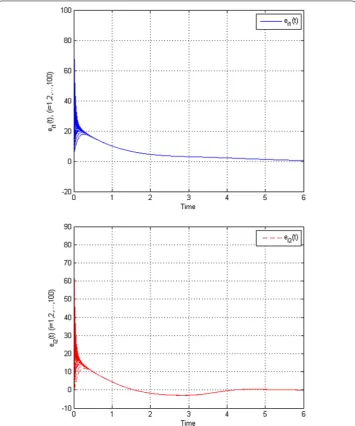
Figure 3 The curves of complex network synchronization errors.
From Figure it is clear that the values of λmax(Bˆl) decrease along as the number of pinned-nodeslincreases. Especially, whenl= andl= , we getλmax(Bˆ) = –. andλmax(Bˆ) = –.. Hence, we need only select the firstl= rearranged nodes of
network (.) as pinned nodes for the synchronization of complex network in finite-time. As shown in Figure , the synchronization errorsei(t) (≤i≤) tend to synchronize in finite time. Furthermore, the picture of the synchronization errorsei(t) in the directed network is similar to that of the undirected network and is omitted.
5 Conclusion
undi-rected network and a diundi-rected network. Sufficient conditions are given for the finite-time synchronization of a complex network by finite-time stability theory. Moreover, we have separately formulated the pinned-nodes schemes from undirected and directed networks. The most significant aspect of the finite-time synchronization of complex networks is certainly the application value, that is to say, the synchronization system can be applied to various fields, such as cryptography communications, laser system, nervous system, traf-fic networks, internet, superconducting materials, and so on. The synchronization system is able to satisfied the exacting requirements of these applications on precision, velocity, quality, and costing. Finally, the numerical simulations have clearly verified the effective-ness of the developed pinning control to the finite-time synchronization of hybrid-coupled delayed dynamical networks.
Acknowledgements
This work was supported by the National Natural Science Foundation of China (No. 61305076) and the Funds for Basic Creative Research of Department of Basic Science, Shijiazhuang Mechanical Engineering College (No. JCCX1601).
Competing interests
The authors declare that they have no competing interests.
Authors’ contributions
Both authors contributed equally to the writing of this paper. Furthermore, both authors also read and carefully approved the final manuscript.
Publisher’s Note
Springer Nature remains neutral with regard to jurisdictional claims in published maps and institutional affiliations.
Received: 11 July 2017 Accepted: 14 October 2017
References
1. Sun, X, Si, S: Complex Network Algorithms and Applications. National Defence Industry Press, Beijing (2015) 2. Lu, J, Liu, H, Chen, J: Synchronization in Complex Dynamical Network. Higher Education Press, Beijing (2016) 3. Xu, J: The synchronization of complex networks and its application based on pinning control. Master dissertation,
Nanjing University of Posts and Telecommunications (2014)
4. Cai, S, Zhou, P, Liu, Z: Pinning synchronization of hybrid-coupled directed delayed dynamical network via intermittent control. Chaos24, 033102 (2014)
5. Qin, J, Zheng, W, Gao, H: A study of synchronization of complex dynamical network model. In: Proceeding of International Symposium on Circuits and Systems, Brazil, pp. 1596-1598 (2011)
6. Yu, W, Chen, G, Lv, J: On pinning synchronization of linearly coupled complex dynamical networks. Automatica45, 429-435 (2009)
7. Wu, W, Zhou, W, Chen, T: Cluster synchronization of linearly coupled complex networks under pinning control. IEEE Trans. Circuits Syst. I, Regul. Pap.56, 829-839 (2009)
8. Guo, X, Li, J: A new synchronization algorithm for delayed complex dynamical networks via adaptive control approach. Commun. Nonlinear Sci. Numer. Simul.17, 4395-4403 (2012)
9. Zheng, S, Wang, S, Dong, G, Bi, Q: Adaptive synchronization of two nonlinearly coupled complex dynamical networks with delayed coupling. Commun. Nonlinear Sci. Numer. Simul.17, 284-291 (2012)
10. Mei, J, Jiang, M, Xu, W, Wang, B: Finite-time synchronization control of complex dynamical networks with time delay. Commun. Nonlinear Sci. Numer. Simul.18, 2462-2478 (2013)
11. Sun, W, Hu, T, Chen, Z, Xiao, L: Impulsive synchronization of a general nonlinear coupled complex network. Commun. Nonlinear Sci. Numer. Simul.16, 4501-4507 (2011)
12. Lu, R, Yu, W, Lv, J, Xue, A: Synchronization on complex networks of networks. IEEE Trans. Neural Netw. Learn. Syst.25, 2110-2118 (2014)
13. Yu, D, Bai, X, Ren, W, Kang, C: Finite-time synchronization control of complex networks. J. Jilin Univ.32, 0423-0429 (2014)
14. Cortes, J: Finite-time convergent gradient flows with applications to network consensus. Automatica42, 1993-2000 (2006)
15. Jin, X, He, Y, Wang, D: Adaptive finite-time synchronization of a class of pinned and adjustable complex networks. Nonlinear Dyn.85, 1393-1403 (2016)
16. Xu, Y, Zhou, W, Fang, J, Xie, C, Tong, D: Finite-time synchronization of the complex dynamical network with non-derivative and derivative coupling. Neurocomputing173, 1356-1361 (2016)
17. Mei, J, Jiang, M, Wu, Z, Wang, X: Periodically intermittent controlling for finite-time synchronization of complex dynamical networks. Nonlinear Dyn.79, 295-305 (2015)
19. Ma, Q, Lu, J: Cluster synchronization for directed complex dynamical networks via pinning control. Neurocomputing
101, 354-360 (2013)
20. Wang, J, Feng, J, Xu, C, Zhao, Y, Feng, J: Pinning synchronization of nonlinearly coupled complex networks with time-varying delays usingM-matrix strategies. Neurocomputing177, 89-97 (2016)
21. Liang, Y, Wang, X: A method of quickly calculating the number of pinning nodes on pinning synchronization in complex networks. Appl. Math. Comput.246, 743-751 (2014)
22. Barabási, AL, Albert, R: Emergence of scaling in random networks. Science286, 509-512 (1999)
![Figure 1 The chaotic state of system (4.1) with initial conditions x1(τ) = 0.3 and x2(τ) = 0.8, whereτ ∈ [–1,0].](https://thumb-us.123doks.com/thumbv2/123dok_us/957861.1117277/13.595.119.478.343.586/figure-chaotic-state-initial-conditions-t-t-wheret.webp)