Available online:
http://edupediapublications.org/journals/index.php/IJR/
P a g e | 2 0 1Contour Tracking for Non-Rigid Objects by Using
Supervised Level Set Model
B.Sai Prasanth,
[email protected]
Mr.T.SaiKumar,
[email protected]
Associate Professor, ECE Department
CMR Technical Campus
Kandlakoya (V), Medchal (M), Hyderabad-501401.
A bs tract :
In this paper we can track the objects according to their shape. We can track the non-rigid objects by using supervised level set model (SLSM).In existing method we use the bounding box method track the object. The proposed method extracts the accurate contours of the target as tracking output, which achieves better description of the non-rigid objects while reduces background pollution to the target model. The SLSM can ensure a more accurate convergence to the exact targets in tracking applications. In particular, we firstly construct the appearance model for the target in an Online boosting manner due to its strong discriminative power between the object and the background. We firstly describe the proposed mechanism of two-phase SLSM for single target tracking, and then give its generalized multi-phase version for dealing with multi-target tracking cases. In SLSM method we apply the contour on non-rigid objects to track the objects exactly. Contour Based Object Tracking is an efficient method for tracking Objects, which can detect multiple objects simultaneously. Contour based object tracking can track the Objects in both images and videos. In this method we will find the contours of the objects, then using this contours we will track the Objects. Finding the contours is the most important task in the contour based object tracking.
Keywords
Supervised level set model, Non-rigid objects, contour tracking, Bayesian manner, Matlab.
1.
Introduction
The objective of video tracking is to associate target objects in consecutive video frames. The association can be especially difficult when the
objects are moving fast relative to the frame rate. Another situation that increases the complexity of the problem is when the tracked object changes orientation over time. For these situations video tracking systems usually employ a motion model which describes how the image of the target might change for different possible motions of the object.
To perform video tracking an algorithm analyzes sequential video frames and outputs the movement of targets between the frames. There are a variety of algorithms, each having strengths and weaknesses. Considering the intended us e is important when choosing which algorithm to use. There are two major components of a visual tracking system: target representation and localization, as well as filtering and data association
Contour tracking detection of object boundary:
Contour tracking methods iteratively evolve an initial contour initialized from the previous frame to its new position in the current frame. This approach to contour tracking directly evolves the contour by minimizing the contour energy using gradient descent.
Object tracking, which refers to the task of generating the trajectories of the moving objects in a sequence of images, is a challenging research topic in the field of computer vision. The problem and its difficulty depend on several factors, such as the amount of prior knowledge about the target object and the number and type of parameters being tracked, e.g., location, scale, detailed contour. Although there has been some success with building trackers for specific object classes
Available online:
http://edupediapublications.org/journals/index.php/IJR/
P a g e | 2 0 2 A novel approach to non-rigid object trackingbased on a supervised level set model (SLSM). In contrast with conventional level set models, which emphasize the intensity consistency only and consider no priors, the curve evolution of the proposed SLSM is object-oriented and supervised by the specific knowledge of the target we want to track. Therefore, the SLSM can ensure a more accurate convergence to the target in tracking applications. In particular, we firstly construct the appearance model
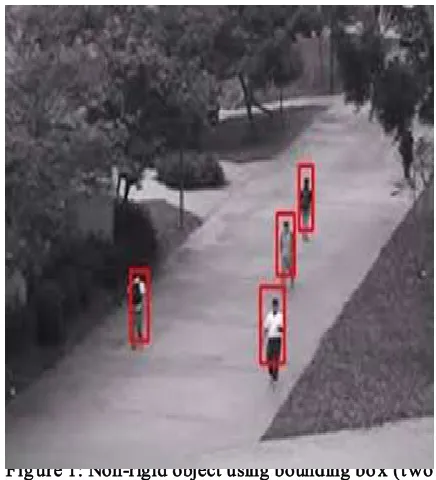
for the target in an on-line boosting manner due to its strong discriminative power between objects and background. Then the probability of the contour is modeled by considering both the region and edge cues in a Bayesian manner, leading the curve converge to the candidate region with maximum likelihood of being the target. Finally, accurate target region qualifies the samples fed the boosting procedure as well as the target model prepared for the next time step. Positive decrease rate is used to adjust the learning pace over time, enabling tracking to continue under partial and total occlusion. Experimental results on a number of challenging sequences validate the effectiveness of the technique. Despite having the promising performance, these traditional trackers face a practical problem that they use rectangular bounding box or oval to approximate the tracked target. However, objects in practice may have complex shapes that cannot be well described by simple geometric shapes, see Fig. 1(a) for some examples. Since the rectangle box used for presenting the tracked target directly determines the samples to be extracted in the subsequent target appearance modeling/update step, it is a critical factor to tracking performance. Inaccurate target presentation easily results in performance loss due to the pollution of non-object regions.
Fig ure 1: Non-rigid object using bounding bo x (two imag es )
Residing inside the rectangle box. In order to better fit the object shape, some methods adopt the scale selection mechanism that aims to search for the best scale that covers the target accurately. An intuitive idea is to run the algorithm in different scales, then select the one maximizing the object function of the tracking algorithm. Further, this selection mechanism is also extended to orientation. By simultaneously controlling both the scale and orientation, the statistic bias for the target distribution can be controlled, see Fig.1 (a), and this, to some extent, makes better target description and tracking estimation. Nevertheless, all these scale/orientation adjustments are still
Based on simple geometric shapes (such as rectangle and oval), which will inevitably introduce a large number of background pixels when used for presenting real-world object with complex shapes.
Supervis ed level s et model:
Available online:
http://edupediapublications.org/journals/index.php/IJR/
P a g e | 2 0 3 pace over time, which enables tracking to continueunder partial and total occlusion. Fig.1 shows some tracking examples of our method in various challenging cases.
2.
The 2-Phase Supervised Level Set Model
Mr. Sun and et al in (2011) propose a model in which, unlike conventional level models that rely only on highly stable and do not consider any precedent in advance, SIMS object-oriented model And under special surveillance target That convergence will ensure more accurate tracking applications And distinguish between objects and background isolation The model is stronger. Bayesian methods for taking Area and signs of were used for edge. The curve leads to convergence model. The selected area with the highest probability of being the target. As a result, the exact target area the purpose of the model is ready for the next step. Tracking can continue under partial occlusion and total.
Level Set Formulation :
Our goal is to estimate the target contour from a sequence of images. Let
I
k: x → Rm denote theimage at time k that maps a pixel x =
[
XY
]
T ∈ 2R
to a value, where the value is a scalar in the case of a grayscale image (m = 1) or a three-element vector for an RGB image (m = 3).
Let C(s) =
[ ( )
]
T
X S Y S
, s ∈ [0, 1], denote a closed curve in R2. An implicit function φ(x, y) is defined such that the zeroth level set of φ is C, that
is, φ(x, y) = 0 if and only if C(s) =
[
XY
]
T for some s ∈ [0, 1]. In response to the low efficiency of the traditional level set models, the proposed SLSM maintains the advantage of using two-valued level set function φ to replace the traditional signed distance functionUsing this simple form can avoid the re-initialized process of the level set function in each Iteration as well as the cumbersome numerical realization. Given all the observations
I
0:kup to time k, boosting score maps
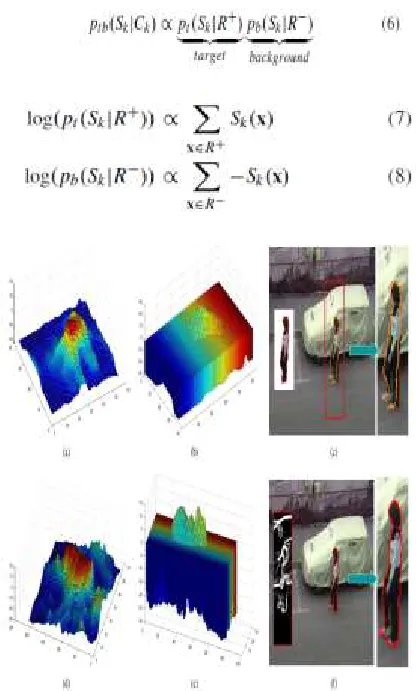
k, we model the probability of contour Ck at time k by considering both the region and edge cues in a Bayesian manner aswhere
p s c
tb( | )
k k presents the likelihood that the regions inside and outside Ck are the target object and background, respectively; and( | )
e k k
p I c
gives the likelihood that the contour is on image edge;p c
( )
k is the prior probability of the contour, where we encode the length prior for smoothing region boundary. Here, the assumption we depend on is that the measurements are independent of each other. When we maximize the probability of (5), obviously, we expect to obtain the contour that surrounds the target region and exactly converges to its edge. Let R+ be the region of the image inside the curve and R− the region outside the curve. The region-based probabilityFig ure 2: Tracking principle of the proposed 2-phase SLSM meth o d
Under the objective of driving the contour to the target boundary, we use image gradient for edge detecting, see Fig. 3, and the edge-based probability
( | )
e k k
Available online:
http://edupediapublications.org/journals/index.php/IJR/
P a g e | 2 0 4 Where ∇ denotes spatial gradient operator, ∗denotes convolution and
G
is the Gaussian filter with standard deviation σ. We define the energy function, minimizing which over the level set function is equivalent to maximizing theWhere ξ, μ and τ are the coefficients that weight
the relative importance of each item.
l
(C)
is the length of the curve. The last item is for constraining φ2 = 1, where W can be defined as (φ2 − 1)2 and
= R+ U R− is the image domain. Employing the binary level set function as a differentiable threshold operator we unify the integral region and rewrite (11) asAnd implemented by the following gradient descent
Where div is the divergence operator. In contrast with conventional level set formulations, ours,
Instead of based upon intensity consistency, is supervised by the prior knowledge of the tracked target. Therefore, the curve, in SLMS, can be steered to the target from a wide variety of states, without any request of the initial curve that must be inside or outside the target completely. Fig. 2 illustrates the tracking principle of the proposed algorithm.
3.
The Multi-Phase Supervised Level Set
Model
In above 2-phase supervised level set model, with only one level set function, we can represent and track only one target. In this section, we generalize the 2-phase SLSM to the multi-phase version with which we can deal with multi target tracking cases. We use several active contours to enclose and represent the multiple tracked targets. Similarly, we firstly construct the appearance models for these tracked targets, then use them as prior knowledge to supervise and refine the evolution of the active contours. One can employ any existing appearance modeling method to construct these target models. In this work, for convenience, we use the same way as in part B of Sec. III to learn the appearance model for each tracked target. Specifically, let us Consider N tracked targets. For each target i we construct its implicit appearance model T (i) by the manner of boosting classifier learning using Algorithm 1. In the new arriving frame, a larger ring of neighboring pixels surrounding the initial target region is included as an extension to form the search region of the i th target. Then the learnt target model T (i) is applied as a detector within the search region so that each sample evaluated gets a confidence score S(i)(x),
Indicating the likelihood of the pixel x belonging to the target i . We denote the appearance models of
all N targets as
{ }
1i N i
T
T
, and the score maps ofall targets as
{ ( )}
1i N
i
T
S X
.We include them asthe prior targets knowledge into the level set formulation to supervise the active contours evolution and obtain the multi-target contour tracking results. This is explained next.
Our goal is to estimate the N contours of the N
target from a sequence of images. Let
{ }
1N i i
R
denote the candidate regions of the N targets. We consider that each pixel can belong to only one target. Then the tracking task in each image frame
consists of finding a partition
* 1
{ }
N i iR
of the imageAvailable online:
http://edupediapublications.org/journals/index.php/IJR/
P a g e | 2 0 5 case, it is convenient to cast the tracking task in aBayesian framework. The problem would then consist of finding a partition {
R
i } Ni=1 which maximizes a posteriori probability over all possible N-region partitions ofHere, for simplicity, we do not consider the edge cue as in (5) (it may have only a very small effect in most of the cases, because the regional fitting term is dominant). Assuming that I (x) is independent of I (y) for
X Y
and taking -log of (15)The first term in (17), referred to as the data term, measures the conformity of the image data I (x), in region
R
i, with respect to the corresponding targetmodel
T
( )i , i = 1 . . . N.This conformity can be naturally estimated by the
confidence score
S X
i( )
which indicates how likely a pixel x belongs to the target i . Here note that this confidence score is only computed within a local search region surrounding the initial target region, not on the whole image domain. We fill the rest of the image region with zero score so that the scoremap
S X
i( )
is defined over the whole image. In this case, the data term can be expressed as follows:The second term in (17) embeds prior information on the target regions. Here, we encode the length prior for smoothing regions boundaries
Where μ is a positive factor
We use level set manner to represent the active curves. Let us consider N level set functions
The set of curves {Ci} N i=1 is represented by the union of the zero-level sets of the functions φi. Here we also use the binary level set function of (4), and denote = {φi} N i=1. Employing the binary level set function as a differentiable threshold operator; we can now define the target regions or phases in the domain, in the following way:
Figure 3: (a) shows a 3 target regions partition; and (b) considers the 4th region, background region.
Available online:
http://edupediapublications.org/journals/index.php/IJR/
P a g e | 2 0 6 is the length of the regionboundary. The last item is for the binary constraint of the level set functions. In above description, we only consider the conformity of the image date within
each region
R
i with respect to its correspondingtarget model
T
i (intra class). However, in fact, the Nsearch regions (local regions surrounding the initial target regions) for the N targets may have overlaps in terms of spital position between each other’s .i.e. the confidence scores within these N search regions may have spital overlaps
The first term measures the conformity of the
image data in region
R
i with respect to itscorresponding target model
T
i , while the secondterm measures its unconformity with respect to other target models
Fig ure 4: (a): N = 2 targets using N = 2 lev el s et fu n ctions; (b): N = 3 targets u s in g N = 3 lev el s et
Available online:
http://edupediapublications.org/journals/index.php/IJR/
P a g e | 2 0 7 We show in Fig.5 (b), the N = 3 targets case using N= 3 level set functions. Fig.6 illustrates the tracking principle of the proposed multi-phase SLSM on a 2-target sequence. Although our framework can accommodate additional information for more complex cases, such as considering the targets previous trajectories and intersections information, in this paper, our goal is to present the whole supervised framework and we only use the boosting based appearance information for illustration.
4.
Experimental Results
In this section, the proposed SLSM method was tested on a number of video sequences which correspond to different challenges for visual tracking. In all cases, we use five weak classifiers and employ the local histogram of oriented gradients as well as the color cues to construct the 11D feature vector as in [7]. The initial curve of a target in the first frame was a rough bounding box supplied manually while the subsequent ones were fed by the result of previous frame.
Comparisons with Bounding Box Trackers Firstly, we compare the proposed contour tracking method with regular bounding box trackers on a plane sequence to show its advantage. This is a very low contrast sequence and captures a flying plane which looks quite small because of the long distance air shooting. These challenges make the tracking task difficult. We employ two prevalent trackers to give
the regular tracking results: a) standard particle filter based on HSV histogram [2], with 30 particles; b) the DF tracker in [4] where a distribution field is proposed as the image descriptor. A DF is an array of probability distributions that defines the probability of a pixel of taking each feature value. As can been seen in Fig. 7(a) and Fig. 7(b), it is a challenge for the bounding box trackers to accurately locate the target, since the long and thin wings of the plane make the bounding box contain a lot of background pixels.
Available online:
http://edupediapublications.org/journals/index.php/IJR/
P a g e | 2 0 8 Figure 5: Tracking principle of the proposedmulti-phase SLSM
Available online:
http://edupediapublications.org/journals/index.php/IJR/
P a g e | 2 1 15.
Conclusion
We have presented a novel supervised level set model (named SLSM) in this paper for non-rigid objects contour tracking. By considering the context of tracking, we refined the curve evolution of the SLSM by the specific knowledge of the targets we want to track, which is learned in an online boosting manner. Hence, in contrast with conventional intensity consistency based level set methods, our approach is object-oriented and can lead a more accurate convergence to the exact targets in tracking applications. We firstly proposed the mechanize of 2-phase SLSM for single target tracking, then proposed the generalized multi-phase SLSM for dealing with multi-target cases. Experimental results on a number of challenging video sequences have verified that the proposed method is effective in many complicate scenes.
6.
References
[1].A. Elgammal, R. Dura swami, and L. S. Davis, “Probabilistic tracking in joint feature-spatial spaces,” in Proc. IEEE Comput. Soc. Conf. CVPR, Jun. 2003, pp. I-781–I-788.
[2] P. Perez, C. Hue, J. Vermaak, and M. Gangnet, “Color-based probabilistic tracking,” in Proc. 7th ECCV, 2002, pp. 661–675.
[3] D. Comaniciu, V. Ramesh, and P. Meer, “Kernel-based object tracking,” IEEE Trans. Pattern Anal. Mach. Intell., vol. 25, no. 5, pp. 564–577, May 2003. [4] D. Y. Kim and M. Jeon, “Spatio-temporal
auxiliary particle filtering with _1-norm-based
appearance model learning for robust visual tracking,” IEEE Trans. Image Process., vol. 22, no. 2, pp. 511–522, Feb. 2013.
[5] X. Mei and H. Ling, “Robust visual tracking and vehicle classification via sparse representation,” IEEE Trans. Pattern Anal. Mach. Intell., vol. 33, no. 11, pp. 2259–2272, Nov. 2011.
[6] S. Zhang, H. Yao, X. Sun, and X. Lu, “Sparse coding based visual tracking: Review and experimental comparison,” Pattern Recognit., vol. 46, no. 7, pp. 1772–1788, 2013.
[7] S. Avidan, “Ensemble tracking,” IEEE Trans. Pattern Anal. Mach. Intell., vol. 29, no. 2, pp. 261– 271, Feb. 2007.
[8] H. Grabner, C. Leistner, and H. Bischof, “Semi-supervised on-line boosting for robust tracking,” in Proc. ECCV, 2008, pp. 234–247.
[9] S. Hare, A. Saffari, and P. H. S. Torr, “Struck: Structured output tracking with kernels,” in Proc. IEEE ICCV, Nov. 2011, pp. 263–270.
[10] L. Zhang and L. van der Maaten, “Structure preserving object tracking,” in Proc. IEEE Conf. CVPR, Jun. 2013, pp. 1838–1845.
[11] L. Lu and G. D. Hager, “A nonparametric treatment for location/ segmentation based visual tracking,” in Proc. IEEE Conf. CVPR, Jun. 2007, pp. 1–8.
Available online:
http://edupediapublications.org/journals/index.php/IJR/
P a g e | 2 1 2 [14] S. Osher and J. A. Sethian, “Fronts propagatingwith curvature dependent speed: Algorithms based on Hamilton–Jacobi formulations,”J. Comput. Phys., vol. 79, no. 1, pp. 12–49, 1988.
[15] J. A. Sethian, Level Set Methods and Fast Marching Methods, 2nd ed. Cambridge, U.K.: Cambridge Univ. Press, 1999.
[16] D. Mumford and J. Shah, “Optimal approximations by piecewise smooth functions and associated variational problems,” Commun. Pure Appl. Math., vol. 42, no. 5, pp. 577–685, 1989. [17] T. F. Chan and L. A. Vese, “Active contours without edges,” IEEE Trans. Image Process., vol. 10, no. 2, pp. 266–277, Feb. 2001.
[18] J. Lie, M. Lysaker, and X.-C. Tai, “A binary level set model and some applications to Mumford– Shah image segmentation,” IEEE Trans. Image Process., vol. 15, no. 5, pp. 1171–1181, May 2006. [19] X. Sun, H. Yao, and S. Zhang, “A novel supervised level set method for non-rigid object tracking,” in Proc. IEEE Conf. CVPR, Jun. 2011, pp. 3393–3400.
[20] B. Han and L. Davis, “On-line density-based appearance modeling for object tracking,” in Proc. 10th IEEE ICCV, Oct. 2005, pp. 1492–1499.
[21] H. Grabner and H. Bischof, “On-line boosting and vision,” in Proc. IEEE Comput. Soc. Conf. CVPR, Jun. 2006, pp. 260–267.
[22] B. Babenko, M.-H. Yang, and S. Belongie, “Robust object tracking with online multiple instance learning,” IEEE Trans. Pattern Anal. Mach. Intell., vol. 33, no. 8, pp. 1619–1632, Aug. 2011.
[23] Z. Kalal, J. Matas, and K. Mikolajczyk, “P-N learning: Bootstrapping binary classifiers by structural constraints,” in Proc. IEEE Conf. CVPR, Jun. 2010, pp. 49–56.