International Journal of Research (IJR)
e-ISSN: 2348-6848, p- ISSN: 2348-795X Volume 2, Issue 05, May 2015 Available at http://internationaljournalofresearch.org
Synthesis And Characterization Of Cu (Ii) And Zn(Ii)
Complexes With Schiff Base Derived From
3-Aminocoumarin And 4-Acetyl Resorcinol
Girma Sisay
1& B.S. Shyamala Donge
21. Department of Chemistry, Bule Hora University, Bule Hora, Ethiopia 2. Department of Chemistry, Osmania University, Hyderabad-500007, India
Full Length Research Article
Corresponding author: Girma Sisay
Address E-mail: [email protected]
Phone number: +251912849593
Fax: +251464430355
ABSTRACT
Schiff base metal complexes achieved great attention in research focus because of their industrial, antifungal, antibacterial, anticancer and herbicidal application. Novel Schiff base mixed ligand complexes of Cu(II) and Zn(II) were prepared from 3-AC and 4-AR by template synthesis. Both complexes were characterized by elemental and metal ion analyses, IR and UV-Vis spectroscopy, magnetic susceptibility data and conductance measurements.
Analytical data of the mixed ligand complexes shows a M:L ratio of 1:2 and 1:1 for copper and Zinc complexes respectively. Based on these data, an octahedral geometry for Cu(II) complex and a tetrahedral geometry for the Zn(II) complex was proposed. In the Cu(II) complex, the mixed ligand acts as an ON donor and in the Zn(II) complex, it acts as an ONO donor.
Key words:
Mixed ligand complexes; 3-aminocoumarin (3-AC); 4-acetylresorcinol (4-AR) and Schiff base
1.
INTRODUCTION
Coumarins, or benzo-α-pyrones, are a very large and important family of compounds. Their defining structure consists of fused pyrone and benzene rings, with the pyrone carbonyl group at position 2 (Wagner,2009). Coumarin is a widely occurring secondary metabolite that occurs naturally in several plant families and essential oils. It has been used in flavoring food and in cosmetic products as a fragrant (Aslam, et al., 2010, Dighe, et al. 2010)
Fig. 1: Structure of Coumarin (2H-chromen-2-one)
Many substituted coumarins and their derivatives have been developed synthetically which are known to exhibit a wide spectrum of pharmacological activities, such as, antimicrobial, antifungal, anticoagulant, anti-inflammatory, antioxidant, analgesic etc (Seyed M. R., 2011, Singh, I. et al., 2010,
International Journal of Research (IJR)
e-ISSN: 2348-6848, p- ISSN: 2348-795X Volume 2, Issue 05, May 2015 Available at http://internationaljournalofresearch.org
Aminocoumarins which contain an amino group bonded to the benzene nucleus are widely investigated, where as those containing amino group in α-pyrone ring have received great attention in recent years. From the group of aminocoumarins, 3-aminocoumarin and its derivatives are not well studied (Mayekar, et al., 2010). The 3-aminocoumarin moiety can be recognized in the molecular structure of several natural antibiotics, such as novobiocin, chlorobiocin, coumermycin, etc. These antibiotics and their derivatives are in the research focus (Bistra, et al., 2010)
Acylation of resorcinol is a very important reaction leading to the formation of 2,4-dihydroxy acetophenone also known as resoacetophenone(4-acetyl resorcinol) and 2,4-dihydroxy-5-acetyl acetophenone (reso-di-acetophenone). 4-acetyl resorcinol (4-AR) finds wide applications as an intermediate in the manufacture of pharmaceuticals, perfumes, fine chemicals and leukotriene antagonists (Yadav and Joshi, 2002)
The condensation of primary amines with aldehydes and ketones give imines. Imines that contain an aryl group bound to the nitrogen or to the carbon atom are called Schiff bases, since their synthesis was first reported by Schiff (Shalin, et al., 2009)
R NH2 + R' C O
R'' R N C
R''
R'
+ H2O
A large number of Schiff bases and their complexes are of significant interest and attention because of their biological activity including anti-tumor, antibacterial, fungicidal, anti-carcinogenic and catalytic activity (Srivastava, et al., 2011). They are capable of forming coordinate bonds with many of metal ions through either/both azomethine nitrogen and phenolic oxygen. Schiff bases are generally bi-, tri- or polydentate ligands capable of forming very stable complexes
with transition metals. Some are used as liquid crystals (Arulmurugan, 2010).
The pharmacological activity of Schiff bases (containing ON and ONO donor atoms) of 3-amino coumarin derived by condensation with salicylaldehyde, acetylacetone and ortho-nitrobenzaldehyde and their metal complexes are reported by Shyamala et al. (Shyamala et al, 2010)
Fig. 2: Proposed structure of the ligand N-acetylacetonyl-3-aminocoumarin
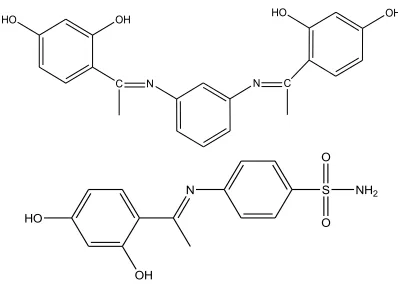
The ONNO donor Schiff bases of 4-acetyl resorcinol with orthophenylene diamine and sulphanilamide have been reported by Venkatesh P. This study shows better activity of the Cu2+ and Zn2+ metal complexes of sulphanilamide Schiff base which might be due to its pharmacophore sulphanilamide and its potency is further enhanced by the metal coordination Venkatesh, 2011).
N N C
OH HO
C
HO OH
S
O O
NH2 N
HO
OH
Fig. 3: Schiff bases derived from 4-acetyl resorcinol with orthophenylene diamine and
sulphanilamide
International Journal of Research (IJR)
e-ISSN: 2348-6848, p- ISSN: 2348-795X Volume 2, Issue 05, May 2015 Available at http://internationaljournalofresearch.org
Since coumarin moiety, ON donating ligands as well as 4-acetyl resorcinol and their metal ions influence and enhance biological activity, (Sohrab, 2009), the present investigation attempts at synthesizing and characterizing metal complexes with Schiff base derived
from 3-aminocoumarin and 4-acetyl
resorcinol) with the aim to obtain more potent biologically active compounds and their metal complexes.
2.
EXPERIMENTAL
Materials and methods
All the chemicals, reagents and solvents were A.R. grade purchased from Sigma-Aldrich Fluka, BDH, Merck, Riedel-de Haën, Scharlau and ACS, ISO. Solvents such as ethanol and methanol were distilled for further purification.
IR spectra were recorded using Perkin-Elmer FT-IR spectrophotometer in the range of 4000-450cm-1. 1H and 13C NMR were recorded in CDCl3 by using Bruker 400 ultra
shielded NMR. The magnetic susceptibility of the complexes was measured using
MSB-AUTO, Sherwood magnetic balance.
Elemental analysis of CHN was done by using Exter Analytical CE 440 elemental analyzer. Molar conductivities of the complexes were recorded at room temperature using HANNA Instrument EC 214 conductivity meter. The metal estimation was done using BUCKER Scientific 210 VGB atomic absorption spectrophotometer. The electronic spectrum of Zn complex was recorded in the UV and visible region (200-2500 nm) by Cary 5E UV-VIS NIR spectrophotometer and for other complexes it was carried out in the range of 200-900 nm by SPECTRONIC GENESYTM 2PC UV-Visible spectrophotometer. Melting or decomposition point was determined by Stuart SMP3 digital melting point apparatus.
Synthesis
Synthesis of 4-acetyl resorcinol (4-AR) or 2,4-dihydroxy-acetophenone (Baluja, 2006)
Anhydrous zinc chloride (16.5 g) was dissolved in 15.8 mL glacial acetic acid. Resorcinol (11.0 g) was added and the mixture was heated at 110°C for 3 h. The resulting solution was cooled to room temperature and then poured over crushed ice. The product was filtered and washed with 30% HCl to remove excess zinc chloride. The product was recrystallized from methanol, dried and weighed. Yield: 8.8 g (80%), m.p: 1440C.
HO OH
+
glacial acetic acid ZnCl2
1100C
3hrs
HO OH
O
4-acetyl resorcinol resorcinol
O
OH
Scheme 1: Synthesis of 4-acetylresorcinol
Synthesis of 3-aminocoumarin
(3-AC)(Maddi, 2007)
3-aminocoumarin can be prepared in three steps. These are: i) acylation of glycine to form acetylglycine, ii) synthesis of
3-acetylaminocoumarin by reacting
acetylglycine, salicylaldehyde & piperidine in acetic anhydride, iii) hydrolysis of acetylaminocoumarin to form 3-aminocoumarin.
a. Preparation of acetylglycine
Acetylglycine was synthesized by adding acetic anhydride (14.5 g, 0.14 mol) to a solution of glycine (5.0 g, 0.06 mol) in water (75 mL). The reaction mixture was stirred for 20 min. at room temperature, and cooled in a refrigerator overnight. Acetylglycine which separated as white crystals was filtered, washed with cold water and dried at 1000C. Yield: 4.2 g (84%), m.p: 206-2080C.
International Journal of Research (IJR)
e-ISSN: 2348-6848, p- ISSN: 2348-795X Volume 2, Issue 05, May 2015 Available at http://internationaljournalofresearch.org
b. Synthesis of 3-Acetylaminocoumarin
3-Acetylaminocoumarin was prepared by heating a mixture of acetylglycine (5.0 g, 0.043 mol), salicylaldehyde (12.2 g, 0.1 mol) and a drop of piperidine in acetic anhydride (5 mL, 0.049 mol) at 130-140oC for 6 h. The reaction mixture was cooled, diluted with 10 ml of water, and further refluxed for 30 min. The gummy mass thus obtained after removal of water under reduced pressure was repeatedly washed with ether to remove adhering traces of piperidine and acetylglycine. The crude product when crystallized from ethanol furnished the product as a crystalline solid. Yield: 2 g (40%), m.p: 200-2030C.
c. Hydrolysis of
3-Acetylaminocoumarin
3-Aminocoumarinwas prepared by treating a
solution of 3-acetylaminocoumarin (5 g, 0.024 mol) in hot ethanol (25 mL) with
concentrated hydrochloric acid (5 mL) and the resulting mixture was refluxed for 2 h. The reaction mixture was cooled diluted with water, neutralized with aqueous saturated sodium bicarbonate and kept overnight. The solid thus separated was filtered. Further purification by crystallization from ethanol gave the product, a creamish crystalline solid, Yield: 3.5 g (70%), m.p: 1270C. It was characterized by 1H NMR.
1H NMR: 4.3ppm (s, NH
2), 6.76ppm (s, CH),
7.20-7.40ppm (m, CH). These results are concurrent with the reported data.
H2N
O
OH
glycine
AC2O, H2O cool
N H
O OH O
acetylglycine
piperidine in AC2O
130-1400C 6hrs
O O
N H O
3-acetylaminocoumarin OH
O
, ,
Conc.HCl 2hrs
O O
NH2 3-aminocoumarin
Scheme 2: Synthesis of 3-aminocoumarin
Synthesis of Schiff base ligand
The preparation of the ligand was attempted
by the following method. The
3-aminocoumarin (0.50 g, 0.0031 mol) was dissolved in methanol (20 mL) and heated for few minute. Then, resoacetophenone (0.47 g, 0.0031 mol) was added to the hot alcoholic solution of 3-aminocoumarin. The mixture was refluxed over water bath for more than 8 h. The solution was cooled overnight and needle like crystals were obtained. TLC, melting point and NMR spectroscopy data of the product revealed that it was 3-aminocoumarin, and the Schiff base condensation did not take place. So, an alternate template method synthesis was carried out.
Synthesis of metal complexes
International Journal of Research (IJR)
e-ISSN: 2348-6848, p- ISSN: 2348-795X Volume 2, Issue 05, May 2015 Available at http://internationaljournalofresearch.org
to 7 with alcoholic ammonia solution (1:1) and refluxed further for about 8-18 h over water bath. The solid obtained was filtered, washed with methanol, and air dried. Yield: 2.64 g (42%) and 2.3 g (46.2%) for Cu(II) and Zn(II) respectively.
3.
RESULT AND DISCUSSION
In the course of synthesis, it was found that 3-aminocoumarin and 4-acetyl resorcinol condensed to give Schiff base of mixed ligands by template method only in the zinc and copper complexes. Cr(III), Fe(III) and Ni(II) ions did not form any complexes with the Schiff base of mixed ligands. Both metal complexes obtained were colored and stable to air and moisture at room temprature. Cu(II)
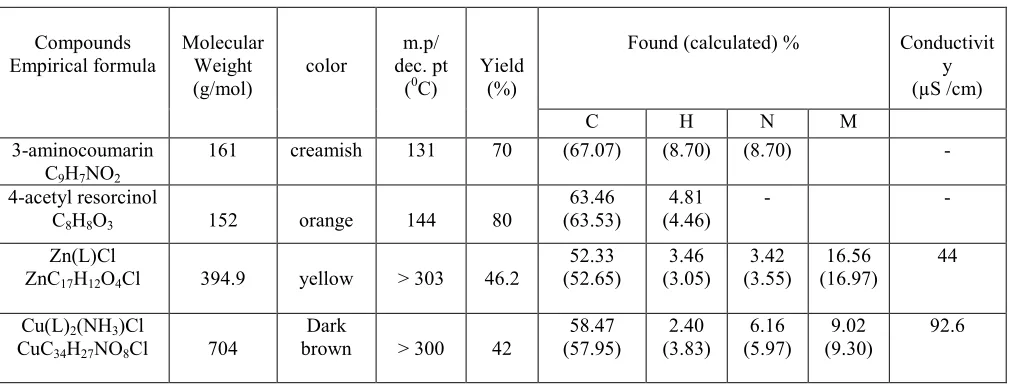
complex is soluble in common organic solvents such as DMF, DMSO, and acetonitrile and sparingly soluble in acetone, chloroform, methanol, dioxane and water. But the zinc complex is soluble only in DMF and acetonitrile and sparingly soluble in other solvents. the observed molar conductance value of zinc complex (44 µS/cm in table 1) in 10-3 M DMF solution suggests the non-electrolytic nature of this complex. The complexes do not show sharp melting points. They decompose at temperatures above 3000C (Table 1). The analytical data reveals M:L ratio of 1:1 and 1:2 for Zn(II) and Cu(II) mixed ligand complexes respectively (Table 1). The data has good agreement with the suggested structure of the complexes.
Table 1: Elemental analysis and some physical characteristics of ligands and complexes
Compounds
Empirical formula Molecular Weight
(g/mol) color
m.p/ dec. pt
(0C) Yield (%)
Found (calculated) % Conductivit y (µS /cm)
C H N M
3-aminocoumarin C9H7NO2
161 creamish 131 70 (67.07) (8.70) (8.70) - 4-acetyl resorcinol
C8H8O3 152 orange 144 80
63.46
(63.53) (4.46) 4.81 - - Zn(L)Cl
ZnC17H12O4Cl 394.9 yellow > 303 46.2
52.33
(52.65) (3.05) 3.46 (3.55) 3.42 (16.97) 16.56 44 Cu(L)2(NH3)Cl
CuC34H27NO8Cl 704
Dark
brown > 300 42 (57.95) 58.47 (3.83) 2.40 (5.97) 6.16 (9.30) 9.02 92.6
Infrared spectra
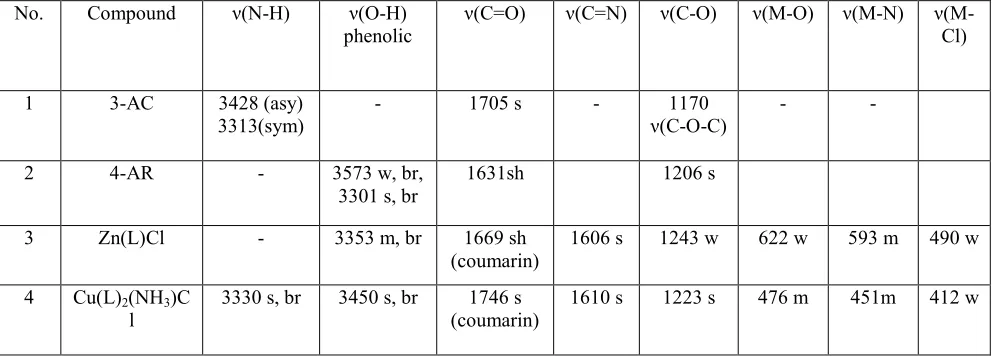
The characteristic infrared frequencies of ligand and metal complexes are listed in Table 2 and 3. The IR spectrum of 3-aminocoumarin shows a doublet at 3428 cm
-1 and 3313 cm-1 assignable to asymmetric and
symmetric
ν
NH2 respectively. The strong bandlocated at 1706 cm-1 was assigned to
ν
C=O ofcoumarin moiety
.
Lowering of this peak from the expected value of 1729 cm-1 for unsubstituted coumarin may be due to conjugation between C=O and the NH2 groupat C312. Slight broadening of the
ν
N-H canInternational Journal of Research (IJR)
e-ISSN: 2348-6848, p- ISSN: 2348-795X Volume 2, Issue 05, May 2015 Available at http://internationaljournalofresearch.org
1407 cm-1 is assigned to
ν
C-N.
Infraredspectrum of the 4-acetyl resorcinol shows two broad bands at 3573 cm-1 and at 3301cm
-1 that may be attributed to H-bonded two
phenolic OH stretching frequencies (
ν
O-H)(Silverstein, 1981). In addition there are three strong bands at 1631 cm-1, 1607 cm-1 and 1206 cm-1 which are assigned to the
ν
C=O,ν
C=Candν
C-Orespectively.In Cu(II) complex, a medium broad band centered at 3450 cm-1 can be assignedto
ν
O-H of phenol. Theν
N-H for coordinatedammonia molecule is observed near the same region as a broad band centered at 3330 cm-1. Zn(II) complex shows a medium broad band in the region 3500-3300 cm-1 which is assigned to
ν
O-H stretching frequency. Thebroad nature of the band suggests presence of intra or/and intermolecular H-bonding. The band at 3301cm-1 observed due to
ν
O-Hin4-AR disappeared in both copper and zinc complexes indicating deprotonation of OH and coordination between metal ion and oxygen of phenol. The Zn(II) and Cu(II) complexes exhibit bands at 1669 cm-1 and 1746 cm-1 respectively which are assigned to
ν
C=0moiety of the coumarin (William, 1982).This carbonyl stretching is located at higher frequency in Cu(II) complex indicating its non participation in coordination to the metal ion (Abou-Melha & Faruk, 2008). It also accounts for the disappearance of H-bonding between C=O and NH2 that shifts
ν
N-H of3-AC to lower frequency in comparison to unsubstituted coumarin. The band located at
1631cm-1 which was assigned to acetyl carbonyl group of 4-acetyl resorcinol also disappeared in both the mixed ligand complexes. This confirms that the condensation reaction has taken place and Schiff base has formed. The band observed as a shoulder at 1630 cm-1 in Cu(II) complex can be assigned to the bending mode of NH3
of ammonia (Hossein and Maryam, 2008). New bands at 1606 cm-1 in Zn(II) complex and at 1610 cm-1 in Cu(II) complex are assigned to
ν
C=N stretch. The azomethinestretching frequency in free Schiff bases are normally observed around 1630-1620 cm-1 (Nakamoto, 1987). This band is seen shifted to lower frequency indicating the involvement of azomethine nitrogen in coordination to metal28. It is also deducible that mixed ligand Schiff base complex has formed. The phenolic
ν
C-O stretching is seento have shifted to higher frequency by 17-27 cm-1 in both the complexes showing coordination of the metal to the ligand through oxygen of phenol.
A medium band around 1031 cm-1 in Zn(II) complex and 1050 cm-1 in Cu(II) complex is characteristic of
ν
O-C-O corresponding tocyclic grouping of 3-aminocoumarin. Some new bands identified in the complexes at 458 and 412 cm-1 have been assigned to stretching frequency of metal chlorine bonds (
ν
M-Cl). New bands at 593 and 622 cm-1 inZn(II) complex and at 451 and 476 cm-1 in Cu(II) complex are assigned to
ν
M-N andν
M-Orespectively (Nakamoto, 1987).
International Journal of Research (IJR)
e-ISSN: 2348-6848, p- ISSN: 2348-795X Volume 2, Issue 05, May 2015 Available at http://internationaljournalofresearch.org
Table 2: Important IR absorption frequencies (in cm-1) of 3-AC, 4-AR and mixed ligand Schiff base complexes
No. Compound ν(N-H) ν(O-H)
phenolic ν(C=O) ν(C=N) ν(C-O) ν(M-O) ν(M-N) ν(M-Cl)
1 3-AC 3428 (asy)
3313(sym) - 1705 s - ν(C-O-C) 1170 - -
2 4-AR - 3573 w, br,
3301 s, br 1631sh 1206 s 3 Zn(L)Cl - 3353 m, br 1669 sh
(coumarin) 1606 s 1243 w 622 w 593 m 490 w 4 Cu(L)2(NH3)C
l
3330 s, br 3450 s, br 1746 s (coumarin)
1610 s 1223 s 476 m 451m 412 w
s= strong, br = broad, m = medium, w = weak, sh = shoulder, asy= asymmetric, sym= symmetric
Electronic spectra and Magnetic moments
In both 3-aminocoumarin and 4-acetylresorcinol, absorption bands observed at 323 nm and 318 nm respectively are assigned to n→π* transition of carbonyl group. Similarly, the π→π* transition band of benzene ring was observed at 242 nm for 3-aminocoumarin and at 230 nm and 270 nm for 4-acetylresorcinol.
Copper(II) complex of mixed ligand Schiff base shows a broad absorption band at 460 nm (21739 cm-1) which can be assigned to d-d transition corresponding to 2T2g← 2Eg. An intense
band was observed around 390 nm which is characteristic of charge transfer transition.
As expected for a d10 electronic configuration, the electronic spectrum of zinc(II) mixed ligand complex does not show any d-d transition. The observed bands are due to the ligand and charge transfer transitions. The bands at 325 nm (30769 cm-1) and 286 nm (34965 cm-1) are assigned to n→π* transition of azomethine (Bagihallia, 2009) and to π→π* transition of benzene ring respectively. The other band located at 473 nm (21,142 cm-1), is assigned to charge transfer transition. The yellow color of the complex may be conjured as having arisen from this absorption in the visible region(Ronald C. Denney and Roy, 1987)
International Journal of Research (IJR)
e-ISSN: 2348-6848, p- ISSN: 2348-795X Volume 2, Issue 05, May 2015 Available at http://internationaljournalofresearch.org
Table 3: Electronic spectra and magnetic moment data
Compounds
Transitions (nm)
µeff (BM)
d-d / CT π→π* / benzene n→π* / carb. /azom.
3-AC 242 270 (carb.) -
4-AR 318 230 323 (carb.) -
Zn(L)Cl 473 (CT) - 325 (azom.) DM
Cu(L)2(NH3)Cl 460, 390 2.05
carb. = carbonyl, azom. = azomethine, DM = diamagnetic
4.
CONCLUSION
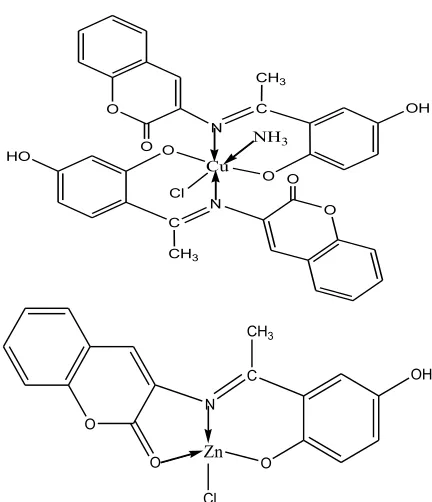
From the results obtained for copper(II) and zinc(II) mixed ligand complexes, it is clear that Schiff base of mixed ligands has formed through the template method of synthesis. The ligand acts as bidentate ON donor in Cu(II) complex, coordinating to the metal through oxygen of phenol and azomethine nitrogen of Schiff base of the mixed ligand. It acts as a tridentate ONO donor in Zn(II) complex, coordinating to the metal through oxygen of phenol, azomethine nitrogen and carbonyl oxygen of coumarin. Based on elemental and metal ion analyses, IR, and electronic spectral data, magnetic susceptibility and conductance data, an octahedral geometry for the Cu(II) complex and a tetrahedral geometry for Zn(II) complex was suggested. The proposed structures are given in Figure 4.
Extension of this work can be carried out to synthesize a single crystal and thereby crystal structures can be determined. Also biological activity of these complexes can be evaluated as the complexes contain the biologically active coumarin moiety. Additional data as thermal analysis, x-ray crystallography and
ESR spectral study (for Cu2+ complex) may also be conducted.
C N
CH3
O
O
OH
Cu
O C
N
CH3
O
HO O
O Cl
NH3
C
N CH3
O
O Zn O
OH
Cl
Fig. 4: Suggested structure of Cu2+ and Zn2+ mixed ligand Schiff base complexes
International Journal of Research (IJR)
e-ISSN: 2348-6848, p- ISSN: 2348-795X Volume 2, Issue 05, May 2015 Available at http://internationaljournalofresearch.org
The authors are grateful to the Addis Ababa University and all members of the Chemistry department. We are also thankful to Dr. Ignacio V. Garcia for his constant support and help in running samples for elemental analysis, magnetic moment and UV-Vis spectroscopy. Our gratitude is also due to SAIF, IIT Madras, India for their contribution in analyzing samples for IR, and UV-Vis spectroscopy for some samples and to Dr. Marraiyya, UK, for elemental analyses.
5.
REFERENCES
[1.] Abou-Melha & Faruk, (2008). Bimetallic complexes of Schiff base
bis-[4-hydroxycuomarin-3-yl] 1N,
5N-thiocarbohydrazone as a potentially dibasic pentadentate ligand, synthesis, spectral, and antimicrobial properties, J. Iran. Chem. Soc., 5: (1), 122-134.
[2.] Arulmurugan, S. (2010). Biological activities of Schiff base and its complexes: a review. Rasayan J. Chem., 3: (3), 385-410.
[3.] Aslam, K.; Khosa, M.K.; Jahan N. and Nosheen, S. (2010). Synthesis and applications of coumarin. Pak. J. Pharm. Sci., 23: (4), 449-454.
[4.] Bagihallia, G.B.; Patila S.A. and
Badami P.S. (2009). Synthesis,
physicochemical investigation and biological studies of Zinc(II) complexes with 1,2,4-triazole Schiff bases. J. Iran. Chem. Soc., 6: (2), 259-270.
[5.] Baluja, S.; Solanki A. and Kachhadia, N. (2006). Evaluation of Biological activities
of some schiff bases and metal complexes, J. Iran. Chem. Soc., 3(4), 312-317
[6.] Bistra, S.; Voislava J.; Boris Shi.; Rosica P. N.; Goran S.;Bozhna M.and Emil P. (2010). Experimental and theoretical investigation of the structure and nucleophilic properties of 4-aminocoumarin. ARKIVOC, 10: 62-76.
[7.] C. Housecroft and A.G. Sharpe. (2007). Coordination complexes: magnetic properties. In: Inorganic Chemistry, Prentice Hall, England, 3rd ed., 555-588.
[8.] Dighe, N.S.; Pattan, S.R.; Dengale, S.S. and Musmade, D.S. (2010). Synthetic and pharmacological profiles of coumarins: A review. Arch. Appl. Sci. Res., 2: (2), 65-71.
[9.] Hossein N. and Maryam N. B. (2008). Efficient, convenient and mild three-component template preparation and characterization of some new Schiff base complexes. J. Chin. Chem. Soc., 55: ( 4), 858-862
[10.] i. Shyamala, B. S.; Lakshmi P. V. A. and Raju, V. J. (2010). Synthesis, characterization, antifeeding and insect growth-regulating activities of Cr(III), Mn(II), Fe(III), Co(II), Ni(II) and Cu(II)
complexes with
N-acetylacetonyl-3-aminocoumarin. J. Sci. Res., 2 :(3), 525-537.
[11.] ii. Shyamala, B. S.; Lakshmi P. V. A. and Raju,V. J. (2010). Synthesis, antifeedant and insect growth regulating activity of
International Journal of Research (IJR)
e-ISSN: 2348-6848, p- ISSN: 2348-795X Volume 2, Issue 05, May 2015 Available at http://internationaljournalofresearch.org
complexes and their physicochemical characterization. Int. J Pharm. Sci., 2: (4), 150-152.
[12.] Kasabe, A.; Mohite, V.; Ghodake J. and Vidhate, J. (2010). Synthesis, characterization and primary antimicrobial, antifungal activity evaluation of Schiff bases of 4-chloro-(3-substituted-phenylimino)-methyl-[2H]-chromene-2-one. E. J. Chem., 7: (2), 377-382.
[13.] Kingston (2011). Magnetic Moments URL:
wwwchem.uwimona.edu.jm/spectra/MagMo m.html.
[14.] Maddi, V.; Mamledesai, S.N; Satyanarayana D. and Swamy, S. (2007). Synthesis and anti inflammatory activity of substituted (2-oxochromen-3-yl) benzamides, Indian. J. Pharm. Sci., 69: (6), 847-849.
[15.] Mayekar, S.A.; Chaskar, A.C. and Mulwad, V.V. (2010). Facile synthesis of coumarinyl isothiocyanate from amino coumarin. Synthetic Communications, 40: 46–51.
[16.] Miesler, Gary L. and Donald A. Tarr. (1990). Coordination chemistry II: electronic spectra. In: Inorganic chemistry, prentice hall, Eglewood Cliffs, New Jersey, 313-336.
[17.] Nakamoto, K. (1997). Application in coordination chemistry. In: Infrared and
Raman Spectra of Inorganic and
Coordination Compounds, Part B, John Wiley & Sons, New York. 5th ed., 1-99.
[18.] Pulimamidi S. R.; Ananthalakshmi P.V. and Raju V. J. Synthesis and structural studies of first row transition metal complexes with tetradentate ONNO donor Schiff base derived from
5-acetyl-2,4-dihydroxyacetophenone and
ethylenediamine. E-Journal of Chemistry,
2011, 8 (1), 415-420.
[19.] Ronald C. Denney and Roy S. (1987). Visible and Ultraviolet Spectroscopy, John Wiley and sons, New York, 2-54.
[20.] Rosette M. Roat-Malone. (2002).
Bioinorganic chemistry, John Wiley & Sons, New Jersey.
[21.] Seyed M. R. (2011). Plant coumarins as allelopathic agents. Int. J. Biol. Chem., 51: 86-90.
[22.] Shalin K.; Durga, N. Dh. and Saxena P. N. (2009). Application of metal complexes of Schiff bases. J. Sci. and Ind. Res., 68: 181-187.
[23.] Silverstein, R.M.; Bassler, G.C. and Morrill, T.C. (1981) Spectrometric Identification of Organic Compounds. 4th ed. John Wiley and Sons, New York.
[24.] Singh, I.; Kaur, H.; Sunil, K.; Arun, K.; Lata S. and Kumar, A. (2010). Synthesis of new coumarin derivatives as antibacterial agents. Int. J. ChemTechRes, 2: (3), 1745-1752.
International Journal of Research (IJR)
e-ISSN: 2348-6848, p- ISSN: 2348-795X Volume 2, Issue 05, May 2015 Available at http://internationaljournalofresearch.org
behavior of N2SO Schiff-base Co(II)
complexes in non-aqueous media at the surface of solid electrodes. Int. J. Electrochem. Sci., 4: 846- 854.
[26.] Srivastava, K. P.; Vidyarthi, S. N. and Rakesh S. (2011). Environmentally benign studies of bivalent transition metal complexes of tridentate (NNO donor) Schiff base ligands. Der Chemica Sinica, 2: (2), 66-76.
[27.] Venkatesh, P. (2011) Synthesis, characterization and microbial activity of various Schiff base complexes of Zn(II), and Cu(II) ions. Asian J. pharm. Heal. Sci., 1 :(1), 8-11.
[28.] Wagner, B.D. (2009) The use of coumarins as environmentally-sensitive fluorescent Probes of Heterogeneous Inclusion Systems. Molecules, 14: 210-237.
[29.] William R. Porter and William F. Trager. (1982). 4-Hydroxycoumarin/2-hydroxychromone tautomerism: Infrared
spectra of
3-substituted-2-13c-4-hydroxycoumarins. J. Heterocycl Chem. 19: (3), 475–480.
[30.] Yadav, G.D. and Joshi, A.V. (2002).
A green route for the acylation of resorcinol with acetic acid. Clean Techn Environ