International Journal of Research (IJR)
e-ISSN: 2348-6848, p- ISSN: 2348-795X Volume 2, Issue 12, December 2015Available at http://internationaljournalofresearch.org
Analysis of 4 Leg Active Power filter Performance under
Conventional and Fuzzy Integrated Predictive Control
Techniques for Power Quality Improvement
T. Susheela
M-tech Student,Department of Electrical & Electronics Engineering,Sarada Institute of Science Technology
& Management, Srikakulam (Dt); Andhra Pradesh, India.
T. Bhavani
Assistant Professor, HOD Department of Electrical & Electronics Engineering, Sarada Institute of Science
Technology & Management, Srikakulam (Dt); Andhra Pradesh, India.
Abstract-
Active power filters are used for reducing harmonics in the power system. This paper deals with different control techniques of active power filter discussed along with their performance. The control techniques implemented in this paper are PI predictive control technique and fuzzy based predictive control technique. Both the techniques are implemented for reference current to be maintained in the system at the un-balanced loading conditions. The PI based predictive technique generates the duty ratio by reducing the error. But the fuzzy based predictive control technique generates the reference current from the rotator frame with 16 problem possibility conditions which suppress the harmonic by optimizing the 49 rules based fuzzy. This technique reduces the cost and size of active power filter considerably; at the same time the problems associated with PI based predictive control are also eliminated. With this study a comparison of different control techniques of active power filter is presented on different indices such as THD, complexity and cost and topology-II has been proven to be superior. The effectiveness of this topology is tested, studied and shown by using Matlab/Simulink software.
Index terms- Active power filter; PI based predictive control technique; fuzzy based predictive control technique
I. INTRODUCTION
The general use of power electronic devices in our daily applications, disturbances occur on the electrical supply network. These disturbances are due to the use of non-linear devices. These will introduce harmonics in the
power system thereby causing equipment overheating, damage devices, EMI related problems etc. Active Power Filters (APF) is extensively used to compensate the current harmonics and load unbalance. Power quality is one of the most important topics that electrical engineers have been noticed in recent years. Current harmonics is one of the problems related to power quality. This phenomenon happens continuously in distribution systems. The presence of harmonics does not mean that the factory or office cannot run properly. Like other power quality phenomena, it depends on the “stiffness” of the power distribution system and the susceptibility of the equipment. As shown below, there are a number of different types of equipment that can have disoperation or failures due to high harmonic voltage and/or current levels. In addition, one factory may be the source of high harmonics but able to run properly. This harmonic pollution is often carried back onto the electric utility distribution system, and may affect facilities on the same system which are more susceptible. Some typical types of equipment susceptible to harmonic pollution include: - Excessive neutral current, resulting in overheated neutrals.
Generally, current controlled voltage source inverters are used in distributed system. Recently, a few
control strategies for grid connected inverters
International Journal of Research (IJR)
e-ISSN: 2348-6848, p- ISSN: 2348-795X Volume 2, Issue 12, December 2015Available at http://internationaljournalofresearch.org
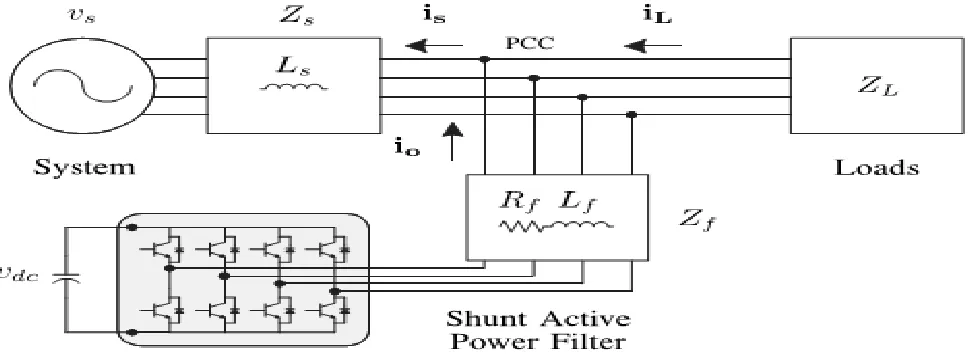
to damp out the harmonics in distribution network is proposed in [4]. In [5], a control strategy for renewable interfacing inverter based on – theory is proposed. In this strategy both load and inverter current sensing is required to compensate the load current harmonics. Here, the main idea is to control the inverter at extreme loading conditions. It is shown in this paper that the grid-interfacing inverter can effectively controlled by: 1) PI based predictive control technique; 2) fuzzy based predictive control technique; for the proposed 8 pulse APF shown in fig.1 By using the effective control technique of these 2 topologies the PQ constraints at the
PCC can therefore be strictly maintained within the utility standards without additional hardware cost.
Among these events, harmonics are the most dominant one. The effects of harmonics on PQ are specially described in [4]. According to the IEEE standard, harmonics in the power system should be limited by two different methods; one is the limit of harmonic current that a user can inject into the utility system at the point of common coupling(PCC) and the other is the limit of harmonic voltage that the can supply to any customer at the PCC.
Fig.1. Components configuration of Fuzzy based predictive controlled APF.
II. Fuzzy Based Predictive Current Control
The block diagram of the proposed digital predictive current control scheme is shown in Fig. 3. Consequently, the analysis has to be developed using discrete mathematics in order to consider additional restrictions such as time delays and approximations. The main characteristic of predictive control is the use of the system model to predict the future behavior of the variables to be controlled. The controller uses this information to select the optimum switching state that will be applied to the power converter, according to predefined optimization criteria. The predictive control algorithm is easy to implement and to understand, and it can be implemented with three main blocks, as shown in Fig.2.
Fig. 2. Proposed predictive Fuzzy Based Predictive Current Control.
International Journal of Research (IJR)
e-ISSN: 2348-6848, p- ISSN: 2348-795X Volume 2, Issue 12, December 2015Available at http://internationaljournalofresearch.org
this case, the system voltages, the load currents, and the dc-voltage converter are measured, while the neutral output current and neutral load current are generated directly from these signals (IV).
2) Prediction Model: The converter model is used to predict the output converter current. Since the controller operates in discrete time, both the controller and the system model must be represented in a discrete time domain [12]. The discrete time model consists of a recursive matrix equation that represents this prediction system. This means that for a given sampling time Ts , knowing the converter switching states and control variables at instant kTs , it is possible to predict the next states at any instant [k + 1]Ts .
Current Reference Generation:
A dq-based current reference generator scheme is used to obtain the active power filter current reference signals. This scheme presents a fast and accurate signal tracking capability. This characteristic avoids voltage fluctuations that deteriorate the current reference signal affecting compensation performance. The current reference signals are obtained from the corresponding load currents as shown in Fig. 3. This module calculates the reference signal currents required by the converter to compensate reactive power, current harmonic and current imbalance.
Fig. 3. dq-based current reference generator block diagram.
FLC Controller:
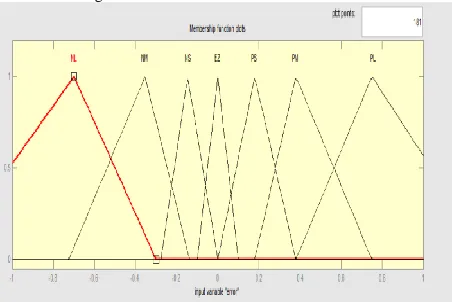
Fuzzy logic is widely used in control technique. The term "fuzzy" refers to the fact that the logic involved can deal with concepts that cannot be expressed as "true" or "false" but rather as "partially true". Although alternative approaches such as genetic algorithms and neural networks can perform just as well as fuzzy logic in many cases, fuzzy logic has the advantage that the solution to the problem can be cast in terms that human operators can understand, so that their experience can be used in the design of the controller of predictive current control. The linguistic variables are defined as (NB, NS, Z, PS, PB) which mean big, negative small, zero, positive small and positive big respectively. The membership functions are shown in Fig.4.
International Journal of Research (IJR)
e-ISSN: 2348-6848, p- ISSN: 2348-795X Volume 2, Issue 12, December 2015Available at http://internationaljournalofresearch.org
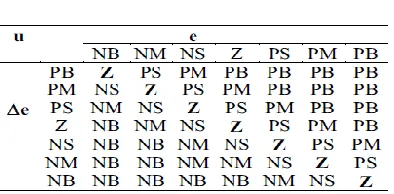
Table I. The decision table of FLC
As seen from table I, each interval of each variable is divided into seven membership functions:
Negative Big (NB), Negative Medium (NM), Negative Small (NS), Zero (Z), Positive Small (PS), Positive Medium (PM) and Positive Big (PB).
Switching Control of lGBTs:
Switching pulses are generated using hysteresis current controller. There are various current control methods for active power filter configurations but hysteresis method is preferred among other current control methods because of quick current controllability, easy implementation and unconditioned stability. Thus the actual currents track the reference currents generated by current control loop. The switching pattern of each IGBT is formulated as,
If (la* - Ia ) = +hb then the upper switch S I will be ON in the phase a leg of inverter.
If (la* - Ia ) = -hb then the lower switch S4 will be ON in the phase a leg of inverter.
Where, hb width of hysteresis band. Similarly switching pulses are derived for other three legs.
III. Matalb/Simulink model of 8 pulses Active Power Filter with PI and Fuzzy based Predictive Control techniques.
Fig .5. Simulink model of Predictive Current control technique without Fuzzy for proposed 8 pulse APF.
Fig .6. Simulated output wave forms of the Predictive Current controlled APF without Fuzzy (a) Source voltage. (b) Load Current. (c) Neutral Current. (d) Source Current. (e) Compensating Current. (f) Dc Voltage.
Fig .7. Total Harmonic Distortion of Source Current showing 2.33% with Predictive Current controlled without Fuzzy controlled 8 pulse Active Power Filter connected to Un-balanced loads.
International Journal of Research (IJR)
e-ISSN: 2348-6848, p- ISSN: 2348-795X Volume 2, Issue 12, December 2015Available at http://internationaljournalofresearch.org
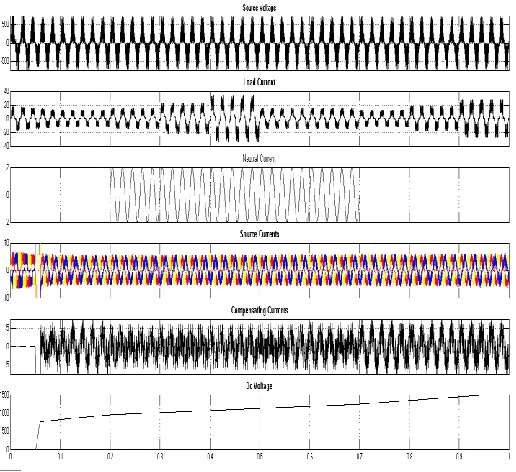
Fig .9. Simulated output wave forms of the Fuzzy based Predictive Current controlled APF (a) Source voltage. (b) Load Current. (c) Neutral Current. (d) Source Current. (e) Compensating Current. (f) Dc Voltage.
Fig .10. Total Harmonic Distortion of Source Current showing 0.17% with Fuzzy based Predictive Current controlled 8 pulse Active Power Filter connected to Un-balanced loads.
IV. CONCLUSION
The power quality of the power system network has been increased with the 8 pulse Active Power Filter and its performance has studied while controlling with PI based predictive control technique and Fuzzy based predictive control technique. Based upon the theoretical analysis it is proven that fuzzy based predictive control technique will effectively controls the 8 pulse Active power filter. Hence this system is tested under simulation for improvement of power quality. These results shown that
the high harmonic currents drawn by the non linear load do not affect the power system network with effective fuzzy based predictive controlling the 8 pulse Active power filter.
TABLE II
Analysis of the source current with pi and fuzzy based predictive current controller
Controller Source Current Harmonics
PI based Predictive
Current Control 2.33%
Fuzzy based Predictive
Current Control 0.17%
REFERENCES
[1] J. Rocabert, A. Luna, F. Blaabjerg, and P. Rodriguez,
“Control of power converters in AC microgrids,” IEEE
Trans. Power Electron., vol. 27, no. 11, pp. 4734–4749, Nov. 2012.
[2] M. Aredes, J. Hafner, and K. Heumann, “Three-phase
four-wire shunt active filter control strategies,” IEEE
Trans. Power Electron., vol. 12, no. 2, pp. 311–318, Mar. 1997.
[3] S. Naidu and D. Fernandes, “Dynamic voltage restorer based on a fourleg voltage source converter,” Gener. Transm. Distrib., IET, vol. 3, no. 5, pp. 437–447, May 2009.
[4] N. Prabhakar and M. Mishra, “Dynamic hysteresis current control to minimize switching for three-phase four-leg VSI topology to compensate nonlinear load,” IEEE Trans. Power Electron., vol. 25, no. 8, pp. 1935– 1942, Aug. 2010.
International Journal of Research (IJR)
e-ISSN: 2348-6848, p- ISSN: 2348-795X Volume 2, Issue 12, December 2015Available at http://internationaljournalofresearch.org
based three-phase four-wire shunt active filters,” Power
Electron., IET, vol. 4, no. 4, pp. 463–470, Apr. 2011.
[6] F. Wang, J. Duarte, and M. Hendrix, “Grid-interfacing converter systems with enhanced voltage
quality for microgrid application;concept and
implementation,” IEEE Trans. Power Electron., vol. 26,
no. 12, pp. 3501– 3513, Dec. 2011.
[7] X.Wei, “Study on digital pi control of current loop in active power filter,” in Proc. 2010 Int. Conf. Electr. Control Eng., Jun. 2010, pp. 4287–4290.
[8] R. de Araujo Ribeiro, C. de Azevedo, and R. de Sousa, “A robust adaptive control strategy of active power filters for power-factor correction,
harmonic compensation, and balancing of nonlinear loads,” IEEE Trans.Power Electron., vol. 27, no. 2, pp. 718–730, Feb. 2012.
[9] J. Rodriguez, J. Pontt, C. Silva, P. Correa, P. Lezana, P. Cortes, and U. Ammann, “Predictive current control of
a voltage source inverter,” IEEE Trans. Ind. Electron.,
vol. 54, no. 1, pp. 495–503, Feb. 2007.
[10] P. Cortes, G. Ortiz, J. Yuz, J. Rodriguez, S. Vazquez, and L. Franquelo, “Model predictive control of an inverter with output LC filter for UPS applications,” IEEE Trans. Ind. Electron., vol. 56, no. 6, pp. 1875– 1883, Jun. 2009.
[11] R. Vargas, P. Cortes, U. Ammann, J. Rodriguez, and J. Pontt, “Predictive control of a three-phase neutral-point-clamped inverter,” IEEE Trans. Ind. Electron., vol. 54, no. 5, pp. 2697–2705, Oct. 2007.
[12] P. Cortes, A. Wilson, S. Kouro, J. Rodriguez, and H.
Abu-Rub, “Model predictive control ofmultilevel
cascaded H-bridge inverters,” IEEE Trans. Ind. Electron., vol. 57, no. 8, pp. 2691–2699, Aug. 2010.
[13] P. Lezana, R. Aguilera, and D. Quevedo, “Model predictive control of an asymmetric flying capacitor converter,” IEEE Trans. Ind. Electron., vol. 56, no. 6, pp. 1839–1846, Jun. 2009.
[14] P. Correa, J. Rodriguez, I. Lizama, and D. Andler, “A predictive control scheme for current-source rectifiers,” IEEE Trans. Ind. Electron., vol. 56, no. 5, pp. 1813–1815, May 2009.
[15] M. Rivera, J. Rodriguez, B. Wu, J. Espinoza, and C. Rojas, “Current control for an indirect matrix converter
with filter resonance mitigation,” IEEE Trans. Ind.