610 | P a g e
LOW POWER HIGH-PERFORMANCE NON-BINARY
LOW-DENSITY PARITY CHECK CODER (FNB-LDPC)
OVER GF (2
m
) USING CHECK-NODE UNIT,
M.Srinivasan
1,G M. Tamilselvan
21
Department of Electronics and Communication Engineering,
KGiSL Institute of Technology, Coimbatore,(India)
2
Department of Electronics and Communication Engineering,
Bannari Amman Institute of Technology, Sathyamangalam, (India)
ABSTRACT
An error correction codes are one of important part in channel coding to enhance the performance of communication system. Recently, low-density parity check (LDPC) codes used as the same purpose but hardware design require large resources, which limits the performance of coders. This paper presents a low
power, high-performance non-binary LDPC coder (FNB-LDPC) over Galois fields
GF
2
m . The hardware realization of check-node unit (CNU) is a challenging part because it consists of big modules such as FFT/IFFT and multiplier. We overcome these problems by modified CNU structure. The proposed versatile induced flexible LDPC coder supports all field size of suggested Galois fields without the necessity to reconfigure the hardware structure to increase the performance in terms of hardware utilization, power, and delay.Keywords:
FNB-LDPC coder, check node unit, variable node unit, Galois field, real-valued FFT,
versatile bit serial multiplier.
I.INTRODUCTION
LDPC codes are a class of block code that satisfies both long length and randomness. The fully parallel LDPC
code [1] extended from BP decoding algorithm by capitalizing on parallel structure. A 1024 bit LDPC code
achieves a maximum symbol throughput of 1Gbps implemented in ASIC technology. QC-LDPC [2] code
achieves high hardware utility efficiency (HUE) and brings about great memory block reduction without any
performance degradation. First to split the check matrix into several row blocks, then it performs to improved
message passing computations sequentially block by block. A resource efficient LDPC decoder based on a
reduced complexity Min-Sum algorithm reduced the interconnect complexity by restricting the extrinsic
message length to 2 bits and simplified the CNU [3]. The high throughput decoding of high-rate LDPC codes
modified by the sliced message passing (SMP) decoding architecture [4] which overlaps the CNU and VNU and
611 | P a g e
table (LUT) based VNU design have the best solution for high-speed hardware design and it extended for
(2048, 1723) LDPC code of the IEEE 802.3an standard [5].
A parallel NB-LDPC decoder over
GF
256
have implemented in 28-nm CMOS technology [6]. The trellisbased CNU design maximize the storing capacity by reduced the large amount of memory occupying activities.
The sorted log likelihood ratio (LLR) vector of a check-to-variable message has approximated using a piecewise
linear function. The first and second minimums have computed by modified CNU [7] in terms of
accurate and imprecise manner. In this paper, we present a flexible non-binary LDPC coder (FNB-LDPC)
over
GF
2
m .The objective of proposed FNB-LDPC coders increases the hardware utilization efficiency by maximum clock
frequency, and minimizes the power consumption.
II. PROBLEM DEFINITION AND SYSTEM MODEL
Sułek et al. [18] have proposed a NB-LDPC coder using the mixed domain FFT-BP decoding algorithm with the
multiplication units and it also named as semi-parallel decoder. Coder favors mapping a touch of the check to
the multiplier focuses embedded in a FPGA, in like way making use of the wide number of sorts of FPGA
resources. The throughput wrapped up by a single FPGA by the decoder in light of current conditions made. In
LDPC coder, the CNU block enhanced by an approximated evaluation of the nonlinear vectors. The
NB-LDPC coder implemented using an FPGA development board from Xilinx with Virtex4 XC4VSX55 device
with two different GF orders such as
GF
8
andGF
32
. TheGF
8
NB-LDPC decoder consumes thenumber of slices utilized as 14535, the number of multiplier as 128 and maximum clock frequency of 170.8MHz.
The
GF
32
NB-LDPC decoder consumes the number of slices utilized as 22494, the number of multiplier as192 and maximum clock frequency of 130.2MHz. This NB-LDPC coder is not a fully parallel structure and it
consume more hardware utilization than existing LDPC coders discussed in related works. Moreover, the
multiplier is as main part of CNU block in LDPC coder, but author’s use recursive multiplier for this design. For
that reason, we present the flexible non-binary LDPC coder (FNB-LDPC) over
GF
2
m without the necessity of reconfigurable hardware structure. The proposed FNB-LDPC coder implemented over different Galoisfields
GF
2
m without modified structure of hardware design. The performance of proposed coder will compare with existing coders including NB-LDPC coder [18].2.1 System Model of Proposed FNB-LDPC Coder
Check node unit (CNU) module consists of different modules such as permutation, non-linear functions,
real-valued FFT/IFFT, and versatile bit serial multiplier.
2.1.1 Real-valued FFT/IFFT module
The initial process in the proposed technique for noise degradation is the transformation of input signals in time
612 | P a g e
architecture for domain conversion can be replaced with modified low power pipelined architecture so as to
make the complete hardware architecture efficient in terms of area and power consumption.
Fig. 1 Parallel Pipelined Architecture for 16 Point Radix 2 RFFT
At stage 1, the butterfly unit will process the pair of real samples x(ф) and x(ф + M/2). The
butterfly unit consists of 2:1 multiplexer with one selector line S. When the inputs are real, then the selector line
S set to 1 and the butterfly starts to compute the input values. When the inputs are complex S set to 0, then the
multiplexer just passes the input without computation. At stage 2, the architecture consists of shuffling unit,
butterfly unit and twiddle factor block A.
The shuffling unit is used to transform the order of the data that required from the stage 1 to stage 2, which also
contains 2:1 multiplexer and two delay elements. The twiddle factor
W
module is shown in Fig. 2.613 | P a g e
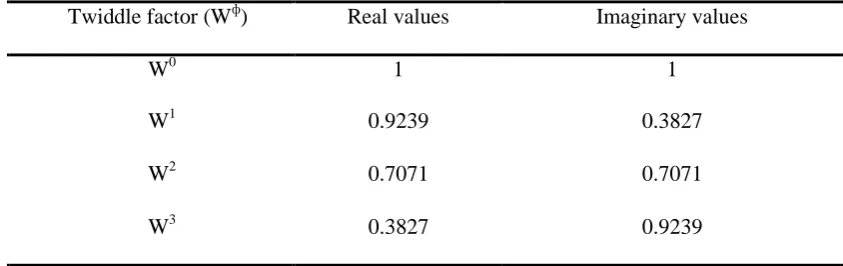
Table 1: Twiddle factor real and imaginary coefficients for M=16
Twiddle factor (W
ф)
Real values
Imaginary values
W
01
1
W
10.9239
0.3827
W
20.7071
0.7071
W
30.3827
0.9239
III. EXPERIMENTAL RESULTS
The performance metrics such as device utilization and maximum frequency of proposed and existing coder is
given in table 2. The proposed coder implemented with flexible bit design in Virtex7 FPGA devices. The Table
2 shows the performance as device utilization, maximum frequency, and power consumption of proposed router
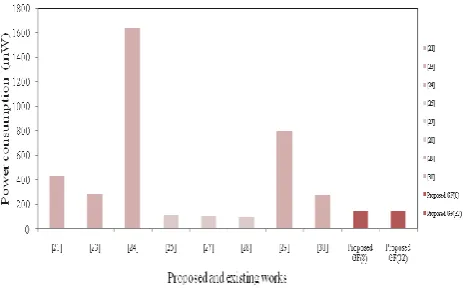
perform very effective than other existing routers. The fully parallel stochastic
LDPC-BC decoder [8] consumes gate count of 760.3K, maximum clock frequency of 768MHz, and power
consumption of 437.2mW. The half-stochastic decoding architecture for LDPC-BC decoder over
GF
16
[9]consumes gate count of 1077K gate counts, and maximum clock frequency of 333MHz. The multi-mode LDPC
decoder architecture [10] consumes gate count of 320K gate counts, the maximum clock frequency of 400MHz,
and power consumption of 284.3mW.
The memory efficient decoder architecture [11] consumes the number of slices is 16803, a number of slice LUT
are 31305, the number of slice registers are 4066, the maximum clock frequency of 400MHz, and power
consumption of 1638mW.
The Quasi-cyclic LDPC coder [12] consumes the gate counts as 416.2K, maximum clock frequency as 474MHz,
and power consumption of 114.3mW. The self-corrected min-sum (SCMS-V1) coder consumes LUT and FF
pair count as 60K, maximum clock frequency as 300MHz, and SCMS-V2 consumes LUT and FF pair count as
51K, maximum clock frequency as 300MHz [13].
LDPC-BC decoder [14] consumes an area of 1.79 mm2, maximum clock frequency of 100MHz, and power
consumption of 104mW. The LDPC decoder [15] consumes an area of 3.11 mm2,
maximum clock frequency of 200MHz, and power consumption of 99.2mW. The LDPC decoder [16] consumes
an area of 15.75 mm2, maximum clock frequency of 100MHz, and power consumption of 800mW.The
NB-LDPC decoder [17] consumes a gate count of 564K, the maximum clock frequency of 277MHz, and power
consumption of 274mW.
The NB-LDPC coder [18] implemented with two different separate GF orders as
GF
8
andGF
32
. The
8
614 | P a g e
and maximum clock frequency of 170.8MHz. The
GF
32
NB-LDPC decoder consumes the number of slicesutilized as 22494, the number of multiplier as 192 and maximum clock frequency of 130.2MHz.
The proposed design consumes maximum clock frequency as 506.303MHz, and power consumption of 143mW.
The FNB-LDPC 32 bit coder consumes slice registers of 2932, slice LUTs of 3523, number of LUT and FF
pairs as 4323 for y=3 VNUs, maximum clock frequency of 334.437MHz, and power consumption of 143mW.
The maximum frequency of proposed coder increase in terms of 196.43% compare to NB-LDPC coder for
8
615 | P a g e
Fig. 3 Maximum Clock Frequency Comparison of Proposed and Existing Work
Fig. 4 Power Consumption Comparison of Proposed and Existing Works
IV.CONCLUSION
The new flexible non-binary LDPC (FNB-LDPC) coder proposed to enhance the performance of design and it is
not required reconfigure hardware structure for any GFs. The proposed coder consists of two units such as check
node unit (CNU) and variable node unit (VNU). The hardware realization of check-node unit (CNU) is a
challenging part because it consists of big modules such as FFT/IFFT and multiplier.
The proposed FNB-LDPC coder have implemented on Virtex7 FPGA expertise in Xilinx tool. From the
experimental results, proposed coder perform very effective than existing coders in terms of hardware utilization,
616 | P a g e
REFERENCES
[1] J. Broulim, P. Broulim, J. Moldaschl, V. Georgiev and R. Salom, "Fully parallel FPGA decoder for irregular
LDPC codes", 2015 23rd Telecommunications Forum Telfor (TELFOR), 2015.
[2] L. ZHAO, R. LIU, Y. HOU and X. ZHANG, "High Hardware Utilization and Low Memory Block
Requirement Decoding of QC-LDPC Codes", Chinese Journal of Aeronautics, vol. 25, no. 5, pp. 747-756, 2012.
[3] V. Chandrasetty and S. Aziz, "An area efficient LDPC decoder using a reduced
complexity min-sum algorithm", Integration, the VLSI Journal, vol. 45, no. 2, pp. 141-148, 2012.
[4] F. Angarita, T. Sansaloni, M. Canet and J. Valls, "Improved Sliced Message Passing Architecture for High
Throughput Decoding of LDPC Codes", Journal of Signal Processing Systems, vol. 66, no. 2, pp. 99-104, 2011.
[5] V. Torres, A. Perez-Pascual, T. Sansaloni and J. Valls, "Fully-parallel LUT based (2048,1723) LDPC code
decoder for FPGA", 2012 19th IEEE International Conference on Electronics, Circuits, and Systems (ICECS
2012), 2012.
[6] J. Lin and Z. Yan, "An Efficient Fully Parallel Decoder Architecture for Nonbinary LDPC Codes", IEEE
Transactions on Very Large Scale Integration (VLSI) Systems, vol. 22, no. 12, pp. 2649-2660, 2014.
[7] O. Boncalo, D. Declercq, A. Amaricai, V. Savin and F. Ghaffari, "Check node unit for LDPC decoders
based on one-hot data representation of messages", Electronics Letters, vol. 51, no. 12, pp. 907-908, 2015.
[8] X. Lee, C. Chen, H. Chang and C. Lee, "A 7.92 Gb/s 437.2 mW Stochastic LDPC Decoder Chip for IEEE
802.15.3c Applications", IEEE Transactions on Circuits and Systems I: Regular Papers, vol. 62, no. 2, pp. 507-516, 2015.
[9] X. Lee, C. Yang, C. Chen, H. Chang and C. Lee, "An Area-Efficient Relaxed Half-Stochastic Decoding
Architecture for Non-binary LDPC Codes", IEEE Transactions on Circuits and Systems II: Express Briefs, vol. 62, no. 3, pp. 301-305, 2015.
[10] S. Ajaz and H. Lee, "Efficient multi-Gb/s multi-mode LDPC decoder architecture for IEEE 802.11ad
applications", Integration, the VLSI Journal, vol. 51, pp. 21-36, 2015.
[11] V. Chandrasetty and S. Aziz, "Resource efficient LDPC decoders for multimedia communication",
Integration, the VLSI Journal, vol. 48, pp. 213-220, 2015.
[12] M. Roberts and R. Jayabalan, "A Power- and Area-Efficient Multirate Quasi-Cyclic LDPC Decoder",
Circuits, Systems, and Signal Processing, vol. 34, no. 6, pp. 2015-2035, 2014.
[13] O. Boncalo, A. Amaricai, P. Mihancea and V. Savin, "Memory trade-offs in layered self-corrected min-sum
LDPC decoders", Analog Integrated Circuits and Signal Processing,, vol. 87, no. 2, pp. 169-180, 2015.
[14] J. Yoon and J. Park, "An Efficient Memory-Address Remapping Technique for High-Throughput
QC-LDPC Decoder", Circuits, Systems, and Signal Processing, vol. 33, no. 11, pp. 3457-3473, 2014.
[15] C. Condo, A. Baghdadi and G. Masera, "Reducing the Dissipated Energy in Multi-standard Turbo and
LDPC Decoders", Circuits, Systems, and Signal Processing, vol. 34, no. 5, pp. 1571-1593, 2014.
[16] K. Lin and M. Lin, "High-Throughput Architectures for Circular Block-Type Low-Density Parity-Check
617 | P a g e
[17] C. Lin, S. Tu, C. Chen, H. Chang and C. Lee, "An Efficient Decoder Architecture for Non-binary LDPC
Codes With Extended Min-Sum Algorithm", IEEE Transactions on Circuits and Systems II: Express Briefs, vol. 63, no. 9, pp. 863-867, 2016.
[18] W. Sułek, "Non-binary LDPC Decoders Design for Maximizing Throughput of an FPGA Implementation",
Circuits, Systems, and Signal Processing, vol. 35, no. 11, pp. 4060-4080, 2016.
[19] M.Srinivasan and G.M.Tamilselvan, "VLSI Implementation of Low Power High Speed ECC Processor