,
349
|
P a g e
Evaluating the Effect of Adding S.F. and P.V.A. on the
Compressive Strength of Local Gypsum Plaster
Asst. Prof. Dr. Ahmed S. D. AL-Ridha
1,
Lec. Ali A. Abbood
1, Asst. Prof. Ali F. Atshan
2,
Lec. Hussein H. Hussein
3, Engineer: Samer Saeed Abdulhussain
1,
Engineer: Isam Dhahir Khudhur
11
Civil Engineering Department / College of Engineering / Mustansiriyah University.
2
Department of Environmental Engineering / College of Engineering / Mustansiriya University.
3
Petroleum Engineering Departments / College of Engineering / Baghdad University.
Abstract
In this research , an attempt has been made to improve the compressive strength of Local Gypsum Plaster by
using two additives , namely : (S.F.) and (P.V.A.) . For this objective four mixes were used , the first mix is the
reference mix (mix of no additives) and the rest three are the mixes of using the two additives ( S.F. and P.V.A.)
individually (each one alone) and altogether (as a combination) .
Because of the importance of “Setting Time” property from practical aspects in gypsum works, it was taken
into consideration together with the “Compressive Strength” property in this study.
In the beginning , when (S.F.) alone with a content of (1.2%) was added , the compressive strength of the mix
was improved by (23.5 %)as compared to that of the reference mix , but the mix setting time is reduced by (68
%) . When the other additive (P.V.A.) with a content of (4%) was added to the (S.F.) mix (altogether) , a more
improvement in the compressive strength has occurred (to reach (27.2 %)) , while the percentage of reduction in
the setting is decreased to (54.6 %) .
Keywords: Compressive Strength, Local Gypsum Plaster, (S.F.), (P.V.A.), Setting Time.
1. Introduction.
In the recent years gypsum products have been exceedingly used as in-door finishing. Houses, especially in
the U.S.A. and Europe, are either built from or lined with gypsum-based products favored by architects because
of their superior properties, such as obtainable availability of in-expensive raw materials, volumetric stability,
acoustic and thermal insulation, fire resistance, quite low toxicity and the comparatively low energy and
temperatures needed in its manufacture [1]. Gypsum is also used in several applications beyond the construction
field : e.g. in making molds for ceramic products [2] , in medical [3] , and dental accessories or implants [4] ,
furthermore, it is the major constituent in Portland cement in order to delay its setting time [5]. The numerous
,
350
|
P a g e
Many researchers have attempted to develop plaster characteristics and extend its range of applicationsthrough the addition of other materials [7] , [8] , [9] . One of these additives is "Silica gel" (a highly porous form
of silica) , it is a by-product of the sodium silicate industry with fabulous heat and fire resistance ,
chemical-stability, along with a large specific surface area , and high water sensitivity . In addition, its erratic nature
reduces density as well as thermal conductivity and promotes the high temperature durability of plaster
composites with trivial loss of compressive strength [2], [10]. The yield strength, elastic modulus, and interior
bond of plasterboards have been observed to increase when nano-SiO2 is added [11]. Silica fume, in turn, is a
very good pozzolanic material with a high reaction rate, although it is rarely used with gypsum [12] Many
authors have reported that the addition of ultra-fine sand (U.F.S.) or micro-silica improves the mechanical
properties of Portland cement pastes [13] , [14].
The water-gypsum ratio has an influence on the basic physical characteristics of the hardened gypsum, such
as its volumetric density, total open porosity, and other related characteristics such as its moisture, mechanical,
thermal and acoustic insulation properties. The theoretical water-gypsum ratio necessary for the hydration of
calcium sulphate hemi-hydrate CaSO4·½H2O into calcium sulphate dehydrate CaSO4·2H2O is (0.187).
Additional water, in a so called over-stoichiometric quantity, is necessary for the process of hardening of the
gypsum paste. The properties of the hardened gypsum made from a gypsum paste by casting, pressing, or
vibrating, depend on the value of the water-gypsum ratio [15].
2. Research Objective.
The objective of this research is to get the highest possible improvement in the compressive strength property
of Local Gypsum Plaster with the least possible wastage in its setting time property. Two additives namely; S.F.
and P.V.A. were used individually and altogether for this objective.
3. Experimental Work.
3.1. Materials.
3.1.1. Gypsum.
3.1.1.1. Gypsum products.
Materials that are resulted from the calcinations of gypsum (CaSO4.2H2O) and having the chemical
composition of hemihydrate (CaSO4.1/2H2O) are called "Gypsum Products" . Although they are identical in
compositions and x-rays diffraction peaks, they are different in their physio- mechanical properties . They
consist of three main types : joss , plaster , and dental stone , each type has several varieties [16] . The second
type is of our concern in this research.
3.1.1.2. Local Gypsum Plaster.
Local Gypsum Plaster in Iraq is a materials produced from calcined gypsums by the "Koor method".
Gypsums rocks pieces are placed on opening in the koor domes and the heated source is at the base of the
domes. Heating continue for (24) hours. The final products the Local Gypsum Plaster is a mechanicals mixture
,
351
|
P a g e
Local Gypsum Plaster used as a main matrix in this project was calcium sulfate hemihydrate gypsum(CaSO4.1/2H2O), which was obtained from local market in Baghdad / Iraq.
3.1.2. Silica Fume (S.F.).
Silica fumes are highly reactive pozzolanic substances and are a byproduct from the production of silicone or
Ferro- silicon metals. It is a very fine powder and composed from the flue gases from electric is furnace . The
silica fume that is used in this research is a product from Sica Manufacturer in Egypt and have the product name
"Sika Fume-HR".
3.1.3. Polyvinyl Acetate (P.V.A.) .
Polyvinyl acetate (P.V.A.) , commonly referred to as wood glue , white glue , carpenters glue , school glue ,
Elmer's glue in the U.S. , or PVA glue , is an aliphatic rubbery synthetic polymer with the formula (C4H6O2) , it
is also used (unprecedentedly) here in our present work as an additive to gypsum works .
3.1.4. Mixing water.
Ordinary potable water was used for mixing to all gypsum mixes in this study.
3.2. Gypsum Mixes.
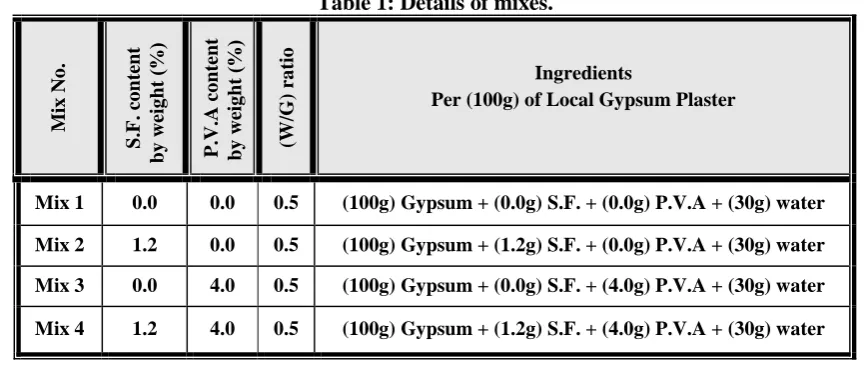
Four mixes of Local Gypsum Plaster have been studied in this research according to S.F. and P.V.A. contents
(by weight) : 0.0% , 1.2% (for S.F.) and 0% , 4% (for P.V.A.) . The (water / gypsum) ratio used for all these
mixes is fixed at (0.5). The constituent materials (Local Gypsum Plaster, S.F. , P.V.A. and water) of all mixes
were weighted quantities . The mixes details are illustrated in Table (1).
Table 1: Details of mixes.
M
ix
No
.
S.F
.
co
nte
nt
by
weig
ht
)
%(
P
.V.
A
co
nte
nt
by
weig
ht
)
%(
(W/G
)
ra
tio
Ingredients
Per (100g) of Local Gypsum Plaster
Mix 1 0.0 0.0 0.5 (100g) Gypsum + (0.0g) S.F. + (0.0g) P.V.A + (30g) water
Mix 2 1.2 0.0 0.5 (100g) Gypsum + (1.2g) S.F. + (0.0g) P.V.A + (30g) water
Mix 3 0.0 4.0 0.5 (100g) Gypsum + (0.0g) S.F. + (4.0g) P.V.A + (30g) water
Mix 4 1.2 4.0 0.5 (100g) Gypsum + (1.2g) S.F. + (4.0g) P.V.A + (30g) water
3.3. Mixing procedure.
In the beginning (S.F.) powder was added to the Local Gypsum Plaster and dry mixed , then the specified
quantity of the water was added to the mix , then re-mixed manually for (approximately 30 seconds) , and
poured in to the mold . The mold has been vibrated benefiting from the vibration of a (small generator) for about
10 seconds . After about 30 minutes, the cubic (5×5×5) cm. specimens were taken off from the mold . Then, the
,
352
|
P a g e
(P.V.A.) additive, the required quantity of it is added to the required quantity of water and mixed very well, andthen they are added to the Local Gypsum Plaster.
3.4. Testing program.
3.4.1. Compression strength.
The 50 mm cubic specimens were tested in this research at age of about one week or over to evaluate the
compressive strength. Fig. (1-a) shows the testing machine used in our research [test is carried out according to
ASTM : C472-99][17] .
3.4.2. Setting time.
One of the most disadvantages of gypsum plaster mixes , precisely in the preparation of the paste is that its
setting time is rather small (i.e. compared with cement or concrete paste) and this disadvantage doesn't provide
enough comfort for the workers to do their job freely , this promotes us to investigate the effect of our additives
(S.F. and P.V.A.) individually and together on the setting time .
Setting time is usually measured by a device called (Vicat apparatus), which consist of a 300 gm weighted rod
ended with a needle (5cm. long) and (1mm. in diameter) fixed by a holder with a graduated plate and a
cylindrical pan having (70*40)mm dimensions , the apparatus is shown in Fig.(1-b) , [test is carried out according to ASTM : C472-99][17] .
4. Results &Discussions.
4.1. Compressive Strength:
4.1.1. Effect of (S.F.) on Compressive Strength of Local Gypsum Plaster with Various (P.V.A.)
Contents.
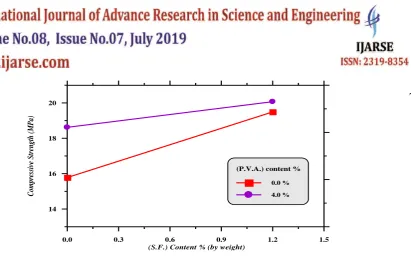
Figure and Table (2) presents the effect of (S.F.) on the compressive strength of the Local Gypsum Plaster
with two (P.V.A.) contents (0% and 4%). They reveal that with the addition of (S.F.) alone the compressive
strength is increased by (23.5 %), and this percentage of increase in reduced to (7.8 %) with the presence of
(P.V.A.) . The reduction in the percentage of increase may be attributed to the emulsifying nature of the (P.V.A.
+ water) solution which isolates some of the S.F. particles and hence minimizes their effect in improving the compressive strength of local gypsum plaster.
,
353
|
P a g e
Mix No. (P.V.A.) content by weight (%) (S.F.) content by weight (%) (W/G) ratio Compressive Strength (MPa) Percentage of Increase
(%)
Mix 1 0.0 0.0 0.5 15.78 ----
Mix 2 0.0 1.2 0.5 19.49 23.5
Mix 3 4.0 0.0 0.5 18.62 ----
Mix 4 4.0 1.2 0.5 20.07 7.8
0.0 0.3 0.6 0.9 1.2 1.5
(S.F.) Content % (by weight)
14 16 18 20 C om pr es si ve S tr en gt h ( M P a)
(P.V.A.) content %
0.0 %
4.0 %
Figure (2) and Table (2): Effect of (S.F.) on Compressive Strength of Local Gypsum Plaster
with Various (P.V.A.) Contents.
4.1.2. Effect of (P.V.A.) on Compressive Strength of Local Gypsum Plaster with Various (S.F.)
Contents.
Figure and Table (3) displays the effect of (P.V.A.) on the compressive strength of the Local Gypsum Plaster
with two (S.F.) contents (0% and 1.2%). They illustrate that with the addition of (P.V.A.) alone the compressive
strength is increased by (18 %), and this percentage of increase is reduced to (3 %) with the presence of (S.F.).
Figure (3): Effect of (P.V.A.) on Compressive Strength of Local Gypsum Plaster with Various
(S.F.) Contents.
0.0 1.0 2.0 3.0 4.0 5.0
(P.V.A.) Content % (by weight)
14 16 18 20 C om pr es si ve S tr en gt h (M P a)
(S.F.) content %
0.0 %
,
354
|
P a g e
0.0 0.3 0.6 0.9 1.2 1.5
(S.F.) content % (by weight)
2 4 6 8 10 12 14 S et ti n g ti m e (m in .)
(P.V.A.) content %
0.0 % 4.0 % Mix No. (S.F.) content by weight (%) (P.V.A.) content by weight (%) (W/G) ratio Compressive Strength (MPa) Percentage of increase
(%)
Mix 1 0.0 0.0 0.5 15.78 ----
Mix 3 0.0 4.0 0.5 18.62 18.0
Mix 2 1.2 0.0 0.5 19.49 ----
Mix 4 1.2 4.0 0.5 20.07 3.0
Table (3): Effect of (P.V.A.) on Compressive Strength of Local Gypsum Plaster with Various
(S.F.) Contents.
4.2. Setting Time:
4.2.1. Effect of (S.F.) on Setting Time of Local Gypsum Plaster with Various (P.V.A.) Contents.
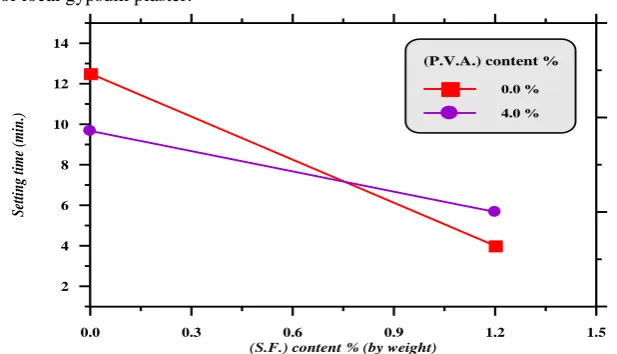
Figure and Table (4) presents the effect of (S.F.) on the setting time of the Local Gypsum Plaster with two
(P.V.A.) contents (0% and 4%). They reveal that with the addition of (S.F.) alone the setting time is
considerably decreased by (68 %), and this percentage of decrease is reduced to (41.4 %) with the presence of
(P.V.A.). The reduction in the percentage of decrease may also be attributed to the emulsifying nature of the
(P.V.A. + water) solution which isolates some of the S.F. particles and hence minimizes their effect in reducing the setting time of local gypsum plaster.
Figure (4) and Table (4) : Effect of (S.F.) on Setting Time of Local Gypsum Plaster with Various
(P.V.A.) Contents .
Mix No. (P.V.A.) content by weight (%) (S.F.) content by weight (%) (W/G) ratio Setting Time (min.) Percentage of Decrease
(%)
Mix 1 0.0 0.0 0.5 12.50 ----
Mix 2 0.0 1.2 0.5 4.00 68.0
Mix 3 4.0 0.0 0.5 9.67 ----
,
355
|
P a g e
0.0 1.0 2.0 3.0 4.0 5.0
(P.V.A.) Content % (by weight)
2 4 6 8 10 12 14
S
et
ti
n
g
ti
m
e
(m
in
.)
(S.F.) content %
0.0 %
1.2 %
4.2.2. Effect of (P.V.A.) on Setting Time of Local Gypsum Plaster with Various (S.F.) Contents .
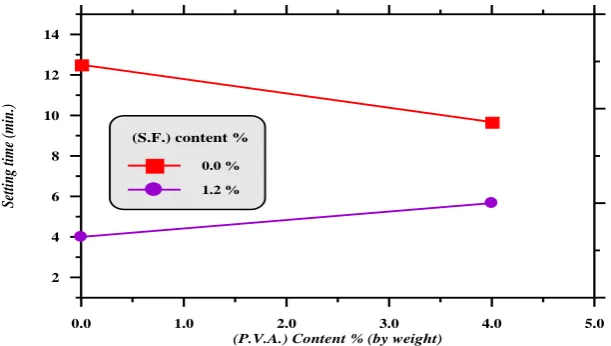
Figure and Table (5) displays the effect of (P.V.A.) on the setting of the Local Gypsum Plaster with two (S.F.)
contents (0% and 1.2%) . They illustrate that with the addition of (P.V.A.) alone the setting time is decreased by
(22.6 %) [when the mix of no additives is considered as the reference mix] , but the setting time is increased by
(41.75 %) with the presence of (S.F.) (together with P.V.A.) [when the mix of S.F. alone is considered as the
reference mix].
Figure (5) and Table (5): Effect of (P.V.A.) on Setting Time of Local Gypsum Plaster with
Various (S.F.) Contents.
4.3. Privilege of the Combined Addition of (S.F.) and (P.V.A.) .
4.3.1. On Compressive Strength:
Bar chart (1) shows the combined effect of (S.F.) and (P.V.A.) on the compressive strength of Local Gypsum
Plaster. It displays that if taking the case of (Mix 1 : zero S.F. and zero P.V.A.) as a reference case , then when
adding S.F. alone (Mix 2) , the compressive strength is increased by (23.5 %) , while when using P.V.A. alone
(Mix 3) , the compressive strength is increased by (18.1 %) , but when using both S.F. and P.V.A. (Mix 4) , the
compressive strength is increased by (27.2 %) , which means that an improvement in the compressive strength
has resulted when using both (S.F.) and (P.V.A.). Mix No. (S.F.)
content by weight (%)
(P.V.A.) content by weight (%)
(W/G) ratio
Setting Time (min.)
Percentage of changing
(%)
Mix 1 0.0 0.0 0.5 12.5 ----
Mix 3 0.0 4.0 0.5 9.67 - 22.60
Mix 2 1.2 0.0 0.5 4.00 ----
,
356
|
P a g e
Bar Chart (1): Combined Effect of (S.F.) and (P.V.A.) on Compressive Strength.
4.3.2. On Setting Time:
Bar chart (2) presents the combined effect of (S.F.) and (P.V.A.) on the setting time of Local Gypsum Plaster.
It illustrates that if taking the case of (Mix 1 : zero S.F. and zero P.V.A.) as a reference case , then when adding
S.F. alone (Mix 2) , the setting time is decreased by (68 %) , while when using P.V.A. alone (Mix 3) , the setting
time is decreased by (22.6 %) , but when using both S.F. and P.V.A. (Mix 4) , the setting time is decreased by
(54.6 %) , which means that the presence of (P.V.A.) has reduced the deterioration in the setting time induced
by the individual use of(S.F.) (i.e. alone) .
Bar Chart (2): Combined Effect of (S.F.) and (P.V.A.) on Setting Time.
68.0%*
22.6
%
*
54.6%*
Ref.*
*Percentage of decreasing
23.5%*
18.1%*
27.2 %*
Ref.*
,
357
|
P a g e
5. Conclusions
1) When adding (S.F.) alone , the compressive strength is increased, and the percentage of increase is reduced
with the presence of P.V.A. (together with S.F.).
2) When adding (S.F.) alone , the setting time is considerably decreased , and the percentage of decrease is
reduced with the presence of P.V.A. (together with S.F.).
3) When adding (P.V.A.) alone , the compressive strength is increased, and the percentage of increase is reduced
with the presence of S.F. (together with P.V.A.).
4) When adding (P.V.A.) alone , the setting time is decreased [when the mix of no additives is considered as the
reference mix] , while the setting time is enlarged with the presence of S.F. (together with P.V.A.) [when the
mix of S.F. alone is considered as the reference mix].
5) When using both S.F. and P.V.A. (Mix 4) , the compressive strength is increased by (27.2 %) as compared
with the reference case
(
Mix 1 : zero S.F. and zero P.V.A.). When this percentage of increase is compared with the23.5 % (when S.F. is added alone) and 18.1 % (when P.V.A.is added alone)one can conclude that an
improvement in the compressive strength has resulted when using both (S.F.) and (P.V.A.).
6) When using both S.F. and P.V.A. (Mix 4) , the setting time is decreased by (54.6 %) as compared with the
reference case (Mix 1 : zero S.F. and zero P.V.A.) .When this percentage of decrease is compared with the 68 %
(when S.F. is added alone) and 22.6 % (when P.V.A. is added alone) it can be concluded that the presence of
(P.V.A.) (together with S.F.) has reduced the deterioration in the setting time induced by the individual use of
(S.F.).
6. References.
[1] Khalil, A.A. ; Gad , G.M. “Mineral and chemical constitutions of the UAR gypsum raw materials”. Indian
Ceramics, 16 (1972) 173 - 177. Cited by reference [9] .
[2] Combe , E. C. ; Smith , D. C. “Some Properties of Gypsum Plaster” . J. Brit. Dent. , 17 (1964) 237-245.
Cited by reference [9] .
[3] Peters , C. P. ; Hines , J. L. ; Bachus , K. N. ; Craig M. A. ; Bloebaum, R. D. “Biological Effect of Calcium
Sulfate as Bone Graft Substitute in Ovine Metaphyseal Defects” J. Biomed. Mater. Res. A., 76, No3 (2005)
456-462 . Cited by reference [9] .
[4] Craig , R. G. “Restorative Dental Materials” 7th Edition, St. Louis, Toronto, and Princeton. The C.V. Mospy
comp. , (1989) 303-330. Cited by reference [9] .
[5] Papageorgiou , A. ; Tzouvalas , G. ; Tsimas , S. “Use of Inorganic Setting Retarders in Cement Industry”
Cem. Concr. Res. , 27 (2005) 183-189 . Cited by reference [9] .
[6] El-Maghraby , H.F. ; Gedeon , O. ; Khalil , A.A. “Formation and Characterization of Poly(vinyl alcohol – co
– vinyl Acetate – co-itaconic Acid / Plaster Composites : part II : Composite Formation and Characteristics”
,
358
|
P a g e
[7] Bas_pinar , S. M.; Kahraman , E. “Modifications in the properties of gypsum construction element viaaddition of expanded macroporous silica granules” . Construction and Building Materials 25 (2011) 3327–3333.
http://dx.doi.org/10.1016/j.conbuildmat.2011.03.022 Cited by reference[9] .
[8] Khalil , A.A. ; Abdel kader, A. H. “Preparation and physicomechanical Properties of Gypsum Plaster-Agro
Fiber Wastes Composites” Interceram Int. J. Refractories Manual (Special Technologies) 21(2010) , 62-67 .
Cited by reference [9] .
[9] A. A. Khalil , A. Tawfik, A. A. Hegazy, M. F. El-Shahat "Effect of different forms of silica on the physical
and mechanical properties of gypsum plaster composites "Materiales de Construcción Vol. 63, 312, 529-537,
octubre-diciembre 2013 .
[10] Murat , M. ; Attari , A. “Modification of some physical properties of gypsum plaster by addition of clay
minerals” , Cem. Concr. Res. , 2(1991) 378–87. Cited by reference [9] .
[11] Wen , L. ; Yu-he , D. ; Mei , Z. ; Ling , X. ; Qian , F. “Mechanical properties of nano-SiO2 filled gypsum
particle board” Trans Nonferrous MetalsSoc China 16 (2006), 361-364. Cited by reference [9].
[12] Fu , X. ; Chung , D.D.L. “Effects of silica fume, latex, methylcellulose, and carbon fibers on the thermal
conductivity and specific heat of cement paste .” Cem. Concr. Res. , 27, no. 12 (1997) , 1799-1804 . Cited by
reference [9] .
[13] Shebl , S.S. ; Seddeq , H. S. ; Aglan , H. A. “Effect of micro-silica loading on the mechanical and acoustic
properties of cement pastes”Construction and Building Materials 25 (2011), 3903-3908. http : // dx . doi . org /
10 .1016 / j. conbuildmat . 2011.04.021 . Cited by reference [9] .
[14] Ogawa , K. ; Uchikawa , H. ; Takemoto , K. ; Yasui , I. “The mechanism of the hydration in the system
C3S- pozzolana”, Cem. Concr. Res. ,10 (1980) 683-696 . Cited by reference [9] .
[15] F. Wirsching, “Drying and Agglomeration of Flue Gas Gypsum, (ed. Kuntze, R., A.)”, The Chemistry and
Technology of Gypsum Philadelphia: American Society for Testing and Materials, 1984, pp. 161-174. Cited by
reference : Padevět , P. Tesárek, T. Plachý "Evolution of mechanical properties of gypsum in time "
INTERNATIONAL JOURNAL OF MECHANICS , Issue 1, Volume 5 , 2011 .
[16] Zeki A. Aljubouri Auday M. Al-Rawas "Physical Properties and Compressive Strength of the Technical
Plaster and Local Juss "Iraqi Journal of Earth Sciences , Vol. 9 , No. 2 , pp 49-58 , 2009 .
[17] ASTM C472 – 99 (Reapproved 2009) : " Standard Test Methods for Physical Testing of Gypsum Plaster