The LbL contribution to the muon g-2 from the axial-vector
mesons exchanges within the nonlocal quark model
A.E. Dorokhov1,2, A.P. Martynenko2, F.A. Martynenko2, A.E. Radzhabov2,3,∗, and A.S. Zhevlakov3
1Joint Institute of Nuclear Research, BLTP,141980, Moscow region, Dubna, Russia 2Samara University, 443086, Samara, Russia
3Matrosov Institute for System Dynamics and Control Theory SB RAS, 664033, Irkutsk, Russia
Abstract.The light-by-light contribution from the axial-vector (AV) mesons exchanges to the muon anomalous magnetic moment is estimated in the frame-work of the nonlocal chiral quark model. The preliminary answer for contribu-tions froma1and f1mesons to (g−2)µis 0.34·10−11and does not support the Melnikov-Vainshtein estimate 2.2·10−11.
The light-by-light contributions to the anomalous magnetic moment of muon of the dy-namical quark loop, i.e. contact type, and of the light pseudoscalar and scalar resonances exchanges within the nonlocal chiral quark model was calculated in our previous works [1– 3]. In the present work we extend our model calculations by including the vector–axial-vector sector. To this aim the model parameters should be refitted to the pion observables, the mix-ing of the pseudoscalar and longitudinal part of the axial-vector mesons as well as to theρ−γ mixing.
It is interesting to note that in [4] is shown that the axial-vector exchange interaction in muonic hydrogen gives essential contribution to hyperfine splitting. For hyperfine splitting the axial-vector contribution is even bigger than the pion one [5].
For these purposes we consider the S U(2) ×S U(2) chiral quark model where the pseudoscalar–scalar and vector–axial-vector sectors are included. The corresponding La-grangian is
L=Lf ree+LPS,S +LV,AV, Lf ree=q(x)(i¯ ∂ˆ−mc)q(x), (1)
LPS,S =G1 2 [J
a S(x)J
a S(x)+J
a P(x)J
a
P(x)], LV,AV=
G2 2 [J
a V(x)J
a V(x)+J
a AV(x)J
a AV(x)],
wheremcis the current quark mass matrix with diagonal elementsmuc =m d
c,G1 andG2 are the coupling constants in pseudoscalar–scalar and vector–axial-vector sectors, respectively. The nonlocal quark currents are given by
JaM(x)=
Z
d4x1d4x2 f(x1)f(x2) ¯q(x−x1)ΓaMq(x+x2), (2)
withM =S,P,V,AV andΓaS =λa,ΓaP =iγ5λa,ΓaV = γµλa,ΓaAV =γ5γµλa. For theS U(2) model,the flavour matrices areλa ≡τa,a =0, ..,3 withτ0 =1. In Eq. (2), f(x) is the form factor reflecting the nonlocal properties of the QCD vacuum. The action of the model can
be bosonized by the usual Hubbard-Stratonovich trick with introduction of auxiliary mesonic fields. In order to obtain a physical scalar field with zero vacuum expectation value, the shift of the scalar isoscalar field should be performed leading to appearance of the dynamical momentum-dependent quark mass
m(p)=mc+mdynf2(p), mdyn=G1 8Nc
(2π)4
Z
d4Ekf
2(k)m(k)
k2+m2(k). (3)
The meson vertices withoutπ−a1mixing in momentum space are
VM=gM(k)ΓMf(p−)f(p+), (4)
wheregM(k) is the meson renormalization constant,p±,kare the quark and meson momenta, respectively. The presence of the longitudinal component of axial-vector mesons leads to modification of the pion vertex as
Vπ=gπ(k)iγ5λa1−k˜ˆgπ(k)f(p−)f(p+). (5)
Due to the nonlocal interaction, there appear additional contributions to the antiquark-quark-photon vertex and the meson-antiquark-quark-antiquark-quark-photon vertex which takes the form1
Γµp2,p1=Q(γµ−(p1+p2)µm
(1)
(p1,p2)), ΓM;µ
p2,p1,q=−gM(k)
f(1)(p1,p1+q)f(p2)(2p1+q)µQΓM+
+f(1)(p2,p2−q)f(p1)(2p2−q)µΓMQ
, (6)
where m(1)(p
1,p2) = (m(p21)−m(p22))/(p21−p22) is the first order finite-difference. In the presence of the vector sector, an additional dressing of interaction vertices with photons arises due toρ(ω)→γtransition [6, 7]. The model parameters are taken from [6].
The general form of the axial-vector meson to two-photon transition form factor is [8, 9]
Tαµν=ie2ερστα
A1qτ1g
µρgσν+A
2qτ2g
µρgσν+A
3qν1q
ρ
1q
σ
2g
τµ+
+A4qν2q
ρ
1q
σ
2g
τµ+A
5q µ 1q ρ 1q σ 2g
τν+A
6q µ 2q ρ 1q σ 2g
τν, (7)
where p, q1 and q2 are momenta of AV meson and photons with indices α, µ, ν, Ai ≡
Ai(p2,q2 1,q
2
2). The gauge invariance provides the relations
A2=q21A5+(q1·q2)A6, A1=(q1·q2)A3+q22A4 (8)
and the Bose symmetry leads toA1(p2,q21,q22) = −A2(p2,q22,q21), A3(p2,q21,q22) = −A6(p2,q22,q21), A4(p2,q12,q22) = −A5(p2,q22,q21). Alternatively, one can rewrite the am-plitude as
Tαµν=ie2ερστα
Rµρq1,q2R νσ
q1,q2(q1−q2)
τ(q1·q2) M2A F
(0)
AVγ∗γ∗(p
2,q2 1,q
2 2)
+Rνρq1,q2Q µ 1q σ 1q τ 2 1 M2 A
F(1)AVγ∗γ∗(p
2,
q21,q22)+Rµρq1,q2Q ν 2q σ 2q τ 1 1 M2 A
F(1)AVγ∗γ∗(p
2, q22,q21)
,
Rµνq1,q2 =−g µν+ 1
X
(q
1·q2)
qµ1qν2+q2µqν1−q21qµ2qν2−q22qµ1qν1, (9)
Qµ1=qµ1−qµ2 q 2 1 (q1·q2)
, Qν2=qν2−qν1 q 2 2 (q1·q2)
, X=(q1·q2)2−q21q 2 2,
1The antiquark-quark-photon and meson-antiquark-quark vertices with two photons appearing due to the
0.00 0.05 0.10 0.15 0.20 0.25 0.30 0.35
0.0 1.0 2.0 3.0 4.0 5.0
F(−M
A
2 ,Q 2 ,0) [GeV
−2
]
Q2 [GeV2]
−F(1)exp
−F(1)
F(0)
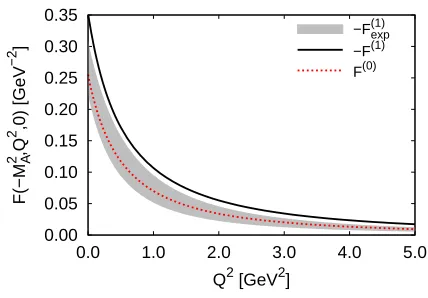
Figure 1.Behaviour of the form-factors for on mass-shellf1(1285). Nonlocal model calculation: black solid line is−F(1)AVγ∗γ∗(M2A,Q2,0), red dotted is F
(0)
AVγ∗γ∗(MA2,Q2,0). Shaded region is the result of L3
collaboration for−F(1)AVγ∗γ∗(M2A,Q2,0).
whereRµνq1,q2 is the totally transverse tensor,Q µ
1andQ
ν
2are transverse with respect toq1and q2, respectively.
According to the Landau–Yang theorem, the axial-vector mesons can not decay into two real photons. However, the coupling of 1++ mesons to two photons is allowed in the case when one or both photons are virtual. The two-photon “decay” width is defined as
˜
Γγ∗γ∗(AV)= lim
Q2→0
MA2
Q2Γ TS
γγ∗=
πα2M5
A
12 [F (1)
AVγ∗γ∗(M
2
A,0,0)]
2. (10)
At present, we have only few experimental data on the 1++ meson transition form fac-tor into two photons. The L3 Collaboration studied the reaction e+e− → e+e−γ∗γ∗ → e+e−f1(1285)→e+e−ηπ+π−and the f1(1285) meson transition form factor for the case when one of the photons is real and another one is virtual was extracted [10]. The comparison of the model calculations for the axial-vector meson form factors with the results of the L3 collaboration is shown in fig.1. One can see that for on-mass shell meson, the agreement of the model calculation with the experiment is reasonable. The muon anomalous magnetic moment is defined from the following projection [11]
aHLbLµ = 1 48mµTr
( ˆp+mµ)[γρ, γσ]( ˆp+mµ)Πρσ(p,p),
Πρσ(p0,p)=−ie6
Z d4q 1 (2π)4
Z d4q 2 (2π)4
1
q21q22(q1+q2−k)2
× (11)
×γµ pˆ 0−qˆ
1+mµ (p0−q
1)2−m2µ
γν pˆ−qˆ1−qˆ2+mµ (p−q1−q2)2−m2µ
γλ ∂
∂kρΠµνλσ(q1,q2,k−q1−q2),
Figure 2.LbL contribution from intermediate meson exchanges.
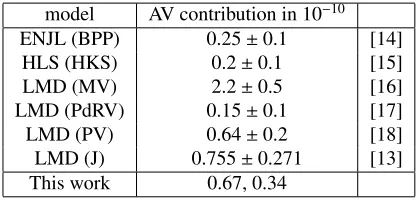
Table 1.Contribution to (g-2) of muon from axial-vector meson exchanges. Most of contribution comes fromf1(1285).
model AV contribution in 10−10
ENJL (BPP) 0.25±0.1 [14]
HLS (HKS) 0.2±0.1 [15]
LMD (MV) 2.2±0.5 [16]
LMD (PdRV) 0.15±0.1 [17]
LMD (PV) 0.64±0.2 [18]
LMD (J) 0.755±0.271 [13]
This work 0.67, 0.34
contribution can be represented in the form [3]
aLbLµ = ∞ Z
0 dQ1
∞ Z
0
dQ2 ρ(Q1,Q2), (12)
whereρ(Q1,Q2) is density.
In the nonlocal chiral quark model the separate result for contribution of a1(1260) and f1(1285) with full kinematic dependence is 0.67·10−11. However, due to decrease of the pion contribution resulting from theρ−γandπ−a1 mixings, the axial-vector contribution becomes 0.34·10−11. Therefore we present these two numbers in table 1 for comparison with predictions of other approaches. One can see that our result is visible but not so big as the Melnikov-Vainshtein estimations [16].
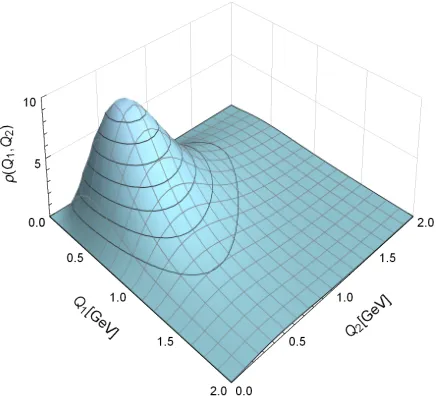
The densityρ(Q1,Q2) is shown in fig.3 for the axial-vector meson f1(1285). One can see that peak of density is located at Q1,Q2 ∼ 0.5 GeV and most of contribution is in energy domain below 1.5 GeV.
In future we plan extend our calculations to the sector with strange particles and reesti-mate the influence of vector–axial-vector sector on the contact term (quark loop). Actually, the presence of the contact term is a main difference between models with quark degrees of freedom and pure mesonic one or the dispersive approach. Up to now, it is not clear how to relate these calculations since the mesonic contributions exist in both approaches, while the contact term is only attributed to the quark models. This contribution is small only for some models [14], while in calculation in the nonlocal model [3], the DSE/BSE approach [19], the model with quark box [20], CχQM [21] this contribution is not small and even bigger than resonance one. Important to note, that in the nonlocal chiral quark model just the contact term guarantees the correct QCD asymptotics [1, 7].
Figure 3.Behaviour of the density (12) in units 10−11GeV−2, for the axial-vector mesonf 1(1285).
References
[1] A. Dorokhov, A. Radzhabov, A. Zhevlakov, Eur. Phys. J.C71, 1702 (2011) [2] A. Dorokhov, A. Radzhabov, A. Zhevlakov, Eur. Phys. J.C72, 2227 (2012) [3] A.E. Dorokhov, A.E. Radzhabov, A.S. Zhevlakov, Eur. Phys. J.C75, 417 (2015) [4] A. Dorokhov, N. Kochelev, A. Martynenko, F. Martynenko, A. Radzhabov, Phys. Lett.
B776, 105 (2018)
[5] A.E. Dorokhov, N.I. Kochelev, A.P. Martynenko, F.A. Martynenko, R.N. Faustov, Phys. Part. Nucl. Lett.14, 857 (2017)
[6] R.S. Plant, M.C. Birse, Nucl.Phys.A628, 607 (1998)
[7] A.E. Dorokhov, W. Broniowski, Eur. Phys. J.C32, 79 (2003), [8] L. Rosenberg, Phys. Rev.129, 2786 (1963)
[9] S.L. Adler, Phys. Rev.177, 2426 (1969)
[10] P. Achard et al. (L3), Phys. Lett.B526, 269 (2002) [11] S.J. Brodsky, J.D. Sullivan, Phys. Rev.156, 1644 (1967) [12] F. Jegerlehner, A. Nyffeler, Phys.Rept.477, 1 (2009) [13] F. Jegerlehner, Springer Tracts Mod. Phys.274, pp.1 (2017) [14] J. Bijnens, E. Pallante, J. Prades, Phys.Rev.Lett.75, 1447 (1995) [15] M. Hayakawa, T. Kinoshita, A. Sanda, Phys.Rev.Lett.75, 790 (1995) [16] K. Melnikov, A. Vainshtein, Phys. Rev.D70, 113006 (2004)
[17] J. Prades, E. de Rafael, A. Vainshtein, Adv.Ser.Direct.High Energy Phys.20, 303 (2009) [18] V. Pauk, M. Vanderhaeghen, Eur. Phys. J. C74, 3008 (2014)