Article
1
TOPSIS Based Algorithm for Solving Multi-objective
2
Multi-level Programming Problem with Fuzzy
3
Parameters
4
Surapati Pramanik 1, *, Partha P. Dey 2 and Florentin Smarandache3
5
1 Department of Mathematics, Nandalal Ghosh B.T. College, Panpur, P.O.-Narayanpur, District –North 24
6
Parganas, Pin code-743126,West Bengal, India; e-mail: [email protected]
7
2 Department of Mathematics, Jadavpur University, Kolkata-700032, West Bengal, India; e-mail:
8
9
3 Mathematics & Science Department, University of New Mexico, 705 Gurley Ave., Gallup, NM 87301, USA;
10
11
* Correspondence: e-mail: [email protected]; Tel.: +91-9477035544
12
Abstract: The paper proposes TOPSIS method for solving multi-objective multi-level programming
13
problem (MO-MLPP) with fuzzy parameters via fuzzy goal programming (FGP). At first,λ- cut
14
method is used to transform the fuzzily described MO-MLPP into deterministic MO-MLPP. Then,
15
for specificλ, we construct the membership functions of distance functions from positive ideal
16
solution (PIS) and negative ideal solution (NIS) of all level decision makers (DMs). Thereafter, FGP
17
based multi-objective decision model is established for each level DM for obtaining individual
18
optimal solution. A possible relaxation on decisions for all DMs is taken into account for
19
satisfactory solution. Subsequently, two FGP models are developed and compromise optimal
20
solutions are found by minimizing the sum of negative deviational variables. To recognize the
21
better compromise optimal solution, the concept of distance functions is utilized. Finally, a novel
22
algorithm for MO-MLPP involving fuzzy parameters is provided and an illustrative example is
23
solved to verify the proposed procedure.
24
Keywords: multi-objective multi-level programming; fuzzy parameters; TOPSIS; fuzzy goal
25
programming; multi-objective decision making
26
27
1. Introduction
28
Multi-level programming (MLP) technique is a powerful analytical device for describing
29
decentralized planning problems involving several decision makers (DMs) in a hierarchical
30
organization. MLP has diverse practical applications in such fields as agricultural economics [1],
31
conflict resolution [2], network design [3], pollution control policies [4], warfare [5], and so on. In a
32
multi-level programming problem (MLPP), there exists a single and independent DM at each level
33
and each level DM attempts to optimize its objective function over a common feasible region but the
34
decision of each level DM is exaggerated by the actions and reactions of the other DMs.
35
Consequently, decision deadlock may occur in the decision making circumstances. However, it has
36
been observed that each level DM should have a motivation to cooperate with each other, and a
37
minimal level of satisfaction of all level DMs must be considered for overall profit of the hierarchical
38
structure.
39
Using the idea of tolerance membership function of fuzzy set theory [6] to MLPPs for
40
satisfactory decisions, Lai [7] incorporated an efficient fuzzy approach at first in 1996. Shih et al. [8]
41
and Shih and Lee [9] applied non-compensatory max-min aggregation operator and compensatory
42
fuzzy operator respectively for solving MLPPs. Sakawa et al. [10] criticized Lai et al.’s method [7]
43
and claimed that the method discussed in [7] may produce undesirable solution to the MLPPs when
44
the fuzzy goals of objective function and decision variables of upper level DM are inconsistent. In
45
order to get rid of such situations, Sakawa et al. [10] proposed an interactive fuzzy programming
46
(IFP) for MLPPs by removing the fuzzy goals of the decision variables. Sinha [11, 12] proposed fuzzy
47
mathematical programming for solving MLPPs through a supervised search procedure. Pramanik
48
and Roy [13] proposed fuzzy goal programming (FGP) models to MLPPs by taking into
49
consideration of the relaxation of decision of the upper DMs for proper allocation of decision powers
50
to the DMs within the hierarchical organization. Baky [14] presented alternative FGP models for
51
solving multi-objective MLPP (MO-MLPP) to get the highest degree of each of the membership goals
52
by minimizing over and under deviational variables.
53
In 2000, Sakawa et al. [15] presented IFP for obtaining satisfactory solution to MLPPs with fuzzy
54
parameters by updating the satisfactory degree of DMs in view of of the overall satisfactory balance
55
among all DMs. Zhang et al. [16] derived an approximation branch and bound algorithm for solving
56
decentralized multi-objective bi-level decision making with fuzzy demands. Gao et al. [17]
57
developed λ-cut and goal programming based approach for solving fuzzy linear multi-objective
58
bi-level decision problems and presented a case study on a newsborn problem. Pramanik [18]
59
formulated three novel and effective FGP models in order to solve bi-level programming problem
60
(BLPP) with fuzzy parameters by considering preference bounds of upper and lower level DMs and
61
distance function is used to select better compromise optimal solution. Pramanik [19] also
62
presentedλ- cut and FGP based models for MLPP with fuzzy parameters by extending the concept
63
discussed in [18]. Pramanik and Dey [20] solved multi-objective BLPP (MO-BLPP) involving fuzzy
64
parameters based on FGP approach due to Pramanik and Dey [21] and presented an algorithm with
65
termination criteria. Baky et al. [22] extended the concept of Pramanik and Dey [20] and proposed an
66
alternative FGP approach for solving MO-BLPP with fuzzy demands by taking into consideration of
67
the relaxation on decision of upper level DM and obtained solutions of both level DMs by
68
minimizing over and under deviational variables. Baky and Sayed [23] proposed a hybrid approach
69
of TOPSIS and FGP for MO-BLPP with fuzzy parameters. Baky and Sayed [24] studied FGP method
70
to solve MO-BLPP with fuzzy parameters using TOPSIS and modified TOPSIS techniques.
71
TOPSIS is a familiar multi-attribute decision making method which was developed by Hwang
72
and Yoon [25] is based on the principle that a DM selects an alternative which is nearest from
73
positive ideal solution (PIS) and farthest from negative ideal solution (NIS). Abo- Sinna et al. [26]
74
and Abo- Sinna and Amer [27] investigated TOPSIS for multi-objective large scale non-linear
75
programming problems with block angular structure and max-min operator is used to resolve the
76
conflict between new criteria. Abo- Sinna and Abou-El-Enien [28] presented a TOPSIS based
77
interactive algorithm for large scale multi-objective programming problem involving fuzzy
78
parameters. Baky [29] proposed two interactive TOPSIS algorithms for solving non-linear
79
MO-MLPPs. Recently, Dey et al. [30] investigated TOPSIS scheme for linear fractional MO-BLPP
80
through FGP approach by assigning preference bounds on the decision variables to reach the
81
optimal solution.
82
In this paper, we have extended the concept of Dey et al. [25] for solving MO-MLPP with fuzzy
83
parameters using FGP procedure. The remainder of the paper is structured in the following way.
84
formulation of MO-MLPP with fuzzy parameters is exhibited. Section 4 provides deterministic
86
formulation of MO-MLPP with fuzzy parameters usingλ- cut technique. Some basic concepts
87
relating to distance measures are briefly stated in section 5.TOPSIS basedFGP approach for solving
88
MO-MLPP with fuzzy parameters is developed in the next section. Distance functions for obtaining
89
compromise optimal solution are discussed in section 7. In section 8, TOPSIS based algorithm for
90
solving MO-MLPP with fuzzy parameters through FGP method is provided. A MO-MLPP with
91
fuzzy parameters is solved to demonstrate the validity and efficiency of the proposed approach in
92
section 9. Finally the last section concludes the paper with some future scope of research.
93
2. Preliminaries
94
In this section, some basic definitions regarding fuzzy set theory are provided.
95
Definition 2.1 Fuzzy set [6] A fuzzy set ~
in U is defined by ~
= { x, μ~(x)
x U},
96
whereμ~(x)
: U [0, 1] is called the membership function of ~
and μ~(x)
is the degree of
97
membership to which x ~
ψ.
98
Definition 2.2 Normal fuzzy set [31] ~
is said to be a normal fuzzy set if there exists a point x
99
in U such that μ~(x) = 1.
100
Definition 2.3 Convex fuzzy set [31] ~
is called a convex fuzzy set if and only if for any x1, x2
101
U and λ [0, 1], μ~
[λx1 + (1 - λ) x2] Min [μ~(x1), μ~ (x2)].
102
Definition 2.4 λ- cut [31] Theλ-cut of a fuzzy set ~
of U is a non-fuzzy set denoted by
103
λ
defined by a subset of all elements xU such that their membership functions exceed or identical
104
to a real numberλ [0, 1], i.e.λ = ( ) λ,λ [0,1],
μ
: ~ x x U
x .
105
Definition 2.5 Triangular fuzzy number [31] Triangular fuzzy number is both convex and
106
normal fuzzy set in U which is defined by ~
T= μ~( )
T x
x, where
107
) ( μ~
T x =
Otherwise if
t x s if s
t x t
s x r if r
s r x
, 0
, ,
108
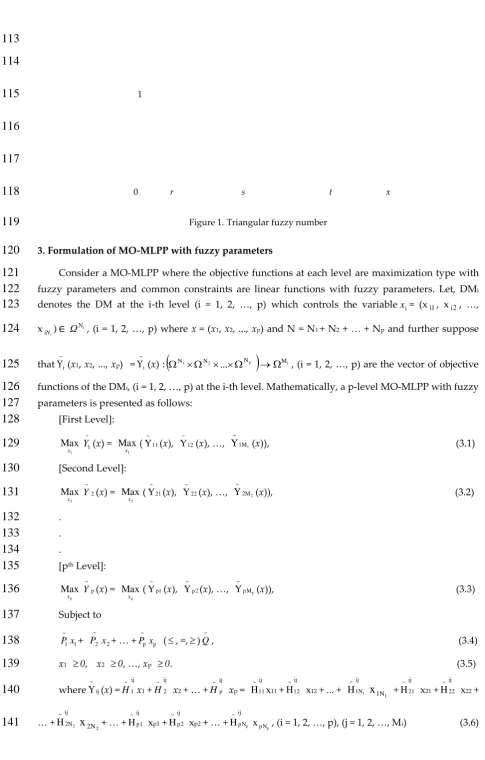
Generally, a triangular fuzzy number is represented as (r, s, t) (see Fig. 1).
109
110
) ( μ~
T x
111
113
114
1
115
116
117
0 r s t x
118
Figure 1.Triangular fuzzy number
119
3. Formulation of MO-MLPP with fuzzy parameters
120
Consider a MO-MLPP where the objective functions at each level are maximization type with
121
fuzzy parameters and common constraints are linear functions with fuzzy parameters. Let, DMi
122
denotes the DM at the i-th level (i = 1, 2, …, p) which controls the variablexi= (xi1, xi2, …,
123
x )
i
iN i
N
∈ Ω , (i = 1, 2, …, p) where x = (x1, x2, ..., xp) and N = N1 + N2+ … + Np and further suppose
124
that ~
i
(x1, x2, ..., xp) =
~
i
(x) :
N1N2 Np
... Mi, (i = 1, 2, …, p) are the vector of objective
125
functions of the DMi, (i = 1, 2, …, p) at the i-th level. Mathematically, a p-level MO-MLPP with fuzzy
126
parameters is presented as follows:
127
[First Level]:
128
1
Max
x
~
1 Y (x) =
1
Max
x ( 11
~
Y (x), 12 ~
Y (x), …, 1M1 ~
Y (x)), (3.1)
129
[Second Level]:
130
2
Max
x 2
~ Y (x) =
2
Max
x ( 21
~
Y (x), 22 ~
Y (x), …, 2M2 ~
Y (x)), (3.2)
131
.
132
.
133
.
134
[pth Level]:
135
p Max
x p
~ Y (x) =
p Max
x ( p1
~
Y (x), p 2 ~
Y (x), …, p Mp ~
Y (x)), (3.3)
136
Subject to
137
1 ~
1x
P + 2 ~
2 x
P + … + p
~
px
P (, =,) ~
Q, (3.4)
138
x1 0, x2 0, …, xp 0. (3.5)
139
where ij ~
Y (x) = ij
1 ~ H x1 +
ij
2 ~
H x2+ … +
ij
p ~ H xp =
ij
11 ~
H x11 +
ij
12 ~
H x12 + ... +
ij 1N ~
1 H
1
1N
x
+ij
21 ~
H x21 +
ij
22 ~
H x22 +
140
… +
ij 2N ~
2
H
2
2N
x
+ … +ij
p 1 ~
H xp1 +
ij
p 2 ~
H xp2+ … +
ij
p N ~
p H
p p N
x , (i = 1, 2, …, p), (j = 1, 2, …, Mi) (3.6)
Here, ~
i
P is M Ni matrix, (i = 1, 2, …, p),
~
Q is the M component column
142
vector. ij
k ~
H = H ,H ,...,H ,
ij kN ~ ij k2 ~ ij k1 ~
k
(i = 1, 2, …, p), (j= 1, 2, …, Mi) are constants, x = x1x2 … xp is the
143
set of decision vector, N = N1 + N2+…+ Np = total number of decision variables in the system and M is
144
the total number of system constraints. Here, 1 ~
Y (x), 2 ~
Y (x), …, p ~
Y (x) are linear and bounded with
145
fuzzy coefficients and let us represent the system constraints (3.4) & (3.5) as J().
146
4. Deterministic formulation of MO-MLPP with fuzzy parameters
147
At first, we convert the fuzzily described objectives and constraints to deterministic objectives
148
and constraints for a specific value of λ.Now, for specific value ofλ,maximization-type objective
149
functionYij( )
~
x , (i = 1, 2, …, p), (j = 1,2, …, Mi) can be replaced by the upper bound of its
λ
-cut i.e.,150
U ij ~ λY
x = p
U ij
p ~ λ 2 U ij
2 ~ λ 1 U ij
1 ~
λ(H ) x (H ) x ... (H ) x
, (i = 1, 2, …, p), (j = 1, 2, …, Mi) (4.1)
151
Similarly, minimization-type objective functionYij( )
~
x , (i =1, 2, …, p), (j = 1,2, …, Mi) can be
152
replaced by the lower bound of itsλ-cut i.e.,
153
L ij ~ λ
x
Y = p
L ij
p ~ λ 2 L ij
2 ~ λ 1 L ij
1 ~ λ
) ( ... ) ( )
(H x H x H x , (i = 1, 2, …, p), (j = 1, 2, …, Mi) (4.2)
154
The inequality constraints
155
j N
1 j ij
~
x P
i
~
Q , (i = 1, 2, …, m1) (4.3)
156
j N
1 j ij
~
x P
i
~
Q , (i = m1+1, m1+2, …, m2) (4.4)
157
can be modified by the following constraints:
158
j U N
1 j ij
~ λ
x P
L
i ~ λ
Q
, (i = 1, 2, …, m1) (4.5)
159
L N
1 j ij
~ λ
P
xj
U
i ~ λ
Q
, (i = m1+1, m1+2, …, m2) (4.6)
160
The fuzzy equality constraints
161
j N
1 j ij
~
x P
= i
~
Q , (i = m2+1, m2+2, …, M) (4.7)
162
can be replaced by two equivalent inequality constraints as given below.
163
U N
1 j
ij ~ λ
P
xj
L
i ~ λ
Q
, (i = m2+1, m2+2, …, M) (4.8)
164
L N
1 j ij
~ λ
P
xj
U
i ~ λ
Q
, (i = m2+1, m2+2, …, M) (4.9)
Lee and Li [32] proved that the Eq. (4.7) is equivalent to the Eq. (4.8) and Eq. (4.9).
166
Then, for a prescribed value ofλ, the MO-MLPP reduces to the following problem as given
167
below.
168
U 1 ~ λ
)) ( ( Max
1
x Y
x =Max (Y ( )) , (Y ( )) ,..., (Y ( )) ,
U 1M ~ λ U 12 ~ λ U 11 ~ λ
1 1
x x
x
x
169
, )) ( Y ( ,..., )) ( Y ( , )) ( Y ( Max ))
( (
Max 2M U
~ λ U 22 ~ λ U 21 ~ λ U
2 ~ λ
2 2
2
x x x
x Y
x
x
170
.
171
.
172
.
173
U p ~
λ( ( ))
Max p
x Y
x =
U
pM ~ λ U p2 ~ λ U p1 ~ λ
)) ( Y ( ,..., )) ( Y ( , )) ( Y (
Max p
p
x x
x
x
174
Subject to
175
U N
1 j ij
~ λ
P
xj
L
i ~ λ
Q
, (i = 1, 2, …, m1, m2+1, m2+2, …, M)
176
L N
1 j ij
~ λ
P
xj
U
i ~ λ
Q
, (i = m1+1, …, m2, m2+1, m2+2, …, M)
177
x1
0, x2
0, …, xp
0. (4.10)178
5. Some basic concepts concerning distance measures
179
Basic concept of distance measure is presented in this section, for additional details see [26, 27,
180
28]. Let, ~
Y(x) = ( 1
~
Y (x), 2
~
Y (x), …, M
~
Y (x)) be the vector of the objective functions with fuzzy
181
parameters. For a prescribed value ofλ, we assume that Y* = ( *
1
Y ,Y2*, ..., * M
Y ) be the PIS of the
182
objective functions such that * i
Y = U
i ~ λ
J ( ( ))
Max Y x
x , (i = 1, 2, ..., M) and Y
- = (
1
Y ,Y2, ..., -M
Y ) be the NIS
183
of the objective functions such thatYi=
L i ~ λ
J ( ( ))
Min Y x
x , (j = 1, 2, ..., M). B
K-metric is used to attain the
184
measure of “closeness”. BK-metric defines the distance between
~
Z(x) and Z* which is presented as
185
follows:
186
Bk =
k 1 M
1 j
k U j ~ λ * j k
j ( ( ))
ε
Y Y x , k = 1, 2, ..., ∞. (5.1)
187
Here, k j
ε , (j = 1, 2, ..., M; k = 1, 2, ..., ∞) denotes the relative weight of the j-th objective function.
188
However, if U j ~ λ(Y (x))
, (j = 1, 2, ..., M) is not expressed in commensurable unit, then we can employ
189
Bk =
k 1
M
1 j
k
j * j
U j ~ λ * j k j
Y Y
)) ( ( Y ε
x Y
, k = 1, 2, ..., ∞. (5.2)
191
In order to find the compromise solution of the multi-objective decision making (MODM)
192
problem we solve the following problem:
193
Max ~
Y(x) = ( 1 ~
Y (x), 2 ~
Y (x), …, M ~
Y (x))
194
Subject to
195
1 ~
1x
P + 2
~
2 x
P + … + p
~
px
P (, =,) ~
Q,
196
x1 0, x2 0, …, xp 0. (5.3)
197
According to Lai et al. [33], the above problem (5.3) is transformed into the following auxiliary
198
problem as given below.
199
Min Bk =
k 1
M
1 j
k
j * j
U j ~ λ * j k j
Y Y
)) ( ( Y ε
x Y
, k = 1, 2, ..., ∞
200
Subject to
201
1 ~
1x
P + 2
~
2 x
P + … + p
~
px
P (, =,)Q~ ,
202
x1 0, x2 0, …, xp 0. (5.4)
203
The parameter ‘k’ is known as the ‘balancing factor’ between the group utility and maximal
204
individual regret. It is to be noted that if the value of ‘k’ increases, the group utility i.e. Bk decreases
205
[33].
206
6. TOPSIS based FGP approach for MO-MLPP with fuzzy parameters
207
For specific value of ofλ, consider the deterministic MODM problem at i-th level is expressed
208
as follows:
209
U i ~ λ
)) ( ( Max
i
x Y
x =
U
iM ~ λ U i2 ~ λ U i1 ~ λ
)) ( Y ( ,..., )) ( Y ( , )) ( Y (
Max i
i
x x
x
x , (i = 1, 2, …, p)
210
Subject to
211
U N
1 j ij
~ λ
P
xj
L
i ~ λ
Q
, (i = 1, 2, …, m1, m2+1, m2+2, …, M)
212
L N
1 j ij
~ λ
P
xj
U
i ~ λ
Q
, (i = m1+1, …, m2, m2+1, m2+2, …, M)
213
x1 0, x2 0, …, xp 0. (6.1)
214
TOPSIS model for i-th level DM can be formulated as follows:
215
Min (dPISi( ))
k λ
x , (i = 1, 2, …, p)
216
Max (dNISi( ))
k λ
Subject to
218
U N 1 j ij ~ λ P xj
L i ~ λ Q
, (i = 1, 2, …, m1, m2+1, m2+2, …, M)
219
L N 1 j ij ~ λ P xj
U i ~ λ Q
, (i = m1+1, …, m2, m2+1, m2+2, …, M)
220
x0 0, x1 0, …, xp 0. (6.2)
221
where (gPISi( ))
k λ
x =
k 1 M 1 j k -ij λ * ij λ U ij ~ λ * ij λ k j i ) (Y ) (Y )) ( Y ( ) (Y ε x
, (i = 1, 2, …, p);
222
)) ( (gNISi
k λ x = k 1 M 1 j k -ij λ * ij λ -ij λ U ij ~ λ k j i ) (Y ) (Y ) (Y -)) ( Y ( ε x
, (i = 1, 2, …, p).
223
Here, * ij λ(Y )
= J Max x U ij ~ λ(Y (x))
and -ij λ ) (Y = J Min x U ij ~ λ(Y (x))
, (i = 1, 2, …, p) are the PIS and
224
NIS for i-th level DM respectively.
225
Let,
PIS * k λ i g = J Min x (g ( ))
i PIS k λ
x and
PISi k λ g = J Max x (g ( ))
i PIS k λ x ;
226
NIS * k λ i g = J Max x (g ( ))
i NIS k λ
x and
NISi k λ g = J Min x (g ( ))
i NIS k λ
x , (i = 1, 2, …, p).
227
The membership functions for (gPISi( ))
k λ
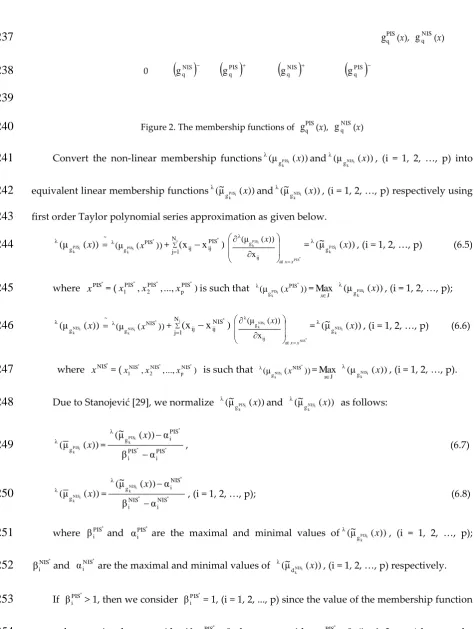
x and (gNISi( ))
k λ
x (see Fig.2) can be constructed as
228
follows:229
)) ( μ ( PISik g λ x =
* PIS k λ PIS k λ PIS k λ PIS k λ * PIS(F) k λ * PIS k λ PIS k λ PIS k λ PIS k λ PIS k λ PIS k λ i i i i i i i i i i g )) ( g ( if 1, , g )) ( g ( g if , g g )) ( g ( g )) ( (g g if 0, x x x x(i = 1, 2, …, p) (6.3)
230
)) ( μ ( NISi
k g λ x =
* NIS k λ NIS k λ * NIS k λ NIS k λ NIS k λ NIS k λ * NIS k λ NIS k λ NIS k λ NIS k λ NIS k λ i i i i i i i i i i g )) ( g ( if 1, g )) ( g ( g if , g g g -)) ( (g g ) ( g if 0, x x x x, (i = 1, 2, …, p) (6.4)
231
232
233
μgPISq (x), ( )
μ NIS q
g x Max - Min solution
234
235
1
PIS q
g (x), gNISq (x)
237
0
gqNIS
PIS q g
NIS q g
PIS q g238
239
Figure 2. The membership functions of gqPIS(x), NIS q
g (x)
240
Convert the non-linear membership functions (μ PISi( ))
k g λ
x and (μ NISi( ))
k g λ
x , (i = 1, 2, …, p) into
241
equivalent linear membership functions (μ~ PISi( ))
k g λ
x and (μ~ NISi( ))
k g λ
x , (i = 1, 2, …, p) respectively using
242
first order Taylor polynomial series approximation as given below.
243
)) ( μ ( PISi
k g λ
x
~
(μ PISi( *))
k PIS g λ
x + i(x xPIS*)
ij N 1 j ij * PIS i PIS k at ij g λ x )) ( μ ( x x x
= (μ~ PISi( ))
k g λ
x , (i = 1, 2, …, p) (6.5)
244
where PIS*
x = (x1PIS*,x2PIS*,...,xpPIS*)is such that (μ PISi( *))
k PIS g λ x = J Max
x (μ i( ))
PIS k g λ
x , (i = 1, 2, …, p);
245
)) ( μ ( NISi
k g λ
x
~
(μ NISi( *))
k NIS g λ
x + (x x )
* i NIS ij N 1 j ij * NIS i NIS k at ij g λ x )) ( μ ( x x x
= (μ~ NISi( ))
k g λ
x , (i = 1, 2, …, p) (6.6)
246
where xNIS*= (
) ..., , , * * * NIS p NIS 2 NIS
1 x x
x is such that (μ NISi( *))
k NIS g λ x = J Max
x (μgNISk i( ))
λ x , (i = 1, 2, …, p).
247
Due to Stanojević [29], we normalize (μ~ PISi( ))
k g λ
x and (μ~ NISi( ))
k g λ
x as follows:
248
)) ( μ ( PISi
k g λ
x = * *
* i PIS k PIS i PIS i PIS i g λ α β α )) ( μ~ ( x
, (6.7)
249
)) ( μ ( NISi
k g λ
x = * *
* i NIS k NIS i NIS i NIS i g λ α β α )) ( μ~ ( x
, (i = 1, 2, …, p); (6.8)
250
where PIS* i
β and PIS* i
α are the maximal and minimal values of (μ~ PISi( ))
k g λ
x , (i = 1, 2, …, p);
251
* NIS i
β and NIS* i
α are the maximal and minimal values of (μ~ NISi( ))
k d λ
x , (i = 1, 2, …, p) respectively.
252
If PIS* i
β > 1, then we consider PIS* i
β = 1, (i = 1, 2, ..., p) since the value of the membership function
253
cannot be superior than one. Also if PIS* i
α < 0, then we consider PIS* i
α = 0, (i = 1, 2, ..., p) because the
254
value of the membership function cannot be less than zero [30]. The results also hold
255
for NIS* i
β and NIS* i
α , (i = 1, 2, ..., p).
256
Max (μ PISi( ))
k g λ
x , (i = 1, 2, ..., p)
258
Max (μ NISi( ))
k g λ
x , (i = 1, 2, ..., p)
259
Subject to
260
U N
1 j ij
~ λ
P
xj
L
i ~ λ
Q
, (i = 1, 2, …, m1, m2+1, m2+2, …, M)
261
L N
1 j
ij ~ λ
P
xj
U
i ~ λ
Q
, (i = m1+1, …, m2, m2+1, m2+2, …, M)
262
x1 0, x2
0, …, xp
0. (6.9)263
According to Pramanik and Dey [22], the flexible membership goals of with aspiration level
264
unity can be expressed as follows:
265
)) ( μ ( PISi
k g λ
x + -PISi
d = 1, (i = 1, 2, ..., p) (6.10)
266
)) ( μ ( NISi
k g λ
x + -NISi
d = 1, (i = 1, 2, ..., p) (6.11)
267
where -PISi
d [0, 1] and -NISi
d [0, 1], (1, 2, …, p) are the negative deviational variables
268
corresponding to PIS and NIS respectively. The following MODM model is solved based on FGP
269
method to achieve the optimal decision of each level DM as follows:
270
271
MODM Model:
272
Min ζ
273
Subject to
274
)) ( μ ( PISi
k g λ
x + -PISi
d = 1, (i = 1, 2, ..., p)
275
)) ( μ ( NISi
k g λ
x + -NISi
d = 1, (i = 1, 2, ..., p)
276
U N
1 j ij
~ λ
P
xj
L
i ~ λ
Q
, (i = 1, 2, …, m1, m2+1, m2+2, …, M)
277
L N
1 j
ij ~ λ
P
xj
U
i ~ λ
Q
, (i = m1+1, …, m2, m2+1, m2+2, …, M)
278
ζ -PISi d ,ζ
-NISi
d , (i = 1, 2, ...,p)
279
-PISi
d [0, 1], -NISi
d [0, 1], (i = 1, 2, ..., p)
280
x1
0, x2
0, …, xp
0. (6.12)Solving the above Eq. (6.12), let i
x = ( i 1
x , i 2
x , …, i p
x ) be the optimal solution of i-th level DM.
282
To avoid any unwanted circumstance i.e decision deadlock, the level DMs should offer some
283
relaxation on decision by assigning preference upper and lower bounds on the decision variables
284
under their control [18, 22, 30, 35, 36, 37] for ovallall benefit and smooth functioning of the
285
organization and these preference bounds are included in the constraints set.
286
Consider i i
and i i
, (i = 1, 2, ..., p) be the lower and upper tolerance values on the decision vector287
considered by i-th level DM such that
288
i i
x -
ii i ix xii+ i i
, (i = 1, 2, ..., p) (6.13)289
Therefore, the new hybrid models of FGP and TOPSIS for MO- MLPP for a specificλcan be
290
formulated as follows:
291
Model (I):
292
Minimize ρ
293
Subject to
294
)) ( μ ( PISi
k g λ
x + -PISi
D = 1, (i = 1, 2, ..., p)
295
)) ( μ ( NISi
k g λ
x + -NISi
D = 1, (i = 1, 2, ..., p)
296
U N
1 j ij
~ λ
P
xj
L
i ~ λ
Q
, (i = 1, 2, …, m1, m2+1, m2+2, …, M)
297
L N
1 j ij
~ λ
P
xj
U
i ~ λ
Q
, (i = m1+1, …, m2, m2+1, m2+2, …, M)
298
i i
x -
ii i ix xii+ i i
, (i = 1,2, ...,p)299
ρ -PISi
D ,ρ -NISi
D , (i = 1,2, ...,p)
300
-PISi
D [0, 1], -NISi
D [0, 1], (i = 1,2, ...,p)
301
x1 0, x2 0, …, xp 0. (6.14)
302
303
304
Model (II):
305
Minimizeσ= -PIS PISiD i
w +
-NIS NISiD i
w , (i = 1, 2, ...,p)
306
Subject to
307
)) ( μ ( PISi
k g λ
x + -PISi
D = 1, (i = 1, 2, ..., p)
308
)) ( μ ( NISi
k g λ
x + -NISi
U N
1 j ij
~ λ
P
xj
L
i ~ λ
Q
, (i = 1, 2, …, m1, m2+1, m2+2, …, M)
310
L N
1 j ij
~ λ
P
xj
U
i ~ λ
Q
, (i = m1+1, …, m2, m2+1, m2+2, …, M)
311
i i
x - i i
i ix xii+ i i
, (i = 1, 2, ...,p)312
-PISi
D [0, 1], -NISi
D [0, 1], (i = 1,2, ...,p)
313
x1 0, x2 0, …, xp 0. (6.15)
314
The i-th level DM can take the normalized weight i.e. i PIS
w + i
NIS
w = 1, (i = 1, 2, ..., p) or any
315
preference weight in the decision making situation. -PISi
D and -NISi
D [0, 1], (i = 1, 2, ..., p) are
316
negative deviational variables.
317
7. Selection of compromise optimal solution of MO-MLPP
318
For selecting compromise optimal solution, we consider a termination criteria based on distance
319
functios. The family of distance functions defined by Zeleny [38] is expressed as given below.
320
L(
ω
, q) =
1
K
1
k ωq(1 q) (7.1)
321
whereq, (q = 1, 2, ..., Q) represents the measure of closeness of the preferred compromise
322
solution to the optimal compromise solution vector regarding q - th objective function. Here, ω=
323
(ω1,ω2, ..., ωQ) denotes the vector of attribute level and(1 ) is the distance parameter.
324
We consider= 2, then the distance function becomes
325
L2 (
ω
, q) =2 1 Q
1 q
2 q 2
q(1 )
ω
(7.2)
326
For maximization type of problemq = (the preferred compromise solution/ the individual best
327
solution). The solution for which L2 (
ω
, q) will be minimal would be the compromise optimal328
solution for each level DM.
329
330
331
8 TOPSIS based algorithm to MO-MLPP with fuzzy parameters
332
The proposed TOPSIS based algorithm (see Fig 3) for MO-MLPP with fuzzy parameters is
333
provided below.
334
Step 1: For specified value ofλ, the upper and lower bounds of the fuzzily described objective
335
Step 2: Calculate the maximum and minimum values for the upper and lower λ- cuts of the
337
objective functions for all level DMs separately subject to the common constraints.
338
Step 3: Compute PIS and NIS for i-th level DM and formulate distance functions for PIS and
339
NIS (gPISi( ))
k λ
x and (gNISi( ))
k λ
x , (i = 1,2, ...,p) respectively for i-th level DM.
340
Step 4: Request all the level DMs to select the value of k, (k = 1, 2, ..., ∞).
341
Step 5: Compute the maximum and minimum values of (gPISi( ))
k λ
x and (gNISi( ))
k λ
x , (i = 1, 2, ...,
342
p) subject to the common constraints and construct the membership functions (μ PISi( ))
k g λ
x and
343
)) ( μ ( NISi
k g λ
x , (i = 1, 2, ..., p).
344
Step 6: Transform the non-linear membership functions (μ PISi( ))
k g λ
x and (μ NISi( ))
k g λ
x , (i = 1, 2, ..., p)
345
into equivalent linear membership functions (μ~ PISi( ))
k g λ
x and (μ~ NISi( ))
k g λ
x , (i = 1, 2, ..., p) respectively
346
by using suitable transformation technique and then normalize equivalent linear membership
347
functions.
348
Step 7: Formulate the MODM model (6.12) to identify the satisfactory solution i
x = ( i 1
x , i 2
x ,
349
…, i p
x ) , (i = 1, 2, ..., p) of i-th level DM.
350
Step 8: DMs offer the lower and upper tolerance values
iiand i i
, (i = 1,2, ...,p) respectively on351
the decision vector i
x = ( i 1
x , i 2
x , …, i p
x ) , (i = 1, 2, ..., p).
352
Step 9: Construct the TOPSIS based FGP Models (6.14) and (6.15).
353
Step 10: Solve the Models (6.14) and (6.15).
354
Step 11: L2 (
ω
, q) is employed to identify better compromise optimal solution of the problem.355
Step 12: If the compromise optimal solution is acceptable to all level DMs then stop. Otherwise,
356
adjust the lower and upper tolerance values of all level DMs and go to Step 8.
357
358
359
360
361
362
363
364
365
366
367
368
369
Start Each level DM provides his/her fuzzily described objective functions
Fuzzily described constraints are given
Upper and lower bounds of the fuzzily described objective
functions and constraints are defined for specific value of λ
370
371
372
373
374
375
376
377
378
379
380
381
382
383
384
385
386
387
388
389
390
391
392
393
394
395
396
397
398
399
400
401
A flowchart of the proposed algorithms
402
9. Numerical example
403
The following MO-MLPP with fuzzy parameters is considered to demonstrate the proposed
404
procedure.
405
[First Level]
406
1 x
Max( 11 ~
Y (x) = ~
7x1 + x2 +
~
2x3, 12 ~
Z (x) = ~
2x1 +
~
10 x2
-~
3x3)
407
[Second Level]
408
2 x
Max( 21 ~
Y (x) = -~
2x1 +
~
4x2 +
~
4x3, 22 ~
Z (x) = -6~x1 +
~
7x2 +
~
4x3),
[Third Level]
410
3 x
Max( 31 ~
Y (x) = -3~x1 +
~
2x2 +
~
10x3, 32 ~
Z (x) = -5~x1 +
~
7x2 +
~
12x3)
411
Subject to
412
~
2x1 +
~
2x2 + x3
~
10,
413
x1 +
~
5x2 -
~
2x3
~
12,
414
~
4x1 + x2 -
~
3x3
~
5,
415
x1
0, x2
0, x3
0. (9.1)416
Here, we consider all the fuzzy numbers to be triangular fuzzy numbers and they are given by
417
~
2= (0, 2, 3), 3~= (2, 3, 4), 4~= (2, 4, 5), 5~= (4, 5, 6), 6~= (5, 6, 8), 7~= (5, 7, 8), 10~ = ( 9, 10, 12), 12~ =
418
(11, 12, 14).
419
Replacing the fuzzy coefficient by specifiedλ, the MO-MLPP can be represented as given
420
below.
421
1 x
Max
U
11 ~ λ
) (
Y
x = (8 - λ) x1 + x2 + (3 - λ) x3,
422
1 x
Max
U
12 ~ λ
) (
Y
x = (3 - λ) x1 + (12 - 2λ) x2 - (4 - λ) x3,
423
2 x
Max
U
21 ~ λ
) (
Y
x = - (3 - λ) x1 + (5 - λ) x2 + (5 - λ) x3,
424
2 x
Max
U
22 ~ λ
) (
Y
x = - (8 - 2λ) x1 + (8 - λ) x2 + (5 - λ) x3,
425
3 x
Max
U
31 ~ λ
) (
Y
x = - (4 - λ) x1 + (3 - λ) x2 + (12 - 2λ) x3,
426
3 x
Max
U
32 ~ λ
) (
Y
x = - (6 - λ) x0 + (8 - λ) x2 + (14 - 2λ) x3,
427
Subject to
428
(2λ) x1 + (2λ) x2 + x3 (12 - 2λ),
429
x1 + (4 +λ) x2 - (2λ) x3 (14 - 2λ),
430
(5 - λ) x1 + x2– (4 - λ) x3 (4 +λ),
431
x1, x2, x3 0. (9.2)
432
For λ= 0.5, the above fuzzy MO-MLPP transforms itself into deterministic MO-MLPP as
433
follows:
434
1 x
Max
U
11 ~ 0.5
) (
Y
x = 7.5 x1 + x2 + 2.5 x3,
435
1 x
Max
U
12 ~ 0.5
) (
Y
x = 2.5 x1 + 11 x2– 3.5 x3,
436
2 x
Max
U
21 ~ 0.5
) (
Y
x = - 2.5 x1 + 4.5 x2 + 4.5 x3,
2 x
Max
U
22 ~ 0.5
) (
Y
x = - 7 x1 + 7.5 x2 + 4.5 x3,
438
3 x
Max
U
31 ~ 0.5
) (
Y
x = - 3.5 x1 + 2.5 x2 + 11 x3,
439
3 x
Max
U
32 ~ 0.5
) (
Y
x = - 5.5 x0 + 7.5 x2 + 13 x3,
440
Subject to
441
x1 + x2 + x3 11,
442
x1 + 4.5 x2 - x3 13,
443
4.5 x1 + x2– 3.5 x3 4.5,
444
x1, x2, x3
0. (9.3)445
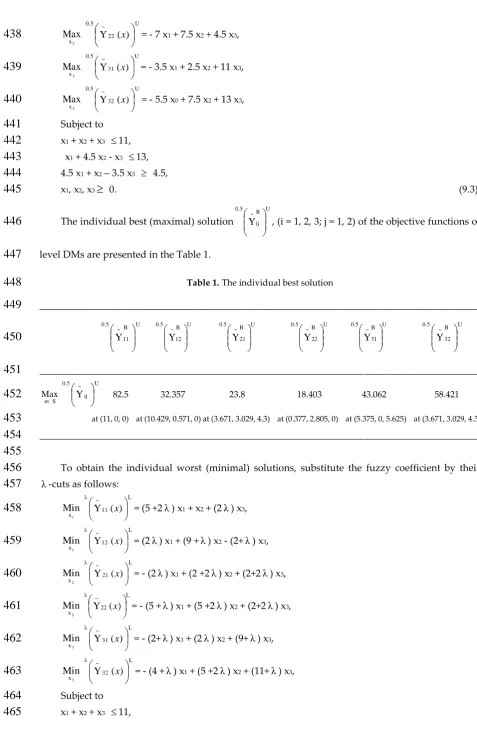
The individual best (maximal) solution
U B
ij ~ 0.5
Y
, (i = 1, 2, 3; j = 1, 2) of the objective functions of
446
level DMs are presented in the Table 1.
447
Table 1.The individual best solution
448
________________________________________________________________________________________
449
U B
11 ~ 0.5
Y
U B
12 ~ 0.5
Y
U B
21 ~ 0.5
Y
U B
22 ~ 0.5
Y
U B
31 ~ 0.5
Y
U B
32 ~ 0.5
Y
450
__________________________________________________________________________________________________
451
S Max
x
U
ij ~ 0.5
Y
82.5 32.357 23.8 18.403 43.062 58.421
452
at (11, 0, 0) at (10.429, 0.571, 0) at (3.671, 3.029, 4.3) at (0.377, 2.805, 0) at (5.375, 0, 5.625) at (3.671, 3.029, 4.3)
453
__________________________________________________________________________________________________
454
455
To obtain the individual worst (minimal) solutions, substitute the fuzzy coefficient by their
456
λ-cuts as follows:
457
1 x
Min
L
11 ~ λ
) (
Y
x = (5 +2λ) x1 + x2 + (2λ) x3,
458
1 x
Min
L
12 ~ λ
) (
Y
x = (2λ) x1 + (9 +λ) x2 - (2+λ) x3,
459
2 x
Min
L
21 ~ λ
) (
Y
x = - (2λ) x1 + (2 +2λ) x2 + (2+2λ) x3,
460
2 x
Min
L
22 ~ λ
) (
Y
x = - (5 +λ) x1 + (5 +2λ) x2 + (2+2λ) x3,
461
3 x
Min
L
31 ~ λ
) (
Y
x = - (2+λ) x1 + (2λ) x2 + (9+λ) x3,
462
3 x
Min
L
32 ~ λ
) (
Y
x = - (4 +λ) x1 + (5 +2λ) x2 + (11+λ) x3,
463
Subject to
464
x1 + x2 + x3 11,
x1 + 4.5 x2 - x3 13,
466
4.5 x1 + x2– 3.5 x3 4.5,
467
x1, x2, x3
0. (9.4)468
For λ= 0.5, the above problem (9.4) reduces to the problem as given below.
469
1 x Min L 11 ~ 0.5 ) ( Y x = 6 x1 + x2 + x3,
470
1 x Min L 12 ~ 0.5 ) ( Y x = x1 + 9.5 x2 - 2.5 x3,
471
2 x Min L 21 ~ 0.5 ) ( Y x = - x1 + 3 x2 + 3 x3,
472
2 x Min L 22 ~ 0.5 ) ( Y x = - 5.5 x1 + 6 x2 + 3 x3,
473
3 x Min L 31 ~ 0.5 ) ( Y x = - 2.5 x1 + x2 + 9.5 x3,
474
3 x Min L 32 ~ 0.5 ) ( Y x = - 4.5 x1 + 6 x2 + 11.5 x3,
475
Subject to
476
x1 + x2 + x3
11,477
x1 + 4.5 x2 - x3
13,478
4.5 x1 + x2– 3.5 x3
4.5,479
x1, x2, x3
0. (9.5)480
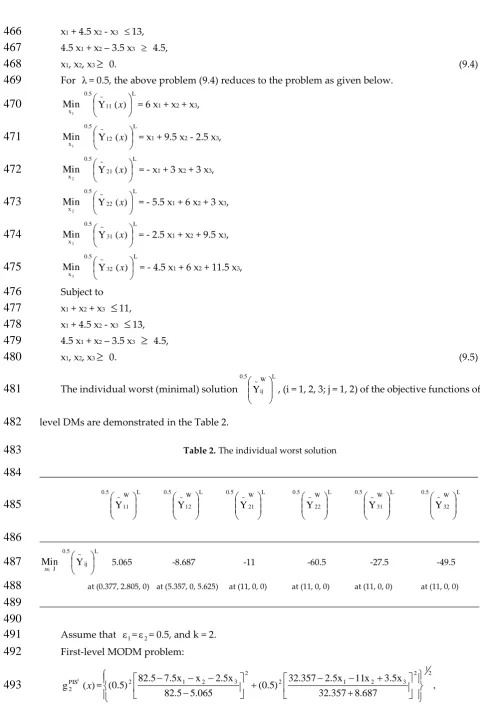
The individual worst (minimal) solution
L W ij ~ 0.5 Y
, (i = 1, 2, 3; j = 1, 2) of the objective functions of
481
level DMs are demonstrated in the Table 2.
482
Table 2.The individual worst solution
483
________________________________________________________________________________________484
L W 11 ~ 0.5 Y L W 12 ~ 0.5 Y L W 21 ~ 0.5 Y L W 22 ~ 0.5 Y L W 31 ~ 0.5 Y L W 32 ~ 0.5 Y 485
__________________________________________________________________________________________________486
J Min x L ij ~ 0.5 Y 5.065 -8.687 -11 -60.5 -27.5 -49.5
487
at (0.377, 2.805, 0) at (5.357, 0, 5.625) at (11, 0, 0) at (11, 0, 0) at (11, 0, 0) at (11, 0, 0)
488
__________________________________________________________________________________________________
489
490
Assume that ε1=ε2= 0.5, and k = 2.
491
First-level MODM problem:
492
) ( gPIS1
2 x = ,
) ( gNIS1
2 x =
2 1 2 3 2 1 2 2 3 2 1 2 687 . 8 357 . 2 3 687 . 8 3.5x x 11 2.5x ) 5 . 0 ( 065 . 5 5 . 82 5.065 -2.5x x 7.5x ) 5 . 0 (
494
We determine:
PIS
* 2 ( )g 1 x = J Min x 1 PIS 2
g (x) = 0.022 at (10.509, 0.491, 0);
gPIS2 1(x)
= J Max x 1 PIS 2g (x) =
495
0.606 at (1, 0, 0);
NIS
* 2 ( )g 1 x = J Max x 1 NIS 2
g (x) = 0.69 at (10.429, 0.571, 0);
gNIS2 1(x)
= J Min x 1 NIS 2g (x) = 0.134 at
496
(1.415, 0, 0.533).
497
The membership functions of PIS1 2
g (x) and NIS1 2
g (x) can be formulated as follows:
498
022 . 0 ) ( g if 1, 606 . 0 ) ( g 022 . 0 if , 022 . 0 606 . 0 ) ( g 606 . 0 ) ( g 0.606 if 0, ) ( μ 1 1 1 1 1 PIS 2 PIS 2 PIS 2 PIS 2 PIS 2 g x x x x x ;499
) ( μ NIS12
g x =
69 . 0 ) ( g if 1, 69 . 0 ) ( g 0 if , 134 . 0 69 . 0 134 . 0 -) ( g 134 . 0 ) ( g if 0, 1 1 1 1 NIS 2 NIS 2 NIS 2 NIS 2 x x x x500
Solve the following MODM Model to obtain the satisfactory solution of First-level DM:
501
Min α
502
Subject to
503
((1 + (x1 – 10.509)
0.096 + (x2 – 0.491)
0.096 + (x3 – 0)
(-0.002) – 0.004)/ (1-0.004)) + d-PISi= 1,504
1 + (x1 – 10.429)
0.1 + (x2 – 0.571)
0.183 + (x3 – 0)
(-0.036) +-NISi
d = 1,
505
α -PIS1 d ,α
-NIS1
d ,
506
-PIS1
d [0, 1], -NIS1
d [0, 1],
507
x1 + x2 + x3 11,
508
x1 + 4.5 x2 - x3 13,
509
4.5 x1 + x2– 3.5 x3 4.5,
510
x1, x2, x3
0. (9.6)511
The satisfactory solution of the First-level MODM problem is obtained as F* x = ( F*
1
x , F* 2
x , F* 3
x ) =
512
(10.429, 0.571, 0). Suppose the First-level DM decides F* 1
x = 10.429 with lower tolerance 1 1
= 5.929513
and upper tolerance 1 1
= 0.571 such that 10.429 – 5.929 x1 10.429 + 0.571.
514
) (
gPIS2 2 x = ,
5 . 60 403 . 18 4.5x x 5 . 7 7x 403 . 18 ) 5 . 0 ( 11 8 . 23 4.5x x 5 . 4 2.5x 8 . 3 2 ) 5 . 0 ( 2 1 2 3 2 1 2 2 3 2 1 2
516
) ( gNIS2 1 x =2 1 2 3 2 1 2 2 3 2 1 2 5 . 60 403 . 18 5 . 60 4.5x x 5 . 7 7x -) 5 . 0 ( 11 8 . 23 11 4.5x x 5 . 4 2.5x -) 5 . 0 (
517
We calculate:
gPIS2 ( )
* 2 x = J Min x 2 PIS 2g (x) = 0.013 at (3.653, 3.027, 4.276);
gPIS2 2(x)
= J Max x 2 PIS 2g (x) =
518
0.953 at (11, 0, 0);
gNIS2 ( )
* 2 x = J Max x 2 NIS 2g (x) = 0.698 at (3.671, 3.029, 4.3);
g2NIS1(x)
= J Min x 2 NIS 2g (x) =
519
0.054 at (8.96, 0, 2.04).
520
The membership functions PIS2 2 g
μ (x) and NIS2 2 g
μ (x) can be obtained as follows:
521
013 . 0 ) ( g if 1, 953 . 0 ) ( g 013 . 0 if , 013 . 0 953 . 0 ) ( g 953 . 0 ) ( g 0.953 if 0, ) ( μ 1 1 1 1 2 PIS 2 PIS 2 PIS 2 PIS 2 PIS 2 g x x x x x ;522
) ( μ NIS22
g x =
698 . 0 ) ( g if 1, 698 . 0 ) ( g 054 . 0 if , 054 . 0 698 . 0 054 . 0 -) ( g 054 . 0 ) ( g if 0, 1 2 1 2 NIS 2 NIS 2 NIS 2 NIS 2 x x x x .523
MODM model for Second-level DM for obtaing satisfactory solution is developed as given
524
below.
525
Min α
526
Subject to
527
1 + (x1 – 3.653)
(-0.05) + (x2 – 3.027)
0.557 + (x3 – 4.276)
0.036 +-PIS2
d = 1,
528
1 + (x1 – 3.671)
(-0.088) + (x2 – 3.029)
0.123 + (x3 – 4.3)
0.103 +-NIS2 d = 1,
529
α -PIS2
d ,α -NIS2 d ,
530
-PIS1
d [0, 1], -NIS2
d [0, 1],
531
x1 + x2 + x3 11,
532
x1 + 4.5 x2 - x3 13,
533
4.5 x1 + x2– 3.5 x3 4.5,
534
x1, x2, x3
0. (9.7)535
The satisfactory solution of the Second-level MODM problem is determined as S* x =
536
( S* 1
x , S* 2
x , S* 3
x ) = (3.672, 3.027, 4.3). Let the Second-level DM decides S* 2
x = 3.027 with lower tolerance
537
2 2
= 1.027 and upper tolerance22= 1.473 such that 3.027 – 1.027
x2
3.027 + 1.473.Third-level MODM problem:
539
) (
gPIS2 3 x = ,
5 . 49 421 . 58 x 2 1 x 5 . 7 5.5x 421 . 58 ) 5 . 0 ( 5 . 27 062 . 43 9.5x x 2.5x 062 . 3 4 ) 5 . 0 ( 2 1 2 3 2 1 2 2 3 2 1 2
540
) ( gNIS2 3 x =2 1 2 3 2 1 2 2 3 2 1 2 5 . 49 421 . 58 5 . 49 12x x 5 . 7 5.5x -) 5 . 0 ( 5 . 27 062 . 43 5 . 7 2 9.5x x 2.5x -) 5 . 0 (
541
Here,
PIS
* 2 ( )g 3 x = J Min x 3 PIS 2
g (x) = 0.062 at (3.849, 2.713, 4.438);
gPIS2 3(x)
= J Max x 3 PIS 2g (x) = 0.744 at
542
(11, 0, 0);
NIS
*2 ( )
g 3 x = J Max x 3 NIS 2
g (x) = 0.625 at (3.671, 3.029, 4.3);
gNIS3( )
2 x =
J Min x 3 NIS 2
d (x) = 0.02 at (10.241,
543
0.613, 0).
544
The membership functions of PIS3 2
g (x) and NIS3 2
g (x) can be presented as given below.
545
062 . 0 ) ( g if 1, 744 . 0 ) ( g 062 . 0 if , 062 . 0 744 . 0 ) ( g 744 . 0 ) ( g 0.744 if 0, ) ( μ 3 1 3 3 3 PIS 2 PIS 2 PIS 2 PIS 2 PIS 2 g x x x x x ;546
) ( μ NIS32
g x =
652 . 0 ) ( g if 1, 652 . 0 ) ( g 02 . 0 if , 02 . 0 652 . 0 02 . 0 -) ( g 02 . 0 ) ( g if 0, 3 3 3 3 NIS 2 NIS 2 NIS 2 NIS 2 x x x x547
Next, in order achieve the satisfactory solution of Third-level DM, we solve the following
548
MODM model:
549
Min α
550
Subject to
551
((1 + (x1 – 3.849)
(-0.04) + (x2 – 2.713)
0.032 + (x3 – 4.438)
0.125) – 0.072)/ (1-0.072) +-PIS3
d =
552
1,
553
1 + (x1 – 3.671)
(-0.049) + (x2 – 3.029)
0.048 + (x3 – 4.3)
0.137 +-NIS3 d = 1,
554
α -PIS3
d ,α -NIS3 d ,
555
-PIS3
d [0, 1], -NIS3
d [0, 1],
556
x1 + x2 + x3
11,557
x1 + 4.5 x2 - x3
13,558
4.5 x1 + x2– 3.5 x3
4.5,559
x1
0, x2
0, x3
0. (9.8)560
By solving the above Eq. (9.8), the satisfactory solution of the Third-level DM is obtained as T* x =
561
( T* 1
x , T* 2
x , T* 3
decides T* 3
x = 4.3 with lower tolerance 3 3
= 2.3 and upper tolerance 3 3
= 0.7 such that 4.3 – 2.3
x3563
4.3 + 0.7.564
Finally, the FGP models due to Dey et al. [30] for solving MO-MLPP involving fuzzy
565
parameters based on TOPSIS method are formulated as follows:
566
Model (I)
567
Minimize ρ
568
Subject to
569
((1 + (x1 – 10.509)
0.096 + (x2 – 0.491)
0.096 + (x3 – 0)
(-0.002) – 0.004)/ (1-0.004)) +-PISi D = 1,
570
1 + (x1 – 10.429)
0.1 + (x2 – 0.571)
0.183 + (x3 – 0)
(-0.036) + D-NISi= 1,571
1 + (x1 – 3.653)
(-0.05) + (x2 – 3.027)
0.557 + (x3 – 4.276)
0.036 + D-PIS2= 1,572
1 + (x1 – 3.671)
(-0.088) + (x2 – 3.029)
0.123 + (x3 – 4.3)
0.103 + D-NIS2= 1,573
((1 + (x1 – 3.849)
(-0.04) + (x2 – 2.713)
0.032 + (x3 – 4.438)
0.125) – 0.072)/ (1-0.072) +-PIS3 D =
574
1,
575
1 + (x1 – 3.671)
(-0.049) + (x2 – 3.029)
0.048 + (x3 – 4.3)
0.137 + D-NIS3= 1,576
ρ -PISi
D ,ρ -NISi
D , (i = 1, 2, 3)
577
-PISi
D [0, 1], -NISi
D [0, 1], (i = 1, 2, 3)
578
x1 + x2 + x3 11,
579
x1 + 4.5 x2 - x3 13,
580
4.5 x1 + x2– 3.5 x3 4.5,
581
10.429 – 5.929 x1 10.429 + 0.571,
582
3.027 – 1.027 x2 3.027 + 1.473,
583
4.3 – 2.3
x3
4.3 + 0.7,584
x1, x2, x3
0. (9.10)585
The optimal solution of the Model (I) for MO-MLPP is shown in the Table 3.
586
587
588
Table 3. The optimal solution of Model (I)
589
__________________________________________________________________________________________________
590
Approach Optimal solution Optimal solution point Objective values Membership values
591
Model (I)
ρ
= 0.3550353 4.963, 2.559, 3.478 48.475, 28.384, 14.759, 0.561, 0.903, 0.74,592
0.102, 27.285,37.11 0.768, 0.776, 0.802
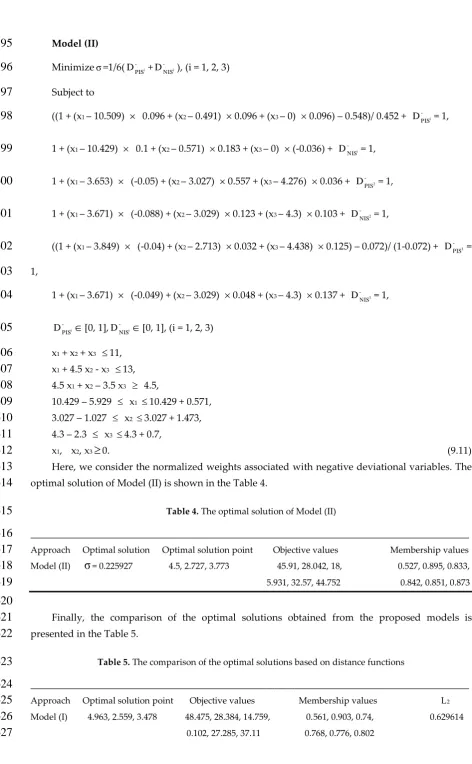
593
Model (II)
595
Minimizeσ=1/6( -PISi
D +
-NISi
D ), (i = 1, 2, 3)
596
Subject to
597
((1 + (x1 – 10.509)
0.096 + (x2 – 0.491)
0.096 + (x3 – 0)
0.096) – 0.548)/ 0.452 +-PISi D = 1,
598
1 + (x1 – 10.429)
0.1 + (x2 – 0.571)
0.183 + (x3 – 0)
(-0.036) +-NISi D = 1,
599
1 + (x1 – 3.653)
(-0.05) + (x2 – 3.027)
0.557 + (x3 – 4.276)
0.036 +-PIS2 D = 1,
600
1 + (x1 – 3.671)
(-0.088) + (x2 – 3.029)
0.123 + (x3 – 4.3)
0.103 + D-NIS2= 1,601
((1 + (x1 – 3.849)
(-0.04) + (x2 – 2.713)
0.032 + (x3 – 4.438)
0.125) – 0.072)/ (1-0.072) + D-PIS3=602
1,
603
1 + (x1 – 3.671)
(-0.049) + (x2 – 3.029)
0.048 + (x3 – 4.3)
0.137 +-NIS3 D = 1,
604
-PISi
D
[0, 1], -NISiD
[0, 1], (i = 1, 2, 3)605
x1 + x2 + x3 11,
606
x1 + 4.5 x2 - x3 13,
607
4.5 x1 + x2– 3.5 x3 4.5,
608
10.429 – 5.929 x1 10.429 + 0.571,
609
3.027 – 1.027 x2 3.027 + 1.473,
610
4.3 – 2.3 x3 4.3 + 0.7,
611
x1, x2, x3
0. (9.11)612
Here, we consider the normalized weights associated with negative deviational variables. The
613
optimal solution of Model (II) is shown in the Table 4.
614
Table 4. The optimal solution of Model (II)
615
________________________________________________________________________________________
616
Approach Optimal solution Optimal solution point Objective values Membership values
617
Model (II)
σ
= 0.225927 4.5, 2.727, 3.773 45.91, 28.042, 18, 0.527, 0.895, 0.833,618
5.931, 32.57, 44.752 0.842, 0.851, 0.873
619
620
Finally, the comparison of the optimal solutions obtained from the proposed models is
621
presented in the Table 5.
622
Table 5. The comparison of the optimal solutions based on distance functions
623
________________________________________________________________________________________
624
Approach Optimal solution point Objective values Membership values L2
625
Model (I) 4.963, 2.559, 3.478 48.475, 28.384, 14.759, 0.561, 0.903, 0.74, 0.629614
626
0.102, 27.285, 37.11 0.768, 0.776, 0.802