Article
1
Exploring the Future Development of Research,
2
Technology and Business of Machine Tool Domain
3
in new-generation information technology
4
environment based on Machine Learning
5
Jihong Chen 1, Kai Zhang 1, Yuan Zhou 2,*, Yufei Liu 3, Lingfeng Li 1, Zheng Chen 1 and Li Yin1
6
1 National Numerical Control Systems Engineering Research Center, School of Mechanical Science and
7
Engineering, Huazhong University of Science and Technology, Wuhan 430074, China;
8
[email protected](J.C.); [email protected](K.Z.); [email protected](L.L.);
9
[email protected](Z.C.); [email protected](Y.L.)
10
2 School of Public Policy and Management, Tsinghua University, Beijing 100084, China; [email protected](Y.L.)
11
3 The CAE Center for Strategic Studies, Chinese Academy of Engineering, Beijing 100088, China
12
* Correspondence: [email protected]; Tel.: +86-138-0120-7051
13
Received: date; Accepted: date; Published: date
14
Abstract: The combination of new-generation information technology and manufacturing
15
technology has resulted in major and profound impact on future development paradigm of
16
manufacturing. It is challenging for existing methods to conduct a multidimensional trend
17
exploration related to machine tool domain, which is the basis of virtually everything in
18
manufacturing. In this paper, we proposed an integrating approach framework combined topic
19
models, bibliometric, trend analysis and patent analysis to mine insightful information about future
20
development from multi-source data related to machine tool, such as papers, grants, patents and
21
news. Specifically, papers and grants provided two different perspectives to explore the current
22
focuses and future trends in machine tool research. Furthermore, the future technology
23
development of machine tool was investigated through patents analysis. Finally, news related to
24
machine tool industry in recent years was analyzed to analyze future machine tool business mode.
25
The integration of the above various analytical methods and the multi-dimensional mining of
26
literatures enabled the analysis of the future development of machine tool domain systematically
27
from multi-perspectives which include research, technology development and industry. The
28
conclusions obtained in this paper is beneficial to different communities of machine tool in terms of
29
determining the research directions for researchers, identifying industry opportunities for
30
corporations and developing reasonable industry policy for policy makers.
31
Keywords: future development analysis; machine tool; machine learning; multi-source data; topic
32
model
33
34
1. Introduction
35
The explosive growth of the new-generation information technology and the deep integration
36
with manufacturing technology have formed the main driving forces of the new round industrial
37
revolution, which is triggering major and profound changes in the manufacturing technical systems,
38
development paths and industry modes [1-3]. The machine tool is the ubiquitous instruments in
39
manufacturing industry and virtually everything in industries is manufactured on the basis of the
40
Machine tool [4]. As machine tool plays a unique role in industry, machine tool technology is bound
41
to become the essential part to the change of manufacturing in the condition of new-generation
42
information technology and thus support the sustainable development of manufacturing further [5].
43
As a support and symbol of manufacturing paradigm change, exploring the development trend of
44
machine tool is of great significance to identify and grasp the opportunity to develop manufacturing
45
industry for a variety of communities.
46
The development of specific technology domain depends on the synergy of intrinsic
47
characteristics of technology and external factors. Through the analysis, we conclude that machine
48
tool discipline possesses the following two complex characteristics.
49
1) Complex inherent heterogeneous nature of machine tool technology. The reason lies in
50
machine tool technology belongs to an interdisciplinary categorization whose technical category
51
covers various fields such as mechanics, hydraulics, control, materials, microelectronics and
52
information technology. Complex interactions and effects exist in various related technical fields,
53
presenting complex intrinsic heterogeneity [6].
54
2) The dimension complexity of development caused by the deep integration of the
new-55
generation information technology and machine tool technology. The cross-integration of the
new-56
generation information technology and machine tool domain runs through all aspects of research,
57
management, service and other technical activities. It is noting that conducting a simple analysis of a
58
certain dimension of technical activities is difficult to clarify the future evolution in machine tool field
59
comprehensively [7].
60
The two complexities summarized above make it a challenging task to analyze the development
61
trend of the machine tool field.
62
Many research have been employed to explore the development trend of machine tool discipline.
63
Raju et al. carried out an qualitative literature study to describe research focus and current trends on
64
Micro Electro-Discharge Machining, including its requirements, performance and applications [8]. In
65
addition, there exists other similar literature reviews carried out to explore the current states and
66
trends of specific subcategory of machine tools [9, 10]. The characteristic of these studies are based
67
on the accumulated expert's experience to qualitative review the papers related to a specific
sub-68
technology of machine tools and analyze its development trend. With the change of information
69
environment in machine tool domain recently, some other researches aimed at exploring future
70
development trend of machine tool technology overall which also depended on qualitative analysis
71
[5]. Based on expert domain experience, these works provided valuable insights to some extent for
72
guiding the future development of technology. However, it is difficult to explore a large number of
73
related papers by reading them because of the enormous time and energy required and the
74
difficulties in comprehending topics in heterogeneous areas [11]. The above qualitative analysis
75
method is incapable of keeping up with the rapid increase number of papers comprehensively in the
76
whole machine tool discipline. In addition, it is challenging for conventional qualitative review
77
method to tackle the complex inherent heterogeneous of machine tool technology. Moreover, the
78
above qualitative works are based solely on the literature review of the papers of specific machine
79
tool technology or the analysis based on expert experience, but failed to conduct multi-dimensional
80
collaborative exploration from various aspects of as research, technology development and business
81
mode. As a result, the conclusion of the review analysis is easy to generate knowledge solidification
82
and make predictions along the existing technical paradigm, which may lead to the neglect of
83
emerging trends under the new technology development paradigm [12, 13].
84
Scientific literatures have been considered as a valuable and rich source of knowledge or a key
85
proxy about technology development, reflecting the current technological focuses in their respective
86
disciplines and the trend of technology development in both theory and practice [14, 15]. Bibliometric
87
or patent analysis method have been widely employed by many researchers to analyze scientific
88
literatures quantitatively, which was regarded as a more systematic, objective, and effective method
89
compared to qualitative literature review approach to explore the evolution trend of specific
90
discipline [16-19]. For example Ernst analyzed the patent data in the machine tool industry to explore
91
the future development trend of CNC technology [20]. Attempts to quantitative analysis of the
92
development of domain by methods such as bibliometric can help to solve the limitations of
93
objectivity and comprehensiveness of qualitative review method to some extent [21, 22]. However,
94
these works ignored the multi-dimensional analysis of multi-source literatures related to specific
95
researchers have focused on the integration of multi-source data to conduct the task of technology
97
trend exploration [24, 25]. The combination of multi-source technology data contributes to
98
incorporate more information to carry out a more comprehensive analysis of technology evolution.
99
However, these studies lack the semantic analysis of the content of scientific literatures and make it
100
difficult to dig into the content of the literatures to explore the evolution trend of technology [15]. In
101
light of the fact that literatures can enable us to obtain the solutions to specific problems and learn
102
the creation of new ideas, a large amount of information reflecting the technological development
103
trend exist in the content of scientific literatures. Implementing detailed mining of literatures content
104
can help us obtain deeper insight into technology development [11]. To effectively process and
105
analyze the content of scientific literatures, machine learning method based on topic models have
106
been proposed and widely used in technical foresight tasks in recent years [26-32]. The topic models
107
in above works can be employed to mine a large number of literature contents to obtain latent
108
intellectual structures of technological focuses related with a specific technology domain, which can
109
model the complex inherent heterogeneous technology structures. The limitation of existing
110
technology forecasting works based on topic models is to choose only papers for analysis and lack
111
multi-dimensional data association and integration to explore future evolution of technology.
112
To investigate the development of machine tool discipline, we proposed an integrated approach
113
framework in this paper. The proposed framework combined machine learning, trend analysis,
114
patent analysis and bibliometric to analyze multi-source literatures related to machine tool
115
systematically, including papers, funds, patents and news. What’s more, the integrated framework
116
proposed in this paper could analyze the future evolution of machine tool domain from the
multi-117
view perspectives of research, technology development and business mode. Concretely, machine
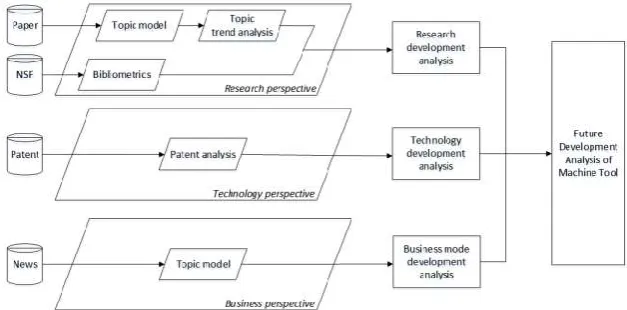
118
learning method based on topic models were applied to obtain existing intellectual structures of
119
research focuses within machine tool domain. Trend analysis method models dynamic evolution
120
over time for the extracted research focuses to predict future research trends. Science grants is an
121
important dimension reflecting research activity and bibliometric is used to analyze the NSF grants
122
of machine tool as a complement to machine tool papers analysis. Based on the analysis of the above
123
research perspective, the proposed approach used patent analysis methods, including patent
124
development trajectories and institutional cooperation networks to analyze patents to explore the
125
technology development of machine tool. Finally, topic model extracted the latent intellectual
126
structures from the latest news contents related to machine tool business to model the business modes
127
focuses of machine tool industry. As a result, the framework proposed by us can carry out
multi-128
dimensional and semantic analysis of multi-source data and explore the development of machine
129
tool from multi-layered perspective.
130
The rest of this paper is organized as follows: Section 2 reviews the related researches. Section 3
131
presents the main framework proposed and the data applied for subsequent analysis. Section 4
132
discusses the experiments and discussions, and finally Section 5 concludes this paper.
133
2. Related Work
134
Although much attention has been paid to explore future development trend of specific
135
technology, existing methods are limited in terms of taking the whole ecosystem of technology domain
136
into consideration when analyzing the evolution of domain. In this section, we review recent progress
137
on the task of technology trend analysis and give a brief summary.
138
2.1 Trend analysis of machine tool
139
Recently, machine tool domain has been given new connotations and entered a new stage of
140
development [7]. Many researchers adopted qualitative review method of literatures to explore the
141
evolution trend of machine tool [8-10]. Tang provided a state of the art review on algorithms for
142
collision detection and avoidance in five-axis NC machining and explored the challenges that needed
143
to be addressed further [33]. Lauro et al. presented a brief review of monitoring techniques and signal
144
processing methods applied in machining processes to identify technological focus in that field [34].
145
prospected future trends of technology [35]. In addition, similar works include qualitative review of
147
papers literatures of specific technology such as spindle thermal error compensation, reliability
148
analysis and reconfigurable machine tools to identify technological focuses and explore future trends
149
of specific technology [36-38]. The characteristics of these studies are based on the expert's experience
150
to conduct an in-depth qualitative review for papers related to a sub-technology of machine tools and
151
analyze the current progress and future trend of the technology. However, given the limited research
152
scope and energy of single expert it is difficult to analyze a large number of related documents by
153
reading them. As a result, the above literature review method is incapable of keeping up with the
154
rapid increase number of papers comprehensively in the whole machine tool discipline and makes it
155
hard to analyze and track the future development of machine tool systematically. In addition, the
156
application of qualitative review method based on papers above is difficult to generalize to a
157
comprehensive analysis of the future development of the entire machine tool domain.
158
Some other researches aimed to study future development trend of the entire machine tool field
159
[4, 7, 39]. For example, Liu et al. proposed a new generation of machine tool, i.e. Cyber-Physical
160
Machine Tool as a future development trend of machine tools technology [5]. However, these works
161
depended only on the experience of experts to explore the future development of machine tool. The
162
conclusions are easy to generate knowledge solidification and make predictions along the existing
163
technical paradigm, resulting in their objectivity, consistency and validity is limited [12, 13]. In
164
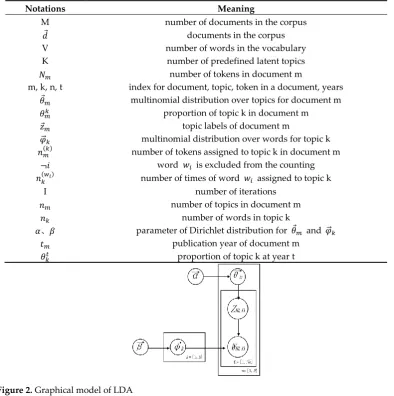
particular, the impact of the new-generation information technology on machine tool field runs
165
through the entire technology cycle and it is essential to carry out multi-dimensional analysis of
166
research, technology development and business to clarify the current and future development of
167
machine tool. The existing works lack a multi-layer analysis of machine tool technical activities.
168
2.2 Bibliometric and patent analysis for technology forecasting
169
Compared with qualitative review method, based on available abundant scientific literatures
170
the use of quantitative analysis method can provide objective information to explore technology
171
future development [19, 40]. Many researchers have adopted bibliometrics or patent analysis method
172
to investigate future evolution of technology [17, 40]. Marzi et al. presented a bibliometrics analysis
173
to discuss product and process innovation in the manufacturing and provided insights about future
174
research avenues in the manufacturing field [16]. Ernst analyzed the patent data in the machine tool
175
industry to explore the future development trend of CNC technology [20]. The quantitative analysis
176
method helps to relieve the limitations of the objectivity and validity of the qualitative review method
177
to a certain extent [21, 22]. However, existing works only analyze a single data dimension (papers or
178
patents) and ignore to conduct collaborative analysis of multi-source data, such as papers, patents,
179
funds, and news, to explore the future development of technology from a more comprehensive
180
perspective. Multi-dimensional data maps all aspects of technical activities, including richer
181
information on domain development. Recently, more and more works focused on the integration of
182
multi-source literature data to conduct technology trend analysis [25]. Wang et al. carried out a
183
review and emerging technology forecast in nanogenerator using integrating methods to analyze
184
papers and patents literature [24]. Xu et al. conducted a method to explore the innovation capacities
185
of a multi-layered innovation ecosystem, merging publication data, patent data and business data
186
[41]. Multi-source data integration enables analyzing the development trend of technology domain
187
more objectively. However, no work attempts to analyze the multi-source literature data in the
188
machine tool to explore the its future development. Moreover, It is noting that the existing
189
quantitative analysis works of multi-source data used for technology forecasting consider limited
190
information and lack of in-depth semantic analysis of the content of scientific literatures [15].
191
2.3 Machine learning method in emerging technologies analysis
192
The content of the scientific literature contains abundant information and knowledge reflecting
193
the technology concerns and future development trends. Further exploration and understanding of
194
the literature contents will help us gain insights into the future evolution of technology [30]. To
195
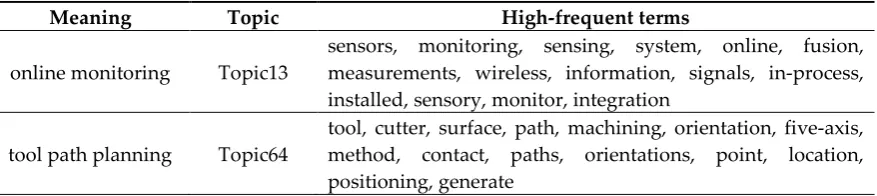
has been widely used in technology trend analysis tasks in recent years [26-29, 32].Yang et al.
197
explored the research trending topics of smart factories using topic modeling method to determine
198
the future research directions [11]. Abuhay et al. modeled the underlying topical structures of the
199
International Conference on Computational Science and provided insights regarding the past and
200
future technology trends in computational science [31]. In these works, topic models mined a large
201
number of literature contents to obtain latent intellectual structures of technological focuses related
202
with a specific technology domain which could be used subsequent technology forecasting task. To
203
the best of our knowledge, no research has been done applying topic models to perform a large-scale
204
and systematic research of scientific literatures related to Machine Tool. In addition, there exists
205
obvious limitation in these existing works. Specifically, the above works take only a single data
206
dimension into consideration for analysis and lack the association and integration of
multi-207
dimensional data, making it difficult to collaboratively explore the technology domain future
208
evolution from the multi-perspective of research, technology development and business.
209
Compared with qualitative literature review method, quantitative methods can improve
210
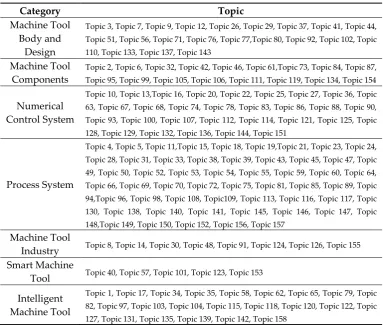
objectivity and validity of analysis results. Moreover, the integration of multi-source literatures can
211
more comprehensively analyze the development trends of the technical domain. Furthermore, the
212
topic model can conduct semantic analysis for the contents of the literatures to model complex
213
inherent heterogeneous of the technology. Based on the above analysis and in light of the complex
214
characteristics of the machine tool domain, in this paper we proposed an integration framework
215
combining machine learning method and other data mining approaches to analyze multi-source
216
literature data related to machine tool domain and explore the future trend of this domain from
multi-217
perspective including research, technology development and business dynamics.
218
3. Method and Data
219
In this section, we will discuss the proposed framework and literature data for analysis in this
220
paper. Specifically, in section 3.1 we will first discuss the research framework to explore the future
221
development of machine tool domain from multiple-dimension perspectives. Then in Section 3.2, we
222
will discuss the multi-source literature data acquisition in machine tool. Finally, In Section 3.3 we will
223
detail discuss topic model which is core component in the proposed framework.
224
3.1 Method Framework
225
Given the fact that it is critical to identify and grasp the opportunity to develop machine tool,
226
the future development of the machine tool field is an important question to be solved. In light of the
227
emerging information technologies penetrate into all aspects of machine tool domain, the above
228
problem can be broken down into the following three sub-problems. First, what new changes will
229
occur in machine tool research in the future under the influence of the new-generation information
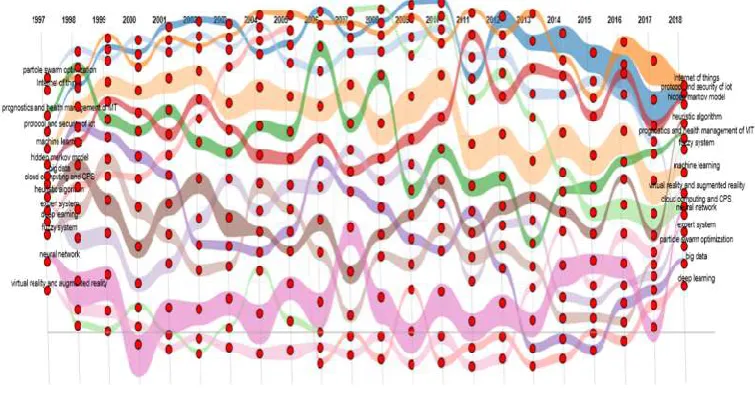
230
technology? Second, what impact will emerging information technology have on technology
231
development of machine tool? And third, what emerging business modes emerge in machine tool
232
industry. In order to solve above problems, this paper developed an approach framework as shown
233
in figure 1. The proposed framework is based on the integration of four methods, including topic
234
model, trend analysis, patent analysis and bibliometric.
235
This framework explored the future development of research, technology and business in
236
machine tool discipline by analyzing multi-source data related to machine tool. Specifically, we
237
mainly select literature of papers to analyze the research evolution of machine tool as papers is a
238
source of knowledge that maps specific discipline research activities and contains abundant
239
information that reflects current development and future trend of that discipline [15]. The papers
240
reflect the output of the research activity, while the grants reflect the input of the research. Compared
241
with papers, the literature of grants contains some additional information on the people, inputs and
242
processes of science activity [42]. We choose the literature of grants related with machine tool to
243
conduct an auxiliary analysis for the research evolution. The literature of patents is a mapping of
244
technology development in a specific domain. For this reason, the patents have been considered as a
245
choose patents to investigate the new changes of technology development of machine tool. Given the
247
fact that the Google searches news publications written to reflect the business and market, we apply
248
the Google news related with machine tool industry to analyze the new changes of business modes
249
of this industry [44]. Data collection methods and pre-processing steps will be discussed in section
250
3.2.
251
252
Figure 1. Future Development analytical framework of machine tool
253
The integrated framework proposed above is used to analyze the multi-source literatures data
254
of machine tool. In order to analyze the research development of machine tool, topic model is used
255
for mining latent intellectual structures of research concerns from literature of papers. Then based on
256
topic strength development through time of modeled research focuses, we conduct trend analysis by
257
the way of Mann-Kendall test method and predict development trend of research focuses [45]. As a
258
useful supplement to the literature of papers, a simple bibliometric analysis of grants is carried out
259
as an auxiliary perspective to explore the research development of machine tool. Furthermore, patent
260
analysis methods (including Patent growth trajectory and institutional cooperation network) are
261
applied to analyze the technology development of machine tool. Patent growth trajectory can reflect
262
the state of technological development very well [46]. Finally, in order to clarify the problem of the
263
change of the machine tool business mode, topic model is used to mine the latent intellectual topics
264
of business focuses from the collected news. The advantage of the approach framework proposed is
265
that it can integrate semantics, time dynamics and the fusion of multi-dimensional data to carry out
266
multi-perspective evolution analysis of machine tool domain in complex environment. The main
267
machine learning method involved in our framework will be discussed in Section 3.3 below.
268
3.2 Data collection
269
In this study, we selected papers, funds, patents, and news related to machine tool domain to
270
analyze its development. This section will discuss in detail the acquisition method and pre-processing
271
steps of data used for analysis.
272
Papers data used in this paper were searched from Science Citation Index
Expanded(SCI-273
EXPANDED) and Social Sciences Citation Index(SSCI) databases on the Web of Science, which are
274
the most authoritative scientific and technical literature indexing tool [47]. The search time range of
275
SCI-EXPANDED database was set from 1997-2018 as SCI-EXPANDED did not contain data before
276
the year of 1997. For the same reason, the search time range of SSCI database was set from 2000-2018.
277
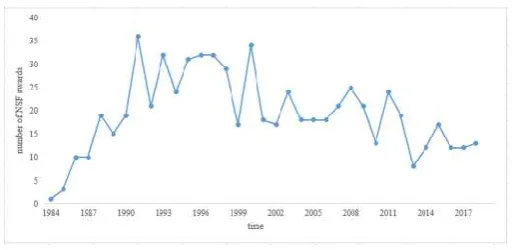
In addition, in order to ensure the quality of the retrieved data and facilitate subsequent analysis, at
278
the time of retrieval we restricted results by English language and set document type as Article. Based
279
on above settings, we searched papers literatures that contained terms such as "Machin* tool*",
280
“machin* center*”, “milling center*” and "NC machin*" et al. as the raw data. The raw papers
281
collected included the title, abstract, author, publication year, source and other field information.
282
Because the abstract is a compact representation of a paper, we chose the exported abstract field to
283
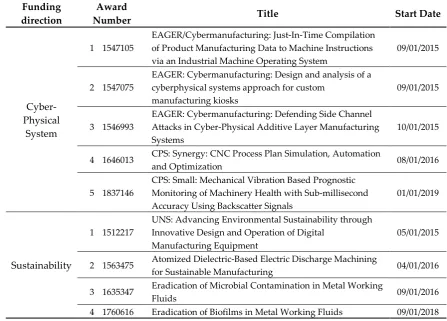
information that hinders subsequent data mining analysis. We performed the pre-processing steps
285
listed in Table 1 below to remove the noise information. Among which, NLTK stop words list is a
286
commonly used stop word list in natural language processing, including a, the, of, for, etc., which do
287
not contain valuable information to comprehend the future development of technology. The CNC
288
machine tool domain stop words list refers to the stop word list specific to the machine tool, including
289
words such as abstract, paper, experiment, method, etc., which also do not contain useful information
290
for exploring the development of domain. After pre-processing steps, we collected 7832 papers to
291
constitute the final paper dataset of machine tools for analysis experiments.
292
Table 1. pre-processing steps
293
Step Description
1 Remove repeat document
2 Remove stop words from NLTK stop words list
3 Remove stop words from CNC machine tool field stop words list 4 Remove low and high frequency words
5 Remove abstract whose length less than 20
For grants related with research, we extracted from the National Science Foundation (NSF)
294
award database. NSF is a federal funding agency and searching the NSF award database allows for
295
retrieval the whole awards issued by the NSF [42]. In this paper, we used the keywords "Machin*
296
tool*", “machin* center*”, “milling center*” and "NC machin*" et al. to retrieve fund data related with
297
machine tool and time range is set from 1984 to 2019. Then 675 awards were retrieved from the NSF
298
award database. As for patent data analyzed in this paper, we built a unique patent database on
299
machine tool from Derwent World Patents Index database with time range from 1997 to 2018. We
300
searched the patents belonging to the two IPC classification numbers B23 and G05B001918. The
301
specific retrieve keywords are given in the section 4.2. The reason for selecting these two IPC
302
classification numbers is that the B23 classification number indexes patents within machine tool, and
303
G05B001918 indexes the patents related to the numerical control system. Finally, we obtained 10090
304
patents for subsequent experiment analysis and we also chose the patent abstract information as a
305
proxy for the patent text. As for the news related to machine tool business, we selected the keywords
306
"business model", "market trend", "future trend" OR "new mode" et al. within the range of machine
307
tool represented by the keywords of "Machin* tool*", “machin* center*”, “milling center*” and "NC
308
machin*" to retrieve relevant news data from Google search with time range from 2015 to 2019. Then
309
we used the crawler tool to crawl the search results from Google Chrome. The acquired news dataset
310
was used for subsequent data analysis tasks after the pre-processing steps shown in Table 1. After
311
removing the noise data, the final 1120 news were obtained. The various multi-source data
312
information related to machine tool field is summarized in Table 2.
313
Table 2. Information summary of multi-source data related with machine tool
314
Dataset Source Number
Papers Web of Science 7832
Grants NSF award database 675
Patents Derwent World Patents Index database 10090
News Google News 1120
3.3 Topic Model
315
Given a document corpus, the purpose of topic model is to allow users to explore the hidden
316
intellectual structures behind the corpus in the form of topics. Latent Dirichlet Allocation (LDA) has
317
been widely used for inferring latent topics from document collections based on the basic
318
assumptions that each topic is represented as a multinomial distribution over a vocabulary and each
319
document is represented as a multinomial distribution over these topics [26]. In this paper we use
320
section we discuss the principles of LDA in detail. The notations and their corresponding meanings
322
used in this paper are summarized in table 3.
323
The graph model of LDA is shown in figure 2. Given a document collection containing M
324
documents, the dictionary generated by this collection consists of V different words. We assume the
325
number of latent topics contained in this collection is K.
326
Table 3. Notations used in topic modeling.
327
Notations Meaning
M number of documents in the corpus
⃗ documents in the corpus
V number of words in the vocabulary
K number of predefined latent topics
number of tokens in document m
m, k, n, t index for document, topic, token in a document, years
⃗ multinomial distribution over topics for document m
proportion of topic k in document m
⃗ topic labels of document m
⃗ multinomial distribution over words for topic k
( )
number of tokens assigned to topic k in document m
¬ word is excluded from the counting
( )
number of times of word assigned to topic k
I number of iterations
number of topics in document m number of words in topic k
、 parameter of Dirichlet distribution for ⃗ and ⃗
publication year of document m proportion of topic k at year t
328
Figure 2. Graphical model of LDA
329
LDA is a probabilistic generative model. When generating the mth ( ∈ [1, ]) document in
330
corpus, LDA samples a topic multinomial distribution ⃗ for the ducument m from a Dirichlet prior
331
distribution with hyper-parameter ⃗ : p ⃗ ⃗ = ⃗ ⃗ where ⃗ and ⃗ are both K
332
dimensional vectors and the elements of ⃗ are satisfied with: ∑ ⃗ , = 1, k=1,...,K. Then LDA
333
assigns a latent topic , for each word , in document m ( ∈ [1, ]) based on the topic
334
multinomial distribution ⃗ of the mth document. n characterizes the position of the word in
335
document and satisfies collection ∈ [1, ] where states the number of words in ducument m.
336
Assuming all words is independent from each other in a document in LDA, for document m, the joint
337
probability of topic assignments for all words is shown in formula 1 where ⃗ characterizes topic
338
assignments for all words in mth document.
339
p ⃗ ⃗ = p , ⃗ (1)
As discussed above the kth topic is assumed to be a multinomial distribution over V words in
340
the dictionary. According to LDA, each multinomial distribution of topic ⃗ follows a Dirichlet prior
341
distribution with hyperparameters ⃗ : p ∅ ⃗ = ( ⃗ | ⃗) where both ⃗ and ⃗ are V
dimensional vectors, ∅ denotes a matrix with × dimension containing all topics’ multinomial
343
distributions. ⃗ , denotes the probability of generating word w given topic k and it satisfies
344
∑ ⃗ , = 1, where w=1,...,V. Then each word in document m can be generated by sampling from the
345
corresponding multinomial distribution of latent assignment topic: p , | = , = ⃗ , .
346
Given a document collection, , is observable variable, and are prior
hyper-347
parameters. , 、⃗ and ⃗ , are hidden variables which can be estimated by the observed words
348
in corpus. The joint distribution of all variables is as follows:
349
p ⃗ , ⃗ , ⃗ , ∅| ⃗, ⃗ = , | ⃗ , ∙ , | ⃗ ∙ ⃗ | ⃗ ∙ ∅| ⃗ (2)
The hidden variables in the generative process can be approximated by applying the Gibbs
350
Sampling method. The parameters inference method of Gibbs Sampling has been widely used in
351
various parameters estimating problems of topic models. We can derive the conditional distribution
352
to sample a topic z for each word of corpus in every iteration as follows:
353
p( = | ⃗¬, ⃗) ∝
,¬ ( )
+
∑ ( ),¬ + ∙
,¬ ( )
+
∑ (,¬) + (3)
Figure 3 presents the abstract of a randomly selected machine tool paper and the results of the
354
topic modeling. The selected paper discusses about cloud service mode in machine tool
355
manufacturing. Compared with other topics, topic 174 has a much higher proportion in modeling
356
results. It can be seen from the word distribution under topic 174 that the topic is mainly about cloud
357
services, which demonstrates the effectiveness of topic modeling.
358
359
Figure 3. topic modeling result of paper abstract
360
4. Results and Discussions
361
This section presents the results of the experimental analysis and discussion. Concretely, Section
362
4.1 presents data mining results for papers and grants to analyze current focuses and future trends
363
of machine tool domain under research perspective. Then, section 4.2 discusses the analysis of patents
364
to explore the technology development of machine tool. Finally, in section 4.3 we examine the
365
changes in the business mode of machine tool industry through the analysis of news.
366
4.1 Analysis to research trend of machine tool
367
4.1.1 Topic modeling of machine tool papers
368
In this section, we conducted topic modeling for papers of the machine tool domain to mine
369
topic extraction tasks. Previous studies have shown that consider only statistical indicator to
371
determine the hyper-parameters of the LDA may produce incoherent quality topics which constitutes
372
the primary obstacle to acceptance of topic models in practice [48, 49]. The main reason lies in the
373
objective function of the LDA model may not correlate well with human judgments [50]. In order to
374
model the technical concerns in the actual machine tool research activities more accurately, we used
375
manual inspection method to adjust the model to optimize the modeling effect and determine the
376
hyper-parameters of LDA. Upon manual inspection, we found that 180 topics resulted in a
377
granularity that better captures the scientific intellectuals within machine tool domain, i.e., K was set
378
180. As for other hyper-parameters α、β and I, we recommend setting α=0.1, β=0.01 and I=1000.
379
Under this set of hyper-parameters setting, the LDA model works best. After completing the topic
380
modeling of the machine tool papers, we employed manual interpretation method to check the mined
381
research topics and removed noisy topics. The noise topic refers to a topic that does not reflect a clear
382
technology meaning as a whole. For example, a modeled topic consists of words such as ”size”,
383
“average”, “sample”, “factor”, “small” and “large” etc. To facilitate subsequent analysis, we removed
384
these noise topics and finally obtained 158 topics. For reasons of display space, the overall topic
385
modeling results of the machine tool papers are shown in table A1 in the appendix. Some of the
386
representative results we selected are shown in Table 4 below. Every piece of intellectual structures
387
modeled is characterized by 15 high frequency terms. Furthermore, based on prior knowledge of
388
machine tool, we labeled each topic and mapped it to the actual machine tool research concerns, as
389
seen in the "Meaning column" in Table A1.
390
Table 4. Examples of the topic modeling results of machine tool papers
391
Meaning Topic High-frequent terms
online monitoring Topic13
sensors, monitoring, sensing, system, online, fusion, measurements, wireless, information, signals, in-process, installed, sensory, monitor, integration
tool path planning Topic64
tool, cutter, surface, path, machining, orientation, five-axis, method, contact, paths, orientations, point, location, positioning, generate
We further give a brief analysis and explanation for the topic modeling results of machine tool
392
papers. For example, Topic 92 is composed of terms like “vibration”, “frequency”, “amplitude”,
393
“mode”, “resonance” and “suppression” etc., which refers to the research point of “vibration
394
suppression”. Topic 133 consists of “component”, “structural”, “design”, “mechanical”,
395
“performance” and “topology” etc., which reflects “structure design” of machine tool. Based on prior
396
domain knowledge, we can know that both of above topics are sub-areas of machine tool design
397
research. Furthermore, topic 25 (characterized by "measuring", "inspection", "coordinate", "system",
398
"error", and "profile" etc.) refers to "profile control", which belongs to research of numerical control
399
system category. In addition, there are many topics in the modeling results reflecting technologies
400
related to process system in machine tool. For example, topic 64 characterizes "tool path planning"
401
concern. Based on our domain knowledge, the latent intellectual structures obtained by topic
402
modeling are highly correlated with the actual research activities of the machine tool. In addition,
403
many research concerns obtained by LDA model exceed the research scope of traditional machine
404
tools domain. Topic139 contains words like “learning”, “deep”, “algorithms”, “representations”,
405
“convolutional” and “temporal” and refers to “deep learning” technology in artificial intelligence
406
(AI). Deep learning is the research frontier and hot spot of current AI. The topic mining results reflect
407
that deep learning has been applied to research exploration in the field of machine tools and has
408
become a research focus in this field. Similar research focuses are abundant in the results of modeling
409
like topic153 etc., indicating that external information technologies has been widely integrated with
410
research in the machine tool domain.
411
In order to further explore the impact of the new-generation information technology on machine
413
tool research activities, we divide the research concerns modeled in the 4.1.1 section according to the
414
category of the machine tool domain to which it belongs, as shown in Table 5. We can classify the
415
machine tool technology category into “Machine Tool Body and Design”, “Machine Tool
416
Components”, “Numerical Control System”, “Process System” and “Machine tool industry” et al.,
417
which conform to the conventions of the traditional machine tool field. In addition, the “Machine tool
418
industry” category consists of some research concerns about the management of machine tools
419
industry, as our paper dataset contains some SSCI papers which cover the management aspects of
420
machine tools. In all categories, the “Process System” category and “Numerical Control System”
421
category contains the largest number of research concerns, accounting for 34.8% and 19.0% of the
422
total research concerns respectively. In light of our prior domain knowledge, these two categories are
423
the focuses of research in machine tool domain.
424
Table 5. Categorization of machine tool research concerns
425
Category Topic
Machine Tool Body and
Design
Topic 3, Topic 7, Topic 9, Topic 12, Topic 26, Topic 29, Topic 37, Topic 41, Topic 44, Topic 51, Topic 56, Topic 71, Topic 76, Topic 77,Topic 80, Topic 92, Topic 102, Topic 110, Topic 133, Topic 137, Topic 143
Machine Tool Components
Topic 2, Topic 6, Topic 32, Topic 42, Topic 46, Topic 61,Topic 73, Topic 84, Topic 87, Topic 95, Topic 99, Topic 105, Topic 106, Topic 111, Topic 119, Topic 134, Topic 154
Numerical Control System
Topic 10, Topic 13,Topic 16, Topic 20, Topic 22, Topic 25, Topic 27, Topic 36, Topic 63, Topic 67, Topic 68, Topic 74, Topic 78, Topic 83, Topic 86, Topic 88, Topic 90, Topic 93, Topic 100, Topic 107, Topic 112, Topic 114, Topic 121, Topic 125, Topic 128, Topic 129, Topic 132, Topic 136, Topic 144, Topic 151
Process System
Topic 4, Topic 5, Topic 11,Topic 15, Topic 18, Topic 19,Topic 21, Topic 23, Topic 24, Topic 28, Topic 31, Topic 33, Topic 38, Topic 39, Topic 43, Topic 45, Topic 47, Topic 49, Topic 50, Topic 52, Topic 53, Topic 54, Topic 55, Topic 59, Topic 60, Topic 64, Topic 66, Topic 69, Topic 70, Topic 72, Topic 75, Topic 81, Topic 85, Topic 89, Topic 94,Topic 96, Topic 98, Topic 108, Topic109, Topic 113, Topic 116, Topic 117, Topic 130, Topic 138, Topic 140, Topic 141, Topic 145, Topic 146, Topic 147, Topic 148,Topic 149, Topic 150, Topic 152, Topic 156, Topic 157
Machine Tool
Industry Topic 8, Topic 14, Topic 30, Topic 48, Topic 91, Topic 124, Topic 126, Topic 155 Smart Machine
Tool Topic 40, Topic 57, Topic 101, Topic 123, Topic 153
Intelligent Machine Tool
Topic 1, Topic 17, Topic 34, Topic 35, Topic 58, Topic 62, Topic 65, Topic 79, Topic 82, Topic 97, Topic 103, Topic 104, Topic 115, Topic 118, Topic 120, Topic 122, Topic 127, Topic 131, Topic 135, Topic 139, Topic 142, Topic 158
However, by analyzing the results of the topic modeling, we can find a considerable amount of
426
research concerns do not belong to the traditional machine tool domain. For this reason, we cannot
427
simply divide them into the original machine tool categories. It is noting that these concerns reflect
428
new developments in machine tool research under the influence of emerging information
429
technologies. Based on the characteristics of these research focuses, we divided them into two new
430
categories labeled "Smart Machine Tool" and "Intelligent Machine Tool" respectively in Table 5.
431
Concretely, the "Smart Machine Tool" category contains research focuses such as “Internet of things
432
(IoT)”, “protocol and security of IoT”, “big data”, “distributed platform” and “cloud computing and
433
Cyber-physical system”. The above research concerns are closely related to emerging information
434
technologies, reflecting that the interconnection of machine tool equipment and the collection of
435
machine tool big data is getting more and more attention from scholars within domain. For
436
“Intelligent Machine Tool”, this category contains research concerns like “deep learning”, “machine
437
learning”, “neural network”, “expert system” and “heuristic algorithm” et al. These concerns are all
438
artificial intelligence domain with its powerful feature representation learning ability. In addition,
440
this category also includes research on machine tool intelligent application technology supported by
441
intelligent analysis methods, such as “prognostics and health management of machine tool” and
442
“machine tool condition monitoring”. The categorization of “Intelligent Machine Tool” shows that
443
intelligent methods such as deep learning and its application in the machine tool domain have
444
become the focuses of researchers and many research works have been carried out around the
445
direction of machine tool intelligence. Through the above investigation, we can conclude that the
446
integration of the new-generation information technology and machine tools has brought significant
447
changes to the research system in the machine tool domain, which has led to new exploration
448
directions outside the traditional research scope of machine tool. Researchers are beginning to focus
449
on the integration of machine tools with artificial intelligence, industrial Internet of things, big data
450
analytics, cloud computing and cyber-physics systems to enable machine tool to operate in a more
451
flexible, efficient, energy-efficient and sustainable manner.
452
Based on the above analysis, we selected the representative research concerns in the two
453
categories of “Smart Machine Tool” and “Intelligent Machine Tool” to draw the evolution river map
454
during the research process of machine tool, aiming at more intuitively displaying the impact of the
455
new-generation information technology on the research activities of machine tools which is shown in
456
Figure 4 below. The width of the evolution curve for each particular research concern selected in each
457
year is proportional to the topic strength of the research concern at that year. The calculation formula
458
of topic strength for a specific technology is as follows:
459
=∑ × I( = )
∑ I( = ) (4)
where M is the number of papers in the corpus and is the publication year of paper m. (∙)
460
denotes indicator function, that the function takes a value of 1 when the expression in parentheses is
461
true, otherwise it takes a value of 0.
462
463
Figure 4. evolution river map of the selected research concerns
464
From the river map of technology evolution, we can see that the research concerns like "Internet
465
of things", "protocol and security of IoT", "cloud computing and Cyber-physical system", "machine
466
learning" and "deep learning" etc. have gradually become more and more important in the research
467
community of machine tools. This further clarify the characteristic of gradual integration between
468
machine tool research and emerging information technologies.
469
4.1.3 Topic trend analysis
470
The above discussion analyzes the emerging research concerns that occur in research community
471
process of machine tool. In this section, we further explore the future development trend of these
473
emerging research concerns generated in machine tool domain. In experiment, we focused on the
474
research topics contained in the two categories of “Smart Machine Tool” and “Intelligent Machine
475
Tool” in Table 5, because these two categories best reflect the impact of the new-generation
476
information technology on the research ecology of machine tool. According to formula 4, we
477
calculated the topic strength of 27 elements under two categorization year by year and further
478
obtained the evolutionary sequence of 27 elements over time respectively. Then we used the
Mann-479
Kendall trend analysis method to detect the rising or falling trend of the selected research focuses
480
[45]. Through trend analysis, “protocol and security of IoT”, “internet of things”, “big data” and
481
“cloud computing and CPS” in the “Smart Machine Tool” category showed a significant rising trend,
482
as shown in the following Figure 5(a). This suggests the fact that these technologies will become
483
increasingly important in future machine tool research. Furthermore, for the "Intelligent Machine
484
Tool" category, "deep learning", "machine learning", "hidden markov model" and other seven topics
485
presented a rising trend as shown in Figure 5(b). In addition, the six research topics including "fuzzy
486
system", "neural network", "expert system" and so on showed a significant falling trend as shown in
487
Figure 5(c) below.
488
(a) (b) (c)
Figure 5. Research topic trends of machine tool
489
We conducted a brief analysis of the research topics characterized with an increasing or
490
decreasing trend. The rise or decline of a specific research focus implies deep principles of discipline
491
development. In view of the fact that the new-generation information technology has changed the
492
information environment of the manufacturing industry and will greatly improve the operational
493
performance and efficiency of physical objects, researchers in the machine tool domain will also focus
494
on how to obtain inside and outside big data of the CNC machine tool and how to apply artificial
495
intelligence to mine big data to realize self-learning of knowledge. Then, based on the interconnection
496
of machine tools, the problem of accumulation and inheritance of knowledge will be further solved.
497
The self-learning, accumulation and inheritance of knowledge in the machine tool is a core issue in
498
the domain, which further promotes the attempts of machine tool researchers to solve it through
499
emerging information technology. Big data research focus is mainly about data collection,
500
transmission, storage and fusion of multi-source heterogeneous data. Multi-source heterogeneity is
501
also a typical feature of machine tool big data, which can explain that big data will become more and
502
more important in the research of machine tools. Cloud computing studies how to analyze big data
503
efficiently to meet the speed requirements of data analysis in the industry. The machining process of
504
machine tool continues to accumulate a large amount of internal and external data, which requires
505
real-time analysis of the data and rapid feedback of the analysis results. This real-time data analysis
506
demand will make cloud computing attract more and more attention in future machine tool research.
507
Internet of things studies how to achieve equipment interconnection. As discussed above, the
508
interconnection of equipment will improve the ability to manage machine tool resources and the
509
sharing of domain knowledge. Given the special characteristic of industrial production, safety is of
510
paramount importance. The protocol and security of internet of things (IoT) focuses on explore how
511
to ensure the security of the Internet of Things. The above discussion can explain the rising trend of
512
IoT and security related concerns in research of machine tool. As for machine learning, it aims to
513
representation learning ability, has achieved the state-of-the-art performance on many predictive
515
tasks related with machine tool. Based above reasons, machine learning, in particular deep learning,
516
will receive more and more focus by machine tool researchers. The exploration of these advanced
517
algorithm models makes it possible to develop from the descriptive analysis to the diagnostic,
518
predictive and strategic analysis, which further promotes the research of intelligent applications like
519
fault prediction and prognostic and health management in machine tool and helpimproving people's
520
analytical decision-making ability for complex tasks under uncertain environment. Under the
521
synergy of big data, internet of things, cloud computing and artificial intelligence, the enhancement
522
of the perception, analysis and control ability of the machine tool processing state makes it possible
523
to map the actual machining state of the machine tool to the virtual space. As can be seen from Figure
524
5(a), more and more research focuses on cyber-physical system (CPS) modeling of machine tools. The
525
reason lies in that the fusion of the cyber and physical space of will further greatly improve the
526
traditional simulations and actual machining methods in the domain of machine tools.
527
For the research concerns that decline in Figure 5(c), fuzzy system, expert system and heuristic
528
algorithm belongs to the research category of traditional analysis methods. These methods solve
529
some of the problems in the machine tool domain but inevitably have many limitations, which makes
530
them gain decreased attention. For instance, it is difficult for expert system to acquire and represent
531
domain knowledge of expert, which resulted in its generalization ability in practical tasks is not
532
strong. It is worth noting that the trend of neural networks as a classical machine learning method is
533
also declining in machine tool research. The reason lies in that, different from deep learning, neural
534
network refers to the shallow network and requires manual feature engineering as input. However,
535
deep learning enables end-to-end modeling to learn features automatically. In addition, the deep
536
learning model owes a larger capacity than the neural network, which means that the model can
537
complete complex learning tasks. In view of the advantages of deep learning and the application of
538
big data and cloud computing, deep learning has replaced the research of shallow neural networks
539
to some extent in the machine tool domain.
540
4.1.4 Research analysis of machine tools based on fund data
541
As research input, grants is an important data dimension reflecting research activities. We
542
retrieved the grants related to machine tool from the NSF award database to analyze the research in
543
the machine tool domain further. The retrieval method for grants is described in Section 3.2 and we
544
obtained 675 grants related to the machine tool domain through retrieval. The number over time of
545
machine tool grants granted by NSF is shown below.
546
547
Figure 6. The number over time of machine tool grants granted by NSF
548
It can be observed from Figure 6 that the number of granted grants by NSF related to machine
549
tool has declined in recent years. The possible reason lies in that the US manufacturing industry has
550
gradually focused on cutting-edge research, and funding awards for conventional manufacturing
551
technologies have been reduced. And the United States is the first country in the world to carry out
552
research on machine tool technology, and many of its machine tool research technologies have
553
7.96% of the total number of machine tool grants granted by NSF. We further analyzed the 54 grants
555
since 2015 and found that two research concerns were the focuses of NSF funding in recent years.
556
One of the research topic is the “Cyber-physical system” which has been the fund award focus for
557
the past five years as shown in Table 6 below, accounting for 9.3% of the total number of machine
558
tool grants after 2015. Given the fact that individual research funding activity of NSF does not cover
559
the whole research scope of the machine tool domain, we are unable to verify all of the above
560
conclusions derived from the machine tool papers at the global level. However, from the analysis
561
perspective of machine tool funds, we can still prove that cyber-physical system is the focus and trend
562
of research in the machine tool domain, which is consistent with the conclusion mined by machine
563
tool papers. It is also worth noting that another NSF's focus in recent years is sustainability, as shown
564
in the table below. The reason is that the critical role of machine tools in the manufacturing industry
565
and the increasing constraints of global environmental and resource direct the future development
566
direction of the machine tool industry to be low energy, high efficiency, green and sustainable.
567
According to Topic 14 which is modeled from papers of machine tools in Section 4.1.1, sustainability
568
is also the focus topic of machine tool research. Topic 14 contains high-frequent terms such as
569
“industry”, “safety”, “construction”, “cost”, “economic”, “environmental”, “sustainability”,
570
“enhance”, “sustainable” and “costs” et al, representing research topic of sustainability for machine
571
tool.
572
Table 6. The grants of machine tool about cyber-physical system and sustainability
573
Funding direction
Award
Number Title Start Date
Cyber-Physical
System
1 1547105
EAGER/Cybermanufacturing: Just-In-Time Compilation of Product Manufacturing Data to Machine Instructions via an Industrial Machine Operating System
09/01/2015
2 1547075
EAGER: Cybermanufacturing: Design and analysis of a cyberphysical systems approach for custom
manufacturing kiosks
09/01/2015
3 1546993
EAGER: Cybermanufacturing: Defending Side Channel Attacks in Cyber-Physical Additive Layer Manufacturing Systems
10/01/2015
4 1646013 CPS: Synergy: CNC Process Plan Simulation, Automation
and Optimization 08/01/2016
5 1837146
CPS: Small: Mechanical Vibration Based Prognostic Monitoring of Machinery Health with Sub-millisecond Accuracy Using Backscatter Signals
01/01/2019
Sustainability
1 1512217
UNS: Advancing Environmental Sustainability through Innovative Design and Operation of Digital
Manufacturing Equipment
05/01/2015
2 1563475 Atomized Dielectric-Based Electric Discharge Machining
for Sustainable Manufacturing 04/01/2016
3 1635347 Eradication of Microbial Contamination in Metal Working
Fluids 09/01/2016
4 1760616 Eradication of Biofilms in Metal Working Fluids 09/01/2018
4.2 Development trend analysis of machine tool technology dimension
574
Patents have been considered as an important proxy to reflect technological development in
575
industry. In this section, we analyzed the patents to explore the development characteristics of
576
machine tool technology dimension under the environment of new-generation information
577
technology. From the analysis of section 4.1, the impact of emerging information technology on the
578
machine tool domain is mainly reflected in the integration and application of technologies such as
579
on this observation, we mainly focused on the development of the above technologies in the domain
581
of machine tools, as an extension of technology development dimension for the analysis of in Section
582
4.1. We searched the patent data of the relevant technologies in machine tool through the keywords
583
that constituted the various technologies in the Table 7 below. In this section, we used patent
584
development trajectories and institutional cooperation networks to analyze patent data to explore the
585
technology development of machine tool.
586
Table 7. The keywords that constituted the emerging technologies in machine tool
587
Technology Keywords
Big data
big data, data collection, data transmission, transfer protocol, Ethernet, industrial wireless network, MQTT, NC-Link, MT-Connect, wireless transmission, distributed platform, Hadoop
Cloud computing
cloud computing, edge device, edge module, fog calculation, fog end equipment, cloud platform, cloud service, cloud storage, cloud, industrial cloud, distributed computations, parallel computing, cloud manufacturing
Internet of things Internet of Things, Industrial Internet of Things, Industrial internet, IoT, IIoT
Cyber-physical
systems Cyber-Physical system, CPS, Digital twins
Intelligent methods and applications
artificial intelligence, machine learning, logistic regression, support vector machines, naïve bayes, decision tree, random forest, transfer learning, deep learning, Virtual Reality, Augmented Reality, Convolutional neural network, Recurrent neural network, Restricted Boltzmann machine, supervised learning, unsupervised learning, neural networks, customized production, remote monitoring, shared manufacturing, state prediction, state forecasting
4.2.1 Trajectories of technologies development
588
we explored the development status of specific technologies in the machine tool domain through
589
the method of patent growth trajectory. We counted the number of patents retrieved for each of the
590
emerging technologies in Table 7 by year, as shown in Figure 7 below. It can be observed from Figure
591
7 that the number of patents of the emerging technologies listed above in machine tool domain has
592
been increasing through time, indicating that these technologies play an increasingly important role
593
in the practical application of machine tools. Specifically, for big data technology, the phenomenon
594
that the number of affiliated patents in machine tool domain has been increasing by year since 2000
595
reflects the accumulation of technologies related with machine tool data acquisition, transmission
596
and storage and the gradually improvement for data basis. With the accumulation of more and more
597
data, the efficient analysis of data has become more and more critical. As can be observed from the
598
figure, the application of cloud computing technology in the machine tool domain has made great
599
progress since 2012. In addition, the internet of things technology has been applied in the field of
600
machine tools since 2017 and there has been a significant increase in the number of patents in 2018,
601
indicating that internet of machine tool is in the early stage of promotion and application. With the
602
landing of big data, cloud computing and internet of things in machine tool and the gradual
603
improvement of the machine tool information foundation, intelligent technologies such as machine
604
learning and machine learning-based applications have increased significantly from the year after
605
2015, indicating that these intelligent technologies are gradually contributing value in the practical
606
application of machine tools. However, for cyber-physical system (CPS) technology, the number of