R E S E A R C H
Open Access
Bayesian fault detection and isolation
using Field Kalman Filter
Jerzy Baranowski
*, Piotr Bania, Indrajeet Prasad and Tian Cong
Abstract
Fault detection and isolation is crucial for the efficient operation and safety of any industrial process. There is a variety of methods from all areas of data analysis employed to solve this kind of task, such as Bayesian reasoning and Kalman filter. In this paper, the authors use a discrete Field Kalman Filter (FKF) to detect and recognize faulty conditions in a system. The proposed approach, devised for stochastic linear systems, allows for analysis of faults that can be
expressed both as parameter and disturbance variations. This approach is formulated for the situations when the fault catalog is known, resulting in the algorithm allowing estimation of probability values. Additionally, a variant of algorithm with greater numerical robustness is presented, based on computation of logarithmic odds. Proposed algorithm operation is illustrated with numerical examples, and both its merits and limitations are critically discussed and compared with traditional EKF.
Keywords: Fault detection, Bayesian reasoning, Data analysis, Field Kalman Filter
1 Introduction
The problem of fault detection and isolation is one of the most important research topics in process control. Efficient methods should quickly detect the occurrence of a fault and determine the fault origin with sufficient probability. However, people usually have to deal with measurement disturbances, process noise, and compli-cated dynamics when analyzing the actual industrial pro-cesses. As the field is very broad for the purpose of this paper, we will focus on faults that can be represented by a change of either parameters in the mathematical model or parameters of stochastical disturbances of the analyzed system. Diagnosis and isolation of such faults relies on two elements—detecting the change in the parameter value and isolating what type of fault causes such change.
A typical approach to such estimation for linear dis-tributed systems is the use of variations of Kalman filters, often used as residue generators, with some kind of clas-sification algorithm. The problem of estimating the state of a linear dynamic system driven by additive Gaussian noise with unknown time varying statistics is considered in [1] through Kalman filtering with Bayesian methods for
*Correspondence: [email protected]
Department of Automatics and Biomedical Engineering, AGH University of Science and Technology, Aleja Adama Mickiewicza 30, 30-059 Krakow, Poland
estimation of noise variance, while maximum likelihood is used in [2], and correlation methods are used in [3] and [4].
In [5], methodology for the detection and accommoda-tion of actuator faults for a class of multi-input–multi-output (MIMO) stochastic systems is presented. Actuator fault diagnosis is based on the estimation of the state vec-tor, where Kalman filter is used to estimate the state. A Kalman filter approach is proposed for state estimation for stochastic discrete-time linear systems in [6–9] while in [10–12], a Kalman filter is applied for estimation of state vector for non-linear systems. Model-based isolation and estimation of additive faults in discrete-time linear Gaussian systems is presented in [13], where fault esti-mation is carried out and a Kalman filter is used with Bayesian statistics. A novel sensor fault detection and isolation algorithm based on an extended Kalman filter is presented for noise and efficiency in real-time imple-mentation in [14]. In the paper [15], a diagnostic system based on a uniquely structured Kalman filter is developed for its application to in-flight fault detection of aircraft engine sensors. A bibliographic review on a distributed Kalman filter is provided in [16] with a comparison to the different approaches. Very important group of meth-ods for fault detection and isolation is based on particle
filtering. This method, a certain extension of Kalman fil-tering, allows very good results in a wide spectrum of cases. The disadvantage can be however increased com-putational complexity. Important works on the subject are among the others [17–22].
It should be also noted that similar approach to sys-tem analysis is present in the issues of model selection and working point detection problems. First of this prob-lems is used to verify which model of the possible group fits the best presented data. It is usually connected with some kind of hypothesis testing. The second group has a special place in the process control applications. It is very often encountered in industrial situations that the system is very hard to be modeled fully representing its nonlin-ear character. In such cases, a set of linnonlin-earized models in different working points is created. Appropriate algo-rithm for choice of which linear model should now be used depending on data is very similar to fault detection and isolation one.
In this paper, the authors expand on their earlier results in [23], where the Field Kalman Filter was proposed. The Field Kalman Filter is an advanced signal processing algo-rithm which in its full form allows full estimation of state and parameters of linear systems with Gaussian distur-bances. The main disadvantage of this filter is that in general case, it is infinite dimensional, and for practi-cal applications, moving horizon approximation has to be used.
In this paper, we apply and modify this filter for the problem of fault detection and isolation. In particular, an advantage is taken over the fact that typical faults usually form a limited set of cases. In such situation, problem dimension reduces substantially, and the algo-rithm requires solution of a parameter-dependent family of systems of equations. Proposed filter is optimal for sys-tems with fixed parameters and highly efficient for those where changes in parameter values occur. We present the algorithm for computing fault probability and also its more numerically robust version for computing logarith-mic odds of fault occurrence with respect to each other possibility.
The rest of this paper is organized as follows. First, we present the Field Kalman Filter in the discrete case. Sec-ond, we formulate its application for fault detection and isolation problem. We formulate the necessary modifi-cation of the filter for parameter-varying systems with formulation of necessary forgetting operator. We discuss algorithms’ numerical drawbacks and introduce more robust modification. Then, we illustrate both algorithms’ operation with advanced examples of fault detection, where faults are either in parameters or in the distur-bances. The paper ends with discussion, comparing our results to those based on EKF and conclusions regarding future work.
Remark 1(Notation)We denote the set of symmetrical and positively defined matrices of dimension n by S+n. By x ∼ N(m,S), we understand a normally distributed random variable with a mean m and a covariance matrix S. Also, we define function N(x,m,S)as
N(x,m,S)= √ 1
(2π)n|S|exp
−1 2(x−m)
TS−1(x−m).
(1)
2 Field Kalman Filter
Let us consider the following stochastic system
xk+1=A(θ,uk)xk+B(θ,uk)uk+G(θ,uk)wk, (2)
yk =C(θ)xk+vk. (3)
We have the assumptions as following:
1. xk∈Rn,yk∈Rm,wk ∈Rl,vk∈Rm,wk ∼N(0,I), vk ∼N(0,V(θ)),
uk∈U, U= {u∈Rr :umin≤u≤umax}, k=0, 1, 2,. . ..
2. Equations (2)–(3) depend on parameter vector
θ ∈⊂Rp. The matrix functionsA,B,G,C,Vare ofC1class w.r.t. both arguments and are of
appropriate dimensions.
3. The prior distribution of parameterθwill be denoted byp0. The set of all initial distributions ofθ is defined
asπ0= {p0∈L1(;R):p0(θ)≥0 ∧ p0 1=1}.
4. We assume that the initial joint distribution of the variables(x0,θ)has the following form
q0(x0,θ)=p0(θ)N(x0,m0,S0). (4)
wherem0∈Rn, S0∈S+(n), p0∈π0.
5. The first measurement is performed atk=1, and Yk =(y1,y2, ...,yk)∈Rm×kis a matrix ofk first measurements.
Remark 2We define that observability of the parame-ters has the following property
θ1=θ2⇒p(θ1|Yk)=p(θ2|Yk)∀θ1,θ2,Yk. (5)
In other words, we require that probabilities of different values of parameters conditional on the same set of mea-surements are different. In this paper, we assume that the parameters of all considered systems are observable.
Theorem 1Let uk be given by fixed sequence and
ProofThe proof of a very similar theorem can be found in [23]. The difference is that here, we consider a discrete-time system instead of a continuous one. Nevertheless, there is a completely analogous distribution construction for these two types of time systems.
To create a diagnostic algorithm, we will need the fol-lowing corollary:
Corollary 1Under the assumptions of Theorem1, we have
ProofIt is a direct consequence of the Bayes’ theorem and Eq. (6).
Now, we can formulate the fault detection problem.
3 Fault detection problem
Equations (14) and (15) are the solution to estimating the distributions of state and parameters. This solution (fil-ter), in general, is infinite dimensional. It is caused by the fact that we need to solve Eqs. (7)–(13) for all the possible values ofθ, in order to compute the necessary integral in Eq. (15). Because of this sizeable computation, it is greatly difficult to implement in practice.
Situation changes when the number of potential param-eters in set is finite. In this case, the integral in (15) becomes a summation operator. Consequently, Eqs. (7)– (13) only need to be calculated for a finite number ofθ values.
This problem formulation, i.e., θ ∈ = {θ0, θ1,
θ2, . . ., θr}, is not a common case for parameter
estima-tion; however, it is greatly suited to a fault detection prob-lem, when we already know what type of faulty conditions can occur in the system.
Next, we denote the parameterθ0as a normal operating
condition. The parameters θ1,θ2, ..,θr represent system
faults. The initial distribution ofθcan be rewritten as
p0(θ)= r
s=0
p0,sδ(θ−θs). (16)
As a consequence, the distribution Eq. (15) becomes a discrete distribution
Equation (18) can be rewritten in a more convenient, recursive form
Now, the distribution of(xk,θ)conditioned onYktakes
the form
The set of functionsmk(θs),Sk(θs)withpk,0, pk,1, pk,2, . . .,
pk,r determines the conditional distribution p(xk+1,θ |
yk+1)in the next time step.
3.1 Forgetting operator
In real practice, parameters are time varying and the old data must be gradually forgotten, as it becomes obsolete.
The estimator might not work properly on varying parameters. For example, when enough data supports faultθj that up to numerical precision, we havepi,j = 1
andpi,s = 0 for s = j, then from Eq. (19), we can see
that adding new data, supporting different fault will not be registered (as its likelihood will be multiplied by 0).
It can be understood that if all the data, regardless of how old is it, has the same importance, then the new evidence for fault occurrence might be ignored.
To allow our estimator to handle time-varying parame-ters, we introduce a forgetting operatorF. Letα ∈ (0, 1)
then this new distribution has a greater entropy. There-fore, the amount of information about the parameters is reduced. The stationary distribution forFis uniform, i.e., limk→∞F(α)kP
0 = r−1(1, 1, ..1)T, for any initial
distribu-tionP0. It should be noted that the choice of forgetting
operator is not unique, as there are multiple possible oper-ators that increase the entropy. In our case, we interpret the parameter α as the desired depth of the memory, whereα = 1 corresponds to infinite memory, a smaller alpha value corresponds to a faster forgetting rate. Pro-posed operator was chosen through practice and does not consider the option of instantaneous forgetting, as it was not needed.
3.2 Algorithm for fault estimation
Based on the above discussion, we can formulate the following algorithm for fault estimation.
Remark 3(Calculation of conditional mean, covariance and most probable value ofθ)Proposed algorithm can also be used to estimate actual values of state and parameters
Algorithm 1Fault detecting Field Kalman Filter 1: Initialization:
4: goto Prediction step.
of the system through either mean and covariance or max-imum a posteriori estimation. The following formulas can be used:
Remark 4 It needs to be emphasized that the case, when parameters vary over time, while practically signif-icant, do not fulfill the original assumptions of the filter. Because of that, our filter, even with forgetting operator, is not optimal for the problem. However, as it can be seen in provided examples in Section 5, it is convergent in practice.
4 Improvement of numerical properties
induces an extremely small value of pk,s. Consequently,
Eq. (29) works out as a quotient of two extremely small numerical values which can cause a numerically intractable result. This numerical limitation was also observed and illustrated in a scalar system example demonstrated in Section 5 of our paper.
Therefore, to eliminate this numerical instability, we propose an alternative approach, using logarithmic odds (see for example [24]). Let us consider the logarithm of probability quotient i.e.
ek,i,j= lnpk,i pk,j
,i,j=0, 1,. . .,r. (33)
By substituting Eqs. (1) and (19) into (33) , we get the following recursion
ek,i,j=ek−1,i,j+dk,i,j, (34)
where
dk,i,j= 12ln|Wk(θj)| −12ln|Wk(θi)| +12|yk −C(θj)m−k(θj)|2W
k(θj)−1
− 1
2|yk−C(θi)m−k(θi)|2Wk(θi)−1.
(35)
To use logarithmic odds to determine most probable fault, we need to verify for which fault θs all the ratios ek,s,j are positive. Such fault has maximum a posteriori
probability.
Whenever we have positive logarithmic odds for one parameter valueθiMAP against others, i.e.,ek,iMAP,j ≥ 0 for allj=0, 1,. . .,r, then it is the most probable value of the parameter, i.e.,pk,j≤pk,iMAP.
Furthermore, to introduce the forgetting operation mentioned in Section 3.1, we can implement it as
ek,i,j=βek−1,i,j+dk,i,j (36)
whereβ ∈[ 0, 1] is a new forgetting factor. The product of ek−1,i,jandβ ∈[ 0, 1) corresponds to certain new
dis-tribution. This new distribution has greater entropy and is closer to a uniform distribution. Hence, ifβ ∈ (0, 1), the old data need to be gradually forgotten. Ifβ =0, then ek,i,j = 0 andpk,i = pk,jfor alli,j= 1,. . .,r. Ifβ = 1, it means that all the old data are supposed to be taken into account.
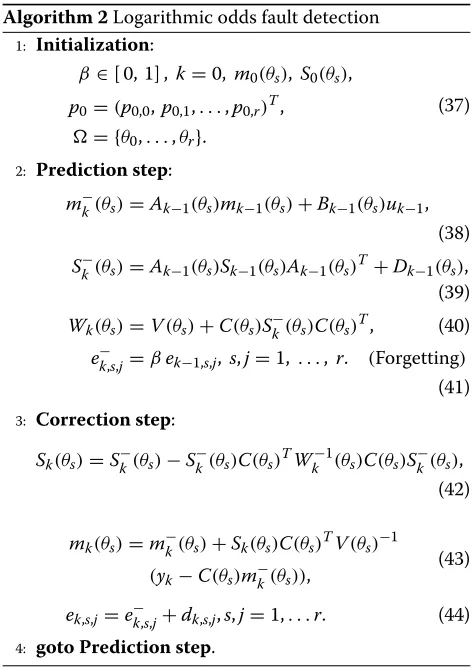
Now, we can propose a logarithmic odds algorithm for fault detection and classification:
5 Examples of operation
In this section, we illustrate the algorithm operation using three examples of linear systems. In the first one, we use Algorithm 1 for a scalar discrete system, where all elements of the system depend on the parameters (i.e., state, control and output). In the second example, we use the same algorithm for a second-order, time contin-uous system, with discrete-time observation, parameter-dependent state, control and noise matrices, and noise
variance. The final example uses the same system to illus-trate the log-odds Algorithm 2.
Algorithm 2Logarithmic odds fault detection 1: Initialization:
β∈[ 0, 1] , k=0, m0(θs), S0(θs), p0=(p0,0,p0,1,. . .,p0,r)T,
= {θ0,. . .,θr}.
(37)
2: Prediction step:
m−k(θs)=Ak−1(θs)mk−1(θs)+Bk−1(θs)uk−1,
(38)
S−k(θs)=Ak−1(θs)Sk−1(θs)Ak−1(θs)T+Dk−1(θs),
(39)
Wk(θs)=V(θs)+C(θs)S−k(θs)C(θs)T, (40)
e−k,s,j=βek−1,s,j, s,j=1,. . ., r. (Forgetting)
(41)
3: Correction step:
Sk(θs)=S−k(θs)−S−k(θs)C(θs)TWk−1(θs)C(θs)Sk−(θs),
(42)
mk(θs)=m−k(θs)+Sk(θs)C(θs)TV(θs)−1
(yk−C(θs)m−k(θs)),
(43)
ek,s,j=e−k,s,j+dk,s,j,s,j=1,. . .r. (44)
4: goto Prediction step.
5.1 Example 1. Scalar system with changes in parameters
Let us consider the following scalar system
xk+1=a(θ)xk+b(θ)uk+gwk,
yk =c(θ)xk+vk, g= √
0.1, E(v2k)=0.1. (45)
In this system, we consider a normal operation state and four fault cases. The settings of these cases are shown in Table 1. The first fault corresponds to increase in system dynamics, combined with substantial increase of system gain. The second fault introduces system oscillation but a lesser gain increase. The third fault slightly increases systems’ dynamics, increases input gain, and decreases output gain. The fourth fault introduces a larger increase in the dynamics than the third, but with smaller increment in input gain and lower reduction in output gain.
The initial conditions of the filter were set asm0(θ)=0
Table 1Parameters of system (45) dependent on normal and faulty conditions
Fault 0, normal operating Fault 1 Fault 2 Fault 3 Fault 4 conditions
a(θ) 0.9 0.5 −0.5 0.8 0.7
b(θ) 0.1 1 0.9 1 0.3
c(θ) 1 2 1.2 0.5 0.6
faults wasp0 =[0.95, 0.0125, 0.0125, 0.0125, 0.0125]. The
simulation of system started with normal operation condi-tions. Then, after every 200 steps, the operating mode was changed in such a scheme: normal, fault 1, fault 2, fault 3, fault 4, fault 3, fault 2, fault 1, and normal. The system was excited by a square input signaluwith zero mean, a period of 158, and the amplitude as 1. We set the forgetting factor asα=0.99, which is experimentally efficient.
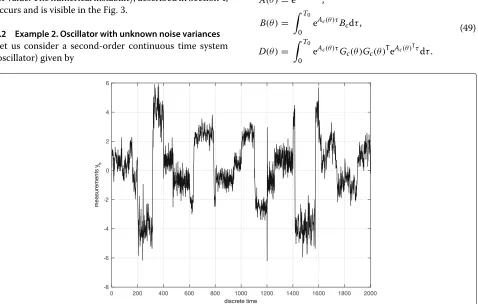
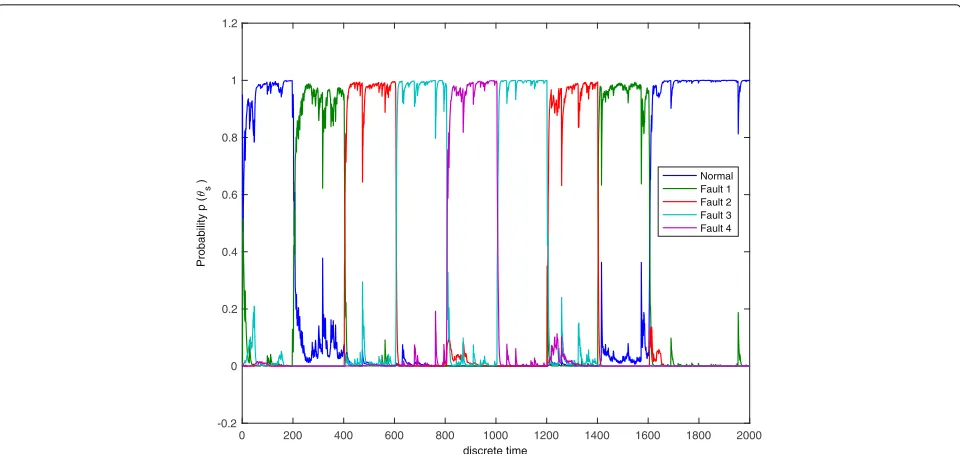
We present the measured signal in Fig. 1. We have applied the algorithm to this signal. Using Eq. (29), we computed the probabilities of particular faults and pre-sented them in the Fig. 2. We can observe consistency between maximal probability and the planned test regime of faults occurring. It is evident in Fig. 3, where the results of fault detection and isolation are presented based on maximum a posteriori estimate.
The results show that estimator reacts very quickly, usu-ally within five samples detecting a change in the parame-ter value. The numerical instability, described in Section 4, occurs and is visible in the Fig. 3.
5.2 Example 2. Oscillator with unknown noise variances
Let us consider a second-order continuous time system (oscillator) given by
dx=(Ac(θ)x+Bcu)dt+Gc(θ)dw,
Ac=
0 1
−θ2 1 −2ξθ1
, Bc=
0 bcθ12
, Gc=
0 θ2
.
(46)
with discrete-time observation
yk=x1(tk)+vk, vk∼N(0,θ3),
tk=kT0, T0>0, k=1, 2,. . .
(47)
where ξ = 0.1 and bc = 1. The initial condition is
Gaussian, i.e., x(0) ∼ N(m0,S0). We can see that this is
a system with varying natural frequency, varying process, and measurement noise variances.
Assuming that control u is a piecewise constant, i.e., u(t) = uk, t ∈[tk−1, tk), we can discretize system
(46)–(47). The discrete-time system corresponding to Eqs. (46)–(47) has the form
xk+1=A(θ)xk+B(θ)uk+G(θ)wk, yk =Cxk+vk,
x0∼N(m0,S0),C=[ 1, 0] .
(48)
where matrices A, B,and Dcan be calculated from the formulas
A(θ)=eAc(θ)T0,
B(θ)= T0
0
eAc(θ)τB
cdτ,
D(θ)= T0
0
eAc(θ)τG
c(θ)Gc(θ)TeAc(θ)
Tτ dτ.
(49)
0 200 400 600 800 1000 1200 1400 1600 1800 2000
discrete time -8
-6 -4 -2 0 2 4 6
measurements
yk
0 200 400 600 800 1000 1200 1400 1600 1800 2000 discrete time
-0.2 0 0.2 0.4 0.6 0.8 1 1.2
Probability p (
s
) Normal
Fault 1 Fault 2 Fault 3 Fault 4
Fig. 2Probability of which operation state system (45) is in conditional on the measurements. Probabilities are computed using formula (29)
G(θ) is non-uniquely defined as a factor of D(θ) = G(θ)G(θ)T. However, it is not needed for filter compu-tation. In addition, it should be noted that discretization operation (49) increases the nonlinearity of system depende nce on parameters. The discretization step isT0=0.05.
In this example, noise variancesθ2andθ3are unknown
and must be estimated, which is not a typical task. We consider four cases: normal operating conditions, change
in the oscillator natural frequency (fault 1), increase in process noise variance by an order of magnitude (fault 2), and increase in measurement noise by an order of mag-nitude (fault 3). Values of parameters corresponding to normal operating conditions and faults are shown in Table 2.
The simulation was started with normal conditions. Next, after every 2500 steps (125 s), the operating mode
0 200 400 600 800 1000 1200 1400 1600 1800 2000
discrete time -1
0 1 2 3 4 5
Fault number
Numerical instability
Table 2Parameters corresponding to normal operation and faulty conditions of oscillator (46)
Fault 0, normal operating conditions Fault 1 Fault 2 Fault 3
θ1 3.0 5.0 3.0 3.0
θ2 10−1 10−1 1.0 10−1
θ3 10−2 10−2 10−2 10−1
Parameterθ1is the oscillator natural frequency. Parametersθ2andθ3are process
and measurement noise covariances, respectively
was changed according to the scheme as normal, fault 1, fault 2, and fault 3. The inputuwas a zero mean, square signal. The forgetting factorαwas 0.99. Measurements are presented in Fig. 4. Probabilities obtained with Eq. (32) are presented in Fig. 5. Again, in this case, faults with maximum probability correspond to the fault schedule.
5.3 Example 3. Oscillator with unknown noise variances—logarithmic odds approach
In this example, we analyze the same second-order con-tinuous time system as in the example 2. The settings of parameters were as ξ = 0.1 , bc = 1, T0 = 0.05,
m0 = (0, 0)T, andS0 = 10−2I. Initial distribution was
uniform. The fault case 3 is now different than in the previous example, as the natural frequency also changes.
The simulation started with the normal conditions. Next, after every 2500 steps, the operating mode was changed in the scheme as normal, fault 1, fault 2, fault 3, and normal (see Table 3). The inputuwas a zero mean, square signal with a period of 630. The forgetting fac-torβ =was 0.995. The estimation results are shown in Fig. 6. We can see that there are no numerical errors;
however, there is a case of wrongly identified fault, when fault 2 is identified instead of normal state for a short time (comparing with a schedule).
We can reconstruct the probabilities from log-odds using formula
pk,j=
e−ek,iMAP,j r
s=0e−ek,iMAP,s
. (50)
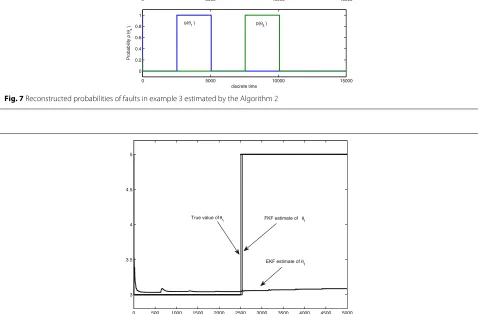
and they are presented in Fig. 7. As one can see, the prob-ability estimate is much less varying than in the case of using Algorithm 1.
6 Discussion
While proposed fault detection and isolation algorithm gives promising results, it is more than natural to compare it with the industry standard which is Extended Kalman Filter. We will now explain the differences between our approach and EKF.
The most important fact is that the Extended Kalman Filter (EKF) forms Gaussian approximation of true prob-ability density of the state variables and parameters. The original state equations are extended by adding new equations which represent parameters as constant state variables. Prediction of their mean values is based on the extended system of state equations while the covariance matrix is calculated on the basis of linearized model. The correction step is the same as in the classical Kalman fil-ter. Input noise and measurement noise covariances have to be known a priori and cannot be estimated by EKF. Due to the nonlinearity of the extended system, the EKF esti-mate can often diverge. In the considered fault isolation
0 1000 2000 3000 4000 5000 6000 7000 8000 9000 10000 discrete time
-15 -10 -5 0 5 10 15
measurements
yk
0 1000 2000 3000 4000 5000 6000 7000 8000 9000 10000 discrete time
-0.2 0 0.2 0.4 0.6 0.8 1 1.2
Probability p (
s
)
Normal Fault 1 Fault 2 Fault 3
Fig. 5Probability of which operation state the oscillator (46) is in conditional on the measurements. Probabilities are computed using formula (29)
problem, the probability density of the parameter val-ues is discrete and its Gaussian approximation formed by EKF is continuous, so it cannot represent their character properly.
All these issues suggest that EKF is not an optimal (or sufficiently sub-optimal) tool for the considered fault detection and isolation problem. Nevertheless, it is pos-sible to apply EKF for this task, using it to estimate the parameter values and providing appropriate thresholding to isolate appropriate faults.
In contrast to EKF, the proposed Field Kalman Filter forms true density of the state and parameter if the forget-ting factor is 1. Noise covariances need not to be known a priori and they can be estimated on the basis of data. Since FKF allows calculation of probabilities of particular faults it is possible to easily construct statistical tests for fault detection and isolation.
The only actual advantage of EKF over FKF is a sub-stantially reduced computational complexity. FKF needs to solve a system of equations for every considered fault type, while EKF requires solution of only one system of equations (but with extended state). This reduction
Table 3Parameters corresponding to normal operation and faulty conditions of oscillator (46) in the example 3
Fault 0, normal operating conditions Fault 1 Fault 2 Fault 3
θ1 3.0 5.0 3.0 1.0
θ2 10−1 10−1 1.0 1.0
θ3 10−2 10−2 10−2 10−1
Parameterθ1is the oscillator natural frequency. Parametersθ2andθ3are process
and measurement noise covariances, respectively
comes at a price; as for system with complicated param-eter dependence (like the one in examples 2 and 3), EKF might not converge at all. Lack of convergence for param-eter estimation (natural frequency of the oscillator) is presented in the Fig. 8.
7 Conclusions
We have presented two algorithms for fault estimation. Both of them are based on the proposed by the first two authors the Field Kalman Filter. Algorithm 1, i.e., direct application of FKF is attractive because it can be easily used for determination of fault probabilities, providing level of confidence in fault detection. There is however some numerical sensitivity connected to computations close to 0/0 operation.
At the cost of dropping, the direct probability com-putation one can use log-odds-based approach of the Algorithm 2. In this case, the problem of division by zero is reduced to addition and subtraction of numbers in the same order of magnitude. The main disadvan-tage is requirement of additional memory storage—with Algorithm 1, only the vector ofrprobabilities is needed, while Algorithm 2 requires a r× r matrix of logarith-mic odds. Additionally, the result in form of odds can be complicated to interpret if the resulting probability distri-bution of faults is multi-modal. Original probabilities can be reconstructed but also with additional computational cost.
0 5000 10000 15000 0
0.5 1 1.5 2 2.5 3
discrete time
Fault number
Fig. 6Estimated fault number in the example 3, using Algorithm 2 as a function of time
0 5000 10000 15000
0 0.2 0.4 0.6 0.8 1
Probability p
(
θs
) p(θ0) p(θ2)
p(θ3)
p(θ0)
0 5000 10000 15000
0 0.2 0.4 0.6 0.8 1
discrete time
Probability p
(
θs
) p(θ1) p(θ3)
Fig. 7Reconstructed probabilities of faults in example 3 estimated by the Algorithm 2
0 500 1000 1500 2000 2500 3000 3500 4000 4500 5000
3 3.5 4 4.5 5
discrete time
FKF estimate ofθ1
True value ofθ1
EKF estimate ofθ1
and other considered test systems. It should be however noted that they are not equivalent and their selection may require future work.
Future directions of work will include addressing the abovementioned issue, as well as implementation for more advanced systems. In particular, we want to extend the fault detection algorithm to the problems continuous in time. Additionally, the real-time performance of proposed algorithms will be tested in the laboratory environment systems.
Acknowledgements
We acknowledge this work under the scope of project titled ”PRONTO: PROcess NeTwork Optimization”. This project is financed by European commission’s HORIZON 2020 /Marie Skłodowska-Curie/ITN/EID grant agreement no: 675215.
Authors’ contributions
All the authors have participated in writing the manuscript and have revised the final version. All authors read and approved the final manuscript.
Competing interests
The authors declare that they have no competing interests.
Publisher’s Note
Springer Nature remains neutral with regard to jurisdictional claims in published maps and institutional affiliations.
Received: 31 January 2017 Accepted: 6 November 2017
References
1. D Alspach, A parallel filtering algorithm for linear systems with unknown time varying noise statistics. IEEE Trans. Autom. Control.19(5), 552–556 (1974). doi:10.1109/TAC.1974.1100645
2. R Kashyap, Maximum likelihood identification of stochastic linear systems. IEEE Trans Autom Control.15(1), 25–34 (1970).
doi:10.1109/TAC.1970.1099344
3. BM Åkesson, JB Jørgensen, NK Poulsen, SB Jørgensen, in17th European Symposium on Computer Aided Process Engineering, Computer Aided Chemical Engineering, ed. by V Ple¸su, P¸S Agachi. A tool for kalman filter tuning, vol. 24 (Elsevier, 2007), pp. 859–864.
doi:10.1016/S1570-7946(07)80166-0. http://www.sciencedirect.com/ science/article/pii/S1570794607801660. Accessed 15 Nov 2017 4. B Carew, P Belanger, Identification of optimum filter steady-state gain for
systems with unknown noise covariances. IEEE Trans Autom Control. 18(6), 582–587 (1973). doi:10.1109/TAC.1973.1100420
5. B Jiang, FN Chowdhury, Fault estimation and accommodation for linear mimo discrete-time systems. IEEE trans control syst technol.13(3), 493–499 (2005)
6. J-y Keller, DDJ Sauter, Kalman Filter for discrete-time stochastic linear systems subject to intermittent unknown inputs. IEEE Trans Autom Control.58(7), 1882–1887 (2013)
7. L Giovanini, R Dondo, A fault detection and isolation filter for discrete linear systems. ISA Trans.42(4), 643–9 (2003)
8. S Huang, KK Tan, TH Lee, Fault diagnosis and fault-tolerant control in linear drives using the Kalman filter. IEEE Trans Ind Electron.59(11), 4285–4292 (2012)
9. RH Chen, JL Speyer, A generalized least-squares fault detection filter. Int. J. Adapt. Control Sig. Process.14(7), 747–757 (2000)
10. GG Rigatos, A derivative-free Kalman filtering approach to state estimation-based control of nonlinear systems. IEEE Trans. Ind. Electron. 59(10), 3987–3997 (2012)
11. W Li, SL Shah, D Xiao, Kalman filters in non-uniformly sampled multirate systems : For FDI and beyond. Automatica.44, 199–208 (2008). doi:10.1016/j.automatica.2007.05.009
12. P Li, V Kadirkamanathan, Particle filtering based likelihood ratio approach to fault diagnosis in nonlinear stochastic systems. IEEE Trans Syst Man Cybern Part C: Appl Rev.31(3), 337–343 (2001)
13. D Antônio, T Yoneyama, Automatica A Bayesian solution to the multiple composite hypothesis testing for fault diagnosis in dynamic systems. Automatica.47(1), 158–163 (2011). doi:10.1016/j.automatica.2010.10.030 14. GH Foo, X Zhang, S Member, DM Vilathgamuwa, S Member, A sensor fault
detection and isolation method in interior permanent-magnet synchronous motor drives based on an extended Kalman filter. IEEE Trans. Ind. Electron.60(8), 3485–3495 (2013)
15. T Kobayashi, DL Simon, Hybrid Kalman filter approach for aircraft engine in-flight diagnostics: sensor fault detection case. J. Eng. Gas Turbines Power.129(3), 746–754 (2006). doi:10.1115/1.2718572
16. MS Mahmoud, HM Khalid, Distributed Kalman filtering: a bibliographic review. IET Control. Theory Appl.7(4), 483–501 (2013).
doi:10.1049/iet-cta.2012.0732. http://ieeexplore.ieee.org/document/ 6544363/. Accessed 15 Nov 2017
17. CC Drovandi, J McGree, AN Pettitt, A sequential monte carlo algorithm to incorporate model uncertainty in bayesian sequential design. J. Comput. Graphical Stat.23(1), 3–24 (2014)
18. L Martino, J Read, V Elvira, F Louzada, Cooperative parallel particle filters for online model selection and applications to urban mobility. Digital Signal Process.60, 172–185 (2017)
19. CM Carvalho, MS Johannes, HF Lopes, NG Polson, Particle learning and smoothing. Statist. Sci.25(1), 88–106 (2010)
20. C Andrier, A Doucet, R Holenstein, Particle markov chain monte carlo methods. JR Statist. Soc. B.72(3), 269–342 (2010)
21. I Urteaga, MF Bugallo, PM Djuric, Sequential Monte Carlo methods under model uncertainty. IEEE Work. Stat. Sig. Process. Proc, 1–5 (2016). doi:10.1109/SSP.2016.7551747
22. N Chopin, PE Jacob, O Papaspoliopoulos, Smc2: an efficient algorithm for sequential analysis of state-space models. JR Statist. Soc. B.75, 397–426 (2013)
23. P Bania, J Baranowski, in2016 IEEE 55th Conference on Decision and Control (CDC). Field kalman filter and its approximation, (2016), pp. 2875–2880. doi:10.1109/CDC.2016.7798697