
Tuning Variable Selection Procedures by Adding
Noise
Xiaohui Luo,
∗Leonard A. Stefanski and Dennis D. Boos
†Abstract
Many variable selection methods for linear regression depend critically on tuning parameters
that control the performance of the method, e.g., “entry” and“stay” significance levels in
forward and backward selection. However, most methods do not adapt the tuning parameters
to particular data sets. We propose a general strategy for adapting variable selection tuning
parameters that effectively estimates the tuning parameters so that the selection method
avoids overfitting and underfitting. The strategy is based on the principle that underfitting and
overfitting can be directly observed in estimates of the error variance after 1) adding controlled
amounts of additional independent noise to the response variable and 2) then running a variable
selection method. It is related to the simulation technique SIMEX found in the measurement
error literature. We focus on forward selection because of its simplicity and ability to handle
large numbers of explanatory variables. Monte Carlo studies show that the new method
compares favorably with established methods.
∗Xiaohui Luo is Biometrician, Clinical Biostatistics, Merck Research Laboratories, Rahway, NJ 07065-0900
(E-mail: edmund [email protected]).
†Leonard A. Stefanski and Dennis D. Boos are Professors, Department of Statistics, North Carolina State
KEY WORDS: AIC; BIC; Forward selection; Mallows Cp; Model selection; Regression; SIMEX.
1. INTRODUCTION
Common variable selection methods such as stepwise, forward and backward selection, and
gen-eralizations of Mallows Cp (e.g., Atkinson, 1980) depend on tuning parameters that control the
selection procedure, e.g., entry/stay significance levels for stepwise, forward and backward
selec-tion, and a penalty factor for generalized MallowsCp. Depending on the choice of tuning parameter,
the selection procedure may tend to underfit or overfit the model by selecting too few or too many
variables. For example, the default significance level to enter in the SAS forward selection
proce-dure is αEnter = 0.50 and is known to result in overfitting. Conversely, taking αEnter too small will
prevent important predictors from entering the model. Other variable selection procedures have
similar features. Atkinson’s (1980) generalization of Mallows Cp chooses the subset of variables
that minimizes a penalized log-likelihood criterion. The tuning parameter is the penalty for adding
an additional variable to the model. If this penalty is negligible, then unimportant variables will
enter the model at a high rate. If it is too large, then important variables will be restricted from
entering the chosen model.
Some studies provide general guidelines for selecting tuning parameters. For example, based
on simulation results, Atkinson (1980) and Zhang (1992) suggested that the penalty factor for
Atkinson’s generalized Mallows Cp statistic should be chosen between 1.5 and 6 (Mallows Cp is
obtained when the penalty factor is set equal to 2). Forward selection is well discussed in many
on the use of data-dependent tuning parameters for forward selection and generalized Cp. The
research described in this paper addresses this void. We introduce a generally applicable,
simulation-based method for choosing tuning parameters in variable selection procedures. The new method
exploits the fact that, when coupled with a variable selection procedure, both underfitting and
overfitting result in biased estimates of the error variance. The basic idea is to add controlled
amounts of random error to the response variable and tune the model selection procedure to estimate
the new error variance in an unbiased way. The method is related to the SIMEX (simulation
extrapolation) method used in the measurement error literature to estimate and reduce bias (Cook
and Stefanski, 1994; Stefanski and Cook, 1995; Carroll et al., 1995). In model selection contexts
Breiman (1992) adds random error to the response variable to estimate model error (see definition
below), and Ye (1998) and Shen and Ye (2002) use it to estimate model degrees of freedom.
Following a general introduction and discussion of variable selection in linear models in
Sec-tion 2., the tuning strategy is outlined in general terms and in detail for forward selecSec-tion in
Section 3. The method is extensively studied via simulation in Section 4., and further illustrated
by application to two data sets in Section 5.
2. VARIABLE SELECTION IN LINEAR REGRESSION
Consider the linear regression model
Y =µ+ǫ=X β+ǫ (1)
where Y = (Y1, Y2, . . . , Yn)T is a vector of dependent variables, µ= E(Y) =Xβ, X is a full-rank
design matrix with n observations and pMax predictors, ǫ∼ N(0, σ
2
In) with σ
2
unknown and In
Henceforth, predictors with nonzero coefficients are called important, those with zero coefficients
are unimportant. If the rows ofX are random, then we are thinking of conditional analyses holding
X fixed.
Two common objectives of variable selection are interpretation and prediction. When statistical
modeling is an adjunct to the development and testing of substantive theoretical models, the
variables that enter the model are important because they often give insight to and sometimes
guide the process of theoretical model development. For such applications of variable selection the
ability to distinguish between important and unimportant variables is paramount. This aspect of
variable selection is not as crucial when prediction is the sole or primary objective of modeling. For
prediction, the utility of the selected model is often evaluated by prediction error (PE), defined as
PE = E(Ynew−Yb)T(Ynew−Yb) = ME +n σ2
, (2)
where the expectation is taken only with respect to Ynew, and
ME = (Yb −µ)T(Yb
−µ), (3)
whereYb is the least squares estimate ofY,Ynew is a random vector independently and identically
distributed asY, and ME denotes the model error. The expected prediction error is thus determined
by the expected model error given by,
E(ME) = (E(Yb)−µ)T (E(Yb)
−µ) +p σ2
, (4)
purpose of prediction entails a bias-variance tradeoff. Entering more variables generally reduces
bias, but inflates variance.
Many model selection criteria are based on estimating statistical information such as the Akaike
Information Criterion (AIC) and the Bayesian Information Criterion (BIC). The key idea behind
an information criterion is to penalize the likelihood for the model complexity and select a model
by maximizing the penalized likelihood criterion. Under linear regression with normal errors, AIC
is asymptotically equivalent to Mallows Cp statistic, which is a special case of Atkinson’s (1980)
generalized Cp statistic, given by
GMCη(J) =
SSE(J)
σ2 −n+η pJ (5)
whereJ is a subset model,pJ is the number of predictors inJ, SSE(J) is the residual sum of squares
of J, η is the penalty factor for model complexity, and in practiceσ2
is usually estimated by σb2
F,
the residual mean squares from the full model. For given η, a model is selected by minimizing
GMCη(J) over all the subset models. But different models may be selected due to different choices
of penalty factors.
Mallows Cp (η = 2) is used widely and abused as well. It was pointed out by Mallows (1973)
and reemphasized by Mallows (1995) that E(PE) = E(σb2
Cp) if the additive error is independently
distributed with mean 0 and variance σ2
, σb2
is an unbiased estimator of σ2
, and the model is
selected independently of the data under study. But the last assumption is usually conveniently
overlooked in practice. Hence selecting a model by minimizing Cp tends to overfit, a fact which is
manifest in the Monte Carlo study in Section 4.
mean squares is given by
MSE(J) = Y
T
(In−PJ)Y
n−pJ
(6)
where In is ann×n identity matrix, and PJ =XJ(XTJ XJ)−1XTJ, the projection matrix of XJ.
IfJ contains all the important variables, (n−pJ) MSE/σ2follows aχ2n−pJ distribution and hence
E(MSE) = σ2
; we call such models inclusive. Otherwise, (n−pJ) MSE/σ2 follows a noncentral
χ2
n−pJ distribution with E(MSE) > σ
2
; such models are called non-inclusive. If the coefficients of
the important variables are not too small and the predictors are uncorrelated, then we will have
a very good separation between inclusive models and non-inclusive models. Consequently we can
find the true model by intersecting all the inclusive models.
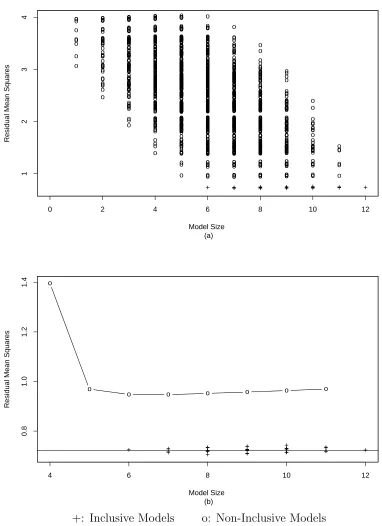
For example, suppose that there are six important variables (with coefficients all equal) among
twelve uncorrelated predictors, and that the error follows a standard normal distribution. The
common value of the coefficients is chosen so that the theoretical R2
= 0.75. In Figure 1 (a), the
MSE of each subset model is plotted versus its model size. All the inclusive models appear at the
bottom of the plot. For model sizes less than six, there is no separation between the models because
all the models are non-inclusive. In Figure 1 (b), the best non-inclusive models (giving minimum
MSE) at each model size ≥ 4 are plotted and connected, and all the inclusive models are plotted
as well. In addition a horizontal line at σb2
F is drawn as a baseline. We see that the models are
well separated. But if the predictors are correlated or some of the coefficients are tiny, then the
noncentral parameter of theχ2
distribution will be very small, and consequently it is more difficult
to distinguish inclusive models from non-inclusive models.
One common approach to model selection is to first identify the model maximizing R2
at each
model size, and then compare MSE of the candidate models with the baseline σb2
F. A model is
o o o o o o o o o o o o o o o o o o o o o o o o o o o o o o o o o o o o o o o o o o o o o o o o o o o o o o o o o o o o o o o o o o o o o o o o o o o o o o o o o o o o o o o o o o o o o o o o o o o o o o o o o o o o o o o o o o o o o o o o o o o o o o o o o o o o o o o o o o o o o o o o o o o o o o o o o o o o o o o o o o o o o o o o o o o o o o o o o o o o o o o o o o o o o o o o o o o o o o o o o o o o o o o o o o o o o o o o o o o o o o o o o o o o o o o o o o o o o o o o o o o o o o o o o o o o o o o o o o o o o o o o o o o o o o o o o o o o o o o o o o o o o o o o o o o o o o o o o o o o o o o o o o o o o o o o o o o o o o o o o o o o o o o o o o o o o o o o o o o o o o o o o o o o o o o o o o o o o o o o o o o o o o o o o o o o o o o o o o o o o o o o o o o o o o o o o o o o o o o o o o o o o o o o o o o o o o o o o o o o o o o o o o o o o o o o o o o o o o o o o o o o o o o o o o o o o o o o o o o o o o o o o o o o o o o o o o o o o o o o o o o o o o o o o o o o o o o o o o o o o o o o o o o o o o o o o o o o o o o o o o o o o o o o o o o o o o o o o o o o o o o o o o o o o o o o o o o o o o o o o o o o o o o o o o o o o o o o o o o o o o o o o o o o o o o o o o o o o o o o o o o o o o o o o o o o o o o o o o o o o o o o o o o o o o o o o o o o o o o o o o o o o o o o o o o o o o o o o o o o o o o o o o o o o o o o o o o o o o o o o o o o o o o o o o o o o o o o o o o o o o o o o o o o o o o o o o o o o o o o o o o o o o o o o o o o o o o o o o o o o o o o o o o o o o o o o o o o o o o o o o o o o o o o o o o o o o o o o o o o o o o o o o o o o o o o o o o o o o o o o o o o o o o o o o o o o o o o o o o o o o o o o o o o o o o o o o o o o o o o o o o o o o o o o o o o o o o o o o o o o o o o o o o o o o o o o o o o o o o o o o o o o o o o o o o o o o o o o o o o o o o o o o o o o o o o o o o o o o o o o o o o o o o o o o o o o o o o o o o o o o o o o o o o o o o o o o o o o o o o o o o o o o o o o o o o o o o o o o o o o o o o o o o o o o o o o o o o o o o o o o o o o o o o o o o o o o o o o o o o o o o o o o o o o o o o o o o o o o o o o o o o o o o o o o o o o o o o o o o o o o o o o o o o o o o o o o o o o o o o o o o o o o o o o o o o o o o o o o o o o o o o o o o o o o o o o o o o o o o o o o o o o o o o o o o o o o o o o o o o o o o o o o o o o o o o o o o o o o o o o o o o o o o o o o o o o o o o o o o o o o o o o o o o o o o o o o o o o o o o o o o o o o o o o o o o o o o o o o o o o o o o o o o o o o o o o o o o o o o o o o o o o o o o o o o o o o o o o o o o o o o o o o o o o o o o o o o o o o o o o o o o o o o o o o o o o o o o o o o o o o o o o o o o o o o o o o o o o o o o o o o o o o o o o o o o o o o o o o o o o o o o o o o o o o o o o o o o o o o o o o o o o o o o o o o o o o o o o o o o o o o o o o o o o o o o o o o o o o o o o o o o o o o o o o o o o o o o o o o o o o o o o o o o o o o o o o o o o o o o o o o o o o o o o o o o o o o o o o o o o o o o o o o o o o o o o o o o o o o o o o o o o o o o o o o o o o o o o o o o o o o o o o o o o o o o o o o o o o o o o o o o o o o o o o o o o o o o o o o o o o o o o o o o o o o o o o o o o o o o o o o o o o o o o o o o o o o o o o o o o o o o o o o o o o o o o o o o o o o o o o o o o o o o o o o o o o o o o o o o o o o o o o o o o o o o o o o o o o o o o o o o o o o o o o o o o o o o o o o o o o o o o o o o o o o o o o o o o o o o o o o o o o o o o o o o o o o o o o o o o o o o o o o o o o o o o o o o o o o o o o o o o o o o o o o o o o o o o o o o o o o o o o o o o o o o o o o o o o o o o o o o o o o o o o o o o o o o o o o o o o o o o o o o o o o o o o o o o o o o o o o o o o o o o o o o o o o o o o o o o o o o o o o o o o o o o o o o o o o o o o o o o o o o o o o o o o o o o o o o o o o o o o o o o o o o o o o o o o o o o o o o o o o o o o o o o o o o o Model Size (a)
Residual Mean Squares
0 2 4 6 8 10 12
1 2 3 4 + +++ +++++ ++++ +++++ +++ + o o
o o o o o o
Model Size (b)
Residual Mean Squares
4 6 8 10 12
0.8
1.0
1.2
1.4
+ ++++ +++++++++ +++++++++++ ++++++++ +++++ +
+: Inclusive Models o: Non-Inclusive Models
the baseline. The model with the smallest size among the acceptable candidate models is then
selected. This approach is equivalent to applying the same rule on Mallows Cp but using model
size as a baseline, which views Mallows Cp as an estimate of the model size (Mallows 1995). For
subset model J,
Cp =
SSE(J)
b
σ2
F
−(n−2pJ) = (n−pJ)
MSE(J)
b
σ2
F
−1
+pJ ;
and then, Cp ≤pJ ⇐⇒MSE(J)≤bσ
2
F (7)
We call this approach intelligent Cp and denote it by ICp to distinguish it from the minimum Cp
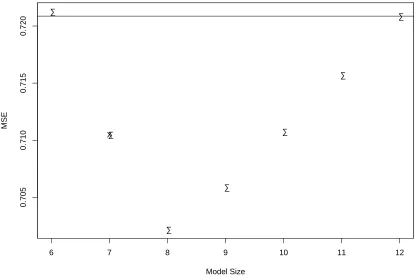
method that selects the model with the smallestCpvalue. TheICpmethod is illustrated in Figure 2.
In this plot, the models are pre-selected by maximizing R2
at each model size. A horizontal line
at bσ2
F is drawn as our baseline. MSE decreases as model size decreases from twelve to eight, while
it increases as model size decreases from eight to six. All the pre-selected models with model size
greater than six are acceptable, but the model with six predictors is not. Therefore, the model with
seven predictors is selected.
For simplicity and also to handle models with large numbers of candidate variables (largepMax),
we have chosen to develop and apply our simulation-based variable selection method in the context
of forward selection. For comparison purposes we also included in our simulation studies a modified
Cp method applied to the candidate models from forward selection (instead of by maximizing
R2
), calling it forward-restricted intelligent Cp (ICp/F R). In addition we include Breimans little
•
•
•
•
•
•
•
Model Size
MSE
6 7 8 9 10 11 12
0.705
0.710
0.715
0.720
X
3. TUNING VARIABLE SELECTION PROCEDURES BY ADDING NOISE
Selection of a set of regressors induces a partition of the total variation in Y into regression (SSR)
and error (SSE) components. A liberal variable selection method over-selects variables resulting in
an inflated SSR and a deflated SSE. A conservative variable selection method under-selects variables
thereby inflating SSE and deflating SSR. Although degrees-of-freedom corrections alleviate these
biases somewhat, they still are manifest in mean squares (MSR and MSE).
The latter claim is somewhat easier to explain for the case of liberal methods. Suppose that
a method is liberal, i.e., it tends to misclassify unimportant variables thereby including them in
the regression model. It follows that the number of variables in the chosen model tends to exceed
the number of important variables. The fact that variable selection methods generally identify the
best-fitting subset of variables of a given size, implies that the chosen model tends to have a mean
squared error that is as small as or smaller than the minimum MSE of all of the inclusive models
of the chosen model’s size. Any particular inclusive model admits an unbiased estimator of σ2
.
However, the minimum of a set of unbiased estimators will generally be biased low, and thus the
MSE of a model identified by a liberal variable selection procedure tends to be biased low.
If the method is conservative, then the chosen model tends not to be inclusive. The claim that
in such cases the MSE is biased high is based on the fact that for the case of random regressors,
E{Var(Y|S1)} ≥ E{Var(Y|S2)} for subsets of regressor variables S1 ⊆ S2 with strict inequality
when all important variables are in S2 but not all are in S1. However, in this case the fact that
variable selection methods generally identify the best-fitting subset of variables of a given size works
to offset the increase in MSE due to regression on a non-inclusive set of predictors. The net effect
of these two biasing factors in finite samples is not easily analyzed and depends to a great extent
In summary, the biasing effects of liberal methods are fairly well established and understood
whereas those of conservative methods are more dependent on particulars of the data set under
analysis. The trick is to exploit this information to determine the value of the tuning parameter
that admits the least-biased, liberal method. This can only be accomplished if we have a means for
identifying liberal choices of tuning parameters. Here is where we borrow ideas from the
measure-ment error literature. Simulation extrapolation (SIMEX) is a technique for studying the biasing
effects of measurement error (Cook and Stefanski, 1994; Stefanski and Cook, 1995; Carroll et al.,
1995). It works by adding additional measurement error to the data, and studying the effects this
has on statistics calculated from remeasured data. It is in this spirit that we apply SIMEX ideas
to the variable selection problem.
Assume the linear model (1) for the response variableY. Consider the remeasured variable
Y∗ =Y +τ√λZ,
where Z is a N(0,In) pseudo-random vector, and λ > 0 and τ > 0 control the variance of the
added errors. The obvious over-parameterization reflects the different roles played by λ (as the
scale) andτ (as the unit) in control of the added errors. The remeasured response variable has the
property that
E(Y∗|X) = E(Y|X), and Var(Y∗|X) = Var(Y|X) +τ2
λIn,
i.e., the conditional expectations of Y and Y∗ given X are identical, and the variance ofY∗ given
X exceeds the variance of Y given X by a known, controlled amount (τ2
λ). Note that these
Now suppose that the remeasured data (Y∗
i , Xi), i= 1, . . . , nare passed to a tuning
parameter-controlled variable selection procedure, e.g., forward selection. If the entry significance level is set
too high (so that forward selection is liberal), the expected increase (relative to the true data) in
MSE of τ2
λ will not be fully realized. A liberal method will tend to select unimportant predictors,
thereby biasing MSE low for the reasons noted previously. In effect the liberal method fits (some
of) the noise. We can see this in the statistics generated from remeasured data by generating
remeasured data sets with different values of λ (τ remains fixed). The mean squared errors from
the models found by forward selection with a liberal value of the entry significance level, and for
different values of λ, when plotted against λ will tend to have slope less than τ2
. Alternatively, if
in the forward selection, the entry significance level was such that there was no bias in the MSEs
of the forward-selected models, then the MSEs of the remeasured data sets should increase linearly
in λ, with slope equal to τ2
.
The previous argument depends critically on the selection bias that results from choosing the
best model from a set of inclusive models. Therefore it breaks down in the extreme cases for which
the significance level to enter is equal to 1.0 or 0.0. In the former case, forward selection enters
every variable, and provided the model is full rank, the MSE of the full model will have expectation
that increases exactly linearly inλwith slopeτ2
. In the latter case forward selection excludes every
variable, and the MSE of the null model will also have expectation that increases exactly linearly
in λ with slopeτ2
.
We can now describe our tuning strategy for forward selection as an algorithm.
1. Generate independent remeasured data sets for each of a grid of λ’s:
0< λ1 <· · ·< λnλ ≤4
and calculate the average MSE (over identically distributed remeasured data sets); call these
MSE(λk, α), k= 1, . . . nλ. (Note: the remeasured data sets are the same for allαbut different
for different values of λ.)
3. For each α fit a line to the pairs {λk, MSE(λk, α), k = 1, . . . nλ} and call the resulting slope
b
γ(α).
4. Our target, or “tuned” entry significance level is the value ofαin the open interval (0, 1) for
which γb(α) =τ2
.
The above algorithm works because forα ∈(0,1) the slopebγ(α) will be less than τ2
for α too
large and greater than τ2
for α too small.
In practice we must choose the grid of α values along with the grid of λ values, and we must
deal with finite sample and Monte Carlo variation in the estimated slopes when identifying the
interior value of α for which bγ(α) =τ2
. We now describe the specifics of the implementation used
in our simulation study.
First, the added variance multiplier, τ2
, should be appropriately scaled and we took τ2
=σb2
F,
the estimate of σ2
from the fit of the full model, so that the remeasured data are
Yi,λ∗k,b =Yi+
p
λkbσF Zi,λk,b, i= 1,2, . . . , n, k= 1, . . . , nλ, b= 1, . . . , B, (8)
where Zi,λk,b independent and identically distributed standard normal random variables,
indepen-dent of the original data. Note that the same contaminated data sets are used for each α, but are
independent for different λ. The remeasured data are passed to forward selection with entry level
α and the average (over b = 1, . . . , B) mean squared errors, MSE(λk, α) is computed.
forward selection will fit the full model for all the contaminated data sets, and bγ(1) is a consistent
estimator of σb2
F as B → ∞. Instead of bσ
2
F, we use bγ(1) as a baseline to which other slopes bγ(α)
are compared. This substitution is a type of Monte Carlo swindle. The target tuning parameter
0 < αb∗ < 1, should satisfy bγ(αb∗) ≈ bγ(1). Plots of bγ(α) versus α are informative and should be
examined in particular applications. They sometimes reveal a clear, well-defined value of αb∗; and
in cases where they do not, the ambiguity usually is a consequence of two or more nearly identically
good models corresponding to two or more close values of α. In practice all such models should
be considered. However, for our Monte Carlo study it was necessary to implement an automated
method of identifying a particular αb∗ and the corresponding model. We define αb∗ as the smallest
value of α that is greater than αb0, where
b
α0 = Max{α <1 :bγ(α)>bγ(1) orbγ(α) is a local maximum} (9)
The defining rule is illustrated in Figure 3, where the models selected are marked by L
.
A key to our tuning procedure is that after white noise is added to the original data, forward
selection should yield a different sequence of candidate models, which helps distinguish the optimal
value of α. We need to add enough noise in order to introduce sufficient variation among the
sequences. But the noise level should not be too high, otherwise MSE(λ, α) is not (approximately)
linear in λ. In a pilot study, we set λ = (0.25,0.5,0.75,1,1.5,2,3,4) and fitted the simple linear
regression of MSE(λ, α) on different combinations of the aboveλ’s and found thatλ= (0.5,1,1.5,2)
provides satisfactory results. Note that the MSE from the original data (corresponding to λ= 0),
is not included in the simple linear regression to estimate the slope. This is because there is no
Monte Carlo variation at λ= 0 to smooth out discontinuities in MSE(0, α) as a function of α.
+ +
+ ++
+
++++ +
+
+ +
+ +
+ +
+ ++
+ +
+
+++++++++++++++++ ++++
+++++++++ +++++
+++++++ ++++
++++++ ++++++
++
O
0 0.028
alpha
1(a)
slope
1.110
+ +
+++ +
++++++
+
+
+ +
+ ++++
+++++++++++++++++++ +++
+++ ++++
++++++ ++
++ +++
++++
++++++++++ ++
O
0 0.034
alpha
1(b)
slope
1.245
Figure 3: Demonstration of the Tuning Procedure
(a): αb∗ identified by a crossing of the baseline
slopes. The pilot study also suggested that the grid of α values is important. The finer the grid
the better, but this increases the computational burden. We found that no universal set works
for all data sets, and we suggest choosing the α’s adaptively based on the real data under study.
For a given real data set, the order of the predictors entering the model in forward selection is
determined, and so is the significance level associated with each step (more than one predictor can
enter the model at one step). Suppose the full model is obtained after k steps (k ≤ pmax), and
the associated significance levels are 0 < a1 < a2 < . . . < ak < 1. Then we chose the α’s as 0,
{ai+5ai
−1
6 ,
2ai+4ai
−1
6 ,
3ai+3ai
−1
6 ,
4ai+2ai
−1
6 ,
5ai+ai
−1
6 , i= 1,2, . . . , k}, 1+2ak
3 , 2+ak
3 , and 1, where a0 = 0.
4. MONTE CARLO STUDY
We performed a simulation study designed to compare our proposed method (hereafter called
NAMS, which stands for Noise Addition Model Selection), to ICp/F R, LB, and Minimum Cp.
Minimum Cp is based on all subsets, and ICp/F R and LB are based on forward selection
candi-date models. In addition, the model with the minimum model error among the forward selection
candidate models was identified and designated “Best” (which is the best that a forward selection
procedure can do in prediction, though in practice we do not have such information).
4.1 Simulation Setup
The setup of the simulation follows closely, and extends somewhat, the setup in Tibshirani and
Knight (1999), which is a simplified version of Breiman (1992). In the base simulation each data
set contains 21 predictors with n = 50 or 150 observations. The predictors follow a multivariate
normal distribution with mean 0 and covariance between xi and xj equal to ρ|i−j|, withρ= 0, 0.3,
and 0.7, respectively. The design matrices are fixed once generated. We have six different design
(those with non-zero coefficient) are generated in two clusters, around x7 and x14. Their initial
values are
β7+j = (h−j)2, |j|< h
β14+j = (h−j)2, |j|< h
(10)
The values h = 1,2,3,4 are used, resulting in 2,6,10 and 14 non-zero coefficients, respectively.
In addition, the null model H0 (all the coefficients are 0) and the full model FULL (with the
coefficients generated randomly from Uniform(0.5,1.5)) are also included. The regression equation
error follows a standard normal distribution. Except for H0, the coefficients of each model are
multiplied by a common constant so as to make the theoretical R2
equal to 0.75. Theoretical R2
is
defined as
TheoreticalR2
= (µ−µ01)
T (µ−µ01)
(µ−µ01)T (µ−µ01) +n σ2, (11)
where σ2
is the error variance,1 is a vector of 1’s, andµ0 =µT 1/n.
For a given combination ofnand ρ, we generate 100 data sets independently based on the same
design matrix and coefficients. All five variable selection methods are applied to each data set. The
true model is fit as well. For each method, the mean is calculated for both the model size and the
model error.
We augmented the base simulation study with three additional cases. In the first we took
n = 150 with 42 predictors (the original 21 predictors and their squares), in order to study how
the different methods perform in the presence of additional unimportant variables. In the second
we set n = 500 with the original 21 predictors, in order to study the performance of the methods
with a larger sample size. In the third, we reran the simulations with n = 150 observations and
21 predictors adjusting the coefficients so that the theoretical R2
equaled 0.35, 0.95 and 0.99,
respectively. The third case allowed us to study the consistency of the methods as R2
1.
4.2 Simulation Results
For the simulations with 21 predictors (n = 150,50) and R2
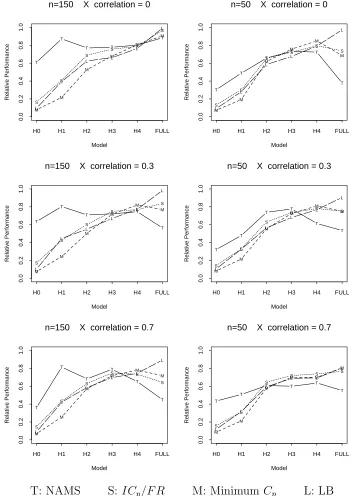
= 0.75, the ratios of model error of
Best to model error of NAMS, ICp/F R, Minimum Cp and LB are calculated for each combination
ofn andρ, and plotted in Figure 4. The larger the ratio, the better the performance. Note that the
relative standard error of the estimates (standard error divided by estimate) in Figure 4 is about
0.23 for H0, 0.12 for H1, and 0.06 for H2-H4 and FULL, respectively. Similar relative standard
errors are found in the other figures. We did not see much difference between the simulation result
with 150 observations and that with 50 observations, except that all the methods have poorer
performance when the sample size is smaller. Therefore, we concentrate on the simulation result
with 150 observations. Figure 4 shows that NAMS is the best in terms of model error when the true
model is H0, H1, H2, or H3. For FULL, NAMS loses to all the other methods. For H4, NAMS is
still the best when the predictors are uncorrelated, but as the correlation increases, NAMS underfits
and loses to the other methods. In addition, NAMS is the most stable in relative performance with
respect to Best, as indicated by its relatively flat performance curve. ICp/F R, Minimum Cp and
LB provide better relative performance as the true model increases in size; however, they do so at
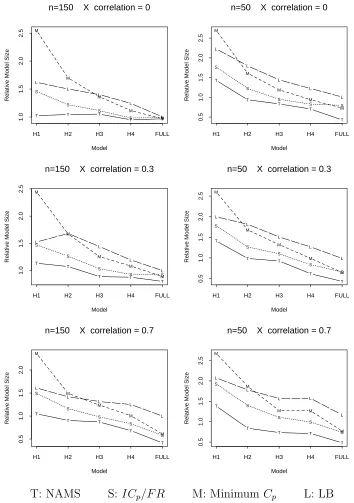
the expense of overfitting models of small and moderate sizes. This claim is supported by Figure 5,
where the ratios of model size of NAMS, ICp/F R, Minimum Cp and LB to model size of True
are plotted for each combination of n and ρ. Figure 5 shows that NAMS always selects the most
parsimonious models, while LB and Minimum Cp select much larger models especially for H0-H2.
Therefore, NAMS is the best in achieving dimension reduction.
For the simulation with 42 predictors, 150 observations, and R2
= 0.75, the ratios of model
Model
Relative Performance
H0 H1 H2 H3 H4 FULL
0.0 0.2 0.4 0.6 0.8 1.0 T T
T T T
T S S S S S S M M M M M M L L L L L L
n=150 X correlation = 0
Model
Relative Performance
H0 H1 H2 H3 H4 FULL
0.0 0.2 0.4 0.6 0.8 1.0 T T T T T T S S S S S S M M M M M M L L L L L L
n=50 X correlation = 0
Model
Relative Performance
H0 H1 H2 H3 H4 FULL
0.0 0.2 0.4 0.6 0.8 1.0 T T
T T T
T S S S S S S M M M M M M L L L L L L
n=150 X correlation = 0.3
Model
Relative Performance
H0 H1 H2 H3 H4 FULL
0.0 0.2 0.4 0.6 0.8 1.0 T T T T T T S S S
S S S
M M M M M M L L L L L L
n=50 X correlation = 0.3
Model
Relative Performance
H0 H1 H2 H3 H4 FULL
0.0 0.2 0.4 0.6 0.8 1.0 T T T T T T S S S S S S M M M M M M L L L L L L
n=150 X correlation = 0.7
Model
Relative Performance
H0 H1 H2 H3 H4 FULL
0.0 0.2 0.4 0.6 0.8 1.0 T T
T T T
T
S S
S
S S S
M M M M M M L L L L L L
n=50 X correlation = 0.7
T: NAMS S:ICp/F R M: Minimum Cp L: LB
Figure 4: Relative Performance with Respect to Best (21 predictors).
Model
Relative Model Size
H1 H2 H3 H4 FULL
1.0
1.5
2.0
2.5
T T T
T T
S S
S
S S
M
M
M
M M L
L L
L L
n=150 X correlation = 0
Model
Relative Model Size
H1 H2 H3 H4 FULL
0.5
1.0
1.5
2.0
2.5
T
T T
T T S
S S
S S
M
M
M M
M L
L
L L
L
n=50 X correlation = 0
Model
Relative Model Size
H1 H2 H3 H4 FULL
1.0
1.5
2.0
2.5
T T
T T
T S
S S
S S
M
M
M M
M L
L L
L L
n=150 X correlation = 0.3
Model
Relative Model Size
H1 H2 H3 H4 FULL
0.5
1.0
1.5
2.0
2.5
T
T T
T T S
S S
S S M
M
M M
M L
L L
L L
n=50 X correlation = 0.3
Model
Relative Model Size
H1 H2 H3 H4 FULL
0.5
1.0
1.5
2.0
T
T T
T T S
S S
S S M
M M
M
M L
L L
L L
n=150 X correlation = 0.7
Model
Relative Model Size
H1 H2 H3 H4 FULL
0.5
1.0
1.5
2.0
2.5
T
T
T T
T S
S S
S S M
M
M M
M L
L
L L
L
n=50 X correlation = 0.7
T: NAMS S:ICp/F R M: Minimum Cp L: LB
Figure 5: Relative Model Size with Respect to Best (21 predictors).
for each ρ. NAMS has the smallest model error for H0-H4 regardless of ρ, and for FULL when
ρ = 0, 0.3. Moreover, NAMS does not lose as much to the other methods as in the simulation
with 21 predictors on FULL with ρ = 0.7. The other three methods are adversely affected by the
additional 21 predictors, and their model errors increase substantially as the number of predictors
increases from 21 to 42. However, NAMS is less affected by the additional predictors and its model
error does not increase as much as the number of predictors increases from 21 (Figure 4) to 42
(Figure 6). It is evident in Figure 6 that NAMS is the overall method of choice forn = 150 and 42
predictors.
Figure 7 displays results from the simulation with n = 500 observations, R2
= 0.75 and the
original 21 predictors. All methods have much smaller model errors compared to the simulation
results with 150 observations, and they are closer to True and Best. Because overfitting is not
penalized as much when the sample size is large, NAMS does not outperform the other three
methods as much on H0-H3. However, for H4 and FULL, NAMS is nearly as good as the others,
except for FULL with ρ= 0.7.
Finally, the simulation with differentR2
showed that as R2
approaches 1, the model error of all
methods approached 0. This experiment, whose results are not displayed in this paper, used the
same design matrix and error for all R2
. We adjusted the coefficients instead of the error variance,
to get the desired theoretical R2
.
4.3 Conclusion and Discussion
From the simulation with 150 observations and 21 predictors (Figures 4, 5), we see that in terms
of model error, NAMS is the best when the true model is simple (H0-H2). It is marginally better
than the other methods when the true model is H3. It provides the best prediction by using
Model
Relative Performance
H0 H1 H2 H3 H4 FULL
0.0
0.2
0.4
0.6
0.8
1.0
T
T
T
T T
T
S
S
S
S
S
S
M
M
M
M
M
M
L
L
L L
L
L
n=150 X correlation = 0
Model
Relative Performance
H0 H1 H2 H3 H4 FULL
0.0
0.2
0.4
0.6
0.8
1.0
T
T T
T
T T
S
S
S
S
S
S
M
M
M M
M
M
L
L
L
L
L
L
n=150 X correlation = 0.3
Model
Relative Performance
H0 H1 H2 H3 H4 FULL
0.0
0.2
0.4
0.6
0.8
1.0
T
T
T
T
T
T
S
S
S
S
S S
M
M
M
M
M
M
L
L
L L
L
L
n=150 X correlation = 0.7
T: NAMS S:ICp/F R M: Minimum Cp L: LB
Figure 6: Relative Performance with Respect to Best (150 observations and 42 predictors).
Model
Relative Performance
H0 H1 H2 H3 H4 FULL
0.0
0.2
0.4
0.6
0.8
1.0
T
T
T T
T
T
S
S
S
S
S
S
M
M
M
M
M
M
L
L
L
L
L
L
n=500 X correlation = 0
Model
Relative Performance
H0 H1 H2 H3 H4 FULL
0.0
0.2
0.4
0.6
0.8
1.0
T
T
T T
T
T
S
S
S
S
S
S
M
M
M
M
M
M
L
L
L
L
L
L
n=500 X correlation = 0.3
Model
Relative Performance
H0 H1 H2 H3 H4 FULL
0.0
0.2
0.4
0.6
0.8
1.0
T
T
T
T T
T
S
S
S
S
S
S
M
M
M
M
M
M
L
L
L
L
L
L
n=500 X correlation = 0.7
T: NAMS S:ICp/F R M: Minimum Cp L: LB
Figure 7: Relative Performance with Respect to Best (500 observations and 21 predictors).
others if the true model is complicated (H4 or FULL), especially when the correlation between the
predictors is high. But as shown in Figure 4, NAMS is the most stable in relative performance with
respect to Best, while ICp/F R, Minimum Cp and LB tend to overfit. Because they overfit, these
three methods provide better relative performance as the model gets more complicated. On the
whole, Minimum Cp overfits badly and provides very poor performance and is not recommended in
practice. ICp/F R is better than Minimum Cp except for H4.
We see a similar pattern in the simulation with 50 observations and 21 predictors, except that
every method performs worse due to the small sample size. When the sample size is 50, the ratio
of the number of predictors to the number of observations is greater than 0.25 so that it is difficult
to find a satisfactory model (Freedman et al. 1992).
For 500 observations and 21 predictors (Figure 7), all of the methods perform better, especially
for H4 and FULL, and all have similar model errors in most cases. However, Minimum Cp overfits
badly for H0-H2. NAMS has the smallest model error for H0-H2. There is not much difference
between the four methods for H3, H4 and FULL, except that NAMS loses to the other methods for
FULL with ρ = 0.7. We also recorded average mean squared errors (MSE) of the models selected
by the different methods. With the exception of FULL, ICp/F R, Minimum Cp and LB always
had Average MSE <1 (= the true error variance), indicating that these methods tended to overfit
thereby underestimating residual variation. NAMS unbiasedly estimated error variance in all cases
except for FULL.
The simulation with 150 observations and 42 predictors (Figure 6) shows that NAMS successfully
ignores the additional unimportant variables and outperforms the other methods except for the
FULL model when ρ = 0.7. The other three methods frequently fit the unimportant variables,
NAMS has the best prediction ability when the true model is simple. For complicated models
with greater correlation in the design matrix, NAMS loses to the other three methods in terms
of model error due to its tendency to underfit; but NAMS is as good as or better than the other
methods if either the sample size or the theoretical R2
is large. In addition, NAMS provides much
better performance than any of the other three methods when the number of predictors is large,
except for FULL with ρ = 0.7. In summary, NAMS is good at finding a parsimonious model
without sacrificing prediction ability when such a model exists.
5. EXAMPLES
We now illustrate the method on two data sets.
Pollution Data. (McDonald and Schwing 1973). This data set has 60 observations and 15
predictors. The response variable is the Total Age Adjusted Mortality Rate obtained for the
years 1959−1961 for 201 Standard Metropolitan Statistical Areas (SMSA). The result from ridge
regression is copied from McDonald and Schwing (1973). We apply NAMS, LB,ICp/F R, Minimum
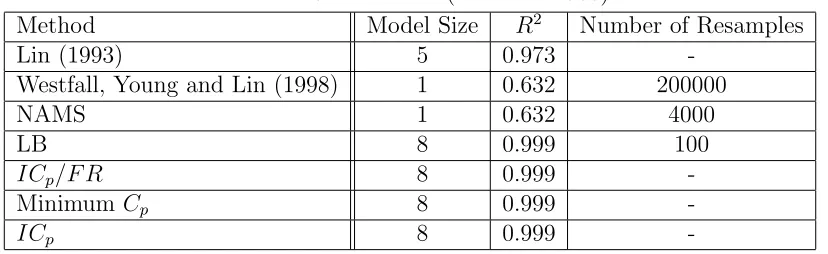
Cp, and Intelligent Cp to the data. The results are summarized in Table 1. All the methods have
similar performance in terms of model size and R2
. NAMS, ICp/F R and ICp select the same
five-variable model. LB and Minimum Cp select the same variable model, and a different
six-variable model was chosen by McDonald and Schwing (1973) using ridge regression. For NAMS,
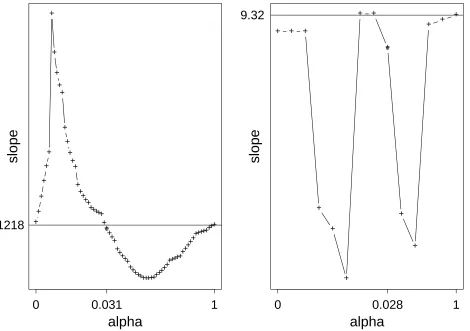
α0 is estimated to be 0.03 which corresponds to a five-variable model (1, 2, 6, 9, 14). Figure 8 (left
panel) displays the slope-versus-α plot from which the optimal choice of α was obtained.
Rubber Data. (Lin 1993). The original data set in Williams (1968) contains 28 runs and 23
predictors (there were 24 predictors in the paper, but two of them are identical). Lin (1993)
took half of the data set (14 runs and 23 predictors) to demonstrate the use of supersaturated
Table 1: Pollution Data
Method Variables Selected Model Size R2
Number of Resamples
Ridge Regression∗ 1,2,6,8,9,14 6 0.724
-NAMS 1,2,6,9,14 5 0.717 4000
LB 1,2,3,6,9,14 6 0.735 100
ICp/F R 1,2,6,9,14 5 0.717
-Minimum Cp 1,2,3,6,9,14 6 0.735
-ICp 1,2,6,9,14 5 0.717
-∗ From McDonald and Schwing (1973)
Table 2: Rubber Data (Williams 1968)
Method Model Size R2
Number of Resamples
Lin (1993) 5 0.973
-Westfall, Young and Lin (1998) 1 0.632 200000
NAMS 1 0.632 4000
LB 8 0.999 100
ICp/F R 8 0.999
-Minimum Cp 8 0.999
-ICp 8 0.999
-to analyze the data and “the important fac-tors were identified as 15, 12, 20, 4, and 10 with an
R2
= 97.3%.” As pointed out by Wang (1995), factors 10 and 15 do not show up even in a model
with R2
= 0.99 when forward selection is applied to the other half of the data set. Later, Westfall,
Young and Lin (1998) attributed this inconsistency to multiple testing and developed a
resampling-based method to adjust the p-value for multiplicity. As shown in their Table 3, only one variable
(factor 15; adjusted p-value 0.016) is selected, because the next candidate variable, factor 12, has
an adjusted p-value of 0.816, and is deemed as non-significant.
The mean squared error from the full model provides the reference line used by the NAMS
method to tune forward selection. Thus NAMS is not directly applicable to super saturated designs
(SSD). However, such designs are commonly used under the assumption ofeffect sparsity, i.e., when
only a few of the many predictors are thought to be important. In such cases a liberal, initial model
fit resulting in a highR2
+ +
+ +
+ +
+
+
+ +
+
+
+ +
+ +
+ +
+++ +++++
+ +
+ ++
++ +++
+++++++++++++++ +++++
++++ ++++++
+++
o
0 0.031 1
1218
alpha
slope
+ + +
+
+
+ + +
+
+
+ + +
+
o
0 0.028 1
9.32
alpha
slope
Figure 8: Slope-versus-alpha plots for the real data examples. Circled point L
indicates optimal α.
Left panel, Pollution data; right panel, Rubber data.
adaptation of NAMS for SSDs. In the first stage use a liberal model fitting strategy to obtain a
collection of predictors resulting in a large R2
. Then starting with the predictors so identified, use
NAMS to pare down the set of predictors. We now show that this two-stage approach produces a
reasonable model for the Rubber data.
In the Rubber data, the model with 8 predictors from forward selection has an R2
= 1.000.
So, we concentrate on these 8 predictors. NAMS, LB, ICp/F R, Minimum Cp and Intelligent Cp
were applied to select models. As shown in Table 2, NAMS selects the one-variable model with α0
estimated to be 0.028, while LB, MinimumCp,ICp, andICp/F Rall select an eight-variable model,
We also applied the five methods using pilot studies with the first 3, 4, 5, 6, and 7 predictors
selected in forward selection, respectively, and obtained very consistent results: NAMS always
selects the one-variable model, while the other methods always select the largest possible model.
As another way to evaluate the methods, we applied them to the original data set (28
obser-vations and 23 predictors). LB, ICp, and ICp/F R select a three-variable model, and Minimum
Cp selects a five-variable model (note that the predictors enter the model in a different order in
the original data). NAMS again selects the same one-variable model (factor 15), while the other
methods apparently overfit the data.
REFERENCES
Atkinson, A. C. (1980), “A Note on the Generalized Information Criterion for Choice of a
Model,” Biometrika, 67, 413–418.
Breiman, L. (1992), “The Little Bootstrap and Other Methods for Dimensionality Selection in
Regression: X-Fixed Prediction Error,” J. Am. Stat. Assoc., 87, 738–754.
Carroll, R. J., Ruppert, D. and Stefanski, L. A. (1995),Measurement Error in Nonlinear Models,
London: Chapman Hall.
Cook, J. R. and Stefanski, L. A. (1994), “Simulation-Extrapolation Estimation in Parametric
Measurement Error Models,”J. Am. Stat. Assoc., 89, 1314–1328.
Draper, Norman R. and Smith, Harry (1981), Applied Regression Analysis (Second Edition),
New York: John Wiley & Sons.
Freedman, L. S., Pee, D., and Midthune, D. N. (1992), “The Problem of Underestimating the
Residual Error Variance in Forward Stepwise Regression,” Statistician, 41, 405–412.
Mallows, C. L. (1973), “Some Comments on Cp,”Technometrics, 15, 661–675.
Mallows, C. L. (1995), “More Comments onCp,” Technometrics, 37, 362–372.
McDonald, G. C. and Schwing, R. C. (1973), “Instabilities of Regression Estimates Relating
Air Pollution to Mortality,” Technometrics, 15, 463–481.
Shen, X. and Ye, J. (2002), “Adaptive Model Selection,” Journal of the American Statistical
Association 97, 210–221.
Stefanski, L. A. and Cook, J. R. (1995), “Simulation-Extrapolation: The Measurement Error
Jackknife,” Journal of the American Statistical Association 90, 1247–1256.
Tibshirani, R. and Knight, K. (1999), “The Covariance Inflation Criterion for Adaptive Model
Selection,” J. R. Statist. Soc., 61, 529–546.
Wang, P. C. (1995), “Letters to the Editor: Comments on Lin (1993),” Technometrics, 37,
358–359.
Westfall, P. H., Young, S. S. and Lin, D. K. J (1998), “Forward Selection Error Control in the
Analysis of Supersaturated Designs,” Statistica Sinica, 8, 101–117.
Williams, K. R. (1968), “Designed Experiments,”Rubber Age, 100, 65–71.
Ye, J. (1998), “On Measuring and Correcting the Effects of Data Mining and Model Selection,”
J. Am. Stat. Assoc., 93, 120–131.
Zhang, P. (1992), “On the Distributional Properties of Model Selection Criteria,” J. Am. Stat.



![Inte bara idiom (Not only idioms) [In Swedish]](data:image/gif;base64,R0lGODlhAQABAIAAAP///wAAACH5BAEAAAAALAAAAAABAAEAAAICRAEAOw==)