ConSum v0:
An Experimental Cipher
David A. Madore
April 29, 2007
CVS:
$Id: consum.tex,v 1.22 2007-04-28 23:16:41 david Exp $
Abstract
We present an experimental block cipher, ConSum, based on a hitherto unstudied design element: theConway transformation. ConSum features an extremely simple design and the ability to operate with arbitrary key lengths, block sizes and round numbers. We study it empirically and statistically so as to illustrate how it might be secure.
Contents
1 Introduction 2
1.1 What is ConSum? . . . 2 1.2 Why another block cipher? . . . 3 1.3 Naming conventions . . . 3
2 Conventions and notations 4
3 The Conway transformation 5
4 The ConSum cipher 10
4.1 Description . . . 10
4.2 Computational considerations . . . 11
5 Addition and XOR 12 5.1 The carry structure . . . 12
5.2 The addition entropy . . . 12
5.3 Relevance to ConSum . . . 14
6 Statistics and cryptanalysis of 8-bit ConSum 15 6.1 Bernoulli distribution of ciphertexts . . . 15
6.2 Bit change correlations . . . 16
6.2.1 Plaintext to ciphertext . . . 16
6.2.2 Key to ciphertext . . . 18
6.3 Correlation of-differentials . . . 19
6.3.1 Plaintext to ciphertext . . . 19
6.3.2 Key to ciphertext . . . 20
6.4 Correlation of⊕-differentials . . . 20
6.5 Why analyze only8-bit ConSum? . . . 21
7 Tables and test vectors 22 7.1 Eight-bit Conway transformation . . . 22
7.2 Step-by-step encryption . . . 22
7.3 Repeated encryption . . . 23
7.4 Variation on parameters . . . 24
1
Introduction
1.1
What is ConSum?
As its name indicates, the cipher we are presenting is built from two basic elements: theConway transformationand addition. We chose the name “Conway transformation” because it is an instance of Conway multiplication of binary numbers, introduced in [1] and [2] (where it is called “Nim multiplication”); as far as we are concerned, the Conway transformation is a simply constructed bijective linear transformationx 7→ K(x)on(F2)2
n
(binary sequences of length2n) with satisfactory “mixing” properties. The other design element of ConSum is simply addition of binary integers, (x, y) 7→ x y. Note that both of these elements are “linear” in a certain sense: the Conway transformation is linear relative to the XOR operation (x, y) 7→ x⊕y on bit strings (which makes(F2)2
n
into an F2
-vector space), that is,K(x⊕y) =K(x)⊕K(y), and it is only from the departure of x y from x⊕ y, viz., the carry bits, that the security of ConSum should emerge. We will give, below, an argument based on entropy computations as well as certain statistical observations, to argue why the complexity of the carry bits could suffice to account for cryptographic security.
1.2
Why another block cipher?
Simplicity in design is a double-edged sword: while it makes our cipher appealing and easy to analyze in ways that indicate security, the very same characteristic also makes is conceivable that attacks might be found which exploit this simplicity.
For this reason, ConSum is intended more as an experiment in cryptography than as a directly usable cipher: this is why emphasis is put on the word “experimental” in the title. The provoking question we wish to ask the cryptographic community by submitting this cipher to peer review is whether an extremely simple design using only “linear” building elements can nevertheless defy cryptanalysis. We feel that there is much to learn from this experiment: if ConSum holds, it shows certain new elegant ways of constructing block ciphers; if it does not, we will have gained some insight in the way the addition () and XOR (⊕) operations interact on binary strings, a discovery which could be relevant in mathematics as well as cryptography. Either way, there is something to be gained by studying the construction.
1.3
Naming conventions
Since the flexible nature of ConSum does not impose a specific block size, key length, or number of rounds, we dictate that the notation “ConSum(v0, b128, k256, r12)” means “ConSum version 0 with block size 128 bits, key length 256 bits, and 12 rounds”. Omitting the key length means it is equal to block size. Omitting other parameters means they have their default values: 128 bits for block size, and 10 rounds.
2
Conventions and notations
We consider bit strings whose lengths are usually powers of 2 (which we will feel free to write in hexadecimal whenver convenient). We make the convention that if x0 and x1 are two bit strings (of lengths N0 and N1) then x1|x0 is their
concatenation (of lengthN =N0+N1) in whichx0is thelow(= least significant)
part and x1 is the high (= most significant) part (note that we are not implying
anything about how these bit strings are arranged in memory: in particular, we are not saying anything about endianness, here). This will be particularly useful whenx0andx1are of the same length2n, in which casex1|x0 is of length2n+1.
We write x ⊕y for the eXclusive OR of two bit strings x and y (of equal length). Formally, this can be defined inductively as follows:
0⊕0=0, 0⊕1=1, 1⊕0=1, 1⊕1=0
(x1|x0)⊕(y1|y0) = (x1⊕y1|x0⊕y0)
by induction:
00=0, 01=1, 10 =1, 11=0
c(0,0) =0, c(0,1) = 0, c(1,0) = 0, c(1,1) =1
(x1|x0)(y1|y0) = (x1y1)|(x0y0)
c((x1|x0),(y1|y0)) =c(x1, y1)
ifc(x0, y0) =0
(x1|x0)(y1|y0) = (x1ˆ y1)|(x0y0)
c((x1|x0),(y1|y0)) = ˆc(x1, y1)
ifc(x0, y0) =1
0ˆ 0=1, 0ˆ 1=0, 1ˆ 0 =0, 1ˆ 1=1
ˆ
c(0,0) =0, cˆ(0,1) = 1, ˆc(1,0) = 1, ˆc(1,1) =1
(x1|x0) ˆ(y1|y0) = (x1y1)|(x0ˆ y0)
ˆ
c((x1|x0),(y1|y0)) =c(x1, y1)
ifˆc(x0, y0) =0
(x1|x0) ˆ(y1|y0) = (x1ˆ y1)|(x0ˆ y0)
ˆ
c((x1|x0),(y1|y0)) = ˆc(x1, y1)
ifˆc(x0, y0) =1
(1)
(To make sense of this, keep in mind that xˆ ymeansxy1 where the1
comes from a carry.)
We similarly writexyfor the difference ofxandy(performed with borrows, with the borrow from the highest bit forgotten).
3
The Conway transformation
3.1
Definition and algebraic properties
We define the Conway transformation Kx of a bit string x of length N = 2n (necessarily a power of two) by induction onnas follows:
K0=0, K1=1
K(x1|x0) =K(x0⊕x1)|K2x1
(2)
We emphasize that in the first line of this definition, 0 and1 are single bits, and in the second line x0 andx1 are of equal length, this length being a power of2.
We summarize the definition ofKas follows:
The following table gives the Conway transformation on all 4-bit strings (written as hexadecimal digits):
x 0 1 2 3 4 5 6 7 8 9 a b c d e f
Kx 0 8 c 4 b 3 7 f d 5 1 9 6 e a 2
As an example of the Conway transformation, here is the iteration of it on8-, 16-,32- and64-bit strings, starting with1:
01 0001 00000001 0000000000000001 80 8000 80000000 8000000000000000 de de4a de4ae3a9 de4ae3a94a88a921 4a e3a9 4a88a921 e3a92850a9218171 a9 a921 a9218171 a92181714b010a1a 48 0e69 22fd8f18 06e6e47169fc8502 69 8f18 69fc8502 8f189ae87791f90e 2f a38c 4de7ee6b 9c27eb8bd1c005e0 e6 e6e4 e6e41fea e6e41feab43c1101
Evidently, the Conway transformation is bijective; and its inverse is given by:
K−10=0, K−11=1
K−1(z
1|z0) = (K−2z0)|(K−2z0⊕K−1z1)
Here is the iteration ofK−1 on bit strings as previously starting with1:
01 0001 00000001 0000000000000001 ee 8585 d963d963 ada91d55ada91d55 85 d963 ada91d55 e047faadccf408df ba b0fc 2cb3f272 124577333f9b3e84 d9 ada9 e047faad 8d5d71c89d1fcf59 4c dec1 2dde49b7 4bbcd0f3b31f88e0 fc f272 3f9b3e84 1b7d40da69970634 f8 e898 2fd98015 68ce96ea3d0605dd ad e047 8d5d71c8 d42ff6393766c90a
More generally, and although we will not use it as such in the ConSum cipher, we can define the Conway productof two bit strings of equal length2n, xandy, writtenx~y, as follows:
0~0=0, 0~1=0, 1~0=0, 1~1=1
(x1|x0)~(y1|y0) = ((x1~y0) ⊕ (x0 ~y1) ⊕ (x1~y1))
|((x0~y0) ⊕ K(x1~y1))
The following facts hold:
Facts 1. The set{0,1}2n
of strings of length2n, with the two binary composition maps ⊕(eXclusive OR) and ~ (Conway product), and unit elements0(zero bit string) and1(bit string whose least significant bit is1and all others0), is a field isomorphic to F22n (the Galois field with22
n
elements — which is unique). The Conway transformation is then simplyKx =x~K1.
In particular, we emphasize that the Conway transformationK islinear over the fieldF2, that is, K(x⊕y) = Kx⊕Ky; in fact,K is linear overF22n in the
sense thatK(z~x) =z~Kx.
represented as white and1as black).
3.2
The Conway transformation as a permutation
To avoid confusion, let us presently write Kn for the Conway transformation on
bit strings of length N = 2n. From the facts stated previously, we know that Kn(x) = x~Kn(1)where({0,1}2
n
,⊕,~)∼=F22n, and (sinceKn(1)is obviously not equal to1, at least so long asn >0) this implies thatKnis a permutation with
no fixed points other than 0, all of whose orbits (other than{0}) have the same cardinality, namely the multiplicative order of the element κn = Kn(1) of the
field. We now try to say a little more about this order.
To make notations more readable, we temporarily replace the symbols⊕and ~by the more usual+and·(or an absence of symbol) and we agree to identify F22n with the set of bit strings of length N = 2n with these operations; we also
identifyF22n−1 (bit strings of lengthN/2 = 2n
−1) with those bit strings of length
N whose upper half bits are all0.
It is easy to check that the multiplicative orders ofκ2andκ3 are equal to5and
85.
Now notice thatκn = (κn−1|0), and if we putκ¯n = (κn−1|κn−1)then we have
κn + ¯κn = (0|κn−1) and κnκ¯n = (0|κn3−1) (whereκ3n−1 = Kn2−1(κn−1)). This
implies thatκnand¯κnare the roots of the quadratic equationX2+κn−1X+κ3n−1
over the subfieldF22n−1. Since we know that the Galois group ofF22n overF22n−1 consists of the identity and the “Frobenius” map x 7→ x22
n−1
, we have shown ¯
κn = (κn)2
2n−1
, and(κn)2
2n−1+1
=κn¯κn=κ3n−1.
Now let us use this to compute the order of κ4: clearly it must divide
224
−1 = 65 535 = 3×5 ×17×257. Since κ4 does not lie in the subfield
of257. But we have also just shown thatκ257
4 =κ33, which is of order85(likeκ3
itself). Consequently,κ4is of order85×257 = 13(216−1).
Similarly, the order ofκ5 is a divisor of22
5
−1 = 3×5×17×257×65 537 which is not a divisor of 65 535, so it must be a multiple of 65 537, and since
κ65 537
5 =κ34, we see that the order ofκ5 is exactly 13(232−1).
Concerning the order ofκ6 we encounter a difficulty: this time232+ 1is not
prime, it is641×6 700 417. So while we again haveκ2632+1 =κ35 andκ2632−1 6= 1, we cannot immediately conclude concerning the order ofκ6: it divides13(264−1),
but it could also be641×1 3(2
32−1)or6 700 417×1 3(2
32−1). However, it can be
checked that κ6416 = f79e0da1309d2d57and κ6 700 4176 = 9b3606c3047014f6: since neither is inF225, it follows thatκ6 is of order 13(264−1)exactly.
So far we have seen that κn (and hence, Kn) is of order 13(22 n
− 1) for 2≤n≤6. It is always true that the orderdivides13(22n−1), but we do not know whether it is always equal. It is clear, however, always becauseκ22
n−1
+1
n =κ3n−1,
that the order of κn is always a multiple of that of κn−1, and must be greater: a
lower bound is given by the order ofκn−1 multiplied by the smallest prime factor
of22n−1 + 1.
We have not checked the order of κ7, respectively κ8, but by the argument
above it must be a multiple of 274 1773 (264 −1)(which is over 280), respectively
over 2136. It is not directly relevant to ConSum to know exactly what the order is: our point is merely to explain why the Conway transformation does not have certain undesirable properties such as fixed points or very small orbits.
3.3
Computation considerations
In hardware: Recursively applying the definition of the Conway transformation gives a circuit that computes the Conway transformation Kn of a N = 2n-bit
string using≤Nlog 3log 2 ≤N1.6XOR gates (with two inputs each) and≤N depth.
In software: One would typically implement the Conway transformation by a number of functions for successive bit sizes: starting with a table lookup for the Conway transformation of 8-bit strings (or perhaps 4-bit strings on certain embedded system) and implementing the 2n-bit Conway transformation through 3calls to the2n−1-bit function. Experiments on a PentiumR D processor (running
Bit size Length 16bits 1012 cycles 32bits 26 cycles 64bits 7514 cycles 128bits 22612 cycles
Our experiments also suggest that it is not advantageous to perform the 16-bit Conway transformation by table lookup; however, it is advantageous to precompute the8-bit Conway transformation iterated twice.
4
The ConSum cipher
4.1
Description
The ConSum cipher depends on three parameters: an integernbgiving the block
size Nb = 2nb, an integer nk giving the key length Nk = 2nk, and an integer
r which is the number of rounds. The only condition we impose is nk ≥ nb,
although, of course,rshould be reasonably large if we want any kind of security. The “standard” values shall be: nb =nk = 7(so we use128-bit keys and blocks)
andr= 10.
Suppose we are given a 2nb-bit string x (the plaintext) and r + 1 strings
t(0), . . . , t(r)(the subkeys) of that same length. Then we define
y(0) =xt(0)
y(1) =Ky(0)t(1)
y(2) =Ky(1)t(2)
· · ·
y=y(r) =Ky(r−1)t(r)
And the ciphertext is y = y(r). (Note that the number of roundsris equal to the
number of Conway transformations used: the number of additions isr+ 1.) It remains to explain the key schedule, i.e. how we define the subkeys
t(0), . . . , t(r) from the key z. This is also easy: it follows precisely the same
formula, withz instead ofx,t(i)instead ofy(i) and1instead oft(i), that is:
t(0) =z1
t(1) =Kt(0)1
t(2) =Kt(1)1 · · ·
In other words, the subkeys are generated by taking the intermediate values of the encryption of the key with subkeys all equal to1.
The following diagram recapitulates the overall encryption process:
Since we have allowed the key lengthNkto be greater than the block sizeNb,
we simply reduce the subkeys (forget theirNb−Nkmost significant bits, keeping
only the low end) to the desired size.
4.2
Computational considerations
implementation of Triple-DES on the same machine: so ConSum is quite slow, but not slow to the point of being unusable. Since it is meant as an experimental cipher and not immediately for production use, and since the bit size, key length and number of rounds are free (and adequate numbers have yet to be investigated), there is no sense in prematurely trying to fine-tune it for optimization.
5
Addition and XOR
5.1
The carry structure
Assume thatxandyare bit strings of lengthN (here we do not need thatN be a power of two). DefineC(x, y)as the “carry structure” ofxandy: that is,C(x, y) is anN-bit string whosek-th bit is1when adding thek-th bits ofxandyproduced a carry (to be added to the(k+ 1)-th bit), and0otherwise. Formally:
C(0,0) =0, C(0,1) = 0, C(1,0) =0, C(1,1) = 1
C((x1|x0),(y1|y0)) = (C(x1, y1)|C(x0, y0))ifc(x0, y0) =0
C((x1|x0),(y1|y0)) = ( ˆC(x1, y1)|C(x0, y0))ifc(x0, y0) =1
ˆ
C(0,0) =0, Cˆ(0,1) = 1, Cˆ(1,0) =1, Cˆ(1,1) = 1
ˆ
C((x1|x0),(y1|y0)) = (C(x1, y1)|Cˆ(x0, y0))ifˆc(x0, y0) =0
ˆ
C((x1|x0),(y1|y0)) = ( ˆC(x1, y1)|Cˆ(x0, y0))ifˆc(x0, y0) =1
(4)
wherecandcˆhave already been defined in (1): they are simply the top bits ofC
andCˆrespectively.
More usefully, thek-th bit of C(x, y)is the logical AND of thek-th bit of x
andywhen the(k−1)-th bit ofC(x, y)is0, the logical OR when the(k−1)-th bit ofC(x, y)is1, with the convention that the(−1)-th bit ofC(x, y)is always0; andCˆ(x, y)is nearly the same except for this last convention which is reversed.
So we can write
xy=x⊕y⊕(C(x, y)1) (5)
where 1 denotes a left bit shift by one bit (with the top bit thrown away):
x1 = xx=x|0(note thatC(x, x) =x).
5.2
The addition entropy
and their different probabilities. We consider the sum of the−plogpfor each such probabilityp(where thelogis taken in base2), and we call it theaddition entropy, written S(x), of x (expressed in logons). This is the “amount of randomness” in C(x, y) if y is random (whereas x is the given string): S(x) is the amount of information needed to specify C(x, y) wheny is chosen at random (and x is given).
Here is an example. Takex = 1. Then C(x, y)is0ifyends in 0(probability
p = 12). It is 1 if y ends in 01 (probability p = 14). It is 3 = 11 if y ends in 011 (probability p = 18) and so on. So the addition entropy of x = 1 is
S(1) = 1× 1 2+ 2×
1 4+ 3×
1
8+· · ·+N× 1
2N +N ×
1
2N = 2−
1
2N−1. Naturally, the addition entropyS(0)of0is0.
We can similarly defineSˆ(x) to be the entropy of Cˆ(x, y) for randomy; in fact, it is easy to see that, for any x, we haveSˆ(x) = S(x1)(although it is, of course,nottrue thatCˆ(x, y) = C(x1, y)in general!).
Addition entropies are easily computed inductively. Indeed, consider anN -bit string x whose addition entropy S(x) is known, and we wish to compute that of (N + 1)-bit strings starting with x. First consider that of x|0 (the string obtained by adding a 0 at the end of x— remember that this is the least significant bit): evidently bit0will never have any carry on it, so that for any bitb,
C(x|0, y|b) = C(x, y)|0; thus, S(x|0) = S(x). In the same way,Sˆ(x|1) = ˆS(x) becauseCˆ(x|1, y|b) = ˆC(x, y)|1. On the other hand, let us considerS(x|1). Now we haveC(x|1, y|0) = C(x, y)|0andC(x|1, y|1) = ˆC(x, y)|1, each case having probability 12; and the resulting string sets aredisjoint; this proves thatS(x|1) = 1 + 12(S(x) + ˆS(x)). And similarlySˆ(x|0) = 1 + 12(S(x) + ˆS(x)) = S(x|1). Finally we have shown:
Proposition 2. The addition entropySand the addition entropy with carrySˆare subject to the following induction relations:
S(0) = 0 S(1) = 1
ˆ
S(0) = 1 Sˆ(1) = 0
S(x|0) =S(x) S(x|1) = 1 + 12(S(x) + ˆS(x)) ˆ
S(x|0) = 1 + 12(S(x) + ˆS(x)) Sˆ(x|1) = ˆS(x)
Now consider the mean addition entropy SN of all N-bit strings (that is,
the average of the S(x), where x ranges over all N-bit strings; or again, the expectancy of the addition entropy where x is a random N-bit string). Since
ˆ
of only 1’s), and since x1 goes through everyN-bit string exacly once as x
does, it follows that SˆN = SN (with the obvious notation). On the other hand,
the induction relations we have seen show, when averaging, that S1 = 12, and
SN+1 = 12 +SN. Thus,
Corollary 3. The mean addition entropy SN of all N-bit strings and the mean
addition entropy with carrySˆN are given by:
SN = ˆSN = N
2
This says that for a given (known) but randomx, one needs on the average N2 logons of information to specify the value ofC(x, y)for a randomy. One would like to say that because of (5) it also takes N2 logons to specify the value ofxy
(together with the topmost carry) when the value of x⊕y is known, but that is nonsense: whenx⊕y is known, so isy and thereforexy; however, it is true (possibly with a subtlety for the topmost bit) that it takes N2 logons to specify the value of(xy)⊕zwhen the value ofx⊕y⊕zis known, foryandzboth random and unknown.
Note that whenxandy are both random and unknown, it takes not N2 logons but slightly (62%) more, namely 2− 3
4log 3
N, to give the value ofC(x, y)(the proof in a nutshell: giving the lowest bit ofC(x, y)takes2−3
4log 3logons because
it is the logical AND of the lowest bits of xandy; after that, each bit ofC(x, y) also takes 2− 3
4log 3 logons because it is either the logical AND or the logical
OR, the which of which is known by the previous bit). Consequently, it takes 2− 3
4log 3
N logons to specify the value of xy (together with the topmost carry) when the value ofx⊕yis known. However, this is of lesser interest to us.
Note also that in all this, forgetting the topmost carry bit (as we prescribed) decreases the specified entropies byat most one logon (since a bit cannot contain more than that much information).
5.3
Relevance to ConSum
Consider the operation (left-conjugation byKsof addition) defined byx(s)
u=K−s(Ksxu). In other words, makeKsact the left operand, add, and then undo the Ks. What ConSum’s round function amounts to, then, is to take start with a plaintextxand calculate (· · ·((xt(0))(1) t(1))· · ·)(r)t(r), wheret(s)
is a subkey. Now because of (5), we havex(s)u=x⊕K−su⊕K−sC˜(Ksx, u)
(where we have setC˜(x0, u0) =C(x0, u0)1for simplicity’s sake). So ConSum’s round function XORsxwith (a) the XOR oft(0),...,K−rt(r), which do not depend
onx, and (b) the XOR ofC(x, t(0)),K−1C(Kx, t(1)),...,K−rC(Krx, t(r)), which
have respective entropies (for random x) of at least S(t(0)) −1, S(t(1))−1,...,
S(t(r))−1(the−1comes from the fact that we throw away the top bit). We are in
danger of attacks, therefore, at least when the sum of these entropies is less than
N. But since we have proven that for a randomu, S(u)is on the average N2, we are far above this figure even for small numbers of rounds.
6
Statistics and cryptanalysis of 8-bit ConSum
6.1
Bernoulli distribution of ciphertexts
In an ideal cipher,E(z, x), wherez is the key andxthe plaintext, is a randomly and independently chosen permutation of xfor eachz; but if we fix the plaintext
x and let the key z vary, each E(z, x) should be independent: for a given plaintext x, the number of occurrences of each possible value of E(z, x) when
z ranges through a certain set of keys should follow a Bernoulli distribution (with average 1if there are as many ciphertexts as keys). We emphasize this: whereas
x 7→ E(z, x) (fix the key and let the plaintext vary) is a permutation, so each ciphertext occurs once and only once, z 7→ E(z, x)should not be biased in its distribution—this is an important condition in resisting attacks that try to recover the key.
We have performed the following statistical test on ConSum(b8,r4) and ConSum(b8,r5) (that is, the version of ConSum with 8-bit keys and blocks and only4or5rounds): for each given plaintextxwe have computed the number of ciphertexts which are reached 0 through 7 times (more than7 never occurs) by
Count Ideal ConSum r4 ConSum r5 0 24 062 24 067 24 008 1 24 157 24 174 24 212 2 12 078 11 999 12 124 3 4 010 4 083 3 974
4 995 990 990
5 197 186 183
6 32 34 36
7 5 3 9
For example, the186in the “ConSum” column for count5means that there are 186 (plaintext,ciphertext)pairs such that the ciphertext occurred as the encoding of plaintext with5different keys. The “Ideal” column was obtained by rounding 65 536 × 256!
k!(256−k)! × ( 255 256)
256−k × ( 1 256)
k to the closest integer (where k is the
count).
The values in this table indicate that ConSum is not biased, even for a small number of rounds, toward or against producing the same ciphertext for the same plaintext when the key varies.
6.2
Bit change correlations
6.2.1 Plaintext to ciphertext
We have performed the following test on ConSum(b8,r4) and ConSum(b8,r5): for each one of 8 × 8 combinations of a plaintext bit position u and a ciphertext bit position v, we have examined how many out of the 256 × 128 (key,plaintext1,plaintext2) triplets, where the two plaintexts differ exactly at bit position u, give rise to ciphertexts pairs (ciphertext1,ciphertext2) in which bit position v differs. Now for each given bit v, the proportion of pairs of bytes (y1, y2) where y1 6= y2 which differ in bit v is p = 128255 (this is a little over 12
because y1 6= y2 implies they must differ by at least one bit). So for an ideal
cipher we expect in our experiment an average of p, with a variance ofp(1−p), for each(u, v)pair. Here are the observed results, expressed in expected standard deviations (p256×128×p(1−p) = 90.509) relative to the expected mean (256 × 128 × p = 16448.25); we emphasize that these results are bit change
r4 v = 0 v = 1 v = 2 v = 3 v = 4 v = 5 v = 6 v = 7
u= 0 1.28 0.06 −3.32 2.74 −1.48 2.05 −1.77 −0.69
u= 1 2.05 7.91 2.21 1.90 −1.28 −1.51 −0.51 −0.14
u= 2 2.89 −1.00 −0.53 0.26 0.39 −3.98 −1.37 0.13
u= 3 0.39 1.99 −2.81 0.90 −0.27 0.97 0.86 0.04
u= 4 2.43 −2.41 −1.84 −1.57 0.97 0.17 −0.91 1.43
u= 5 −1.02 2.16 −0.29 −1.93 3.42 −0.67 0.64 −1.51
u= 6 −0.78 2.34 2.18 0.70 −0.11 −1.31 1.77 2.34
u= 7 −1.62 0.37 −0.44 −0.60 0.48 −0.02 2.21 −1.06
r5 v = 0 v = 1 v = 2 v = 3 v = 4 v = 5 v = 6 v = 7
u= 0 −0.51 1.61 −0.38 1.61 0.42 −0.64 1.46 −0.38
u= 1 0.33 −0.18 0.28 −1.24 0.28 −0.56 1.10 1.70
u= 2 −2.48 2.14 0.66 −1.68 −3.25 −0.73 −0.98 −1.75
u= 3 −0.07 −0.29 0.81 1.23 −1.62 1.79 0.64 −0.31
u= 4 −0.31 0.62 0.64 −0.22 1.26 0.42 0.95 −1.11
u= 5 1.10 1.04 0.53 1.92 −0.14 −0.93 0.26 2.23
u= 6 1.23 0.75 0.84 0.06 −0.22 0.20 −1.06 −0.22
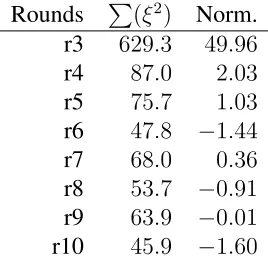
u= 7 −0.00 0.48 0.51 0.13 0.64 0.39 −0.18 0.99 The first table, for ConSum(b8,r4), having sum of squares= 228.7, presents significant deviation from an ideal table (for64gaussian variables with average0 and standard deviation1we expect a sum of squares of 64±11.3). The second table, for ConSum(b8,r5), however, presents no noticeable anomaly, having a sum of squares= 75.5. This is true for all further numbers of rounds:
Rounds P
(ξ2) Norm.
r3 1 479.0 125.07 r4 228.7 14.56 r5 75.5 1.02 r6 50.7 −1.18 r7 67.9 0.35 r8 39.7 −2.14 r9 69.5 0.48 r10 69.8 0.51
(The “Norm.” column is simply the value of the colum P
The values in this table indicate that ConSum is not noticeably biased, from five rounds on, toward correlating bit changes in the ciphertext to single bit changes in the plaintext.
6.2.2 Key to ciphertext
The test described here is analogous to the previous one, except that instead of varying a bit in the plaintext we vary it in the key.
In other words: for each one of8×8combinations of a key bit position uk
and a ciphertext bit positionv, we have examined how many out of the256×128 (key1,key2,plaintext)triplets, where the two keys differ exactly at bit positionuk,
give rise to ciphertexts pairs (ciphertext1,ciphertext2) in which bit position v
differs. This time the ideal proportion is p = 12 because there is no reason to exclude the two ciphertexts being equal. Here are the observed results, expressed in expected standard deviations (p256×128×p(1−p) = 90.510) relative to the expected mean (256×128×p= 16384):
r4 v = 0 v = 1 v = 2 v = 3 v = 4 v = 5 v = 6 v = 7
uk = 0 −0.51 −0.46 −2.21 −2.89 1.30 0.29 −0.51 −1.46
uk = 1 −1.02 −1.17 0.57 0.29 1.28 −1.02 −1.37 −0.15
uk = 2 2.47 1.10 −0.75 0.64 −0.15 −0.04 −0.60 1.06
uk = 3 0.62 −1.86 −0.09 0.66 −0.95 0.18 −0.04 2.67
uk = 4 0.40 −0.80 0.97 0.38 −0.49 −1.83 0.42 −0.93
uk = 5 1.81 0.97 1.59 −0.09 0.33 0.20 −0.53 1.61
uk = 6 −2.06 0.71 2.01 0.22 −0.51 −1.90 0.33 −2.72
uk = 7 0.57 0.49 0.44 1.17 −0.18 −0.38 −0.84 0.11
r5 v = 0 v = 1 v = 2 v = 3 v = 4 v = 5 v = 6 v = 7
uk = 0 0.20 1.94 −1.59 0.46 1.55 1.02 −2.30 −0.09
uk = 1 −1.68 0.66 0.02 −0.02 −1.48 1.04 0.69 0.15
uk = 2 1.39 −1.83 0.49 −1.13 −0.42 0.71 −0.77 −0.24
uk = 3 −1.06 −0.13 −1.70 −0.40 −1.41 0.69 0.84 −1.75
uk = 4 −1.17 0.93 −0.40 −0.51 1.06 −1.37 −0.20 0.57
uk = 5 1.30 −0.66 −2.25 −0.51 −1.66 0.71 −0.55 0.69
uk = 6 −1.33 1.99 0.27 −0.75 −0.02 −1.55 −0.93 1.35
Rounds P
(ξ2) Norm.
r3 629.3 49.96 r4 87.0 2.03 r5 75.7 1.03 r6 47.8 −1.44 r7 68.0 0.36 r8 53.7 −0.91 r9 63.9 −0.01 r10 45.9 −1.60
The values in this table indicate that ConSum is not noticeably biased, from four rounds on, toward correlating bit changes in the ciphertext to single bit changes in the key.
6.3
Correlation of
-differentials
6.3.1 Plaintext to ciphertext
We now consider a table analogous to the one described in section 6.2.1, except that it is a 255 × 255 table which, for each possible non-zero differential u
(between 1 and 255) in the plaintext and each possible non-zero differential v
(between 1 and 255) in the ciphertext, records how many out of the 256 × 256 (key,plaintext1,plaintext2) triplets where plaintext2 = plaintext1 u have ciphertext2 =ciphertext1v.
Rounds P
(ξ2) Norm.
r3 550 027 1345 r4 100 153 97.41 r5 68 875 10.68 r6 67 116 5.80 r7 65 980 2.65 r8 65 495 1.30 r9 65 060 0.10 r10 64 384 −1.78
The results may appear bad as we have detected deviations from a statistically ideal cipher up to six rounds of ConSum. However, this test is extremely stringent since it examins all plaintext differentials versus all ciphertext differentials (something not at all realizable for larger block sizes): so it is not surprising to detect very subtle levels of correlation.
6.3.2 Key to ciphertext
This time the table is 255 × 256, because for each of the 255 non-zero key differentialsukany one of the256ciphertext differentialsvis possible and should
be equally likely: the table counts how often a certain-differentialukin the key
gives rise to a certain-differentialv in the ciphertext. Rounds P
(ξ2) Norm.
r3 76 861 32.05 r4 65 990 1.97 r5 66 825 4.28 r6 65 360 0.22 r7 65 996 1.98 r8 64 879 −1.11 r9 65 312 0.09 r10 65 137 −0.40
Here we find no meaningful correlation from six rounds on (again, this is a very stringent test, as it examines all possible key differentials).
6.4
Correlation of
⊕
-differentials
E(z, x0 ⊕u) = E(z, x0)⊕ v where x0 = x ⊕u (for any function E): hence if we count (for each given pair(u, v)) every pair(z, x)such thatE(z, x⊕u) =
E(z, x)⊕vwe expect257.00±22.627(not257.00±16.000as for-differentials).
Plaintext to ciphertext:
Rounds P
(ξ2) Norm.
r3 186 980 338 r4 79 678 40.63 r5 68 716 10.23 r6 65 170 0.40 r7 65 869 2.34 r8 65 227 0.56 r9 65 726 1.95 r10 64 796 −0.64
Key to ciphertext:
Rounds P
(ξ2) Norm.
r3 75 866 29.30 r4 64 891 −1.08 r5 65 606 0.90 r6 64 994 −0.79 r7 65 591 0.87 r8 65 263 −0.05 r9 66 081 2.22 r10 65 008 −0.75
6.5
Why analyze only
8
-bit ConSum?
width of the bit strings (this is intuitive in the diagrams showing its matrix, and the fact that it has no small periods also goes in this direction); as for carry bits, we have argued in section 5 that the amount of entropy they bear is proportional to the string length. So there is no particular reason to increase the number of rounds when we have more bits of input (basically, the Conway operation just becomes more complicated).
On the other hand,8-bit ConSum provides us with a toy-model for the larger ConSum sizes, on which we can perform statistical tests of some significance (4bits is too small,16bits is already too large).
7
Tables and test vectors
7.1
Eight-bit Conway transformation
The following table lists the value ofKx(the Conway transformation ofx) for all 8-bit valuesx; here, the line determines the more significant hexadecimal digit of
x, and the column the less significant digit.
x10 x11 x12 x13 x14 x15 x16 x17 x18 x19 x1a x1b x1c x1d x1e x1f 0x0 00 80 c0 40 b0 30 70 f0 d0 50 10 90 60 e0 a0 20 1x0 8d 0d 4d cd 3d bd fd 7d 5d dd 9d 1d ed 6d 2d ad 2x0 c6 46 06 86 76 f6 b6 36 16 96 d6 56 a6 26 66 e6 3x0 4b cb 8b 0b fb 7b 3b bb 9b 1b 5b db 2b ab eb 6b 4x0 b9 39 79 f9 09 89 c9 49 69 e9 a9 29 d9 59 19 99 5x0 34 b4 f4 74 84 04 44 c4 e4 64 24 a4 54 d4 94 14 6x0 7f ff bf 3f cf 4f 0f 8f af 2f 6f ef 1f 9f df 5f 7x0 f2 72 32 b2 42 c2 82 02 22 a2 e2 62 92 12 52 d2 8x0 de 5e 1e 9e 6e ee ae 2e 0e 8e ce 4e be 3e 7e fe 9x0 53 d3 93 13 e3 63 23 a3 83 03 43 c3 33 b3 f3 73 ax0 18 98 d8 58 a8 28 68 e8 c8 48 08 88 78 f8 b8 38 bx0 95 15 55 d5 25 a5 e5 65 45 c5 85 05 f5 75 35 b5 cx0 67 e7 a7 27 d7 57 17 97 b7 37 77 f7 07 87 c7 47 dx0 ea 6a 2a aa 5a da 9a 1a 3a ba fa 7a 8a 0a 4a ca ex0 a1 21 61 e1 11 91 d1 51 71 f1 b1 31 c1 41 01 81 fx0 2c ac ec 6c 9c 1c 5c dc fc 7c 3c bc 4c cc 8c 0c
7.2
Step-by-step encryption
We perform the encryption of plaintext 0000...0000 (128 bits) with key
0000...0000in ConSum(v0, b128, k256, r10).
Key schedule: t(0) =
0000000000000000 0000000000000000 0000000000000000 0000000000000001
t(1) =8000000000000000 0000000000000000 0000000000000000 0000000000000001
t(2) =
5e4ae3a94a88a921 e3a92850a9218171 4a88a921e2208b6b a92181714b010a1b
t(3) =
bde3cbf9e3a92850 c376d7b8fc4df767 e3a92850a9218171 20dfffe8556c7617
t(5) =
679c50b6fe2b4f6b 038bd29a4c2a85ac f670bd42668cf89d afc7650022fd8f19
t(6) =6a68e79f65cd77d3 863e9d9e461d73f4 d0a9e13bd61aed60 05a6f4aee59e1cf1
t(7) =33da041e149339c0 3a912275b41863b6 048c255511b09e07 77941d605d6e83a7
t(8) =
3949da428b1f529b 7614ac31c747e15f ef39d4887a6e57a9 d27e22db0c2f58db
t(9) =
21797023c351872d 85c639150ca2602a 98c8a0e75c8172d0 e9ec6b6796c93d6f
t(10)=5a2bb3684ab96ebf 12c0944f82dcf0e5 c1a17b575e9e7491 b2e70aa12d9738db
Encryption:
y(0) =0000000000000000 0000000000000001
y(1) =8000000000000000 0000000000000001
y(2) =a8d38ccb2ca9348d 8ccaa9c1f4228b8c
y(3) =efc998c83a0383f8 dc99505629e6427a
y(4) =7daf7aac099df886 d1ec1c967687cd52
y(5) =b1bad4d984789a50 e4d667f5e49be585
y(6) =cf3c323d27b3e9f0 03733b882cc77667
y(7) =6db1a70fffa763cb 23ac09438b54c3b8
y(8) =80f660ff6fc880da f48eb29892864c6c
y(9) =8b21980fac55fae4 f7b7173c1527ac40
y(10) =20e2998f0041115a 3b6bfb505e881ef3
The last line (20e2998f0041115a 3b6bfb505e881ef3) is the ciphertext.
7.3
Repeated encryption
We start with a0 = a1 = a2 = 00...00 as128-bit strings and repeatedly define
an+1 as the encryption ofanwith key an−2|an−1 (that is an−2 as high-order bits
andan−1 as low-order bits) using ConSum(v0, b128, k256, r10):
a3 =20e2998f0041115a 3b6bfb505e881ef3
a4 =407f607817a169b9 114de8c86eae011d
a5 =328a1865d48c4500 1c83a1464557a5d0
a6 =ddf08de099b9f063 21d6321a2f2568d9
a7 =26533d04205d5b68 fb130bc2fa055e2f
a8 =626e73beafd865ab e5c28b8100fd9f3c
a9 =39b78910c3a3704b d88f424023d1875e
a10 =1018adf304fe111c ec7cc35878e98eb2
a100 =21108083fcaeeaf9 76b39f6d3e01ad18
a1000 =9ebcfb6ead11f411 9bef167eb2e44c67
a10000 =a00920187851a27d 1bc5268df24a5960
a100000 =4ebf22fec1d25af3 f9e99376a5f670bc
7.4
Variation on parameters
We constantly use a key and plaintext of00...00(various lengths): ConSum(v0, b128, k256, r10): 20e2998f0041115a 3b6bfb505e881ef3
ConSum(v0, b128, k256, r9): 8b21980fac55fae4 f7b7173c1527ac40
ConSum(v0, b128, k256, r11): b77cac9ee4e251a1 0d2695d0b093a24d
ConSum(v0, b128, k256, r12): b27f1601a8370bed 44b4a89e35826818
ConSum(v0, b256, k256, r10):b47258422ff4d2ad a2e286117feecfed 07d77b55f150266a ed944303c92194d0
ConSum(v0, b256, k512, r10):72fb12624775873c 9426a190d2bd7053 e9cd0a14ecbbc4d9 95a2467f42def11c
ConSum(v0, b64, k128, r10): 57fff41ae07852f4
ConSum(v0, b64, k64, r10): e8a28731578224ca
ConSum(v0, b64, k256, r10): 1333b3dbf1b2d9b2
ConSum(v0, b32, k32, r10): be92e11f
ConSum(v0, b16, k16, r10): 8a22
ConSum(v0, b8, k8, r10): 99
ConSum(v0, b4, k4, r10): e
References
[1] E. Berlekamp, J. H. Conway & R. Guy,Winning Ways, Academic Press.