Commissioning and initial experimental program of the BGO-OD
experiment at ELSA
S. Alef1, P. Bauer1, D. Bayadilov2, R. Beck2, M. Becker2, A. Bella1, P. Bielefeldt1, S. Böse2, A. Braghieri3, K. Brinkmann4, P. Cole1,5, R. Di Salvo6, H. Dutz1, D. Elsner1, A. Fantini6,7, O. Freyermuth1, S. Friedrich1, F. Frommberger1, V. Ganenko8, D. Geffers1, G. Gervino9,10, F. Ghio11,12, S. Görtz1, A. Gridnev13, E. Gutz4, D. Hammann1, J. Hannappel1, W. Hillert1, A. Ignatov14, R. Jahn2, R. Joosten2, T.C. Jude1, F. Klein1, J. Knaust1, K. Kohl1, K. Koop2, B. Krusche15, A. Lapik14, P. Levi Sandri16,, I.V. Lopatin13, G. Mandaglio17,18, F. Messi1, R. Messi6,7, V. Metag4, D. Moricciani6, A. Mushkarenkov14, M. Nanova4, V. Nedorezov14, D. Novinskiy13, P. Pedroni3, B. Reitz1, M. Romaniuk6, T. Rostomyan1, N. Rudnev14, C. Schaerf6,7, G. Scheluchin1, H. Schmieden1, A. Stugelev13, V. Sumachev13, V.Tarakanov13, V. Vegna1, D. Walther1, D. Watts , H. Zaunick2,4, and T. Zimmermann1
1Physikalishes Institut, Nußallee 12, 53115, Bonn, Germany
2Helmoltz-Institut für Strahlen- und Kernphysik, Nußallee 14-16, 53115 Bonn, Germany 3INFN sezione di Pavia, Via Agostino Bassi, 6 - 27100 Pavia, Italy
4Justus-Liebig-Universität, II. Physikalisches Institut, Heinrich-Buff-Ring 16, 35392 Gießen, Germany 5Idaho State University, 921 S. 8th Ave., Pocatello, Idaho 83209, USA
6INFN Roma Tor Vergata, Via della Ricerca Scientifica 1, 00133 Roma, Italy 7Universitá di Roma Tor Vergata, Via della Ricerca Scientifica 1, 00133 Roma, Italy
8Kharkov Institute of Physics and Technology, Akademicheskaya St. 1, Kharkov, 61108, Ukraine 9INFN sezione di Torino, Via P.Giuria 1, 10125 Torino, Italy
10Universitá di Torino, via P. Giuria 1, 10125 Torino, Italy 11INFN sezione di Roma, P.le Aldo Moro, 2, 00185 Roma, Italy
12Istituto Superiore di Sanitá, Viale Regina Elena 299, 00161 Roma, Italy
13Petersburg Nuclear Physics Institute, Gatchina, Leningrad District, 188300, Russia
14Russian Academy of Sciences Institute for Nuclear Research, prospekt 60-letiya Oktyabrya 7a, Moscow 117312, Russia
15Institut für Physik, Klingelbergstraße 82, 4056 Basel, Switzerland
16INFN Laboratori Nazionali di Frascati, Via E. Fermi 40, 00044 Frascati, Italy 17INFN sezione Catania, 95129 Catania, Italy
18Universitá degli Studi di Messina, Via Consolato del Mare 41, 98121 Messina, Italy
19The University of Edinburgh, James Clerk Maxwell Building, Mayfield Road, Edinburgh EH9 3JZ, UK
Abstract.BGO-OD is a new meson photoproduction experiment at the ELSA facility of Bonn University. It aims at the investigation of non strange and strange baryon excita-tions, and is especially designed to be able to detect weekly bound meson-baryon type structures. The setup for the BGO-OD experiment is presented, the characteristics of the photon beam and the detector performances are shown and the initial experimental program is discussed.
1 Introduction
The BGO-OD Collaboration was formed at the end of 2010 with the aim of studying meson photo-production offthe nucleon (and eventually offlight nuclei) at Bonn ELSA. The photon beam covers the region between 0.3 to 2.9 GeV, and substantial linear polarization can be obtained up to 1.8 GeV via coherentBremsstrahlung. The detector covers∼95% of 4πand is optimized for the measurement of final states with both charged and neutral particles. We present here the beam characteristics, the detector performances, as obtained in the commissioning runs of the experiment, and we discuss the main scientific goals and the initial experimental program.
2 The photon beam
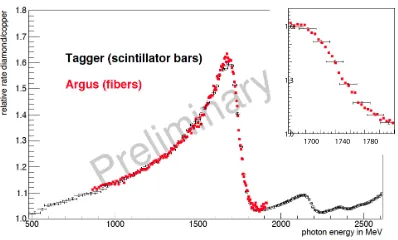
Theγ-ray beam for BGO-OD is obtained throughBremsstrahlungof the 3.2 GeV electrons extracted from the ELSA stretcher ring [1]. Amorphous copper radiators of different thicknesses are available and a diamond radiator can be inserted as well, allowing production of a linearly polarized photon beam. The energy of the photons is determined by the tagging technique: the electrons that have emittedBremsstrahlungphotons are momentum-analyzed by a tagger magnet and their position is measured by a tagger counter formed by 120 scintillators (160 ps time resolution, 0.5% - 2.0% energy resolution, and capable of handling up to 50 MHz event rate). The tagger is part of the event trigger. In order to have a more precise measurement of the photon energy (and thus of its polarization) under the coherent peak, the tagger is complemented with theARGUS hodoscope formed by 480 scintillating fibers. The energy resolution of theARGUSis∼0.08%. In Fig. 1 we show the relative rate (diamond/copper) as measured by the tagger and byARGUS.
1.0 1.3 1.6
1700 1740 1780
Figure 1.Relative count rate (diamond/copper) as measured by the tagger (scintillator bars, black points), and by theARGUShodoscope (scintillating fibers, red squares). In the insert, the detail of the coherent edge region.
3 The detector
for particle tracking and identification. The polar angles between 8◦and 25◦are covered by a ring of scintillating counters (SciRi) and by MRPC chambers (Daisy) with excellent time resolution. Finally, the forward region is covered by theOpen Dipoleforward spectrometer. Its central part is a 0.45 T large aperture dipole magnet (provided by DESY on permanent loan basis). Tracking is performed by position detectors in front of the magnet (MoMoandScifi2), both consisting of scintillating fibers, and 8 double layer Drift Chambers followed by 3 ToF scintillating walls behind it.
Figure 2.Schematic view of the BGO-OD experimental setup. Electron beam enters from the bottom-right corner.
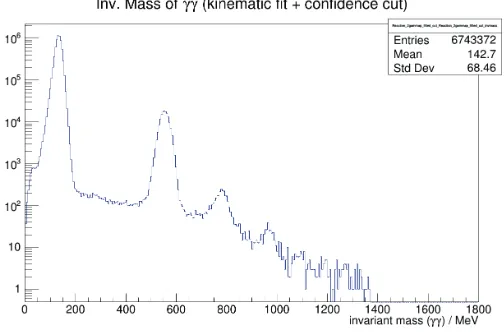
The performance of the BGORugby Ballis summarized in Fig. 3 where we show the two-photon invariant mass spectrum from a proton target obtained with kinematical fit and confidence cut. The π0, η, ωandηpeaks are all clearly visible. The energy calibration is obtained using a Na-22 source with peak at 1.275 MeV.
Figure 3.The two-photons invariant mass from a proton target measured by theRugby
Ballcalorimeter.
TheRugby Ballcan also measure protons[2] and neutrons[3], and by using sampling ADCs with
400 MeV. The time resolution allows to distinguish the signal of the stoppedK+from the signal of the subsequent weak decayK+→μ+ν. (see Fig. 4).
Figure 4.Left: energy of the delayed signal from the decayK+→μ+ν. The peak at 153 MeV corresponds to theμ+energy deposition from aK+decay at rest. Right: reconstructedK+lifetime.
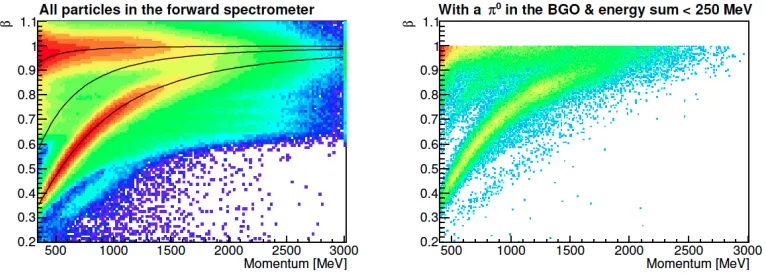
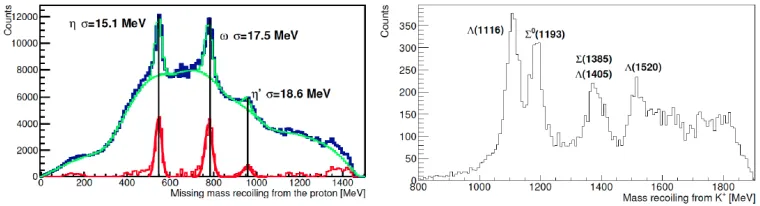
In the forward region, particle identification is performed by looking at the bidimensional plot of particle velocity versus particle momentum (Fig. 5). By selecting protons or charged kaons in this plot we can obtain the two missing mass plots shown in Fig. 6.
Figure 5.Left:βvs. momentum for all particles detected in theOpen Dipoleforward spectrometer. Right: same plot in coincidence with aπ0in the calorimeter and with energy sum in the calorimeter less than 250 MeV. The K+line is accentuated and is clearly visible.
4 Experimental program
Figure 6.Missing mass spectrum in theOpen Dipoleforward spectrometer. Left: from the proton.η,ωand also
ηpeaks are clearly visible. Right: from theK+.ΛandΣ0peaks are very clear and also other hyperons peaks are present.
CBELSA/TAPS collaboration[5] will be investigated by measuring the differential cross section in γp → K0Σ+and the beam asymmetry over theK∗threshold region, achieving high statistics by
in-cluding data of both neutral and charged decays of theK0andΣ+. The acceptance of theOpen Dipole forward spectrometer is also ideal to measure data at centre-of-mass anglesθcm≤15◦forK+Y, where
data are scarce and incompatible. A central goal is to disentangle the structure of hyperon excitations, e.g. theΛ(1405) or hypothesisedΣ∗states ofJP=1/2−in the same mass range.
Pseudoscalar and vector meson photoproduction will be studied too, both offthe proton and offthe neutron, measuring cross sections and beam asymmetries. Thanks to the high energy resolution for the incoming photon energy provided by theARGUS hodoscope, the beam asymmetry inη photo-production will be measured at threshold, allowing for a more detailed study of the strong energy dependence observed by the GrAAL collaboration[6], and at higher energy (up to 1800 MeV) where no experimental data are available yet. The high efficiency of theRugby Ballfor neutron detection will allow the measurements ofηandωoffthe quasi-free neutron with liquid D2 target. Finally, the Φphotoproducion will be investigated as well.
5 Conclusion
The BGO-OD experiment is commissioned; the performances of the beam and of the apparatus are as expected, production runs are underway and data analysis is ongoing for many reaction channels. The experimental program includes meson photoproduction from proton, deuteron and light nuclei.
References
[1] W. Hillert, Eur. Phys. J. A28, 139 (2006)
[2] A. Zucchiattiet al., Nucl. Instr. and Meth. A321, 219 (1992) [3] O. Bartaliniet al., Nucl. Instr. and Meth. A562, 85 (2006)
[4] T.C. Jude, D.I. Glazier and D.P. Watts, Phys. Lett. B735, 112 (2014) [5] R. Ewaldet al., Phys. Lett. B713, 180 (2014)