Article
Localization parameters for interacting particles in
disordered two-dimensional lattices
Tirthaprasad Chattaraj1 0000-0002-7911-5569
1 2 3
4 5 6
7
1 UniversityofBritishColumbia-Vancouver,B.C.,V6T1Z1,Canada
* Correspondence:[email protected];Tel.:+1-604-822-8510
Abstract: In two dimensional disordered lattices, presence of interaction makes particles less localizedthanthenon-interactingoneswithintherangeofdisorderstrength W ≤4andinteraction strength V ≤ 4. If the interaction strength is higher, then particles localize more. Although, a localization-delocalization transitionis not found, atransition withchanges in the dominant correlationsisobserved.Thenatureofcorrelationsbetweentheparticlesasnearestneighborsbecome dominantbeyondcertaindisorderstrengths.
Keywords:Disorderedsystem;Twodimension;Localization
PACS:64.60.an,71.30.+h,71.45.-d
8
1. Introduction
9
The case of localization of two interacting particles in one dimensional lattices has been
10
investigated thoroughly [1–7] since last nineties. These studies were motivated by the observation of
11
persistent currents in 1D wires [8–10]. Similar experimental observation of localization-delocalization
12
transition in two-dimensional systems [11,12] had drawn attention for theoretical research on effect of
13
interaction on such transition [13–15]. However, the study of localization of two interacting particles
14
in 2D lattices brings computational difficulty with it. In a recently developed algorithm, [16,17]
15
based on recursive calculation of two-particle Green’s functions, such difficulties have been reduced
16
and such calculations have been made possible to perform within reasonable amout of resources.
17
Although, even after algorithmic reduction of difficulties, the task still remains challenging for large
18
lattices. Therefore certain approximations must be employed which has been justified in detail in a
19
separate work [17]. However, such calculations not only helps in gaining understanding on the effect
20
of interaction on localization, but also provide information on the correlations of the particles. These
21
correlations between particles calculated from two-particle Green’s functions, reveal further details on
22
the phases of localization in the disordered systems.
23
For the calculation of localization parameters, one of the prescribed approach is to calculate
24
two-particle Green’s propagator from the center of the lattice to boundaries [18] with combination
25
of scaling arguments [19]. This approach has been implemented in previous studies [13]. However,
26
computational difficulty limits such calculations to small system sizes which often entail significant
27
finite size effects. The drastic approximations involved in such studies also render it difficult to make
28
any conclusive statement on localization-delocalization transition in 2D disordered systems.
29
In this article, inverse participation ratio (IPR) is calculated as a localization parameter. Calculation
30
of IPR involves computation of all Green’s propagators for given interaction strength between the
31
particles and strength of disorder of the lattice. The IPR can be taken as a macroscopic parameter
32
dependent on the distribution of particles on the whole lattice and is less susceptible to finite size
33
effects. Thus the IPR numbers are expected to provide a better understanding on the length scale of
34
localization of interacting particles in finite 2D disordered systems. Additional informations on the
35
localization are obtained from the correlations between particles calculated from two-particle Green’s
36
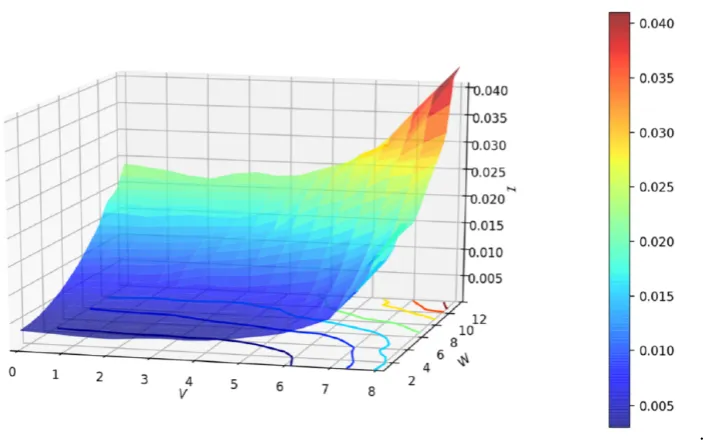
functions. The correlation parameters provide more information on the underlined structure of the
37
distribution of the particles in localized systems.
38
The IPR parameters are calculated for a broad range of disorder strengths of the lattices and
39
interaction strengths between the particles. This broad range of calculations help in gaining further
40
insights into the interplay of disorder and interaction in 2D systems. With the additional informations
41
on correlations, separate phases can be recognized between localized states in finite disordered 2D
42
systems.
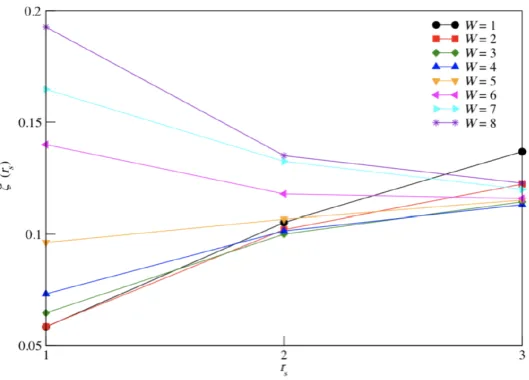
43
2. Method
44
In this article. the Hubbard Hamiltonian with nearest neighbor hopping and nearest neighbor
45
interaction is considered for the study. The particles are taken as hard core bosons. This is the most
46
general form of Hamiltonian for studies on localization in both one- and two-dimensional disordred
47
systems.
48
H=
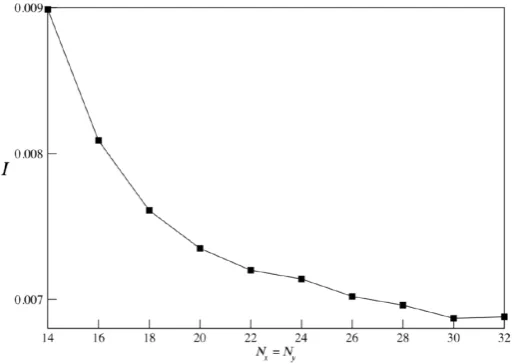
∑
ij
eija†ijaij+
∑
ij(a†ijai+1j+a†ijaij+1)
+V
∑
ij(nijni+1j+nijnij+1) (1)
Herei,jare the site indices on two axes of the lattice. The onsite energyeijis chosen randomly from a
49
uniform box distribution [−W2,W2] of widthW, which defines the disorder strength. The computational
50
algorithm involved in the calculations is explained in detail in a separate article [17]. The Green’s
51
elements for a given disorder strength from an initial occupation of particles at adjacent sites in the
52
middle of the lattice are calculated at very large times (τ=1000) using the algorithm. The lattice was
53
considered to have 20 sites per dimension. The approximation of maximum relative distance (r) was
54
applied withr=5 for significant enhancement of the efficiency of the calculations without significant
55
errors [17]. The Green’s elements were thus computed at sufficiently large times than required for the
56
spreading of the particles to the lattice boundaries.
57
G(i,j,τ) =
∑
ω
e−iωτG(i,j,
ω) (2)
Once all such Green’s elements were found, that is for every site indices (i,j) with|i−j| ≤rfor two
58
particles, the joint density distribution (ρ), density distribution ($) and inverse participation ratio
59
(I) were calculated for each realization of disorder, which were averaged afterwords over many
60
realizations.
61
ρ(i,j,τ) =|G(i,j,τ)|2 (3)
$(i,τ) =1
2
∑
j6=iρ(i,j,τ) (4)I = ∑i$(i,τ)
2
∑i$(i,τ) (5)
For a measure of total correlation (ζ) with respect to the distance between particles, the minimum step
62
distance between the particles on the lattice (rs, hamming distance) was taken as a measure of distance
63
and the correlation elements were summed based on such distance irrespective of the locations of the
64
particles on the lattice.
ζ(rs) =
∑
|i−j|=rsρ(i,j,τ) (6) This parameter then reflects the total correlation within the density distribution in the disordered 2D
66
lattice.
67
3. Results
68
The results of the calculations for medium sized finite disordered 2D lattices are shown in Fig.1.
69
The calculations involved combinations of disorder (W) and interaction strengths (V) within the range
70
1≤W ≤12 and 0≤ V≤8. The IPR numbers were found to be ranging from 0.004 to 0.04 within
71
this broad range of disorder and interaction strengths. Higher IPR represent more localization of the
72
particles.
73
Figure 1. Two dimensional disorder-interaction diagram with black squares showing the regions where nature of correlations change. The inverse participation ratios plotted are averaged over 320 realizations of disorder.
Figure1shows a reduction in localization with increase in interaction uptoV≤4, when compared
74
toV = 0 case, for the range of disorder strength 1 ≤ W ≤ 4. This range can be termed as weak
75
interaction and weak disorder region, where the interacting particles have smaller IPR and lesser
76
localization compared to non-interacting ones. This is made clearly visible in Fig.2with IPR numbers
77
for fixed disorder cross sections plotted as a function of interaction strength.
Figure 2. Cross sections from the Fig. 1on disorder axis. It shows decrease in IPR from that of non-interacting particles within the range 1≤W≤4 and 0≤V≤4.
Beyond the weak disorder - weak interaction regime, enhancement in localization is observed in
79
presence of interaction.
80
The marked squares on Fig.1indicates a change in the correlations between the particles in their
81
localization. The measure of total correlationζ(rs)forrs =2 is larger than that ofrs =1 toward the
82
lower IPR region of these squares.ζ(1)becomes larger thanζ(2)when either disorder or interaction
83
is increased beyond these marked squares. The following Fig. 3exhibits one of such squares for
84
V = 4, where it can be observed thatζ(2) > ζ(1)beyondW = 6. This change in the underlined
85
correlations between the particles in their localization can be an observable for measurements involving
86
two-particle correlators. This change also signifies not only a transition from low IPR to high IPR
87
region, but also a type of underlined phase of the particles which cannot be observed from single
88
particle density measurements.
89
Figure 3. Correlation of the two particles depending on the (hamming) distance between them irrespective of their location at lattice forV=4.
The density distribution of one of such points from Fig. 1(W = 1,V = 4) is shown in Fig. 4.
90
As the distribution shows, after averaging over 250 realizations, the final distribution appears to be
localized. This point from the Fig.1has low IPR compared to other points of the diagram. However,
92
the density distribution appears to be localized for a finite sized 2D disordered lattice.
93
Figure 4.Density distribution on the two dimensional lattice forV=4 andW=1. Averaged over 320 realizations of disorder.
The scaling analysis of this specific point (W=1,V=4) from Fig.1is described in Fig.5, which
94
indicates a localized state as the IPR approaches a constancy for larger system sizes. However, a
95
conclusion on the absence of delocalization for the model under consideration at this weak interaction
96
- weak disorder regime may not be drawn as the calculations involved the previously mentioned
97
approximations. Any such conclusion will require analysis of the full problem which will involve
98
further computational challenges.
99
Figure 5.Scaling of IPR with the lattice size forV=4 andW=1. Averaged over 50 realizations of disorder.
The effect of increasing localization, when both interaction and disorder is strong, can be
100
interpreted as the effect from participation of bound state in the underlined dynamics and disorder
101
enhancement of binding. This is also implied from the correlations between the particles. However
102
when the bound state interpreted as the particles correlated as nearest neighbor ones, Fig.1do not
map directly with that of crossing points where such correlations change. The effect of different types
104
of correlations in the underlined distribution might show different features of localization.
105
Accompanied with the understanding on correlations within the localized distribution of particles,
106
one can attempt to draw separate phases of localizations. A 3D distribution of the same Fig. 1is
107
shown in Fig.6. The contours drawn on the lower surface of Fig.6indicate such differences between
108
localized phases. While the contours with IPR≤ 0.01 reveals a centricity towards the origin, the
109
contours with IPR≥0.02 have centricity away from the origin on the diagram. This can be based on
110
the correlations between the particles. This region with IPR≤0.01 shows a possibility delocalized
111
behavior that may be corroborated with other works [13]. However, this study do not find any sign of
112
delocalized behavior which may be a result of finite sized systems under consideration combined with
113
the approximations involved int the calculations.
114
;
Figure 6.Three dimensional disorder-interaction diagram. The different character of the light blue and light green contours indicate a possible difference between the two regions. The inverse participation ratios plotted are averaged over 320 realizations of disorder.
4. Conclusion
115
This study has attempted to calculate localization parameters for disordered 2D lattice systems.
116
The calculations not only provide an understanding on the length scales of the localized interacting
117
particles, but also present an understanding on the correlations between the particles in their localized
118
states. The inverse participation ratios calculated for a vast range of disorder and interaction parameters
119
reveal the effects of both interaction and disorder on localization of particles in disordered 2D systems.
120
Although, a localization-delocalization transition is not found in this study, it doesn’t exclude such
121
possibilities. Understanding of the correlations suggest different phases of localization within the
122
broad ranges of disorder and interaction strengths.
123
Funding:Please add: “This research received no external funding” or “This research was funded by [name of
124
funder] grant number [xxx].” Check carefully that the details given are accurate and use the standard spelling of
125
funding agency names athttps://search.crossref.org/funding, any errors may affect your future funding.
126
Acknowledgments:In this section you can acknowledge any support given which is not covered by the author
127
contribution or funding sections. This may include administrative and technical support, or donations in kind
128
(e.g. materials used for experiments).
129
Conflicts of Interest:The author declares no conflict of interest.
References
131
1. Romer R. A., Schreiber M. and Vojta T. Disorder and two-particle interaction in low-dimensional quantum
132
systems.Physica E2001,9, 397
133
2. Frahm K. M. Eigenfunction structure and scaling of two interacting particles in the one-dimensional
134
Anderson model.Eur. Phys. J. B2016,89, 115
135
3. von Oppen F., Wettig T. and Muller J. Interaction-induced delocalization of two particles in a random
136
potential: scaling properties.Phys. Rev. Lett. 1996,76, 491
137
4. Krimer D. O., Khomeriki R. and Flach S. Two interacting particles in a random potential.JETP Letters2011,
138
94, 406
139
5. Waintal X. and Pichard J. L. Two interacting particles in a disordered chain I: Multifractality of the interaction
140
matrix elements.Eur. Phys. J. B1998,6, 117
141
6. Arias S. T., Waintal X. and Pichard J. L. Two interacting particles in a disorder chain III: Dynamical aspects of
142
the interplay disorder-interaction.Eur. Phys. J. B1999,10, 149
143
7. Chattaraj T. and Krems R. V. Effects of long-range hopping and interactions on quantum walks in ordered
144
and disordered lattices.Phys. Rev. A2016,94, 023601
145
8. Ambegaokar V. and Eckern U. Coherence and persistent currents in mesoscopic rings.Phys. Rev. Lett.1990,
146
65, 381, doi:xxxxx.
147
9. Levy L. P., Dolan G., Dunsmuir J. and Bouchiat H. Magnetization of mesoscopic copper rings: Evidence for
148
persistent currents.Phys. Rev. Lett1990,64, 2074
149
10. Chandrasekhar V., Webb R. A., Brady M. J., Ketchen M. B., Gallagher W. J. and Kleinsasser A. Magnetic
150
response of a single, isolated gold loop.Phys. Rev. Lett1991,67, 3578
151
11. Kravchenko S. V., Simonian D., Sarachik M. P., Mason W. and Furneaux J. E. Possible metal/insulator
152
transition at B=0 in two dimensions.Phys. Rev. B1994,50, 8039
153
12. Kravchenko S. V., Simonian D., Sarachik M. P., Mason W. and Furneaux J. E. Electric field scaling at a B=0
154
metal-insulator transition in two dimensions.Phys. Rev. Lett1996,77, 4983
155
13. Ortuno M. and Cuevas E. Localized to extended states transition for two interacting particles in a
156
two-dimensional random potential.Europhys. Lett.1999,46, 224
157
14. Vasseur G. and Weinmann D. Delocalization due to correlations in two-dimensional disordered systems.
158
Eur. Phys. J. B2004,42, 279
159
15. Martinez M. and Pichard J. L. From independent particle towards collective motion for two polarized
160
electrons on a square lattice.Eur. Phys. J. B2002,30, 93
161
16. Berciu M. and Cook A. M. Efficient computation of lattice green’s functions for models with
162
nearest-neighbour hopping.Europhys. Lett.2010,92, 40003
163
17. Chattaraj T. Recursive computation of Green’s functions for interacting particles in disordered lattices and
164
binary trees.arXiv2018,1808.04898
165
18. Song P. H. and von Oppen F. General localization lengths for two interacting particles in a disordered chain
166
General localization lengths for two interacting particles in a disordered chain.Phys. Rev. B1999,59, 46
167
19. MacKinnon A. and Kramer B. The scaling theory of electrons in disordered solids: Additional numerical
168
results.Z. Phys. V - Condensed Matte1983,53, 1