Article
1
Extreme Learning Machine for Robustness
2
Enhancement of Gas Detection Based on
3
Tunable Diode Laser Absorption Spectroscopy
4
WENHAI JI 1, LI ZHONG 1, YING MA 1, DI SONG 1, XIAOCUI LV 1, CHUANTAO ZHENG 2,
5
GUOLIN LI 1,*
6
1 College of Information and Control Engineering, China University of Petroleum, Qingdao 266580, China
7
2 State Key Laboratory on Integrated Optoelectronics, College of Electronic Science and Engineering, Jilin
8
University, Changchun, 130012, China
9
* Correspondence:[email protected]; Tel.: +86-532-86980953
10
11
Abstract: In this work, a tailored extreme learning machine (ELM) algorithm to enhance the overall
12
robustness of gas analyzer based on the tunable diode laser absorption spectroscopy (TDLAS)
13
method is presented. The ELM model is tailored through activation function selection, input weight
14
and bias searching, and cross validation method to address the analyzer robustness issues for
15
industrial process analysis field application. The two particular issues are the inaccurate gas
16
concentration measurement caused by the process gas background components variation, and the
17
inaccurate spectra shift calculation caused by spectral interference. By using our algorithm, the
18
concentration error is reduced by one order of magnitude over a much larger stream pressure and
19
component range compared with that obtained by classical least square (CLS) fitting methods based
20
on reference curves. Additionally, it is shown that with our algorithm, the wavelength shift accuracy
21
is improved to less than 1 count over 1000 counts spectra length. In order to test the viability of our
22
algorithm, a trace ethylene (C2H4) TDLAS analyzer with coexisting methane was implemented, and
23
its experimental measurements support analyzing robustness enhancement effect.
24
Keywords: gas analyzers; optical sensors; TDLAS; extreme learning machine
25
26
1. Introduction
27
Absorption spectroscopy is a versatile technique to obtain fundamental physics parameters with
28
great precision. Tunable diode laser absorption spectroscopy (TDLAS) technology has gained
29
popular acceptance for trace gas measurement in various industries due to rapid development of
30
optoelectronics technology. Because of its high sensitivity and fast response time, it is widely used in
31
coal mine safety [1], combustion measurement [2], petrochemical process analysis [3], dissolved gas
32
detection [4], gas emission and air quality monitoring [5] etc.
33
But there are challenges to maintain the analyzing robustness and accuracy for long term onsite
34
industrial applications. The conventional concentration measurement method is based on calibration
35
model using reference spectra [6, 7]. The common issues are spectral deformation and spectral
36
interference caused by process background and operating condition variation. These factors are
37
entangled in real time measurement due to the dynamic nature of industrial process. The analyzing
38
system deviates from the original calibration and its performance degrades over time. To address
39
these issues, linear regression algorithms such as classical least square fitting (CLS, also known as
40
multiple linear regression -MLR) method [6], partial least square fitting (PLS) method [7] are
41
commonly adopted in TDLAS spectra analysis. CLS algorithm is also named as reference curve
42
method. PLS is an integration of regression and principle component analysis. The models are good
43
for certain tolerance of background change.
44
But when the spectral interference or deformation becomes stronger, it is hard to achieve
45
satisfactory performance with the linear regression algorithms. Then nonlinear algorithms such as
46
artificial neural networking (ANN) [8], supporting vector machine (SVM) [9] and extreme learning
47
machine (ELM) [10-15] were introduced in spectra analysis. Among those, ELM is a novel single layer
48
forward neuro networking (SLFN) algorithm proposed and developed by G. Huang [16-20]. It has
49
the relative advantages of simple structure and less computation time. ELM is capable of regression
50
and classification [21-22]. For the classification application, ELM was used in coal classification [10],
51
dynamic fresh fruit detection [11], and traffic road signs identification [22] etc. The regression ELM
52
for quantitative calculation was applied in element analysis [12], gas concentration retrieval [13],
53
stellar star abundance calculation [14], diesel fuel and blend oil analysis [15], and food extrusion
54
processing [23] etc. ELM spectra analysis [10-15] was used in micro-NIR, Fourier transform infrared
55
(FTIR) spectroscopy, laser induced breakdown spectroscopy (LIBS) area. Its application in TDLAS
56
spectra analysis for industrial process analysis was not implemented so far.
57
2. Experiment
58
The process of TDLAS analyzer gas concentration measurement is shown in Figure. 1. The
59
spectra generation process is illustrated in Figure. 1 (a). The second harmonic component of laser
60
absorption was obtained through laser current modulation and demodulator extraction. The
61
procedure of calibration model training and verification is illustrated in Figure. 1(b) and (c).
62
However, in the practical model verification, there are challenges due to the harsh operating
63
environment. Particularly, we will deal with two issues. First issue is the accurate gas concentration
64
prediction caused by background components and gas pressure variation during process
65
measurement. Second issue is the accurate spectra shift prediction with strong spectral interference.
66
The direct impact is the degradation of prediction accuracy, shown by the error band width d change
67
from ideal case to practical case in Figure. 1(c). ELM was proposed to address the challenges. With
68
ELM, we aim to calculate both the gas concentration in dynamical process background and the actual
69
spectra shift with the interfering spectral structures.
70
We choose trace ethylene (C2H4) measurement as the application example. C2H4 is an important
71
indicator gas which needs real time monitoring at ppmv (part per million by volume, default as ppm)
72
level in many areas. For example, in the biomedical area, analyzing C2H4 in breath air can be used to
73
study lipid peroxidation of human body cell, so that related deases can be diagnosed at early stages.
74
Another example is monitoring coal spontaneous combustion which is a major risk in the coal mining
75
wells and storages [24-25]. Trace level C2H4 is produced in early stages and the concentration
76
increases as the process continues. CH4 is a common coexisting component and also brings spectra
77
interference. So, accurate measurement of C2H4 concentration at trace level is difficult.
78
Accordingly, 0-200ppm range C2H4 measurement experiment was designed with 0-2000ppm
79
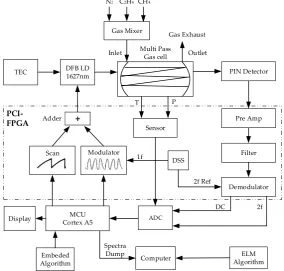
CH4 presence and in dynamic environment. The system schematic is shown in Figure. 2. A
Cortex-80
A5 chip manufactured by Atmel is used as the master micro controller unit (MCU). The A5 MCU
81
controls a commercial module PCI-FPGA-1A manufactured by Port City Instruments (PCI). Its main
82
functions are laser wavelength scan, modulation, photoelectric current amplification and
83
demodulation. A sawtooth shape driving current is applied to the distributed feedback (DFB) laser
84
to scan the wavelength. The tuning range is around 0.45 nm which covers two absorption peaks of
85
the C2H4 at 1626.35nm and 1626.53nm respectively. The laser temperature is stabilized and adjusted
86
by a WTC3293 module (TEC, temperature controller). The scan period is 102ms and the maximum
87
out of fiber power is 3.3mW. The laser driving current is superimposed with a 31.4 KHz sin wave AC
88
signal (1f) for amplitude modulation. The transmitted light is collected by a PIN InGaAs detector.
89
The photon current is directed sequentially through I/V convertor, preamplifier, band pass filter, and
90
phase sensitive lock-in amplifier (demodulator). The second harmonic component denoted as 2f is
91
generated by using a frequency doubled reference signal (2f Ref) in demodulator. The modulation
92
synthesizer (DSS). The optical power signal during the scan denoted as DC is obtained through a low
94
pass filter. DC and 2f, together with gas status parameter temperature T and pressure P are feed to
95
the A5 processor through an analog to digital convertor (ADC).
96
(b) Model training
(c) Model verification (1) Ideal case
(2) Practical case
Spectral interference Frequency drift Calibration Model Calibration Model Y 200 ... 100
0 500 1000
-2500 0 2500 5000 Am pl it ud e( a. u. ) Wavelength(a.u.)
0 500 1000
-2500 0 2500 5000 Am pl it ud e( a. u. ) Wavelength(a.u.)
0 500 1000
-2500 0 2500 5000 Am pl it ud e( a. u. ) Wavelength(a.u.) 200 100
0 500 1000
-2500 0 2500 5000 Am pl it ud e( a. u. ) Wavelength(a.u.) Calibration Model X Am p litu d e Wavelength Demodulator Detector Gas Cell
C2H4 CH4 N2 scanning
LD (a) Spectra generation
0 20 40 60 80 100 0 20 40 60 80 100 Set Pred ict ion
0 20 40 60 80 100 -20 0 20 40 60 80 100 120 Predict io n Set
97
Figure 1. The process of TDLAS analyzer gas concentration measurement. (a) 2f spectra generation;
98
(b) Model training with training set; (c) Model verification with collected spectra.
99
DC 2f Outlet
Inlet Multi Pass Gas cell Gas Mixer N2 C2H4 CH4
TEC DFB LD
1627nm PIN Detector
Scan Modulator MCU Cortex A5 Display DSS Embeded Algorithm Computer ELM Algorithm + ADC Spectra Dump Adder Gas Exhaust T P Pre Amp Filter 2f Ref 1f Sensor PCI-FPGA Demodulator
100
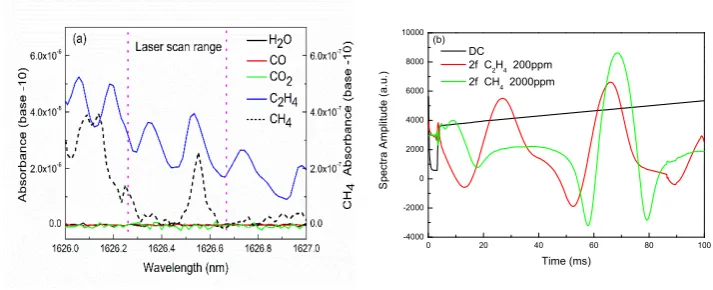
The C2H4 absorption features were thoroughly searched in the near infrared region [24, 26].
102
Absorbance of 1ppm-m moisture (H2O), carbon monoxide (CO), carbon dioxide (CO2), CH4 and C2H4
103
in 1626-1627nm wavelength region is depicted in Figure 3. (a). To demonstrate the clear features of
104
CH4 spectra, its absorbance is plotted on right axis whose scale is 10 times of left axis. At 25℃,
105
atmosphere pressure and 1ppm-m concertation level, the peak absorbance of CH4 is one magnitude
106
weaker than C2H4. The other potential components such as H2O, CO, and CO2 are four or more
107
magnitudes weaker than C2H4. Thus, from 1626.25nm to 1626.70nm region (defined by two magenta
108
dotted lines in Fig. 3(a)) is the ideal wavelength scan range for C2H4 analysis. Experimentally acquired
109
DC and 2f spectra of 200ppm C2H4 and 2000ppm CH4 balanced in N2 are shown in Figure. 3(b) and
110
used as the reference curve in CLS method. The spectral structure of C2H4 and CH4 are overlapped.
111
The gas stream is generated through an automatic gas mixing station with premixed 1000 ppm C2H4
112
in nitrogen (N2), 1% CH4 in N2 and pure N2 bottles.
113
To address the spectra analysis challenges, two experiments were designed. To prepare for
114
analyzer calibration model, test samples should be representative and cover all possible status. Thus,
115
the associated independent variables of the samples such as gas concentrations, pressure, laser
116
driving current etc. should be randomly set. The first experiment was the process simulation test,
117
where CH4 was mixed in stream. The C2H4, CH4 concentration, and gas pressure was randomly
118
varied through the Excel random function in experiment design. The second experiment was spectra
119
shift simulation test, where driving current was randomly adjusted with dynamic gas composition
120
to mimic spectra drift effect.
121
0 20 40 60 80 100
-4000 -2000 0 2000 4000 6000 8000 10000
DC
2f C2H4 200ppm
2f CH4 2000ppm
S
pec
tr
a
A
m
pl
itu
de
(a
.u
.)
Time (ms)
(b)
122
Figure 3. (a) Absorbance of 1ppm-m H2O, CO, CO2, CH4 and C2H4 in 1626-1627nm wavelength
123
region. (b) Experimentally acquired DC and 2f spectra of 200ppm C2H4 and 2000ppm CH4.
124
2.1. Process Simulation Experiment
125
This experiment was to simulate the industrial process in a controlled scenario, where the C2H4
126
concentration, CH4 concentration and gas pressure varied during the measurement. Fifty mixing gas
127
streams were generated with C2H4 up to 200 ppm, CH4 up to 2000 ppm and balancing nitrogen. The
128
pressure was controlled in 900 to 1100 mbar range. Gas cell was maintained at room temperature. In
129
order to get representative test sample, the concentrations and pressure were randomly set. The 50
130
corresponding spectra are plotted in Figure. 4 (a). For an isolated spectra feature, the gas
131
concentration is proportional to the spectra peak height, which is the simple case of Beer-Lambert
132
law. But due to CH4 interference, accurate measurement can’t be obtained by direct counting the C2H4
133
spectra peak height.
134
2.2. Spectral Drift Simulation Experiment
135
A commercial analyzer can be used for 5-10 years. During its lifetime, spectra deformations are
136
unavoidable. Many factors lead to deformation, including the complex operating environment, the
137
spectra drift is the most common type and produces adverse impact on the calibration model
139
accuracy.
140
In this experiment, the gas cell pressure was fixed at 1000 mbar. The gas concentration was also
141
randomly set. The starting current was randomly set in between 59.8 mA to 60.2 mA. The variation
142
range was 0.4 mA and the peak shift range was around 16 counts over 1000 counts spectra range. The
143
current scanning range was fixed at 24 mA. Thus, there was no stretching or shrinking effect. The
144
collected spectra are shown in Figure.4 (b). For an isolated spectra feature, the spectra shift can be
145
calculated by peak tracking based on peak position difference between current spectrum and target
146
spectrum. But it is unlikely to get spectra shift by tracking any spectra peak for the overlapping
147
spectra structures in Figure. 4(b).
148
0 20 40 60 80 100
-4000 -3000 -2000 -1000 0 1000 2000 3000 4000 5000 6000
Process test spectra
S
p
ec
tr
a
A
m
plit
ud
e (
a.u.
)
Time (ms)
(a)
0 20 40 60 80 100
-4000 -3000 -2000 -1000 0 1000 2000 3000 4000 5000 6000
Drift test spectra
Spe
ctr
a
Am
pli
tud
e (
a
.u
.)
Time (ms) (b)
149
Figure 4. Spectra collected in the process simulation test (a) and in spectra drift simulation test (b).
150
3. ELM Algorithm Theory
151
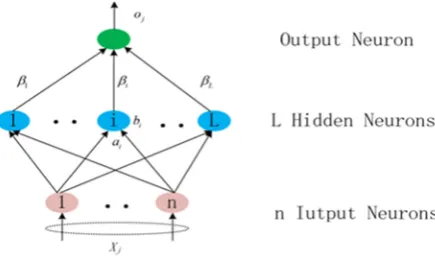
ELM was originally developed for the single-hidden-layer feedforward neural networks and
152
then extended to the “generalized” SLFNs whose hidden layer need not be tuned [16–20]. Essentially,
153
ELM originally proposes to apply random computational nodes in the hidden layer, which are
154
independent of the training data. Different from traditional learning algorithms for a neural type of
155
SLFNs [16], ELM aims to reach not only the smallest training error but also the smallest norm of
156
output weights. ELM is identified with better training speed and generalization ability than BP neuro
157
networking and SVM. The ELM algorithm structure is shown in Figure. 5.
158
Figure 5. Structure of ELM algorithm.
159
We target to improve the prediction accuracy of C2H4 concentration or spectra shift amount.
160
They are assigned as model output o. The prediction is based on the collected spectra. Other variables
161
such as gas temperature T and pressure P may also be helpful to improve prediction accuracy. They
162
are assigned as model input X.
163
1
( ) , 1, ,
L
i i j i j
i
g W X b o j N
β =
⋅ + = =
, (1)where βi is the output weight, [ 1, 2, , ]T
i i i in
W = ω ω ω is input weight, Xj is the j-th input of
165
spectra sample X, g( ) is the activation function, W Xi⋅ jis the inner product,bi is the bias of
166
the neuron,
o
j is the output with respect Xj, N is the number of the sample, L is the number of167
hidden layer nodes, n is the input layer neuron number, the output layer neuron number is 1.
168
The goal of ELM model training is to find βi,Wi and bi to match the real output t with
169
model prediction o,
170
1
||
|| 0
N
j j
j
o
t
=
−
=
, (2)Let
171
1
( ) , 1, ,
L
i i j i j
i
g W X b t j N
β
= ⋅ + = =
, (3)or in matrix form,
H
β
=
T
, (4)where,
172
1 1 1 1
1 1
( ) ( )
H
( ) ( )
L L
N L N L N L
g W X b g W X b
g W X b g W X b ×
⋅ + ⋅ +
=
⋅ + ⋅ +
, (5)
As a result, the output weight is estimated after model training as,
173
^
-1 = ( T)
H T H HH T
β
= + + , (6)Compared with SLFNs, the major difference of ELM is that the input weight matrix W and bias
174
matrix b of the hidden layer is randomly initialized. Only the number of hidden layer neurons L is to
175
be optimized. That’s why ELM is so distinct in its simple structure and fast learning speed. The
176
problem of low learning efficiency and tedious parameter setting of traditional ANN algorithm is not
177
an issue in ELM.
178
ELM optimization research was focused on kernel or excitation function selection [19],
179
progressing modelling and generic algorithm [23], priori parameter initialization [27], and particle
180
swarm optimization [28] etc. ELM model can be improved through optimizing the neuron numbers
181
L [16]. Due to the randomness of the input weight and threshold, there exists fluctuations in the final
182
output. Its stability and generalization ability could be further improved by generic algorithm (GA)
183
optimization of input weight W and bias b. GA is well known for searching of global optimized
184
parameter [23]. GA searching is done through many generations of selection, crossover and mutation
185
operation. Since GA is well studied, its detailed theory is not presented.
186
The activation function is also critical to the model performance in terms of model convergence
187
speed and predication accuracy. But there is no general rule of activation function selection. In neuro
188
networking algorithms, the popular activation function choices are sigmoid, tanh, and ReLU [29] etc.
189
The impact of activation function needs further study with experiment data.
190
To compare the performance of ELM, the conventional classical least square (CLS) fitting
191
method is introduced with following expression,
192
0 1 1 2 2
where Y is the collected spectra, R1 and R2are reference spectra,ai (i=1,2) is the corresponding
193
regression coefficient which is used to determine the gas concentration.
194
4. Algorithm model evaluation and discussion
195
4.1. Experimental Spectra Analysis Procedures
196
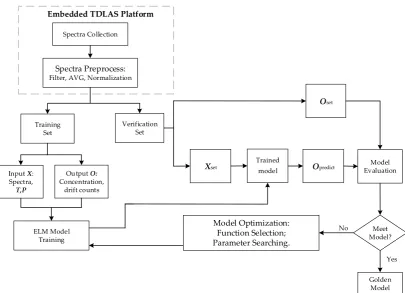
Spectra were analyzed with the following procedures: spectra collection, spectra pre-process,
197
spectra partition, model training, model evaluation, model optimization, as shown in Figure. 6.
198
No
Yes Spectra Collection
Spectra Preprocess:
Filter, AVG, Normalization
Training Set
Verification Set
ELM Model Training
Model Evaluation
Meet Model?
Golden Model
Model Optimization: Function Selection; Parameter Searching.
Input X: Spectra,
T,P
Output O:
Concentration, drift counts
Oset
Embedded TDLAS Platform
Xset
Trained
model Opredict
199
Figure 6.Spectra analysis flow chart.
200
Spectra collection and pre-process is the first step and done in the embedded system. The
201
collected spectrum has 1000 data points. The spectra were averaged after 50 scans. They were further
202
smoothed by Savitzky–Golay (S-G) polynomial filter to improve the signal to noise ratio (SNR). To
203
cancel the effect of light power fluctuation on spectra strength, spectra were normalized by DC. The
204
PCI-FPGA module separates the spectra into the laser off null period and scan period. The
205
demodulation was done through software, it produces a delay in 2f spectra with respect to DC and
206
needs further alignment. So the region from 80 to 860 was selected for analysis to exclude null period
207
and trivial 0s from spectra alignment.
208
In spectra partition, they were divided into verification set and training set. A popular method
209
is the k-fold cross validation (CV). We take 5-fold CV as an example. Spectra were first labeled by
210
indices. They were separated into 5 subgroups per the remainder after the spectra index was divided
211
by 5. Spectra in 4 subgroups were used for model training. Spectra in the leftover subgroup were
212
used for verification. The 5 subgroups took turns to act as training and verification sets.
213
The model performance can be evaluated in many respects such as training time, computation
214
resources, prediction accuracy etc. For the gas analysis purpose, the accuracy is the most significant
215
(
)
_
_ _
i i i
i o t Scale Error Abs
Fs
Scale Error Max Scale Error
− =
=
( ) ,
(8)
where oi and ti are the prediction and set values of the i-th spectrum in verification set, Fs is
217
the full measurement range. Depending the analyzing variables, the accuracy formula may take some
218
modifications. The spectra shift prediction was converted to the current changes in mA.
219
4.2. Process Simulation Test Analysis
220
The 50 spectra collected in the process simulation test are used to calculate the C2H4
221
concentration prediction in dynamic backgrounds with ELM model. There are several aspects that
222
effect the model performance, such as the function options and parameters value. It is done through
223
the following optimization step.
224
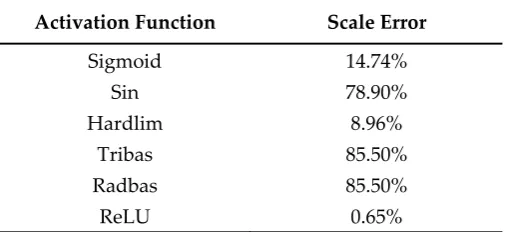
First, we study the effect of activation function with sigmoid, sin, hardlim, tribas, radbas and
225
rectified linear unit (ReLU) choices with subgroup 1 to 4 as training set and subgroup 5 as verification
226
set. The scale errors for different activation functions are listed in Table 1. The scale error for ReLU is
227
0.65% which is substantially better than other choices. By comparing the analytical expression of
228
different activation functions [29], we find that ReLU has linear expression and broad linear response
229
input range without saturation. In this research scenario, the spectra has linear or quasi-linear
230
response to concentration, pressure, temperature or drift variation in defined range. Thus, ReLU is
231
more favorable to the spectra analysis compared with other activation functions than other choices.
232
It is also faster in convergence and its behavior is closer to authentic biological neural activation
233
function. So ReLU is selected for future ELM model.
234
Table 1. Model performance indicated by scale error with different activation functions.
235
Activation Function Scale Error
Sigmoid 14.74% Sin 78.90% Hardlim 8.96%
Tribas 85.50% Radbas 85.50%
ReLU 0.65%
Then, the GA global searching is used to find optimum hidden layer neuron number L, input
236
weight W and bias b. In GA search setting, the group scale is 50, max generation is 25, crossover rate
237
is 0.93, and mutation rate is 0.05. L is optimized at 150. After Wbestand bbest are identified at
238
generation 12, the scale error is improved from 0.65% to 0.37%.
239
Finally, a 5-fold cross validation method is used for the model evaluation. In the validation, each
240
of the 5 groups take turns to act as verification set to test the model trained from the rest four groups.
241
Scale error of each test subgroup with corresponding ELM model is listed in Table 2. It is obvious
242
that ELM model built with subgroup 2-5 as training and subgroup 1 as verification has lowest scale
243
error 0.27%.
244
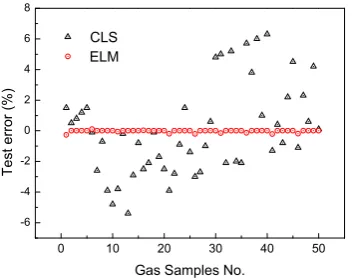
The optimized ELM models are obtained after GA parameter searching, activation function trial,
245
and 5-fold cross validation. The test error which is defined as prediction values subtract set value
246
normalized by the full range is plotted in Figure. 7(circle). The optimum ELM model is obtained with
247
ReLU activation function and with k=1 subgroup cross validation. The errors of training set are closer
248
to zero because they are deeply suppressed by the activation function during the model training
249
process in which the predication matches the set value as close as possible. The errors of 10 spectra
250
in verification set are larger than in training set. The ELM model performance is represented by max
251
253
Table 2. Scale error in each subgroup for CLS and optimized ELM models.
254
Subgroup CLS ELM
1 5.70% 0.27%
2 2.80% 0.40%
3 6.00% 0.46%
4 4.20% 0.57%
5 6.30% 0.37%
As comparison basis, CLS is introduced to obtain the C2H4 concentration. Its performance is
255
represented by the max error of 50 sample spectra. In CLS regression, R1 is taken with 200ppm C2H4
256
and R2 is taken with 2000ppm CH4. The scale error of CLS method for 50 spectra is listed in Table 2
257
with max error of 6.30%. The CLS test error is also plotted in Figure. 7 (triangle). From the Table 2
258
and Figure. 7, the error of ELM model is reduced by one order of magnitude than traditional CLS
259
method.
260
0 10 20 30 40 50
-6 -4 -2 0 2 4 6 8
CLS ELM
T
es
t erro
r (
%
)
Gas Samples No.
261
Figure 7. C2H4 concentration prediction errors vs gas samples for CLS method and optimized ELM model.
262
4.3. Spectral Drift Simulation Test Analysis
263
4.3.1. Spectra shift measurement with ELM model
264
The ELM algorithm was still utilized to obtain the actual spectral shift in the dynamic process.
265
After GA optimization and 5-fold cross validation, the neuron number is 170 and the activation
266
function is ReLU. In the modelling C2H4 concentration is replaced by spectral shift in the model. The
267
scale error is defined as the current prediction error divided by the 16 counts variation range. The
268
scale errors for subgroups are listed in Table 3.The best model corresponding to scale error of 4% is
269
ELM model trained by subgroup 1,2,4,5. The spectra shift prediction error is 4%×16= 0.64 count.
270
In conventional peak tracking method, spectra shift is monitored the by tracking the peak with
271
least spectral interference. So the right C2H4 peak is selected. The scale error of each subgroup is listed
272
in Table 3. Due to concentration variation and residue CH4 interference, the precision and accuracy
273
of spectra wavelength shift calculation is much worse than ELM method. The max error is 100% and
274
16 counts.
275
Table 3. Scale error of spectra shift calculation in each subgroup for peak tracking and ELM.
Subgroup Peak Tracking ELM
1 -56% -16%
2 -75% -15%
3 69% 4%
4 63% 10%
5 -100% 5%
4.3.2. Prediction error after shift correction
277
After the spectra shift obtained through peak tracking and ELM model, the spectra can be
278
backshifted. The purpose is to match the shifted spectra with calibration spectra so that original
279
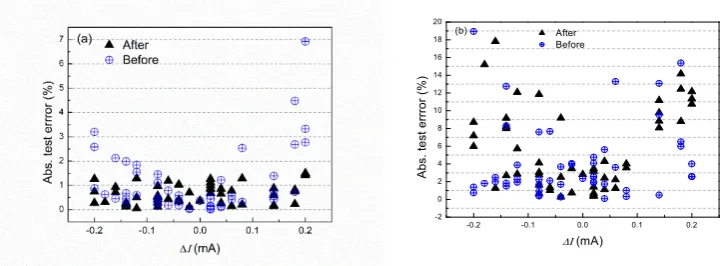
calibration model is still valid. The C2H4 concentration prediction error with and without backshift
280
correction are calculated with previously obtained optimum ELM model and CLS method. The result
281
is shown in Figure. 8 (a) and (b).
282
-0.2 -0.1 0.0 0.1 0.2 -2
0 2 4 6 8 10 12 14 16 18 20
After Before
A
bs
.
tes
t errror (%)
ΔΙ (mA)
(b)
283
Figure 8. C2H4 concentration prediction abs. error vs. current shift with and w/o shift correction. (a) ELM
284
method (b) peak tracking method.
285
The scale error of C2H4 concentration for each spectrum is plotted against ΔI,
286
set 60 I I
Δ = − , (9)
where Iset is the setting current, 60 mA is the base current. Before correction, the error pattern
287
demonstrates a V shape. The explanation is that as spectra shifts more, the error increase more. After
288
ELM correction, the error patterns demonstrate flat belt shape. The belt widths are greatly shrunk.
289
The error is improved from 6.92% to 1.50%. For peak tracking and CLS method, the error has no
290
obvoius improvement. This is due to the fact of very inaccurate peak shift calculation. The
291
improvement of spectra shift correction with ELM method is demonstrated.
292
5. Conclusions
293
In this paper, ELM were employed in the TDLAS spectra analysis. Two experiments were carried
294
out with trace C2H4 measurement as the application example. In the process simulation test, not only
295
the C2H4 and CH4 concentration were varied, but also the gas pressure was controlled in 900 to 1100
296
mbar range. For optimized ELM model, scale error of C2H4 concentration is obtained at 0.27% with
297
ReLU activation function, GA optimization of input neuron number L, input weight W and bias b,
298
and 5-fold cross validation. For traditional CLS method, the scale error is 6.30%.
299
In the spectra shift simulation test, ELM and peak tracking method are used to analysis the
300
spectra shift. The prediction errors of spectra shift are less than 1 count for ELM and 16 counts for
301
peak tracking. Then the spectra were back shifted to match with the calibration. The C2H4
302
reduced from 6.92% to 1.50% by ELM method after shift correction. There is no noticeable error
304
improvement with peak tracking and CLS method. The errors remain in 20% range.
305
In a summary, the optimized ELM model has demonstrated dramatic improvement of TDLAS
306
prediction accuracy by one order of magnitude in the trace C2H4 measurement in a simulated
307
industrial process analysis scenario. The robustness enhancement is explicit. ELM algorithm could
308
be extended to other areas of spectra analysis in the harsh application environments and dynamic
309
process background. Complicated spectra deformation in addition to spectra shift could be dealt with
310
ELM algorithm for future research.
311
Author Contributions: Conceptualization, Wenhai Ji and Guolin Li; methodology, Wenhai Ji and Li Zhong;
312
software, Ying Ma and Xiaocui Lv; validation, Di Song; formal analysis, Ying Ma; investigation, Li Zhong;
313
writing—original draft preparation, Wenhai Ji.; writing—review and editing, Chuantao Zheng and Guolin Li.
314
Funding: This research received funding from Natural Science Foundation of China (Nos. 61775079, 61627823),
315
Natural Science Foundation of Shandong Province (No. ZR2017LF023), Key Science and Technology R&D
316
program of Jilin Province (No. 20180201046GX), Huimin Special Project of Qingdao Science and Technology
317
Bureau (No. 17-3-3-89-nsh), Jilin University State Key Laboratory on Integrated Optoelectronics Open Research
318
Fund Project (No. IOSKL2017KF0).
319
Conflicts of Interest: The authors declare no conflict of interest. The funders had no role in the design of the
320
study; in the collection, analyses, or interpretation of data; in the writing of the manuscript, or in the decision to
321
publish the results.
322
References
323
1. Y. Wei.; J. Chang.; J. Lian.; et al. A Coal Mine Multi-Point Fiber Ethylene Gas Concentration Sensor. Photonic
324
Sensors 2015, 5(1), 67-71.
325
2. D. Shi.; W. Song.; J. Ye.; et al. Experimental Investigation of Reacting Flow Characteristics in a Dual-Mode
326
Scramjet Combustor. International Journal of Turbo & Jet-Engines 2016, 33(2), 95-104.
327
3. Y. Wang.; Y. Wei.; J. Chang. Tunable Diode Laser Absorption Spectroscopy Based Detection of Propane for
328
Explosion Early Warning by Using a Vertical Cavity Surface Enhanced Laser Source and Principle
329
Component Analysis Approach. IEEE Sensors Journal 2017, 17, 4975-4982.
330
4. J. Jiang.; M. Zhao.; G.-M. Ma.; H.-T. Song.; C.-R. Li.; X. Han.; C. Zhang. TDLAS-Based Detection of
331
Dissolved Methane in Power Transformer Oil and Field Application. IEEE Sensors Journal 2018, 18,
2318-332
2325.
333
5. Z. Yuan.; X. Yang.; W. Xie.; X. Li. Research on the Online Test of Diesel NOx Emission by TDLAS.
334
Spectroscopy and Spectral Analysis 2018, 38, 194-199.
335
6. H. Li.; Y. Zhu.; F. Dong.; et al. Simulation Design and Verification of CO Monitoring Based on Tunable
336
Diode Laser Absorption Spectroscopy. Precision Electromagnetic Measurements (CPEM) 2010 Conference
337
on. IEEE, 2010, 482-483.
338
7. Y. Wang.; Y. Wei.; T. Liu.; et al. TDLAS Detection of Propane/Butane Gas Mixture by Using Reference Gas
339
Absorption Cells and Partial Least Square Approach. IEEE Sensors Journal 2018, 18(20), 8587-8596.
340
8. P. Barmpalexis.; A. Karagianni.; I. Nikolakakis.; K. Kachrimanis. Artificial Neural Networks (ANNs) and
341
Partial Least Squares (PLS) Regression in The Quantitative Analysis of Cocrystal Formulations by Raman
342
and ATR-FTIR Spectroscopy. Journal of Pharmaceutical and Biomedical Analysis 2018, 158, 214-224.
343
9. C. Malegori.; E. J. Nascimento Marques.; S. T. de Freitas.; M. F. Pimentel.; C. Pasquini.; E. Casiraghi.
344
Comparing the Analytical Performances of Micro-NIR and FT-NIR Spectrometers in the Evaluation of
345
Acerola Fruit Quality, Using PLS and SVM Regression Algorithms. Talanta 2017, 165, 112-116.
346
10. B. Le.; D. Xiao.; Y. Mao. Coal. Classification Based on Visible, Near-Infrared Spectroscopy and CNN-ELM
347
Algorithm. Spectroscopy and Spectral Analysis 2018, 38, 2107-2112.
348
11. Y. Yang.; S. Zhang.; Y. He. Dynamic Detection of Fresh Jujube Based on ELM and Visible/Near Infrared
349
Spectra. Spectroscopy and Spectral Analysis 2015, 35, 1870-1874.
350
12. T. Owolabi.; M. Gondal. Development of Hybrid Extreme Learning Machine Based Chemometrics for
351
Precise Quantitative Analysis of LIBS Spectra Using Internal Reference Pre-Processing Method.
352
ANALYTICA CHIMICA ACTA 2018, 1030, 33-41.
13. Y. Chen.; Z. Wang.; Z. Wang.; X. Li. Research on Concentration Retrieval of Gas FTIR Spectra by Interval
354
Extreme Learning Machine and Genetic Algorithm. Spectroscopy and Spectral Analysis 2014, 34, 1244-1248
355
.
356
14. Y. Bu.; G. Zhao.; J. Pan.; Y. Bharat Kumar. ELM: an Algorithm to Estimate the Alpha Abundance from
Low-357
resolution Spectra. Astrophysical Journal 2016, 817, 78.
358
15. X. Bian.; C. Zhang.; X. Y. Tan.; M. Dymek.; Y. Guo.; L. Lin.; B. Cheng.; X. Hu. Boosting Extreme Learning
359
Machine for Near-Infrared Spectral Quantitative Analysis of Diesel Fuel and Edible Blend Oil Samples.
360
Analytical Methods 2017, 9, 2983-2989.
361
16. G. Huang.; Q. Zhu.; C. Siew. Extreme Learning Machine: A New Learning Scheme of Feedforward Neural
362
Networks. In Proceedings of the IEEE International Conference on Neural Networks, Budapest, Hungary,
363
25-29 July 2004; 985-990.
364
17. G. B. Huang.; Q. Y. Zhu.; C. K. Siew. Extreme Learning Machine: Theory and Applications.
365
Neurocomputing 2006, 70, 489-501.
366
18. G. B. Huang.; D. H. Wang.; and Y. Lan. Extreme Learning Machines: A Survey. International Journal of
367
Machine Learning & Cybernetics 2011, 2, 107-122.
368
19. G. B. Huang. An Insight into Extreme Learning Machines: Random Neurons, Random Features and
369
Kernels. Cognitive Computation 2014, 6, 376-390.
370
20. G. B. Huang.; H. Zhou.; X. Ding.; R. Zhang. Extreme Learning Machine for Regression and Multiclass
371
Classification. IEEE Trans Syst Man Cybern B Cybern 2012, 42, 513-529.
372
21. X. X. Yin.; S. Hadjiloucas.; J. He.; Y. Zhang.; Y. Wang.; D. Zhang. Application of Complex Extreme Learning
373
Machine to Multiclass Classification Problems with High Dimensionality. Digital Signal Processing 2015,
374
40, 40-52.
375
22. Z. Huang.; Y. Yu.; J. Gu.; H. Liu. An Efficient Method for Traffic Sign Recognition Based on Extreme
376
Learning Machine. IEEE Transactions on Cybernetics 2016, 47, 920-933.
377
23. R. J. Kowalski.; C. Li.; G. M. Ganjyal. Optimizing Twin-Screw Food Extrusion Processing through
378
Regression Modeling and Genetic Algorithms. Journal of Food Engineering 2018, 234, 50-56.
379
24. W. D. Pan.; J. W. Zhang.; J. M. Dai.; Y. F. Zhang. Tunable Diode Laser Absorption Spectroscopy for
380
Simultaneous Measurement of Ethylene and Methane near 1.626 μm. Journal of Infrared & Millimeter
381
Waves 2013, 32, 486-490.
382
25. F. V. D. Schoor.; F. Verplaetsen. The Upper Explosion Limit of Lower Alkanes and Alkenes an Air at
383
Elevated Pressures and Temperatures. Journal of Hazardous Materials 2016, 128, 1-9.
384
26. S. W. Sharpe.; T. J. Johnson.; R. L. Sams.; P. M. Chu.; G. C. Rhoderick.; P. A. Johnson. Gas-phase Databases
385
for Quantitative Infrared Spectroscopy. Applied Spectroscopy 2004, 58, 1452-1461.
386
27. K. Javed.; R. Gouriveau.; N. Zerhouni. SW-ELM: A Summation Wavelet Extreme Learning Machine
387
Algorithm with A Priori Parameter Initialization. Neurocomputing 2014, 123, 299-307.
388
28. F. Han.; M. R. Zhao.; J. M. Zhang.; Q. H. Ling. An Improved Incremental Constructive Single-Hidden-Layer
389
Feedforward Networks for Extreme Learning Machine Based on Particle Swarm Optimization.
390
Neurocomputing 2016, 228,133-142.
391
29. C. Yeom.; K. Kwak. Short-Term Electricity-Load Forecasting Using a TSK-Based Extreme Learning