2226
Energy Efficient Wireless Sensor Network Using
Dynamic Cluster Head Selection And Fuzzy
Inference System
Aayushi More, Dr. Shikha Agrawal, Prof. Manish Kumar Ahirwar
Abstract: Wireless SensorNetwork (WSN) have been advanced to give a superior administrations, among them WSNs have developed as a potential innovation that pulled in expanding consideration and sending as a superior and minimal effort answer for last-mile broadband Web get to. WMNs comprise of work switches and work customers. WSN is a promising remote innovation for a few developing and industrially fascinating applications, e.g., broadband home systems administration, network and neighborhood systems, facilitated arrange the executives, canny transportation frameworks. It is picking up noteworthy consideration as a conceivable route for Internet specialist organizations (ISPs) and opposite end clients to build up vigorous and solid remote broadband administration access at a sensible expense. This paper present dynamic cluster head selection (DCHS) network and used to fuzzy inference system (FIS) technique. The proposed technique is best performance compared to previous one.
Keywords: Wireless Sensor Network, Fuzzy Logic System, Packet Delivery Ratio, Dead Node, Energy
——————————◆——————————
I.
INTRODUCTION
WSNs are getting to be broad utilization of as a result of its boundless systems administration abilities. Different applications, for example, urban wellbeing, correspondences in misfortune, scholarly carriage frameworks, and public systems and so on are altogether bolstered by WMNs. Contrasted with wired associations WMNs are the best arrangement as far as cost, arrangement and equipment. WMNs furnish wide scale availability with less expense when contrasted with wired broadband system get to on account of which it is named as best choices of the wired broadband system as far as expense [1]. As far as expense as well as WMNs can be effectively kept up and solid and offer predictable administrations [1]. As WMNs have preferences over its partner, it tends to be widely utilized in the few fields of sensor and specially appointed systems. WMN is an empowering innovation in the field of remote that can be utilized for a few fields [2].
As WMNs are equipped for self-sorted out and self-arranged, it tends to be sent utilizing one hub and the quantity of hubs can be augmented effectively when required for example they can undoubtedly be scaled up, it's forthright speculation is less thus drawing in the consideration of ISP, transporters and others.
Introducing a WMN isn't such a great amount of extreme, as all the fundamental constituents beforehand exist in the steering conventions of impromptu system, for example, WEP (wired proportional security security), MAC convention of IEEE 802.11 standard and so on. Numerous organizations have now comprehended the forthcoming of the WMNs innovation and arrangement numerous results of remote work systems. Be that as it may, more investigation is peaceful required for making WMNs be all. The current MAC and steering convention in WMNs don't give the adequate adaptability and as the quantity of terminals builds a lotof throughput falls. In this way steering layer convention should be re-imagined. The standard gatherings existing in the business also work forcefully on new details in WMNs, for example, IEEE 802.11 [3], IEEE 802.15, and IEEE 802.16 [4] all have shaped sub-gatherings to accentuation on novel measures in WMNs. In the following area, we will begin by quickly characterizing the WSN demonstrating its advantages to the network, its sorts and applications.
II.
WIRELESS SENSOR NETWORK
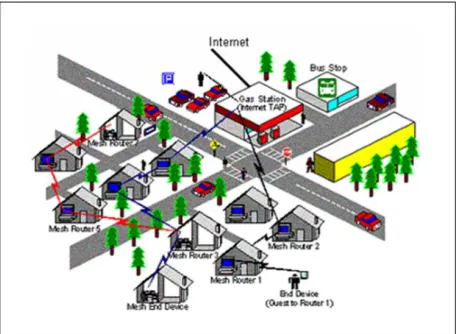
Directly the primary issue in utilizing broadband system at home (even a little one) is the distinguishing proof of the site of the passageways, for which site review is to be done that is over the top expensive [5]. What's more, setting up of numerous passages at home is additionally not monetarily what's more, appropriate as a result of the Ethernet wiring required from the passage to the modem or center [6]. Moreover, if the terminal hubs go under two diverse passageways the interchanges between them need to sit back through the entrance center point producing blockage in the system. Every one of these issues in utilizing broadband system at home can be understood utilizing remote work systems, as appeared in figure 1 in which all the passages are supplanted by remote work switches having network availability between them that give increasingly adaptable and more flaw tolerant.
_______________________________
• Aayushi More is currently pursuing masters of engineering program in computer science engineering in UIT RGPV, Bhopal, India, PH-9826221703, E-mail: [email protected]
• Dr. Shikha Agrawal is currently working as an Assistant Professor in computer science engineering in UIT RGPV Bhopal, India, PH-942543160, E-mail: [email protected] • Prof. Manish Kumar Ahirwar is currently working as an
Figure 1: WMNs for broadband home networking
Additionally by including progressively number of work hubs or just by altering its position or its capacity level, no man's lands can be killed. Here additionally the traffic with in the home systems need not to hang loose through the entrance center, the work hub does it, due to which the clog in the system is limited. Here remote work switches does not have any limitations on the power utilization and portability as it is fixed. In this way conventions required for WMNs are must be improved one contrasted with those conventions for portable impromptu systems [7]and remote sensor systems [8].So, WMNs are well suitable for broadband system utilizes at home. In a network, the web is gotten to through a DSL modem having web association and is associated with a remote switch. In such a system regardless of whether the traffic needs to be shared inside the system it needs to course through the web which essentially diminishes the asset usage. Numerous territories in the middle of houses in the general public may not be secured by remote administrations and furthermore remote administrations must be set up in individual homes which is again costlier. There might be a solitary course accessible for individual home access the Internet. While WMNs ease the above disadvantages with the assistance of adaptable work associate between homes, as appeared in figure 2 and WMNs likewise license different uses for instance scattered document stockpiling, scattered record access, and gushing on the off chance that video and sound.
Figure 2: WMNs for Civic and Locality
At present, in a few workplaces standard IEEE 802.11 remote systems are normally utilized, which are again associated through wired Ethernet associations thus the expense of undertaking system is high. Be that as it may, if the passageways in IEEE 802.11 are substituted by the work switch as appeared in figure 3, increment the strength and usage of the asset of undertaking systems. As we realize that WMNs is effectively versatile if the undertaking become the size of the system can be effectively grow. A few parameters, for example, control level of correspondence, traffic design, design of the system, thickness of the terminal in the system, organize topology, portability of the hubs and number of channels utilized by every hub influences the ability of the WMNs. So as to build up the convention, structural plan, setting up and activities of the system there must be an emphatically comprehension of the relationship between limit of the system and the above factor is required. Investigation of WMNs At present much research has been done so as to think about the limit in the event of remote impromptu systems which can be actualized to investigate the limit of WMNs. If there should be an occurrence of a stationary multi-jump arrange, [3] talked about, the ideal transmission power level of a hub is accomplished if there are six hubs around it go about as neighbor hubs. An ideal trade off between number of hubs from source to the objective and the recurrence spatial-reuse productivity has accomplished utilizing the estimation of [4]. This is productive for the situation in WMNs where the portability is negligible. In any case, if as in half and half WMNs, the versatility is the concern, no speculative results are expressed till date. In [6] certain investigational considers have been done, where the reenactment consequences of point portable system confirm the speculative consequences of [8].
2228 Figure 4: Previous Technique
III. DCHS
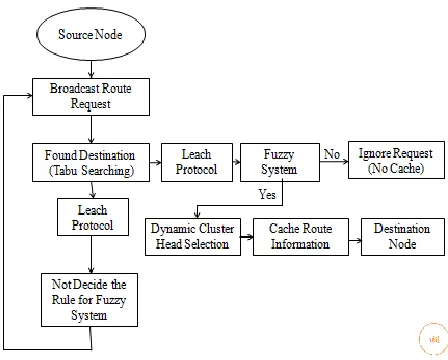
In this paper, a clustering algorithm based on clustering is proposed to solve the heterogeneity caused by random selection of LEACH protocol cluster head. First, the k- Medoids clustering algorithm is used to divide the nodes of the whole network area into several classes, and then select the first cluster head and the second cluster head in the cluster.
Algorithm CH-Selection (E, N, K, X, Y) 1. Asc - sort(E)
2. i = 1
3. whileI ≤ N do
4. if(Ei>=EAvg and i<= k) then 5. Eligible(i) = True
6. else
7. Eligible(i) = False 8. end if
9. i=i + 1 10. end while
11. if(disti>distj and Eligible (i)) then 12. CHi=CMj
13. end if
14. return(CHi , CHj)
Here, we explain in detail our new energy efficient EELACH-C protocol whose goal is to increase the longevity of the network. Let us assume that all the sensor nodes are equipped with equal amount of initial energy.
Figure 5: Flow Chart of Proposed Methodology
The correspondence in WSNs is accomplished through different bounces. The hubs which are in the transferable scope of one another can associate straightforwardly, yet the hubs not coming in the transferable scope of one another can impart the information bundles by utilizing other mid-route bounces for correspondence. About all the steering conventions endeavor to course through most brief way. As we realize that vitality required for the transmission of information bundles is legitimately relative to the way length, all the directing convention that keeps an eye on briefest way has one of the greatest preferred position of vitality productivity. If there should be an occurrence of the briefest way directing some fixed jumps are persistently uses to transmit the information that makes a portion of the hubs be over-burden due to which they pass on making gaps in the system or in most pessimistic scenarios my break the system into equal parts. In this manner need of burden adjusting steering emerges. The asset usage is one of the significant measurement concerning both static and dynamic traffic request. In [10] the exhibition metric connection use has been utilized for traffic building in the Internet where the point is to upgrade the usage at the best blocked connection. The ebb and flow look into on ideal work system directing [11] normally expected to improve the stream throughput, with fulfillment of the reasonableness requirements.
IV FUZZY INFERENCE SYSTEM
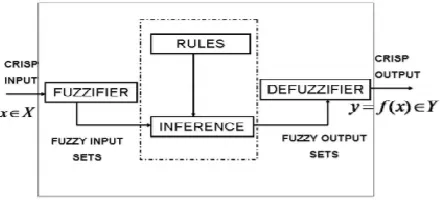
Figure 6: The structure of a fuzzy logic system
Figure 7: Optimization 27 rules with 3 inputs, 1 outputs
Figure 8: Members Functions of Input1
Figure 9: Members Functions of Input2
Figure 10: Members Functions of input3
Figure 11: Members Functions of Output1
Figure 12: Rule Viewer Optimization
2230 system and various work switch it can choose as entryways
and sets up the association with every one of them. Especially, because of the base station bolsters one channel, it is expected here that a solitary channel is utilized for the correspondence between the work switches. Here a system topology has been intended for the examination of the framework limit throughput. In this the remote work switches are composed discretionarily in certain zone. So as to keep up a one of a kind steering way by expelling the excess way least spreading over tree has been utilized.
IV.
SIMULATION RESULT
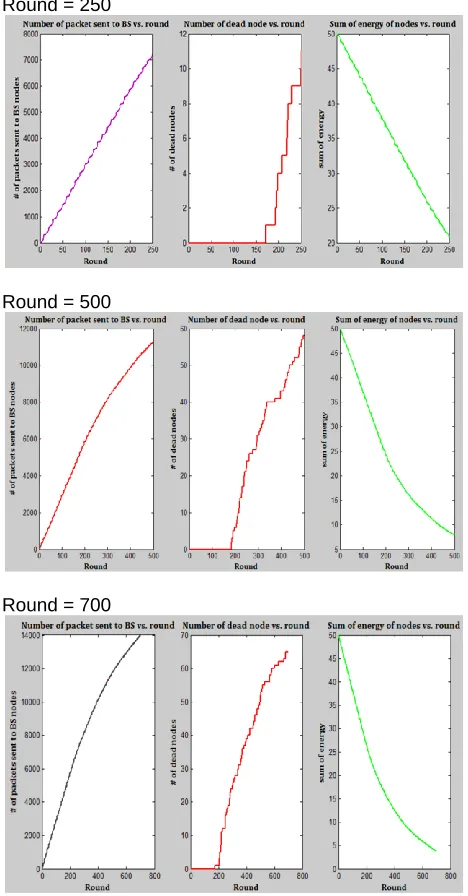
In this subsection we evaluate the performancedynamic cluster head selection using fuzzy system in terms of: Packet delivery ratio (PDR): The proportion of successful data packets delivered to the destination compared to the total generated data packets.
Round = 250
Round = 500
Round = 700
Round = 1000
Round = 1200
Table 1: Packet Sent to Base Station Node Round 250 500 700 1000 1200
7100 11300 14000 15500 15800
Figure 13: Bar Graph of the Packet Sent to Base Station Node for Different Round
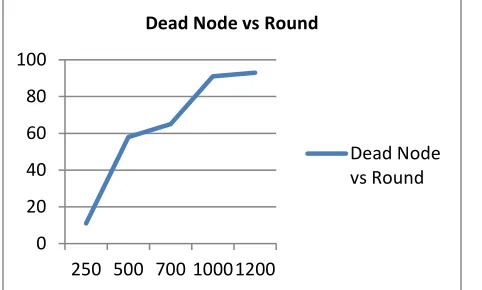
Table 2: Dead Node vs Round Round 250 500 700 1000 1200
11 58 65 91 93
0 2000 4000 6000 8000 10000 12000 14000 16000 18000
Packet Sent to Base Station Node
Figure 14: Bar Graph of the Dead Node for Different Round
Table 3: Sum of Energy vs Round Round 250 500 700 1000 1200
22 8 4 2 1
Figure 15: Bar Graph of the Sum of Energy for Different Round
V.
CONCLUSION
Yet, again we saw that the WMNs is generally utilized in the applications, for example, VOIP, VANET, inaccessible learning, video conferencing where the utilization of multicasting is much increasingly required. Since in every one of these applications the pictures and recordings of constant makes the traffic for stream which needs higher system limit, on time conveyance to the beneficiary and so forth. For this QoS insurance in these cases we consider decreasing the presentation metric, for example, clog, start to finish postponement and cost in multicasting in WMNs, which we have introduced in third part of this proposition. Here various parameters are related like edge cost, edge postponement and edge blockage.Simulation results shows that the proposed algorithm is much better than existing algorithm in terms of energy efficiency and lifetime of the network.
REFERENCES
[1] Rohit Pachlor and Deepti Shrimankar, “LAR-CH: A Cluster-Head Rotation Approach for Sensor networks”, IEEE Sensors Journal, Volume 18, Issue 23, PP. No. 01-08, Dec.1, 2018.
[2] M. Bheemalingaiah and M. M. Naidu, “Performance Analysis of Power -aware Node-disjoint Multipath Source Routing in Mobile Ad Hoc Networks”, IEEE 7th
International Advance Computing Conference, PP. No. 361-371, IEEE 2017.
[3] DoganYildiz, SerapKaragol and OkanOzgonenel, “A Hyperbolic Location Algorithm for Various Distributions of a Wireless Sensor Networks”, Smart Grid and Cities Congress and Fair (ICSG), 5th International Istanbul, PP. No. 451-459, IEEE 2016. [4] Alexandros Ladas, Nikolaos Pavlatos,
NuwanWeerasinghe and Christos Politis, “Multipath Routing Approach to Enhance Resiliency and Scalability in Ad-hoc Networks”, Ad-hoc and Sensor Networking Symposium, PP. No. 01-06, IEEE 2016. [5] Pengwu Wan, BenjianHao, Zan Li, Licun Zhou, Mian
Zhang, "Time differences of arrival estimation of mixed interference signals using blind source separation based on wireless sensor networks", IET Signal Processing, vol.10, issue 8, pp.924-929, 2016. [6] Mohammadi K., Alavi O., Mostafaeipour A., Goudarzi
N. And Jalilv and M., "Assessing different parameters estimation methods ofWeibull distribution to compute wind power density", ELSE VIER Energy Conversion and Management Journal, Vol.108, pp. 322-335, 2016.
[7] Miriam Carlos-Mancilla, Ernesto López-Mellado, and Mario Siller, “Wireless Sensor Networks Formation: Approaches and Techniques,” Journal of Sensors, vol. 2016, Article ID 2081902, 18pages, 2016.
[8] Park S. Y. and Lee J. J., "Stochastic Opposition-Based Learning Usinga Beta Distribution in Differential Evolution", IEEE Transactions On Cybernetics, vol. 46, Number 10, pp.2184-2194, October 2016.
[9] Osama Ennasr, Guoliang Xing and Xiaobo Tan, " Distributed Time-Difference-of-Arrival (TDOA)-based Localization of a Moving Target", in Proc. IEEE 55th Conference on Decision and Control (CDC), pp. 2652-2658, IEEE 2016.
[10] Santar Pal Singh, S.C. Sharma, "Range-Free Localization Techniques in Wireless Sensor Networks: A Review", in Proc. 3rd International Conference on Recent Trends in Computing 2015 (ICRTC-2015), vol.57, pp. 7 – 16, 2015.
[11] Yildiz D., Karagol S., Ozgonenel O., Tadiparthi S., Bikdash M., “A Novel Self Localization Approach for Sensors”, Sensor Signal Processing for Defense (SSPD), Edinburgh, Scotland, 2015.
0 20 40 60 80 100
250 500 700 10001200
Dead Node vs Round
Dead Node vs Round 0 5 10 15 20 25
250 500 700 1000 1200
Sum of Energy vs Round