SECURITY IN WIRELESS SENSOR NETWORKS: WITH RESPECT TO THE LATEST ISSUES AND CHALLENGES
Meena Chaudhary1, Dr. Rajeev Kumar2
Department of Computer Science and Engineering
1,2
Sri Venkateshwara University, Gajaraula (Amroha), U.P. India
Abstract
Wireless Sensor Network (WSN) is a developing innovation that shows extraordinary guarantee for different cutting edge applications both for mass open and military. The detecting innovation joined with handling force and remote correspondence makes it lucrative for being abused in wealth in future. The consideration of remote correspondence innovation additionally brings about different sorts of security dangers. The expectation of this paper is to examine the security related issues and difficulties in remote sensor systems. We recognize the security dangers, audit proposed security instruments for remote sensor systems. We likewise talk about the comprehensive perspective of security for guaranteeing layered and powerful security in remote sensor systems.
Keywords Sensor, Security, Attack, Holistic, Challenge.
1. Introduction
Wireless Sensor Networks (WSN) are developing as both a vital new level in the IT environment and a rich area of dynamic examination including equipment and framework outline, organizing, circulated calculations, programming models, information administration, security and social elements [1]. The fundamental thought of sensor system is to scatter small detecting gadgets; which are fit for detecting a few changes of episodes/parameters and speaking with different gadgets, over a particular geographic territory for some particular purposes like target following, observation, ecological checking and so forth. Today's sensors can screen temperature, weight, dampness, soil cosmetics, vehicular development, clamor levels, lighting conditions, the nearness or nonappearance of specific sorts of items or substances, mechanical anxiety levels on joined articles, and different properties [2]. If there should arise an occurrence of remote sensor organize, the correspondence among the sensors is done utilizing remote handsets. The appealing components of the remote sensor systems pulled in numerous scientists to chip away at different issues identified with these sorts of systems
Security is an extensively utilized term enveloping the qualities of confirmation, respectability, protection, nonrepudiation, and hostile to playback [3]. The more the reliance on the data gave by the systems has been expanded, the more the danger of secure transmission
of data over the systems has expanded.
2. Security of Data in WSN
2.1 Cryptography
2.2. Steganography
While cryptography aims at hiding the content of a message, steganography [6] aims at hiding the existence of the message. Steganography is the art of covert communication by embedding a message into the multimedia data (image, sound, video, etc.) [7]. The main objective of steganography is to modify the carrier in a way that is not perceptible and hence, it looks just like ordinary. It hides the existence of the covert channel, and furthermore, in the case that we want to send a secret data without sender information or when we want to distribute secret data publicly, it is very useful. However, securing wireless sensor networks is not directly related to steganography and processing multimedia data (like audio, video) with the inadequate resources [8] of the sensors is difficult and an open research issue.
2.3 Physical Layer Secure Access
Vital focuses in physical layer secure access are the effective plan so that the bouncing succession is adjusted in less time than is required to find it and for utilizing this both the sender and collector ought to keep up a synchronized clock. A plan as proposed in [9] could likewise be used which presents secure physical layer access utilizing the solitary vectors with the channel blended adjustment.
3. Security Threats and Issues in Wireless Sensor Networks
The majority of the dangers and assaults against security in remote systems are practically like their wired partners while some are exacerbated with the consideration of remote network. Truth be told, remote systems are typically more helpless against different security dangers as the unguided transmission medium is more powerless to security assaults than those of the guided transmission medium. The communicate way of the remote correspondence is a basic contender for listening in. In the majority of the cases different security issues and dangers identified with those we consider for remote specially appointed systems are likewise pertinent for remote sensor systems. These issues are well - listed in some past examines [10] furthermore various security plans are
now been proposed to battle against them. Be that as it may, the security systems formulated for remote specially appointed systems couldn't be connected straightforwardly for remote sensor systems on account of the architectural disparity of the two networks. While ad hoc networks are self-organizing, dynamic topology, peer to peer networks formed by a collection of mobile nodes and the centralized entity is absent [11]; the wireless sensor networks could have a command node or a base station (centralized entity, sometimes termed as sink).
The architectural aspect of wireless sensor network could make the employment of a security schemes little bit easier as the base stations or the centralized entities could be used extensively in this case. Nevertheless, the major challenge is induced by the constraint of resources of the tiny sensors. In many cases, sensors are expected to be deployed arbitrarily in the enemy territory (especially in military reconnaissance scenario) or over dangerous or hazardous areas. Therefore, even if the base station (sink) resides in the friendly or safe area, the sensor nodes need to be protected from being compromised.
3.1. Attacks in Wireless Sensor Networks
Attacks against wireless sensor networks could be broadly considered from two different levels of views. One is the attack against the security mechanisms and another is against the basic mechanisms (like routing mechanisms). Here we point out the major attacks in wireless sensor networks.
3.1.1 Denial of Service
system, additionally for any occasion that lessens a system's ability to give an administration. In remote sensor organizes, a few sorts of DoS assaults in various layers may be performed. At physical layer the DoS assaults could stick and altering, at connection layer, crash, fatigue, injustice, at system layer, disregard and insatiability, homing, confusion, dark gaps and at transport layer this assault could be performed by vindictive flooding and desynchronization. The systems to forestall DoS assaults incorporate installment for system assets, pushback, solid confirmation and recognizable proof of activity.
3.1.2 Attacks on Information in transit
In a sensor network, sensors monitor the changes of specific parameters or values and report to the sink according to the requirement. While sending the report, the information in transit may be altered, spoofed, replayed again or vanished. As wireless communication is vulnerable to eavesdropping, any attacker can monitor the traffic flow and get into action to interrupt, intercept, modify or fabricate [13] packets thus, provide wrong information to the base stations or sinks. As sensor nodes typically have short range of transmission and scarce resource, an attacker with high processing power and larger communication range could attack several sensors at the same time to modify the actual information during transmission.
3.1.3 Sybil Attack
By and large, the sensors in a remote sensor system may need to cooperate to achieve an errand, thus they can utilize dispersion of subtasks and excess of data. In such a circumstance, a hub can put on a show to be more than one hub utilizing the personalities of other true blue hubs (Figure 1). This kind of assault where a hub produces the characters of more than one hub is the Sybil assault. Sybil assault tries to corrupt the honesty of information, security and asset usage that the circulated calculation endeavors to accomplish. Sybil assault can be performed for assaulting the dispersed stockpiling, steering system, information total, voting, reasonable asset distribution and bad conduct discovery. Fundamentally, any shared system (particularly remote specially appointed systems) is helpless against sybil assault. Be that as it may, as
WSNs can have some kind of base stations or passages, this assault could be anticipated utilizing productive conventions. Douceur demonstrated that, without an intelligently concentrated power, sybil assaults are constantly conceivable aside from under extraordinary and farfetched presumptions of asset equality and coordination among substances. Be that as it may, discovery of sybil hubs in a system is not all that simple. The radio asset testing to recognize the nearness of sybil node(s) in sensor arrange and demonstrated that the likelihood to identify the presence of a sybil hub is:
Where, n is the number of nodes in a neighbor set, s is the number of sybil nodes, m malicious nodes, g number of good nodes, c is the number of nodes
that can be tested at a time by a node, of which S
are sybil nodes, M are malicious (faulty) nodes, G
are good (correct) nodes and r is the number of
rounds to iterate the test.
Figure 1: Sybil Attack
3.1.5 Hello Flood Attack
Hello Flood Attack is introduced in. This attack uses HELLO packets as a weapon to convince the sensors in WSN. In this sort of attack an attacker with a high radio transmission (termed as a laptop- class attacker in) range and processing power sends HELLO packets to a number of sensor nodes which are dispersed in a large area within a WSN. The sensors are thus persuaded that the adversary is their neighbor. As a consequence, while sending the information to the base station, the victim nodes try to go through the attacker as they know that it is their neighbor and are ultimately spoofed by the attacker.
3.1.7 Wormhole Attack
Wormhole attack is a critical attack in which the attacker records the packets (or bits) at one location in the network and tunnels those to another location. The tunneling or retransmitting of bits could be done selectively. Wormhole attack is a significant threat to wireless sensor networks, because; this sort of attack does not require compromising a sensor in the network rather, it could be performed even at the initial phase when the sensors start to discover the neighboring information.
3.1.4 Blackhole/Sinkhole Attack
In this attack, a malicious node acts as a blackhole to attract all the traffic in the sensor network. Especially in a flooding based protocol, the attacker listens to requests for routes then replies to the target nodes that it contains the high quality or shortest path to the base station. Once the malicious
Figure 3 (a and b) shows a situation where a wormhole attack takes place. When a node B (for example, the base station or any other sensor) broadcasts the routing request packet, the attacker receives this packet and replays it in its neighborhood. Each neighboring node receiving this replayed packet will consider itself to be in the range of Node B, and will mark this node as its parent. Hence, even if the victim nodes are multi-hop apart from B, attacker in this case convinces them that B is only a single hop away from them, thus creates a wormhole.
4. Proposed Security Schemes and Related Work
In the recent years, wireless sensor network security has been able to attract the attentions of a number of researchers around the world. In this section we review and map various security schemes proposed or implemented so far for wireless sensor networks.
4.1. Security Schemes for Wireless Sensor Networks
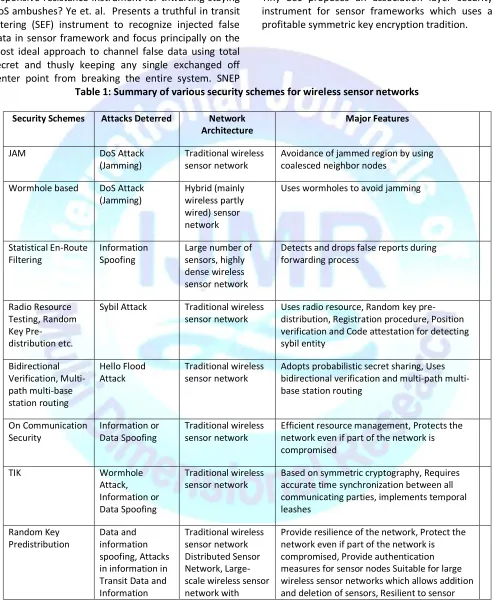
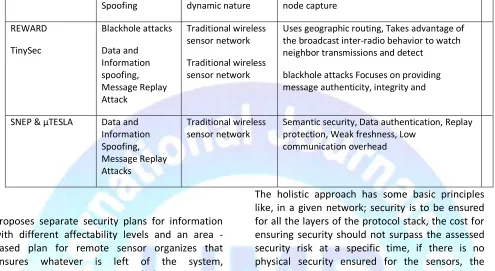
In the maker’s exhibit that wormholes those are so far considered terrible for WSN could enough be used as a responsive resistance instrument for thwarting staying DoS ambushes? Ye et. al. Presents a truthful in transit filtering (SEF) instrument to recognize injected false data in sensor framework and focus principally on the most ideal approach to channel false data using total secret and thusly keeping any single exchanged off center point from breaking the entire system. SNEP
and µTESLA are two secure building ruins for giving data mystery, data freshness and convey approval. Tiny Sec proposes an association layer security instrument for sensor frameworks which uses a profitable symmetric key encryption tradition.
Table 1: Summary of various security schemes for wireless sensor networks
Security Schemes Attacks Deterred Network
Architecture
Major Features
JAM DoS Attack
(Jamming)
Traditional wireless sensor network
Avoidance of jammed region by using coalesced neighbor nodes
Wormhole based DoS Attack (Jamming)
Hybrid (mainly wireless partly wired) sensor network
Uses wormholes to avoid jamming
Statistical En-Route Filtering
Information Spoofing
Large number of sensors, highly dense wireless sensor network
Detects and drops false reports during forwarding process
Radio Resource Testing, Random Key
Pre-distribution etc.
Sybil Attack Traditional wireless sensor network
Uses radio resource, Random key pre-distribution, Registration procedure, Position verification and Code attestation for detecting sybil entity
Bidirectional Verification, Multi-path multi-base station routing
Hello Flood Attack
Traditional wireless sensor network
Adopts probabilistic secret sharing, Uses bidirectional verification and path multi-base station routing
On Communication Security
Information or Data Spoofing
Traditional wireless sensor network
Efficient resource management, Protects the network even if part of the network is compromised
TIK Wormhole
Attack, Information or Data Spoofing
Traditional wireless sensor network
Based on symmetric cryptography, Requires accurate time synchronization between all communicating parties, implements temporal leashes
Random Key Predistribution
Data and information spoofing, Attacks in information in Transit Data and Information
Traditional wireless sensor network Distributed Sensor Network, Large-scale wireless sensor network with
Spoofing dynamic nature node capture
REWARD
TinySec
Blackhole attacks
Data and Information spoofing, Message Replay Attack
Traditional wireless sensor network
Traditional wireless sensor network
Uses geographic routing, Takes advantage of the broadcast inter-radio behavior to watch neighbor transmissions and detect
blackhole attacks Focuses on providing message authenticity, integrity and
SNEP & µTESLA Data and Information Spoofing, Message Replay Attacks
Traditional wireless sensor network
Semantic security, Data authentication, Replay protection, Weak freshness, Low
communication overhead
Proposes separate security plans for information with different affectability levels and an area - based plan for remote sensor organizes that ensures whatever is left of the system, notwithstanding when parts of the system are traded off executes symmetric key Cryptographic calculations with postponed key divulgence on bits to build up secure correspondence channels between a base station and sensors inside its extent.
4.2. Holistic Security in Wireless Sensor Networks
A holistic approach aims at improving the performance of wireless sensor networks with respect to security, longevity and connectivity under changing environmental conditions.
Figure 4: Holistic view of Security in wireless sensor networks
The holistic approach has some basic principles like, in a given network; security is to be ensured for all the layers of the protocol stack, the cost for ensuring security should not surpass the assessed security risk at a specific time, if there is no physical security ensured for the sensors, the security measures must be able to exhibit a graceful degradation if some of the sensors in the network are compromised, out of order or captured by the enemy and the security measures should be developed to work in a decentralized fashion.
5. Conclusion
The vast majority of the assaults against security in remote sensor systems are brought on by the inclusion of false data by the traded off hubs inside the system. For guarding the consideration of false reports by bargained hubs, a method is required for distinguishing false reports. Be that as it may, growing such a discovery component and making it proficient speaks to an incredible examination
challenge. Once more, guaranteeing all
joint effort with each other will acquire a hard research challenge. Regardless of the fact that all encompassing security could be guaranteed for remote sensor organizes, the cost-adequacy and vitality effectiveness to utilize such components could at present stance incredible exploration challenge in the coming days.
REFERENCES
[1] Culler, D. E and Hong, W., “Wireless Sensor
Networks”, Communication of the ACM, Vol. 47, No. 6, June 2004, pp. 30-33.
[2] Pathan, A-S. K., Islam, H. K., Sayeed, S. A.,
Ahmed, F. and Hong, C. S., “A Framework for Providing E-Services to the Rural Areas using Wireless Ad Hoc and Sensor Networks”, to appear in IEEE ICNEWS 2006.
[3] Undercoffer, J., Avancha, S., Joshi, A., and
Pinkston, J., “Security for Sensor Networks”, CADIP Research Symposium, 2002, available at, http://www.cs.sfu.ca/~angiez/personal/paper/ sensor-ids.pdf
[4] Perrig, A., Szewczyk, R., Wen, V., Culler, D., and
Tygar, J. D., “SPINS: Security Protocols for Sensor Networks”, Wireless Networks, vol. 8, no. 5, 2002, pp. 521-534.
[5] Saleh, M. and Khatib, I. A., “Throughput
Analysis of WEP Security in Ad Hoc Sensor Networks”, Proc. The Second International Conference on Innovations in Information Technology (IIT’05), September 26-28, Dubai, 2005.
[6] Kurak, C and McHugh, J, “A Cautionary Note on
Image Downgrading in Computer Security
Applications”, Proceedings of the 8th
Computer Security Applications Conference, San Antonio, December, 1992, pp. 153-159.
[7] Kim, C. H., O, S. C., Lee, S., Yang, W. I., and Lee,
H-W., “Steganalysis on BPCS Steganography”, Pacific Rim Workshop on Digital Steganography (STEG’03), July 3-4, Japan , 2003.
[8] Younis, M., Akkaya, K., Eltoweissy, M., and
Wadaa, A., “On handling QoS traffic in wireless sensor networks”, Proc. of the 37th Annual Hawaii International Conference on System Sciences, 2004, 5-8 January, 2004, pp. 292-301.
[9] Orihashi, M., Nakagawa, Y., Murakami, Y., and
Kobayashi, K., “Channel synthesized
modulation employing singular vector for secured access on physical layer”, IEEE GLOBECOM 2003, Volume 3, 1-5 December, 2003, pp. 1226 – 1230.
[10]Zhou, L. and Haas, Z. J., “Securing ad hoc networks”, IEEE Network, Volume 13, Issue 6, ov.-Dec. 1999, pp. 24 – 30. Strulo, B., Farr, J., and Smith, A., “Securing Mobile Ad hoc Networks — A Motivational Approach”, BT Technology Journal, Volume 21, Issue 3, 2003, pp. 81 – 89.
[11]Wang, B-T. and Schulzrinne, H., “An IP traceback mechanism for reflective DoS attacks”, Canadian Conference on Electrical and Computer Engineering, Volume 2, 2-5 May 2004, pp. 901 – 904.
[12]Douceur, J. “The Sybil Attack”, 1st
International Workshop on Peer-to-Peer Systems (2002).