Contents
1 Spatio-temporal phase shaping 1
1.1 Spectral shaping . . . 2
1.2 Spatial shaping . . . 7
1.3 Applications of spatio-temporal phase shaping . . . 8
2 2D Spatial Light Modulators 13 2.1 Liquid crystal displays . . . 13
2.2 Deformable mirrors . . . 15
2.3 Our choice . . . 16
3 Spatial shaping 17 3.1 Implementation . . . 17
3.2 Calibration methods . . . 18
3.3 Calibration results . . . 20
3.4 Bitplane configuration . . . 26
3.5 Spatial shaping results . . . 27
3.6 Effective phase delay . . . 29
4 Spectral shaping 35 4.1 Femtosecond laser source . . . 35
4.2 Shaper setup . . . 36
4.3 Wavelength versus pixel calibration . . . 38
4.4 Wavelength versus effective phase delay . . . 38
4.6 SHG optimisation setup . . . 41
4.7 SHG optimisation results . . . 42
5 In situ FROG 47 5.1 Setup . . . 48
5.2 FROG measurements . . . 49
6 Learning loop 53 6.1 Evolutionary algorithms . . . 54
6.2 Covariance Matrix Adaptation . . . 55
6.3 Parameterisations . . . 56
6.4 Simulated SHG optimisation . . . 60
6.5 Experimental SHG optimisation . . . 63
7 Conclusions 65
Acknowledgements 67
A SLM manufacturers 69
B Fringe shift calibration 71
C Moving nodes parameterisation 75
1
Spatio-temporal phase shaping
Light is our primary means of observing the universe. Sunlight scatters off the objects around
us, showing us the world we live in. At night, on the open sea, one is treated to the most
beautiful celestial views, with light coming from stars at unintelligible distances away from
us. Now we want to use light as a tool, not in its raw form, but harnessed and sculptured, to
see things previously beyond our reach. We lit up the dark when we learnt to harness fire,
and nowadays we can control light in more fundamental ways, to illuminate the universe on a
molecular scale. In this thesis, we will show how light can be manipulated and shaped into the
extreme forms required for this, and we will demonstrate some of the applications.
Shaping light is done with a Spatial Light Modulator (SLM). For this project a novel two
dimensional SLM was bought and implemented. Chapter 2 discusses the different types of
two dimensional Spatial Light Modulators available and the considerations made in choosing
the newly bought SLM. The implementation and calibration of the SLM is described in
Chap-ters 3 and 4, in the spatial and spectral domain, respectively. Several new calibration
2
Chapter 1: Spatio-temporal phase shapingwe present a unique application of a two dimensional SLM with an in situ FROG setup that
contains no moving parts. Finally, Chapter 6 focusses on the algorithms underlying the
op-timisation experiments in which SLMs are often used. New insights in the coupling between
the SLMs and the driving algorithms are presented, including a novel parameterisation that
improves the optimisations.
This chapter will continue with an introduction in the world of shaping light. We will start
with the spectral domain, in which we manipulate different colours separately. Then the
spa-tial domain is discussed, and we end with some potenspa-tial applications of the combination of
spatial and spectral shaping of light.
1.1 Spectral shaping
Molecular processes occur on a time range of femtoseconds to nanoseconds. These processes
include such things as the interaction between molecules in chemical reactions, the folding of
proteins into different configurations, and the excitation and subsequent fluorescent emission
of dyes. In order to influence these systems we must interact with them at these time scales.
Pulses of light only a few tens of femtoseconds long, allow us to manipulate and steer
molec-ular interactions. However, even the most simple molecules exhibit intricate behaviour that
places extreme demands on the nature of the light with which it interacts. In order to effect a
desired response, light must be tailored very specifically to manipulate the interaction of light
and matter.
It is the field of coherent control that busies itself with controlling physical systems on
a quantum mechanical level through interaction with light. By shaping the light so that its
temporal signature matches the development of the system under scrutiny, it is possible to
steer processes and gain insight in their nature.1
For one, we can use this control that we have over molecules to effect a certain result.
As an example of this we can look at photodynamic therapy,2wherein cancer cells are
selec-tively treated by a photosensitizer: a drug that only becomes active through excitation with
light. By specifically tailoring the excitation light to the dynamics of this photosensitizer, we
can increase its efficiency and reduce unwanted side effects. For this, precise control over the
temporal profile of the excitation light is a necessity.
Secondly, we can use the interaction of light with molecules to gain further insight into the
workings of the molecules. While these systems are too complex to understand a priori, we
Section 1.1: Spectral shaping
3
Figure 1.1: The addition of sinusoidal waves with varying frequencies. If a broad spectrum of frequencies is combined, an ultrashort pulse is the result.
excite the molecules with specific and well defined light pulses.3
Evidently, we need precise control over the temporal characteristics of our light pulses in
order to manipulate systems on a femtosecond or picosecond timescale. This is known as
spectral (or temporal) shaping of light. For an extensive treatise on spectral shaping the reader
is referred to the review article of Weiner.4Here, only an attempt is made to give the reader an
intuitive understanding of spectral shaping.
1.1.1 Femtosecond light pulses
Forgoing a debate on the wave-particle duality of light, let us picture light as a wave with a
certain amplitude and frequency. The amplitude gives the intensity of the light while the
fre-quency defines its colour. A single colour would then give us one continuous sinusoidal wave,
but what happens if we combine a broad range of colours, as in Fig. 1.1?
Where the waves of all the colours simultaneously reach their peak value, we find a peak
in our intensity. However, when we look at our beam of light slightly before or after this peak
intensity, we see the intensity drop quickly. As the frequencies of all colours differ slightly, the
total contribution of the different colours does not amount to much at several tens of
fem-toseconds from the peak intensity. Some are at the peak of a vibration, while others are in a
trough. Summed up, we see that there is only a short pulse in time wherein all the colours
interfere constructively. In fact, the more colours we add, the shorter this pulse becomes.
If we thus want to make a pulse that is as short as possible — and remember that we need
a very short pulse to interact with the fast vibrations of the molecules — then we must have a
4
Chapter 1: Spatio-temporal phase shapingFigure 1.2: Analogy between the acoustic and optical domain. The staff describes the time and frequency characteristics of the music. Similarly, we can describe a pulse of light in time and frequency. Figure adapted from Ref. 3.
time, then it will consist of many different colours.
1.1.2 A melody of light
We now know that ultrashort pulses have a broad spectrum (i.e. it consists of many different
colours). So how does this permit us to shape this pulse in time? This question is most easily
answered with a musical analogue to light.
While light is an electromagnetic vibration where different frequencies represent different
colours, sound is a vibration of air where each pitch has a unique frequency. The
representa-tion of a sinusoidal wave with an amplitude and frequency holds in both cases.
In music, each frequency is represented by a note on a musical score. Fig. 1.2 shows such
a musical score, with the pitch varying as we move up on the staff and time progressing as we
read the notes from left to right.
The femtosecond pulse that was described before, can be represented in the musical
ana-logue as hitting all the keys on a piano at once. This will produce a short burst of sound with a
lot of energy, but very little melody. If we want to make music, then we have to shift the notes
with respect to each other.
The simplest “music” that we might play, would be to slide a hand across the piano, striking
all the keys one after another. On a musical score, this is represented by placing the notes one
after another, going up in frequency as we move from left to right across the keys. With our
ears, we will also hear the pitch go up as we move up the musical scale. Crucial, is the delay
between the notes which shifts the low and high pitch in time.
Section 1.1: Spectral shaping
5
of notes in which he plays with the length of the notes, their combinations, their amplitudes,
and most importantly, the delays between them. If this is done right, then Beethoven’s Fifth
symphony or the national anthem of the Republic of Palau will emerge.
With light we can do the same. As said, key is the delay between the different notes or,
better said, between the different frequencies. If we look back to Fig. 1.1, then we see that
a specific point in time was chosen where all colours are simultaneously at the peak of their
vibration. The phase (delay) between the different colours is zero and we obtain a single burst
of light, just like when hitting all the keys of a piano at once.
Playing with the relative phases of the different colours allows us to create not a musical
melody, but a “melody” of light. A sweep across the musical scale is a chirped pulse in the
optical domain: the red light precedes the blue, just as the low pitch precedes the higher notes
or vice versa. More complicated phase differences can give rise to higher order chirp, pulse
trains, or light pulses that are specifically tailored to specific molecules.
Let us consider the musical analogue once more. Occasionaly, a particularly skilful
musi-cian may compose an exceptionally good song. In fact, it is even possible to alter someone’s
mood and to play on someone’s emotions with the right music. Maybe you go out dancing and
get in a party mood with the latest disco hit or you wind down after a stressful day with your
favourite mellow pop song. It requires a very specific composition of notes to elicit an
emo-tional response. We can say that this music is tailored to a specific “vibration” and provides
control over your emotional processes.
With light we now aim to do the same thing. Not with emotions, but rather with molecules.
While we may not be able to make a molecule cry or giddy with joy, we can influence a chemical
reaction, break an intramolecular bond, or selectively excite a certain molecular marker. It is
towards this goal that we employ spectral phase shaping.
1.1.3 Experimental setup
One question is left unanswered: how do we manipulate the phase of light? For this, we have
a spatial light modulator (SLM). We want to apply a delay in time (corresponding to a shift in
phase) to a ray of light. Two ways exist of doing this, but before we look into this we must first
6
Chapter 1: Spatio-temporal phase shapingFigure 1.3: A 4f zero dispersion pulse compressor. The incident pulse is dispersed on a grating, separating the colours. Each colour is focussed onto an SLM pixel by the positive lens. In a transmissive setup as displayed here, the right half exactly mirrors the left half, thereby recombining the pulse after the second grating.
4f zero dispersion pulse compressor
Figure 1.3 shows a 4f zero dispersion pulse compressor.4The operation of this setup is
three-fold.
The incident femtosecond pulse is first divided into its separate frequency components
with a grating. The workings of a grating are slightly different, but the end result is similar to
that of a prism: every colour component is reflected off the grating at a slightly different angle,
thus converting a spectral difference (frequency) into a spatial difference (angle).
The second optical element is a positive lens which has two functions. One is to collimate
the beam coming off the grating so that it can later be recombined into one pulse. More
im-portantly, it focusses each colour onto a separate pixel on the SLM. This will allow us to then
manipulate each colour individually. Precisely how this manipulation is achieved we will find
out in the next section.
The third aspect of this setup is that it recombines all the colours back into one pulse. This
is achieved by the right half of Fig. 1.3, which is the precise mirror image of the left half. Shown
in Fig. 1.3 is a so-called transmissive setup wherein the light is manipulated as it is transmitted
through the SLM. Alternatively, a reflective setup can be used, using an SLM that reflects the
light. In that case, the light is automatically recombined as it retraces its path through the
focussing lens and past the grating.
If we remove the SLM from the setup, then we in no way alter the light as it passes through
the setup and we obtain the exact same pulse at the output as we put in. Also of note is the
distance between the various optical elements, which should be precisely the focal lengthf of
Section 1.2: Spatial shaping
7
So how does the SLM work? We have separated the spectrum and each colour is incident
on a different part of the SLM. With what magic is modulation of phase achieved?
Liquid crystal displays
A liquid crystal display (LCD) — as used in flatscreen computer monitors, telephone displays,
and digital alarm clocks — is a very commonplace example of a spatial light modulator. Light
from a backlight is first polarized and then passed through a liquid crystal (LC) which rotates
the polarization. The amount of rotation is regulated by applying a voltage over the LC. A
second polarizer at the front of the display then makes the intensity dependent on the driving
voltage.
For our application we are looking for phase modulation and not amplitude modulation.
Pure phase modulation can also be obtained using LCs, though some customization is
re-quired. In a normal LCD the liquid crystal is a so called twisted nematic LC whichtwists
the polarization. An alternative — and more expensive — form of nematic LCs is the
paral-lel aligned nematic variety. Here the polarization is left intact and applying a voltage over the
LC will change the refractive index for one polarization direction. By slowing down the light,
we can thus apply a phase shift as a function of a driving voltage. This gives us a phase-only
spatial light modulator.
Liquid crystal based SLMs can be used both in transmissive and reflective setups. The
electrodes in LCDs are transparent, thus allowing light to pass through. A reflective coating
can be added if a reflective setup is desired. Liquid crystal on silicon (LCoS) devices are only
usable in reflective setups as they have an opaque silicon backplane.
Deformable mirrors
An alternative method of phase modulation makes use of deformable mirrors. In a reflective
4f setup, we can also induce phase delay by physically changing the path length of the various
colours. In a deformable mirror, the surface of the mirror is deformed, thereby increasing or
decreasing the distance traversed by different parts of the spectrum.
1.2 Spatial shaping
Apart from manipulating light in time, we can also shape it in space using a spatial light
mod-ulator. While we are concerned with the phase delay as a function of frequency in spectral
8
Chapter 1: Spatio-temporal phase shapingFigure 1.4: With spatial shaping, the SLM shapes the phase of the wavefront. Far from the SLM (in the far-field) this transforms into an amplitude modulation. With a non-intuitive phase mask, complicated figures can be made, such as the Optical Sciences logo. So, what is the point?
Spatial shaping is nothing other than the manipulation of a beam profile. A glass lens is a
simple example of a two dimensional “phase mask” used for spatial shaping: different parts of
a beam incident on a lens will travel through different lengths of glass, thereby focussing the
beam onto the focal plane.
A more complicated spatial shaping process occurs on a grating. Diffraction off the regular
pattern of the grating causes a collimated incoming beam to be sent off into multiple
diffrac-tion orders. In general, this is the process that applies to all forms of spatial shaping. The
familiar terms of Fresnel and Fraunhofer diffraction apply.
An example is given in Fig. 1.4. On the SLM, a non-intuitive phase mask is displayed, which
manipulates the wavefront of the incident light. The intensity is left unchanged. Far from the
SLM — in the aptly named far-field — we obtain a complicated diffraction pattern. Given the
proper phase mask, we can even create highly complex images.
In short, we can create complicated scattering patterns on a two dimensional SLM to
spa-tially modulate a beam. An incoming monochromatic beam can be transformed into a wildly
scattered, inhomogeneous beam profile by applying a complicated phase mask. The inverse
is then also true: highly complex spatial distortions can be compensated using an SLM. This
is the concept by which adaptive optics in astronomical telescopes can compensate for
atmo-spheric distortions. It is even possible to compensate the incalculable distortions occurring in
highly turbid media such as bone, teeth, or egg shells.5
1.3 Applications of spatio-temporal phase shaping
A few recent examples of spatio-temporal shaping — the combination of shaping in the
spec-tral and spatial domains — will be discussed here, as well as some yet untested ideas.
spear-Section 1.3: Applications of spatio-temporal phase shaping
9
headed by the research groups of Nelson and Silberberg. They have recently presented some
proof-of-concept experiments wherein one dimension of the SLM is used for spectral shaping
of femtosecond pulses, while the second dimension is given various different uses.
Feurer and co-workers6presented proof-of-concept spatio-temporal shaping already in
2002. Across the spatial dimension of their SLM they created different pulse trains in time,
resulting in an image appearing in an unusual space-time plot. The limitation of the
spa-tial shaping to one dimension appears to severely limit applications of this technique to the
creation of funny images, as fervently shown by Vaughan.7
A more serious application of a two dimensional SLM was presented by Gundogdu and
co-workers8in 2007, in the dubiously named paper “Multidimensional coherent spectroscopy
made easy”. In this work, they physically divide one incident beam into four beams on the
SLM, spreading the spectrum in one dimension with a grating, and separating the four beams
along the spatial dimension. The four separately shaped beams are then combined in a
BOX-CARS setup to provide two dimensional spectra.
Frumker and Silberberg9used an identical device as used in the work of this thesis to shape
both amplitude and phase. By applying a grating in the spatial dimension of the SLM, they can
selectively attenuate their spectrum. The spectrum diffracts part of the incoming light into
higher orders which is not coupled back at the output of their shaper setup. In this way, they
can use a phase-only SLM for both phase and amplitude modulation. In related work,10they
added a scanning mirror that walked the beam across the spatial dimension of the SLM. By
applying different phase masks along the spatial dimension, they could greatly increase the
perceived refresh rate of their SLM. They report refresh rates of about 140 kHz, three orders of
magnitude greater than achievable with regular liquid crystal SLMs.
The main advantages named in the aforementioned applications all stem from the fact
that a single incident beam can be used for the same purposes where several separate laser
beams were originally required. By subdividing one beam on the SLM, one obtains a setup
that is easy to align, has an inherent phase relation between the various beams, and allows for
arbitrary waveform generation in all beams. Another possible application of two dimensional
SLMs that offers these same advantages is presented in this work in Chapter 5. There, we
demonstrate a single beam FROG setup with no moving parts which allows for quick and easy
characterisation of complicated waveforms at the sample position.
All applications of spatio-temporal shaping with a single two dimensional SLM are
10
Chapter 1: Spatio-temporal phase shapingFigure 1.5: Spatio-temporal pulse shaping can be either (a) uncoupled or (b) coupled.
is generally insufficient if the spatial characteristics of the system being studied are relevant.
However, systems that operate in only one spatial dimension do exist, and some (limited)
ap-plications of spatio-temporal shaping may exist here. One might consider, for example, the
excitation and propagation of surface plasmons, or the propagation of light in photonic
wave-guides. Whether spatio-temporal shaping has any real applications in the world of surface
plasmons remains to be seen, as — to the knowledge of the author — no such research has
been performed.
1.3.1 Smart CARS
Real spatio-temporal shaping where the light is shaped in two spatial dimensions to
accom-modate the spatial characteristics of the sample is more easily done using separate shapers for
both the spatial and spectral domains. An example of such a system11, would be the
combi-nation of chemically selective imaging through shaped CARS12(coherent anti-Stokes Raman
spectroscopy) with resolution enhancement and compensation for wavefront distortions with
spatial shaping.5
By tailoring the excitation pulses in CARS to the vibrations of specific molecules, or
pos-sibly even the specific folding-configurations of proteins, excellent chemical selectivity in
mi-croscopy can be obtained.12This may in the future allow for imaging cell processes in vivo.
Spatial shaping has been proven to allow for compensation of severe scattering in turbid
media and can even provide focussing within these media.5This should then also be possible
Section 1.3: Applications of spatio-temporal phase shaping
11
Combining the spatial and spectral shaping may in the future allow for chemical selective
imaging of biologically relevant processes within cell tissue or, in other words, deep within
human tissue. Apart from imaging, very local excitation of photosensitizers (previously
men-tioned in Section 1.1) may lead to unintrusive treatment of skin ailments.
The precise implementation of spatio-temporal shaping using multiple shapers will
re-quire significant study. As shown in Fig. 1.5, the straightforward combination of spectral and
spatial shaping will lead to uncoupled spatio-temporal shaping wherein the spatial and
spec-tral shaping are always separable. Preferably, the pulse can be shaped not just both in time
and space, but uniquely shaped in time at every point in space, and shaped in space at every
unique point in time. This will require coupling of the spatial and spectral shaping, for example
2
2D Spatial Light Modulators
Several design parameters were defined for the selection of a two dimensional spatial light
modulator. First, we had the need for a very large bandwidth, preferably from 400 up to 900nm.
Secondly, only phase-only modulators were considered with as little parasitic amplitude
mod-ulation as possible. Finally, a minimum of a few hundred uniquely addressable pixels in each
dimension were required to assure sufficient resolution for the creation of more complicated
pulse shapes.
This chapter lists the main manufacturers of two dimensional liquid crystal based SLMs,
as well as deformable mirrors. The given information is accurate per September 2007.
Consid-ering the rapid advances in SLM technology — especially in the field of deformable mirrors —
the use for the reader of this information in selecting a new SLM may be limited.
2.1 Liquid crystal displays
Liquid crystal based two dimensional SLMs are produced by only a few companies. The
14
Chapter 2: 2D Spatial Light Modulatorsdifferent products will be discussed here separately. The information given in this chapter
comes from both the websites of the manufacturers, as well as from telephone and e-mail
con-versations with their engineers and sales people. Their contact details are given in Appendix A.
2.1.1 Hamamatsu
In 2007, Hamamatsu introduced a new two dimensional SLM labelled the Programmable Phase
Modulator (PPM). The PPM consists of a parallel aligned nematic liquid crystal (PAL-SLM)
which is optically addressed with an LCD. The LCD at the back obviously has pixels, but the
LC at the front of the device which applies the phase modulation, has no pixel structure. This
means that there is less diffraction and you get a continuous shaping of your light. Whereas
a normal LCD is driven electrically, the PAL-SLM changes its optical properties when a
write-light is shone on it from the back. The pixelated write-light coming from the LCD is therefore swrite-lightly
defocused and shone on the PAL-SLM where it is converted into a phase modulation. It should
be noted that even though there are no pixels on the LC, there is a limit on the resolution of
the device. The LC cannot be modulated over shorter ranges than 10–20µm, regardless of the
write-light setup used. Moreover, Hamamatsu does not look favourable upon replacing the
original write light setup with a custom built one.
The PPM has a resolution of 1024 by 768 pixels and has standard bandwidths of 100 nm
in a range from 350 to 1600 nm for which a 2πphase shift is guaranteed. Custom devices can
be made with a maximum bandwidth of up to 350 nm. The restriction on the bandwidth is
caused by the need to have both a good anti-reflection coating at the front as well as a mirror
at the back of the device. The delivery time for a custom device is around 4 months for a price
exceedinge22.000,=. The Hamamatsu device is the only 2D LC-SLM with a 100% fill factor.
2.1.2 Boulder Nonlinear Systems
Boulder Nonlinear Systems (BNS) offers the XY Phase Series spatial light modulators in 5
va-rieties. Given our pulses with a central wavelength of 800 nm, only the model P512-0785 is
relevant. This device has a wavelength range of 760 to 865 nm. This range can potentially
be extended slightly, but at a loss of phase-resolution for the extended part of the spectrum.
Unique for the BNS device is the possibility of adding a dielectric mirror coating on top of the
electrical contacts at the back of the LC. This extends the fill factor to 100% and thus mitigates
the negative side-effects of a pixelated device. However, this extra coating does reduce the
Section 2.2: Deformable mirrors
15
50 addressable levels per pixel for a 2πphase shift. The refresh rate is around 18 Hz, which
is three times less than the other available phase shapers which operate at 60 Hz. Delivery
times of this SLM are up to 6 weeks, though reduced delivery times of 2 weeks are occasionally
possible. The estimated cost of a device wase20.000,=.
2.1.3 Holoeye
Holoeye has a large range of spatial light modulators, but only in the second half of 2007 did
they introduce a phase only modulator. This is the HEO1080p spatial light modulator with an
amazing resolution of 1920 by 1080 pixels with 8 bit addressing. This is only slightly smaller
than the largest SLM on the market which has 1920 by 1200 pixels and is also produced by
Holoeye. This high resolution does come at a cost: the fill factor is only 87%. While this is
good for pixelated devices, it will lead to significant amplitude loss which will not occur with
the devices of Hamamatsu and BNS. The bandwidth of the HEO1080p is officially given as
420–810 nm, but the device should also still be useful at slightly higher wavelengths. Other
groups have already used this SLM with 30 fs pulses centred at 800 nm. A 2πphase shift is
guaranteed across the whole advertised wavelength range. The Holoeye device has a delivery
time of 4 weeks at a price ofe15.000,=.
2.2 Deformable mirrors
In the field of astronomy, deformable mirrors are the norm for wavefront correction. The
sur-face of a mirror is actively shape, thereby changing the path length of reflecting light. This
translates into a phase shift and thus these devices can be used for all forms of spatial and
spectral phase shaping. Both pixelated devices, as well as mirrors with a continuous flexible
membrane are available.
The mechanical nature of these shapers limit the number of actuators to a few hundred or
thousand, although rapid advances in microelectromechanical systems (MEMS) have led to
the recent introduction of a 200 by 240 pixel micro mirror device by the Fraunhofer Institute
for Photonic Microsystems. This same company also sells a 1 megapixel device for use in
in-dustrial lithography, but this SLM is only usable in the UV. The pixel stroke — the maximum
displacement of each pixel — is also limited to 180 (nm), which would equate to less than half
16
Chapter 2: 2D Spatial Light Modulators2.3 Our choice
Given the wide bandwidth range required, only the Hamamatsu and Holoeye SLMs were
con-sidered as serious candidates. While the Hamamatsu shaper had the advantage of being
un-pixelated, the excessive delivery time coupled with the high price made us opt for the
Holo-eye HEO1080P instead. The HDTV resolution (1920 by 1080 pixels) of this SLM was an added
benefit.
The main advantage of deformable mirrors is their very high refresh rate of several
kilo-hertz, compared to the typical 50–60 Hz of LC based devices. When the pixel count of
de-formable mirrors is increased through further development in MEMS fabrication, then these
devices will be a serious alternative to the high resolution LC SLMs currently on the market.
At the start of this project, however, the available two dimensional deformable mirrors were
3
Spatial shaping
The easiest setup imaginable with a two dimensional SLM is to aim a monochromatic laser at
it, and observe the far field diffraction when different phase masks are applied. Using simple
variations on this basic recipe, the Holoeye HEO1080P SLM is calibrated and characterised.
We will determine the SLM input vs. phase delay relationship, as well as the phase delay as
a function of position on the shaper. In the process, a novel pixel-by-pixel characterisation
technique is introduced, and several limitations of the SLM are detailed.
3.1 Implementation
The Holoeye HEO1080P Phase Only Modulator is connected to a computer through a DVI
ca-ble and is set up as a second monitor. The Windows desktop can then be extended to the
second monitor and anything that is displayed on the extended desktop will be displayed on
the SLM.
In practice, displaying phase masks is done either by manually selecting a 2944x1080
-18
Chapter 3: Spatial shapingCCD
SLM
Figure 3.1: Michelson interferometer with an SLM in one of the arms.
VIEW. In LABVIEW, the image is put on the second screen by displaying either a matrix or
image on a borderless, full-screen window that is appropriately offset. While the device only
uses the green colour channel, it is often easier to use a greyscale image which of course works
equally well. In the rest of this thesis, the termSLM inputwill be used to indicate the values set
on the computer and sent to the driving electronics of the SLM. The SLM has 8 bit addressing,
meaning that each pixel can be given a green or gray colour level from 0 to 255.
The driver software of the device can be adjusted using the software supplied by Holoeye
Corp. The device can be connected with a serial cable, after which new calibration data can
be loaded. The procedures for this are well explained in the manuals on the cd-rom that is
delivered with the SLM.
3.2 Calibration methods
The SLM converts a driving electric signal into an optical phase shift for every one of the 2
mil-lion pixels in the LCD. The relation between the SLM input (256 levels as set on the computer)
and the output optical phase shift (up to 2π, or more) has to be determined. Several different
ways of calibrating the SLM input vs. phase relationship will be discussed here.
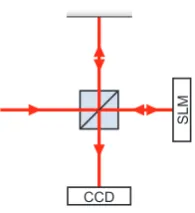
Frumker and Silberberg9make use of a Michelson interferometer (Fig. 3.1). The SLM area
is divided into two parts: one half is left unchanged while the other half is scanned through the
phase range. By analysing the resulting interference pattern with a camera, the input/phase
relation can be retrieved.
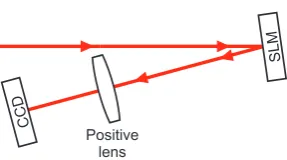
A similar method is suggested by Holoeye in the documentation of the SLM. Using an
opaque plate with two slits, they split up the beam into two distinct beams as in Fig. 3.2. These
two beams are reflected off the SLM and focussed onto one spot where an interference
pat-tern can be observed with a camera. Since the two beams are incident on different halves of
Section 3.2: Calibration methods
19
Figure 3.2: Interference of two parallel beams. The lens overlaps the two beams on the CCD.
SLM
45°
Polarizer
CCD
Figure 3.3: Calibration setup using a polarizer to convert phase modulation into amplitude modulation.
SLM
Grating CCD
Figure 3.4: Calibration setup using a transmissive grating to split the beam. On the CCD interference fringes can be seen.
phase delay is applied to one of the beams, the interference fringes will shift. This shift is a
good measure of the phase delay and thus directly related to the driving voltage. The main
advantage of this method over the setup of Frumker and Silberberg, is the simple alignment.
Furthermore, Frumker and Silberberg use a beam splitter which can give unwanted reflections
and additional interference effects that complicate measuring the movement of the fringes.
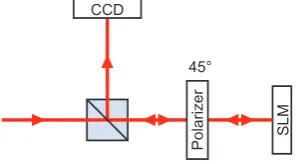
Vaughan7gives two alternative methods. In the first method, a polarizer is placed before
the SLM at 45◦(Fig. 3.3). The LCD is birefringent and a phase change will only be applied
to one polarisation; the polarisation will thus change as a function of the input. By passing
the modulated beam back through the polarizer, the amplitude is modulated. The amplitude
change can be observed with a camera, and the desired relation can be retrieved.
The second method used by Vaughan makes use of a (transmissive) grating (Fig. 3.4). A
monochromatic beam is split into two beams using a grating in such a way that the two beams
20
Chapter 3: Spatial shapingFigure 3.5: Calibration using the far field diffraction pattern of simple phase masks. The lens applies the Fourier transform to get the far field diffraction.
beams, the interference pattern of the returning beams is changed. This is essentially similar
to the Michelson interferometer, but has only one beam that has to be aligned. This is offset
by the need for a proper grating. The method proposed by Holoeye is a simplification of this
scheme. In that setup the two beams are not collinear as in the Vaughan setup, but the lack of
a prism greatly simplifies the implementation.
A final method by Chimento13 uses the field diffraction pattern (Fig. 3.5). The
far-field diffraction pattern for simple phase plates can be solved algebraically, and the measured
diffraction can thus be readily compared. Chimento uses a Heaviside function as a phase
pat-tern: a jump in phase across the middle of the SLM with a flat (but different) phase on both
halves. This is actually the same phase pattern as used in the aforementioned setups, but with
a better name. In this configuration, the relation between voltage and phase can be found by
analysing the heights and depth of the two peaks and one trough in the far field diffraction
pattern associated with the Heaviside function. The setup does require good alignment of the
beam on the centre of the phase mask, but this has the advantage of having a well aligned
beam for subsequent experiments.
The Michelson interferometer of Frumker and Silberberg; and the setup of Vaughan using
the polarizer were primarily considered for calibration of our SLM. Eventually, the method
suggested by Holoeye proved to give better results with a simpler setup. The method used by
Chimento was found later and not applied to our SLM.
There is most likely a dependence of the SLM input to phase shift correlation on the
in-coming light’s wavelength. When broadband pulses are shaped, this correlation has to be
re-established as is done in Section 4.4.
3.3 Calibration results
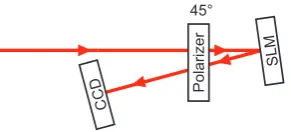
Initially, a simplified version of the polarisation setup of Vaughan (Fig. 3.6) was constructed to
Section 3.3: Calibration results
21
45°
SLM
Polarizer
C C D
Figure 3.6: Simplified setup with a polarizer to allow amplitude modulation. The beam is passed twice through a polarizer at 45◦while undergoing a change in polarisation on the SLM that depends on the applied phase delay. On the second pass through the polarizer, the polarisation modulation is converted into amplitude modulation.
Figure 3.7: Intensity plot of measured (left) and calculated (right) near field diffraction pattern for a phase mask with one horizontal bar of varying phase delay. The horizontal axis gives the phase delay as the input value for the SLM; the vertical axis is a cross section of the CCD.
With the polarizer in place, a checkerboard pattern was applied to the SLM with varying
sizes of the squares. The resulting intensity distributions differed greatly from the expected
patterns. For specific checkerboard sizes and phase delays the unshaped parts of the beam
would also display some amplitude modulation. To simplify the setup, only a single vertical
band of light was given a phase delay. On the camera, this again caused variations in intensity
over a much larger region of the beam. A numerical analysis of the near field diffraction offered
the explanation as can be seen in Fig. 3.7. The large distance between the SLM and the detector
22
Chapter 3: Spatial shapingFigure 3.8: Measured intensity for varying phase delays using a polarizer at 45◦as in Fig. 3.6. The SLM input is defined by the green colour value of the pixels sent to the SLM.
phase steps in the checkerboard pattern. This also explains the observed intensity variation in
the unshaped parts of the checkerboard patterns.
There is one important feature in Fig. 3.7 that should be recognized. There is a slight
cur-vature in the lobes of the measured intensity plot which is not present in the simulations. This
curvature is caused by the non-linear calibration of the SLM. Ideally, a linear increase in input
value (horizontal axis) leads to a linear increase of the phase delay. In reality, this relationship
is more complicated and it is precisely this relation that we are trying to determine in this part
of the project.
Moving the detector closer to the SLM reduces the extent of the diffraction pattern as the
Fraunhofer limit is approached:
R>a 2
λ ≈30 cm, (3.1)
whereinRthe distance to an aperture with widtha. However, for complicated phase masks
with small features (ain Eq. 3.1), the effects are still noticeable.
By averaging over many measurements, it can also suffice to apply a phase delay to the
whole SLM and thus the whole laser beam. This does mean that we cannot normalise the
intensity with an unmodulated beam. Since the near field diffraction will induce intensity
fluctuations in the unmodulated beam anyway, this is a small price to pay. The laser intensity
has also proven to be sufficiently constant across the duration of the experiments to do away
with this normalisation.
The summed intensity on the CCD as a function of the SLM input is given in Fig. 3.8. On the
non-Section 3.3: Calibration results
23
linearity. However, two odd features stand out: the intensity initially rises for an increasing
phase delay and at high input values there are some jumps in intensity. We will at first ignore
these oddities and attempt to map this curve to a proper sinusoid with suitable amplitudes
and attenuation. After all, the expected plot of intensity as a function of the phase delay is a
neat sinusoid. A short explanation follows, referencing the elements of the setup as shown in
Fig. 3.6.
After the light passes the polarizer for the first time, it will have a polarisation direction
~r. We can describe this beam as a sinusoid with an amplitudeAi n and split it into two parts
with orthogonal polarisations, of which only one will be shaped by the birefringent SLM. For
simplicity, we will assume a polarisation angle of 45◦.
Ai nsin (
Here, the senkrecht polarisation direction~s(with amplitudeAs) is the polarisation
perpendic-ular to the optical table. It is this polarisation that is shaped by the SLM. The other polarisation
directionp~(with amplitudeAp) is parallel with respect to the optical table and reflected by the
SLM without modulation. Upon reflection off the SLM, a phase shiftφis imparted on the
par-allel part of the beam, leaving us with two sinusoids that have different amplitudes and a phase
shift.
Now we have an elliptically polarized beam that goes back through the polarizer at 45◦. If we
still consider the two beams separately, then the beams after polarisation are described by the
following equation.
inte-24
Chapter 3: Spatial shapingFigure 3.9: Calibration curves for the phase delay as a function of input level. The blue curve was obtained using amplitude modulation; the red curve is obtained using an interference pattern.
grate these sinusoids.
Apparently, all we are left with is a cosine with an offset and amplitude. For the case of a
polarizer at 45◦we haveA=B=12π, but Eq. 3.5 actually holds for all polarizer directions. For
a polarisation angleα, Eq. 3.5 becomes:
I=
Figure 3.8 should thus be mapped to a cosine, albeit with a phase shift to compensate for
the initially rising intensity. If this is done correctly, then Fig. 3.9 is found. There are three
jumps discernable in this curve — most notably at an input of 180 — exactly there where
the measured intensity has its maxima and minimum. The accuracy with which two cosines
can be mapped around their maxima or minima is of course relatively small and as such this
method is restricted in its accuracy, at least for a part of the input values.
The initial rise of the intensity and the jumps at high input values have not yet been
ex-plained. The rise in intensity is probably caused by an inherent birefringence of the SLM.
The parallel polarisation will then always be given a phase delay compared to the orthogonal
Section 3.3: Calibration results
25
Figure 3.10: Default and new gamma curve for a 5:5 bitplane configuration.
difference and cause the intensity to rise. The jumps in intensity at higher input values can,
however, not be easily explained. They do appear to be reproducible across measurements,
but are probably caused by alignment issues as later experiments with different setups did not
exhibit this phenomenon.
Since the calibration of the SLM is limited in accuracy when using amplitude modulation,
the alternative method as suggested by Holoeye (Fig. 3.2) has also been tried. A double slit was
custom made from a business card and the resulting interference pattern was imaged onto
the CCD via two lenses. The second lens served to enlarge the image for better analysis. Half
of the SLM was kept at a fixed input level of 0, while the other half was scanned across the
256 different shaping levels. The shifts of the interference peaks were recorded and from this
the phase shift — measured in radians — was derived. The resulting relation between input
level and phase delay is compared with the amplitude modulation in Fig. 3.9. A more detailed
explanation of this calibration technique is given in Appendix B.
When the relation between SLM input level and phase delay has been determined, the SLM
software can be updated with an improvedgamma curve. The gamma curve is the internal
look up table of the SLM which converts the input of the user to the appropriate voltage for the
liquid crystal. Ideally, a linear increase in SLM input leads to a linear increase in phase delay.
Adjusting the gamma curve based on the calibration experiments explained above, allows us
to obtain this linear input-phase relation.
For the current configuration (see Section 3.4), there are 192 discrete voltage levels
avail-able to drive the SLM. We thus have to map 256 (8 bit) input values to 192 voltages in such
de-26
Chapter 3: Spatial shapingFigure 3.11: Measured phase delay as a function of input level for a 5:5 bitplane configuration using the default gamma curve (blue) and the optimized gamma curve (red).
Figure 3.12: Observed interference pattern shift for increasing phase delays. Shift with default gamma curve (left) and optimized gamma curve (right). With the new gamma curve a linear relation between the SLM input and the associated retardance is obtained.
fault gamma curve is shown in Fig. 3.10. With this curve loaded in the SLM, we obtain the
phase delays as in Fig. 3.11. Using the default gamma and the associated phase delays, we can
find a new gamma curve that should give a linear phase delay. The observed interference
pat-terns before and after the calibration are shown in Fig. 3.12 and it is clear that this calibration
method allows us to obtain a linear relation between the input values and the resulting phase
delay.
3.4 Bitplane configuration
After obtaining the improved gamma curve, a very simple helical phase mask was applied to
Section 3.5: Spatial shaping results
27
Figure 3.13: Laguerre-Gaussian beam profile showing radial asymmetry.
was clearly visible, a strong vibration was also present in the beam profile. This vibration was
not caused by mechanical vibrations in the system, or by instabilities in the laser. Holoeye
confirmed that this flickering is caused by the SLM, and they consider it normal behaviour:
“Due to the limited viscosity of the LC molecules these molecules flicker a little bit around
the mean value.” They suggested reconfiguring the SLM to use a 5:5 bitplane configuration,
instead of the default 22:6 bitplane configuration.
By changing the bitplane configuration, the addressing frequency of the liquid crystals can
be increased. While the driving electronics only accept 60 frames per second from the
com-puter, internally they can duplicate these frames. Each frame is then sent several times to the
liquid crystals within the refresh rate of 60Hz. However, as more updates are sent to the
crys-tals each second, less information can be contained in each. As a result, some resolution is lost
in the driving voltage of the SLM. With a 22:6 bitplane configuration 1472 voltage levels are
ac-cessible (through 256 input levels), while with a 5:5 bitplane configuration only 192 voltage
levels are accessible (through 256 input levels).
After setting the bitplane configuration to 5:5 some reduction of the flickering was found.
Even with the 5:5 bitplane configuration, a strong temporal dependence of the phase shaping
effectiveness is found. Frumker and Silberberg report a similar modulation with a
characteris-tic frequency of 300 Hz.9They assign this flickering to the electronic modulation scheme and
state that this is not a physical limitation of the liquid crystals.
3.5 Spatial shaping results
Some very simple beam profiles and diffraction patterns have been created with spatial
shap-ing. The Laguerre-Gaussian beam mentioned in Section 3.4 was made by applying a helical
28
Chapter 3: Spatial shapingFigure 3.14: Optimisation of phase mask for a complicated target using the Gerchberg-Saxton algorithm. After only a few iterations a good approximation of the target is obtained.
point, the beam will then destructively interfere. In this way, a donut mode is created.
Apart from the jittering mentioned earlier, there is a radial asymmetry in the resulting
beam profile as can be seen in Fig. 3.13. A similar effect is observed by Chimento using a MEMS
device.13The asymmetry is not dependent on the orientation of the phase mask, and
chang-ing the position of the beam on the SLM only has a small influence on the intensities of the two
lobes but not on their positions. The asymmetry can be ascribed to the spatial deformation of
the SLM as well as the non-uniform effective phase delay discussed in Section 3.6.
More complicated beam patterns require the calculation of unintuïtive phase masks. The
Gerchberg-Saxton (GS) algorithm14gives a way of iteratively optimising a phase mask to
ap-proximate a known target image in the focal plane. For most problems a good approximation
of the target is obtained after only a few iterations, (Fig. 3.14). If strong restraints — such as
binary phase steps — are added, convergence is less good. Many alternatives to the GS
algo-rithm are available15–17, but none share its simplicity and speed. Of course, this is offset by less
noise, sharper features, and less zero-order light. In our work, the speed of the GS algorithm
was preferred over the accuracy of its alternatives. With proper optimisations, phase mask
calculations at video-rate may even be possible.
In the GS algorithm (Fig. 3.15), an initial random phase mask is applied to the known
(Gaussian) amplitude profile of the incident beam and the result is Fourier transformed to
obtain the Fraunhofer diffraction pattern at the focal plane. While the calculated phase is
maintained, the amplitude is replaced by the desired amplitude of the target image and the
inverse Fourier transform is calculated. The resulting phase is the new phase mask, and the
amplitude should be replaced with the known amplitude of the incident beam. This process
can then be repeated ad infinitum.
In principle, the GS algorithm could also be used with a feedback loop. If the far field image
— containing the actual amplitude profile as opposed to the calculated targetAd— is captured
with a camera, this can be used to approximate the additional phase shaping from the optical
Section 3.6: Effective phase delay
29
Figure 3.15: The Gerchberg-Saxton algorithm. (Ref. 14)
in the SLM itself. With this additional shaping in mind, a new phase mask can be calculated
in order to get an improved image on the camera. When this process is repeated, a noticeable
improvement can be obtained. A slight experimental complexity that has to be overcome is
the mapping of the measured beam profile to the matrices in the algorithm. In order to get
good resolution both on the SLM and in the focal plane, the desired image has to fill the whole
matrix used in the GS algorithm. This means that in the experimental setup one also gets
a very large image which could not be projected onto the available camera. Ordinarily, the
Fourier transform could be applied to a larger matrix padded with zeroes in order to obtain a
smaller image with equal resolution. However, given that the SLM already has 2 megapixels,
this makes the calculations infeasible. A better solution would be to sacrifice some resolution
in both domains and use some appropriate lenses to project the image onto the camera.
The large diffraction patterns calculated with the GS algorithm are all easily viewed with
the naked eye. The vibrations of the liquid crystals do not have a noticeable effect in that case
due to the inherent temporal filtering of the human eye.
3.6 Effective phase delay
In the specification sheet of the SLM, Holoeye discusses the optical flatness of the display. The
listed maximal deviation of the SLM surface is 3–4 waves at 633 nm. This is much larger than
the customary flatness of mirrors in the order of tens of nanometers. Since the deformation is
30
Chapter 3: Spatial shapingFigure 3.16: Phase mask applied to the SLM for obtaining the effective phase delay per superpixel. The light from A and B is steered off from the main bundle via a diagonal grating. At A, an additional, variable, flat phase is added on top of the sawtooth grating in order to obtain the effective phase delay of the pixels in A (bottom).
the SLM slightly out of focus. Additionally, a phase mask can be applied to the SLM that
fur-ther compensates the deformations. However, the varying thickness of the LC panel will also
influence the phase delay range. In order to analyze the variation in effective phase delay, a
novel calibration method has been developed.
Because the HEO 1080P SLM is a two dimensional display, gratings can be displayed that
can steer incident light off into higher diffraction orders. By applying such a grating to a small
part of the display, a part of the light can be diffracted onto a camera. We use this to very
selectively analyze small parts of the SLM. The effective phase delay is then determined using
the same method as in Section 3.3.
All the light is steered off vertically into a higher diffraction order, as shown in Fig. 3.16. To
two small squares of 32 by 32 pixels a different grating is applied that diffracts a part of the light
away from the main beam. By using a diagonal grating, we obtain the least interference from
the rest of the light. The applied grating has a phase range of 0 to 128 input levels. This leaves
another 127 input levels for a constant phase delay. One of the two squares is thus given an
ad-ditional variable phase delay and the resulting shift of the interference pattern is recorded with
a camera. This process is repeated for the whole SLM, subdivided into superpixels of 32 by 32
pixels. The maximal phase delay per superpixel is then plotted to give a map of the maximal
retardance as a function of position on the LC display. A characteristic plot is given in Fig. 3.17.
ad-Section 3.6: Effective phase delay
31
Figure 3.17: Maximal phase delay per superpixel as a function of position on the SLM. The variation per superpixel is up to 10% per measurement; the overall shape, however, is constant.
-6%
Figure 3.18: Fast fluctuations in the maximal phase delay of one superpixel in the middle of the SLM. The vibrations are undersampled due to the response time of the CCD.
ditional thickening is observed at the left side of the SLM. The measured delay differences also
correspond well with the 1.8–2.4µm maximal thickness difference reported by Holoeye. Given
a common LC thickness of roughly 10µm, a 2µm thickness difference results in a maximal
phase delay bandwidth of 0.75π, similar to the results shown in Fig. 3.17.
Despite long integration times of 30 ms, a strong time dependence was observed with
max-imal variations of 10%. First of all, there are very fast fluctuations as in Fig. 3.18, where the
maximal phase delay for one superpixel is shown as a function of time. These variations have
32
Chapter 3: Spatial shapingFigure 3.19: Slow fluctuations of the maximal phase delay of one superpixel in the middle of the SLM.
-8%
Figure 3.20: Difference in shaping effectiveness between two consecutive measurements. Fig. 3.17 gives one of the two original measurement series.
(in the measurements these vibrations were undersampled due to the finite response time of
the CCD). Apart from the high frequency vibrations, a much slower time dependence is also
observed. By increasing the integration time of the CCD, these variations can be easily
ob-served. Fig. 3.19 shows the change in maximal phase delay over the space of several
min-utes. When two consecutive characterisations of the SLM are done, the influence of the long
term fluctuations becomes more apparent. Fig. 3.20 shows the difference between two
mea-surement series. The total meamea-surement time per superpixel is about 3 seconds and the time
between the two measurement series is several hours. Strong variations of up to 10% are
Section 3.6: Effective phase delay
33
is comparable between different measurements. Real pixel-by-pixel calibration is thus
unfea-sible, but a good profile can be obtained by applying a smoothing filter to the measured profile
4
Spectral shaping
With the basic calibration of the spatial light modulator described in Chapter 3, we now turn
to the spectral domain. First, the setup and alignment of a folded 4f zero dispersion pulse
compressor setup is explained, after which a quick and simple method for wavelength versus
pixel calibration is introduced. The spectral shaping capabilities of the SLM are demonstrated
using a second harmonic generation experiment.
4.1 Femtosecond laser source
A Coherent Legend Elite Ti:Sapphire laser amplifier is used to generate femtosecond pulses at
800 nm with a FWHM bandwidth of 36 nm. The amplifier is pumped with a tuneable
Coher-ent Micra Ti:Sapphire laser, which in turn is pumped by an integrated Verdi laser. The pulses
emerge with a power of 3 W and a repetition rate of 5 kHz. Since the amplifier is needed to
power a Coherent OPerA Solo Optical Parametric Amplifier, only a part of the 3 W is sent into
the shaper setup. As the maximum permissible power for the SLM is not known to us or the
36
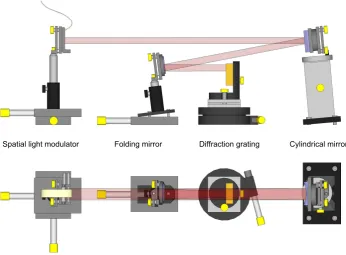
Chapter 4: Spectral shapingFigure 4.1: Spectral shaping setup; the yellow control knobs are used for fine adjustment of position and rotation of the various elements in the setup.
4.2 Shaper setup
For shaping in the spectral domain, the SLM is placed in a 4f zero dispersion pulse
compres-sor.4Since the Holoeye HEO1080P is a reflective SLM, the incoming and outgoing pathways of
the shaper setup are identical.
A plan of the setup is given in Fig. 4.1. The broadband pulse is initially dispersed on a gold
coated ruled diffraction grating from Edmund Optics with 830 lp/mm and a blaze angle of 19◦
for 800 nm. After passing a folding mirror, the first order diffraction is focussed by a 25 cm
cylindrical mirror which was gold coated in-house.
The folding mirror and SLM are placed on linear stages with micrometer screws for fine
ad-justment of the distances to the cylindrical lens. A second linear stage under the SLM moves
it perpendicular to the propagation plane for alignment of the spectrum on the SLM. Both the
cylindrical mirror and the grating are affixed to AMOLF-built mounts that allow fine
Section 4.2: Shaper setup
37
4.2.1 Alignment
The alignment of the shaper setup is a multistep process which is complicated by the small
form factor of the setup as well as the — partially invisible — wavelength range of the laser
source.
First and foremost, the grating has to be aligned so that all diffraction orders are in the
same plane as the incident beam. This ensures that the first diffraction order emerges parallel
to the table from the grating.
The initial alignment steps are done in the zero order. In those instances, a mirror should
be substituted for the SLM to prevent accidental burning of pixels in the focus of the zero order.
• One after another, the grating, folding mirror, and cylindrical lens are placed into
posi-tion, ensuring that the beam always emerges straight along the same path.
• The replacement mirror is placed at the position of the SLM. The rotation of this mirror
must be such that the incoming and outgoing beams on the grating overlap
horizon-tally. This can be checked easily with an IR viewer. Vertically, some tilt has to be applied
in order to separate the two beams spatially on the grating. The distance between the
re-placement mirror and the cylindrical lens is adjusted until a collimated beam is obtained
at the output of the shaper.
• The grating is rotated to the first order. The proper rotation is obtained if a collimated
beam again emerges from the shaper and the two spots on the grating overlap.
• The mirror is replaced with the SLM and the distance between the SLM and the lens is
adjusted until a collimated outgoing beam is again obtained.
• If the pulse length can be measured with an autocorrelator, then the folding mirror
position can be adjusted by optimising for a minimal pulse length after the shaper.
After these steps, the spatial dispersion in the emerging beam must be minimized. This is
most easily done by applying a grating to the SLM such that most light is diffracted away from
the main beam, apart from narrow bands both at the far right and far left of the spectrum. By
alternating between the red and blue part of the spectrum, the precise position of the different
colours can be determined.
The vertical separation between the left and right part of the spectrum is adjusted by
38
Chapter 4: Spectral shaping760 770 780 790 800 810 820 830 840
In
Figure 4.2: Spectral dip observed when a 32 pixel wide grating is applied at pixel 743. By scanning a grating across the SLM, the wavelength versus pixel relation can be obtained.
compensated for by rotating the grating and SLM in unison. If the initial alignment has been
done properly, this should not be necessary.
4.3 Wavelength versus pixel calibration
To determine which colour is focussed on which pixel, the two dimensional shaping
capabili-ties of the SLM can be employed. By applying a grating in the vertical direction of the SLM, the
beam can be realigned spatially. If this grating is applied selectively to a band of a few pixels
wide, it is possible to steer off a part of thespectrumof the beam. By analyzing the resulting
spectrum, the wavelength versus pixel calibration is easily obtained.
Figure 4.2 shows a typical measurement as the grating is scanned along the LCD. After
an initial determination of the peak position, the accuracy in the wings of the spectrum is
improved by extrapolating the well-defined peak positions in the centre of the spectrum to the
less intense wings. In this way, an accurate determination of the wavelength per SLM pixel can
be determined as shown in Fig. 4.3.
4.4 Wavelength versus effective phase delay
As previously explained in Section 3.6, we can determine the maximum retardance as a
func-tion of locafunc-tion on the SLM. This allows us to determine the relafunc-tion between wavelength and
the effective maximal phase delay. For this purpose only a scan in the spectral dimension of
Section 4.4: Wavelength versus effective phase delay
39
0 200 400 600 800 1000 1200 1400 1600 1800
W
Figure 4.3: Pixel versus wavelength calibration. In the wings of the spectrum the accuracy of the calibration is reduced due to the low intensities.
0
750 770 790 810 830 850
In
Figure 4.4: Retardance (blue dots) as a function of wavelength for maximal SLM input. A linear fit (green line) is drawn through the points where the intensity (red line) was sufficiently high. In the wings of the spectrum, the error in the maximum retardance is too great for an accurate fit.
By determining the effective phase delay, we can also verify the SLM input vs. phase delay
relation found in Section 3.3. For all wavelengths of the laser system used, we still find a linear
SLM input vs. phase relation. There is thus no need to create look up tables to convert a desired
phase delay to the appropriate SLM input for each wavelength, but the single gamma curve
within the SLM suffices.
Figure 4.4 shows the maximum retardance as a function of wavelength. The input
spec-trum is overlaid for comparison. In the wings of the specspec-trum the observed interference
40
Chapter 4: Spectral shapingof the measurements.
The large spread in the measured effective phase delays can be ascribed to the temporal
variations described in Section 3.6. Nevertheless, a linear fit can be made through the points
where the maximum retardance could be determined with high confidence. A near constant
effective phase delay is found across the whole spectrum of the femtosecond pulses. Since the
temporal fluctuations of the SLM are much larger than the influence of the wavelength on the
effective phase delay, it is deemed unnecessary to compensate for this minor change in later
experiments.
The results in Fig. 4.4 are not compensated for the spatial distortion found in Section 3.6.
Apparently, the spatial distortion of the SLM and the wavelength dependent refractive index of
the liquid crystals, combined with the alignment of the SLM in the 4f configuration, result in
a near constant effective phase delay across the whole SLM. In later experiments with spectral
shaping we can thus also forego compensating for the spatial inhomogeneity of the SLM.
4.5 Second harmonic generation
One of the simplest experiments that applies phase shaping of ultrashort pulses, is the
opti-misation of second harmonic generation (SHG) in a non-linear crystal. In such a crystal, the
incoming pulses are converted into light with half the wavelength — the second harmonic
— with an efficiency that is dependent on the intensity of the pulse. SHG is aχ2process,
as in Eq. 4.1.18,19A shorter pulse of equal energy will result in higher SHG efficiency as the
peak power is greater. By optimising the SHG signal, the pulse duration is optimised to
ap-proach a transform limited pulse (the shortest possible pulse). In the spectral representation
this corresponds to a flat phase profile across the spectrum.
~
P(t)=²0¡χ1~E(t)+χ2~E2(t)+χ3E~3(t)+. . .¢ (4.1)
A detailed description of the algorithm used to find the flat phase profile is given in
Chap-ter 6. In short, the SHG signal of a random sample of phase profiles is measured, afChap-ter which
a computer algorithm suggests a new set of phase profiles of which the SHG signals are then
again measured. With each loop through the optimisation — one generation — the SHG signal
slightly improves, and the optimisation is terminated after a fixed number of generations, or
when a stable phase mask is obtained.
pro-Section 4.6: SHG optimisation setup
41
Figure 4.5: Setup for measuring SHG. Two photodiodes measure the SHG signal as well as a reference signal from the reflection from the focussing lens.
file that compensates best for phase distortions in the input pulse as well as for the effects of
elements in the beam path such as dispersion in lenses. Important to note is that distortions
occurring after the shaper are also compensated for.
SHG optimisation occurs purely in the spectral domain and thus does not make use of
the two dimensional characteristic of the SLM. If the second (spatial) direction would also be
optimised, the spatial and spectral optimisation could not be decoupled and no information
can be extracted from the optimisation. Moreover, any spatial optimisation would be purely
related to alignment of the SHG experiment, while the spectral optimisation gives insight into
the pulse characteristics. Most other experiments call for transform limited pulses which is the
main motivation to do an SHG optimisation experiment. Optimising the spatial dimension
may result in higher SHG efficiency, but does not improve the beam characteristics. Most
probably, a spatial optimisation would be restricted to improved focussing of the beam onto
the non-linear crystal.
4.6 SHG optimisation setup
After being shaped, the beam is focussed onto a thin Beta Barium Borate (BBO) crystal of
25µm with a 3.5 cm lens as in Fig. 4.5. The SHG signal is filtered with a bandpass filter,
de-tected with a photodiode and enhanced via a transimpedance amplifier. A second photodiode
measures the reflectance from the lens as a reference.
The measured second harmonic signal is divided by the reference to compensate for
fluc-tuations in both laser- and shaper stability. The result of this is normalized with the SHG
ob-tained with no phase mask applied to the SLM. The resulting amplification factor is used as
42
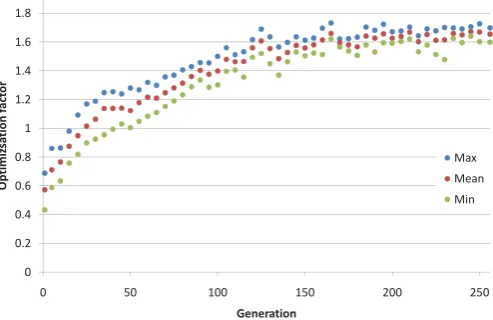
Chapter 4: Spectral shapingFigure 4.6: Best, mean, and worst fitness values per generation of a characteristic SHG optimisation run. This optimisation took two hours to complete with about 10,000 phase masks evaluated.
0
765 775 785 795 805 815 825
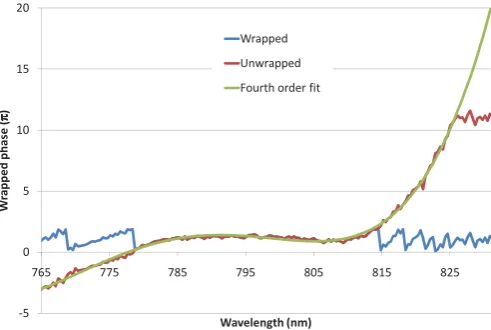
U
Figure 4.7: Best phase mask using a photodiode to measure SHG signal. The wrapped phase (blue line, left axis) can be unwrapped to obtain the red line (right axis). The pha