Annotating Clinical Events in Text Snippets for Phenotype Detection
Prescott Klassen
1, Fei Xia
1, Lucy Vanderwende
2, and Meliha Yetisgen
1 University of Washington1, Microsoft Research2PO Box 352425, Seattle, WA 98195, USA, One Microsoft Way, Redmond, WA 98052, USA {klassp, fxia, melihay}@uw.edu, [email protected]
Abstract
Early detection and treatment of diseases that onset after a patient is admitted to a hospital, such as pneumonia, is critical to improving and reducing costs in healthcare. NLP systems that analyze the narrative data embedded in clinical artifacts such as x-ray reports can help support early detection. In this paper, we consider the importance of identifying the change of state for events—in particular, clinical events that measure and compare the multiple states of a patients health across time. We propose a schema for event annotation comprised of five fields⟨location, attribute, value, change-of-state, reference⟩and create preliminary annotation guidelines for annotators to apply the schema. We then train annotators, measure their performance, and finalize our guidelines. With the complete guidelines, we then annotate a corpus of snippets extracted from chest x-ray reports in order to integrate the annotations as a new source of features for classification tasks.
Keywords:Annotation, Event Extraction, Phenotype Detection
1.
Introduction
A chest x-ray is a common type of medical report for mon-itoring the change in health of patients over time. Figure 1 presents an example chest x-ray. Our recent efforts have been to build an NLP system that analyzes the narrative em-bedded in x-ray reports to detect phenotypes/diseases such as pneumonia. To create the gold standard for training the system, we asked medical experts to annotate x-ray reports with phenotype labels and identify snippets of text that sup-ported their labeling decision (e.g., Figure 1: lines 9-11). Analysis of the text snippets reveal that the snippets typi-cally mention a change of state (COS) where a symptom is either initiating, increasing, persisting, decreasing, or ter-minating.
Monitoring the state of the patient, and comparing cur-rent state with previous states, is of critical importance to phenotype detection in the clinical scenario. In this paper, we propose to expand the annotation of COS to include the comparison of states over time. We implement a tu-ple schema of five fields⟨location, attribute, value, change-of-state, reference⟩, create annotation guidelines and mea-sure their performance by comparing the pairwise inter-annotator agreement between three inter-annotators, and finalize our guidelines. Once completed, the guidelines and schema are applied to a corpus of text snippets extracted from chest x-ray reports. The resulting annotations are intended to be integrated as a new source of features for classification tasks in a pneumonia detection system.
2.
Previous work on Phenotype detection
Early detection and treatment of ventilator associated pneu-monia (VAP) is important as it is the most common healthcare-associated infection in critically ill patients. Even short-term delays in appropriate treatment for patients with VAP are associated with high mortality rates, longer-term mechanical ventilation, and excessive hospital costs. Our research goal is to build NLP systems which assist healthcare practitioners in identifying patients who arede-veloping critical illnesses (e.g., VAP).
Figure 1: Sample chest x-ray report
2.1.
PNA/CPIS Detection
Figure 2: A snippet featuring an event annotation connecting all five fields of the COS tuple.
2.2.
Experiment Results
First, two sequence labelers were trained to predict the loca-tions of CPIS and PNA rationale snippets, and the f-scores for predicting snippets are 78.7% (for PNA) and 93.9% (for CPIS), respectively. Next, two SVM classifiers, one for CPIS and the other for PNA, were trained and eval-uated using 5-fold cross validation. Three sets of exper-iments were run using features selected from the whole document, the predicted snippets alone, or a combination of both. The same features were used for all three sets of experiments, including unigrams and bigrams filtered for stopwords, digits, and punctuation, UML concepts, and al-ternate proposing conjunctions (versus, or, etc.). Snippets alone performed the best for both classification tasks, re-sulting in a macro F1-score of 76.9% and an accuracy score of 87.1% for CPIS, and a macro F1-score of 74.0% and an accuracy score of 82.1% for PNA (Tepper et al., 2013).
Error analysis for both classification tasks reveals that resolving classification errors requires features that go be-yond simple concepts or word ngrams. Consider the snip-pet“The previously noted right upper lobe opacity consis-tent with right upper lobe collapse has resolved’’, which is labeled in the gold standard 1A (no infiltrate). The sys-tem mislabeled it 1C (localized infiltrate), because the snip-pet supports 1C entirely up until the crucial words “has re-solved”. These types of errors motivate the COS annotation task we describe in this paper.
3.
Change of State for Clinical Events
Our corpus contains annotated radiology reports and high-lighted snippets of text where annotators found support for their annotations. These snippets frequently describe obser-vations of change and such COS obserobser-vations appear more often in snippet text than in non-snippet text1.Previous COS analyses (e.g., (Sun et al., 2012)) have focused on an analysis where events are expressed as verbs. In our data, however, many of the events are expressed as nouns and adjectives. Our annotation scheme is explained below.
3.1.
Description of COS tuple
The event analysis in (Uzuner et al., 2010; Uzuner et al., 2011; Albright et al., 2013) mark multiple types of events, temporal expressions, and event relations whereas our an-notation is constrained to tracking changes in a patients medical condition. We define an event in our corpus as a tuple, consisting of the fields loc, attr, val, cos, andref,
1
Out of a random sample of 100 snippets and 100 non-snippet texts, 83 snippets contain mentions of COS; in contrast, 61 non-snippet texts contain mentions of COS.
where loc is the anatomical location (e.g.,right lungin Fig-ure 2), attr is an attribute of the location that the event is about (e.g.,atelectasisin Figure 2), val is a possible value for the attribute (e.g.,minimal patchyin Figure 2), cos indi-cates the change of state for the attribute value compared to some previous reports (e.g.,mildly improvedin Figure 2), and ref is a link to the report(s) that the change of state is compared to (e.g.,since the prior studyin Figure 2). Not all tuples will have values for all five fields. A field can be unspecified and inferred from the context of the surround-ing snippet text or from the collection of snippets that have been extracted from the sequence of a patients x-ray re-ports. More discussion about the event definition can be found in (Vanderwende et al., 2013).
4.
Change of State (COS) Annotation
In this section we describe our corpus of extracted text snip-pets, the tools and processes we implemented for annota-tion, and report on inter-annotator agreement.
4.1.
Development Process
We annotated the events in the x-ray reports in several steps:
1. Extract text snippets from x-ray reports.
2. Create annotation guidelines.
3. Create an annotation tool.
4. Train annotators, conduct triple annotation on a small sample of the snippets, compare annotations, and fi-nalize annotation guidelines.
5. Annotate the complete corpus, following the finalized annotation guidelines.
Steps 1, 3, and 4 are explained below.
4.2.
Annotation Tools and Schema
The event tuple structure described in Section 3.1 was trans-lated into a schema for use with the BRAT2 annotation
tool (Stenetorp et al., 2012). BRAT is a lightweight, web browser-based annotation tool which is easy to install and use across major operating systems. BRAT allows annota-tors to mark entities and link entities by arcs.
To use BRAT for our annotation, we mark five types of entities, corresponding to the five fields in an event tuple. To mark an event tuple, because some fields are shared by multiple events, we decided to use directed, labeled arcs to link two entities. There are four arc labels: (1)The label
Stateconnects a Cos entity with an Attr, Loc, or Val entity; (2)Valueconnects an Attr or Loc entity with a Val entity;
2
Figure 3: A snippet featuring shared entities between events.
Figure 4: An event tuple extracted from the graph in Figure 2.
(3)Locationconnects an Attr or Loc entity with a Loc en-tity, and (4)Referenced-byconnects an Attr or Cos entity with a Ref entity.
Once the entities in a snippet are connected to one another by labeled arcs, one or more connected, directed graphs are formed by these arcs. See Figure 2 for a screen capture of our schema applied to a text snippet. From the graph, event tuples are generated. Figure 4 shows the event tuple generated from the graph in Figure 2.
Note that events can share entities between them. The graph in Figure 3 features two attr entities connected to a single change of state entity. Two event tuples are generated from the graph, both featuring the same shared change of state entity.
In addition to the description of the annotation tool and schema, the annotation guidelines include a list of common terms from the corpus and their mappings to entities in the schema.
4.3.
Snippet Corpus Description
As mentioned in Section 2.1, our corpus consists of 1008 unique text snippets extracted from 1344 x-ray reports. The snippets were selected by medical experts to support their decision when annotating the reports with PNA/CPIS la-bels. Table 1 provides some statistics of the corpus.
Corpus Item Count
X-ray Reports 1344 Unique Snippets 1008
Entities 7173
Labeled Arcs 4128 Event Tuples 2101
Table 1: Statistics of the snippet corpus
4.4.
Inter-annotator agreement
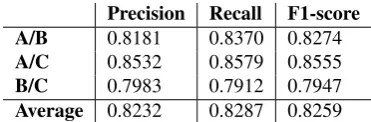
To train annotators, calculate the inter-annotator agreement, and finalize the annotation guidelines, 100 snippets were selected at random from our corpus of 1008 unique text snippets. They were annotated in two stages by three anno-tators. In the first stage, the annotators read the annotation guidelines, learned to use the annotation tools, and then an-notated the first 20 snippets. The annotators then met and compared annotations, and the feedback from this discus-sion was used to revise and finalize annotation guidelines. In the second stage, the annotators revised their annotation of the first twenty snippets following the revised guidelines, and completed annotating the remaining 80 snippets.
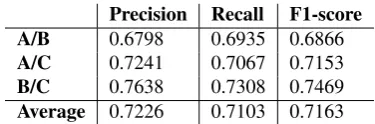
To calculate inter-annotator agreement, we compare the annotations of each of the annotator pairs at three lev-els: word level, entity level, and event level. Each level provides a different aspect about annotation disagreements between annotators and contributes to the development of annotation guidelines.
4.4.1. At the word level
To compare annotation at the word level, we use the stan-dard BIO scheme to obtain word-level labels from entity annotation. That is, if a text span is labeled as an entity of type X, the word-level label of the first word in the span is B-X, and the label of other words in the span is I-X, and words that do not appear in any entity has label O.
Precision Recall F1-score A/B 0.8607 0.8434 0.8520
A/C 0.8532 0.8579 0.8555
B/C 0.7862 0.8330 0.8089
Average 0.8334 0.8448 0.8388
Table 2: Inter-annotator agreement at the word level for the first 20 snippets. A, B, and C denote the three annotators. The scores are micro-averages over different word-level la-bels.
Precision Recall F1-score A/B 0.8181 0.8370 0.8274
A/C 0.8532 0.8579 0.8555
B/C 0.7983 0.7912 0.7947
Average 0.8232 0.8287 0.8259
Table 3: Inter-annotator agreement at the word level for the final 100 snippets.
tion and assertion information improved phenotype classi-fication accuracy. We will also extend our schema to anno-tate relations between events (e.g., one event causes another event).
Our ultimate goal is to use event detection, phenotype detection, and other NLP systems to monitor patents med-ical conditions over time and prompt physicians with early warning, and thus improve patient healthcare quality while reducing the cost of healthcare.
6.
Acknowledgements
This project was partially funded by the University of Washington Research Royalty Fund and the Institute of Translational Health Sciences grant UL1TR000423. We would also like to thank the anonymous reviewers and Wen-wai Yim for helpful feedback.
7.
References
Albright, D., Lanfranchi, A., Fredriksen, A., Styler IV, W. F., Warner, C., Hwang, J. D., Choi, J. D., Dligach, D., Nielsen, R. D., Martin, J., Ward, W., Palmer, M., and Savova, G. K. (2013). Towards comprehensive syn-tactic and semantic annotations of the clinical narrative.
Journal of American Medical Informatics Association (JAMIA), 20:922–930.
Bejan, C. A., Vanderwende, L., Xia, F., and Yetisgen-Yildiz, M. (2013). Assertion modeling and its role in clinical phenotype identification. Journal of American Medical Informatics Association (JAMIA), 46(1):68–74. Stenetorp, P., Pyysalo, S., Topi´c, G., Ohta, T.-k., Anani-adou, S., and Tsujii, J. (2012). Brat: a web-based tool for nlp-assisted text annotation. InProceedings of the Demonstrations Session at EACL 2012.
Sun, W., Rumshisky, A., Uzuner, O., Szolovits, P., and Pustejovsky, J. (2012). The 2012 i2b2 temporal relations challenge annota-tion guidelines. Manuscript, Available at https://www.i2b2.org/NLP/TemporalRelations/Call.php. Tepper, M., Evans, H. L., Xia, F., and Yetisgen-Yildiz, M. (2013). Modeling annotator rationales with application to pneumonia classification. InExpanding the Bound-aries of Health Informations Using AI Workshop of AAAI 2013.
Uzuner, ¨O., Solti, I., Xia, F., and Cadag, E. (2010). Community annotation experiment for ground truth gen-eration for the i2b2 medication challenge. Journal of American Medical Informatics Association (JAMIA), 17(5):519–23.
Uzuner, ¨O., South, B. R., Shen, S., and DuVall, S. L. (2011). 2010 i2b2/va challenge on concepts, assertions, and relations in clinical text.Journal of American Medi-cal Informatics Association (JAMIA), 18(5):552–6. Yu, S., Farooq, F., Krishnapuram, B., and Rao, B.-r. (2011).
Leveraging rich annotations to improve learning of med-ical concepts from clinmed-ical free text. InICML workshop on Learning from Unstructured Clinical Text, Bellevue, WA.
Zilberberg, M. D. and Shorr, A. F. (2010). Ventilator-associated pneumonia: the clinical pulmonary infection