Bridging the gap between speech technology and natural language processing:
an evaluation toolbox for term discovery systems
Bogdan Ludusan
∗, Maarten Versteegh
∗, Aren Jansen
†, Guillaume Gravier
‡, Xuan-Nga Cao
∗Mark Johnson
§, Emmanuel Dupoux
∗∗LSCP - EHESS/ENS/CNRS, Paris;†CLSP - Johns Hopkins University, Baltimore ‡IRISA - CNRS, Rennes;§Macquarie University, Sydney
Abstract
The unsupervised discovery of linguistic terms from either continuous phoneme transcriptions or from raw speech has seen an increasing interest in the past years both from a theoretical and a practical standpoint. Yet, there exists no common accepted evaluation method for the systems performing term discovery. Here, we propose such an evaluation toolbox, drawing ideas from both speech technology and natural language processing. We first transform the speech-based output into a symbolic representation and compute five types of evaluation metrics on this representation: the quality of acoustic matching, the quality of the clusters found, and the quality of the alignment with real words (type, token, and boundary scores). We tested our approach on two term discovery systems taking speech as input, and one using symbolic input. The latter was run using both the gold transcription and a transcription obtained from an automatic speech recognizer, in order to simulate the case when only imperfect symbolic information is available. The results obtained are analysed through the use of the proposed evaluation metrics and the implications of these metrics are discussed.
Keywords:evaluation, spoken term discovery, word segmentation
1.
Introduction
Unsupervised discovery of linguistic structures is attracting a lot of attention. Under the so-called ‘zero resource set-ting’ (Glass, 2012), a learner has to infer linguistic units from raw data without having access to any linguistic la-bels (phonemes, syllables, words, etc.). This can have ap-plications in languages with little or no resources, and has considerable relevance for cognitive modelling of human infants language acquisition (Jansen et al., 2013).
One area of particular interest is the automatic discovery of words or ‘terms’ from unsegmented input. This partic-ular problem has been addressed from the viewpoint of at least two language processing communities: natural lan-guage processing (NLP) and speech technology (ST). Most of the systems from the NLP community take as input a speech corpus that has been transcribed phonemically (gold transcription), but where the word boundaries have been deleted (Brent and Cartwright, 1996; Brent, 1999; John-son et al., 2007; Goldwater et al., 2009). The aim is to recover these boundaries, as well as to construct a lexicon of terms. Note that most of these algorithms exhaustively ’parse’ their inputs in terms of a sequence of word tokens. A set of standard evaluation criteria has been established: segmentation, word token and word type precision, recall and F-scores. The corpora are for the most part in English (Daland and Pierrehumbert, 2011), although a small num-ber of studies are now conducted across different languages (Fourtassi et al., 2013; Daland and Zuraw, 2013). The al-gorithms of term discovery coming out of the ST commu-nity also attempt to discover terms, but work from the raw speech input, and may not produce an exhaustive parse. These systems are more recent and have not yet converged on an accepted set of corpora and evaluation methods (Park and Glass, 2008; Jansen and Van Durme, 2011; Flamary et al., 2011; McInnes and Goldwater, 2011; Muscariello et al., 2012). The name term discovery (TD) will be used
throughout this paper for both kinds of systems.
The aim of this paper is to propose both a corpus as well as a set of evaluation tests that would enable researchers to com-pare the performance of different systems within and across communities. As new ST/NLP hybrid systems are emerg-ing (Lee and Glass, 2012), it is our belief that a common evaluation method will be useful to bridge the gap between the two communities.
2.
Evaluation method
Algorithms for discovering recurring patterns in linguistic data can be used for a variety of purposes: speech corpora indexing, keyword search, topic classification, etc. We do not claim that a single evaluation method is relevant for all these applications. Rather, we propose a toolbox contain-ing several evaluation metrics, each one tailored to measure a different subcomponent of the TD algorithm. The reason for proposing such a toolbox, rather than a single measure, is that it enables more fine grained comparisons between systems. In addition, it enables, a system diagnostic tool to assess which subcomponent needs improvement. Another design feature of our evaluation toolbox is that it is per-formed in the phoneme space, i.e., aligning the waveform with gold phonemic transcription. This is a useful feature to enable a comparison of ST and NLP systems.
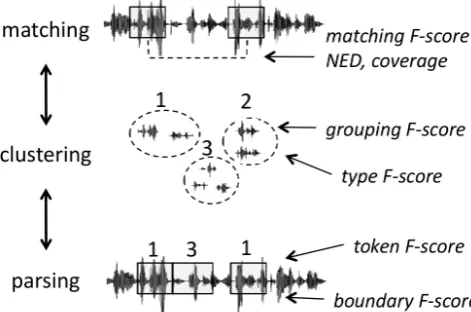
Extracting recurring terms from continuous speech is a problem that involves several interconnected components (see Figure 1). Firstly, one component involves match-ingstretches of speech input. This is typically done with a Dynamic Time Warping technique (DTW), and can be viewed as constructing a list of pairs of fragments, each cor-responding to stretches of speech. We propose in this paper several methods for evaluating matching quality. Secondly, many systems also incorporate a mechanism forclustering
Figure 1: Logical pipeline highlighting three components that can be part of term discovery systems, and presentation of our 5-levels evaluation toolbox. The top two (matching and grouping scores) use the aligned phoneme transcription as gold standard, and the last three (type, token and bound-ary scores) use the word level alignment.
fragments (Muscariello et al., 2012), others perform the fragment clustering only as the last step (Park and Glass, 2008; Jansen and Van Durme, 2011; Flamary et al., 2011; McInnes and Goldwater, 2011). Clustering quality can be evaluated rather standardly in terms of the purity/inverse-purity of their phonemic content. Thirdly, the extracted clusters or fragments are used forparsingthe input and as-sign segmentation boundaries. Some systems perform pars-ing implicitly (as a trace of the matchpars-ing process), others, perform an explicit parsing step, allowing to clean up po-tentially overlapping matches. The discovered clusters and the parses can be evaluated in terms of a gold lexicon and a gold alignment. For this, we use the standard NLP metrics (type,tokenandboundaryF-score).
Note, however, that contrary to NLP systems, most ST sys-tems do not exhaustively parse their input. It is therefore important to compute the NLP type statistics on the part of the corpus that has been covered, while keeping track of a separate coverage statistic. In contrast to ST systems, NLP systems do not work from raw speech. In order to com-pare them, we therefore complement the word segmenta-tion NLP systems with a speech recognisegmenta-tion front-end, and perform the evaluation on the entire front-end plus the word segmentation pipeline.
2.1. Precision, recall and F-score
We use the same logic at all the defined levels of the tool-box, i.e., we define a set of found structures (X), which we compare to the set of gold structures (Y) using average pre-cision, recall and F scores as defined in (1). In most of the cases,XandY will be sets of fragments(i, j)or of pairs of such fragments. We will always sum over fragment types, as defined through their phonemic transcriptionsT, with a weightwdefined as the normalized frequency of the types in the corpus. The functionmatch(t, X)counts how many tokens of typetare in the setX.
P recision= X
t∈types(X)
w(t, X)×match(t, X∩Y)
match(t, X)
Recall= X
t∈types(X)
w(t, X)×match(t, X∩Y)
match(t, Y)
F-score= 2×P recision×Recall
P recision+Recall (1)
2.2. Alignment
Previous evaluation techniques of ST-TD systems have used the word as the level of alignment (e.g. Park and Glass (2008), Muscariello et al. (2012)). However, in order to ob-tain a more fine grained evaluation, and to enable a compar-ison with NLP systems, we align the signal with phoneme-level annotations. As the speech part of the system has no knowledge of the segmental content in the signal it pro-cesses, a discovered boundary may fall between two anno-tated phoneme boundaries. In order to transcribe a given fragment, we consider as being part of the annotation any phoneme that has either at least 50% overlap in time with the fragment, or at least 30ms overlap. By setting a 30 ms overlap we impose a minimum limit for a chunk to be per-ceived as belonging to a certain category (30ms being ar-guably the upper bound of the minimum amount of speech needed to identify a phoneme (Tekieli and Cullinan, 1979)), while using the 50% limit we take into consideration also short phonemes, if there is sufficient overlap with the said fragment. Note that, through the alignment, the representa-tion level for the system evaluarepresenta-tion has changed: Matches found at the acoustic level are evaluated at the phonemic level. Thus, each found acoustic fragment is treated like a separate phoneme string occurrence during the evaluation.
2.3. Matching quality
We propose two sets of measures of matching quality, one qualitative and easy to compute, and the other quantitative and computationally intensive. With respect to the former type, we propose the normalized edit distance (NED) and the coverage. The NED is the Levenstein distance between each two string occurrences, divided by the maximum of the length of the two strings. It expresses the goodness of the pattern matching process and can be interpreted as the percentage of phonemes shared by the two strings. The coverage is defined by the percentage of phonemes corre-sponding to discovered fragments from the total number of phonemes in the corpus. These two values give an intuitive idea of the matching quality and can capture the trade-off between very selective matching algorithms (low NED, low coverage), and very permissive ones (high NED, high cov-erage). A formal definition of these measures is presented in Equations 2 and 3, wherePdisc is the set of discovered
fragment pairs, and Pgold the gold set of non-overlapping
phoneme-identical pairs. Note that coverage is computed over all found fragments (Fdisc), some of which may be
N ED= X (x,y)∈Pdisc
ned(x, y)
|Pdisc| (2)
ned((i, j),(k, l)) = Levenstein(Ti,j, Tk,l)
max(j−1 + 1, k−l+ 1)
Coverage= cover(Fdisc)
cover(Fgold) (3)
cover(P) =∪(i,j)∈P{i, i+ 1, ..., j}
A more quantitative evaluation is given by the precision, recall and F-scores of the set of discovered pairs with re-spect to all possible matching pairs of substrings in the cor-pus. For efficiency, we restrict the substrings to a particular range, e.g., between 3 and 30 phonemes. Precision is com-puted as the proportion of discovered substring pairs which belong to the list of gold pairs. In order for this statistic not to be dominated by very frequent substrings (the num-ber of pairs grows with the square of the frequency), we compute these proportions across pairs of the same type, re-weighted by the frequency of the type. Note that, as the gold list contains all of the substrings, we have to aug-ment the discovered pair set with all the logically implied substrings. The proper way to generate those would be to read them off the DTW alignment. However, this informa-tion is not accessible in most ST-TD systems. We therefore re-generate the list of discovered substrings using DTW in phoneme space. This allows not to penalize too much an al-gorithm discovering the pairdemocracy/emocracy; indeed, this match will generate the correct substring match emoc-racy/emocracy, and many other smaller ones. By a similar computation, we can define recall as being the proportion of gold pairs present in the discovered set. For systems not separating matching from clustering, the matching quality can be still computed by decomposing the found clusters into a list of matching pairs and applying the above algo-rithm. The measures are defined formally in Equation 1, whileX is the substring completion ofPdisc,Y is the set
of all non overlapping matching substrings in the gold tran-script of minimum length 3, and the functions involved in their computation are defined in the following equations.
types(X) ={Ti,j, where(i, j)∈f lat(P)} (4)
w(t, X) = f req(t, X) |f lat(X)|
match(t, X) =|{(x,(i, j))∈X, where Ti,j=t}|
f req(t, X) =|{(i, j)∈f lat(X), where Ti,j=t}|
f lat(X) ={(i, j), where∃x(x,(i, j)) =t∈X}
2.4. Grouping quality
We propose to compute grouping quality using the pairwise matching approach as above (see also Amigo et al. (2009)) but not expanding the set of pairs using substrings, and re-stricting the analysis to the covered corpus. Apart from that, the computation is the same as above, i.e. averaging across all matching pairs of the same types and re-weighting by
type frequency. The interpretation of Grouping quality is different from that of Matching quality. Matching quality is asking how well the algorithm is able to locate any identical stretches of speech in the whole corpus. Grouping quality is asking how good and homogeneous the discovered groups of fragments are. Again, the measures used here are defined in Equation 1, while the sets involved in their computation are defined in 5. As in the These sets are constructed as the sets of all pairs of fragments belonging to the same cluster.
X={((i, j),(k, l))where∃c∈Cdisc(i, j)∈c
and(k, l)∈c}
Y ={((i, j),(k, l))∈Fall×Fall, where
∃c1, c2∈Cdisc(i, j)∈c1and(k, l)∈c2and
Ti,j=Tk,land{i, ..., j} ∩ {k, ..., l}=∅}
(5)
whereCdisc is the set of discovered clusters, each cluster
being a set of fragments.
2.5. Token, Type and Boundary quality
For systems that output clusters and use them to parse the input, it is possible to evaluate the relevance of these clus-ters with respect to a gold lexicon, and to the gold word boundaries. Here, we apply the exact same definitions as in NLP systems: for instance, token recall is defined as the probability that a gold word token has been found in some cluster (averaged across gold tokens), while token precision represents the probability that a discovered token matches a gold token (averaged across discovered tokens). The F-score is the harmonic mean between the two. Similar def-initions are applied for the Type score. Again, the same formal definition of the metrics is employed here (Equa-tion 1). The subsets involved in their computa(Equa-tion are the following:
X=Fdisc: set of discovered fragments Y ={(i, j)∈Fall, where Ti,j ∈L and
i, j∈cover(X)}
(6)
The f latfunction in Equation 4 is being redefined as the identity function. The only difference between type and token scores, is that for type, the weighting function is re-defined as a constant:
w(t, X) = 1
|types(Fdisc)| (7)
The Boundary score is defined in a different manner, to take into account the fact that the fragments found might not be perfectly aligned to the gold transcription. We use Equation 1, with sets and functions defined as follows:
X =set of discovered boundaries Y =gold set of boundaries
there is only one type for the boundaries match(t, X) =|X| w(t, X) = 1
(8)
As we said above, these statistics are be computed over the
matching grouping token type boundary
NED cov. P R F P R F P R F P R F P R F
JHU
matching 85.7 35.8 0.2 16.6 0.3 3.4 26.4 5.7 0.6 1.9 0.9 0.6 0.7 0.6 19.3 14.9 16.9 clustering 39.1 28.1 0.1 13.5 0.2 4.9 72.5 9.1 0.8 1.1 0.9 0.6 0.5 0.6 27.5 8.5 13.0 parsing 50.7 24.5 2.7 29.6 4.9 4.9 8.3 6.0 0.3 0.2 0.3 0.2 0.2 0.2 34.0 5.5 9.5 MODIS 78.8 8.4 7.5 29.5 11.9 11.6 1.8 3.2 1.0 3.2 1.5 0.5 0.6 0.6 35.6 5.6 9.7 AG
unigram gold 0 100 100 100 100 100 100 100 54.1 68.5 60.5 30.9 41.3 35.4 82.9 84.8 83.2 monos gold 0 100 100 100 100 100 100 100 51.0 76.9 61.4 36.4 44.7 41.3 78.7 88.6 83.3 unigram reco 84.9 100 8.8 14.0 10.8 4.3 52.4 7.9 4.8 6.9 5.7 1.6 1.1 1.3 30.0 31.7 30.8 monos reco 88.6 100 8.5 13.1 10.4 4.0 58.6 7.5 4.8 7.6 5.9 1.7 1.1 1.3 30.6 32.6 31.6
Table 2: Results of the evaluation toolbox for the JHU, MODIS and AG systems (in percentage). Several outputs of JHU are evaluated separately, and the AG system is paired either with a gold transcription or an HMM phone recognizer.
which has only 59.2% phone accuracy. As our AG model is build under the assumption that word forms have a unique realization, it is not surprising to also witness a sharp drop in lexicon-related measures. Indeed, the variability of the phoneme transcriptions for each word triggers a multipli-cation of surface word forms that have to be segmented and stored as separate entries. Note that here, the more con-strained monosyllable model gives comparable results to the unigram model. It would be interesting to improve the AG model by incorporating possibility to encode variations between the underlying forms and the surface forms. Pos-sible directions for such extensions include modeling vari-ability through noisy channel methods (Elsner et al., 2012), or replacing the sequence of phonemes as input by decod-ing lattices (Neubig et al., 2010).
We now turn to the evaluation of the ST systems at the phoneme level. The results on JHU and MODIS show a sharp decrement in coverage compared to the exhaustive coverage of the AG system: The matching stage of the JHU system has the highest coverage (36%), which then drops after clustering (28%), and drops again after pars-ing (24%). MODIS has the lowest coverage of all (8.4%), which is explained by a rather conservative DTW threshold compared to the JHU system. This conservative threshold in MODIS has some advantage, though, as it produces the highest matching F-score of the ST systems (12%, as op-posed to less than 5% for the others). For the JHU system, the matching F-score is overall low, but the parsing com-ponent contributes to increase it. Regarding the clustering F-score, we can see that the JHU system is giving the high-est grouping F-score when we take the output just after the clustering step, suggesting that its graph clustering method is quite effective (certainly in terms of recall). This ad-vantage, however, is reduced after the parsing step. This is probably due to the fact that parsing eliminates a lot of nearly overlapping fragment candidates through the Viterbi decoding, and therefore many clusters are left as singletons. Maybe a different decoding step, favoring bigger clusters, would be more effective.
Before moving to the lexical level, it is interesting to note that some the best performing ST systems outperform the AG+reco pipelines on matching and grouping F-scores. This may seem surprising given that the ST systems work
on raw speech, whereas the AG pipeline benefits from su-pervised training with an optimized HMM architecture. There are however two factors that may contribute to this result. The first one is that the AG pipeline does not ex-ploit the full information of the phone recognizer (i.e. a de-coding lattice), but only reads out the most probable parse. The second one is that due to a rather conservative match-ing threshold, plus a threshold on the minimal size of a matching fragment, the ST systems restrict their analyses on a small subset of the entire corpus, namely, a subset with good quality matches.
Finally, the lexical scores of the ST systems are very low, as expected. It is interesting, though, to compare them with the performance of the AG pipeline with phone recognition as input. In particular, there is a sharp difference in bound-ary F-score between the ST systems and the AG+reco tems, which seems mostly due to low recall in the ST sys-tems. One reason AG systems are good are finding bound-aries is that they impose an exhaustive match of the entire utterance, thereby using well identified frequent words to constrain the segmentation of less known surrounding ma-terials. Such a strategy is typically not used in ST systems. It would be interesting to add such a strategy in the pars-ing scheme of the JHU system. Another reason is that AG, contrary to ST systems, does not have a minimal length on fragment matches. Both MODIS and JHU discard possible matches that are less than a fixed length in msec, because the clustering scores tend to decrease for short fragments because of the increased presence of lexical neighbors. Of course, a completely fair comparison would be to run the AG on some unsupervised phoneme decoder as in (Lee and Glass, 2012). This remains to be done in future work.