DOI : https://doi.org/10.32628/CSEIT1952189
Disease Prediction Application based on Symptoms
Ramandeep Singh Sethi1, Aniket Thumar1, Vaibhav Jain1, Sachin Chavan21Student, Computer Department, NMIMS Shirpur, District: Dhule, Maharashtra, India 2Professor, Computer Department, NMIMS Shirpur, District: Dhule, Maharashtra, India
ABSTRACT
The usage of mobile phones in today’s world is more than ever. Mobile phones are everywhere and the mobile technology is growing at an exponential rate. The capabilities of a mobile phone have made it provide us services that make human life better. One such service that mobile phones can offer us is digital healthcare. Also, it is recognized that mobile phone applications that provide healthcare solutions are trending. Such applications provide a convenient and portable healthcare solutions to all the individuals. Such applications provide a rich experience to a user and in this way, the users will come to know more about their health and body. Digital healthcare mobile applications are capable of diagnosing a disease that a patient is suffering from using his/her symptoms. This information can be used further by a medical practitioner for later on consultation.
Keywords : Data Mining, Naïve Bayes Classifier
I. INTRODUCTION
There are several disease predication systems available in market which are available to medical practitioners only. Such systems have decent accuracy but an end user cannot use it on his/her mobile device. Other web-based systems are available to end users but these systems are not portable (Cannot use them as a mobile application) and they do not provide a personalized treatment and remedies. To increase the prediction accuracy, the application must also take care of the patient’s BMI (Body Mass Index) into account while prediction. There is a lot of medical data available which can be used to predict the disease of a patient based on the symptoms that he/she enters in the application. Several other parameters like age, gender, weight and height play a crucial role in disease prediction. The mobile application should also recommend the near-by hospitals where the diagnosed disease can be predicted.
II. LITEARTURE WORK
was concluded that the predictive accuracy results in Naïve Bayes is better than other techniques [8].
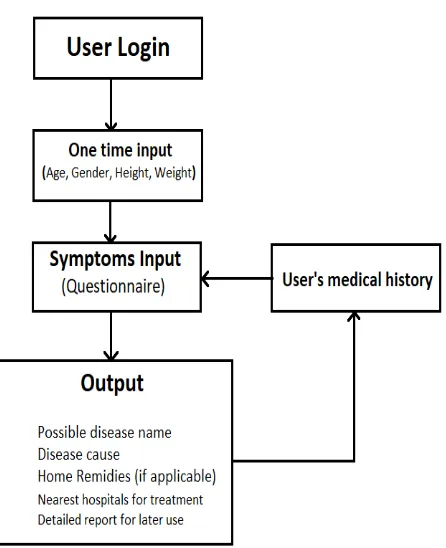
Figure 2.1. Flowchart of proposed system
III. IMPLEMENTATION
Based on our study, Naïve Bayes algorithm has proven to be the best for disease prediction systems.
Bayes theorem provides a way of calculating posterior probability P(c|x) from P(c), P(x) and P(x|c):
𝑃(𝑐|𝑥) = 𝑃(𝑥|𝑐)𝑃(𝑐) 𝑃(𝑥)
• P(c | X) =P(x1|c) * ……* P(xn | c)*P(c)
designed as shown below:
Figure 3.1 Login Screen
To signup, the patient has to choose a username, password and enter his age, weight, gender and height.
Figure 3.2 Signup Screen
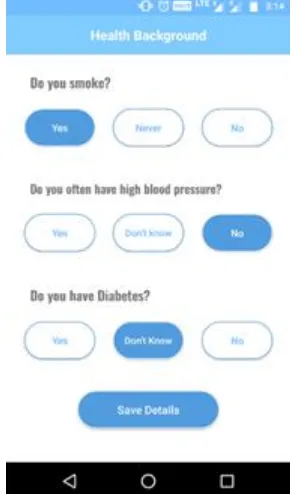
A general health background of patient is also necessary for predicting the right disease. So, during the signup process, the patient has to answer some questions related to his health background:
Figure 3.3 Health Background Screen
Figure 3.4 Home screen
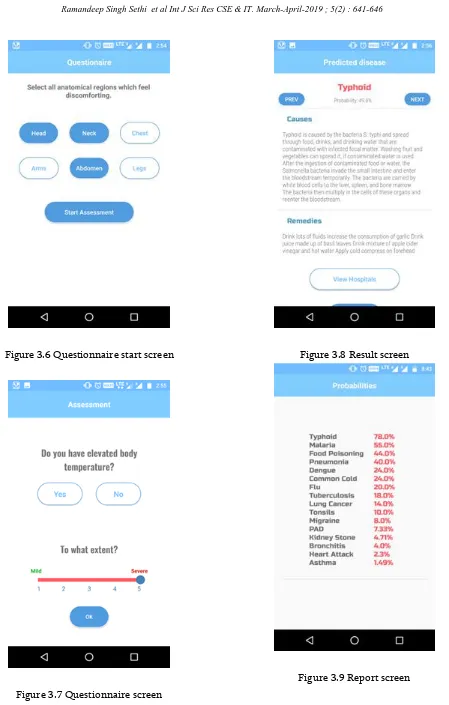
Figure 3.6 Questionnaire start screen
Figure 3.7 Questionnaire screen
Figure 3.8 Result screen
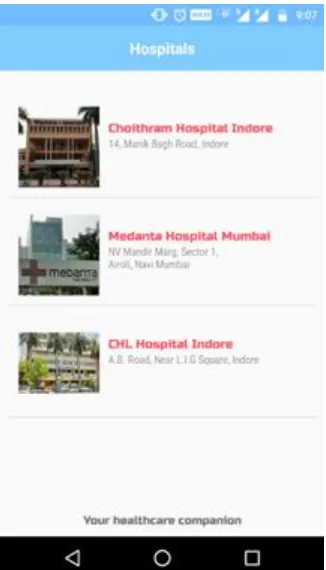
Figure 3.10 Nearby hospitals screen
IV. RESULT ANALYSIS
The app was tested with 200 patients. Patients had to start symptom assessment, record the results of app and visit a medical practitioner to know the actual disease. These details were submitted by them in a survey (Google Form). The accuracy of present healthcare system (ADA) is 34% when top 5 diseases predicted are taken into consideration. Our system is accurate 42% of the times that is, the correct disease (top 3 predictions) was predicted in 84 patients out of 200.
Figure 4.1 Result analysis
V. CONCLUSION
Here we have implemented an improved approach for generalized disease prediction system based on symptoms by using Naïve Bayes algorithm. Our which contains list of diseases with their probability and list of nearby hospitals. The report contains the causes & remedies of the disease with maximum probability. User can also update his personal information (Age, Weight, Height, and Password). It is our opinion that research in healthcare is an exciting area for many years to come and will keep many scientists and engineers busy.
VI. FUTURE WORK
Data Classification with Naive Bayes Approach” [4]. Purvashi Mahajan, Abhishek Sharma “Role of K
-Means Algorithm in Disease Prediction”
[5]. K.Rajalakshmi, Dr.S.S.Dhenakaran and N.Roobini “Comparative Analysis of K-Means Algorithm in Disease Prediction”
[6]. Shalet K.S, V.Sabarinathan, V.Sugumaran, V.J. Sarath Kumar “Diagnosis of Heart Disease Using Decision Tree and SVM Classifier”
[7]. T.F. Michael Raj and S. Prasanna “Implementation of ML Using Naīve Bayes Algorithm for Identifying Disease-Treatment Relation in Bio-Science Text”
[8]. Kazmierska J, Malicki J. “Application of the Naïve Bayesian Classifier to optimize treatment decisions”
[9]. Bairstow PJ, Mendelson R, Nguyen L. “Reducing inappropriate diagnostic practice through education and decision support”
Cite this article as :
Ramandeep Singh Sethi, Aniket Thumar, Vaibhav Jain, Sachin Chavan, "Disease Prediction Application based on Symptoms", International Journal of Scientific Research in Computer Science, Engineering and Information Technology (IJSRCSEIT), ISSN : 2456-3307, Volume 5 Issue 2, pp. 641-646, March-April 2019. Available at doi :