University of South Carolina
Scholar Commons
Theses and Dissertations
2017
Improved Simultaneous Estimation of Location
and System Reliability via Shrinkage Ideas
Beidi Qiang
University of South Carolina
Follow this and additional works at:https://scholarcommons.sc.edu/etd Part of theStatistics and Probability Commons
This Open Access Dissertation is brought to you by Scholar Commons. It has been accepted for inclusion in Theses and Dissertations by an authorized administrator of Scholar Commons. For more information, please [email protected].
Recommended Citation
Improved Simultaneous Estimation of Location and System Reliability Via Shrinkage Ideas
by
Beidi Qiang
Bachelor of Science Denison University, 2012
Submitted in Partial Fulfillment of the Requirements
for the Degree of Doctor of Philosophy in
Statistics
College of Arts and Sciences
University of South Carolina
2017
Accepted by:
Edsel Pena, Major Professor
Lianming Wang, Committee Member
Paramita Chakraborty, Committee Member
Gabriel Terejanu, Committee Member
Acknowledgments
I acknowledge NIH Grant P30GM103336-01A1 and NIH R01CA154731. I would like
to show my gratitude to Professor J. Lynch, and graduate students P. Liu, S. Shen,
Abstract
In decision theory, when several parameters need to be estimated simultaneously,
many standard estimators can be improved, in terms of a combined loss function.
The problem of finding such estimators has been well studied in the literature, but
mostly under parametric settings, which is inappropriate for heavy-tailed
distribu-tions. In the first part of this dissertation, a robust simultaneous estimator of
loca-tion is proposed using the shrinkage idea. A nonparametric Bayesian estimator is
also discussed as an alternative. The proposed estimators do not assume a specific
parametric distribution and they do not require the existence of finite moments. The
performance of proposed estimators are examined in simulation studies and financial
data applications. In the second part, we extend the idea of simultaneous estimation
in the context of estimating system reliability when component data are observed.
We propose an improved estimator of system reliability by using shrinkage
estima-tors for each of the component reliabilities and then utilize the structure function to
combine these estimators to obtain the system reliability estimator. The approach
is general since the shrinkage is not on the estimated parameters of component
reli-ability functions, but is instead on the estimated component hazard functions, and
is therefore extendable to the nonparametric setting. The details in nonparametric
setting are discussed in a later chapter. Simulation results are presented to examine
Table of Contents
Acknowledgments . . . ii
Abstract . . . iii
List of Tables . . . vi
List of Figures . . . viii
Chapter 1 Introduction . . . 1
Chapter 2 Some Review and Motivation . . . 3
2.1 The Decision Theory Framework . . . 3
2.2 On Simultaneous and Shrinkage Estimators . . . 4
Chapter 3 Robust Simultaneous Estimator of Location . . . 8
3.1 Idea and Motivation of Estimator . . . 8
3.2 Evaluating the Estimators . . . 9
3.3 Estimating the Shrinkage Coefficientc∗ . . . 10
3.4 The Nonparametric Empirical Bayesian Approach . . . 11
3.5 Constructing Confidence Intervals . . . 14
3.6 Example and Numerical Illustration . . . 15
3.8 Application to Stock Return Data . . . 17
3.9 Summary . . . 20
Chapter 4 Improved Estimation of System Reliability Through Shrinkage Idea in Parametric Settings . . . 22
4.1 Reliability Concepts . . . 22
4.2 Statistical Model and Data Structure . . . 28
4.3 Improved Estimation Through Shrinkage Idea . . . 30
4.4 Evaluating the Estimators . . . 32
4.5 Estimating the Optimalc∗ . . . 33
4.6 Examples and Numerical Illustration . . . 37
4.7 Simulated Comparisons of the Estimators . . . 37
4.8 Summary . . . 40
Chapter 5 Improved Estimation of System Reliability Through Shrinkage Idea in Nonparametric Settings. . . 42
5.1 The Nonparametric Model and Data Structure . . . 42
5.2 Improved Estimation in Nonparametric Setting . . . 43
5.3 Optimal c∗ . . . 44
5.4 Examples and Numerical Illustration . . . 45
5.5 Simulated Comparisons of the Estimators . . . 47
5.6 Summary . . . 48
Chapter 6 Conclusions and Future Research . . . 49
List of Tables
Table 3.1 Simulated Estimators Under Normal Distributions. k=3 and
n=5. Confidence intervals are indicated in parentheses. . . 15
Table 3.2 Simulated Estimators Under Laplace Distributions. k=3 and
n=5. Confidence intervals are indicated in parentheses. . . 15
Table 3.3 Simulated MSE of Estimators Under Different Distributions. These are based on 1000 simulation replications, k=10 and n=15.
Standard errors are indicated in parentheses. . . 17
Table 3.4 Relative Efficiency (in %) of the Estimators Under Different Dis-tributions. The relative efficiency is calculated with respect to
the sample median. . . 17
Table 3.5 Daily Stock Return of AAPL, AXP, BA, CAT and CSCO for
the First 10 Consecutive Trading Days Starting from January 3rd. 19
Table 3.6 Prediction MSEs of Different Location Estimators Using Daily Dow Jones Stock Return Data. Standard errors are indicated in
parentheses. . . 20
Table 4.1 Average Losses of the Estimators in Series and Parallel Systems under Exponential Lifetime Distribution. These are based on 1000 simulation replications. The systems had 10 components, and the sample size for each replication was 10. Also indicated
are the average values of the estimated shrinkage coefficientc. . . . 39
Table 4.2 Average Losses of the Estimators in Series and Parallel Systems under Weibull Lifetime Distribution. These are based on 1000 simulation replications. The systems had 10 components, and the sample size for each replication was 10. Also indicated are
Table 5.1 Average Losses of the Nonparametric Estimators in Series and Parallel Systems under Exponential Lifetime Distribution. These are based on 1000 simulation replications. The systems had 5 components, and the sample size for each replication was 15. Also indicated are the average values of the estimated shrinkage
List of Figures
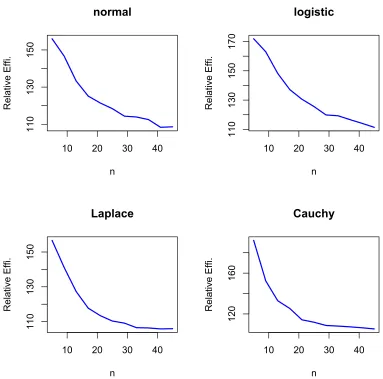
Figure 3.1 The Effect of Shrinkage v.s. Sample Size. Simulation based on 1000 Replications, p=10. The relative efficiency is calculated
with respect to the sample median. . . 18
Figure 3.2 Histogram and QQ plot of Apple Stock Returns for 2683 Con-secutive Business Days, from January 2005 to August, 2015.
The returns seem to follow a heavy-tailed distribution. . . 20
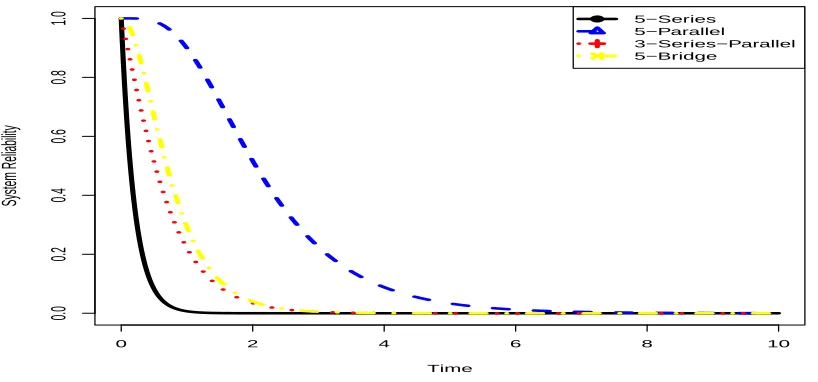
Figure 4.1 System reliability functions for the series, parallel, series-parallel, and bridge systems when the components have common unit ex-ponential lifetimes and there are 5 components in the series and
parallel systems. . . 26
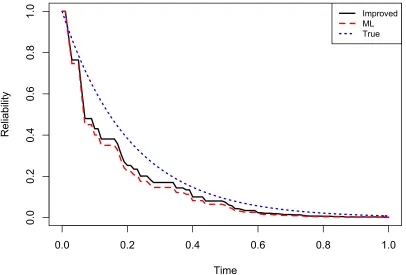
Figure 4.2 Estimated and True System Reliability Functions Over Time for a Series System with 10 components. The estimators are the ML based on component data and the improved estimator
based on a sample of size 10 systems. . . 38
Figure 4.3 Estimated and True System Reliability Functions Over Time for a Parallel System with 10 components. The estimators are the ML based on component data and the improved estimator
based on a sample of size 10. . . 39
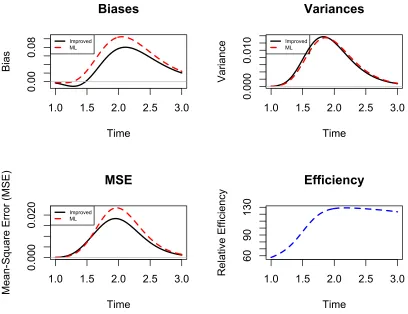
Figure 4.4 Comparing Performances of the Component-Data Based Esti-mators at Different Values of t for a 10-Component Parallel System. 1000 Replications we used, with each replication
hav-ing a sample size of 10. . . 41
Figure 5.1 Estimated and True System Reliability Functions Over Time for a Series System with 5 components. The estimators are the nonparametric ML based on component data and the improved
Figure 5.2 Estimated and True System Reliability Functions Over Time for a Parallel System with 5 components. The estimators are the nonparametric ML based on component data and the improved
Chapter 1
Introduction
In decision theory, when several parameters need to be estimated simultaneously,
many standard estimators can be improved under a combined loss function, by a
combined estimator. The improvement of using combined information is observed,
even when using independent data to estimate those parameters. One example that
uses the idea of simultaneous estimation explicitly is the JamStein shrinkage
es-timator (13). As a biased eses-timator of the mean of Gaussian random vectors, the
James-Stein estimator dominates the standard least squares estimators in terms of
total mean squared error (MSE), when three or more parameters are estimated
simul-taneously. A lot of research has been done focusing on shrinkage estimators and the
problem of simultaneous estimators which dominate the usual maximum likelihood
estimators (MLEs) has been well studied.
One extension presented in this work is the idea of developing a more robust
shrinkage estimator under nonparametric assumptions. In the literature, most
ex-isting James-Stein type shrinkage estimators are developed under the assumption of
multivariate normal distribution. Some studies relaxed the normal assumption, but
still require the existence of finite moments. However, these assumptions may not
always be realistic when heavy-tailed data is observed. To extend the idea, a more
robust estimator based on the sample median is proposed, which does not assume
a specific parametric distribution nor requires the existence of finite moments. An
alternative estimator is also developed using nonparametric Bayesian approach. The
sim-ulation studies and empirical data analysis. The proposed estimator is expected to
outperform the usual ML estimates in heavy-tailed distributions especially in "large
p, smalln" settings.
Another natural extension is to apply the idea of simultaneous estimation to
failure time analysis, notably survival analysis and reliability, especially estimating
the reliability of a coherent system using lifetime data from its components. When
component-level data are available, the traditional way of estimating system reliability
is to find component level MLEs and then utilize these MLEs according to the system
structure to obtain an estimator of the system reliability. We propose an improved
estimator of system reliability under an invariant global loss function. Shrinkage type
estimators for each of the components reliability functions are obtained first and then
these estimators are combined according to the system structure function to obtain an
improved estimator of the system reliability. The approach is general since the
shrink-age is not on the estimated component reliability function parameters but is instead
on the estimated components hazard functions, and are therefore extendable to the
setting where the components reliability functions are specified non-parametrically.
The performances of different estimators will be compared though simulation studies.
The proposed estimator is expected to perform better under the given loss function,
as compared to the MLEs.
The rest of the dissertation is organized as follow. In Chapter 2 , the James-Stein
estimator and its extensions and applications are reviewed. The ideas and results
of extending the simultaneous estimation idea to nonparametric setting is discussed
in Chapter 3. In Chapters 4 and 5 , the shrinkage estimation method is applied to
the estimation of system reliability. Some properties of the estimator and simulation
analysis are presented. Ideas for future studies, improvements, and extensions are
Chapter 2
Some Review and Motivation
2.1 The Decision Theory Framework
A decision problem has the following elements:
(Θ,A,X,F ={F(·|θ),θ ∈Θ}, L,D)
Here Θ is the parameter space containing the possible values of some parameters θ,
which could be finite- or infinite-dimensional; A is the action space consisting of all possible actions that the decision maker could take;L: Θ×A → <is the loss function, with L(θ,a) denoting the loss incurred by choosing action a when the parameter is
θ. The observable data X takes values in the sample space X, with X, given θ, having distribution F(·|θ), which belongs to the family of distribution functions F. Non-randomized decision functions are (measurable) mappings δ : X → A, and the totality of such decision functions is the decision function space D. To assess the quality of a decision function δ∈ D, we utilize the risk function given by
R(θ, δ) = E[L(θ, δ(X)|θ)],
which is the expected loss incurred by using decision function δ when the parameter
is θ. Good decision functions are those with small risks whatever the value of θ.
In particular, a decision function δ1 is said to dominate a decision function δ2 if
for all θ ∈ Θ, R(θ, δ1) ≤ R(θ, δ2) with strict inequality for some θ ∈ Θ. In such a case the decision function δ2 is inadmissible. The statistical inference problem
of parameter point estimation falls into this decision-theoretic framework with the
2.2 On Simultaneous and Shrinkage Estimators
Simultaneous Estimation
This decision-theoretic framework carries over to simultaneous decision-making, in
particular, simultaneous estimation. Consider, for instance, the situation whereθ =
(µ1, µ2, . . . , µK) ∈ Θ = <K, the action space is A = <K, and the data observable is X = (X1, X2, . . . , XK) ∈ X = <K where the Xj’s are a normal distribution with meanµj and varianceσ2, assumed known. Xj’s are assumed to be independent, given
µj’s. For the simultaneous estimation problem, we could use the loss function given
by
L(θ,a) =||θ−a||2 = K X
i=1
(µi−ai)2,(θ,a)∈Θ× A.
This loss function is referred to as quadratic loss function. The maximum likelihood
(ML) estimator of θ is δM L(X) = X, whose risk function is given by
R(θ, δM L) =E h
||θ−X||2|θi
=Kσ2.
Incidentally, this ML estimator is also the least-squares (LS) estimator of θ. When
K = 1 or K = 2, δM L is the best (risk-wise) estimator of θ.
James-Stein Shrinkage Estimation
James and Stein (13) demonstrated that there is a better estimator ofθthanδM L(X) =
X, when 3 or more parameters are estimated simultaneously. An estimator that
dom-inates the ML estimator is their so-called shrinkage estimator of θ, given by
δJ S(X) = θbJ S = "
1− (K −2)σ
2
kXk2 #
X.
More generally, ifX= (X1, . . .Xn) are IID 1×pmultivariate normal vectors with mean vectorθ, and common covariance matrixσ2I
K, then the James-Stein estimator of θ is given by
δJ S(X) = θbJ S = "
1− (K −2)σ
2
nkXk2 #
where X= 1 n
Pn
j=1Xj denotes the vector of sample means.
The James-Stein shrinkage estimator is one which utilizes the combined data for
estimating each component parameter, even though the component variables are
in-dependent, to improve the simultaneous estimation of the components ofθ. It shows
that optimizing (i.e., minimizing) a global loss is not the same as optimizing
indi-vidually the loss of each component estimator. In essence, there is an advantage in
the borrowing of information from each of the component data, demonstrating that
when dealing with a combined or global loss function, it may be beneficial to borrow
information in order to improve the estimation process. Observe that the James-Stein
type of shrinkage estimator is of the form
δc(X) = ˆθc=cX,
for some c >0, which in this case is data-dependent.
An Empirical Bayes Approach
The James-Stein Shrinkage estimator can be developed using the empirical Bayes
method (9). Suppose X = (X1, . . .Xn) are IID 1×p multivariate normal vectors with mean vector θ, and common covariance matrix σ2IK. If we place a N(0, τ2IK)
prior on the vector θ, the posterior distribution ofθ is
θ|X1, . . .Xn ∼N
τ2
τ2+σ2/nX,
1
τ2 +
n σ2
−1!
.
The Bayes estimator of θ is the posterior mean, which is given by
ˆ
θBayes =
τ2
τ2+σ2/nX. (2.1)
The hyper parameter τ2 is then estimated from the data, which makes the
free-dom. When K ≥3,
E
"
(σ2/n+τ2)
||X||2 #
= 1
K−2, and τ2 is estimated by
ˆ
τ2 = ||X|| 2
K−2 −
σ2
n .
The James-Stein Estimator is then recovered when replacingτ2 by ˆτ2 in (2.1).
Motivation
In the literature, some generalizations of James-Stein type shrinkage estimators were
developed, but most existing methods use the assumption of normal distribution.
However, in "large p, small n" problems, the sample covariance matrix is usually
singular, and thus traditional shrinkage methods cannot be applied. Wang et al.
(28) proposed a shrinkage estimator for population mean under quadratic loss with
unknown covariance matrices. Although no specific distribution is assumed, their
non-parametric shrinkage estimator is based on the sample mean and does require the
distribution to have finite moments. This assumption can be unrealistic when the data
follow some heavy-tailed distribution, such as the Cauchy. Therefore, more robust
shrinkage estimators based on nonparametric assumptions are developed through the
shrinkage idea and the Bayesian approach in Chapter 2.
The application of shrinkage estimation in survival analysis has also been partly
addressed in the literature. In (27) three versions of shrinkage estimators under
expo-nential lifetimes were examined. Later, in (24) shrinkage estimators under the LINEX
loss function in the situation with exponential lifetime censored data were presented.
The shrinkage estimation of the reliability function for other lifetime distributions
were also studied in (6) and (23). The extension to the estimation of the system
reliability has also been discussed under certain system structures and lifetime
distri-butions, see, for instance, (21; 22). Instead of developing estimators under a specific
estimation is extended to general system structures and lifetime models. Improved
estimators of component reliability functions are developed under an invariant global
loss function. The improved estimators are developed under a general framework,
Chapter 3
Robust Simultaneous Estimator of Location
3.1 Idea and Motivation of Estimator
To relax the normality assumption and provide a more robust estimator in
simulta-neous estimation, we extend the shrinkage idea into nonparametric settings, where
heavy-tailed distributions are allowed. The nonparametric shrinkage estimator is
then applied to stock return data, since such data is believed to have heavy-tailed
properties based on empirical evidence.
Consider i.i.d 1×K vectors X1, . . .Xn that satisfy
Xi =µ+i,Xj ∈ <K,i = (i1,· · · , iK),
where ij’s are identically and independently distributed and follow some symmetric
distribution Fj that is centered at 0, for i = 1, . . . , n, j = 1, . . . , K. Fj’s are
un-known. Consider the simultaneous estimation problem of estimating of the location
parameters µj’s, with respect to the quadratic loss function
L(µ,µb) =||µb −µ|| 2,
where µ= (µ1, µ2, ..., µK).
A common nonparametric approach is to estimate the location parameters by the
sample medians. But using the idea of simultaneous estimation, some improvement
can be achieved, in terms of the combined MSE. Consider estimatingµj by a shrinkage
of the sample median, Xfj, i.e.
b
When sample size n is odd, Xfj ≡X(n+1
2 )j. The goal is to find the optimal c in terms
of the combined expected loss function. However, this optimal coefficient c∗ may
depend on the unknown parameters. Thus an estimator ofc∗ will be used in practice.
The James-Stein shrinkage estimator can be viewed as an empirical Bayes
esti-mator when putting a normal prior on the parameters µ. So we also seek a Bayes
approach to develop a robust shrinkage estimator. A Dirichlet process prior is used
given the nonparametric setting.
3.2 Evaluating the Estimators
To find the optimal amount of shrinkage, the risk or expected lossE[L(µb)] =E[||µb−
µ||2] is minimized with respect toc.
R(µ,µb(c)) = E[L(µ,µb(c))]
= K X
j=1
E[cXfj−µj]2
= c2
K X
j=1
var(Xfj) + (c−1)2||µ||2,
where var(Xfj) denotes the variance of the sample median in sample j. Thus the
optimal shrinkage coefficient cis given by
c∗ = 1−
PK
j=1var(Xfj)
||µ||2+PK
j=1var(Xfj)
<1.
The corresponding risk of ˆµ∗ is then
E(L(µ,µˆ∗)) = (c∗)2 p X
j=1
var(Xfj) + (1−c∗)2||µ||2.
Notice the sample median, Xfj, has an asymptotic normal distribution with mean θj
and variance [4nfj(θj)2]−1. Thus, var(Xfj) goes to 0 as sample size increases, and thus
the shrinkage coefficient c∗ converges to 1 when sample size converges to infinity, i.e.
3.3 Estimating the Shrinkage Coefficient c∗
In practice, in the expression ofc∗, the true location parameters and the variances of
the sample medians are unknown since theFj’s are unknown and need to be estimated
based on the observed data. In the nonparametric setting, the sample median of Xj
is used as a robust estimator of µj. Thus ||µ||2 is estimated by
||µ||2 ≈ f
X12+Xf22+· · ·+XfK2
To estimate the variance of the sample median nonparametrically, we adopt the
method proposed by Maritz and Jarrett (19). Consider the case when the sample
size is odd, i.e. n = 2m+ 1. Some modifications are needed when the sample size
is even, but follows the same idea. The moments of the sample median are given by
the following equation,
E[Xfk] =
(2m+ 1)! (m!)2
Z ∞
−∞
xk[F(x)(1−F(x))]mf(x)dx.
Substitute y=F(x) to get
E[Xfk] =
(2m+ 1)! (m!)2
Z 1
0
[F−1(y)]k[y(1−y)]mdy.
The inverse of the distribution function, F−1(x), can be estimated piece by piece by
the observed order statistics. Thus,
E[Xfk]≈ n X i=1 h X(i) ik Wi
where X(i) is the ith observed order statistics, and
Wi =
(2m+ 1)! (m!)2
Z i/n
(i−1)/n[y(1−y)] m
dy.
Combining the above results, the estimated variance of the sample median is then
given by
\
var(Xfj)≡Vj = n X i=1 h X(i)j i2
Wi−
hXn
i=1
X(i)jWi
i2
where X(i)j is the ith order statistic in sample j.
As proved by Maritz and Jarrett (19), Vj is a consistent estimator of var(Xfj)
when var(Xfj) is finite. However, E(Vj) may not exist when considering long-tailed
distribution, such as Cauchy. Under Cauchy distributions, the second-order moments
of the four extreme order statisticsX(1),X(2),X(n−1), andX(n)are not finite, and thus
the expectation of V does not exist. In order to obtain a finite E(V) it is necessary
to use Winsorized estimate which does not involve the four extreme order statistics.
Winsorized estimate is obtained by replacing the smallest l order statistics by the
(l+ 1)th order statistic and replace the largestlorder statistics by the (n−l)th order statistic.
Finally, the estimated c∗ is in the form
ˆ
c∗ = 1−
PK
j=1Vj
Pp
j=1Xfj2+Ppj=1Vj
<1.
3.4 The Nonparametric Empirical Bayesian Approach
Since the James-Stein shrinkage estimator can be developed through empirical Bayes
approach, we seek an analog in the nonparametric setting by assuming a Dirichlet
process prior on the distribution of Xj, j = 1,· · · , K. The definitions of Dirichlet distribution and Dirichlet process are given below and more details are provided in
(11).
Definition 3.1. Assume Z1,· · · , Zk are independent random variables, with Zj ∼
Gamma(αj,1). Let Yj =Zj/Pki=1Zi. Then (Y1,· · · , Yk) follows a Dirichlet distribu-tion with parameters (α1,· · · , αk), denoted by (Y1,· · · , Yk)∼ D(α1,· · · , αk).
Given the definition of a Dirichlet distribution, one can show that if (Y1,· · ·, Yk)∼
variable withP r(X =j|Y1,· · · , Yk) = Yj, then the distribution of (Y1,· · · , Yk)|X =j is also Dirichlet, with parameters (α1,· · · , αj+ 1,· · · , αk).
Definition 3.2. Letα be a nonnegative, finitely additive, finite measure on (X,A).
P is a Dirichlet Process on (X,A) with parameter α, if for all k = 1,2,· · · and for all measurable partitions (B1,· · · , Bk) of X,
(P(B1),· · · , P(Bk))∼ D(α(B1),· · · , α(Bk)).
The following theorem provides a way of updating prior beliefs in response to
observed data using Bayes’ rule.
Theorem 3.3. IfP is a Dirichlet Process on(X,A)with parameterαandX1,· · · , Xn
is a sample from P, then the posterior P|(X1,· · · , Xn) is a Dirichlet Process on (X,A) with parameter α+Pn
i=1δXi, where δXi(A) =I(Xi ∈A) (11).
Consider i.i.d 1×K vectors X1, . . . ,Xn that satisfy Xij ∼ Fj, j = 1,2,· · ·, k,
i = 1,2,· · · , n. We put i.i.d Dirichlet Process prior on Fj, i.e. Fj ∼ Dir(α). Then according to Theorem 3.3, the posterior Fj|(X1, . . . ,Xn), is a Dirichlet process with parameter α+Pn
i=1δXij. By definition of Dirichlet process, for a measurable set B,
(Fj(B), Fj(Bc))|(X1, . . . ,Xn) ∼ D(α(B) +Pni=1I(Xij ∈ B), α(Bc) +Pni=1I(Xij ∈
Bc)). Therefore, we obtain an estimate of ˆF
j(B), given by
ˆ
Fj(B) = E[Fj(B)|X1, . . . ,Xn] = α(B) +
Pn
i=1I(Xij ∈B)
α(<) +n
= α(<)
α(<) +n · α(B)
α(<) +
n α(<) +n ·
1
n
n X
i=1
I(Xij ∈B)
data. To estimate α empirically, observe that
E[I(Xij ≤t)] = E{E[I(Xij ≤t)|Fj]} = E(Fj(t))
= α((−∞, t])/α(<).
As mentioned in (11), α(<) is a measure of faith in the prior and if α(<) is small compared to sample size, more weight is given to the observations. Therefore, we
take α(<) =√nk as a reasonable choice suggested in (25). Then α((−∞, t]) can be estimated empirically by
1 √ nk k X j=1 n X i=1
I(Xij ≤t). The empirical Bayes estimator ofFj is then given by
ˆ
Fj(t) =
√
nk
√
nk+n ·
1 nk k X j=1 n X i=1
I(Xij ≤t) +
n
√
nk+n ·
1
n
n X
i=1
I(Xij ≤t).
Notice that ˆFj(t) is a weighted sum of the empirical distribution based on the data
from sample j and the empirical distribution based on the data from all samples.
Thus, ˆFj(t) can be viewed as a shrinkage of the empirical distribution of sample j
towards the average empirical distribution of all samples.
The Nonparametric Bayesian Shrinkage Estimator (NBSE) of the location
param-eter is then the median of the estimated distribution, which can be found by solving
the following equation for t.
ˆ
Fj(t) =
√
nk
√
nk+n ·
1 nk k X j=1 n X i=1
I(Xij ≤t) +
n
√
nk+n ·
1
n
n X
i=1
I(Xij ≤t) = 1 2.
Since the ˆFj(t) is a step function with discontinuities at theXij’s, numerical solution
will be used but exact equality may not be obtained. We taket∗ = arg inf[Fj(t)>0.5]
3.5 Constructing Confidence Intervals
In this section, we present one approach to constructing corresponding confidence
intervals. Given the nonparametric setting and the form of the estimators, a bootstrap
approach is applicable. The steps are as follows.
1. At iteration m, randomly resample n times from the index set {1,2,· · ·n}
with replacement, where n is the size of the original data. This gives indices
Im1,· · · , Imn.
2. From each original sample j, j = 1,· · · , K, take Xmj = (XIm1j,· · · , XImnj).
TheXmj’s forms a new data with sample size equals to the original sample size.
3. Calculate the estimator of location using methods from the previous sections
based on the bootstrap data. This gives an estimate ˆµm = (ˆµm1,· · · ,µˆmK) of the location vector.
4. Repeat step 1 to 3 M times, save ˆµ1,· · · ,µˆM.
5. At a confidence level of 100(1−α)%, the lower limit of the confidence interval for µj, j = 1,· · ·, K will be the 100(α/2)% percentile of the M estimates ˆ
µ1j,· · · ,µˆM j, and the upper limit will be the 100(1−α/2)% percentile of the M estimates.
We note that the resulting confidence intervals are with respect to the individual
parameters. However, simultaneous confidence intervals may be more appropriate in
the situation since we are estimating several location parameters simultaneously. The
simultaneous confidence intervals may be obtained using the Bonferroni Method or
3.6 Example and Numerical Illustration
To illustrate the performance of the estimators, we provide some numerical examples
under different distributions. We generated data based on normal and Laplace
dis-tributions. Under each distribution, a sample of n = 5 and K = 3 was generated.
Tables 3.1 and 3.2 present the estimates and confidence intervals for one replication,
along with the true location parameters.
Table 3.1: Simulated Estimators Under Normal Distributions. k=3 and n=5. Confi-dence intervals are indicated in parentheses.
True Parameter Sample Mean Shrinkage Median Np Bayesian
0.5 0.220 0.548 0.592
(-0.435,0.876) (-0.846,0.837) (-0.145,0.845)
1.0 0.586 0.781 0.844
(-0.066,1.240) (-0.242,1.260) (-0.556, 1.253)
1.5 1.235 1.279 1.253
(0.301,2.169) (-0.226,2.052) (-0.555, 2.040)
Table 3.2: Simulated Estimators Under Laplace Distributions. k=3 and n=5. Confi-dence intervals are indicated in parentheses.
True Paramete Sample Mean Shrinkage Median Np Bayesian
0.5 -0.028 0.464 1.101
(-1.385,1.328) ( -1.970,1.289) ( -1.033,1.296)
1.0 0.993 1.003 1.135
(0.124,1.863) (-0.374,1.260) (-0.380, 2.184)
1.5 2.689 2.398 2.358
(1.767,3.611) (0.928,3.618) ( 1.101, 3.618)
Since the results are only based on one replication, we cannot make definitive
com-parisons of the performance of the different estimators. However, from the tables, one
could see that the shrinkage estimates and their confidence intervals estimate the true
next section we present the results of simulation studies to compare the performance
of the different estimators in terms of average squared errors.
3.7 Simulated Comparisons of the Estimators
The performance of our method was examined when the true distribution is Normal,
Logistic, Laplace, and Cauchy. At each iteration, different true location parameters
were generated randomly from a standard uniform. The mean squared errors (MSEs)
are presented in Table 3.3, when K = 10, n= 11. We note that the presented MSEs
are not an estimator of the risk, since the data were generated under different true
parameters in each iteration.
To examine the effect of shrinkage, the relative efficiency was calculated with
respect to the sample median via, for example,
RelEff = MSE(Shrinkage median)
MSE(Sample median) ×100%.
The relative efficiency presents the ratio of efficiencies of the two methods, where the
efficiency here represents the performance of an estimator in terms of the estimated
risk. The relative efficiencies are presented in Table 3.4. Based on the simulation
results, the shrinkage median estimator dominates the sample median in all cases, in
terms of mean squared error. The shrinkage median estimator is also the best when
error distribution is Laplace, and the nonparametric Bayes estimator is the best under
Logistic and Cauchy distribution. The improvement of using robust estimators over
JS estimator is most significant under the Cauchy distribution.
As mentioned earlier, the shrinkage coefficientcgoes to 1 as sample size increases.
Therefore, the improvement of using shrinkage is more significant in "large p, small
n" cases. Figure 3.1 captures the effect of shrinkage as sample size increases, under
Table 3.3: Simulated MSE of Estimators Under Different Distributions. These are based on 1000 simulation replications, k=10 and n=15. Standard errors are indicated in parentheses.
Distribution Sample JS Sample Shrinkage Np Bayesian c
Mean Median Median
Normal 0.639 0.566 0.987 0.802 0.900 0.776
(0.009) (0.008) (0.014) (0.011) (0.011) (0.0021)
Logistic 2.165 1.801 2.695 1.624 1.592 0.643
(0.030) (0.027) (0.039) (0.022) (0.021) (0.0032)
Laplace 1.383 1.102 1.006 0.756 0.761 0.722
(0.020) (0.017) (0.017) (0.012) (0.010) (0.0025)
Cauchy 2.532e+04 2.532e+04 2.099 1.300 1.262 0.612
(8.89e+03) (8.89e+03) (0.039) (0.020) (0.018) (0.0035)
Table 3.4: Relative Efficiency (in %) of the Estimators Under Different Distributions. The relative efficiency is calculated with respect to the sample median.
Distribution Sample JS Sample Shrinkage Np Bayesian
Mean Median Median
Normal 154.46 174.38 100 123.07 109.67
Logistic 124.48 149.64 100 165.95 169.28
Laplace 72.74 91.29 100 133.07 132.19
Cauchy 0.0079 0.0079 100 161.46 166.32
3.8 Application to Stock Return Data
In this section, we apply our non-parametric shrinkage method to stock return data.
Daily trading prices of 29 Dow Jones companies (we excluded Visa Inc. since its
initial public offering was in 2008) were collected in 2683 consecutive business days,
from January 3rd, 2005 to August 28th, 2015. In the context of risk management
and portfolio allocation, it is usually important to first understand the distribution
of the returns of financial assets. Thus, the variable of interest here is the daily stock
return, which is calculated as the percentage increase in the closing price from the
pervious day’s closing price, i.e. the return of day i is calculated by
returni =
Closingi−Closingi−1 Closingi−1
10 20 30 40 110 130 150 170 logistic n R el at ive Ef fi.
10 20 30 40
110 130 150 normal n R el at ive Ef fi.
10 20 30 40
110 130 150 Laplace n R el at ive Ef fi.
10 20 30 40
120 160 Cauchy n R el at ive Ef fi.
Figure 3.1 The Effect of Shrinkage v.s. Sample Size. Simulation based on 1000 Replications, p=10. The relative efficiency is calculated with respect to the sample median.
A portion of the data is presented in Table 3.5.
The goal is to make predictions about future returns of all stocks simultaneously
based on the return data from a previous time window. Many financial models are
developed under the assumption of normal returns. Therefore, an intuitive way is
to look at the moving averages for each stock individually. Using the idea presented
Table 3.5: Daily Stock Return of AAPL, AXP, BA, CAT and CSCO for the First 10 Consecutive Trading Days Starting from January 3rd.
AAPL AXP BA CAT CSCO
1.02705806 -1.5024064 -1.9423217 -1.1044527 -3.93374692 0.87582135 -0.9281133 1.6606681 -1.9144796 0.05388367 0.07748127 -0.5143170 -0.6494827 1.4747350 1.50780962 7.28131155 -0.7385547 -0.3367623 -0.2137263 -0.68966341 -0.41888197 0.2046050 1.3317404 -0.9209692 0.00000000 -6.38041456 -0.9281558 -0.3138500 -1.3834832 -0.42734912
1.39394534 -0.2248587 2.2038544 1.2384977 1.55579974 6.63000674 -0.6948341 -2.5221342 0.5304718 -0.79239203 0.57321328 -0.3025500 0.5530293 0.8938217 0.53247671 0.64098695 0.8156360 1.9053231 -0.8040340 -0.74152610
accordingly using the James-Stein estimator. Moreover, empirical evidences have
led to attention on the tail behavior of stock returns and it is now considered that
the returns possess heavy-tailed distributions. The Q-Q plot of the stock returns
of AAPL is presented in Figure 3.2 as an example. In heavy tailed distributions,
we expect the nonparametric shrinkage method to work better than the James-Stein
shrinkage estimator. To make prediction about stock returns on the next business
day, returns from previous 5 or 15 trading days were used as observed data. Table
3.6 presents the prediction result using different methods. The squared errors were
calculated combining all 29 stocks, and the mean and standard deviations of squared
errors were calculated, for the different methods. The shrinkage estimators perform
better in general, and the shrinkage median estimator has the smallest prediction
mean square error, followed by the nonparametric Bayes estimator. Although the
improvement is only around 1% to 2% compared with the James-Stein shrinkage
estimator, it might still be of great financial interest, given the heavy cash flow in the
Histogram of AAPL AAPL D en si ty
-10 -5 0 5 10
0.00
0.05
0.10
0.15
0.20
-3 -2 -1 0 1 2 3
-1 5 -1 0 -5 0 5 10 15
Normal Q-Q Plot
Theoretical Quantiles Sa mp le Q ua nt ile s
Figure 3.2 Histogram and QQ plot of Apple Stock Returns for 2683 Consecutive Business Days, from January 2005 to August, 2015. The returns seem to follow a heavy-tailed distribution.
Table 3.6: Prediction MSEs of Different Location Estimators Using Daily Dow Jones Stock Return Data. Standard errors are indicated in parentheses.
Lag(days) Sample JS Sample Shrinkage Np Bayesian
Mean Median Median
5 3.795 3.561 3.982 3.486 3.488
(0.208) (0.206) (0.211) (0.193) (0.198)
15 3.334 3.255 3.430 3.225 3.271
(0.170) (0.169) (0.177) (0.166) (0.173)
3.9 Summary
In this chapter, we constructed and compared the nonparametric estimators of
loca-tion using the idea of shrinkage. Confidence intervals of the localoca-tion parameter were
also provided using bootstrap approach. Based on simulation results, the shrinkage
estimator dominates the standard ones in all cases. The shrinkage median estimator
and the nonparametric Bayesian estimator are robust under unknown distributions
as compared to the James-Stein estimator. The shrinkage effect is more significant
other. We did see improvements of using the shrinkage median in the stock return
application. Though the improvements are small, it might still be of economic
inter-est.
The ultimate goal of predicting asset returns is to allocate assets in a way that
maximize the expected portfolio return as well as control the risk (20). Since the
shrinkage method provides more accurate predictions of asset returns, it might be
useful to incorporate the predictions in the portfolio allocation to achieve a higher
portfolio return.
The efficient-market hypothesis states that asset prices fully reflect all available
in-formation, which makes it impossible for investors to outperform the market through
market timing or portfolio selection. However, the application in section 3.8 shows
different prediction results when different prediction methods were used. The
shrink-age methods performs better in prediction when past stock return data are used,
which indicates the possibility of exploiting information from the past to get a better
Chapter 4
Improved Estimation of System Reliability
Through Shrinkage Idea in Parametric Settings
This portion of the dissertation will appear in Analytic Methods in Systems and
Software Testing, edited by Ruggeri, F., Kenett, R. and Faltin, F. W.
4.1 Reliability Concepts
Detailed discussions of concepts and ideas presented below are available in (3) and
(17). Consider a component with a lifetime, denoted byT, measured in some unit of
‘time’. Usually, the lifetime will be measured in literal time, but it need not always
be the case. Such a T is a non-negative random variable. The reliability function of
this component is defined via
R(t) = 1−F(t) =P r{T > t},
where F(·) is the corresponding distribution function. We assume that lifetime vari-ables are continuous. ForT, its probability density function (pdf) is
f(t) = dF(t)
dt =− dR(t)
dt .
Its hazard rate functionλ(t) is defined as
λ(t)≡lim dt↓0
1
dtP r{t≤T < t+dt|T ≥t}= f(t)
R(t),
which can be interpreted as the rate of failure of the component at timet, given that
cumulative hazard function is
Λ(t) =
Z t
0
λ(v)dv.
For a continuous lifetime T, we have the following relationships:
f(t) = λ(t) exp{−Λ(t)} and R(t) = exp{−Λ(t)} (4.1)
For a component with lifetimeT, its associated state process is{X(t) :t≥0}, where
X(t) = I{T > t} is a binary variable taking values of 1 or 0 depending on whether the component is still working (1) or failed (0) at time t. The function I(·) denotes indicator function.
Consider a system composed of K components, where this system is either in a
working (1) or failed (0) state. The functionality of a system is characterized by its
structure function
φ:{0,1}K → {0,1},
withφ(x1, x2,· · · , xK) denoting the state of the system when the states of the compo-nents are x= (x1, x2,· · · , xK)∈ {0,1}K. The vector xis called the component state vector. Such a system is said to be coherent if each component is relevant and the
structure function φ is nondecreasing in each argument. The ith component is
rele-vant if there exists a state vector x∈ {0,1}K such that φ(x,0
i) = 0< 1 = φ(x,1i), with the notation that (x, ai) = (x1, . . . , xi−1, ai, xi+1, . . . , xn). We will only consider
coherent systems in this chapter. Four simple examples of coherent systems are the
(i) series; (ii) parallel; (iii) three-component series-parallel; and (iv) five-component
bridge systems, whose respective structure functions are given by
φser(x1, . . . , xK) = QKi=1xi; (4.2)
φpar(x1, . . . , xK) = `Ki=1xi ≡1−QKi=1(1−xi); (4.3)
φserpar(x1, x2, x3) = x1(x2∨x3); (4.4)
The binary operator ‘∨’ means taking the maximum, i.e. a1 ∨a2 = max(a1, a2) = 1−(1−a1)(1−a2) for ai ∈ {0,1}, i= 1,2.
Let Xi, i= 1, . . . , K, be the state (at a given point in time) random variables for
the K components, and assume that they are independent. Denote bypi = Pr{Xi = 1}, i= 1, . . . , K, and let p = (p1, p2, . . . , pK) ∈[0,1]K be the components reliability vector (at a given point in time). Associated with the coherent structure function φ
is the reliability function defined via
hφ(p) = E[φ(X)] = Pr{φ(X) = 1}.
This reliability function provides the probability that the system is functioning, at
the given point in time, when the component reliabilities at this time arepi’s. For the
first three concrete systems given above, these reliability functions are, respectively:
hser(p1, . . . , pK) =QKi=1pi; (4.6)
hpar(p1, . . . , pK) = `Ki=1pi ≡1−QKi=1(1−pi); (4.7)
hserpar(p1, p2, p3) = p1[1−(1−p2)(1−p3)]; (4.8)
For the bridge structure, its reliability function at a given point in time, obtained
first by simplifying the structure function, is given by
hbr(p1, p2, p3, p4, p5) = (p1p4+p2p5+p2p3p4+p1p3p5+ 2p1p2p3p4p5)
−(p1p2p3p4+p2p3p4p5+p1p3p4p5+p1p2p3p5+p1p2p4p5). (4.9)
Of more interest, however, is viewing the system reliability function as a function of
time t. Denoting by S the lifetime of the system, we are interested in the function
RS(t) = Pr{S > t}
processes is{X(t) = (X1(t)· · · , XK(t)) :t≥0}. The system lifetime is then
S = sup{t≥0 :φ[X1(t),· · · , XK(t)] = 1}.
The component reliability functions are Ri(t) =E[Xi(t)] = Pr{Ti > t}, i= 1, . . . , K. If the component lifetimes are independent, then the system reliability function
be-comes
RS(t) =E[φ(X1(t), . . . , XK(t))] = hφ(R1(t), . . . , RK(t)). (4.10)
That is, under independent component lifetimes, to obtain the system reliability
function, we simply replace thepi’s in the reliability functionhφ(p1, . . . , pK) byRi(t)’s.
For the concrete examples of coherent systems given in (4.2–4.5), we therefore obtain:
Rser(t) =QKi=1Ri(t); (4.11)
Rpar(t) = 1−Qi=1K (1−Ri(t)); (4.12)
Rserpar(t) =R1(t)[1−(1−R2(t))(1−R3(t))]. (4.13)
For the bridge structure, in (4.9), we replace each pi by Ri(t) to obtain its system
reliability function. As an illustration of these system reliability functions for the
four examples of coherent systems, with Ri(t) = exp(−λt), i= 1, . . . , K, the system reliability functions are
Rser(t;λ, K) = exp(−Kλt);
Rpar(t;λ, K) = 1−[1−exp(−λt)]K;
Rserpar(t;λ) = exp(−λt)[1−(1−exp(−λt))2];
Rbr(t;λ) = 2 exp{−2λt}+ 2 exp{−3λt}+ 2 exp{−5λt} −5 exp{−4λt}.
When λ = 1 and K = 5, these system reliability functions are plotted in Figure 4.1.
An important concept in reliability is measuring the relative importance of each of
0 2 4 6 8 10
0.0
0.2
0.4
0.6
0.8
1.0
Time
System Reliability
● 5−Series 5−Parallel
3−Series−Parallel 5−Bridge
Figure 4.1 System reliability functions for the series, parallel, series-parallel, and bridge systems when the components have common unit exponential lifetimes and there are 5 components in the series and parallel systems.
importance (cf., (3)). We focus on the so-called reliability importance measure as
this will play an important role in the improved estimation of the system reliability.
The reliability importance of component j in aK-component system with reliability
function hφ(·) is
Iφ(j;p) =
∂hφ(p1,· · · , pj−1, pj, pj+1,· · · , pK)
∂pj
=hφ(p,1j)−hφ(p,0j). (4.14)
This measures how much system reliability changes when the reliability of component
j changes, with the reliabilities of the other components remaining the same. For a
coherent system, the reliability importance of a component is positive. As examples,
the reliability importance of the jth component in a series system is
Iser(j;p) =
hser(p)
pj
, j = 1, . . . , K,
showing that in a series system the weakest (least reliable) component is the most
reliability importance of thejth component is
Ipar(j;p) =
1−hpar(p) 1−pj
, j = 1, . . . , K,
indicating that the most reliable component is the most important component in a
parallel system. For the 3-component series-parallel system, the reliability importance
of the three components are
Iserpar(1;p) = 1−(1−p2)(1−p3);
Iserpar(2;p) =p1(1−p3);
Iserpar(3;p) =p1(1−p2).
Evaluated at p = (p, p, p), they become Iserpar(1;p) = p(2−p) and Iserpar(2;p) =
Iserpar(3;p) =p(1−p), which confirms the intuitive result that when the components are equally reliable, the component in series (component 1) is the most important
component. In general, however, component 1 is not always the most important.
For instance, if components 2 and 3 are equally reliable with reliability p2, then the
reliability importance of components 1, 2 and 3 become
Iserpar(1; (p1, p2, p2)) =p2(2−p2);
Iserpar(2; (p1, p2, p2)) =Iserpar(3; (p1, p2, p2)) = p1(1−p2).
In this case, component 2 (and 3) is more important than component 1 whenever
p1(1−p2)> p2(2−p2),
or equivalently,
p1 >
p2(2−p2) 1−p2
4.2 Statistical Model and Data Structure
We now consider the problem of estimating the system reliability function on the basis
of observed data from the system or its components. We suppose that the system has
K components and the observed data will be theK components time-to-failures, but
which could be right-censored by the system lifetime or the end of monitoring period.
We letTj denote the time-to-failure of componentj, and we assume that theTj’s are
independent of each other. We denote byRj(·;θj) the reliability function ofTj, where
θj ∈Θj with the parameter space Θj an open subset of <mj. Furthermore, note that
it is possible that there could be common parameters among the (θj, j = 1,2, . . . , K).
We also assume that the system structure function φ(·) is known, hence we also know the reliability function hφ(p). The system reliability function RS(·) can there-fore be expressed via
RS(t) = RS(t;θ1,θ2, . . . ,θK)
= hφ[R1(t;θ1), R2(t;θ2), . . . , RK(t;θK)]. (4.15)
Suppose there arenidentical systems, so that the observable component lifetimes are
{Tij :i= 1,2, . . . , n;j = 1,2, . . . , K}.
We assume that the Tij’s are independent, and that for each j, (Tij, i = 1,2, . . . , n)
are identically-distributed with reliability functionRj(·;θj). However, in practice, the exact values of the Tij’s are not all observable. Rather, they could be right-censored
by either the system life or by the monitoring period. The observable right-censored
data is
D ={(Zij, δij) :i= 1,2, . . . , n;j = 1,2, . . . , K} (4.16) where δij = 1 means that Tij =Zij, whereas δij = 0 means that Tij > Zij. We shall
bound of monitoring time for the ith system) and also the system life Si, and
Zij = min{Tij,min(Ci, Si)} and δij =I{Tij ≤min(Ci, Si)}.
On the basis of this observable dataD, it is of interest to estimate the system
reliabil-ity function given in (4.15). A simple estimator of the system reliabilreliabil-ity function is to
utilize only the observed system lifetimes, the Si’s. However, these system lives may
be right-censored by theCi’s, so that we may only be able to observeZi = min(Si, Ci)
and δi = I{Si ≤ Ci} for i = 1,2, . . . , n. If the component lifetime distributions are governed by just one parameter vector, then a parametric approach to estimating this
parameter may be possible, for example when all the component lifetime distributions
are all exponential with rate parameter λ. When component level data is available,
we could improve the estimation of system reliability by utilizing the information on
the internal structure. The lifetime of components are independent with reliability
function
Rj(t;θj) = 1−Fj(t;θj), j = 1· · ·K.
Classically, the estimator of the system reliability function,RS(t), is given by
ˆ
RS(t) = hφ[ ˆR1(t),· · · ,RˆK(t)],
where ˆRj(·) is the MLE of component reliability based on (Zj,δj) ={(Zij, δij) : i= 1,2, . . . , n}. In the parametric setting, ˆRj(t) =Rj(t,θˆj), where θˆj is the MLE ofθj. For component j, to find θˆj, denote the density associated with component j
by fj(t;θj), so the likelihood function based on the completely observed lifetimes of
component j is given by
L(θj,|t1j, . . . , tnj) = n Y
i=1
fj(tij|θj).
In the presence of right-censoring, the likelihood function based on the observed
censored data for component j becomes
Lj(θj; (Zj,δj)) = n Y
This likelihood could be maximized with respect to θj to obtain the ML estimate
ˆ
θj, which will be a function of the (zij, δij), i = 1,2, . . . , n. The resulting system
reliability function estimator is
˜
RS(t) =hφ[R1(t; ˆθ1), R2(t; ˆθ2), . . . , RK(t; ˆθK)]. (4.17)
From the theory of ML estimators for right-censored data (cf., (2)) under
para-metric models, as n → ∞, we have that
(ˆθ1, . . . ,θˆK)∼AN
(θ1, . . . ,θK), 1
nBD
h
I−11 , . . . ,I−1K i
(4.18)
where I−1j is the inverse of the Fisher information matrix for the jth component,
and BD means ‘block diagonal’. Assuming no common parameters among the K
components, by using the Delta-Method, we find that, asn → ∞, ˜
RS(t)∼AN
RS(t),
1
n
K X
j=1
Iφ(j;t) •
R
T
j (t)I −1 j
•
Rj (t)Iφ(j;t)
with
•
Rj (t) =
∂ ∂θj
R(t;θj).
In principle, this asymptotic variance could be estimated, though the difficulty may
depend on the structure function and/or distributional form of the Rj’s. Later we
will instead perform comparisons through numerical simulations.
4.3 Improved Estimation Through Shrinkage Idea
Suppose that the component level data are available. The estimation of the
param-eters, (θj, j = 1,2, . . . , K), becomes a problem of simultaneous estimation. In this
context, the problem is to estimate simultaneously the reliability of all components
in the system. Thus, we propose an improved estimator following the idea of James
and Stein(13). Consider estimators of component reliabilities of the form
˜
where ˆRj(t) = Ri(t,θˆj) is the ML estimator of Rj(t) based on (Zj,δj) under the
assumed parametric model. The system reliability estimator then becomes
ˆ
RS(t;c) = hφ[ ˜R1(t;c),· · · ,R˜K(t;c)]
= hφ{[R1(t;θˆ1)]c,· · · ,[RK(t;θˆK)]c}.
Notice that when c = 1, we obtain the standard ML estimator discussed in the
preceding subsection. If ˆΛj(t) denotes the estimator of the cumulative hazard function
for componentj, according to the relationship mentioned in (4.1), we have
[ ˆRj(t)]c = exp[−cΛˆj(t)].
Thus, we are essentially putting a shrinkage coefficient on the ML estimators of the
cumulative hazard functions. We remark at this point that it is not always the case
that the optimalc∗ is less than 1, so that in some cases, instead of shrinking, we are
expanding the estimators!
The goal is to find the optimal c in terms of a global risk function for the system
reliability estimator. If the optimal shrinkage coefficient isc∗, the improved estimator
of system reliability becomes
ˆ
RS(t;c∗) =hφ{[R1(t,θˆ1)]c
∗
,· · · ,[ ˆRK(t,θˆK)]c
∗
}.
However, the optimal c∗ may depend on the unknown parameters (θ1,· · ·,θK). Therefore, we also need to find an estimator of c∗, denoted by ˆc∗. An intuitive
and simple way to obtain an estimator ofc∗ is to simply replace the unknown θj’s in
the c∗ expression with their corresponding MLEs. The final estimator becomes
ˇ
RS(t) = hφ{[R1(t,θˆ1)]ˆc
∗
,· · · ,[ ˆRK(t,θˆK)]ˆc
∗
4.4 Evaluating the Estimators
From a decision-theoretic viewpoint, the performance of an estimator a(·) of R(·) =
RS(·) will be evaluated under the following class of loss functions,
L(R, a) =−
Z
|R(t)−a(t)|kh(R(t))dR(t). (4.20)
whereh(·) is a positive function. Note that the negative sign is because the differen-tial element dR(t) is negative since R(·) is a non-increasing functions. The notation
−dR(t) = dF(t) will be used interchangeably, where F is the associated distribu-tion funcdistribu-tion. The decision problem of estimating RS, when using this class of loss
function, becomes invariant with respect to the group of monotone increasing
trans-formations on the lifetimes. A special member of this class of loss functions is the
weighted Cramer-von Mises loss function given by
L(R, a) = −
Z [R(t)−a(t)]2
R(t)(1−R(t))dR(t).
This loss function is a global loss function and can be viewed as the weighted squared
losses aggregated (integrated) over time.
The expected loss or risk function is then given by
Risk(R, a) = EL(R, a) = E
"
−
Z [R(t)−a(t)]2
R(t)(1−R(t))dR(t)
#
, (4.21)
with the expectation taken with respect to the random elements in the estimator
a(t). To find the optimal coefficient c, ˆRS(t;c) is plugged into the risk function and
then the risk is minimized with respect toc. To simplify notation,Risk(c) is used to
To demonstrate the existence of an optimal c, notice that as c→ ∞,
Risk(c) = E
"
Z [h
φ{[R1(t;θˆ1)]c,· · ·,[RK(t;θˆK)]c} −R(t)]2
R(t)(1−R(t)) dF(t)
#
→ E
"
Z [0−R(t)]2
R(t)(1−R(t))dF(t)
#
=
Z R(t)
1−R(t)dF(t) = ∞.
Similarly, when c→0,
Risk(c)→
Z 1−R(t)
R(t) dF(t) =∞.
Therefore, since for every finitec > 0,Risk(c) is finite, and since Risk(c) is a
contin-uous function of c, there exists a value of c, denoted by c∗ ∈ [0,∞), that minimizes the risk function Risk(c).
Using properties of maximum likelihood estimators, as n → ∞, θˆj converges in probability to θj, j = 1,· · · , K. Thus, when n → ∞, the optimal c∗ that minimizes the expected loss converges in probability to c∗ = 1. Therefore, for large n, the
improved estimator becomes probabilistically close to the ML estimator.
4.5 Estimating the Optimal c∗
Given the form of the expected loss function, to find the optimal shrinkage coefficient
c, some approximations are used based on the asymptotic properties of maximum
likelihood estimators and Taylor expansion. A first-order Taylor expansion on the
estimated system reliability function ˆRS(t;c) at ( ˜R1(t) =R1(t),· · · ,R˜K(t) =RK(t)) gives
ˆ
RS(t;c)≈hφ[R1(t),· · · , Rk(t)] + K X
j=1
Iφ[j, R1(t),· · · , Rk(t)][ ˜Rj(t)−Rj(t)]