Efficient Techniques for Privacy-Preserving
Sharing of Sensitive Information
Emiliano De Cristofaro
1,∗, Yanbin Lu
2,∗, Gene Tsudik
31 PARC,2 Google, Inc.,3 UC Irvine
Abstract—The need for controlled (privacy-preserving) sharing of sensitive information occurs in many different and realistic everyday scenarios, ranging from national security to social networking. A typical setting involves two parties: one seeks information from the other without revealing the interest while the latter is either willing, or compelled, to share only the requested information. This poses two challenges: (1) how to enable this type of sharing such that parties learn no information beyond what they are entitled to, and (2) how to do so efficiently, in real-world practical terms. This paper explores the notion of Privacy-Preserving Sharing of Sensitive Information (PPSSI), and provides two concrete and efficient instantiations, modeled in the context of simple database querying. Proposed techniques function as aprivacy shieldto protect parties from disclosing more than the required minimum of their respective sensitive information. PPSSI deployment prompts several challenges, that are addressed in this paper. Extensive experimental results attest to the practicality of attained privacy features and show that they incur quite low overhead (about 10% slower than standard MySQL).
I. INTRODUCTION
In today’s increasingly digital world, there is often a tension between safeguarding privacy and sharing infor-mation. On the one hand, sensitive data needs to be kept confidential; on the other hand, data owners are often motivated or forced to share sensitive information. Consider the following examples:
• Aviation Safety: The Department of Homeland Secu-rity (DHS) checks whether any passengers on each flight from/to the United States must be denied board-ing or disembarkation, based on several secret lists, including the Terror Watch List (TWL) [23]. Today, airlines surrender their passenger manifests to the DHS, along with a large amount of sensitive infor-mation, including credit card numbers [44]. Besides its obvious privacy implications, this modus operandi poses liability issues with regard to mostly innocent passengers’ data and concerns about possible data loss. (See [10] for a litany of recent incidents where large amounts sensitive data were lost or mishandled by government agencies.) Ideally, the DHS would obtain information pertaining only to passengers on one of its watch-lists, without disclosing any information to the airlines.
∗Work done while at UC Irvine.
• Law Enforcement: An investigative agency (e.g., the FBI) needs to obtain electronic information about a suspect from other agencies, e.g., the local police, the military, the DMV, the IRS, or the suspect’s employer. In many cases, it is dangerous (or simply forbidden) for the FBI to disclose the subjects of its investigation. Whereas, the other party cannot disclose its entire dataset and trust the FBI to only extract desired information. Furthermore, FBI requests might need to be pre-authorizedby some appropriate authority (e.g., a federal judge). This way, the FBI can only obtain information related to authorized requests.
• Healthcare: A health insurance company needs to retrieve information about its client from other entities, such as other insurance carriers or hospitals. The latter cannot provide any information on other patients and the former cannot disclose the identity of the target client.
Other examples of sensitive information sharing include collaborative botnet detection [38] (i.e., service providers share their logs for the sole purpose of identifying common anomalies), interest sharing from smartphones [16], or preventing cheating in online gaming [7].
Motivated by above examples, this paper develops the architecture forPrivacy-Preserving Sharing of Sensitive Information (PPSSI), and proposes two efficient and secure instantiations that function as a privacy shield to protect parties from disclosing more than the required minimum of sensitive information. We model PPSSI in the context of simple database-querying applications with two parties: aserver, in possession of a database, and a client, performing disjunctive equality queries. In terms of one of the examples above, the airline company (the server) has a database with passenger information, while the DHS (the client) poses queries corresponding to the TWL.
MySQL. All source code is publicly available.1
Organization. In next section, we introduce PPSSI syn-tax, along with its privacy requirements, and review PSI definitions. After reviewing related work in Section III, in Section IV, we discuss the insecurity of a strawman ap-proach obtained with a na¨ıve adaptation of PSI techniques to PPSSI. Then, Section V introduces a secure PPSSI approach using a novel database encryption mechanism. Next, in Section VI, we consider another approach geared for very large databases. Section VII presents our experi-mental analysis, and Section VIII concludes the paper by discussing future work.
II. PRELIMINARIES
This section introduces Privacy-Preserving Sharing of Sensitive Information (PPSSI), formalizes its privacy re-quirements, and overviews Private Set Intersection (PSI) – our main building block.
A. PPSSI Syntax & Notation
We model PPSSI in the context of simple database query-ing. In it, a server maintains a database, DB, containing wrecords withmattributes(attr1,· · ·, attrm). We denote
DB ={(Rj)}wj=1. Each record Rj ={valj,l}ml=1, where valj,lisRj’s value for attributeattrl. A client poses simple disjunctive SQL queries, such as:
SELECT * FROM DB WHERE(attr∗
1 =val∗1 OR· · · ORattr∗v=valv∗) (1)
As a result of the query, the client gets all records in DB satisfying where clause, and nothing else. Whereas, the server learns nothing about any{attr∗
i, vali∗}1≤i≤v. We assume that the database schema (format) is known to the client. Furthermore, without loss of generality, we assume that the client only queries searchable attributes.
In an alternative version supportingauthorized queries, we require the client to receive query authorizations from a mutually trusted offline Certification Authority(CA) prior to interacting with the server. That is, the client outputs matching records only if the client holds pertinent autho-rizations for (attr∗i, vali∗).
Our notation is reflected in Table I. In addition, we use Enck(·) and Deck(·) to denote, respectively, symmetric key encryption and decryption (under keyk). Public key en-cryption and deen-cryption, under keyspkandsk, are denoted as Epk(·) and Esk(·)−1, respectively. σ = Signsk(M) denotes a digital signature computed over message M using secret key sk. Operation Vrfypk(σ, M) returns 1 or 0 indicating whether σ is a valid signature on M. Z∗N refers to a composite-order RSA group, where N is the RSA modulus. We use d to denote RSA private key and e to denote corresponding public key. We use Z∗p to denote a cyclic group with a subgroup of order q, where p and q are large primes, and q|p−1. Let G0,
1Source code is available at http://sprout.ics.uci.edu/projects/iarpa-app/
index.php?page=code.php.
G1 be two multiplicative cyclic groups of prime order p. We use eˆ : G0 ×G0 → G1 to denote a bilinear map. ZKP K is used to denote zero-knowledge proof of knowledge. We useH(·), H1(·), H2(·), H3(·)to denote different hash functions, modeled as random oracles. In practice, we implementH(m), H1(m),H2(m),H3(m)as SHA-1(0||m), SHA-1(1||m), SHA-1(2||m), SHA-1(3||m).
B. Informal Privacy Requirements
We now define PPSSI privacy requirements for both standard and authorized queries.2We consider both Honest-but-Curious (HbC) adversaries and malicious adversaries. An HbC adversary faithfully follows all protocol’s specifi-cations (but might attempt to infer additional information during or after protocol execution). Whereas, malicious adversaries may arbitrarily deviate from the protocol.
Privacy requirements are as follows:
• Server Privacy.The client learns no information about any record in server’s database that does not satisfy the
where(attr∗
i =val∗i) clause(s).
• Server Privacy (Authorized Queries).Same as ”Server
Privacy” above, but, in addition, the client learns no information about any record satisfying the where
(attr∗
i =vali∗) clause, unless the (attr∗i, val∗i) query is authorized by the CA.
• Client Privacy. The server learns nothing about any client query parameters, i.e., all attr∗
i andval∗i (nor about its authorizations, for authorized queries), except the number of queried attributes.
• Client Unlinkability. The server cannot determine (with probability non-negligibly exceeding 1/2) whether any two client queries are related.
• Server Unlinkability. For any two queries, the client
cannot determine whether any record in the server’s database has changed, except for the records that are learned (by the client) as a result of both queries.
• Forward Security (Authorized Queries). The client
cannot violate Server Privacy with regard to prior interactions, using authorizations obtained later. Note that Forward Security and Unlinkability requirements are crucial in many practical scenarios. Referring to one example in Section I, suppose that the FBI queries an employee database without having authorization for a given suspect, e.g., Alice. Server Privacy (Authorized Queries) ensures that the FBI does not obtain any information about Alice. However, unless Forward Security is guaranteed, if the FBI later obtains authorization for Alice, it could inappropriately recover her file from the (recorded) protocol transcript. On the other hand, Unlinkability keeps one party from noticing changes in other party’s input. In particular, unless Server Unlinkability is guaranteed, the client can always detect whether the server updates its database be-tween two interactions. Unlinkability also minimizes the
2To ease clarity, our definitions hereby are only informal – formal security
risk of privacy leaks. Without Client Unlinkability, if the server learns that the client’s queries are the same in two interactions and one of these query contents are leaked, the other query would be immediately exposed.
Finally, note that, on a conservative stance, we have assumed that the database contains no publicly-known records, however, public records can be queried using standard techniques, orthogonally to our privacy-preserving techniques presented in the rest of the paper.
C. Private Set Intersection (PSI)
Private Set Intersection (PSI) [26] constitutes our main building block. It allows two parties – a server and a client – to interact on their respective input sets, such that the client only learns the intersection of the two sets, while the server learns nothing beyond client’s set size.
PSI with Data Transfer (PSI-DT): It involves a server, on input a set ofwitems, each with associated data record, S ={(s1, data1),· · · ,(sw, dataw)}, and a client, on input of a set of v items, C = {c1,· · ·, cv}. It results in the client outputting{(sj, dataj)∈ S | ∃ci ∈ C s.t. ci =sj} and the server – nothing except v. This variant is useful whenever the server holds a set of records, rather than a simple set of elements.
Authorized PSI-DT (APSI-DT): It ensures that client input is authorized by a mutually trusted offline CA. Unless it holds pertinent authorizations, the client does not learn whether its input is in the intersection. At the same time, the server does not learn whether client’s input is authorized, i.e., verification of client authoriza-tions is performed obliviously. More specifically, APSI-DT involves a server, on input of a set of w items: S = {(s1, data1),· · ·,(sw, dataw)}, and a client, on input of a set of v items with associated autho-rizations (typically, in the form of digital signatures), C = {(c1, σi)· · ·,(cv, σv)}. It results in client out-putting {(sj, dataj) ∈ S | ∃(ci, σi) ∈ C s.t. ci = sj ∧
Vrfypk(σi, ci) = 1} (wherepk is CA’s public key).
We also distinguish between (A)PSI-DT protocols based on whether or not they support pre-distribution:
(A)PSI-DT with pre-distribution: The server can “pre-process” its input set independently from client input. This way, the server can pre-distribute its (processed) input before protocol execution. Both processing and pre-distribution can be done offline, once for all possible clients. (A)PSI-DT without pre-distribution: The server cannot pre-process and pre-distribute its input.
Note that pre-distribution precludes Server Unlinkability, since server input is assumed to be fixed. Similarly, in the context of authorized protocols with pre-distribution, Forward Security cannot be guaranteed.
III. RELATEDWORK
A number of cryptographic primitives provide privacy properties resembling those listed in Section II-B. We over-view them below.
Secure Two-Party Computation (2PC).2PC allows two parties, on inputxandy, respectively, to privately compute the output of a public functionf over (x, y). Both parties learn nothing beyond what can be inferred from the output of the computation. Although one could implement PPSSI with generic 2PC, it is usually far more efficient to have dedicated protocols, as 2PC incurs high computational overhead and involves several communication rounds. Oblivious Transfer (OT). OT [42] involves a sender holdingnsecret messages and a receiver willing to retrieve thei-th among sender’s messages. It ensures that the sender does not learn which message is retrieved, and the receiver learns no other message. While the OT functionality some-how resembles PPSSI requirements, note that, in PPSSI, receiver’s inputs are query keywords, whereas, in OT, they are indices.
Oblivious Keyword Search [40].This primitive is akin to a special case of PSI-DT, where Client input is a singleton and Server input is a multi-set. We discuss how to handle multi-sets using PSI-DT in Section V-D.
Private Information Retrieval (PIR).PIR [12] allows a client to retrieve an item from a server database, (1) without revealing which item it is retrieving, and (2) incurring a communication overhead strictly lower than O(n), where n is the database size. Observe that, in PIR, privacy of server’s database is not protected – the client may receive additional bits of information, besides the records requested. Symmetric PIR (SPIR) [28] additionally offers server privacy, thus achieving OT with communication overhead lower thanO(n). However, similar to OT, a client of a symmetric PIR needs to input the index of the desired item in server’s database – an unrealistic assumption for PPSSI. An extension to keyword-based retrieval is known as Keyword-PIR (KPIR) [11]. However, KPIR still does not consider server privacy and it involves multiple rounds of PIR executions.
attrl lth attribute in the database schema ctrj,l number of times wherevalj′,l=valj,l,∀j′<=j Rj jth record in the database tagj,l tag forattrl, valj,l
valj,l value inRjcorresponding toattrl k′j,l key used to encryptkj
kj key used to encryptRj k′′j,l key used to encrypt indexj
erj encryption ofRj ekj,l encryption of keykj
tkj,l token evaluated overattrl, valj,l eindj,l encryption of indexj
TABLE I: Notation.
as that data, although stored by the server, belongs to the client; thus, there is no privacy restriction against the client. Moreover, these solutions do not provide provably-secure guarantees, but are based on statistical (probabilistic) methods.
The second kind of PPDQ is closely related to private predicate matching. Olumofin and Goldberg [41] propose a transition from block-based PIR to SQL-enabled PIR. As opposed to PPSSI, however, server’s database is assumed to be public, thus, its privacy is not protected. Then, Kantarcioˆglu and Clifton [33] consider a scenario where client matches classification rules against server’s database. However, they assume the client’s rule set to be fixed in advance and known to the server. Additional work, such as [43], [13], requires several independent, mutually-trusted, and non-colluding parties. Murugesan et al. [37] also allow “fuzzy” matching, yet their solution requires a number of (expensive) cryptographic operations (i.e., public-key homomorphic operations) quadratic in the size of parties’ inputs, while we aim at constructing scalable solutions with linear complexity.
IV. A STRAWMANAPPROACH
Looking at definitions in Section II-C, it seems that PPSSI can be realized by simply instantiating PSI-DT protocols (or APSI-DT for authorized queries). We outline this strawman approach below and show that it is not secure.
For each record, consider the hash of every attribute-value pair (attrl, valj,l) as a set element, and Rj as its associated data. Server “set” then becomes:
S ={(H(attrl, valj,l), Rj)}1≤l≤m,1≤j≤w
Client “set” is: C={H(attr∗
i, val∗i)}1≤i≤v, i.e., elements corresponding to the where clause in Equation 1. Option-ally, for authorized queries,Cis accompanied by signatures σi over H(attr∗i, val∗i), following the APSI-DT syntax. Parties engage in an (A)PSI-DT interaction; at the end of it, the client obtains all records matching its query. The strawman approach faces two security issues:
Challenge 1: Multi-Sets. While most databases in-clude duplicate values (e.g., “gender=male”), PSI-DT and APSI-DT definitions assume that sets do not include duplicates.3 If server set contains duplicated values, the corresponding messages (pseudorandom function values
3Note that some PSI constructs (e.g., [35]) support multi-sets, however,
their performance is not promising as they incur quadratic computational overhead (in the size of the sets), as opposed to more recent (A)PSI-DT protocols with linear complexity (e.g., [32], [20], [17]). Also, they support neitherdata transfernorauthorization.
computed over the duplicated values) to the client would be identical and the client would learn all patterns and distribution frequencies. This raises a serious concern, as actual values can be often inferred from their frequencies. For example, consider a large database where one attribute reflects “employee blood type”: since blood type frequen-cies are well-known for general population, distributions for this attribute would essentially reveal the plaintext, similar to deterministic encryptions.
Challenge 2: Data Pointers. To enable querying by any attribute, each record –Rj – must be separately encrypted
mtimes, i.e., once for each attribute. As this would result in high storage/bandwidth overhead, one could encrypt each Rj with a unique symmetric key kj and then using kj (instead of Rj) as data associated with H(attrl, valj,l). Although this would reduce the overhead, it would trigger another issue: in order to use the key – rather than the actual record – as the associated “data” in the (A)PSI-DT protocol, we would need to store a pointer to the encrypted record alongside eachH(attrl, valj,l). This would allow the client to identify all H(attrl, valj,l) corresponding to a given encrypted record by simply identifying all H(attrl, valj,l) with associated data pointers equal to the given records. Such a (potential) privacy leak would be aggravated if combined with the previous “attack” on multi-sets: given two encrypted records, the client could establish their similarity based on the number of equal attributes. Remark. We stress that the above issues do not only apply to the na¨ıve adaptation of Private Set Intersection techniques to the specific PPSSI setting but also to privacy-preserving data mining [22], information sharing across databases [1].
V. THEFIRSTPPSSI APPROACH
We now present our PPSSI construction that is both se-cure and reasonably practical. Like the strawman approach, it relies on (A)PSI-DT. However, it addresses aforemention-ed challenges by introducing a novel database-encryption technique. In order to guarantee bothServer Unlinkability
and Forward Security, we use (A)PSI-DT without pre-distribution.
• Client’s input:{ci, σi}1≤i≤v, where:ci=H(attri∗, val∗i).σiis only used for APSI-DT protocols.
• Server’s input:{sj,l}1≤j≤w,1≤l≤m,{Rj}1≤j≤w, where:sj,l=H(attrl, valj,l)
1) Client ks Obliviously computes:{tki←
Token(ci)}∀i
+3 Server 2) Server:EDB←EncryptDatabase(Token(·),{Rj}1≤j≤w)
3) Server
EDB
// Client 4) Client:∀1≤i≤vRi←Lookup(tki,EDB), OutputR1∪ · · · ∪Rv.
Fig. 1: Outline of our first PPSSI approach.
Scheme name Tokendefinition PSI category
DT10-1 (Figure 3 of [20]) Token(c) = ([(Qv
i=1ci)·gRc]/c)Rsmodp PSI-DT without pre-distribution DT10-APSI (Figure 2 of [20]) Token(c) = ([(Qv
i=1σi) 2
·gRc]e/c2)Rs modN APSI-DT without pre-distribution TABLE II:Tokendefinition for (A)PSI-DT without pre-distribution (ci, σi is defined in Figure 1 andc∈ {ci}1≤i≤v)
In step 2, the server runs EncryptDatabase proce-dure – described in Algorithm 1 and discussed in Sec-tion V-A – and creates the encrypted database, EDBthat is transferred to the client in step 3. Finally, in step 4, the client runs Lookup procedure – illustrated in Algorithm 2 and discussed in Section V-B – using tki tokens over EDB; at the end of it, the client obtains the set of records
satisfying its query.
Our protocol can be used with any (A)PSI-DT, how-ever, we use the variants without pre-distribution, since they provide Server Unlinkability and Forward Security. Following a thorough experimental analysis (shown in Appendix of [19]), we select the PSI-DT protocol from [20] (denoted as DT10-1) and its APSI-DT counterpart from [20] (denoted asDT10-APSI) for authorized queries. These protocols were proven secure against HbC adversaries [20]. However, it was later shown that, with very similar overhead, they can be extended to achieve security against malicious adversaries [18].
For the sake of completeness, we defineTokenfunction for the selected (A)PSI-DT constructions in Table II. Note that both Tokendefinitions involve random valuesRc and
Rs contributed by the client and the server respectively.
Tokenfunction can be directly evaluated by the server over
its own inputs (as in step 9 of Algorithm 1) only after step 1 of Figure 1 where necessary information regarding Rc was sent as part of the oblivious computation protocol by the client to the server. These random values are selected at the beginning of and kept fixed throughout the PPSSI protocol execution. They are chosen independently, for each invocation, in order to guarantee Server Unlinkability and
Forward Security.
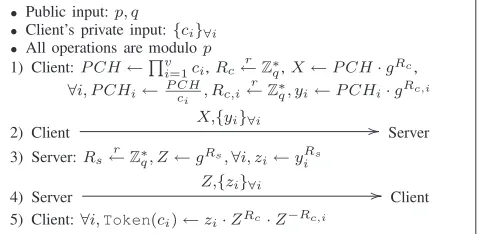
We present the complete details of Token’s oblivious computation in Figure 2 and Figure 3. Both instantiations incur linear computation overhead with respect to client and server set size.
Compared to the strawman approach, we modified the “encryption” technique: rather than (directly) using a sym-metric-key encryption scheme, the EncryptDatabase
procedure is invoked.
A. Database Encryption with counters
• Public input:p, q
• Client’s private input:{ci}∀i
• All operations are modulop 1) Client:P CH←Qv
i=1ci,Rc←r Z∗q,X←P CH·gRc,
∀i, P CHi←P CHc
i , Rc,i
r
←Z∗
q, yi←P CHi·gRc,i
2) Client
X,{yi}∀i
// Server 3) Server:Rs←r Z∗q, Z←gRs,∀i, zi←yRis
4) Server Z,{zi}∀i // Client 5) Client:∀i,Token(ci)←zi·ZRc·Z−Rc,i
Fig. 2: Oblivious computation ofToken(·)using DT10-1.
•Public input:e, N •Client’s private input:{ci}∀i
•CA’s private input:d •All operations are moduloN 1) CA:∀i,σi←(ci)d
2) CA
{σi}∀i
// Client 3) Client:P CH←Qv
i=1ci,P CH∗←Qvi=1σi,Rc←r Zn/4,
∀i, P CH∗
i ←P CH∗/σi,yi←(P CHi∗)2·gRc,i
X←(P CH∗)2·gRc
4) Client X,{yi}∀i // Server 5) Server:Rs←r Zn/4, Z←ge·Rs,∀i, zi←yei·Rs
6) Server
Z,{zi}∀i
// Client 7) Client:∀i,Token(ci)←zi·ZRc·Z−Rc,i
Fig. 3: Oblivious computation ofToken(·)using DT10-APSI.
We illustrate EncryptDatabase procedure in Algo-rithm 1. It takes as input the definition of theToken func-tion, and server’s record set. It consists of two “phases”: (1)Record-leveland (2) Lookup-Tableencryptions.
Record-level encryption is relatively trivial (lines 1–6): first, the server shuffles record locations; then, it pads each Rj up to a fixed maximum record size, picks a random symmetric keykj, and encryptsRj as erj=Enckj(Rj).
Lookup-Table (LTable) encryption (lines 8–15) pertains to attribute name and value pairs. It enables efficient lookup and record decryption. In step 8, the server hashes an attribute-value pair and uses the result as input to Token
function in step 9. In step 10, we use the concatenation of
Algorithm 1:EncryptDatabaseProcedure.
input : FunctionToken(·)and record set{Rj}1≤j≤w output: Encrypted DatabaseEDB
1: Shuffle{Rj}1≤j≤w
2: maxlen←max length among allRj
3: for1≤j≤wdo
4: PadRjtomaxlen;
5: kj← {0r ,1}128;
6: erj←Enckj(Rj); 7: for1≤l≤mdo
8: hsj,l←H(attrl, valj,l);
9: tkj,l←Token(hsj,l);
10: tagj,l←H1(tkj,l||ctrj,l);
11: k′
j,l←H2(tkj,l||ctrj,l);
12: k′′
j,l←H3(tkj,l||ctrj,l);
13: ekj,l←Enck′ j,l(kj); 14: eindj,l←Enck′′
j,l(j);
15: LTablej,l←(tagj,l, ekj,l, eindj,l);
16: end for
17: end for
18: ShuffleLTablewith respect tojandl;
19: EDB← {LTable,{erj}1≤j≤w};
Algorithm 2:LookupProcedure.
input : Search tokentkand encrypted database
EDB={LTable,{erj}1≤j≤w}
output: Matching record setR
1: ctr←1;
2: while∃tagj,l∈LTables.t. tagj,l=H1(tk||ctr)do
3: k′′←H
3(tk||ctr);
4: j′←Dec
k′′(eindj,l);
5: k′←H
2(tk||ctr);
6: k←Deck′(ekj,l);
7: Rj←Deck(erj′);
8: R←R∪Rj;
9: ctr←ctr+ 1; 10: end while
the l-th attribute. In other words, ctrj,l is the counter of occurrences ofvalj′,l=valj,l,∀j′<=j. For example, the third occurrence of value “Smith” for attribute “Last Name” will have the counter equal to 3. The counter guarantees that duplicate(attr, val)pairs correspond to different tags, thus addressing Challenge 1. Next, the server computes k′
j,l = H2(tkj,l||ctrj,l) and kj,l′′ = H3(tkj,l||ctrj,l). Note thatk′
j,lis used for encrypting symmetric keykj. Whereas,
k′′
j,l is used for encrypting the index ofRj. In step 13, the server encryptskj as ekj,l=Enck′
j,l(kj). Then, the server encrypts eindj,l = Enck′′
j,l(j). The encryption of index (data pointer) guarantees that the client cannot link two tags belonging to the same record, thus addressing Challenge 2. In step 15, the server inserts eachtagj,l,ekj,l andeindj,l into LTable, which is {tagj,l, ekj,l, eindj,l}1≤j≤w,1≤l≤m. Next, the server shuffles LTable (step 18). The resulting encrypted database, EDB, is composed of LTable and {erj}wj=1 (step 19).
B. Lookup with counters
We now discussLookupprocedure shown in Algorithm 2. It is used by the client to obtain the query result, i.e., to search EDBfor all records that match client’s search tokens.
In step 1, the client initializes a counter to 1. Next, it searches LTable for tag tagj,l = H1(tk||counter). If there is a match, the client attempts to recover the record associated with tagj,l. To do so, the client needs to locate the associated record: it computes k′′ = H3(tk||ctr) and
recovers j′ = Dec
k′′(eindj,l). Note that erj′ now corre-sponds to the associated record. To decrypterj′, the client first recovers the keykused to encrypterj′, by computing k′ =H2(tk||ctr)and obtainingk=Dec
k′(ekj,l). Finally, the client recoversRjby decryption, i.e.,Rj=Deck(erj′). There are several ways for the client to store LTable. Hash table storage is most efficient as it only requires constant lookup time. We can also use binary search tree, which takes sublinear lookup time, but it requires ordering LTablefirst.
C. Example of Correctness
Assume that server’s database includes the attribute “gender” with two occurrences of value “male”. In Algo-rithm 1, the same tk (step 9) will be generated for the two occurrences of (”gender”, ”male”). However, for the first occurrence, tag = H1(tk||1), k′ = H2(tk||1), k′′ =
H3(tk||1) while, for the second occurrence, tag = H1(tk||2), k′ =H2(tk||2), k′′=H3(tk||2).
Suppose that the client searches for records matching “gender = male”, it first derives tk (step 1 of Figure 1). Next, it matches H1(tk||1)in LTable, derives keysk′ = H2(tk||1), k′′=H3(tk||1), and recovers the index in step
4 and the record in step 7 of Algorithm 2. It also looks forH1(tk||2) and performs the same operations as before, except that k′ = H2(tk||2), k′′ = H3(tk||2). Finally, the
client looks for H1(tk||3): since it finds no match, it terminates.
D. Challenges Revisited
We claim that our approach addresses Challenge 1 and 2, discussed in Section IV. The intuition is as follows: Multi-sets:The use of counters during database encryption makes eachtagj,l(resp.ekj,l,eindj,l) distinct inLTable, thus hiding plaintext patterns.
Data Pointers: Storing eindj,l (rather thanj) in LTable, prevents the server from exposing the relationship between an entryLTablej,l and its associated record Rj.
E. Security Analysis of First PPSSI Approach
1) Cryptographic primitive security definition: Below, we review the standard security definitions for some cryp-tographic primitives.
First, we define the security for a hash function Hs(·) based on the following experiment. The experiment:
HashCollA:
1) A key sis generated by a hash key generator. 2) The adversaryAis givensand outputsx, x′.
3) The output of the experiment is defined to be 1 if and only ifx6=x′ andH
Definition 1: We say that a hash function is (t, ǫ) col-lision resistant if for any adversary Abounded by time t, there exists a negligible parameterǫsuch that
Pr[HashCollA=1]≤ǫ
Then, we define the security for a semantic encryption scheme. The experiment:PrivEncA:
1) Aoutputs a pair of messagesm0, m1.
2) A random bitb is chosen. Give c←Enc(mb)to
A.
3) Amay keep queryingEnc(·). 4) Aoutputsb′.
5) The output of the experiment is defined to be 1 if and only ifb=b′.
Definition 2: We say that an encryption scheme is(t, ǫ)
secure if for any adversary A bounded by time t, there exists a negligible parameterǫsuch that
Pr[PrivEncA=1]≤
1
2+ǫ
Last, we define the security for an unpredictable function. The experiment:PrivTokenA:
1) A is allowed to query Token(·) for polynomial number of times.
2) A outputs a pair (x, y) where x is not queried before.
3) The output of the experiment is defined to be 1 if and only if Token(x) =y.
Definition 3: We say that a Token function is (t, ǫ)
unpredictable if for any adversary A bounded by time t, there exists a negligible parameterǫsuch that
Pr[PrivTokenA=1]≤ǫ
2) Security against Honest-but-Curious/Malicious Client: We use qi to denote the ith query of the form
(attr, val) issued by the client and use Qi to denote all records matching query qi.
We define security against Honest-but-Curious/Malicious client by comparing its view under real model with that under ideal model. In the ideal model, there is a trusted third party (TTP) serving as an honest server who, in response to the queryqi, only repliesQi.
We first consider Honest-but-Curious adversary and then analyze malicious adversary at the end of this section. We define a simulator SIMthat attempts to simulate to a real-model client based on output from ideal-real-model TTP as follows:
Simulator SIM:
SIMis given input{q1, . . . , qn}
1) SIMpicks all the secret and public parameters. 2) SIMinteracts withAas a real-model server during
oblivious computation of Token (step 1 of Fig-ure 1).
3) SIM sends {q1, . . . , qn} to the TTP and receives
{Q1, . . . , Qn}.
4) SIM runs some function on {Q1, . . . , Qn} and outputs the result to the client.
Note that we require SIMto take {q1, . . . , qn} at once and therefore does not handle adaptive query.
We then define an experiment for any adversaryA: The experimentSPrivC,A:
1) The adversaryAoutputs to the challenger a list of queries {q1, . . . , qn}.
2) The challenger chooses a random bit b ← {r 0,1} and does one of the following:
a) If b = 0, then the challenger interacts with A as a real-model server.
b) If b = 1, then the challenger interacts withA as SIM({q1, . . . , qn}).
3) The adversaryAoutputs a bitb′.
4) The output of the experiment is defined to be 1if b′=b, and0 otherwise.
Definition 4: The first PPSSI approach is secure against honest-but-curious client if, for all probabilistic polynomial-time adversariesA, there exists a probabilistic polynomial-time simulator SIMsuch that
Pr[SPrivC,A=1]≤
1
2 +ǫ
This definition ensures that the client in the real model does not get more or different information than the ideal implementation.
Theorem 1: If the hash function H(·), H1(·), H2(·), H3(·) are (t0, ǫ0), (t1, ǫ1), (t2, ǫ2), (t3, ǫ3) collision re-sistant, Enc is a (tenc, ǫenc) semantic secure encryption, and Token is a (tT, ǫT) unpredictable function, then first PPSSI approach is (t, ǫ)-secure against any probabilis-tic polynomial-time honest-but-curious client where t ≤ min(t0, t1, t2, t3, tenc, tT)−w·m·tToken−w·tenc and
ǫ=ǫ0+ǫ1+ǫ2+ǫ3+ 2ǫT+ǫenc.
Proof: Our goal is to construct a simulatorSIMsuch that A cannot tell the difference between the view when interacting with SIM and the view when interacting with real-model server. OurSIMis constructed as follows:
1) SIM picks all the secret and public parameters on behalf of a real-model server and publish all public parameters.
2) SIM interacts with A as a real-model server during oblivious computation of Token (step 1 of Figure 1). 3) SIM queries TTP for {q1, . . . , qn} and gets back
{Q1, . . . , Qn}.
4) Let Q denote ∪iQi. SIMgenerates w− |Q| random records of the same length as any other message in Q. LetDB′ denote the concatenation ofQand these
5) Use Algorithm 1 to encryptDB′and returns encrypted
databaseEDB′ to the client.
6) SIM answers client’s request for
H(·), H1(·), H2(·), H3(·) as a random oracle.
We first analyze A’s view between tags in EDB and tags in EDB′. Note that a tag in LTable is computed
as H1(Token(H(attr, val))||ctr). The only time that A
observes difference is when (1) there exists qj,(attr, val) such that H(qj) = H(attr, val) while qj 6= (attr, val); (2) there exists two different pairs – (attr′, val′), (attr′′,
val′′) – such that H1(Token(H(attr′, val′))||ctr′) =
H1(Token(H(attr′′, val′′))||ctr′′); (3) A forges
Token(H(attr, val)) for certain (attr, val). This means finding a collision in H(·) or H1(·), or breaking Token, which happens with probability at mostǫ′ =ǫ0+ǫ1+ǫ
T if t+w·m·tToken+tenc is bounded bymin(t0, t1, tT).
Next we analyze A’s view between ({ekj,l,
eindj,l}1≤l≤m, erj)1≤j≤w in EDB and those in EDB′. For allek, eind, erwhose corresponding tags do not match {q1, . . . , qn}, A cannot tell the difference between them in EDB and in EDB′ unless (1) A breaks symmetric encryption algorithm; (2) finds collision in H2(·) or H3(·); (3) A can forge Token(H(attr, val)) for certain
(attr, val). All these happen with probability at most ǫ′′=ǫ
enc+ǫ2+ǫ3+ǫT ift+w·m·tToken+w·tenc is bounded bymin(tenc, t2, t3, tT).
The claim follows when t+w·m·tToken+w·tenc ≤
min(t0, t1, t2, t3, tenc, tT).
In order to consider malicious adversary, we need to change the simulator definition and the experiment. InSIM, there is no input of {q1, . . . , qn} and, in SPrivC,A, there
is no step 1. Note, for the first PPSSI approach, it is secure against malicious adversary only if [18] is used for oblivious computation of Token.
Theorem 2: If oblivious computation of Token protocol is secure against malicious client, the hash function H(·), H1(·), H2(·), H3(·) are collision resistant and Enc is a semantic secure encryption, then first PPSSI approach is secure against any probabilistic polynomial-time malicious client.
Proof: SIM construction is the same as that in the proof for theorem 1 except that, in step 2, SIM extracts all{q1, . . . , qn}from the ZKPK sent byA, which requires rewinding ofA. Then the proof follows that for Theorem 1.
3) Security against Honest-but-Curious/Malicious Server: Given that the server gets no output from the protocol, the definition of client’s privacy requires simply that the server cannot distinguish between cases in which the client has different inputs.
We define an experiment for any adversaryA:
The experimentSPrivS,A:
1) The adversary A chooses its own database DB and outputs to the challenger two list of queries –
(q0 1, . . . , q0
n)and(q
1 1, . . . , q
1
n).
2) The challenger chooses a random bit b ← {r 0,1} and does one of the following:
a) If b = 0, then the challenger interacts with A as an honest client using queries(q0
1, . . . , q 0
n). b) If b = 1, then the challenger interacts withA
as an honest client using queries(q1 1, . . . , q
1
n). 3) The adversaryAoutputs a bitb′.
4) The output of the experiment is defined to be 1if b′=b, and0 otherwise.
Definition 5: The first PPSSI approach is secure against honest-but-curious/malicious server if, for all probabilistic polynomial-time adversariesA,
Pr[SPrivS,A=1]≤
1
2 +ǫ
Theorem 3: If oblivious computation of Token function is secure against any probabilistic polynomial-time honest-but-curious or malicious server, the first PPSSI approach is secure against any probabilistic polynomial-time honest-but-curious or malicious server.
Proof: In the first PPSSI approach, the only mes-sages A gets from the client is during oblivious Token computation. If oblivious computation of Token function is secure against any probabilistic polynomial-time honest-but-curious or malicious server, the messages A receives from the client should be hidden by randomness. Therefore the theorem follows.
Remark:. Our protocols do not consider selective failure
(see [9]), which we leave as part of future work.
VI. THESECONDPPSSI APPROACH FORVERYLARGE DATABASES
The first PPSSI approach in Section V, combines effi-ciency with provably-secure guarantees. However, in the context of very large databases, it faces two additional issues:
Challenge 3: Bandwidth.If server’s database is very large and/or communication takes place over a slow channel, the bandwidth overhead incurred by the transfer of the encrypted database may become prohibitive.
• Public input:e, N
• Client’s private input:{ci}∀i
• Server’s private input:d=e−1modφ(N)
whereφ(N)denotes the order ofZ∗
N
1) Client:∀i, ri←r Z∗N, yi←(ri)e·cimodN
2) Client
{yi}∀i
// Server 3) Server:∀i, zi←(yi)dmodN
4) Server
{zi}∀i
// Client 5) Client:∀i,Token(ci)←zi·ri−1modN
Fig. 6: Oblivious computation ofToken(·)using DT10-2.
in several settings, parties (e.g., banks) may be prevented, by regulation, from releasing copies of their databases (even if encrypted).
In the rest of this section, we introduce a novel architec-ture to address the challenges for very large databases. Our new approach incurs very limited overhead (in terms of both computation and communication), even when compared to non-privacy preserving querying systems.
A. Introducing the “Isolated Box”
In order to address Challenge 3 and 4, we propose a system architecture shown in Figure 4. It includes a new component:“Isolated Box”(IB), a non-colluding, untrusted party connected with both the server and the client.
The new interaction involving IB is shown in Figure 5. During the (offline) setup phase, the server encrypts its database, using EncryptDatabase(Algorithm 1), and transfers the encrypted database to the IB. Server’s compu-tation ofTokenfunctionality no longer depends on client’s input, thus, the server can evaluate Token(·) without involving the client.
To pose a query, the client first engages with the server in oblivious computation of Token(online step 1). Next, for each computed token, it runs theIBLookupprocedure (Algorithm 3) to retrieve matching records from the IB.
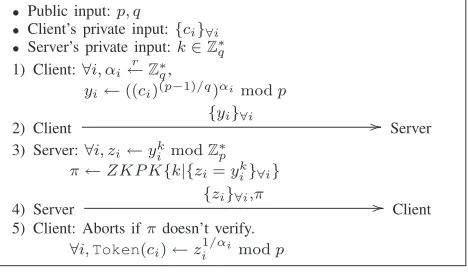
The Token(·) functionality is now instantiated using (A)PSI-DTwithpre-distribution. Specifically, we select the construction from [20] (denoted asDT10-2), [32] (denoted as JL10) and [17] (denoted as IBE-APSI). Again, our choices are based on these protocols’ efficiency and security models. Our experiments – in Appendix of [19] – show that DT10-2, secure in the presence of HbC adversaries, is the most efficient construction, while JL10 combines reasonable efficiency with security against malicious adver-sary. IBE-APSI is the only APSI-DT with pre-distribution, and it is secure against HbC adversaries. For the sake of completeness, we define Tokenfunction for the selected (A)PSI-DT constructions in Table III. Note that d, k, z are server’s secret parameters. Complete details, for each instantiation of oblivious computation, are presented in Figure 6, 7 and 8.
Trust Assumptions. The Isolated Box is assumed not to collude with either the server or the client. (Although, we discuss the consequences of collusion in Section VI-F.) We remark that the use of non-colluding parties in the context
• Public input:p, q
• Client’s private input:{ci}∀i
• Server’s private input:k∈Z∗q
1) Client:∀i, αi←r Z∗q,
yi←((ci)(p−1)/q)αimodp
2) Client
{yi}∀i
// Server 3) Server:∀i, zi←yikmodZ∗p
π←ZKP K{k|{zi=yki}∀i}
4) Server
{zi}∀i,π
// Client 5) Client: Aborts ifπdoesn’t verify.
∀i,Token(ci)←z1i/αimodp
Fig. 7: Oblivious computation ofToken(·)using JL10.
• Public input:P, Q=Ps
• Client’s private input:{ci}∀i
• CA’s private input:s. • Server’s private input:z 1) CA:∀i,σi←(ci)s
2) CA
{σi}∀i
// Client 3) Server:R←Pz(Offline)
4) Server R // Client
5) Client:∀i,Token(ci)←eˆ(R, σi)
Fig. 8: Oblivious computation ofToken(·) using IBE-APSI.
of Secure Computation [46] was first suggested by [24], and then applied in [4], [8], [21], [34], [33], [2].
While our requirement for the presence of IB might seem like a “strong” assumption, we stress that the IB is only trusted not to collude with other parties. It simply stores server’s encrypted database and returns ciphertexts matching client’s encrypted queries (i.e., tags), without learning any information about records and queries. Also note that, in practice, the IB can be either instantiated as a (non-colluding) cloud server or as a piece of secure hardware installed on server’s premises: it is only important to ensure that the server does not learnwhat the IB reads from its storage and transfers to the client.
B. Database Encryption
IB’s presence does not really affect database encryption, i.e., Encryptdatabaseprocedure presented in Algori-thm 1. It only uses a differentToken(·)function. While in the first approach (Section V) we rely on (A)PSI-DT with-out pre-distribution (i.e., the server cannot run Token(·)
before interacting with the client), we now use (A)PSI-DT with pre-distribution. Thus, the server can evaluate
Token(·) over its own inputs, offline, and then transfer the encrypted database to the IB.
C. Query lookup
CLIENT
ISOLATED BOX
T
ra
n
sf
e
r-EDB
SERVER
(O
ff-l
in
e)
Fig. 4: The introduction of the Isolated Box.
• Client’s input:{ci, σi}1≤i≤v, where:ci=H(attr∗i, val∗i)
• Server’s input:{sj,l}1≤j≤w,1≤l≤m,{Rj}1≤j≤w,
where:sj,l=H(attrl, valj,l) Offline:
1) Server:EDB←EncryptDatabase(Token(·),{Rj}1≤j≤w)
2) Server
EDB
// IB Online:
1) Client ks Obliviously computes{tki←
Token(ci)}∀i
+3 Server
2) Client ks {
Ri←IBLookup(tki)}∀i
+3 IB 3) Client:∀R∈ ∪∀iRi, outputR
Fig. 5: Outline of our second PPSSI approach based on IB.
Scheme name Tokendefinition PSI category
DT10-2 (Figure 4 of [20]) Token(c) = (c)dmodN PSI-DT with pre-distribution JL10 (Figure 2 of [32]) Token(c) = ((c)(p−1)/q)kmodp PSI-DT with pre-distribution
IBE-APSI (Figure 5 of [17]) Token(c) = ˆe(Q, c)z APSI-DT with pre-distribution
TABLE III: Tokenfor (A)PSI-DT with pre-distribution (ci=H(attr∗i, val∗i)andc∈ {ci}1≤i≤v)
Algorithm 3:IBLookupProcedure
Client’s input :tki
IB’s input :EDB={LTable,{erj}1≤j≤w}
Client’s output: Matching record setR
1) Client:ctr←1
2) Client:tagi←H1(tki||ctr),ki′′←H3(tkik|ctr)}
3) Client
tagi,ki′′
// IB 4) IB: If(∃tagj,l∈LTablej,ls.t.tagj,l=tagi)
j′←Dec
k′′
i(eindj,l), ret← {ekj,l, erj′}
else ret← ⊥
5) IB ret // Client
6) Client: Ifret=⊥, abort elsek′
i=H2(tki||ctr),ki=Deck′ i(ekj,l) Ri=Decki(erj′),R←R∪Ri ctr←ctr+ 1, Goto step 2.
We use the termtransactionto denote a complete query procedure, for eachtki(from the time the first query fortki is issued, until the last response from the IB is received).
Retrieval denotes the receipt of a single response record during a transaction. A transaction is composed of several retrievals between the client and the IB. The client retrieves records one by one from the IB, by gradually incrementing the counter ctr. In step 1, the client setsctr to1. In step 2, the client derives tagi and an index decryption key k′′i from tokentki. After receivingtagiandki′′in step 3, the IB searches for matching tags in the lookup table in step 4. If there is a match, the IB recovers the indexj′ by decrypting
eindj,l withki′′, assembles the corresponding record erj′ and the ciphertext of its decryption key ekj,l into ret and transmits ret to the client in step 5. Otherwise, ⊥ is transmitted. If the client receives⊥, it aborts. Otherwise, it decryptsekj,l intoki withk′i and recovers recordRi from
erj′ using ki. Then, it increments ctr and starts another retrieval by returning to step 2.
We can use hash table to storeLTablefor efficiency. If LTableis too big to be stored in hash table, we can turn to B-tree. Creating B-tree can be done offline at the server.
D. Optimizations
Since transmission ofret may incur some delay, Algo-rithm 3 can be sped up by pipe-lining computation oftagi and k′′
i (step 2) in next retrieval with the transmission of
ret (step 5) in current retrieval.
Note that the computation ofekj,landeindj,l(steps 13– 14 in Algorithm 1) can also be optimized. Since we use a counter as input to compute k′
j,l (respectively,kj,l′′), each
k′
j,l (respectively, k′′j,l) is different for any j, l. Both k′j,l and k′′
j,l are 160-bit values (SHA-1), while kj is 128 bits and j is clearly smaller. Hence, we can use one-time-pad
encryption (i.e. ekj,l =kj,l′ ⊕kj and eindj,l = k′′j,l⊕j) to speed up computation. In Algorithm 3,Deck′′
i(eindj,l) becomesk′′
i⊕eindj,landDeck′
i(ekj,l)changes tok
′
i⊕ekj,l.
E. Challenges Revisited
Since we use the same encryption procedure discussed in Section V, Challenge 1 and 2 are already addressed. Thus, we only consider Challenge 3 and 4.
Bandwidth:Once the server transfers its database (offline) to the IB, the latter returns to the client only records matching its query. Therefore, bandwidth consumption is minimized.
Finally, the introduction of the IB enables Server Un-linkability and Forward Security, despite the fact that we use (A)PSI-DT with pre-distribution techniques. Indeed, records not matching a query are never available to the client, thus, it does not learn whether they have changed. Similarly, the client cannot use future authorizations to maliciously obtain information from previous (recorded) interactions.
F. Discussion
Privacy Revisited.The introduction of the IB and the use of counter mode in database encryption provide additional privacy properties. If the client performs only one query transaction, as in Algorithm 3, the IB can link all tag values in step 3 to the same (attr, val) pair. This may pose a similar risk to that discussed in the “multi-set” challenge, with respect to the IB. However, the counter allows the client to retrieve matching records one by one. Therefore, the client can choose to add a random delay between two subsequent retrievals in a single transaction. If the distribution of additional delay is indistinguishable from time gaps between two transactions, the IB cannot tell the difference between two continuous retrievals within one transaction from two distinct transactions. As a result, the IB cannot infer whether two continuously retrieved records share the same (attr, val) pair and the distribution of the attribute value remains hidden.
Also note that the introduction of the IB does not violate Client or Server Privacy. Client Privacy is preserved because the client (obliviously) computes a token, which is not learned by the server. The IB does not learn client’s interests, since client’s input to the IB (tag) is statistically indistinguishable from a random value, in the random oracle model. Server Privacy is preserved because the client does not gain any extra information by interacting with the IB. Finally, the IB only holds the encrypted database and learns no plaintext.
Removing Online Server. Although it only needs to per-form oblivious computation of tokens, we still require the server to be online. Inspired by [30] and [25], we can replace the online server with a tamper-proof smartcard, dedicated to computing Token function. The server only needs to program its secret key into the smartcard, which protects the key from being accessed by the client. This way, after handing the smartcard to the client, the server can go offline. The smartcard is assumed to enforce a limit on the number of Tokeninvocations.
Limitations. We acknowledge that our second PPSSI ap-proach has some limitations. Over time, as it serves many queries, the IB gradually learns the relationship between tags and encrypted records through pointers associated with each tag. This issue can be mitigated by letting the server periodically re-encrypt the database. IB also learns database access patterns generated by query executions. Nonetheless, without knowing the distribution of query predicates, the access pattern of encrypted data leaks very little information to the IB. Next, if the server and the IB collude, Client
Privacy is lost, since the IB learnstag that the client seeks, and the server knows the(attr, val)pair eachtagis related to. On the other hand, if the client and the IB collude, the client can access the entire encrypted database, thus, liability (long-term data safety) may be endangered. Last, Server Unlinkability is protected only with respect to the client. Server Unlinkability with respect to the IB is not guaranteed, since the IB learns about all changes in server’s database. Finally, note that PPSSI (with all approaches) currently supports only equality and disjunctive queries. Enabling conjunctive queries would require treating all combinations of (attr, val)pairs as server’s set elements. Thus, client’s input would become exponential in terms of the number of attributes. This remains an interesting challenge left as part of future work.
Dynamic Databases..So far, the database is assumed to be static. We emphasize that our second approach can also deal with dynamic database with some small modifications. To be specific, we require the server, for each different pair of (attr, val), store the max counter, ctrmaxattr,val ←
maxattrl=attr,valj,l=val(ctrj,l). This data is proportional to the number of different(attr, val) pairs and can be huge. Instead of saving it on its own, the server can outsource this data as a new encrypted database to the IB. When the server needs to add4 a new record, it fetches the max counter for each (attr, val) in the new record and then encrypt it according to Algorithm 1(line 8-15) after incrementing corresponding max counters by one. Then the server pushes the new encrypted record and updatedctrmaxattr,valto the IB. To delete a record, the server first needs to query and locate the record. Then it updates its content with a special mark ‘D’, re-encrypts the record and pushes it to the IB. When client retrieves a deleted record, it does not process the record but continues to retrieve the next one.
G. Security Analysis of Second PPSSI Approach
Since we do not consider collusion, the security against Honest-but-Curious/Malicious client and server follows ex-actly from Theorem 1, 2, 3. So we only discuss security against Honest-but-Curious/Malicious Isolated Box.
Like Section V-E, we useqito denote theith query of the form(attr, val)issued by the client and useQi to denote all records matching queryqi.
1) Security against Honest-but-Curious/Malicious Iso-lated Box (IB): We define security against Honest-but-Curious/Malicious Isolated Box (IB) by comparing its view when interacting with an honest client and an honest server with its view when interacting with a simulatorSIM.
SimulatorSIM:
SIMis given|XU|for allU ⊆ {0, . . . , n}whereXU =
∩i∈UQi.
1) SIMoutputs an encrypted databaseEDB′ toA. 2) SIM interacts with A as a client, simulating
queries {q1, . . . , qn} (even though SIM does not know{q1, . . . , qn}).
4We only consider ’append’ operation since it would not present different
Note, in the above definition, the only information SIM
knows is the cardinality of XU which is defined as the intersection of a subset of query answers.
We then define an experiment for any adversaryA:
The experimentSPrivIB,A:
1) The adversaryA outputs to the challenger a data-baseDB and a list of queries{q1, . . . , qn}. 2) The challenger chooses a random bit b ← {r 0,1}
and does one of the following:
a) Ifb= 0, then the challenger interacts withAas an honest client and an honest server.
b) Ifb= 1, then the challenger computes{Q1, . . . , Qn}based onDB, derives all intersectionsXU for all U ⊆ {1, . . . , n} and interacts with Aas
SIM({|XU|}∀U⊆{1,...,n}).
3) The adversaryAoutputs a bitb′.
4) The output of the experiment is defined to be 1 if b′=b, and0otherwise.
Definition 6: The second PPSSI approach is secure against honest-but-curious/malicious IB if, for all proba-bilistic polynomial-time adversariesA, there exists a prob-abilistic polynomial-time simulatorSIMsuch that
Pr[SPrivIB,A=1]≤
1
2 +ǫ
Theorem 4: If the hash function H(·), H1(·), H2(·), H3(·) are (t0, ǫ0), (t1, ǫ1), (t2, ǫ2), (t3, ǫ3) collision re-sistant, Enc is a (tenc, ǫenc) semantic secure encryption, and Token is a (tT, ǫT) unpredictable function, then the second PPSSI approach is (t, ǫ)-secure against any prob-abilistic polynomial-time honest-but-curious/malicious IB wheret≤min(t0, t1, t2, t3, tenc, tT)−w·m·tToken−w·tenc andǫ=ǫ0+ǫ1+ǫ2+ǫ3+ 2ǫT + 2ǫenc.
Proof: Our goal is to construct a simulator SIMsuch that A cannot tell the difference between the view when interacting withSIMand the view when interacting with an honest client and an honest server. Our SIMis constructed as follows:
1) SIMcreatesEDB′:
• Pick w random messages of same length as en-crypted messages.
• Then createLTable′={(tag′ j,l, ekj,l′ ,
eind′
j,l)}1≤j≤w,1≤l≤m where tagj,l′ ∈R {0,1}lh,
ek′
j,l ∈R {0,1}le, eindj,l′ ∈R {0,1}le, lh is the output length of hash function, le is the output length of encryption function.
2) For each queryqi,SIMprepares the matching tag set
Ti ={tag1i. . . tag|iQi|} such that | ∩i∈U Ti| =|XU| ∀U ⊆ {0, . . . , n}as follows:
• ∀U ⊆ {0, . . . , n}, compute |XˆU| where XˆU =
XU\ ∪|U′|>|U|XU′, i.e., the fraction of the inter-section determined by U without being covered in anyU′ such that|U′|>|U|. Given|X
U|,|XˆU|can be computed as
|XˆU|=|XU| − |XU′ |
where |X′
U| = |XU ∩
(∪|U′|>|U|XU′)| = P
|U′|>|U| |XU ∩ XU′| − P
|U′
1|>|U|,|U
′
2|>|U|,U
′
16=U
′
2|(XU ∩
XU′
1)∩(XU ∩XU
′
2)|+· · ·+ (−1)( n n)+···+(
n |U|+1)·
| ∩|U′|>|U|(XU ∩XU′)|). The above formula is attributed to the inclusion-exclusion principle [3]. Note that |XU1 ∩ · · · ∩XUi| = |XU1∪···∪Ui| and therefore we can compute|XˆU|for anyU.
• Randomly pick P∀U|XˆU| different tags from LTable′ and store them in Y. Note that P
∀U|XˆU|=| ∪jn=1Qj|. For eachU, initializeQˆU as follows:
a) Pick|XˆU|distinct tags fromY and add them to
ˆ QU.
b) Update Y ←Y\QˆU.
• For i = 1, . . . , n, set Ti = ∪i∈UQˆU. Note that
| ∩i∈U Ti| = |XU| due to the above construction ofQˆU.
3) SIMplays the role of a client as follows: for theλth query, make |Tλ| probes where θth probe is the θth element inTλ.
We first analyze the view of A between tags in EDB and those inEDB′. The distribution of tags inEDBand those in EDB′ is the same unless one of the following happens: (1) there exists (attri, vali)6= (attrj, valj) but
H(attri, vali) = H(attrj, valj); (2) H(attri, vali) 6=
H(attrj, valj) but H1(Token(H(attr′, val′))||ctr′) =
H1(Token(H(attr′′, val′′))||ctr′′); (3) A forges
Token(H(attr, val)) for certain (attr, val). This means finding a collision in H(·) or H1(·), or breaking Token, which happens with probability at mostǫ′ =ǫ0+ǫ1+ǫ
T ift+w·m·tToken+tenc is bounded bymin(t0, t1, tT).
Next we analyze A’s view between ({ekj,l,
eindj,l}1≤l≤m, erj)1≤j≤w in EDB and those in EDB′. The only time that A observes difference is when (1) A breaks semantic secure encryption algorithm; (2) A finds collision in H2(·) or H3(·) (which breaks one-time-pad encryption); (3)A forges Token(H(attr, val)) for certain
(attr, val). All these happen with probability at most ǫ′′=ǫ
enc+ǫ2+ǫ3+ǫT if t+w·m·tToken+w·tenc is bounded bymin(tenc, t2, t3, tT).
Last we show thatAcannot distinguish the way that an honest client’s queries are answered using EDB and the way that SIM’s queries are answered usingEDB′. For an honest client’s query qi, there are |Qi| matches inEDB. For the SIM’s ith query, it makes |Ti| probes (excluding the last failed probe) and there will be|Ti|matches. Since
|Ti| =|Qi| and∀U,| ∩i∈U Ti| =|XU| =| ∩i∈U Qi|, A cannot distinguisherj from er′j unless Abreaks semantic secure encryption which happens with probability ǫenc if
t+w·m·tToken+w·tenc is bounded bytenc.
Putting it all together, the second PPSSI approach is (t, ǫ)-secure if t + w · m · tToken + w · tenc ≤
min(t0, t1, t2, t3, tenc, tT)andǫ= 2ǫenc+ǫ0+ǫ1+ǫ2+
VII. PERFORMANCEEVALUATION
In this section, we evaluate the performance of our PPSSI approaches. First, we benchmark step-by-step cost of proposed techniques. Next, we compare our first PPSSI approach to PIR. Finally, we build a (limited) database man-agement system to compare our second PPSSI approach to a non privacy-preserving MySQL database.
A. Benchmarking All PPSSI Components
The following benchmark refers to executions on an Intel Harpertown server with Xeon E5420 CPU (2.5 GHz, 12MB L2 Cache) and 8GB RAM inside. We build the benchmark-ing tool based on OpenSSL library (ver.1.0.0c) [47] and PBC library (ver.0.5.11) [36].
1) PPSSI Operations: We now evaluate the performance of all operations involved in both of our PPSSI approaches. Remark that we use 2048-bit modulus and records of fixed
2KB length.
Figure 9 measures the time needed to perform the obliv-ious computation of Token function, for every possible (A)PSI-DT instantiation. Observe that the cost always in-creases linearly with client’s query size. As for protocols without pre-distribution, DT10-APSI is unsurprisingly more expensive than DT10-1. Whereas, DT10-2 and JL10 are, re-spectively, the most and the least efficient ones of protocols with pre-distribution.
Then, Figure 10 evaluates the performance of the Look-up-Table encryption, performed by the server. This opera-tion includes server’s computaopera-tion ofTokenfunction over its own input (Note that this is not oblivious computation). Again, running time always increases linearly with the product of the number of records (w) and the number of attributes (m).
In Figure 11, we report the cost of the Record-level encryption. This only depends on the number of records. Compared to the Lookup-table encryption, the Record-level encryption incurs a negligible overhead.
Finally, Figure 12 presents the running time of the Lookup procedures (Algorithm 2 and Algorithm 3 with-out consideration of communication delay). Unsurprisingly, cost is identical for both algorithms and increases linearly with the number of matching records (vm). This is because we use a hash table to store all server computed tags in LTable and matching one client tag takes only constant time.
We conclude that, as all operations have linear complex-ity, our approaches scale efficiently for larger databases and query sets. All above experiments are done in small scale because it is easy to pinpoint exact numbers in such scale. One can easily infer results for super large parameters and hence we omit them here.
B. First PPSSI Approach vs PIR
We now aim at comparing the efficiency of proposed first PPSSI approach (Section V) to that of related work – SPIR. Recall that first PPSSI approach provides very similar pri-vacy properties of SPIR. Indeed, both PPSSI and SPIR hide
0 100 200 300 400 500 600 700
DT10-1
PPSSI DT10-APSIPPSSI GR-PIR
Total time (s)
Client cost Server cost Network cost
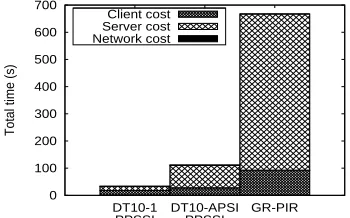
Fig. 13:Performance comparison between the first PPSSI approach (Section V) and GR-PIR [27].
client’s access patterns to the server and also protect privacy of server’s data (with respect to records not matching the queries). However, one possible criticism against our side is that the communication overhead is linear in the size of the database size, whereas, SPIR incurssub-linear
communication overhead. Remark, however, that: (1) SPIR does not support keyword search, and (2) SPIR introduces a remarkably higher computation overhead, which ends up “overshadowing” the advantage in the communication complexity. To support the latter claim, we compare the overall performance of our first PPSSI approach with that of Gentry and Ramzan’s single-database PIR (GR-PIR) [27], which is, to the best of our knowledge, the most efficient single-database PIR. Specifically, GR-PIR [27], assuming a database withnrecords, incursO(k+d)communication complexity (wherek≤lognanddis the bit-length of each record), andO(n)computation overhead. Also recall that, according to [39], any single-database PIR can be extended to SPIR/OT and we are not aware of any SPIR/OT that is more efficient than GR-PIR.
In our comparison, we use a database with w = 1024
records and m= 5 attributes. Each record has size 2KB. We assume the client’s query size is v = 1024 and there will be 10 (1%) records matching the query (vm). On a conservative stance, we choose a relatively slow connection between the client and the server, i.e., a 10M bps link. Remark that we choose 2048-bit modulus and use RC4 and SHA1 as symmetric encryption and hash function, respectively.
0 50 100 150 200 250 300 350 400 450
1 2 3 4 5 6 7 8 9 10
Oblivious Computation of Token (ms)
Client query set size (v) DT10-1
DT10-APSI DT10-2 JL10 IBE-APSI
Fig. 9: TokenOblivious Computation.
0 20 40 60 80 100 120 140
1 2 3 4 5 6 7 8 9 10
Lookup-table encryption (ms)
w * m DT10-1
DT10-APSI DT10-2 JL10 IBE-APSI
Fig. 10: Lookup-Table Encryption (line 8-15 of Algorithm 1).
0 0.001 0.002 0.003 0.004 0.005 0.006
1 2 3 4 5 6 7 8 9 10
Record-level encryption (ms)
Server set size (w) Record-level Encryption
Fig. 11: Record-level Encryption (line 1-6 of Algorithm 1).
0 0.001 0.002 0.003 0.004 0.005 0.006 0.007 0.008 0.009
1 2 3 4 5 6 7 8 9 10
Lookup cost (ms)
matching records Lookup (Alg.2) IBLookup (Alg.3)
Fig. 12: Lookup (Alg. 2) and IBLookup (Alg. 3).
C. Second PPSSI approach vs MySQL
To the best of our knowledge, there is no available approach to PPSSI that combines efficiency with prov-ably secure guarantees and that relies on a non-colluding, untrusted party, such as the Isolated Box. Therefore, we cannot compare our second PPSSI approach for very large databases (Section VI) to any prior work. Nonetheless, we evaluate its performance by measuring it against standard (non privacy-preserving) MySQL.
On a conservative stance, we use MySQL with indexing enabled on each searchable attribute. We run the IB and the server on the same machine. Client is connected to the server and the IB through a 100M bps link. The testing database has 45 searchable attributes and 1 unsearchable attribute (type “LARGEBLOB”) used to pad each record to a uniform size. There are, in total, 100,000 records. All records have the same size, which we vary during experiments. The IB is preloaded with LTable into memory. All results are averaged over 10 runs.
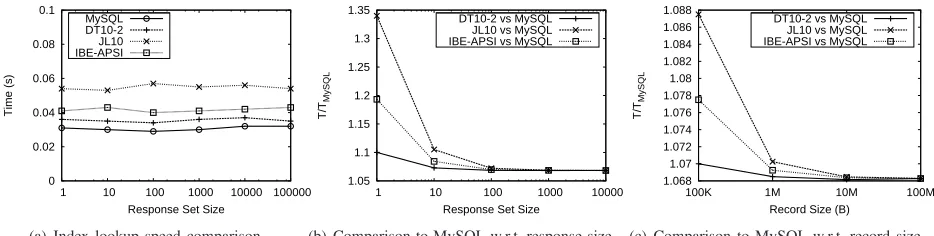
First, we compare theindex lookup time, defined as the time between SQL query issuance and the receipt of the first response from the IB. We select a set of SQL queries that return 0, 1, 10,100,1000, 10000(±10%) responses, respectively, and fix each record size at 500KB. Figure 14(a) shows index lookup time for our PPSSI approach (with respect to all underlying (A)PSI-DT instantiations), as well as MySQL, with respect to the response set size. All proposed schemes’ cost are slightly more expensive than MySQL and are independent of the response size.
Next, we test the impact of the response set size on the
total query time, which we define as the time between SQL
query issuance and the arrival of the last response from the IB. Figure 14(b) shows the time for the client to complete a query for a specific response set size divided by the time taken by MySQL (again, with respect to all underlying (A)PSI-DT instantiations). Results gradually converge to
1.1 for increasing response set sizes, i.e., our approach is only 10% slower than standard MySQL. This is because the extra delay incurred by cryptographic operations (in the oblivious evaluation ofToken) is amortized by subsequent data lookups and decryptions. Note that we can also infer the impact of various client query set size by multiplying the client query set size with each single query delay.
Last, we test the impact of record size on the total query time. We fix response set size at100and vary each record size between100KBand100M B. Figure 14(c) shows the ratio between our PPSSI approach and MySQL, once more with respect to all underlying (A)PSI-DT instantiations. Again, results gradually converge well below 1.1 with increasing record size. This occurs because, with bigger records, the overhead of record decryption becomes the “bottleneck”.
VIII. CONCLUSION
In this paper, we proposed secure and efficient techniques for Privacy-Preserving Sharing of Sensitive Information (PPSSI), which enable a client and a server to exchange in-formation without leaking more than the required minimum of information. Privacy guarantees are formally defined and achieved with provable security.