Rotational Cryptanalysis of ARX Revisited
Dmitry Khovratovich1, Ivica Nikoli´c2, Josef Pieprzyk3, Przemys law Soko lowski4, Ron Steinfeld5
1 University of Luxembourg, Luxembourg 2
Nanyang Technological University, Singapore 3
Queensland University of Technology, Australia 4 Adam Mickiewicz University, Poland
5
Monash University, Australia
[email protected], [email protected], [email protected], [email protected], [email protected]
Abstract. Rotational cryptanalysis is a probabilistic attack applicable to word oriented designs that use (almost) rotation-invariant constants. It is believed that the success probability of rotational cryptanalysis against ci-phers and functions based on modular additions, rotations and XORs, can be computed only by counting the number of additions. We show that this simple formula is incorrect due to the invalid Markov cipher assumption used for computing the probability. More precisely, we show that chained modular additions used in ARX ciphers do not form a Markov chain with regards to rotational analysis, thus the rotational probability cannot be computed as a simple product of rotational probabilities of individual modular additions. We provide a precise value of the probability of such chains and give a new algorithm for computing the rotational probability of ARX ciphers. We use the algorithm to correct the rotational attacks onBLAKE2and to provide valid rotational attacks against the simplified version of Skein.
Keywords: rotational cryptanalysis, Markov cipher, Markov chain,Skein, BLAKE2,
1 Introduction
Rotational cryptanalysis, formally introduced in [13], is a probabilistic attack that follows the evolution of a so-called rotational pair through the rounds of a function (or a cipher). It targets word-oriented functions and, for a successful application, it requires all constants used in the functions to pre-serve their values after a rotation. Rotational cryptanalysis has been launched against the building blocks of several hash functions such as BLAKE2 [1, 10], Keccak [19], Shabal [3, 22], Skein [13–15], SM3 [16], (modified) SIMD and BMW [20], etc.
with a specific difference generates a pair of ciphertexts with another spe-cific difference is unusually high. To compute the probability, one has to investigate the propagation of the input difference through rounds of the ci-pher. The propagation feature is known as a differential characteristic and its probability is computed as a product of the probabilities of all single-round characteristics. Lai and Massey [17] show that this shortcut in the probabil-ity calculation is correct as long as the keys used in the rounds are chosen at random independently and uniformly and the cipher can be modeled as a Markov cipher. This is to say that an iterated cipher can be seen as a se-quence of independent rounds, where the round keys are independent and the differential probability of the round functions is independent of the inputs (but not of the input/output difference). Lai and Massey argue that in such a case, the differences after each round (which follows a differential charac-teristic) can be modeled by a Markov chain. Consequently, the differential probability of each round depends on the input and the output difference only (the differences in previous rounds can be ignored).
The Markov cipher assumption (which results in a Markov chain assump-tion) is used in practically all differential attacks as well as in other probabilis-tic attacks. This is despite the fact that the round keys are not independent but are produced from a single master by the key scheduling algorithm. More-over, some ciphers do not use round keys in every round (after each non-linear operation) – see LED [11] and Zorro [9], for an example of such ciphers. Nev-ertheless, in practical cryptographic primitives, the role of independent and random round keys is usually replaced by some state words. They introduce sufficient entropy so one can argue that the Markov chain assumption holds. However, exceptions from this rule with respect to differential analysis can be found in the case of ARX or ARX-like primitives – we refer the reader to [4, 18, 21, 23, 24] for such examples1.
Likewise, in the case of rotational cryptanalysis, probabilities are com-puted under the Markov chain assumption. This makes rotational cryptanal-ysis exceptionally easy to apply as the rotational probability of a crypto-graphic primitive is the product of rotational probabilities of all the opera-tions/rounds that are used in the primitive. For instance, in schemes based on modular additions, rotations and XORs (further referred as ARX prim-itives), only modular addition has rotational probability p+ smaller than 1. Thus the rotational probability of the whole ARX primitive can be computed easily. If it usesqadditions, then the rotational probability ispq+. With minor modifications, this formula has been used in rotational cryptanalysis of ARX designs.
Our Contribution. We show that in rotational analysis of cryptographic al-gorithms based on ARX, the Markov chain assumption does not always hold. In particular, we establish that rotational probability of an ARX primitive
depends not only on the number of modular additions but also on their po-sitions. In general, the more modular additions are chained (output of the previous additions is the input of the next), the smaller the probability. We work out an explicit formula for the probability of such chained additions and show that the rotational probability of ARX should be computed as the product of the rotational probabilities of modular addition chains. We also reveal that the way the round keys are incorporated into the state, plays a crucial role in calculation of the rotational probability. When round keys are XORed to the state, they might break modular addition chains and thus in-crease the probability. On the other hand, if they are merged using modular addition, the rotational probability of ARX may be reduced.
Chained modular additions are used in ARX hash functions such as BLAKE2 [1] andSkein[6, 7]. Both functions have been successfully attacked using rotational cryptanalysis (in fact, rotational cryptanalysis was officially introduced as a method of analysis on an instance of Skein[13]). The success can be attributed to the lack of constants or to the use of (almost rotational) constants in the designs. We correct the claimed complexity of rotational attacks against BLAKE2 [10]. Our analysis suggests that, due to the afore-mentioned chains of modular additions, the rotational attacks are applicable only to 7 rounds of BLAKE2 instead of the claimed full 12 rounds in [10]. We also provide analysis of the compression function of Skein. Note, in [13] it is shown that the compression function reduced to 42 rounds is vulnerable to rotational attacks, and further, the attack was extended in [14, 15] to include a rebound part, but the rotational part of the attack is still on 42 rounds. We show that due to the structure of addition chains inSkein, the rotational attacks on a version of Skeinwithout any subkey additions, works for 24-28 rounds only (depending on the rotation amount).
The correctness of the results presented in this paper has been experi-mentally verified on ARX primitives with different state sizes and different numbers of rounds. A part of the experiments is given in Appendix A.
2 Differential Cryptanalysis and Markov Ciphers
the probability is, in fact, the main goal (and the most challenging task) of differential cryptanalysis.
For a chosen plaintext difference, the ciphertext difference can be found by propagating the plaintext difference through the encryption function of the cipher. Most ciphers are iterated, i.e. their encryption function consists of repetitive application of some (possibly weak) non-linear round function Y =f(X, Zi), where X is a state at the beginning of the round, Zi is a key used in the round iand Y is an output state. To findβ, an initial plaintext differenceαis propagated round-by-round and afterr rounds (for anr-round cipher), the ciphertext difference β can be obtained. The evolution of differ-ences generated after each round is called a differential characteristic and can be represented by the following sequenceα=∆Y(0), ∆Y(1), . . . , ∆Y(r) =β, where ∆Y(i) is the difference at the output of the ith round.
The efficiency of differential cryptanalysis is tightly related to the proba-bility of differentials (differential characteristics) – the higher the probaproba-bility the lower the complexity. Lai and Massey [17] put a focus on the probability of differential characteristics and study conditions for differential characteristics to form a Markov chain. Note that a sequence of discrete random variables v0, . . . , vr is aMarkov chain if, for 0≤i < r,
Pr(vi+1=βi+1|vi =βi, vi−1 =βi−1, . . . , v0 =β0) = Pr(vi+1 =βi+1|vi =βi).
They introduce the notion of Markov cipher as follows.
Definition 1. An iterated cipher with round function Y = f(X, Z) is a Markov cipher if for all choices of α6= 0, β6= 0,
Pr(∆Y =β|∆X =α, X =γ)
is independent of γ when the round key Z is uniformly random, or equiva-lently, if
Pr
Z(∆Y =β|∆X =α, X =γ) = PrZ(∆Y(1) =β1|∆X =α)
for all choices of γ.
Their main result is described by the following theorem.
Theorem 1 ([17]).If anr-round iterated cipher is a Markov cipher and the
r round subkeys are independent and uniformly random, then the sequence of differences ∆Y(0), ∆Y(1), . . . , ∆Y(r) is a Markov chain.
In other words, the probability of differential characteristics is a product of the probabilities of the single-round characteristics (as they form a Markov chain), as long as the probabilities of the single-round characteristics do not depend on the value of the input state, where round keys are independent and uniformly at random (if the cipher is Markov).
when they are dependent (this is the case for all modern ciphers as all round keys are produced from a single master key).
However, even in such cases, the probability of a characteristic for the whole cipher is still computed as a product of probabilities of single-round characteristics. The justification is based on the fact (or belief) that a round function introduces enough entropy. The entropy makes the inputs to the next round look completely random thus multiplying the probabilities of single-round characteristics seems to be a valid estimate of the probability of the whole characteristic.
3 Rotational Cryptanalysis and Chained Modular Additions
Rotational cryptanalysis is a probabilistic chosen-plaintext attack. It turns to be an effective cryptanalytical tool against ciphers and hash functions that are based on the three operations: modular additions (denoted as +), rotations (denoted as≪r) and XORs (denoted as⊕). Cryptographic algorithms that use the three operations are called ARX primitives. A crucial requirement for rotational cryptanalysis to work effectively is that all constants used in the ARX primitive must preserve their values when rotated2. To launch a rotational attack, one starts from a rotational pair of inputs, i.e. two states such that in the first state all words are chosen at random, while the second state is produced by rotating the words of the first state by a fixed amount. If for such input pair (called a rotational pair), the corresponding output pair of the ARX primitive is also rotational, with a probability higher than for a random permutation (or a function), then this property can be used to distinguish the ARX primitive from a random permutation (or a function).
It is claimed in [13] that rotational probabilities of an ARX primitive could be found by multiplying individual rotational probabilities of all the transformations used in the primitive. As ARX is composed of three distinct operations only, the rotational probabilities of addition, rotation and XOR can be computed. Probabilities of the latter two are:
Pr((x≪r1)≪r2 = (x≪r2)≪r1) = 1,
Pr(x≪r⊕y≪r = (x⊕y)≪r) = 1,
while rotational probability of modular addition is given by the following lemma.
Lemma 1 (Daum[5]).
Pr((x+y)≪r=x≪r+y≪r) = 1 4(1 + 2
r−n
+ 2−r+ 2−n).
2
As modular addition only has rotational probability less than one, it is con-cluded that the theorem given below holds.
Theorem 2 ([13]). Let q be the number of modular additions in an ARX primitive (that has an arbitrary number of rotations and XORs). Then ro-tational probability of the ARX primitive is pq+, where p+ is rotational
prob-ability of modular addition (which depends on the rotation parameter r and the word size n).
In other words, to find rotational probability of ARX, one has to count the number of additionsq only. If pq+>2−m, wherem is the state size, then the primitive is susceptible to rotational cryptanalysis. Theorem 2 is true under the (tacit) assumption that an ARX cipher is Markov and round keys are chosen independently and uniformly at random. Note that as in differential cryptanalysis, if round keys are not used in every round, then randomness (required by the Markov chain) must come from the state words, which are updated by the three operations of ARX. Rotations and XORs have rota-tional probability of 1 and thus are independent of the inputs. The case of modular addition is different. Rotational probability of modular addition is as determined by Lemma 1 as long as inputs are random. The output of modular addition is biased when an input pair is rotational. That is if
(x+y) ≪r =x ≪r+y ≪r and r >0, then the value z =x+y is
bi-ased. If the output of modular addition is taken as input to another addition, then rotational probability of the second addition may not follow Lemma 1 although Theorem 2 states that this should be irrelevant.
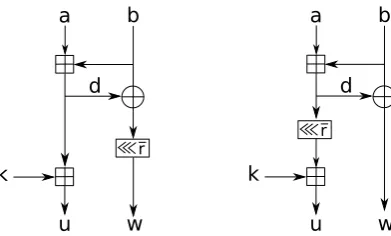
To illustrate the issue, let us focus on two toy ARX primitives given in Fig. 1. Each of them has three inputsa, b, k, two outputsuand w, and uses two modular additions. If the rotation amount r equals 1 and the word size is 64 bits, then by Lemma 1, rotational probability of modular addition is 2−1.415and thus by Theorem 2, rotational probability of both of the primitives should be 2−2.83. Note that for rotation amount of 1, rotational probability of modular addition strongly depends on the value of the most significant bits of the inputs. More precisely, the sum of the most significant bits of the inputs should not be larger than 1.
In the ARX construction on the left of Fig. 1, the two modular additions are chained, i.e. the output of the first is the input to the second. The most significant bit of the word d=a+b, when (a+b)≪1 =a≪1 +b≪1, is biased towards 1. Therefore, the second modular addition u =k+d has rotational probability smaller than the one given by Lemma 1. As the result, Theorem 2 fails to give the correct probability.
a b
k
u w
d
a b
k
u w
d
r r
Fig. 1.Two ARX primitives with equal number of additions but different rotational prob-abilities.
bit and thus the second modular addition d≪ r+k has probability given by Lemma 1. Therefore, in this case, Theorem 2 works as expected.
These two examples suggest that rotational probability of ARX cannot be computed simply by counting the number of modular additions. Instead, one has to investigate the relative positions of modular additions, i.e. if they are chained or separated by rotations. In fact, the longer the chain of modular additions, the lower the rotational probability for each consecutive addition. The rotational probability of chained modular additions is given by the fol-lowing lemma.
Lemma 2 (Chained modular additions). Let a1, . . . , ak be n-bit words chosen at random and let r be a positive integer such that 0< r < n. Then
Pr([(a1+a2)≪r =a1≪r+a2 ≪r]∧
∧[(a1+a2+a3)≪r=a1 ≪r+a2 ≪r+a3≪r]∧ ∧. . .
∧[(a1+. . .+ak)≪r=a1 ≪r+. . .+ak≪r]) =
= 1 2nk
k+ 2r−1
2r−1
k+ 2n−r−1
2n−r−1
Proof. First we consider the rotational probability of addition oflterms:
(a1+a2+. . .+al)≪r=a1≪r+a2 ≪r+. . .+al≪r. (1)
Each of then-bit wordsaican be seen as a concatenation of two words:r-bit word xi and (n−r)-bit word yi, that is, ai = xikyi,|xi| = r,|yi| = n−r. Then (1) becomes:
(x1ky1+. . .+xlkyl)≪r= (x1ky1)≪r+. . .(xlkyl)≪r. (2)
The terms (xikyi) ≪r in the right side of (2), after the rotation onr bits, become (xikyi)≪r =yikxi, thus (2) can be rewritten as:
The sumx1||y1+. . .+xlkyl in the left side of (3) can be expressed as (x1+ . . .+xl+Cy1,...,yl)k(y1+. . .+yl), where Cy1,...,yk is the carry from the sum
y1+. . .+yl. Similarly, the sum in the right side of (3) can be expressed as
(y1+. . .+yl+Cx1,...,xl)k(x1+. . .+xl). Therefore, after the rotation of the
left sum, we obtain:
(y1+. . .+yl)k(x1+. . .+xl+Cy1,...,yl) = (y1+. . .+yl+Cx1,...,xl)k(x1+. . .+xl).
(4) If we take into account the size of the words xi and yi, from (4) we get:
y1+. . .+yl≡y1+. . .+yl+Cx1,...,xl (mod 2
n−r),
x1+. . .+xl+Cy1,...,yl≡x1+. . . xl (mod 2
r),
that is:
Cx1,...xl ≡0 (mod 2
n−r), Cy
1,...,yl≡0 (mod 2
r). (5)
As a result, the rotational probability of l-sum addition is equivalent to the probability that (5) will hold for a random values of xi, yi, i= 1, . . . , l.
The probability of chained modular additions given in the Lemma is there-fore equivalent to the probability of the following system:
Cx1,x2 ≡0 (mod 2
n−r), C
y1,y2 ≡0 (mod 2
r) Cx1,x2,x3 ≡0 (mod 2
n−r), C
y1,y2,y3 ≡0 (mod 2
r) . . .
Cx1,...xk ≡0 (mod 2
n−r
), Cy1,...,yk ≡0 (mod 2
r).
Further we will show that the whole system is equivalent to
Cx1,...xk = 0, Cy1,...,yk = 0. (6)
To do so, we show, by induction on k, that the system of congruences on the left-hand side above, i.e. Cx1,...,xi ≡0 (mod 2
n−r) for all 2 ≤ i ≤ k is equivalent to the equation Cx1,...,xk = 0. The same sequence of reasoning
applies to the right hand side of the above system to show that Cy1,...,yi ≡0
(mod 2r) for all 2≤i≤kis equivalent to the equationC
y1,...yk = 0.
First we deal with the easier reverse direction of the equivalence. Indeed, if Cx1,...xk = b
x1+...+xk
2r c = 0 and hence x1 +. . .+xk < 2r, it follows (by positivity of the xi’s) that x1 +. . . xi < 2r and hence Cx1,...,xi = 0 and
also Cx1,...,xi ≡ 0 (mod 2
n−r) for all 2 ≤ i ≤ k, as required for the reverse direction.
We now prove the forward direction of the equivalence by induction on
k. For the induction base case, we take k = 2.The congruence Cx1,x2 ≡ 0
(mod 2n−r) is equivalent to Cx1,x2 = t·2
n−r for some non-negative integer t. As the carry of addition of two words cannot be larger than 1, it means that Cx1,x2 ∈ {0,1}. If the carry is 1, then from 1 = t·2
Cx1,x2 can only equal zero, and thusCx1,x2 ≡0 (mod 2
n−r) is equivalent to Cx1,x2 = 0, proving the induction base casek= 2.
For the induction step, suppose that for somek≥2 the congruence system Cx1,...,xi ≡0 (mod 2
n−r) for all 2≤i≤k implies the equationC
x1,...xk = 0.
We show that the congruence systemCx1,...,xi ≡0 (mod 2
n−r) for all 2≤i≤
k+1 implies the equationCx1,...xk+1 = 0. Indeed, by the induction hypothesis,
we have that the firstkcongruences of the system imply thatCx1,...,xk = 0 and
hencex1+. . .+xk <2r, whereasxk+1 <2r, sox1+. . . xk+1 <2r+ 2r= 2·2r and thus Cx1,...,xk+1 =b
x1+...+xk+1
2r c ∈ {0,1}. Then, similarly as in the base
case above, the congruence Cx1,...,xk+1 ≡ 0 (mod 2
n−r) and the fact that
r < n imply that the value of the carry Cx1,...,xk+1 must be zero, which
completes the proof of the induction step. As a result, we have reduced the whole system to the two equations given in (6).
Finally, let us find the probability that (6) holds, whenxi, yi, i= 1. . . , k are randomr-bit and (n−r)-bit words, respectively. Namely, we are looking at
Pr(x1+. . . xk<2r∧0≤xi <2r)·Pr(y1+. . . yk <2n−r∧0≤yi<2n−r) (7)
Note that
Pr(x1+. . . xk<2r∧0≤xi <2r) = 2r−1
X
j=0
Pr(x1+. . . xk=j∧0≤xi<2r). (8)
Furthermore, the terms in the right side of (8) can be evaluated according to the well known combinatorial formula
#{z1+. . . zk=j∧0≤zi}=
j+k−1
j
, (9)
Note that in (9), the condition 0≤zi can be replaced with 0≤zi < t when
t > j, as the number of tuples does not increase when zi ≥ t (the sum is
always larger thanj). Therefore
Pr(z1+. . . zk =j∧0≤zi < t∧t > j) =
j+k−1
j
t−k (10)
and (7) can be expressed as:
Pr(x1+. . . xk<2r∧0≤xi<2r)·Pr(y1+. . . yk<2n−r∧0≤yi <2n−r) =
= 2r−1
X
j=0
j+k−1
j
2−rk·
2n−r−1
X
j=0
j+k−1
j
2−(n−r)k=
= 1
2nk 2r−1
X
j=0
j+k−1
j
·
2n−r−1
X
j=0
j+k−1
j
Finally, we use the binomial coefficient formula (for m, n∈N ) m
X
j=0
n+j
j
=
n+m+ 1
m
.
and we conclude the proof
Pr([(a1+a2)≪r =a1≪r+a2 ≪r]∧
∧[(a1+a2+a3)≪r=a1 ≪r+a2 ≪r+a3≪r]∧ ∧. . .
∧[(a1+. . .+ak)≪r=a1 ≪r+. . .+ak≪r]) =
1 2nk
2r−1
X
j=0
j+k−1
j
·
2n−r−1
X
j=0
j+k−1
j = = 1 2nk
k+ 2r−1
2r−1
k+ 2n−r−1
2n−r−1
.
u t
From the above lemma, we obtain the following important result, which forms the basis for our analysis.
Fact 1 Chained modular additions do NOT form a Markov chain with re-spect to rotational differences. Rotational probabilities of chained modular additions cannot be computed as product of probabilities of the individual modular additions.
We used GNU Multiple Precision Floating-Point Reliably library (GNU MPFR) to compute rotational probabilities of chained modular ad-ditions according to the results of Lemma 2. Probabilities for 64-bit words, rotation parameters of 1 and 2 and precision of 10000 digits are given in Ta-ble 1. For instance, when the rotation parameter is 1 and there are 25 chained modular additions, probability that outputs of these 25 additions are rota-tional is 2−109.6. This is to be compared to the claim of Theorem 2, which predicts that probability is 2−1.415·25 ≈ 2−35.4. We note that we have also computed the rotational probabilities when the rotation amount is greater than 2. The discrepancy is present as well, and it has the tendency to grow – the closer the rotation amount to n/2, the larger the discrepancy between the claims of Theorem 2 and of our Lemma 2.
Table 1. The comparison of the rotational probabilities of chained modular additions of 64-bit words given by Theorem 2 of [13], and by our Lemma 2. The probabilities are given log2.
rotation amount : 1
# of additions 1 2 3 4 5 6 7 8
Theorem 2 [13] −1.4 −2.8 −4.2 −5.7 −7.1 −8.5 −9.9 −11.3 Lemma 2 −1.4 −3.6 −6.3 −9.3 −12.7 −16.3 −20.1 −24.1
# of additions 9 10 11 12 13 14 15 16
Theorem 2 [13] −12.7 −14.1 −15.6 −17.0 −18.4 −19.8 −21.2 −22.6 Lemma 2 −28.3 −32.7 −37.1 −41.7 −46.4 −51.3 −56.2 −61.2
# of additions 17 18 19 20 21 22 23 24
Theorem 2 [13] −24.1 −25.5 −26.9 −28.3 −29.7 −31.1 −32.5 −34.0 Lemma 2 −66.3 −71.4 −76.7 −82.0 −87.4 −92.9 −98.4 −104.0
# of additions 25 26 27 28 29 30 31 32
Theorem 2 [13] −35.4 −36.8 −38.2 −39.6 −41.0 −42.4 −43.9 −45.3 Lemma 2 −109.6 −115.3 −121.1 −126.9 −132.8 −138.7 −144.6 −150.6
rotation amount : 2
# of additions 1 2 3 4 5 6 7 8
Theorem 2 [13] −1.7 −3.4 −5.0 −6.7 −8.4 −10.1 −11.7 −13.4 Lemma 2 −1.7 −4.3 −7.5 −11.1 −15.1 −19.4 −23.9 −28.7
# of additions 9 10 11 12 13 14 15 16
Theorem 2 [13] −15.1 −16.8 −18.4 −20.1 −21.8 −23.5 −25.1 −26.8 Lemma 2 −33.6 −38.7 −44.0 −49.4 −54.9 −60.6 −66.3 −72.2
# of additions 17 18 19 20 21 22 23 24
Theorem 2 [13] −28.5 −30.2 −31.8 −33.5 −35.2 −36.9 −38.5 −40.2 Lemma 2 −78.1 −84.2 −90.3 −96.5 −102.8 −109.1 −115.5 −122.0
# of additions 25 26 27 28 29 30 31 32
Theorem 2 [13] −41.9 −43.6 −45.3 −46.9 −48.6 −50.3 −52.0 −53.6 Lemma 2 −128.5 −135.1 −141.8 −148.5 −155.3 −162.1 −169.0 −175.9
a b
k
u w
r
r
a b
k
u w
r
r
Fig. 2.Two ARX primitives with different incorporations of the subkeys: in the ARX on the left the subkey is modularly added hence does not break the chain of modular additions, while in the ARX on the right the subkey is XORed to the state, thus it breaks the chain.
ARX, we have to use Lemma 2 to compute the rotational probability and thus it is much lower.
The correctness of our analysis has been tested using computer simula-tions. Our tests have confirmed the predicted rotational probabilities – we refer to Appendix A for the details of the simulation tests.
4 Applications
Lemma 2 suggests that the rotational probability of ARX can be computed more accurately if we take into account not only the number of additions used in ARX but also their positions. We cluster the additions into chains and calculate the rotational probability as follows:
1. Find all chains of modular additions (including the ones that are com-posed of a single additions) in the ARX primitive.
2. For each chain, compute the rotational probability according to Lemma 2. 3. For the entire primitive, calculate the rotational probability as the
prod-uct of rotational probabilities of chains.
Consider an example of application of the above algorithm to the case of the ARX primitives given in Fig. 1. Our task is to find rotational probabilities of these two primitives when the rotation parameter is 1 (and the word size is 64 bits). The ARX scheme on the left of Fig. 1 has only one chain of two modular additions. Therefore, according to Table 1, the rotational probability of this chain is 2−3.6. On the other hand, the ARX on the right of Fig. 1, has two chains composed of a single modular addition and thus the rotational probability of this scheme is 2−1.4·2−1.4= 2−2.8.
4.1 Application to Rotational Cryptanalysis of BLAKE2
BLAKE2[1] is a hash function, which supports 256 and 512-bit outputs. Fur-ther on we analyze the version with 512-bit output only but we note that similar analysis applies to the other version too. The compression function of BLAKE2is based on a permutationP(V, M), whereV is a state of sixteen 64-bit wordsvi, andM is a message input also composed of sixteen wordsmi. The functionP consists of 12 identical rounds and each round uses 8 applica-tions of the sub-primitive Gi(a, b, c, d) =G(a, b, c, d, mf(i), mg(i)), wheref(i)
g(i) implement a permutation on a set of 16 message words. The primitiveG
is first applied columnwise to 4 columns, and then diagonalwise. The column and diagonal steps are defined, respectively, as:
G0(v0, v4, v8, v12), G1(v1, v5, v9, v13), G2(v2, v6, v10, v14), G3(v3, v7, v11, v15), G4(v0, v5, v10, v15), G5(v1, v6, v11, v12), G(v2, v7, v8, v13), G7(v3, v4, v9, v14).
The function G(a, b, c, d, m1, m2) itself works as follows: 1 :a←a+b+mi 5 : a←a+b+mj 2 :d←(d⊕a)≫32 6 : d←(d⊕a)≫16
3 :c←c+d 7 : c←c+d
4 :b←(b⊕c)≫24 8 : b←(b⊕c)≫63
Rotational cryptanalysis of the BLAKE2 permutation [10] uses the rota-tional parameter equal to 1 (in order to increase the probability) and thus rotational probability of addition is around 2−1.4. Further, it is noted that the functionGhas 6 modular additions thus the expected rotational probability of G is 2−1.4·6 = 2−8.4. The authors also note that the experimental results show that rotational probability is slightly lower or around 2−9.1. They took this as rotational probability of one application of G and because the whole permutation has 12 rounds, each with 8 calls to G, they conclude that ro-tational probability of the permutation used in the compression function of
BLAKE2 is 2−9.1·12·8 = 2−873.6. Since this permutation works for 1024 bits, a rotational distinguisher is claimed for the full 12-round permutation.
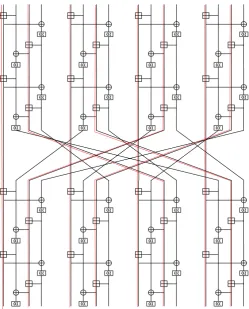
Fig. 3.The 8 chains (denoted in red) of 4 modular additions in one round of the permuta-tion of BLAKE2.
rotational probability smaller than 2−1024. Indeed, Table 1 gives the proba-bility of 2−132.8 for 29 chained modular additions smaller or equal to 2−1062.4. Hence, a rotational distinguisher for the permutation of BLAKE2works for up to 7 rounds only, which is smaller than 12 rounds claimed in [10].
4.2 Application to Rotational Cryptanalysis of Skein
Skein[8] is a hash function proposed for the NIST SHA-3 competition, which reached the final round of the competition. At each round the authors pro-posed some tweaks to the previous version. Here we consider two such ver-sions Skein v1 [6] and Skein v2 [7] and refer to them as Skein, as the attacks [13, 15] target them both. In order to stop rotational attacks, the designers changed the key schedule in v3.
words) are added every 4 rounds. Subkeys are a bitwise linear function of the master key, the tweak value (not to be confused with the submission tweak), and a round counter.
k0 k1 k2 k3 k4 k5 k6 k7
counter MIX
Fig. 4.Four rounds ofThreefishfollowed by a subkey addition. In total,Threefish uses 18 such four rounds. The rounds use different rotation amounts.
The authors also noticed the difference between the theoretical rotational probabilities (Lemma 1) and experimental values. To cope with this problem, they used the experimental value for the 2-round span where the rotational property is required, and a separate value for the local collision part around the subkey injection. Their experiments are well matched with Table 1 and thus are not questioned.
We do not attempt to do rigorous analysis of the corrections method, as it would involve a much more tedious process of taking all constraints and counter properties into account. Instead, we show that a simplified version of the permutation, where all subkeys and counters are set to 0, has far lower rotational probability than expected by Theorem 2.
It is easy to see 4 parallel addition chains on Fig. 4, which cover state words S[0], S[2], S[4], S[6], with one addition per chain per round. We note that the inputs to these additions coming from the other state words undergo rotations and thus can be considered independent. Therefore, for R rounds of Threefish we get 4 chains withR modular additions each. Since there are no constants, we can set the rotation amount to 1 as the most beneficial for the attacker. Table 1 clearly implies that a chain of length 28 has rotational probability smaller or equal to (2−126.9). Therefore, 4 chains over 28 rounds yield the rotational probability around 2−508. Setting the rotation parameter to 2 (as in the previous cryptanalyses of Skein) would reduce the number of attacked rounds to 24 (as (2−122.0)4 = 2−488). For comparison, [15] claims 42-round rotational distinguisher on Skein (with all subkeys and constants included), but with the use of rotational corrections. We cannot disprove these results as our formulas do not apply to the case when rotational corrections are used.
5 Conclusion
We have shown that the rotational probability of ARX depends not only on the number of modular additions, but also on how they are connected. The rotational probability of a chain of modular additions cannot be computed as a product of probabilities of the individual additions. This is because the Markov cipher assumption, used implicitly for computing the probability in such a way, does not hold. Therefore, the chain of additions cannot be a Markov chain with respect to rotational analysis, and thus its probability is lower and is defined by Lemma 2. Our analysis also suggests that the way the subkeys are incorporated into the cipher can influence the rotational probability not only because modular added subkeys simply increase the total number of additions, but because XORed subkeys can break the addition chains and thus can increase the probability.
round of Keccak, there is a very strong diffusion, and, moreover, each of the 25 words goes through a rotation. Therefore the rotational probability in the attacks on Keccak [19] is correct. On the other hand, the assumption used the rotational analysis of NORX [12] is clearly not valid (see Appendix B) as the diffusion in the rounds of NORX does not introduce sufficient entropy at the inputs of the non-linear operations. Hence, the probability of the rotational analysis of NORX [12] is miscalculated3.
To summarize, the rotational probability of a cryptographic primitive not necessarily equals to the product of the rotational probabilities of the indi-vidual operations used in the primitive. Such shortcut in the estimation of probability gives neither upper nor lower bound on the actual probability. The estimation can be used only after confirming that the Markov assump-tion applies to the primitive. Otherwise, the rotaassump-tional probability must be computed ad-hoc.
Acknowledgements. The authors would like to thank the anonymous re-viewers of FSE’15 for very helpful comments and suggestions. Ivica Nikoli´c is supported by the Singapore National Research Foundation Fellowship 2012 (NRF-NRFF2012-06). Josef Pieprzyk was supported by Australian Research Council grant DP0987734.
References
1. J. Aumasson, S. Neves, Z. Wilcox-O’Hearn, and C. Winnerlein. BLAKE2: simpler, smaller, fast as MD5. In M. J. J. Jr., M. E. Locasto, P. Mohassel, and R. Safavi-Naini, editors,Applied Cryptography and Network Security - 11th International Conference, ACNS 2013, Banff, AB, Canada, June 25-28, 2013. Proceedings, volume 7954 of Lec-ture Notes in Computer Science, pages 119–135. Springer, 2013.
2. E. Biham and A. Shamir. Differential cryptanalysis of DES-like cryptosystems. J. Cryptology, 4(1):3–72, 1991.
3. E. Bresson, A. Canteaut, B. Chevallier-Mames, C. Clavier, T. Fuhr, A. Gouget, T. Icart, J.-F. Misarsky, M. Naya-Plasencia, P. Paillier, et al. Shabal, a submission to NISTs cryptographic hash algorithm competition. Submission to NIST, 2008.
4. C. D. Canni`ere and C. Rechberger. Finding SHA-1 characteristics: General results and applications. In X. Lai and K. Chen, editors,Advances in Cryptology - ASIACRYPT 2006, 12th International Conference on the Theory and Application of Cryptology and Information Security, Shanghai, China, December 3-7, 2006, Proceedings, volume 4284 ofLecture Notes in Computer Science, pages 1–20. Springer, 2006.
5. M. Daum. Cryptanalysis of Hash Functions of the MD4-Family. PhD thesis, Ruhr-Universit¨at Bochum, May 2005.
6. N. Ferguson, S. Lucks, B. Schneier, D. Whiting, M. Bellare, T. Kohno, J. Callas, and J. Walker. The Skein hash function family. Submission to NIST (Round 1), 2008. 7. N. Ferguson, S. Lucks, B. Schneier, D. Whiting, M. Bellare, T. Kohno, J. Callas, and
J. Walker. The Skein hash function family. Submission to NIST (Round 2), 2009. 8. N. Ferguson, S. Lucks, B. Schneier, D. Whiting, M. Bellare, T. Kohno, J. Callas, and
J. Walker. The Skein hash function family. 2010.
9. B. G´erard, V. Grosso, M. Naya-Plasencia, and F. Standaert. Block ciphers that are easier to mask: How far can we go? In G. Bertoni and J. Coron, editors,Cryptographic Hardware and Embedded Systems - CHES 2013 - 15th International Workshop, Santa Barbara, CA, USA, August 20-23, 2013. Proceedings, volume 8086 ofLecture Notes in Computer Science, pages 383–399. Springer, 2013.
10. J. Guo, P. Karpman, I. Nikoli´c, L. Wang, and S. Wu. Analysis of BLAKE2. In J. Be-naloh, editor,Topics in Cryptology - CT-RSA 2014 - The Cryptographer’s Track at the RSA Conference 2014, San Francisco, CA, USA, February 25-28, 2014. Proceedings, volume 8366 ofLecture Notes in Computer Science, pages 402–423. Springer, 2014. 11. J. Guo, T. Peyrin, A. Poschmann, and M. J. B. Robshaw. The LED block cipher. In
B. Preneel and T. Takagi, editors, Cryptographic Hardware and Embedded Systems -CHES 2011 - 13th International Workshop, Nara, Japan, September 28 - October 1, 2011. Proceedings, volume 6917 ofLecture Notes in Computer Science, pages 326–341. Springer, 2011.
12. P. Jovanovic, S. Neves, and J. Aumasson. Analysis of NORX: Investigating differential and rotational properties. Latincrypt, 2014. To appear.
13. D. Khovratovich and I. Nikoli´c. Rotational cryptanalysis of ARX. In S. Hong and T. Iwata, editors,Fast Software Encryption, 17th International Workshop, FSE 2010, Seoul, Korea, February 7-10, 2010, Revised Selected Papers, volume 6147 of Lecture Notes in Computer Science, pages 333–346. Springer, 2010.
14. D. Khovratovich, I. Nikoli´c, and C. Rechberger. Rotational rebound attacks on re-duced Skein. In M. Abe, editor, Advances in Cryptology - ASIACRYPT 2010 - 16th International Conference on the Theory and Application of Cryptology and Information Security, Singapore, December 5-9, 2010. Proceedings, volume 6477 ofLecture Notes in Computer Science, pages 1–19. Springer, 2010.
15. D. Khovratovich, I. Nikoli´c, and C. Rechberger. Rotational rebound attacks on reduced Skein. J. Cryptology, 27(3):452–479, 2014.
16. A. Kircanski, Y. Shen, G. Wang, and A. M. Youssef. Boomerang and slide-rotational analysis of the SM3 hash function. In L. R. Knudsen and H. Wu, editors,Selected Areas in Cryptography, 19th International Conference, SAC 2012, Windsor, ON, Canada, August 15-16, 2012, Revised Selected Papers, volume 7707 ofLecture Notes in Computer Science, pages 304–320. Springer, 2012.
17. X. Lai and J. L. Massey. Markov ciphers and differentail cryptanalysis. In D. W. Davies, editor, Advances in Cryptology - EUROCRYPT ’91, Workshop on the The-ory and Application of of Cryptographic Techniques, Brighton, UK, April 8-11, 1991, Proceedings, volume 547 ofLecture Notes in Computer Science, pages 17–38. Springer, 1991.
18. G. Leurent. Analysis of differential attacks in ARX constructions. In X. Wang and K. Sako, editors, Advances in Cryptology - ASIACRYPT 2012 - 18th International Conference on the Theory and Application of Cryptology and Information Security, Beijing, China, December 2-6, 2012. Proceedings, volume 7658 of Lecture Notes in Computer Science, pages 226–243. Springer, 2012.
19. P. Morawiecki, J. Pieprzyk, and M. Srebrny. Rotational cryptanalysis of round-reduced Keccak. In S. Moriai, editor,Fast Software Encryption - 20th International Workshop, FSE 2013, Singapore, March 11-13, 2013. Revised Selected Papers, volume 8424 of Lecture Notes in Computer Science, pages 241–262. Springer, 2013.
20. I. Nikoli´c, J. Pieprzyk, P. Soko lowski, and R. Steinfeld. Rotational cryptanalysis of (modified) versions of BMW and SIMD, 2010.
21. M. Stevens. New collision attacks on SHA-1 based on optimal joint local-collision analysis. In T. Johansson and P. Q. Nguyen, editors,Advances in Cryptology - EURO-CRYPT 2013, 32nd Annual International Conference on the Theory and Applications of Cryptographic Techniques, Athens, Greece, May 26-30, 2013. Proceedings, volume 7881 ofLecture Notes in Computer Science, pages 245–261. Springer, 2013.
23. X. Wang, Y. L. Yin, and H. Yu. Finding collisions in the full SHA-1. In V. Shoup, editor,Advances in Cryptology - CRYPTO 2005: 25th Annual International Cryptology Conference, Santa Barbara, California, USA, August 14-18, 2005, Proceedings, volume 3621 ofLecture Notes in Computer Science, pages 17–36. Springer, 2005.
24. X. Wang and H. Yu. How to break MD5 and other hash functions. In R. Cramer, editor, Advances in Cryptology - EUROCRYPT 2005, 24th Annual International Conference on the Theory and Applications of Cryptographic Techniques, Aarhus, Denmark, May 22-26, 2005, Proceedings, volume 3494 ofLecture Notes in Computer Science, pages 19–35. Springer, 2005.
A Computer Simulations of Rotational Attacks
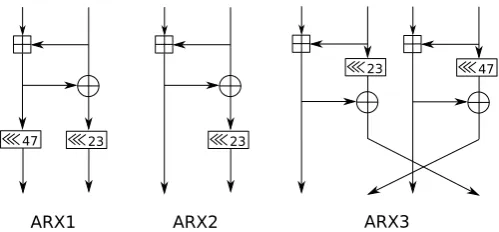
We tested the rotational probabilities predicted by our Lemma 2 and the new algorithm on the case of three ARX primitives with round functions given in Fig. 5. The first ARX has no chains of modular additions, i.e. all chains are
23
47 23
23 47
ARX1 ARX2 ARX3
Fig. 5. The round functions of three ARX primitives used for testing the experimental rotational probabilities.
broken by rotations and/or XORs. The second ARX has one chain of modular additions through the rounds. The third ARX has has two chains and is in fact based on the cipher Threefish-256 (but without subkey additions and counters and with modified rotations). For each of the three ARX primitives, we obtained experimentally the rotational probabilities by taking 232random rotational pairs of inputs (with rotation amounts 1 and 2), and counting how many output pairs were also rotational. The outcomes of our computer simulations are summarized in Tbl. 2. From the table we can see that the experimental probabilities matched our predicted probabilities.
B On the Rotational Analysis of NORX
Table 2. The comparison of the theoretical and experimental rotational probabilities of the tree ARX primitives from Fig. 5. The probabilities are given log2.npstands for not performed – when the theoretical probabilities were below 2−32we did not run the experi-ments.
rotation amount : 1
# of rounds 3 4 5 6 7 8
ARX1 theoretical −4.25 −5.66 −7.08 −8.49 −9.91 −11.32 ARX1 experimental −4.25 −5.66 −7.08 −8.49 −9.91 −11.32 ARX2 theoretical −6.26 −9.32 −12.68 −16.30 −20.13 −24.15 ARX2 experimental −6.26 −9.32 −12.69 −16.30 −20.15 −24.15 ARX3 theoretical −12.53 −18.64 −25.37 −32.60 −40.26 −48.29 ARX3 experimental −12.52 −18.61 −25.16 np np np
rotation amount : 2
# of rounds 1 2 3 4 5 6
ARX1 theoretical −1.68 −3.35 −5.03 −6.70 −8.38 −10.06 ARX1 experimental −1.68 −3.35 −5.03 −6.71 −8.39 −10.07
ARX2 theoretical −1.68 −4.26 −7.46 −11.10 −15.10 −19.39 ARX2 experimental −1.68 −4.26 −7.46 −11.10 −15.11 −19.38
ARX3 theoretical −3.36 −8.53 −14.91 −22.20 −30.20 −38.78 ARX3 experimental −3.36 −8.53 −14.91 −22.25 −29.68 np
1 : a←(a⊕b)⊕((a∧b)1) 5 : a←(a⊕b)⊕((a∧b)1) 2 : d←(a⊕d)≫r0 6 : d←(a⊕d)≫r0
3 : c←(c⊕d)⊕((c∧d)1) 7 : c←(c⊕d)⊕((c∧d)1) 4 : b←(b⊕c)≫r1 8 : b←(b⊕c)≫r1
Among all the transformation in the round, obviously only
H(x, y) = (x∧y)1
does not preserve the rotational property with probability 1. In fact, in [12] it has been proven that the rotational probability of this non-linear function is 9/16. Then, similar to the previous analysis of ARX, the authors counted only the number of applications of H(x, y) per round of NORX (which is 32, as there are 8 applications of Gand each of them applies H(x, y) 4 times), and computed the rotational probabilities of NORX reduced(or extended) to R rounds as (9/16)32·R.
This probability estimation is correct only under the Markov cipher as-sumption. However, this assumption does not hold in the case of NORX. The reason for this is as follows. As in [12], let us assume that the rotation is to the right (and the rotation amount is arbitrary, i.e. 0< r <64). A given pair of words (a, b) composes a rotational pair forH, i.e.
H(a, b)≫r=H(a≫r, b≫r)
proven in [12], and actually gives a hint where the probability 9/16 comes from – obviously the bit equation z∧t= 0 holds with probability 3/4 when z and t are random. Therefore, when a63, b63, ar−1, br−1 are random, then
H(a, b)≫r=H(a≫r, b≫r) with probability 9/16.
But what happens aftera, bcompose a rotational pair? Let us only focus on the value of the most significant bitsa63 and b63. From the rotational re-quirement ofH it follows that only the values (0,0),(0,1),(1,0) for (a63, b63) will satisfya63∧b63= 0. Furthermore, the value ofais updated inG accord-ing to:
a= (a⊕b)⊕((a∧b)1).
Let us focus only on the value of a63, i.e.:
a63=a63⊕b63⊕(a62∧b62)
The term a63⊕b63 as we have seen from above (from the rotational re-quirement, we take only the values of three possible (0,0),(0,1),(1,0)) is 0 with probability 1/3 and 1 with probability 2/3. On the other hand, the term a62∧ b62 takes the value of 0 with probability 3/4 and 1 with 1/4 (we assume a62, b62 are random bits when r 6= 63). Therefore, the value of a63 is 0 with probability 5/12 and 1 with 7/12, i.e. it is biased towards 1. Hence in the next update of a (where a will be used), the value of this bit is not completely random, and it will contribute towards reducing the rota-tional probability ofH (because the rotational probability is lower when the value of a63 one). Instead of the predicted 9/16 the probability will reduce to 3/4·(5/12 + 5/12 + 7/12)·1/2 = 51/96.
![Table 1. The comparison of the rotational probabilities of chained modular additions of64-bit words given by Theorem 2 of [13], and by our Lemma 2](https://thumb-us.123doks.com/thumbv2/123dok_us/7946766.1318986/11.595.117.479.154.516/table-comparison-rotational-probabilities-chained-modular-additions-theorem.webp)