ISSN 2348 – 7968
Dynamical Behavior in a Discrete Three Species Prey-Predator
System
A.George Maria Selvam1, R. Dhineshbabu2 and V.Sathish3
1,3
Sacred Heart College, Tirupattur – 635 601, S.India.
2DMI College of Engineering, Chennai - 600 123, S.India.
ABSTRACT
This paper investigates the dynamical behavior of a discrete prey-predator system with three species. Stability analysis is performed and analytical results are illustrated with numerical simulations. Time series plots and phase portraits are obtained for different sets of parameter values. Bifurcation diagrams are provided for selected range of growth parameter.
Keywords: Discrete prey - predator system, difference equations, equilibrium points, stability.
1. I
NTRODUCTIONSimple models of food webs may exhibit very complex dynamics. The Lotka – Volterra equations [4] (ODE) successfully described an ecological predator – prey model and the oscillations in their populations. In recent decades, many researchers [1, 3, 6, 7, 9] have focused on the ecological models with three and more species to understand complex dynamical behaviors of ecological systems in the real world. They have demonstrated very complex dynamic phenomena of those models, including cycles, periodic doubling and chaos [1, 2]. The dynamical behavior and stability analysis of nonlinear discrete prey-predator and host parasite model has been studied. The discrete time models which are usually described by difference equations can produce much richer patterns [2, 4, 5, 8]. Discrete time models are ideally suited to describe the population dynamics of species, which are characterized by discrete generations.
2.
M
ATHEMATICALM
ODELIn this paper, we consider the discrete-time prey-predator system describing the interactions among three species by the following system of difference equations:
( 1) ( ) [1 ( )] ( ) ( ) ( 1) (1 ) ( ) ( ) ( ) ( ) ( )
( 1) (1 ) ( ) ( ) ( ) (1)
x t r x t x t bx t y t y t c y t dx t y t ey t z t z t f z t gy t z t
+ = − −
+ = − + −
+ = − +
where x t( ), y t( ) and z t( ) are functions of time
representing population densities of the prey and the mid-predator and the top mid-predator, respectively, and all parameters are positive constants. The parameter
r
is theintrinsic growth rates of the prey population,
b
is the per capita rate of predation of the mid-predator,c
denotes the death rate of the mid-predator,d
is the rate of conversion of a consumed prey to a predator,e
is the per-capita rate of predation of the top predator,f
denotes the death rate of the top predator,g
is the rate of conversionof a consumed prey to a predator.
3.
E
XISTENCEO
FE
QUILIBRIUMThe equilibrium points of (1) are the solution of the equations
[1 ]
(1 )
(1 ) .
x r x x b x y y c y dx y eyz
z f z gyz
= − −
= − + −
= − +
The equilibrium points are
E0 =(0, 0, 0), 1
1 1 , 0, 0 , E r = − 2
( ) 1
, , 0
c r d c E
d bd b
−
= −
and
(
)
* * *
3 , , .
E = x y z
where,
* 1
1 1 bf ,
x r g = − + * , and f y g = * 1 .
d c d bf
z
e re g
−
= − +
Interior equilibrium point
E
3 corresponds to the coexistence of all species.4.
D
YNAMICALB
EHAVIORO
FT
HEM
ODEL In this section, we study the local behavior of the system (1) about each equilibrium points. The stability of the system (1) is carried out by computing the Jacobian matrix corresponding to each equilibrium point. The Jacobian Matrix J for the system (1) is2 0
( , , ) 1 . (2)
0 1
r rx by bx
J x y z dy c dx ez ey
gz f gy
− − − = − + − − − +
The determinant of the Jacobian
J x y
( , )
is(1 )[ (1 2 )(1 ) (1 )].
ISSN 2348 – 7968
Hence the system (1) is dissipative dynamical system when
(1− +f gy r)[ (1 2 )(1− x − +c dx)−by(1−c)] <1.
Theorem 1: The equilibrium point
E
0 is locally asymptotically stable if r<1 , 0< <c 2 and0< f <2, otherwise unstable equilibrium point.
Proof: In order to prove this result, we determine the eigenvalues of Jacobian matrix J at
E
0. The Jacobianmatrix evaluated at the equilibrium point
E
0 has theform
0
0 0
( ) 0 1 0 .
0 0 1
r
J E c
f = − −
Hence the eigenvalues of the matrix
0
(
)
J E
areλ
1=
r
,
λ
2= −
1
c
andλ
3= −
1
f
.
Thus0
E
is stable whenr
<
1
,0
< <
c
2
and0
< <
f
2
.Otherwise
E
0is unstable equilibrium point.Theorem 2: The equilibrium point
E
1 is locally asymptotically stable if1
< <
r
3
,d
r
d
c
<
−
and0
< <
f
2
, otherwise unstable equilibrium point.Proof: The Jacobian matrix J for the system evaluated at the equilibrium point
E
1 is given by1
1
2 1 0
1
( ) 0 1 1 0 .
0 0 1
r b
r
J E c d
r f − − = − + − −
Hence the eigenvalues of the matrix
J E
(
1)
are1
2
r
,
λ
= −
21
1
c d
1
r
λ
= − +
−
andλ
3= −
1
f
.Hence
E
1 is locally asymptotically stable when1
< <
r
3
,r
d
d
c
<
−
and0
< <
f
2
, and unstablewhen
r
>
3
,r d d c>
− and
f
>
2
.Theorem 3: The equilibrium point
E
2 is locallyasymptotically stable if ( )
( )
d d bf g
r
d c g d c
+ < <
− − , otherwise
unstable equilibrium point.
Proof: The Jacobian matrix evaluated at
E
2is given by2
1 0
( ) ( )
( ) 1 .
( )
0 0 1
rc bc
d d
r d c d e re d c
J E
b b bd
gr d c g f bd b − − − − − = − − − + −
Hence the eigenvalues of the matrix
J E
(
2)
are1
(
)
1
f
g
gr
d
c
b
bd
λ
= − − +
−
and2,3
1
1
4
(
)
2 24
22
2
cr
cdr c d
c r
cd
d
d
λ
= −
±
−
+
+
.Hence
E
2 is locally asymptotically stablewhen ( )
( )
d d bf g
r
d c g d c
+ < <
− − , and unstable when
d r d c > − or ( ) ( )
d bf g r
g d c
+ >
− .
5.
L
OCALS
TABILITYA
NDD
YNAMICALB
EHAVIORA
ROUNDI
NTERIORF
IXEDP
OINTE
3We now investigate the local stability and
bifurcation of interior fixed point
E
3 . The Jacobianmatrix J at
E
3has of the form11 12 13
3 21 22 23
31 32 33
( ) . (3)
a a a
J E a a a
a a a
=
where,
a
112
r
bf
g
= − +
,a
12b
1
bf
b
r
g
=
+
−
,13
0
a
=
,a
21df
g
=
,
a
22=
1
, 23fe
a
g
= −
,31
0
a
=
,a
32g d
(
c
)
d g
(
bf
)
e
re
−
+
=
−
,a
33=
1
.Its characteristic equation is
3 2
0
(4)
A
B
C
ISSN 2348 – 7968
with
11 12 13
11 33 22 33 11 22 12 21 23 32
12 21 11 22 33 11 23 32
(
),
,
(
)
.
A
a
a
a
B
a a
a a
a a
a a
a a
C
a a
a a
a
a a a
= −
+
+
=
+
+
−
−
=
−
+
By the Routh-Hurwitz criterion,
E
3=
(
x
*,
y z
*,
*)
is locally asymptotically stable if and only ifA C
, ,
andAB C
−
are positive.6. N
UMERICALS
IMULATIONSIn this section, we present the time plots, phase portraits and bifurcation diagrams to illustrate the theoretical analysis and show the interesting complex dynamical behaviors of the system (1).
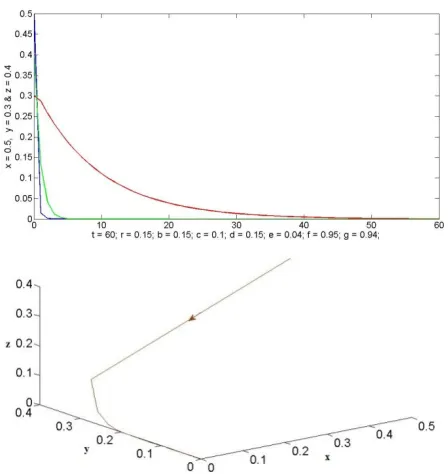
Example1: We shall consider r=0.15,b=0.15,c=0.1, 0.15, 0.04, 0.95
d = e= f = andg=0.94. At
equilibrium point
E
0, the eigenvalues areλ
1=
0.15,
2
0.9
λ =
andλ
3=
0.05
so thatλ
1,2,3<
1
. Hence the trivial equilibrium point is stable (see Figure-1).Figure 1: Time Series Plot and Phase Portrait at E0.
Example2: We shall consider the parameter values 1.1, 0.65, 0.1, 0.5, 1.14,
r= b= c= d = e= f =0.5 and
0.4
g = . The equilibrium point
E
1=
(0.091, 0, 0)
and the eigenvalues areλ
1=
0.9
λ
2=
0.945 and
λ
3=
0.5
so that
λ
1,2,3<
1
. Hence system (1) is stable (seeFigure-2).
Figure 2: Time Series Plot and Phase Portrait at E1.
Example3: We shall consider the parameter values 1.5, 0.65, 0.1, 0.5, 1.14,
r= b= c= d= e= f =0.5 and
0.4
g = . The equilibrium point
E
2=
(0.2, 0.308, 0)
and the eigenvalues are
λ
1=
0.623,
λ
2=
0.9
and3
0.8
λ =
so thatλ
1,2,3<
1
. Thus system (1) is stable (see Figure-3).ISSN 2348 – 7968
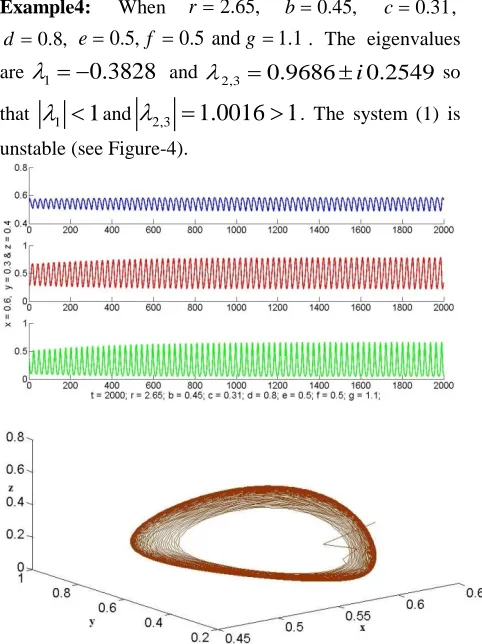
Example4: When r=2.65, b=0.45, c=0.31, 0.8,
d= e=0.5, f =0.5 and 1.1g= . The eigenvalues are
λ
1= −
0.3828
andλ
2,3=
0.9686
±
i
0.2549
so thatλ
1<
1
andλ
2,3=
1.0016
>
1
. The system (1) isunstable (see Figure-4).
Figure 4: Time Series Plot and Phase Portrait at E3.
While with r=2.5,e=0.55 and keeping all other
parameters same, we obtain E3=(0.518, 0.454, 0.191) and the eigenvalues are
λ
1= −
0.2288
and
λ
2,3=
0.9667
±
i
0.2329
so thatλ
1<
1
and2 ,3 0.9943 1
λ = < . We observe the system (1) is stable (see Figure-5).
Figure 5: Time Series Plot and Phase Portrait at E3.
7.
B
IFURCATIONA
NALYSIS VIAN
UMERICALS
IMULATIONSBifurcation is a change of the dynamical behaviors of the system as its parameters pass through a bifurcation (critical) value. Bifurcation usually occurs when the stability of an equilibrium changes. In this section, we focus on exploring the possibility of chaotic behavior for the prey and the mid-predator and the top predator respectively.
Figure 6: Bifurcation diagrams for (a) prey population, (b) mid-predator population and (c) top predator.
Figure (6) presents the bifurcation diagram for prey and the mid-predator and the top predator densities of the system (1) with initial conditions x=0.6,y=0.3 and
0.4
z= as above and we consider the parameters values 0.5 , 0.31,
ISSN 2348 – 7968
References
[1] Abd-Elalim A. Elsadany, Dynamical complexities in a discrete-time food chain, Computational Ecology and Software, 2012, 2(2):124-139.
[2] H.N. Agiza, E.M. Elabbasy, H. EL-Metwally, A.A. Elsadany, Chaotic dynamics of a discrete prey predator model with Holling type II, Nonlinear Analysis: Real World Applications 10 (2009) 116-129.
[3] H. I. Freedman and P.Waltman, “Persistence in models of three interacting predator-prey populations,” Mathematical Biosciences, vol. 68, no. 2, pp. 213–231, 1984.
[4] Leah Edelstein-Keshet, Mathematical Models in Biology, SIAM, Random House, New York, 2005.
[5] Marius Danca, Steliana Codreanu and Botond Bako, Detailed Analysis of a Nonlinear Prey-predator Model, Journal of Biological Physics 23: 11-20, 1997.
[6] R. K. Naji and A. T. Balasim, “Dynamical behavior of a three species food chain model withBeddington-DeAngelis functional response,” Chaos, Solitons & Fractals, vol. 32, no. 5, pp. 1853–1866, 2007.
[7] Raid Kamel Naji and Alaa Jabbar Badai, A three species ratio-dependent food web model dynamics, Journal of Basrah Researches (Sciences) Volume 37, Number 4 .D, 2011. [8] M.Reni Sagayaraj, A.George Maria Selvam, R.Janagaraj.and D.Pushparajan, Dynamical Behavior in a Discrete Prey- Predator Interactions, International Journal of Engineering Science and Innovative Technology (IJESIT) Volume 2, Issue 2, March 2013, ISSN: 2319-5967, pp 311 – 316.