Secure Binary Field Multiplication
⋆Hwajeong Seo1, Chien-Ning Chen2, Zhe Liu2, Yasuyuki Nogami3,
Taehwan Park1, Jongseok Choi1, and Howon Kim1⋆⋆
1
Pusan National University, School of Computer Science and Engineering,
San-30, Jangjeon-Dong, Geumjeong-Gu, Busan 609–735, Republic of Korea {hwajeong,pth5804,jschoi85,howonkim}@pusan.ac.kr
2
Nanyang Technological University,
Physical Analysis & Cryptographic Engineering (PACE), {chienning}@ntu.edu.sg
3 University of Luxembourg,
Laboratory of Algorithmics, Cryptology and Security (LACS), 6, rue R. Coudenhove-Kalergi, L–1359 Luxembourg-Kirchberg, Luxembourg
{zhe.liu}@uni.lu
4
Okayama University,
Graduate School of Natural Science and Technology, 3-1-1, Tsushima-naka, Kita, Okayama, 700-8530, Japan
{yasuyuki.nogami}@okayama-u.ac.jp
Abstract. Binary field multiplication is the most fundamental
build-ing block of binary field Elliptic Curve Cryptography (ECC) and Ga-lois/Counter Mode (GCM). Both bit-wise scanning and Look-Up Table (LUT) based methods are commonly used for binary field multiplication. In terms of Side Channel Attack (SCA), bit-wise scanning exploits inse-cure branch operations which leaks information in a form of timing and power consumption. On the other hands, LUT based method is regarded as a relatively secure approach because LUT access can be conducted in a regular and atomic form. This ensures a constant time solution as well. In this paper, we conduct the SCA on the LUT based binary field multi-plication. The attack exploits the horizontal Correlation Power Analysis (CPA) on weights of LUT. We identify the operand with only a power trace of binary field multiplication. In order to prevent SCA, we also suggest a mask based binary field multiplication which ensures a regular and constant time solution without LUT and branch statements.
Keywords: Binary Field Multiplication, Embedded Processors, Side
Channel Attack, Horizontal Correlation Power Analysis
⋆This work was partly supported by Institute for Information &
communica-tions Technology Promotion(IITP) grant funded by the Korea government (MSIP) (No.10043907, Development of high performance IoT device and Open Platform with Intelligent Software) and the MSIP (Ministry of Science, ICT and Future Plan-ning), Korea, under the ITRC(Information Technology Research Center) support program (IITP-2015-H8501-15-1017) supervised by the IITP(Institute for Informa-tion & communicaInforma-tions Technology PromoInforma-tion).
⋆⋆
1
Introduction
Elliptic Curve Cryptography (ECC) scalar multiplication (point addition and doubling) consists of field arithmetic including addition/subtraction, multipli-cation/squaring and inversion [9]. Of these operations, multiplimultipli-cation/squaring is the most performance-critical operations of point addition and doubling. Any efforts spent in optimizing these operations are deserved. The binary field mul-tiplication is normally established with a combination of exclusive-or and bit-shift operations. The advanced binary field implementations achieved remark-ably good performance by reducing the number of partial products and replacing bit operations into consecutive look-up table accesses known as Lopez et al.’s method [12, 14, 17]. The alternative approach, Block-Comb based multiplication, is introduced in [18]. Several operands are grouped in block-wise and multiple operands are computed at once. Later, an unbalanced fashion of Block-Comb method is presented by Seo et al. in [15]. This method increases the size of block by exploiting the additional registers with instruction set level optimiza-tion techniques and then computes the multiplicaoptimiza-tion in block-wise way as like former Block-Comb approaches. There is nice way to reduce the multiplication overheads into sub-quadratic complexity known as Karatsuba algorithm. This method efficiently replaces multiplication into several addition and subtraction operations. There exist several papers which have considered the Karatsuba’s technique for speeding-up the performance of binary field multiplication over embedded processors. Lopez et al. in [12] conducts Karatsuba multiplication with look-up table accesses. This trial reduces the number of multiplication but it increases overheads for constructing the look-up table which is beyond bene-fits of Karatsuba approach. Oliveira et al. in [14] also mentioned that Lopez et al.’s normal method is faster than Karatsuba’s multiplication by a factor of 44%. Recently, an alternative combination of Karatsuba algorithm and Block-Comb method is introduced [16]. The method exploits 3-term Karatsuba and reduces 3 63-bit partial products out of 9. The results show high performance gains in 163-bit Koblitz curve. There is relatively few number of papers considering Side Channel Attack (SCA) on these binary field multiplication. While the fastest implementations over embedded processors were a quite important factor in the past, because implementations of binary field ECC over embedded processor were too slow due to limited computing power and storages. However without secure implementations against side channel attack, practical applications are limited [3, 2, 11]. In this paper, we explore all binary field multiplication on em-bedded processors in terms of side channel attack and show the vulnerability of LUT based binary field multiplication as well. Lastly, we introduce a secure mask based binary field multiplication.
Summary of Research Contributions
The main contributions of our work are summarized as follows.
hor-Secure Binary Field Multiplication 3
izontal Correlation Power Analysis (CPA) on weights of LUT. The method successfully extracts the correlation co-efficient from power traces of binary field multiplication and identifies the operands used in the operations. 2. Develop the secure binary field multiplication techniques. Unlike previous
binary field multiplication methods, we designed a new mask based binary field multiplication. Since this regular and atomic method is branch-free and LUT-free, proposed method is much secure against simple power analysis than previous approaches. In order to boost the performance, we exploit several levels of Karatsuba multiplication.
The remainder of this paper is organized as follows. In Section 2, we overview the previous binary field multiplication methods. In Section 3, we point out the vulnerability of previous approaches in terms of side channel attack and show our side channel attack results on LUT based binary field multiplication. In Section 4, we present a mask based binary field multiplication. Finally, Section 5 concludes the paper.
2
Binary Field Multiplications
The look-up table based binary field multiplication, introduced in [12, 14], re-places the bit operations into look-up table access operations. In order to utilize the method, we should compute the look-up table by one operand and place them into memory as pre-computed results. Typically, the range is chosen to 4,
indicating a 4-bit value (0x0∼0xf) for 16 (24) cases. The look-up table occupies
memory size at least 16×m, where mis size of operands. After generating the
al.’s method but it increases overheads for constructing the look-up table in on-line which is beyond benefits of Karatsuba approach. Oliveira et al. in [14] also mentioned that original Lopez et al.’s method is faster than Karatsuba’s multi-plication by a factor of 44%. Since Karatsuba method divides long integers into half and conducts multiplication operations on them, as many as we divide mul-tiplication blocks, the pre-computation costs significantly increase. Block-Comb method is grouping several bytes of the operand into a block and then computes the multiplication in block-wise fashion. A Karatsuba Block-Comb (KBC) firstly groups the operand and then Karatsuba multiplication is conducted in block-wise fashion. However, the Block-Comb approach is vulnerable toward timing attacks. The computation time is highly relied on bit setting. In order to remove the timing information, constant time solution was introduced. In the method, each bit is evaluated and conduct operations in a regular timing. If the bit is set, it conduct bit-wise exclusive-or with operand. Otherwise it conducts bit-wise exclusive-or with zero register. Even though this method eliminates the timing information, it still leaks power consumption from branch operations.
3
Side Channel Attacks on Binary Field Multiplications
Real world multiplication can be conducted with dedicated 8-, 16-, or 32-bit mul-tipliers of Arithmetic Logic Unit (ALU). In terms of binary field multiplication, high-end processors such as ARM and Intel chip-sets support polynomial mul-tiplier. However, low-end 8-bit and 16-bit embedded processors do not support polynomial multiplications yet. In order to get acceptable speed performance over low-end devices, previous binary field multiplication operations exploit the basic logical operations or LUT computations. However, the works mainly focus on speed optimizations rather than secure implementations which expose infor-mation leakages. In this paper, we conduct the side channel attacks on binary
field multiplication over the popular embedded board namedARDUINO UNOwith
the 8-bit 16MHz AVR microcontroller Atmega328p. An AVR processor, such as the Atmel ATmega series, features 32 general-purpose registers, of which six are
used for pointers. In particular, the register pair (R26,R27) is aliased asXpointer,
the register pair (R28,R29) is aliased asYpointer, and the register pair (R30,R31)
is aliased as Z pointer. The AVR microcontrollers have separate memories and buses for program and data. It has a total of 133 instructions and each
instruc-tion has a fixed latency. Ordinary arithmetic/logical instrucinstruc-tions (e.g.add) are
executed in a single clock cycle, while a mulinstruction takes two clock cycles,
and alsoload/store instructions take two cycles. Most of the software
imple-mentation on AVR processors is written in both mixed C and Assembly code. The function-call specifies that the first three 16-bit arguments (e.g., pointers)
are passed in register pairs (R24, R25), (R22,R23), and (R21,R20). It
further-more specifies that registersR2-R17,R28, andR29are “called- saved” registers,
and the register R1 is assumed by the compiler to always contain zero thus
Secure Binary Field Multiplication 5
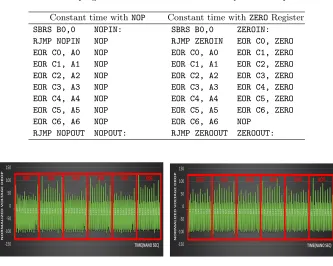
Table 1.AVR program codes for constant time binary field multiplication
Constant time withNOP Constant time withZERORegister SBRS B0,0 NOPIN: SBRS B0,0 ZEROIN:
RJMP NOPIN NOP RJMP ZEROIN EOR C0, ZERO EOR C0, A0 NOP EOR C0, A0 EOR C1, ZERO EOR C1, A1 NOP EOR C1, A1 EOR C2, ZERO EOR C2, A2 NOP EOR C2, A2 EOR C3, ZERO EOR C3, A3 NOP EOR C3, A3 EOR C4, ZERO EOR C4, A4 NOP EOR C4, A4 EOR C5, ZERO EOR C5, A5 NOP EOR C5, A5 EOR C6, ZERO EOR C6, A6 NOP EOR C6, A6 NOP
RJMP NOPOUT NOPOUT: RJMP ZEROOUT ZEROOUT:
-100 -50 0 50 100 150
13773
109145181217253289325361397433469505541577613649685721757793829865901937973
1009104510811117115311891225126112971333136914051441147715131549158516211657169317291765180118371873
NORMALIZED V OL T A G E D R OP TIME(NANO SEC)
Y N Y N Y N
-150 -100 -50 0 50 100 150 1 4079
118157196235274313352391430469508547586625664703742781820859898937976
1015105410931132117112101249128813271366140514441483152215611600163916781717175617951834187319121951199020292068
NORM AL IZED V OL T A G E D R OP TIME(NANO SEC)
NOP XOR NOP XOR NOP XOR
-150 -100 -50 0 50 100 150
13773
109145181217253289325361397433469505541577613649685721757793829865901937973
1009104510811117115311891225126112971333136914051441147715131549158516211657169317291765180118371873
NORM AL IZED V OL T A G E D R OP TIME(NANO SEC) ZERO XOR ZERO XOR ZERO XOR
-100 -50 0 50 100 150 1
3773109145181217253289325361397433469505541577613649685721757793829865901937973
1009104510811117115311891225126112971333136914051441147715131549158516211657169317291765180118371873
NORMALIZED V OL T A G E D R OP TIME(NANO SEC)
Y N Y N Y N
-150 -100 -50 0 50 100 150 1
4079118157196235274313352391430469508547586625664703742781820859898937976
1015105410931132117112101249128813271366140514441483152215611600163916781717175617951834187319121951199020292068
NORM AL IZED V OL T A G E D R OP TIME(NANO SEC)
NOP XOR NOP XOR NOP XOR
-150 -100 -50 0 50 100 150 1 3773
109145181217253289325361397433469505541577613649685721757793829865901937973
1009104510811117115311891225126112971333136914051441147715131549158516211657169317291765180118371873
NORM AL IZED V OL T A G E D R OP TIME(NANO SEC) ZERO XOR ZERO XOR ZERO XOR
Fig. 1.Power traces for (left)NOPoperations and (right)ZEROregister based constant
time binary field multiplication
power consumption with less noise. The power consumption of the AVR micro-controller is measured by LeCroy WaveRunner 610Zi oscilloscope with AP033 active differential probe at the sampling rate 10G/s.
Firstly, Comb variants including original Comb, unbalanced Block-Comb and Karatsuba Block-Block-Comb need to check the bit setting of the operands. If the bit is set, the operands are added to intermediate results. If the bit is not set, the whole operations are skipped. This irregular form of program leaks timing information because it has different timing pattern between branched or non-branched cases. In order to hide timing information, we can ensure
con-stant time solutions by inserting theNOPor addingZEROoperations for branched
cases. In Table 3, the AVR program codes for constant time binary field multi-plication are described. It consumes same clock cycles with padding operations. However both approaches leak another important information namely power consumption. In Figure 1, the power traces of both methods are drawn. For
NOPbased operations, it vividly shows low power consumption than exclusive-or
operations. For alternative approach based on ZERO register, it relatively
con-sumes more power thanNOPbased approaches but it still shows different power
Algorithm 1Lopez et al. multiplication inF2m [12]
Require: A=A[0, ..., n−1], B=B[0, ..., n−1] where word size is 8-bit.
Ensure: C=C[0, ...,2n−1].
1: ComputeT=U·B for all polynomialsU of degree lower thant= 4-bit. 2: C[0, ...,2n−1]←0
3: forkfrom 0 by 1 ton−1do
4: u←A[k]≫t
5: forjfrom 0 by 1 ton−1do
6: C[j+k]←C[j+k]⊕T(u)[j]
7: end for
8: end for
9: C←C·2t
10: forkfrom 0 by 1 ton−1do
11: u←A[k] mod 2t
12: forjfrom 0 by 1 ton−1do
13: C[j+k]←C[j+k]⊕T(u)[j]
14: end for
15: end for
16: return C
On the other hands, Lopez et al.’s look-up table approach is relatively secure against simple power analysis than that of Block-Comb variants, because the method does not have branch statements and only consists of regular memory access operations. This nice property does not leak the irregular form of tim-ing and power consumption. However, Messerges et al. showed that the power consumption of a smart card depends on the activity on both data and address bus [13]. Chen showed the method to identify the memory address from power consumption of consecutive memory accesses and distinguish the multiplication and squaring operations from the multiplication always based exponentiation al-gorithm [4]. The horizontal correlation analysis computes the correlation factor on segments corresponding to the atomic operations and extracts secret infor-mation [5]. This attack successfully finds the secret keys of RSA crypto systems from power traces.
In this paper, we attack the LUT based binary field multiplication, which has high relations between memory access pattern and weights of operands be-cause LUT is written in online by referring the operand values and it is read by referring the another operand values. In Algorithm 1, Lopez’s binary field
multiplication consists of online LUT construction based on the operand (B)
and consecutive LUT accesses by using another operand (A) as an offset. In
Step 1, LUT is generated by multiplying the operands (B) and degree (t). The
degree determines the size of LUT (2t)5. From Step 4, higher 4-bit of operands
(A) are extracted by degree (t) and then the higher value (u) is used as index
5
Normally the degree (t) is set to 4 to get 16 cases because degree 8 needs too large LUT (28 = 256). Since the other degrees including (5, 6, 7) are not the power of
Secure Binary Field Multiplication 7
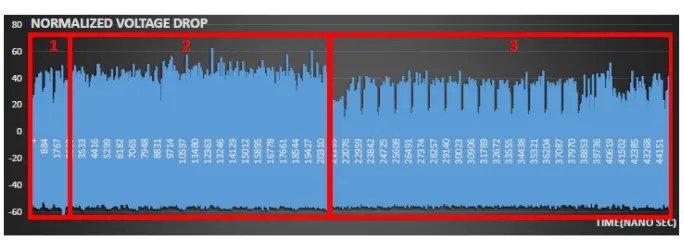
Fig. 2.Power traces of Lopez et al. method ( 1⃝, 2⃝) LUT construction, ( 3⃝) 4-bit wise
binary field multiplication with LUT
of LUT (T). In Step 6, the LUT variables are added to intermediate results
(C). Same procedures are conducted again for lower 4-bit of (A). In Figure 4,
the power traces of Lopez et al. with degree 4 are described. The Section ⃝1 is
constructing the LUT with variable (0, 1, 2, 4, 8) and Section⃝2 is constructing
the LUT with remaining variables (3, 5, 6, 7, 9, 10, 11, 12, 13, 14, 15). The
Sec-tion⃝3 is conducting the 4-bit wise binary field multiplication with LUT. Since,
the LUT is based on operands (A), the power consumption is highly relied on
weights of operands. In Table 2, the source codes for look-up table construction is described. The LUT construction conducts consecutive memory store. The
STinstruction, transferring the data from register to memory storages, takes 2
clock cycles. This instruction consumes certain pattern of power consumption depending on weights of data, because bit one or zero generates different power consumption. If we extract current data patterns from power consumption, we can identify the operands used for building LUT. With the leakage information, we can identify the scalar addition and doubling from scalar multiplication where the information is the secret key of ECDH operations.
In order to show the practical attack results, we target the smallest field namely sect113r1. If we succeed in attacks on the smallest field, we can readily extend to larger binary fields such as 128, 163, 193, 233, 239, 283, 409 and 571-bit.
The 113-bit binary field multiplication over 8-bit processor needs 14 (⌈1138 ⌉) bytes
to store one element of LUT. For side channel attack, we collected power traces of
look-up table construction cases including 0x1, 0x3, 0x5, 0x7, 0x09, 0xb,
0xd, 0xf from ⃝1 and ⃝2 in Figure 4. Each case consists of 14 memory store
operations. In one round of multiplication, we can collect 112 (8×14) operations
and we conduct the horizontal correlation power analysis with their weights. We compute the correlation factor on segments corresponding to the atomic LUT access operations and identify the specific operands. AVR processor uses data bus when it stores byte-wise data from registers to memory. This causes certain power consumption patterns depending on the weights of passing data. The idea
is to calculate the Pearson Correlation Coefficientρbetween power consumption
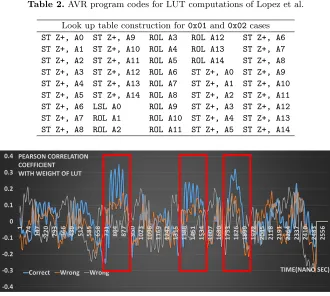
Table 2.AVR program codes for LUT computations of Lopez et al.
Look up table construction for0x01and0x02cases ST Z+, A0 ST Z+, A9 ROL A3 ROL A12 ST Z+, A6 ST Z+, A1 ST Z+, A10 ROL A4 ROL A13 ST Z+, A7 ST Z+, A2 ST Z+, A11 ROL A5 ROL A14 ST Z+, A8 ST Z+, A3 ST Z+, A12 ROL A6 ST Z+, A0 ST Z+, A9 ST Z+, A4 ST Z+, A13 ROL A7 ST Z+, A1 ST Z+, A10 ST Z+, A5 ST Z+, A14 ROL A8 ST Z+, A2 ST Z+, A11 ST Z+, A6 LSL A0 ROL A9 ST Z+, A3 ST Z+, A12 ST Z+, A7 ROL A1 ROL A10 ST Z+, A4 ST Z+, A13 ST Z+, A8 ROL A2 ROL A11 ST Z+, A5 ST Z+, A14
-0.4 -0.3 -0.2 -0.1 0 0.1 0.2 0.3 0.4
1
74 147 220 293 366 439 251 585 658 731 804 877 950
10
23
10
96
11
69
12
42
13
15
13
88
14
61
15
34
16
07
16
80
17
53
18
26
18
99
19
72
20
45
21
18
21
91
22
64
23
37
24
10
24
83
25
56
TIME(NANO SEC) Correct Wrong Wrong
PEARSON CORRELATION COEFFICIENT
WITH WEIGHT OF LUT
Fig. 3.Correlation value of weights and power consumptions
by using i-th operand (A) at the timet, there will be a higher coefficient ρ. In
the correlation graph of Figure 3, we found distinguished three peaks colored in blue. The other lines show wrong estimations with wrong LUT and weights.
4
Secure Binary Field Multiplication
In Section 3, we explored the vulnerability of existing binary field multiplication methods. The main vulnerabilities of existing approaches are branch statements and predicable memory access patterns based on the weights of memory. In order to reduce the information leakages, we introduce a Masked Block-Comb method. The method avoids the branch operation and even LUT accesses but it uses an operand masking to conduct the regular and atomic form of binary field multiplication.
In Algorithm 2, 32-bit wise MBC multiplication is introduced. In Step 3,
i-th bit of operand A[j] is stored in BIT variable. In Step 4, zero value is
subtracted from BIT and borrow bit is stored intoT1 variable. In Step 5, zero
Secure Binary Field Multiplication 9
Algorithm 2Masked Block Comb on 32-bit
Require: Two 32-bit operandsAandB
Ensure: C(64-bit)=A·B
1: forifrom 7 by 1 to 0do
2: forjfrom 3 by 1 to 0do
3: BIT =A[j]&(1≪i) 4: {T1, T0}= 0−BIT
5: M ASK= 0−T1 6: forkfrom 3 by 1 to 0do
7: C[k+j] =C[k+j]⊕(B[k]&M ASK)
8: end for
9: end for
10: C=C≪1
11: end for
12: return C
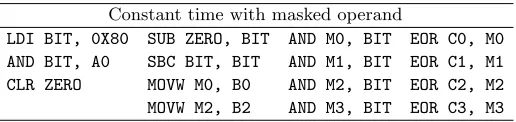
Table 3.AVR program codes for masked block comb multiplication
Constant time with masked operand
LDI BIT, 0X80 SUB ZERO, BIT AND M0, BIT EOR C0, M0 AND BIT, A0 SBC BIT, BIT AND M1, BIT EOR C1, M1 CLR ZERO MOVW M0, B0 AND M2, BIT EOR C2, M2 MOVW M2, B2 AND M3, BIT EOR C3, M3
0xff. After then Step 7, operandB[k] is masked with variableM ASKand then
conduct Block-Comb style multiplication. This operation is conducted by the
number of block size (4, 32-bit). After then intermediate resultsC is left shifted
by 1-bit and this process is iterated by 7 times more. The detailed source code
is available in Table 3. We set the bit withLDIoperation and then conductAND
with operandA0. If the bit is set, the(SBC BIT, BIT)operation outputs0xff.
After then this masking bit are used for ANDoperation with operand B. If the
BIT is0xff, masked operandM is operandB. If not masked operandM is set
to zero variable. The computed masked operandM is finally bit-wise
exclusive-ored with intermediate results C. Since MBC method exploits many masking
process, it shows low performance results than previous approaches. In order to boost the performance, we adopted the asymptotically faster multiplication namely Karatsuba multiplication.
In Algorithm 3, 64-bit wise Karatsuba Masked Block-Comb method is intro-duced. We selected 64-bit for practical usages because size of binary field ECC is multiple of 64-bit and modern processors including INTEL and ARM provide 64-bit polynomial multiplication. This means our method can readily adopt the other 64-bit optimization techniques to the embedded processors as well [7, 8,
6]. In Step 1, 32-bit wise MSK multiplication is conducted on A[3 ∼ 0] and
B[3∼0] and outputs lower part of intermediate results (L[7∼0]). In Step 2,
higher part (H[7 ∼ 0]) are computed by multiplying A[7 ∼ 4] and B[7 ∼ 4].
Algorithm 364-bit Karatsuba Block Comb
Require: An eight 8-bit operandA(64-bit) andB(64-bit)
Ensure: C(128-bit)=A·B
1: L[7∼0] = (A[3∼0]×32−bitB[3∼0])
2: H[7∼0] = (A[7∼4]×32−bitB[7∼4])
3: M[7∼0] = ((A[7∼4]⊕A[3∼0])×32−bit(B[7∼4]⊕B[3∼0]))
4: M[7∼0] =M[7∼0]⊕L[7∼0]⊕H[7∼0] 5: C=H[7∼0]·264⊕M[7∼0]·232⊕L[7∼0]
6: return C
-100 -50 0 50 100 150 1 37 73
109 145 181 217 253 289 325 361 397 433 469 505 541 577 613 649 685 721 757 793 829 865 901 937 973 1009 1045 1081 1117 1153 1189 1225 1261 1297 1333 1369 1405 1441 1477 1513 1549 1585 1621 1657 1693 1729 1765 1801 1837 1873
NORMALIZED V OL T A G E D R OP TIME(NANO SEC)
Y
N
Y
N
Y
N
-150 -100 -50 0 50 100 150 1 40 79
118 157 196 235 274 313 352 391 430 469 508 547 586 625 664 703 742 781 820 859 898 937 976 1015 1054 1093 1132 1171 1210 1249 1288 1327 1366 1405 1444 1483 1522 1561 1600 1639 1678 1717 1756 1795 1834 1873 1912 1951 1990 2029 2068
NORM AL IZED V OL T A G E D R OP TIME(NANO SEC)
NOP
XOR
NOP
XOR
NOP
XOR
-150 -100 -50 0 50 100 150
1 37 73
109 145 181 217 253 289 325 361 397 433 469 505 541 577 613 649 685 721 757 793 829 865 901 937 973
1009 1045 1081 1117 1153 1189 1225 1261 1297 1333 1369 1405 1441 1477 1513 1549 1585 1621 1657 1693 1729 1765 1801 1837 1873
NORM AL IZED V OL T A G E D R OP TIME(NANO SEC)
ZERO
XOR
ZERO
XOR
ZERO
XOR
Fig. 4.Power traces of proposed method
and then the operands are multiplied to output middle part (M[7 ∼ 0]). In
Step 4, higher and lower parts are bit-wise exclusive-ored with middle part. It Step 5, all intermediate results are bit-wise exclusive-ored. Total 64-bit Karat-suba Masked Block-Comb needs 1926 clock cycles. In order to construct binary field multiplication for sect163k1 and sect233k1 with 64-bit API, we need 192 and 256-bit multiplications. For 163-bit multiplication we adopt three terms Karatsuba multiplication. The method reduces the three multiplication out of nine multiplication operations. For 233-bit multiplication we conduct four terms Karatsuba multiplication. Firstly we construct 128-bit binary field multiplica-tion with 1 level Karatsuba with 64-bit 1 level Karatsuba and then this 128-bit multiplication is used for 1 level of 256-bit multiplication. Totally three levels of Karatsuba multiplication is used.
Secure Binary Field Multiplication 11
Table 4.Clock cycles for 163- and 233-bit multiplication on binary fields.
Method Technique Vulnerability Clock Cycle
163-bit binary field multiplication
Kargl et al. [10] 4-bit wise Lookup Table LUT access 5,057 Aranha et al. [1] 4-bit wise Lookup Table LUT access 4,508 Seo et al. [15] Unbalanced Block Comb Branch op. 4,346 Seo et al. [16] Karatsuba Block Comb Branch op. 3,274 Seo et al. [16] Constant Karatsuba Block Comb Branch op. 5,005
Proposed Method Masked Karatsuba Block Comb - 14,445
233-bit binary field multiplication
Aranha et al. [1] 4-bit wise Lookup Table LUT access 8,314
Proposed Method Masked Karatsuba Block Comb - 20,537
does not access memory in consecutive way, our SCA on LUT does not work
properly. In Figure 4, the symbols including Y andN represent0xff mask and
0x00mask, respectively. In Table 4, performance of binary field multiplication is
described. LUT based approach exploits 4-bit wise lookup table accesses but it leaks memory access pattern as we pointed out in this paper. In terms of Block-Comb method, it shows the highest performance. However it is not constant time solution and branch operation leaks power consumption information. The constant Karatusba Block-Comb method is even an atomic solution but it is still based on branch operation which leaks power consumption information. Our proposed method namely masked Karatsuba Block-Comb method shows the lowest speed performance but it does not include vulnerabilities found in existing approaches. Furthermore, our method is easily scalable with Karatsuba approaches. The overheads from 163 to 233 is only 1.4 but previous works are 1.8. For this reason, our method would be better choice for large operands.
5
Conclusion
References
1. D. F. Aranha, R. Dahab, J. L´opez, and L. B. Oliveira. Efficient implementation of elliptic curve cryptography in wireless sensors. Adv. in Math. of Comm., 4(2):169– 187, 2010.
2. E. Brier, C. Clavier, and F. Olivier. Correlation power analysis with a leakage model. InCryptographic Hardware and Embedded Systems-CHES 2004, pages 16– 29. Springer, 2004.
3. S. Chari, C. S. Jutla, J. R. Rao, and P. Rohatgi. Towards sound approaches to counteract power-analysis attacks. In Advances in CryptologyCRYPTO99, pages 398–412. Springer, 1999.
4. C.-N. Chen. Memory address side-channel analysis on exponentiation. InICISC 2014. 2014.
5. C. Clavier, B. Feix, G. Gagnerot, M. Roussellet, and V. Verneuil. Horizontal corre-lation analysis on exponentiation. In Information and Communications Security, pages 46–61. Springer, 2010.
6. C. P. Gouvˆea and J. L´opez. Implementing gcm on armv8. InTopics in Cryptology— CT-RSA 2015, pages 167–180. Springer, 2015.
7. S. Gueron. Aes-gcm software performance on the current high end cpus as a performance baseline for caesar competition.
8. S. Gueron and M. E. Kounavis. Intel⃝R carry-less multiplication instruction and
its usage for computing the gcm mode. Intel white paper (September 2012), 2010. 9. D. Hankerson, S. Vanstone, and A. J. Menezes. Guide to elliptic curve
cryptogra-phy. Springer, 2004.
10. A. Kargl, S. Pyka, and H. Seuschek. Fast arithmetic on atmega128 for elliptic curve cryptography. IACR Cryptology ePrint Archive, 2008:442, 2008.
11. P. Kocher, J. Jaffe, and B. Jun. Differential power analysis. In Advances in CryptologyCRYPTO99, pages 388–397. Springer, 1999.
12. J. L´opez and R. Dahab. High-speed software multiplication in f2m. InProgress in CryptologyINDOCRYPT 2000, pages 203–212. Springer, 2000.
13. T. S. Messerges, E. A. Dabbish, and R. H. Sloan. Investigations of power analysis attacks on smartcards. InUSENIX workshop on Smartcard Technology, volume 17, page 17, 1999.
14. L. B. Oliveira, D. F. Aranha, C. P. Gouvˆea, M. Scott, D. F. Cˆamara, J. L´opez, and R. Dahab. Tinypbc: Pairings for authenticated identity-based non-interactive key distribution in sensor networks. Computer Communications, 34(3):485–493, 2011. 15. H. Seo, Y. Lee, H. Kim, T. Park, and H. Kim. Binary and prime field multipli-cation for public key cryptography on embedded microprocessors. Security and Communication Networks, 7(4):774–787, 2014.
16. H. Seo, Z. Liu, J. Choi, and H. Kim. Karatsuba–block-comb technique for elliptic curve cryptography over binary fields. Security and Communication Networks, 2015.
17. S. C. Seo, D.-G. HAN, H. C. Kim, and S. HONG. Tinyecck: Efficient elliptic curve cryptography implementation over gf(2m) on 8-bit micaz mote.IEICE transactions on information and systems, 91(5):1338–1347, 2008.
18. M. Shirase, Y. Miyazaki, T. Takagi, and D.-G. HAN. Efficient implementation of pairing-based cryptography on a sensor node. IEICE transactions on information and systems, 92(5):909–917, 2009.