Digital Watermarking using Different Types
of Discrete Wavelet and Multiwavelet
Transforms
Mohammad Barr
School of Engineering and Sustainable Development, De Montfort University, Leicester, United Kingdom
ABSTRACT:Watermarking is a technique which is widely used for the protection of intellectual property rights. In this paper, different types of wavelet and multiwavelet transforms are used in a discrete wavelet/multiwavelet based watermarking scheme. The watermarking scheme is subjected to a number of geometric attacks. The performance of each type of wavelet/multiwavelet is analysed and their advantages and disadvantages are discussed. The comparison is based on simulations involving different types of RGB colour images.
KEYWORDS:Discretewavelet transform,discretemultiwavelet transform, watermark embedding, watermark recovery, watermarking.
I. INTRODUCTION
Multimedia content has become increasingly popular in the last decade. This is mainly due to the explosive growth of social media websites and the wide spread availability of advanced electronic gadgets. In such a scenario, it is important to be able to provide copyright protection of multimedia content to ensure its rightful ownership and legal distribution. This is generally achieved with the help of digital watermarking. Digital watermarking is a tool which enables the hiding of one signal into another such that the hidden signal can be used to identify the ownership of a digital content. It can be used to protect digital data against copyright infringement [1]. There are many applications of watermarking (e.g., authentication of multimedia content, ownership identification etc. [2].
Watermarking techniques face a number of challenges. Among these, the most important one is the challenge of protecting it against attacks.Attacks on watermarks are generally aimed at altering the watermarked image. Some common attacks include: elimination, collusion, masking, forgery, copy, ambiguity, and scrambling. Of these one of the most popular attacks is distortion where the aim of the attack is to distort the watermark to make it undetectable. Rotation, scaling, and translation (RST) and affine transforms are common geometric attacks that can be used to distort watermarks.
In terms of characteristics, a watermark displays many different characteristics. These include: robustness and tamper resistance, transparency, capacity, fidelity, computational cost, and false positive rate [2]. Among these, robustness is generally considered very important. Robustness is the characteristic of a watermark that indicates how well the watermark can survive common signal processing operations such as lossy compression. In real-world scenarios, generally, a compromise is made on one or more of these characteristics when watermarking is used.
This paper uses a recent watermarking scheme [3] to compare the performance of watermarking under different types of DWT and DMWT. The rest of the paper is organized as follows: Literature review is presented in Section II. Experimental results are presented in Section III while conclusions are presented in Section IV.
II. RELATEDWORK
The maxima values of the wavelet transform, called Wavelet Transform Modulus Maxima (WTMM) [4], [5], provide interesting insights about an image. For example, they represent edges in an image and unlike the standard DWT which is not translation invariant, WTMM coefficients are translation invariant. This property of WTMM was exploited by Alghouniemy and Tewfik [6]. Their proposed method tries to correct geometric distortions in image watermarking i.e. the method estimates the scaling factor of a previously scaled watermarked image and the angle by which the image has been rotated. In particular, the method computes the Edges Standard Deviation Ratio (ESDR) to get an estimate of the scaling factor and the Average Edges Angles Difference (AEAD) to approximate the angle of rotation. Both ESDR and AEAD are computed from wavelet maxima locations. The proposed method does not require the original image if the image has been normalized before transmission. The idea is that since wavelet transform
maxima represents edges in an image, if an image is scaled by a factor , then its wavelet maxima should also be
scaled by the same factor. Similarly, if an image is rotated by an angle , then its wavelet maxima should also be rotated by a similar angle. This assertion can be used to estimate and by comparing standard deviation and angles of wavelet maxima locations respectively from a reference point (called Maxima Location Mean (MLM) in this case) before and after scaling/rotation. A problem with this method is that its effectiveness has been shown using only a limited range of attack parameters. Moreover, the method requires prior information about the original image, even though it does not rely on the presence of the original image during detection. WTMM was also used by Luo, Xing, and Shi [7]. In [7] mutual information was used to detect the presence or absence of the watermark. Moreover, it only targeted watermarking of grayscale images.
Elijah Mwangi [8] proposed a DWT based geometric attacks invariant method which exploits the properties of centroids of an image to calculate parameters of RST distortions. A drawback of this method is that it requires the system to be informed about which one of the RST distortions (rotation, scaling, and translation) has occurred, to calculate correct parameters. Senthil&Bhaskaran[9] proposed another simple DWT based RST invariant watermarking
scheme which embeds the watermark in the 3rd level approximation (LL) sub-band coefficients of DWT. They use the
Daubechies family of wavelets. The main drawback of this method is that it is too simple to practically save against a variety of attacks.
Patvardhan, Kumar, and Lakshmi [10] proposed a DWT based robust watermarking scheme for colour images (YCbCr). In this method, first the watermark text is converted into a Quick Response (QR) code. It then uses the diagonal sub-band (HH) of the DWT to embed the watermark. The results show that the method is robust against Salt & Pepper noise and JPEG compression but its robustness against RST attacks is very weak. Moreover, this method does not take the HVS into consideration.
All the above methods are based on DWT but none of them compares the performance of their methods under different types of wavelets/multiwavelets. Since, different types of wavelets/multiwavelets exhibit different characteristics, each type can potentially offer unique advantage when used in a DWT/DMWT based watermarking scheme.
III.METHODOLOGY
IV.EXPERIMENTAL RESULTS
All the experiments were performed using MATLAB R2016. The experiments were performed on a MacBook Pro with a 2.2 GHz Intel Core i7 microprocessor, 16 GB DDR3 RAM, Intel Iris Pro 1536 MB graphics card and OS X El Capitan operating system.
The reliability of watermark recovery was objectively measured by explicitly computing the Normalized Cross-Correlation (NCC) between the recovered watermark and the originally embedded logo [11]. The NCC for an image and a template , can be calculated using Eq. (1) [12]
( , ) = ∑ , ( , ) ̅, ( , )
∑ , ( , ) ̅, ∑ , ( , ) .
(1)
In Eq. (1), and represent the coordinates of the image, I while and represent the coordinates of the template .
is the mean value of the template and ̅, is the mean of ( , ) in the region under the template.
The PSNR has been traditionally used as a metric of choice to objectively evaluate image quality. In this paper, it is used to evaluate the quality of the watermarked images. It can be mathematically calculated using Eq. (2).
= 10 log (2)
In Eq. (2), MSE can be defined as:
= ∑ ∑ [ ( , )− ( , )] , (3)
where and represent an original and a distorted image respectively while and represent the respective widths and heights of the images I and J.
The test dataset for the experiments included four cover images which are well-known and publicly available. The cover image test dataset is presentedin Figure 1.
Figure 1. Cover images of resolution 512x512.
A black and white (1 bit per pixel) logo image of resolution 50 × 20 pixels was used in the experiments (See Figure 2).
Figure 2. The ‘TEST’ logo image
The following types of wavelets/multiwavelets were used in the watermarking model of [3] and their results were compared: wavelets (orthogonal Daubechies (d4), Antonini 7.9 biorthogonal scalar wavelet filters) and multiwavelets (Cardbal2 balanced, Geronimo-Hardin-Massopust (GHM), Leburn-Vetterli balanced multiwavelet (BAT02)).
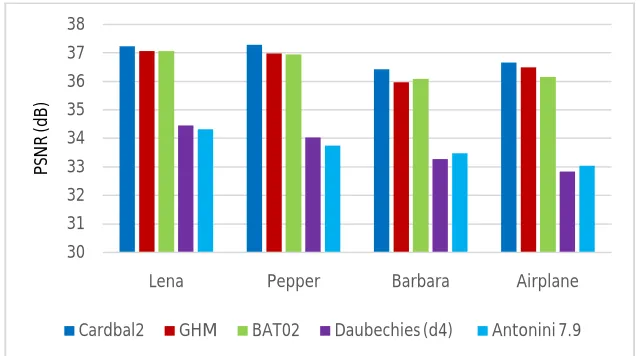
In the first experiment, a watermark is embedded and recovered using the watermarking model in [3]. The experiment is performed five times, once using each wavelet/multiwavelet type. The PSNR of the recovered watermarks are noted in each case. A comparison of the PSNR values obtained in each case is shown in Figure 3. The results clearly show that for all the tested images, the results obtained using Cardbal2 multiwavelet are better compared to those obtained using other types of wavelets/multiwavets.
Figure 3. Comparison of PSNR results for different types of wavelets/multiwavelets.
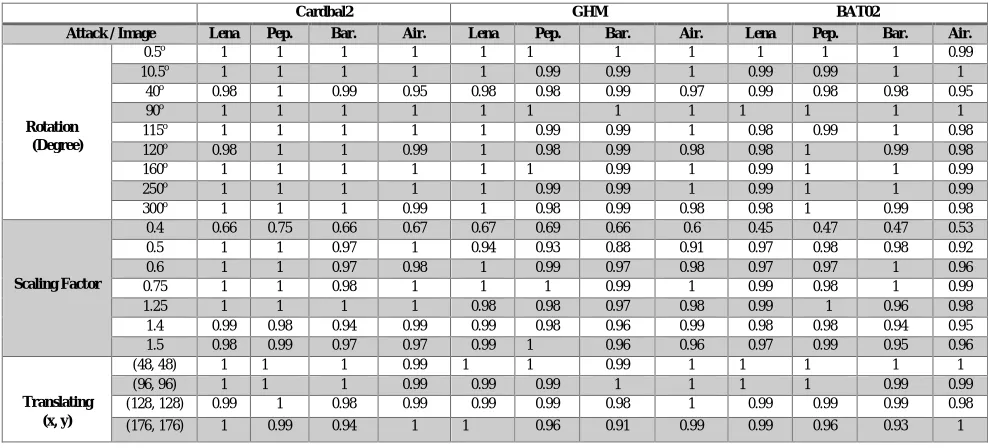
Next, a performance comparison is made of the above three different types of multiwavelets by using each type of multiwavelet in the watermarking model in [3].The NCC values obtained using the different types of multiwavelets are shown in Table1.It can be seen from Table 1 that amongst the tested multiwavelets, the Cardbal2 multiwavelet offers the best results when taking into account attacks. Table 1 shows that Cardbal2 multiwavelet achieves an NCC value of 1 in most of the cases. On the other hand, for the GHM multiwavelet, the lowest NCC value is 0.6 (Airplane, 0.4) while mostly the range of NCC values fall in the range of 0.8 – 1. For BAT02 multiwavelet, the lowest NCC is 0.45 (Airplane, 0.4) while mostly the range of NCC values fall in the range of 0.9 – 1. So, from these results, it can be said that Cardbal2 multiwavelet achieves more stable NCC values for most of the type of attacks. Hence, among multiwavelets, Cardbal2 was found tobe the most suitable type for use in the watermarking mode of [3].
Next, the two different types of wavelets were tested. The results obtained using the different wavelets are shown inTable 2 - Table 3. Table 2 presents the NCC values for rotation, scaling, and translation attacks using the ‘Antonini 7.9’ scalar wavelet. From these results, it can be seen that for most of the tested rotation angles, the NCC values are in the range of 0.8 – 0.9. In case of scaling attacks, most of the NCC values obtained are in the range of 0.81 - 0.98, except for the scaling factor of 0.2 for which the lowest NCC value is 0.55. In case of translation attacks, it can be seen from the results that most of the NCC values are in the range of 0.8 – 0.97.
30 31 32 33 34 35 36 37 38
Lena Pepper Barbara Airplane
P
SN
R
(d
B
)
Table 1. Performance comparison of different multiwavelet types (Cardbal2, GHM, and BAT02).
Table 2. Normalized cross correlation (NCC) values for the recovered logo watermark after undergoing different amounts of rotation, scaling, and translation. The results are shown for the Antonini 7.9 scalar wavelet.
Table 3 presents the results obtained for the ‘Daubechies (d4)’ scalar wavelet. The results are shown for different geometrical attacks (rotation, scaling, and translation) using the Daubechies (d4) scalar wavelet filter bank. In case of rotation attacks, it can be seen that the NCC values obtained are in the range of 0.77 – 0.98. In case of scaling attacks, most of the NCC values are, again, in the range of 0.8 – 0.9. Lastly, in the case of translation attacks, the NCC values are in the range of 0.75 – 0.96.
Cardbal2 GHM BAT02
Attack / Image Lena Pep. Bar. Air. Lena Pep. Bar. Air. Lena Pep. Bar. Air.
Rotation (Degree)
0.5o 1 1 1 1 1 1 1 1 1 1 1 0.99
10.5o 1 1 1 1 1 0.99 0.99 1 0.99 0.99 1 1
40o 0.98 1 0.99 0.95 0.98 0.98 0.99 0.97 0.99 0.98 0.98 0.95
90o 1 1 1 1 1 1 1 1 1 1 1 1
115o 1 1 1 1 1 0.99 0.99 1 0.98 0.99 1 0.98
120o 0.98 1 1 0.99 1 0.98 0.99 0.98 0.98 1 0.99 0.98
160o 1 1 1 1 1 1 0.99 1 0.99 1 1 0.99
250o 1 1 1 1 1 0.99 0.99 1 0.99 1 1 0.99
300o 1 1 1 0.99 1 0.98 0.99 0.98 0.98 1 0.99 0.98
Scaling Factor
0.4 0.66 0.75 0.66 0.67 0.67 0.69 0.66 0.6 0.45 0.47 0.47 0.53
0.5 1 1 0.97 1 0.94 0.93 0.88 0.91 0.97 0.98 0.98 0.92
0.6 1 1 0.97 0.98 1 0.99 0.97 0.98 0.97 0.97 1 0.96
0.75 1 1 0.98 1 1 1 0.99 1 0.99 0.98 1 0.99
1.25 1 1 1 1 0.98 0.98 0.97 0.98 0.99 1 0.96 0.98
1.4 0.99 0.98 0.94 0.99 0.99 0.98 0.96 0.99 0.98 0.98 0.94 0.95
1.5 0.98 0.99 0.97 0.97 0.99 1 0.96 0.96 0.97 0.99 0.95 0.96
Translating (x, y)
(48, 48) 1 1 1 0.99 1 1 0.99 1 1 1 1 1
(96, 96) 1 1 1 0.99 0.99 0.99 1 1 1 1 0.99 0.99
(128, 128) 0.99 1 0.98 0.99 0.99 0.99 0.98 1 0.99 0.99 0.99 0.98
(176, 176) 1 0.99 0.94 1 1 0.96 0.91 0.99 0.99 0.96 0.93 1
Attack \ Image Lena Pepper Barbara Airplane
Rotation (Degrees)
15o 0.97 0.98 0.97 0.90
35o 0.88 0.91 0.94 0.77
90o 0.98 0.97 0.98 0.92
150o 0.93 0.96 0.98 0.82
260o 0.97 0.99 0.98 0.91
340o 0.97 0.97 0.98 0.89
Scaling Factor
0.2 0.65 0.66 0.66 0.55
0.3 0.95 0.96 0.96 0.89
0.5 0.97 0.97 0.98 0.92
0.8 0.98 0.97 0.98 0.92
1.2 0.94 0.96 0.95 0.81
Translation (x, y)
(80, 80) 0.95 0.97 0.95 0.86
(112, 112) 0.92 0.95 0.92 0.85
Table 3.Normalized cross correlation (NCC) values for the recovered logo watermark after undergoing different amounts of rotation, scaling, and translation. The results are shown for the Daubechies (d4) scalar wavelet.
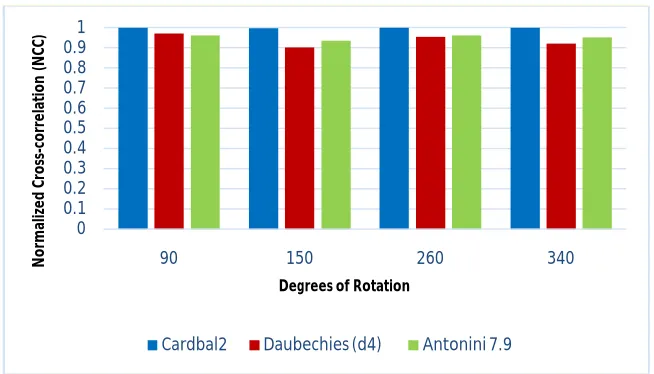
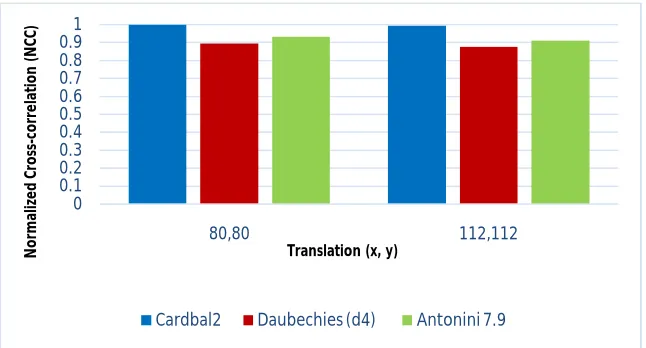
Finally, the results obtained using the Cardbal2 multiwavelet filter bank, are compared against the Antonini 7.9, and Daubechies (d4) scalar wavelet filter banks. In each case, the watermarked images are subjected to geometrical attacks (rotation, scaling, and translation). These results are presented in Figure 4 – Figure 6. The results shown in Figure 4 – Figure 6 are average results for the four tested images. A variety of attack parameters are considered in these results i.e., both low and high strength geometrical attack parameters are used. The results clearly show that the Cardbal2 multiwavelet filter bank is the best choice for use in the watermarking model of [3] as it outperforms the other types of wavelet filters tested.
Figure 4.Comparison of the results obtained using different types of wavelet/multiwavelet filters. The results represent the averages figure of the four images used for this comparison.
0 0.1 0.2 0.3 0.4 0.5 0.6 0.7 0.8 0.9 1
90 150 260 340
N
o
rm
al
iz
e
d
C
ro
ss
-c
o
rr
e
la
ti
o
n
(
N
C
C
)
Degrees of Rotation
Cardbal2 Daubechies (d4) Antonini 7.9
Attack \ Image Lena Pepper Barbara Airplane
Rotation (Degrees)
15o 0.96 0.97 0.97 0.91
35o 0.88 0.91 0.94 0.77
90o 0.98 0.98 0.98 0.94
150o 0.9 0.92 0.94 0.77
260o 0.96 0.98 0.97 0.91
340o 0.93 0.94 0.95 0.86
Scaling Factor
0.2 0.46 0.43 0.47 0.44
0.3 0.88 0.86 0.87 0.77
0.5 0.97 0.96 0.97 0.92
0.8 0.98 0.98 0.96 0.94
1.2 0.92 0.94 0.9 0.77
Translation (x, y)
(80, 80) 0.89 0.96 0.95 0.78
(112, 112) 0.92 0.94 0.90 0.75
Figure 5.Comparison of the results obtained using different types of wavelet/multiwavelet filters. The results represent the averages figure of the four images used for this comparison.
Figure 6.Comparison of the results obtained using different types of wavelet/multiwavelet filters. The results represent the averages figure of the four images used for this comparison.
V. CONCLUSION
In this paper, the performance of different types of two types of wavelets and three types of multiwavelets was analysed for use in a watermarking scheme. It was found that the performance of a wavelet/multiwavelet based watermarking scheme depends on the type of wavelet/multiwavelet used. Moreover, among the tested wavelets/multiwavelets, Cardbal2 multiwavelet was found to produce the best results compared to other wavelets/multiwavelets when used in a watermarking scheme. Moreover, it is concluded that the Cardbal2 multiwavelet achieves a better balance between its PSNR and NCC results.
0 0.1 0.2 0.3 0.4 0.5 0.6 0.7 0.8 0.9 1 0.5 0.8 N o rm al iz e d C ro ss -c o rr e la ti o n ( N C C ) Scaling Factor
Cardbal2 Daubechies (d4) Antonini 7.9
0 0.1 0.2 0.3 0.4 0.5 0.6 0.7 0.8 0.91 80,80 112,112 N o rm al iz e d C ro ss -c o rr e la ti o n ( N C C )
Translation (x, y)
REFERENCES
[1] A. Reddy & B. Chatterji, “A new wavelet based logo-watermarking scheme,” Pattern Recognition Letters, vol. 26, no. 7, pp. 1019-1027,
2005.
[2] I. Cox, M. Miller, and J. Bloom, “Watermarking applications and their properties,” In Proc. International Conference on Information
Technology: Coding and Computing, 2000.
[3] M. Barr & C. Serdean, “Robust logo watermarking based on wavelet transform modulus maxima,” In 8th International Conference on
Intelligent Computing and Information System, Cairo, Egypt, pp. 212 – 217, 2017.
[4] A. Bhatti, S. Nahavandi, Y. Frayman, “3D depth estimation for visual inspection using wavelet transform modulus maxima”, Journal of
Computers and Electrical Engineering, vol. 33, no. 1, pp. 48-57, 2007.
[5] A. Bhatti, and S. Nahavandi, “Stereo correspondence estimation based on wavelets and multiwavelets analysis,” Stereo Vision, In Tech
Education and Publishing, Vienna, Austria, pp. 27-48, 2008.
[6] M. Alghoniemy and A. Tewfik, “Geometric distortion correction in image watermarking,” Electronic Imaging, 2000.
[7] T. Luo, G. Xing, and I. Shi, “Mutual information based watermarking detection in wavelet domain for copyright protection,” In Proc.
Asia-Pacific Trusted Infrastructure Technologies Conference, pp. 113-119, 2008.
[8] E. Mwangi, “A geometric attack resistant image watermarking scheme based on invariant centroids,” in Proc. IEEE International Symposium
on Signal Processing and Information Technology, 15 – 18 December 2007, pp. 190 – 193, 2007.
[9] V. Senthil, R. Bhaskaran, “Wavelet Based Digital Image Watermarking with Robustness against Geometric Attacks”, In Proc. International
Conference on Computational Intelligence and Multimedia Applications, vol. 4, 13-15 December 2007, pp. 89 – 93, 2007.
[10] C. Patvardhan, P. Kumar and C. V. Lakshmi, “Robust DWT based colour image watermarking scheme,” In Proc. National Systems
Conference (NSC), Noida, pp. 1-6, 2015.
[11] J. Ruanaidh& T. Pun, “Rotation, scale and translation invariant spread spectrum digital image watermarking,” Signal processing, vol. 66, no. 3,
pp. 303-317, 1998.