A Virtual Grid-Based Dynamic Routes
Adjustment (VGDRA) Scheme for Wireless
Sensor Networks Based on Sink Mobility
GadekarVaishali. , Prof.Nighot M. K.
P.G. Scholar, Dept. of Computer Engineering. KJCOEMR Pune, Savitribai Phule University of Pune, Pune, India.
Professor, Dept. of Computer Engineering, KJCOEMR Pune,Savitribai Phule University of Pune, Pune, India
ABSTRACT: Recently, a VGDRA scheme for mobile sink-based wireless sensor networks is introduced. This paper presents the proposed implementation of VGDRA, in which we are discussing the approach of efficient data delivery using communication of distance priority i.e. avoiding straight line communication which was used in previous VGDRA scheme. In this paper, we present a VGDRA scheme that aims to minimize the routes reconstruction cost of the sensor nodes while maintaining nearly optimal routes to the latest location of the mobile sink. We propose a set of communication rules that governs the routes reconstruction process thereby requiring only a limited number of nodes to readjust their data delivery routes toward the mobile sink.
KEYWORDS: wireless sensor networks, distance priority, energy model, mobile sink, routes reconstruction.
I.INTRODUCTION
Wireless sensor networks are created by small devices communicating over wireless links without using a fixed networked infrastructure. More detailed routing algorithms are essential for the applicability of such wireless networks, As energy has to be conserved in low powered devices and wireless communication always leads to increased energy consumption.In current system, the administrator manually decides which ping packet to be sent. Sending programs between every pair of edge ports is neither extensive nor scalable. This system is enough to find minimum set of end-to-end packets that travel each link. However, doing this need a way of abstracting across device specific configuration files generating headers and links they reach and finally calculating a minimum set of test packets. It is not designed to identify failures caused from failed links and routers, bugs caused from faulty router hardware or software, and performance problems. The common causes of network failure are hardware failures and software bugs, in which that problems manifest both as reachability failures and throughput/latency degradation. To overcome this we are proposing new system.
II.LITERATURE SURVEY
1. Data MULEs: modeling and analysis of a three-tier architecture for sparse sensor networks
R. C. Shah, S. Roy, S. Jain, and W. Brunetteis Presented This paper presents and analyzes a three-tier architecture for collecting sensor data in sparse sensor networks. The approach exploits the presence of mobile entities (called MULEs) present in the environment. When in close range, MULEs pick up data from the sensors, buffer it, and deliver it to wired access points. This can lead to substantial power savings at the sensors as they only have to transmit over a short-range. This paper focuses on a simple analytical model for understanding performance as system parameters are scaled. Our model assumes a two-dimensional random walk for mobility and incorporates key system variables such as number of MULEs, sensors and access points. The performance metrics observed are the data success rate (the fraction of generated data that reaches the access points), latency and the required buffer capacities on the sensors and the MULEs. The modeling and simulation results can be used for further analysis and provide certain guidelines for deployment of such systems
.
2.
HEED: A hybrid, energy-efficient, distributed clustering approach for ad hoc sensor networks
O. Younis and S. Fahmythe presented HEED (Hybrid Energy Efficient Distributed) protocol is the clustering protocol. It uses using residual energy as primary parameter and network topology features (e.g. node degree, distances to neighbors) are only used as secondary parameters to break tie between candidate cluster heads, as a metric for cluster selection to achieve load balancing. In this all nodes are assumed to be homogenous i.e. all sensor nodes are equipped with same initial energy. But, in this paper we study the impact of heterogeneity in terms of node energy. We assume that a percentage of the node population is equipped with more energy than the rest of the nodes in the same network this is the case of heterogeneoussensor networks. As the lifetime of sensor networks is limited there is a need to reenergize the sensor network by adding more nodes. These nodes will be equipped with more energy than the nodes that are already in use, which creates heterogeneity in terms of node energy, leads to the introduction of HHEED protocol
3.
Geographic convergecast using mobile sink in wireless sensor networks
T.-S. Chen, H.-W.Tsai, Y.-H.Chang, and T.-C. Chen is Presented Geographical Cellular-like Architecture (GCA) in makes a cellular-like hierarchical hexagonal virtual structure to handle sink mobility. GCA however avoids flooding of location information of sink, but there is increase in latency and packet loss ratio because of non-ideal data delivery paths. Hierarchical Cluster-based Data Dissemination (HCDD) in approaches a hierarchical cluster architecture in which the second level cluster-heads of the mobile sink are chosen as routing agents which are responsible for maintaining the track on latest location of mobile sink. In high sink mobility, nodes which are using HCDD suffer from high energy consumption. In this approach, high latency is there because the data delivery paths are not optimal.
4. A quadtree-based data dissemination protocol for wireless sensor networks with mobile sinks
Z. H. Mir and Y.-B.Ko is Presented Quadtree-based Data Dissemination (QDD) scheme was proposed by Mir and Ko in, which also results in early energy depletion of nodes as in above schemes. This approach also reduces the overall network lifetime. Another approach called Virtual grid based Two-Tier Data Dissemination (TTDD) in dedicatedly creates a uniform per source node virtual grid structure approaching the entire sensor field. TTDD even though avoids the flooding of the sink’s topological updates, but, the per source virtual grid construction reduces the network lifetime.
Existing System:
Disadvantages Of Existing System:
Depletes the energy
Reduce the network lifetime
Increase the end-to-end time delay
III.PROPOSED ALGORITHM
System Architecture:
A block diagram showing interactions and information flow among different components of the system is given in following figure. In this section, detailed description of our virtual grid routing scheme, including how to create the virtual infrastructure and how to keep fresh routes towards the latest location of the mobile sink. A virtual infrastructure is designed by partitioning the sensor field into a virtual grid of similar sized cells where the total number of cells is a function of the number of sensor nodes. A set of nodes near to centre of the cells are fixed as cell-headers which are responsible for maintaining track of the latest location of the mobile sink and relieve the rest of member nodes from taking part in routes re adjustment. Neighboring cell-headers communicate with each other via gateway nodes. The group of cell-headers nodes together with the gateway nodes constructs the virtual backbone structure.
Figure 1: Proposed system block diagram.
Implementation Steps of System
The methodology of the technique is described below: 1) Firstly the area is defined in which nodes are created.
2) Similar numbers of nodes are established in each cluster for selecting the best path for communication. also the quality of service parameters of a network depend on the number of nodes.
3) Total area is partitioned into equal parts for creating a virtual network structure.
4) After this, location of mobile sink is taken.
5) Initial energy is appointed to each node as every node require some amount of energy.
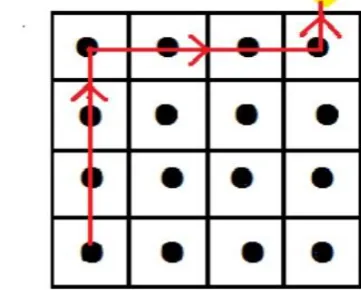
7) Once the cluster heads are selected, then the communication route will be selected on the basis of these heads selection. Straight line communication is used this virtual grid routing approach.
8) Now, the energy of each node will be used to calculate the energy of the network.
Advantage:
Increase the network lifetime
Reduce the energy consumption
Decrease the end-to-end delay time
Increase the throughput
IV.CONCLUSION AND FUTURE WORK
In this Project, a Virtual Grid Routing scheme is implemented in NS2, which was previouslyimplemented using Ns-2 software. The energy model is considered to reduce energy dissipation which will improve the energy consumption and data delivery performance. This technique divides the area into equal number of cells. A mobile sink while moving around the sensor field keeps on changing its location and connects with the nearest border-line cell-header for data collection. Network lifetime is improved and routes reconstruction cost is reduced by this scheme. In future work, we aim to improve the performance of our proposed scheme by using communication based on Ant Colony Routing which will improve the lifetime of network and reduce the routes reconstruction cost even more than this scheme. Energy consumption will also be reduced by using distance priority communication
REFERENCES
[1] Abdul Waheed Khan, Abdul Hanan Abdullah Mohammad AbdurRazzaque, VGDRA: A Virtual Grid-Based Dynamic Routes Adjustment Scheme for Mobile Sink-Based Wireless Sensor Networks,” IEEE SENSORS JOURNAL, VOL. 15, NO. 1, JANUARY 2015
[2] S. R. Gandham, M. Dawande, R. Prakash, and S. Venkatesan, “Energy efficient schemes for wireless sensor networks with multiple mobile base stations,” in Proc. IEEE Global Telecommun. Conf. (GLOBECOM), vol. 1. Dec. 2003, pp. 377–381.
[3] A. W. Khan, A. H. Abdullah, M. H. Anisi, and J. I. Bangash, “A comprehensive study of data collection schemes using mobile sinks in wirelesssensor networks,” Sensors, vol. 14, no. 2, pp. 2510–2548, 2014.
[4] M. Di Francesco, S. K. Das, and G. Anastasi, “Data collection in wireless sensor networks with mobile elements,” ACM Trans. SensorNetw., vol. 8, no. 1, pp. 1–31, Aug. 2011.
[5] I. Chalermek, R. Govindan, and D. Estrin, “Directed diffusion: A scalable and robust communication paradigm for sensor networks,” in Proc.ACM SIGMOBILE Int. Conf. Mobile Comput. Netw. (MOBICOM), 2000, pp. 56–67.
[6] E. B. Hamida and G. Chelius, “Strategies for data dissemination to mobile sinks in wireless sensor networks,” IEEE Wireless Commun.vol. 15, no. 6, pp. 31–37, Dec. 2008.
[7] A. Kinalis, S. Nikoletseas, D. Patroumpa, and J. Rolim, “Biased sink mobility with adaptive stop times for low latency data collection in sensor networks,” Inf. Fusion, vol. 15, pp. 56–63, Jan. 2014.
[8] W. M. Aioffi, C. A. Valle, G. R. Mateus, and A. S. da Cunha, “Balancing message delivery latency and network lifetime through an integrated model for clustering and routing in wireless sensor networks,” Comput.Netw., vol. 55, no. 13, pp. 2803–2820, Sep. 2011.
[9] B. Nazir and H. Hasbullah, “Mobile sink based routing protocol (MSRP) for prolonging network lifetime in clustered wireless sensor network,”in Proc. Int. Conf. Comput.Appl. Ind. Electron. (ICCAIE), Dec. 2010, pp. 624–629.
[10] T. Banerjee, B. Xie, J. H. Jun, and D. P. Agrawal, “Increasing lifetime of wireless sensor networks using controllable mobile cluster heads,”Wireless Commun. Mobile Comput., vol. 10, no. 3, pp. 313–336, Mar. 2010.
[11] T.-S. Chen, H.-W.Tsai, Y.-H.Chang, and T.-C. Chen, “Geographic convergecast using mobile sink in wireless sensor networks,” Comput.Commun., vol. 36, no. 4, pp. 445–458, Feb. 2013.
[12] A. Erman, A. Dilo, and P. Havinga, “A virtual infrastructure based on honeycomb tessellation for data dissemination in multi-sink mobile wireless sensor networks,” EURASIP J. Wireless Commun.Netw., vol. 2012, no. 17, pp. 1–54, 2012.
[13] S. Oh, E. Lee, S. Park, J. Jung, and S.-H. Kim, “Communication scheme to support sink mobility in multi-hop clustered wireless sensornetworks,” in Proc. 24th IEEE Int. Conf. Adv. Inf. Netw. Appl., Apr. 2010,pp. 866–872.
[14] O. Younis and S. Fahmy, “HEED: A hybrid, energy-efficient, distributed clustering approach for ad hoc sensor networks,” IEEE Trans. MobileComput., vol. 3, no. 4, pp. 366–379, Oct. 2004.
[15] B. Tang, J. Wang, X. Geng, Y. Zheng, and J.-U. Kim, “A novel data retrieving mechanism in wireless sensor networks with path-limitedmobile sink,” nt. J. Grid Distrib. Comput., vol. 5, no. 3, pp. 133–140, 2012.
[17] J.-H. Shin and D. Park, “A virtual infrastructure for large-scale wireless sensor networks,” Comput.Commun., vol. 30, nos. 14–15,pp. 2853– 2866, Oct. 2007.
[18] Z. H. Mir and Y.-B.Ko, “A quadtree-based data dissemination protocol for wireless sensor networks with mobile sinks,” in Proc. PersonalWireless Commun., 2006, pp. 447–458.
[19] H. Luo, F. Ye, J. Cheng, S. Lu, and L. Zhang, “TTDD: Two-tier data dissemination in large-scale wireless sensor networks,” Wireless Netw.,vol. 11, nos. 1–2, pp. 161–175, Jan. 2005.
[20] X. Chen and M. Xu, “A geographical cellular-like architecture for wireless sensor networks,” in Proc. Mobile Ad-Hoc Sensor Netw., 2003,pp. 249–258.
[21] L. Buttyán and P. Schaffer, “Position-based aggregator node election in wireless sensor networks,” Int. J. Distrib. Sensor Netw., vol. 2010,pp. 1– 15, 2010.
[22] L. Buttyán and P. Schaffer, “Position-based aggregator node election in wireless sensor networks,” Int. J. Distrib. Sensor Netw., vol. 2010,pp. 1– 15, Jan. 2010.
[23] M. Eslaminejad and S. A. Razak, “Fundamental lifetime mechanisms in routing protocols for wireless sensor networks: A survey and openissues,” Sensors, vol. 12, no. 10, pp. 13508–13544, Jan. 2012.
[24] W. B. Heinzelman, A. P. Chandrakasan, S. Member, and H. Balakrishnan, “An application-specific protocol architecture for wireless microsensor networks,” IEEE Trans. Wireless Commun., vol. 1, no. 4, pp. 660–670, Oct. 2002.
[25] A. Manjeshwar and D. P. Agrawal, “TEEN: A routing protocol for enhanced efficiency in wireless sensor networks,” in Proc. 15thInt. Parallel Distrib. Process.Symp.(IPDPS), vol. 1. Apr. 2000, pp. 2009–2015.
[26] A. Manjeshwar and D. P. Agrawal, “APTEEN: A hybrid protocol for efficient routing and comprehensive information retrieval in wireless,”in Proc. 16th Int. Parallel Distrib. Process.Symp., 2002, p. 48.