ISSN(Online): 2319-8753 ISSN (Print): 2347-6710
I
nternational
J
ournal of
I
nnovative
R
esearch in
S
cience,
E
ngineering and
T
echnology
(A High Impact Factor, Monthly, Peer Reviewed Journal)
Visit: www.ijirset.com
Vol. 8, Issue 1, January 2019
A Secure Communication through Cloud
Using Identity Based Proxy Re-Encryption
Scheme
Ashwini R. Dhange, Associate Prof. Rashmi K. Dixit
Department of Computer Science and Engineering, Walchand Institute of Technology, Solapur, Maharashtra, India
ABSTRACT: The goal of this work is to improve the security towards remote cloud storage and improve the privacy by means of two norms such as Proxy-Reencryption Scheme and Multi-Attribute Based Encryption Logic. The modern society belong communication technologies in brutal way and performs all communications with others using global web and cloud based services; in this case security and privacy concerns for the data are growing. Attribute-based encryption (ABE) provides both access control and data security by defining users with attributes so that only those users who have matching attributes can decrypt data. In real-world applications of ABE, revocation of users or their attributes is needed so that revoked users can no longer decrypt the data. In these implementations, ABE is used in hybrid with a symmetric encryption scheme such as the Advanced Encryption Standard (AES). In this the data is encrypted with AES and the AES key is encrypted with ABE. The hybrid encryption scheme requires re-encryption of the data upon revocation to ensure that the revoked users can no longer decrypt that data. To re-encrypt the data, the data owner (DO) must download the data from the cloud, then decrypt, encrypt, and upload the data back to the cloud, resulting in both huge communication costs and computational burden on the DO depending on the size of the data to be encrypted. In this paper, we propose an attribute-based proxy encryption method in which data can be re-encrypted in the cloud without downloading any data by adopting ABE scheme. The proposed approach minimizes the communication cost between the data owners and cloud storage. For all the experimental results prove that the proposed method reduces the communication cost by as much as one quarter compared to that of the trivial solution as well as the proposed encryption schemes are more prominent to prevent any data lacks from any intruders/hackers.
KEYWORDS: Cloud Server, Deduplication, Attribute Based Encryption (ABE), Cloud Service Storage, Proxy Re-Encryption, Advanced Encryption Standard, AES.
I. INTRODUCTION
Cloud Computing, a powerful medium which allows the users to preserve the data in secured manner without any security issues. When more than one user send the same data to the cloud storage then, Deduplication is more effective. For this kind of issues a new methodology is required to preserve the data into the cloud environment without the following issues such as deduplication problems, security threats and ownership schemes. A Proxy based authentication scheme is introduced to avoid unauthorized users to enter into the server to access the data and powerful encryption scheme called Advanced Encryption Standard (AES) algorithm is useful for preventing the data from any attack more securely as well as maintain the data integrity by means of eliminating the deduplication causes. These two powerful algorithms called Proxy Authentication and AES work along with a novel server-side deduplication scheme is presented to control access to outsourced data. And by handling randomized meet encryption and secure ownership group key distribution the ownership changes dynamically.
ISSN(Online): 2319-8753 ISSN (Print): 2347-6710
I
nternational
J
ournal of
I
nnovative
R
esearch in
S
cience,
E
ngineering and
T
echnology
(A High Impact Factor, Monthly, Peer Reviewed Journal)
Visit: www.ijirset.com
Vol. 8, Issue 1, January 2019
The existing schemes providing integrity verification for different data storage systems, data dynamics has not been fully forwarded. Then how to accomplish a secure and powerful design to seamlessly integrate these two important components for data storage service residue an open challenging task in Cloud storage.
The main disadvantages spotted over the past approaches are as follows: (i) Although the infrastructures under the cloud are much more powerful and reliable than personal computing devices and they have problem for the broad range of both internal and external threats for data integrity, (ii) Second, there is various motivations for CSP to behave unfaithfully toward the cloud users regarding their outsourced data status, (iii) In particular, simply downloading all the data for its integrity verification is not a practical solution due to the expensiveness in I/O and transmission cost besides the network. It is not a sufficient to detect the data exploitation when accessing the data, as it does not give users correctness assurance for those un-accessed data and might be too late to recover the data loss or damage and (iv) Encryption does not completely solve the problem of protecting data privacy against clouds service provider it reduces the complex key management domain. Unauthorized data leakage still remains possible due to the potential exposure of decryption keys.
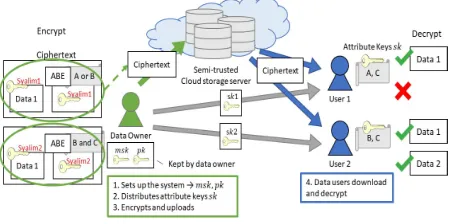
Figure 1. Cloud Server Storage – System Replication
In this paper, the proposed approach uses the convergent encryption scheme called Advanced Encryption Standard (AES) with powerful Attribute Based Encryption (ABE) Scheme, which derive keys from the hash of plaintext and Store it to server. This pointed out some security problems and presented a security model for secure data deduplication. These two protocols focus on server-side deduplication and do not consider data loss settings, against malicious users.
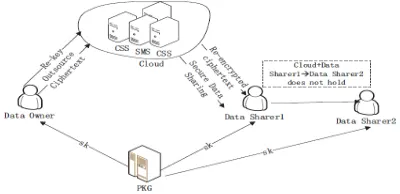
Figure 2. Proxy ReEncryption Scheme Model
A. Existing System Summary
ISSN(Online): 2319-8753 ISSN (Print): 2347-6710
I
nternational
J
ournal of
I
nnovative
R
esearch in
S
cience,
E
ngineering and
T
echnology
(A High Impact Factor, Monthly, Peer Reviewed Journal)
Visit: www.ijirset.com
Vol. 8, Issue 1, January 2019
ABE and symmetric encryption, specifically the advanced encryption standard (AES), are used for efficiency. In hybrid encryption, data is encrypted with AES and the AES key is encrypted with ABE. Because existing revocation methods affect only ABE ciphertext, this fact introduces a problem in which users can keep the AES key prior to revocation and use it to decrypt data even after the users are revoked. Therefore, although existing revocation methods can be applied to revoke users from ABE, re-encrypting data with a new AES key is necessary so that the old AES key can no longer be used.
Figure 3. Traditional Data Prevention Model over Cloud Server
B. Proposed System Summary
In this proposed approach, we propose an attribute-based proxy Reencryption method for revocation in which the DO is no longer required to download any data for re-encryption. By using a symmetric encryption scheme that supports proxy Reencryption in hybrid with ABE, we can perform revocation in the cloud so that a revoked user will no longer be able to decrypt data after revocation. Specifically, we implement a symmetric encryption scheme proposed by Syalim et al. in hybrid with CP-ABE, encrypt data with Syalim’s scheme, and encrypt Syalim scheme’s keys with CP-ABE.
Figure 4. Proposed System Architectural Design
By using a symmetric proxy re-encryption scheme, the data can be reencrypted in the cloud without revealing any data to the cloud. In addition, the DO only has to generate a set of Reencryption keys and a new ABE ciphertext that encrypts the new Syalim scheme’s keys, and then send both to the cloud for re-encryption. Therefore, in the revocation step, sending only the re-encryption keys and ABE ciphertext to the cloud is required, thus reducing the communication cost between the DO and cloud. Because the re-encrypted ciphertext is encrypted under a completely new set of keys, users cannot decrypt data even if they keep the old symmetric keys or parts of the old ciphertext.
C. User Authorization and Authentication
ISSN(Online): 2319-8753 ISSN (Print): 2347-6710
I
nternational
J
ournal of
I
nnovative
R
esearch in
S
cience,
E
ngineering and
T
echnology
(A High Impact Factor, Monthly, Peer Reviewed Journal)
Visit: www.ijirset.com
Vol. 8, Issue 1, January 2019
generates a signature on behalf of the original signer. From a proxy signature, a verifier can be convinced of the original signer’s agreement on the signed message. Researchers have proposed 3 kinds of proxy signature algorithms: full delegation, partial delegation and partial delegation by warrant. The former two are eliminated by partial delegation with warrant which is proved to be more secure and practical, so we also use partial delegation with warrant in our protocol design.
Let A be an original signer who has an authentic key pair (PrKA and PuKA), and B be a proxy signer who has an authentic key pair (PrKB and PuKB). Let mw be A’s warrant information for the delegation, which has semantic means including the original signer’s identity, some information about the proxy signer (for example the identity), period of delegation validity, the qualification of messages on which the proxy signer can sign, etc. Let dA Sign PrKA; be A’s signature on the warrant mw using his/her private key PrKA. A transmits dA to the proxy signer B.
D. Data Manipulation
The data manipulation module supports data owner scenario and it allows the data owner to maintain the data which is on the cloud server securely and to upload data into the cloud storage to save costs. A data owner first encrypts the data and outsources it to the cloud storage with its index information, that is, a tag. If a data owner want to uploads some data that is not already exist in the cloud storage then he is called an initial Uploader; if the data already exist in the cloud storage then it is called a subsequent uploader since it means that other data owners may have uploaded the same data previously then he is called a subsequent uploader. Hereafter, we refer to a set of data owners who share the same data in the cloud storage as an ownership group.
E. Cloud Service Provider
This is an entity that provides cloud storage services. It consists of a cloud server and cloud storage. The cloud server de-duplicates the outsourced data from users if necessary and stores the de-duplicated data in the cloud storage. The cloud server maintains data owner lists of stored data, which are composed of a tag for the stored data and the identities of its owners. The cloud server controls access to the stored data based on the ownership lists and manages (e.g., issues, revokes, and updates) group keys for each ownership group as a group key authority. The cloud server is assumed to be honest-but-curious. That is, it will honestly execute the assigned tasks in the system; however, it would like to learn as much information about the encrypted contents as possible. Thus, it should be deterred from accessing the plaintext of the encrypted data even if it is honest.
F. Data Deduplication Scheme
This data deduplication module allows the data owner to maintain the records into the server more dynamically and with full of integrity. Once the data owner uploaded the records into the database/server, which is counted and manipulated at every time while uploading the data next time into the server then If the data matches with the existing records, the system won't allow the data owner to upload the data further and blocks them to proceed.
II. LITERATURE SURVEY
In the year of 2013, the authors "D. Boneh, K. Lewi, H. Montgomery and A. Raghunathan [1]", proposed a paper titled "Key homomorphic PRFs and their applications [1]", in that they descibed such as a pseudorandom
function F:K×X→Y is said to be key homomorphic if given F(k1,x) and F(k2,x) there is an efficient algorithm to
compute F(k1 ⊕ k2, x), where ⊕ denotes a group operation on k1 and k2 such as xor. Key homomorphic PRFs are
natural objects to study and have a number of interesting applications: they can simplify the process of rotating encryption keys for encrypted data stored in the cloud, they give one round distributed PRFs, and they can be the basis ofa symmetric-key proxy re-encryption scheme [1].
ISSN(Online): 2319-8753 ISSN (Print): 2347-6710
I
nternational
J
ournal of
I
nnovative
R
esearch in
S
cience,
E
ngineering and
T
echnology
(A High Impact Factor, Monthly, Peer Reviewed Journal)
Visit: www.ijirset.com
Vol. 8, Issue 1, January 2019
in groups with an ℓ-linear map. We leave as an open problem the question of constructing standard model key homomorphic PRFs from more general assumptions [1][4][5].
In the year of 2016, the authors "W. C. Garrison III, A. Shull, S. Myers and A. J. Lee [2]", proposed a paper titled "On the Practicality of Cryptographically Enforcing Dynamic Access Control Policies in the Cloud [2]", in that they descibed such as: It is increasingly common to outsource data storage to untrusted, third party (e.g. cloud) servers. However, in such settings, low-level online reference monitors may not be appropriate for enforcing read access, and thus cryptographic enforcement schemes (CESs) [2] may be required. Much of the research on cryptographic access control has focused on the use of specific primitives and, primarily, on how to generate appropriate keys and fails to model the access control system as a whole [2].
Recent work in the context of role-based access control has shown a gap between theoretical policy specification and computationally secure implementations of access control policies, potentially leading to insecure implementations. Without a formal model, it is hard to (i) reason about the correctness and security of a CES, and (ii) show that the security properties of a particular cryptographic primitive are sufficient to guarantee security of the CES as a whole. In this system, a rigorous definitional framework is provided for a CES that enforces read-only information flow policies (which encompass many practical forms of access control, including role-based policies) [2][7].
This framework (i) provides a tool by which instantiations of CESs can be proven correct and secure, (ii) is independent of any particular cryptographic primitives used to instantiate a CES, and (iii) helps to identify the limitations of current primitives (e.g. key assignment schemes) as components of a CES [2][8].
In the year of 2016, the authors "F. Wang, J. Mickens, N. Zeldovich and V. Vaikuntanathan [3]", proposed a paper titled "Sieve: Cryptographically enforced access control for user data in untrusted clouds [3]", in that they descibed such as: Modern web services rob users of low-level control over cloud storage—a user’s single logical data set is scattered across multiple storage silos whose access controls are set by web services, not users [3][5].
The consequence is that users lack the ultimate authority to determine how their data is shared with other web services. In this system, Sieve was introduced, a new platform which selectively (and securely) exposes user data to web services. Sieve has a user-centric storage model: each user uploads encrypted data to a single cloud store, and by default, only the user knows the decryption keys. Given this storage model, Sieve defines an infrastructure to support rich, legacy web applications. Using attribute-based encryption, Sieve allows users to define intuitively understandable access policies that are cryptographically enforceable. Using key homomorphism, Sieve can reencrypt user data on storage providers in situ, revoking decryption keys from web services without revealing new keys to the storage provider [3][9]. Using secret sharing and two-factor authentication, Sieve protects cryptographic secrets against the loss of user devices like smart phones and laptops. The result is that users can enjoy rich, legacy web applications, while benefiting from cryptographically strong controls over which data a web service can access.
III. IMPLEMENTATION
Data Security Phases:
Encryption Process : C=E(P, K) ReEncryption Process: RC=E(C,K) Decryption Process: D=D(RC, K) Where, P – Plaintext,
C – Ciphertext,
RC−Reencrypted Ciphertext
E – AES Encryption Algorithm D – AES Decryption Algorithm K – Key
Key Scramble:
SK =∑(K ⊕ MASTERKEY )
ISSN(Online): 2319-8753 ISSN (Print): 2347-6710
I
nternational
J
ournal of
I
nnovative
R
esearch in
S
cience,
E
ngineering and
T
echnology
(A High Impact Factor, Monthly, Peer Reviewed Journal)
Visit: www.ijirset.com
Vol. 8, Issue 1, January 2019
K=∑ (SK ⊕ MASTERKEY)
Where,
SK- Scrambled Key
Algorithm Notifications:
unm : User Name
DB : Database
emid : Email Id
mno : Mobile Number
Σ : Selection Operator
:= : Assignment Operator
⊕ : Exclusive OR
Algorithm NewRegistration:
// Input: Username, emailID, MobileNumber, City, State, Country,Usertype // Output: All User/DO credentials should store in DB suceessfully.
//Enter User/Dataowner details unm:=Read USERNAME; emid:=Read EMAILID;
mno:=Read MOBILE NUMBER; city:=Read CITY;
state:=Read STATE; country:=Read COUNTRY; if(utype==DataOwner) {
if(emid equals(“text_emailid”)) {“Email id already Exist”} else
{
DBStore(unm ,emid, mno, city, state, country); }
}
DBStore(unm ,emid, mno, city, state, country); }
Algorithm CryptoManager
//Input: Password / Original File / Encrypted File.
//Output: Hashed Password / Encrypted File / Decrypted File / Uploaded Encrypted File/ //Download Decrypted File.
1. Set crypto_algo :=AES;
Set hash_algo :=MD5;
master_key :=”random alphanumeric text” ; AES_key;
AES_Mkey;
2. //Hash password
ISSN(Online): 2319-8753 ISSN (Print): 2347-6710
I
nternational
J
ournal of
I
nnovative
R
esearch in
S
cience,
E
ngineering and
T
echnology
(A High Impact Factor, Monthly, Peer Reviewed Journal)
Visit: www.ijirset.com
Vol. 8, Issue 1, January 2019
3. //Create Key
AES_key:=create_newkey(crypto_algo, doid); // Create AES key for DO // scramble key to store key in database
Mkey:=scramble_key(AES_key, mastr_key); //map AES_Mkey to doid and store in database Dbstore(doid, AES_Mkey);
4. //Upload file
Upload_file (doid, filename, file_data) {
AES_Mkey:=DBFetch(doid); // unscramble key.
AES_key:= unscramble_key(AES_Mkey, mastr_key); //encrypt file data.
encrypted_data:=encrypt_file(file_data, Crypto_algo, AES_key) ; //upload encrypted file on cloud
CloudClientInterface_uploadblock(doid, filename, encrypted_data); //map filename and doid in database
DBstore(doid, filename); }
5. //Reencryption of data on cloud
DBstore_file (doid, filename, encrypted_data) {
AES_Mkey:=DBFetch(doid); // unscramble key.
AES_key:= unscramble_key(AES_Mkey, mastr_key); //reencrypt file data.
reencrypted_data:=reencrypt_file(encrypted_data, Crypto_algo, AES_key) ; //upload reencrypted file on cloud
CloudClientInterface_uploadblock(doid, filename, reencrypted_data); //map filename and doid in database
DBstore(doid, filename); }
6. //Download file
download_file (doid, filename) {
If(ifFileExist(DBFetch(doid, filename))) {
//download reencrypted file from cloud
reencrypted_data:=CloudClientInterface_download(doid, filename,); DBFetch(doid, AES_Mkey);
AES_key:= unscramble_key(AES_Mkey, mastr_key); / //unscramble key. file:= decrypt_file(reencrypted_data, crypto_algo, AES_key) ; //decrypt file data. return file;
ISSN(Online): 2319-8753 ISSN (Print): 2347-6710
I
nternational
J
ournal of
I
nnovative
R
esearch in
S
cience,
E
ngineering and
T
echnology
(A High Impact Factor, Monthly, Peer Reviewed Journal)
Visit: www.ijirset.com
Vol. 8, Issue 1, January 2019
IV. EXPERIMENTAL RESULT
The following figure illustrates the home page design of the proposed system.
Figure 5. Home Page Design
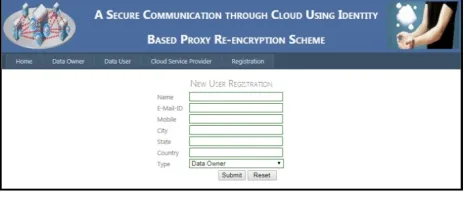
The following figure illustrates the New User Registration page of the proposed system.
Figure 6. New User Registration
After successful registration cloud service provider (CSP) authenticates the user as shown in following figure by clicking on active/deactive button.
Figure 7. CSP Authentication for data Owner
ISSN(Online): 2319-8753 ISSN (Print): 2347-6710
I
nternational
J
ournal of
I
nnovative
R
esearch in
S
cience,
E
ngineering and
T
echnology
(A High Impact Factor, Monthly, Peer Reviewed Journal)
Visit: www.ijirset.com
Vol. 8, Issue 1, January 2019
The following figure shows data owner login page
Figure 9. Data owner login page
Clicking on login button it need to check identity by entering secure code which is sent on email id as shown in following figure.
Figure 10. Identity checking for Data owner
Once data owner login then following figure illustrates the Data Uploading and its Encryption nature of the proposed system.
Figure 11. Data Uploading with Encryption Strategies
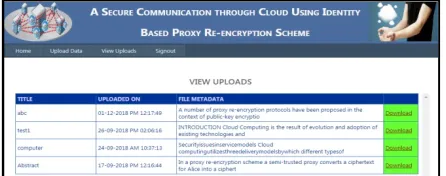
The following figure shows the uploaded data.
ISSN(Online): 2319-8753 ISSN (Print): 2347-6710
I
nternational
J
ournal of
I
nnovative
R
esearch in
S
cience,
E
ngineering and
T
echnology
(A High Impact Factor, Monthly, Peer Reviewed Journal)
Visit: www.ijirset.com
Vol. 8, Issue 1, January 2019
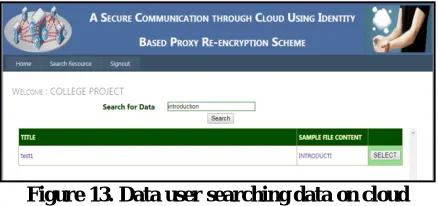
When data user request particular file then the re-encryption of data done in cloud storage by proxy. To search any file data on cloud then he first login and search data by content based search as shown in following figure.
Figure 13. Data user searching data on cloud
This is the data searching process. Now for downloading file click on select button it asks security code which is sent on email id after that it shows download button clicking on that data decryption process will done then user get plaintext data as shown in following figure.
Figure 14. Security checking for download Data
Figure 15. Downloading Data
ISSN(Online): 2319-8753 ISSN (Print): 2347-6710
I
nternational
J
ournal of
I
nnovative
R
esearch in
S
cience,
E
ngineering and
T
echnology
(A High Impact Factor, Monthly, Peer Reviewed Journal)
Visit: www.ijirset.com
Vol. 8, Issue 1, January 2019
V. CONCLUSION
In this system, providing security towards remote cloud storage and improving the privacy by means of Proxy-Reencryption Scheme. In Identity based Proxy Proxy-Reencryption (PRE) scheme the data owner can control sharing capability in a flexible way by using random numbers used in the encryption process. This scheme has some advantages, and can be more appropriately adapted to some applications for content sharing, such as secure cloud data sharing. The advantage of this scheme is that it consumes communication cost and time of encryption and decryption method by proposing an attribute-based proxy re-encryption method in which data can be re-encrypted in the cloud without downloading any data by adopting ABE scheme.
.
REFERENCES
[1] D. Boneh, K. Lewi, H. Montgomery, and A. Raghunathan, “Key homomorphic PRFs and their applications,” Advances in Cryptology-CRYPTO 2013, LNCS, vol. 8042, pp. 410-428, 2013.
[2] W. C. Garrison III, A. Shull, S. Myers, and A. J. Lee, “On the Practicality of Cryptographically Enforcing Dynamic Access Control Policies in the Cloud,” 2016 IEEE Symposium on Security and Privacy (SP), pp. 819-838, 2016.
[3] F. Wang, J. Mickens, N. Zeldovich and V. Vaikuntanathan, “Sieve: Cryptographically enforced access control for user data in untrusted clouds,“ Proc. of 13th USENIX Symposium on Networked Systems Design and Implementation (NSDI ’16), pp. 611-626, 2016.
[4] M. Horváth. "Attribute-Based Encryption Optimized for Cloud Computing," SOFSEM 2015: Theory and Practice of Computer Science, LNCS, vol. 8939, pp. 566-577, 2015.
[5] S. Yu, C. Wang, K. Ren, and W. Lou, "Attribute based data sharing with attribute revocation," Proc. of the 5th ACM Symp. on Information, Computer and Communications Security, pp. 261-270, 2010.
[6] Y. Yasumura, H. Imabayashi, and H. Yamana, “Attribute-based Proxy Re-encryption Method for Revocation in Cloud Storage,” Proc. of 2017 IEEE Int’l Conf. on Big Data, pp. 4476–4778, 2017.
[7] A. Sahai, and B. Waters, "Fuzzy identity-based encryption," Advances in Cryptology–EUROCRYPT 2005, LNCS, vol. 3494, pp. 457-473, 2005. [8] V. Goyal, O. Pandey, A. Sahai, and B. Waters, "Attribute-based encryption for fine-grained access control of encrypted data," Proc. of the 13th ACM Conf. on Computer and Communications Security, pp. 89-98, 2006.
[9] J. Bethencourt, A. Sahai, and B. Waters, "Ciphertext-policy attribute based encryption," Proc. of 2007 IEEE Symp. on Security and Privacy (SP’07), pp. 321-334, 2007.
[10] A. Syalim, T. Nishide, and K. Sakurai, "Realizing proxy reencryption in the symmetric world," Proc. of Int’l Conf. on Informatics Engineering and Information Science, CCIS, vol. 251, pp. 259-274, 2011.
[11] Y. Cheng et al., "Efficient revocation in ciphertext-policy attributebased encryption based cryptographic cloud storage," Journal of Zhejiang University SCIENCE C, vol. 14, Issue 2, pp. 85-97, 2013.
[12] S. Myers and A. Shull, “Efficient hybrid proxy re-encryption for practical revocation and key rotation,” Cryptology ePrint Archive, https://eprint.iacr.org/2017/833.
[13] R. L. Rivest, "All-or-nothing encryption and the package transform," International Workshop on Fast Software Encryption, LNCS, vol. 1267, pp. 210-218, 1997.
[14] Charm: A tool for rapid cryptographic prototyping. http://www.charm-crypto.com/.