Just Walk Out Technology Using RFID,
Computer Vision and Sensor Fusion
Likhitha C1, Anusha N K2, Annapurna R3, Prof. Savita B Patil4
.U G Student , Department of CSE, Sri Krishna Institute of Technology, Bengaluru, India 123
Assistant Professor, Department of CSE, Sri Krishna Institute of Technology, Bengaluru, India 4
ABSTRACT:—In today’s world, technology plays a vital role, without technology it is hard to imagine our day to day
life. Everyday an innovation is taking place in some part of the world. ‘Just walk out technology’ is such an example of innovation and sheer brilliance that will take the world by storm. Currently this technology is been used by self-driving cars and major online shopping giant ‘Amazon’. Amazon have launched it as ‘Amazon go’. But this technology has vast applications in various fields and will play lives changing role in near future.
KEYWORDS:Amazon Go, “Just Walk Out”, RFID Reader, RFID Tags, Sensor Fusion.
I. INTRODUCTION
Just Walk Out Technology automatically detects when products are taken from or stored back to the shelves and keeps track of them in a virtual cart. While you’re carried out buying, you could just go away from the shop. Rapidly after, Amazon will deduct money from customers Amazon account and send customer a receipt. This technology is being presently enforced by Amazon as Amazon Go, that offers checkout-free shopping expertise and it's created potential by an equivalent kinds of technologies as utilized in self-driving cars, face recognition system etc. that are computer vision, sensing element fusion, RFID tag and deep learning. Amazon hasn’t yet revealed how these technologies work in co-ordination with each other but we have tried to explain the functioning of Just Walk out Technology according to the working of Computer vision, Sensor fusion and deep learning,RFID tag.
The use of RFID will simplify shoppers’ experiences at stores and will allow stores to operate in a “no lines, no check out” fashion. This simplified shopper experience will be desired, because the customer will only need to grab what they need, and do not need to wait in the dreadful checkout lines. The “no lines, no checkout” experience the Amazon Go store has is due to the use of sensor fusion; specifically, passive RFID tags. RFID Tags store data similarly to barcodes; however, the tags do not need to be near or insight of the reader for the reader to scan the item. This will allow to the store to work autonomously, where the only staff members will be maintainers. RFID will both revolutionize a new method of shopping that will change the convenience store market, leading to improvements in the shopping experiences by saving time for the consumer. At the same time, Amazon will be able to gather even more information about consumers than was possible before, allowing for more directly targeted marketing. Moreover, as time progresses, more companies will likely adopt similar technology, moving this type of merchandising to various categories of storefronts across the globe. In short, Amazon Go stores are going to change the way that consumers shop for good.
II. LITERATURE SURVEY
1. “The Research of Iot based on RFID Technology”
it, uses of IoT framework bases on RFID innovation is exhibited, for example, product offering and coordinations administration, sustenance security supervision, healing facility resources, staff and compartment administration, and checking for mineworkers. Among these, EPC IoT framework is uniquely laid out, which is made out of RFID equipment, Savant middleware and the Internet framework. Finally, the advancement of RFID innovation in our nation is displayed. In spite of the fact that there are a few troubles at exhibit, we trust that RFID innovation will be additionally created and developed to give more helpful administrations to clients later on.
Disadvantage:
Although readers can scan through most non-metallic materials, they have problems with metal and water.
The fact that you can scan multiple objects in a range is a benefit, but also comes with possible issues that can cause malfunctions. Tag collision may occur if a reader picks up signals from multiple tags at the same time. Reader collision may be an issue if two readers interfere with each other's signals.
RFID systems are still typically more expensive to set up and use than alternative systems such as optical scanning.
RFID also brings up some security issues. Unauthorized devices may be able to read and even change data on
tags without the knowledge of the person who owns the object. Side-channel attacks can pick up RFID data as it passes from a tag to a reader, which could give the attacker access to passwords or information that should be secure. Some states have privacy statutes to restrict activities that might use RFID technology to collect personal information.
2. “ Preview on Structures and Algorithms of Deep Learning“
Profound learning proposed by Hinton et al is another learning calculation of multi-layer neural system, and it is additionally another investigation field in machine learning. This paper portrays the structures and favorable circumstances to shallow learning of profound learning, and dissects current famous learning calculation in detail. At long last, this paper dissects inquire about bearings and future prospects of profound learning.
Disadvantage:
Requires a large amount of data — if you only have thousands of example, deep learning is unlikely to outperform other approaches.
Is extremely computationally expensive to train. The most complex models take weeks to train using hundreds
of machines equipped with expensive GPUs.
Do not have much in the way of strong theoretical foundation. This leads to the next disadvantage.
Determining the topology/flavour/training method/hyper parameters for deep learning is a black art with no theory to guide you.
What is learned is not easy to comprehend. Other classifiers (e.g. decision trees, logistic regression etc) make it much easier to understand what’s going on
3. “Sensor Fusion”
Sensor fusion is consolidating of sensory data or information got from different sources with the end goal that the subsequent data has less vulnerability than would be conceivable when these sources were utilized separately. The term vulnerability diminishment for this situation can mean more exact, more total, or more trustworthy, or allude to the aftereffect of a rising perspective, for example, stereoscopic vision (calculation of depth information by combining two-dimensional images from two cameras at slightly different viewpoints).
Disadvantage:
Inflexible to sensor changes and the workload is concentrated at a single point.
Decentralized: Data fusion occurs locally at each node on the basis of local observations and the information
obtained from neighbouring nodes.
III.SYSTEM REQUIREMENTS AND SPECIFICATION
Functional Requirements
Sensors to sense the objects.
RFID tags
RFID readers to read the RFID signals.
Camera’s to take the images of the objects in the shop.
Technical person who is capable of handling the issues related to electronic devices.
Non-Functional Requirements
Land to build a shop or mall.
Visitors.
Grocery items or eatables that should be available in the mall. Parking slots for the users who enters the shop.
IV.TECHNOLOGY USED
WHAT IS SENSOR FUSION AND HOW ARE RFID TAGS INVOLVED?
Why does Amazon Go need sensor fusion for the store to work? Well, to better understand how the store would run imagine you and maybe ten other workers standing throughout the store. You cannot move or communicate with the other employees and it’s your job to determine the all the items the customers are picking up. It would be overwhelming for one person to do that job. There are numerous customers to keep track of and you could be at an angle where you cannot see if a customer is taking an item off the shelf. WilfriedElemenreich, from the Institute of Informatics, describes sensor fusion as, “the combining of sensory data or data derived from sensory data such that the resulting information is in some sense better than would be possible when these sources were used individually” [3]. Dr.JitendraRaol, a doctoral research guide at Ramiah Institute of Technology, summarizes this idea into a computer collects the images obtained from one or more sensors, then stiches them together to form one picture that will accurately describe the location of the item [4]. Also, but fusing the images together the data being collected will yield better results because it will increase the clarity of the image [4]. Essentially, Amazon Go hopes to enhance the data being collected by the system of cameras, RFIDs tags and readers throughout the store. One way to look at how sensor fusion works is to relate the camera system to the human eyes. We have two eyes to process the physical world, and by having two eyes that have two different perspectives, our brain can fuse those two images together to into one picture that will increase the clarity of the image and tell us how far the item is. This concept is comparable to the system of cameras being used. Each camera is in a fixed location, allowing them to each have their own perspective of the image being processor. When these perspectives are stitched together, this will result in a more detailed, accurate image. However, Amazon knows that they cannot rely solely on cameras to accurately determine what item is picked up off the shelf and if the customer put the item back. The cameras are in fixed location in the sore, there maybe a case where the cameras could potentially have a blindspot. So alongside with cameras, Amazon will use RFID tags and readers to determine when an item moves [2]. To summarize, there are RFID readers in the Amazon Go store and based on where the RFID tags are in relation to the readers, the store will know if the customer moved an item on the shelf and if the customer is leaving the store with the item [2].
WHAT ARE RFID TAGS?
Fig 1:Representation of Storage Ability
The Material Handling Institute (MHI), the nation’s largest material handling, logistics and supply chain association, explains how barcodes “use patterns of dark lines and light spaces to represent numeric or alphanumeric data”, a one dimensional way to store information [6]. While “QR codes store information in a pattern of black and white squares or dots, and can store considerably more information in smaller spaces than linear barcodes”, all of which is illustrated in Figure 1 above [6].
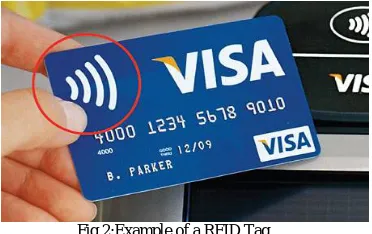
Fig 2:Example of a RFID Tag
For RFID tags, on the other hand, they can store up to eight kilobytes of data compared to qr codes that can hold up to three kilobytes [6]. A new popular use for RFID tags, as shown in Figure 2, is using them to store and validate your banking information on your credit or debit card. This can be done by the additional storage capacity that RFID offers. Another way RFIDs differ from the more traditional identifiers is how RFIDs are read.
Fig 3: Example of a RFID Reader
contributor to Amazon’s goal to have no lines and no checkouts. You just have to grab what you want and walkout, all because of Amazon’s “Just Walk Out Technology.”
Fig 4:Simple Diagram Showing How RFID Works
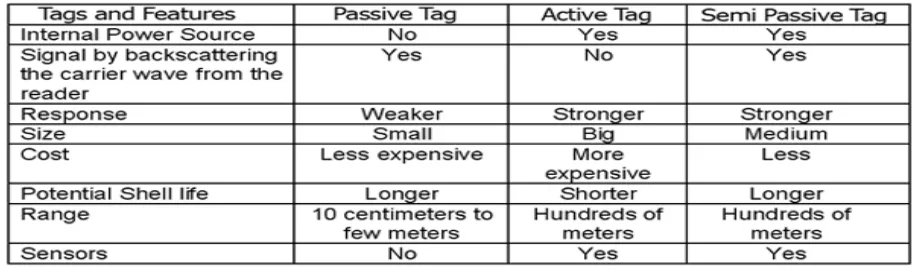
RFID tags store data on a chip that can be converted into into radio-frequency [10]. As shown in Figure 4, when a tag is in range of a reader, the reader will then intake the signal and send the data to a computer to compile the data [10]. This process does vary on the type of RFID tag being used. As shown in Figure 5, there are three types of tags: passive, semi-active, and active.
Fig 5:Difference Between RFID Tags
cost-sensitive applications, because, having no battery and no transmitter, they are very inexpensive”, so passive tags would be the best chose to use for a convenience store that has tags on the items themselves [10]. After reviewing the patient, Amazon has stated that the RFID would power the tags once they were close range of the readers [2]. Comparing the passive and active tags, it is clear that the
V. EXPERIMENTAL RESULTS
FINANCIAL IMPLICATIONS
Amazon’s usage of RFID will provide proof to the retail industry that while switching to RFID may demand high upfront costs, the long-term profits easily outweigh the costs. One of the major roadblocks preventing the industry from making the switch is the cost of the tags at face value. Mark Roberti, owner of RFID Journal, points out that when purchasing in bulk, an individual barcode costs less than a penny, whereas a RFID tag costs about five cents [3]. However, as was previously mentioned, the cost of purchasing individual tags will be incurred much less frequently with RFID, as they are rewritable, allowing modification and reusability. This will negate a small amount of the extra costs associated with RFID tags, but most savings come from assessing the implications of making the transition to the technology. Specifically, reading RFID tags is an incredibly fast process, especially compared to the traditional usage of barcodes. RFID tags can be read in bulk, allowing procedures such as inventory counts to take place with extreme speed improvements and therefore higher frequency. As is pointed out by RFID Arena, taking an inventory count with current barcode technologies allows a speed of only 250 items per hour, whereas RFID tags can be scanned at speeds of up to 25,000 items per hour [13]. With the ability to take inventory counts at such high speeds, Amazon will save significant amount of money, as paid workers will work fewer hours. On top of this, inventory counts will be far more accurate, since each tag has an individual identity. This eliminates inventory errors caused by scanning the same barcode twice, reducing much of errors in stock counts attributed to common methods used today. The benefits only grow when you consider the possibilities granted by the ability to read tags without line of sight, as this means that it is not necessary to unload bulk quantities of a product stored in a crate or palate. With RFID tags, the entire stored quantity can be scanned in an instant, without needing to unpack and then potentially repack said items.Next, RFID tags are much more durable than competing options. If a product's barcode were to somehow become wet or damaged, it becomes much harder to read, if it can still be read at all. In contrast, RFID tags are resistant to inclement weather, extreme temperatures, as well as wear and tear. This is ideal for a retail environment such as Amazon Go, as implementing their “Just Walk Out” technology leaves little room for errors in item detection and recognition. Of course, these details certainly prove that RFID tags are a major innovation when used properly in the retail industry, especially when it comes to monetary incentives; but it is important to see how effectively they work in practice. Fortunately, a few major department store chains have implemented RFID technology into sectors of their supply chains. Notably, Wal-Mart started employing RFID on January 1st, 2005, providing an excellent proving ground for retail usage of the tags. As is calculated by Software Engineer AchchuthanSeetharan, Wal-Mart saves nearly $8.35 billion annually purely due to switching their tags.
Retail Sustainability
supplier warehouse or the retailer’s central warehouse, there was significant impacts in supplier performance and inventory performance, respectively [16]. To be more specific, both suppliers and retailers “have access to more accurate and more detailed knowledge of inventory, demand and supply history” with the implementation of RFID [16]. “[T]he performance of the of the distribution system, including products dispatched and inventory in transit, [was] improved by 33.8% and stock availability [was] improved by 45.6% [16]. Dr.Ilias Vlachos states in his report that 45% is considered a huge improvement, any improvement at all though should not be neglected in supply chain performance [16]. Key performance indicators (KPIs) is a measurable value that demonstrates how effectively a company is achieving key business objectives. Managers use KPIs to to aid them in important decision that will affect the company. “By providing more clarity of information about KPIs across the supply chain, managers can make more accurate and more timely decisions, which, in turn, allow for further lead time reductions” [16]. We live in a society that goes by the motto “time is money”. With the amount of time saved, there is a vast amount of money saved as well through the implementation of RFID. However, simply pushing RFID into corporations is not enough to have a profound effect. As Vlachos states, “this wide application of RFID requires technical infrastructure that includes the standardisation of data exchanges and the implementation of proper software applications” [16]. In other words, the companies must also ensure they have the software to run a business with RFID. As was pointed out previously, Amazon Go uses machine learning and sensor fusion, proving that they do have the technology capable of running a store [1]. Once Amazon Go opens stores to the general public, they will likely see “improving operations, reducing costs, and improving customer satisfaction” [16]. In order to compete, other stores will have to follow suit, leading to higher customer satisfaction for everyone.
POTENTIAL CONCERNS WITH RFID TAGS.
Customer Profiling
The use of RFID tags has raised various concerns, especially in relation to the gathering of information and customer profiling. As is pointed out by researchers at Marche Polytechnic University, using sensor fusion and RFID technology allows Amazon to create incredibly detailed customer profiles [17]. This has a variety of implications on the retail industry, as well as the specific design of Amazon Go stores. The technology implemented in the stores would allow Amazon to perform analysis such as tracking customer paths throughout the store, determining item popularity for individual demographics, and determining item popularity for specific customers, all of which have respective ramifications.
Retail-Specific Complications
While using RFID tags is financially beneficial to Amazon Go, there are various complications that could arise for both Amazon and the economic future. First and foremost, as many have been quick to point out, Amazon Go has high potential of being a major job killer [18]. According to the Bureau of Labor Statistics, grocery stores employ 856,850 cashiers in 2015 [19]. By introducing Amazon Go, Amazon will be creating stark competition to the modern version of grocery stores known today, as the checkout process will be much faster. Therefore, most grocery chains will likely need to look towards similar technologies in order to compete. If they don’t follow suit with Amazon, there is a chance they could be run out of business. Eliminating cashiers reduces a major cost for the company, allowing a lot more annual revenue, especially compared to competitors that will lose some customers to Amazon. Simply put, a large chunk of these jobs will likely disappear over time due to Amazon Go. Leaving such a high number of Americans without work will undoubtedly have a negative impact on the economy. While it isn’t Amazon’s responsibility to solve this issue, it is still a major consideration, with the potential of leading to new regulations for automated stores such as Amazon Go.
On another note, Amazon has yet to elaborate on how they will deal with the issue of returning items to shelves. Of course, detecting an item has been returned to its original position is a simple procedure, but scenarios will not always be quite so easy. For example, suppose a customer is ready to leave the store, and then decides he do not want one of the items in his basket. In a customary grocery store, the customer could just tell the cashier they no longer want the item, so that the cashier could return it. Alternatively, some customers may decide to put the item down in the incorrect location, possibly because they forgot where they picked it up. These situations are especially important for items that are perishable without refrigeration, such as milk products. With Amazon Go’s customer cart tracking system, these situations are either not possible, in the case of handing the item to a cashier, or would result in the item staying within the customer’s virtual cart. Of course, Amazon could allow the customer to manually remove the item from his cart from his phone, but this would provide increased opportunity for theft. Finally, Amazon has shown that their concept involves a customer scanning his phone upon entry into the store, but that only accounts for a single customer. However, customers do not always shop independently; it is common to see a parent bring his children to the grocery store along with them, for instance. This scenario would require the store to somehow detect that the customer and his children are within the same group, and the items they purchase should all be a part of the same shopping cart. With current information about Amazon Go, it is impossible to know how Amazon will solve these issues, so only time will tell.
THAT’S HOW AMAZON GOES
Through the application of sensor fusion and passive RFID tags, Amazon is hoping to revolutionize the grocery retail industry through introduction of Amazon Go. While retailers have looked to speed up checkout by using self-checkout lanes in the past, no retailer has gone as far as Amazon, creating what they label as “Just Walk Out” technology. Upon the launch of Amazon Go, customers will have the option to choose a much more efficient grocery shopping experience, by simply entering the store, grabbing their items, and leaving. They no longer have to worry about scanning each individual item at the checkout; their cart will already be tracked digitally through the use of RFID technology. As popularity for Amazon Go stores grows, other stores will be forced to look to similar technologies to compete, and the entire industry may domino into a revolutionized new way to shop, as was initially introduced by Amazon Go. No doubt, Amazon Go is the shopping experience of the future, as well as one of the first major examples of automation decreasing the demand for human works for basic occupations, such as cashiering. Arguably, Amazon Go will not only shake up the grocery retail industry, but has the potential to change the entire general retail industry, and likely the economy, by setting new standards for customer experiences.
VI.CONCLUSION
REFERENCES
[1] “Frequently Asked Questions” Amazon. 12.5.2016. Accessed 1.9.2017. https://www.amazon.com/b?node=16008589011
[2] S. Kessel, D. Kumar, G. Puerini. “Transitioning Items from a Materials Handling Facility.” US Patent & Trademark Office. 1.8.15. Accessed
1.9.2017. http://appft.uspto.gov/netacgi/nphParser?Sect1=PTO2&Sect2=HITOFF&u=%2Fnetahtml
%2FPTO%2Fsearchadv.html&r=1&p=1&f=G&l=50&d=PG01&S1=(Steven
.IN.+AND+Kessel.IN.)&OS=IN/Steven+and+IN/Kessel&RS=(IN/Steven+AND+IN/Kessel)
[3] W. Elmenreich. “Sensor Fusion inTime-Triggered Systems.”Institute of Technical Informatics. 10.2002. Accessed 2.26.2017. https://mobile.aau.at/~welmenre/papers/elmenreich_Dis sertation_sensorFusionInTimeTriggeredSystems.pdf .p.i
[4] H.R. Roopa, P. Parimala, J.R. Raol. “Image Sensor Data Fusion Using Factorized Kalman Filter.” 2016 IEEE International Conference on Recent Trends in Electronics, Information & Communication Technology (RTEICT).[5].20-21.2016. Accessed 1.26.2017.http://ieeexplore.ieee.org/document/7808025/ [5] G. Fox.“QR Code Marketing- The What, Why and How of Using Them.”TribalCafe. 2017. Accessed 3.1.2017. https://www.tribalcafe.co.uk/qr-codemarketing/
[5] “Automatic Identification and Data Collection (AIDC).” MHI. 2017. Accessed 3.1.2017.
http://www.mhi.org/fundamentals/automaticidentification
[6] “The Skinny on RFID Technology – All you Need to Know.” Shield Safe. 2015. Accessed 3.1.2017. http://www.shieldsafe.net/what-is-rfid-technology/
[7] “Grove – LoRa Radio 433MHz.” Seeed. 2016. Accessed 3.1.2017. https://www.seeedstudio.com/Grove-LoRa-Radio433MHz-p-2777.html
[8] “What is RFID?”. Barcode Graphics Inc.. 2017. Accessed 3.2.2017. http://www.epc-rfid.info/rfid
[9] D. M. Dobkin. “The RF in RFID: Physical Layer Operation of Passive UHF Tags and Readers.” Enigmatics Consulting. 12.2017. Accessed 3.2.2017. http://www.enigmaticconsulting.com/Communications_articles/RFID/Link_b udgets.html
[10] KV.S Rao, P.V. Nikitin, S.F. Lam. “Antenna Design for UHF RFID tags: a Review and a Practical Application.” IEEE Transactions on Antennas and Propagation. 12.5.05. Accessed 1.25.17. http://ieeexplore.ieee.org/abstract/document/1549967/
[11] J. Thrasher, "RFID vs. Barcodes: What are the Advantages?," in RFID Insider, atlasRFID, 2013. [Online]. Available: http://blog.atlasrfidstore.com/rfidvs-barcodes. Accessed: Mar. 1, 2017.
[12] J. Säilä, "6 most common FAQs of Barcode vs RFID," in RFID Arena, 2011. [Online]. Available: http://www.rfidarena.com/2013/12/2/6-most-commonfaqs-of-barcode-vs-rfid.aspx. Accessed: Mar. 1, 2017.
[13] A. Seetharan, "Walmart and RFID," in SlideShare, 2015.[Online]. Available: https://www.slideshare.net/AchchuthanSeetharan/walmart-45668917. Accessed: Mar. 1, 2017.
[14] "Cost reduction in retailing & products using RFID," in IDTechX, 2005. [Online]. Available: http://www.idtechex.com/research/articles/cost_reductio n_in_retailing_and_products_using_rfid_00000205.asp. Accessed: Mar. 1, 2017. [15] I. Vlachos, "A hierarchical model of the impact of RFID practices on retail supply chain performance", Expert Systems with Applications, vol.