© 2014, IJCSMC All Rights Reserved
731
Available Online atwww.ijcsmc.com
International Journal of Computer Science and Mobile Computing
A Monthly Journal of Computer Science and Information Technology
ISSN 2320–088X
IJCSMC, Vol. 3, Issue. 7, July 2014, pg.731 – 739
RESEARCH ARTICLE
Design and Implementation of an Efficient
Scheduling Algorithm for QoS
Management in WiMAX
Sumanpreet Kaur
1, Maninder Singh
2¹Department of Computer Science, Punjabi University, Patiala, India ²Department of Computer Science, Punjabi University, Patiala, India
1
[email protected]; 2 [email protected]
Abstract— Due to the costly spectrum and ever growing demand for multimedia services, it thus become important to optimise and design appropriate scheduling algorithms and channel management techniques to maximise throughput and QoS. In this paper, the IEEE 802.16e standard based Mobile WiMAX (Worldwide Interoperability for Microwave Access) system is explored for the purpose of Quality of Service provisioning. Since the standard does not specify a specific scheduling algorithm for polling services, hence a well thought out algorithm will be of great contribution to the area under investigation. An in-depth study of the Modified Deficit Round Robin (MDRR) scheduling algorithm has been provided. Modifications have been made to the existing scheduler and the refined new MDRR scheduler is implemented in OPNET Modeler. Results from the simulations obtained show that the designed algorithm works well with latency and throughput constraints as well as with the Quality of Service demands of the WiMAX standard.
Keywords— IEEE 802.16, MAC, OFDMA, OPNET, QoS, WiMAX
I. INTRODUCTION
© 2014, IJCSMC All Rights Reserved
732
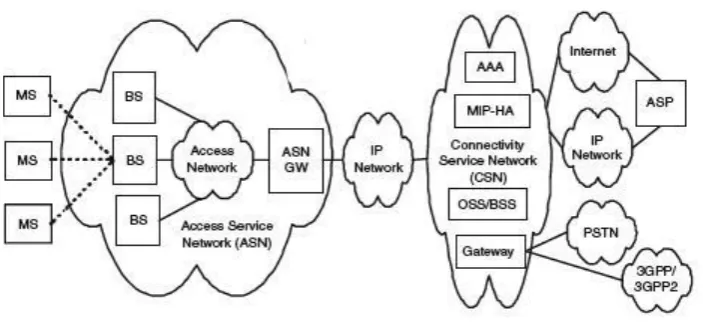
The WiMAX network system mainly comprises of core network and access network. The core network includes the network management system, router, AAA agency or server, user database, and an Intern gateway equipment. It mainly provides an IP connection to WiMAX users. The access network includes base station (BS), subscriber station (SS) and mobile subscriber station (MS). It mainly provides wireless access to WiMAX users. The WiMAX base stations use the media access control layer defined in the standard and allocate uplink and downlink bandwidth to subscribers according to their requirements on real time basis. There are two operational modes in WiMAX: Point-to-Multipoint (PMP) and Mesh mode. In PMP mode, there is a centralised base station that carries out all communications between the BS and the SSs, whereas in Mesh mode, there is no centralised BS and the SSs serve as a router by cooperative access control in a distributed manner.
Since 2001, WiMAX has evolved from 802.16 to 802.16d for fixed wireless access, and to the new IEEE 802.16e standard with mobility support. Mobile WiMAX is expected to deliver significant improvements over Fixed WiMAX which makes it even more attractive for fixed deployments. In wireless environments, link budget (measured in dB) and spectral efficiency are the two primary parameters used for evaluating system performance. The multiple access technique applied over here is OFDMA.
Fig. 1 IP-Based WiMAX Network Architecture
The rest of the paper is organized as follows: Section II describes in brief the QoS in WiMAX. The fundamental scheduling algorithms are introduced in section III. The proposed approach is presented in Section IV. Section V describes the simulation model and the obtained results. Conclusion is reported in Section VI.
II. QUALITY OF SERVICE
© 2014, IJCSMC All Rights Reserved
733
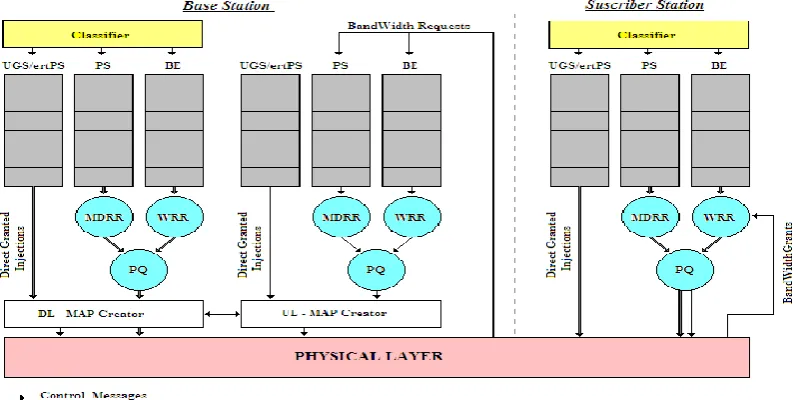
Fig. 2 IEEE 802.16 QoS architecture
Call Admission Control (CAC) determines if new connections are accepted or rejected based on the available system capacity. After connections are accepted, the network traffic must be properly prioritized according to a certain scheduling policy. This scheduling policy should be able to guarantee that QoS requisites are actually being fulfilled. Once the traffic is prioritized, an additional process may be needed, which is resource allocation.
III.WIMAX SCHEDULING ALGORITHMS
Scheduling algorithms are responsible for distributing resources among all users in the network, and provide them with a higher QoS. The scheduling algorithm is a significant part of QoS architecture. Users request different classes of service that may have different requirements (such as bandwidth and delay), so the main goal of any scheduling algorithm is to maximize the network utilization, assure latency guarantees and achieve fairness among all users. There are two types of algorithms defined in BS: downlink algorithm (from BS to SSs), and uplink algorithm (from SSs to BS). Also, SS has an internal scheduling algorithm to use when SS has many application types. The scheduling algorithms in WiMAX BS and SS are shown in Fig. 3.
© 2014, IJCSMC All Rights Reserved
734
Following are some of the fundamental scheduling algorithms:-A. Round Robin(RR)
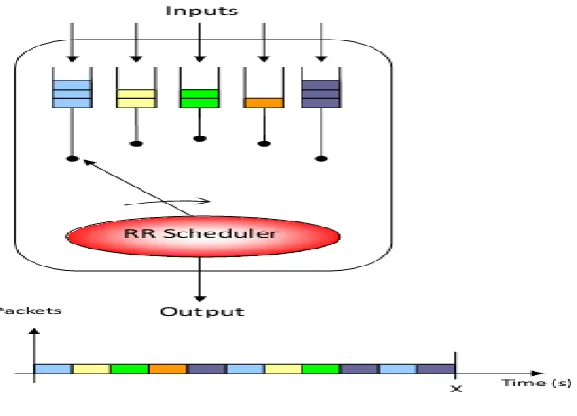
This is one of the most basic scheduling algorithm with least complexity. The FIFO queues are served in a sequential manner till all the queues are served as shown in Fig. 4 . However , it may not be able to offer fairness if packets are of different length in different queues.
Fig. 4 Round Robin Scheduler
B. Weighted Round Robin(WRR)
WRR was designed to solve the above problem in RR algorithm. It assigns a weight to each queue that represents a portion of the available bandwidth for that specific queue. Hence, the number of packets served is proportional to the weight value assigned to the queue. The main problem is that when the traffic has a variable packet size, WRR provides incorrect percentage of bandwidth allocation[16].
C. Deficit Round Robin
DRR was designed to overcome the unfairrness characteristic of the previously defined RR and WRR algorithms. The algorithm includes a deficit counter which is initialised by a value called quantum . Quantum is the amount of credit given to the queue(bits/bytes) whenever it is served. The DRR scheduler visits each queue, adds the quantum value to the deficit counter and compares its value with the size of the first packet in the queue. If the size of the packet is smaller than deficit counter, the packet would be transmitted and the size of the transmission queue would be deducted from the deficit counter. If not, the packet will be held for subsequent rounds until the deficit counter exceeds the size of the packet [15] . If the arriving packet is smaller than the quantum, the transmitted data will be smaller than the allocated bandwidth, leading to an under-utilised channel. On the other hand, if the packet size is much bigger than the quantum, the packet will be held in the queue until enough bandwidth is granted increasing the queueing delay. A proper size of the quantum should be selected to achieve the connection QoS requirements and an optimal channel usage[9].
C. Modified Deficit Round Robin(MDRR)
This algorithm is an extension of the DRR algorithm. The main variation is that a low latency queue is added which is useful for rtPS class. Here, the quantum value given to the queues is based on the weight associated with them as shown in equation 2 and 3. MTU(maximum transmission unit) is the maximmum packet size that a queue may deliver and w is the weight of the actual queue.
Q = mtu + 512* w; (2)
© 2014, IJCSMC All Rights Reserved
735
Fig. 5 MDRR Scheduler
IV.PROPOSEDAPPROACH
In cellular communication systems, in order to improve system capacity, peak data rate and coverage reliability, the signal transmitted to and by a particular user is modified to account for the signal quality variation through a process commonly referred to as link adaptation.
Adaptative Modulation and Coding (AMC) has offered an alternative link adaptation method that adapts the transmission parameters to take advantage of the prevailing channel conditions To implement this approach, the scheduler must be aware of the channel quality. Channel quality measurements are returned by the channel called the Channel Quality Indicator Channel (CQICH), measured by the SS, to the BS. The parameter sent over this channel is the CINR value. The basic idea of the proposed model is to incorporate AMC scheme in the existing MDRR scheduling scheme. In order to conserve bandwidth, more weight is assigned to the mobile stations that are near the base station.
Although MDRR offers an appreciable amount of link utilization, but channel wastage decreases it after a certain number of users. For this, we need to study the impact of the scheduling process on the DL subframe of the WiMAX-OFDMA. Equation 1 shows the DL subframe capacity usage for different number of users in VoIP.
DLSubframe = Preamble + DLMAP + ULMAP + DATABurst + FCH (1)
The main reasons for capacity wastage are [9]:-
Over- allocation of sub-headers in the BW-Request.
Use of fractional number of slots in the OFDMA sub-frame for the MAC PDU.
A bandwidth request is created when a data packet arrives to the WiMAX MAC layer and after the packet has been classified. This BW-req asks for a capacity equals to the sum of the payload (variable), the MAC Header (48bits), two Packing sub-headers (16 bits each), the Grant Manager sub-header (16 bits) and the optional CRC size (32 bits). A total of 128 bit of overhead per PDU is added. The per-user overheads impact the downlink capacity more than the uplink capacity. The downlink sub-frame has DL-MAP and UL-MAP entries for all DL and UL bursts and these entries can take up a significant part of the capacity. So, number of bursts need to be minimized in order to increase the capacity. In the proposed model, aggregation of large number of smaller packets in the same WiMAX burst has been done, thus reducing number of overhead bits [6] and also reducing the number of bursts.
The main aim of a scheduling algorithm is to achieve fairness in terms of total system bandwidth. Fairness is directly related to the configured MRTR. The value of MRTR could affect the BW-Req size and the network capacity. In the proposed model, the MRTR per frame has been taken and it is made discrete in terms of number of slots used. This allows smaller packets with higher reserved rate to be served first which leads to faster serving rates for services such as VoIP.
© 2014, IJCSMC All Rights Reserved
736
Based on the above discussion, a New MDRR scheduling scheme has been proposed. The Quantum(Q) and weight(w) definitions for the MDRR algorithm have been modified and redefined as follows :-
Fig. 6 New MDRR Equation
V. SIMULATIONMODELANDANALYSIS
A. Simulation Scenario
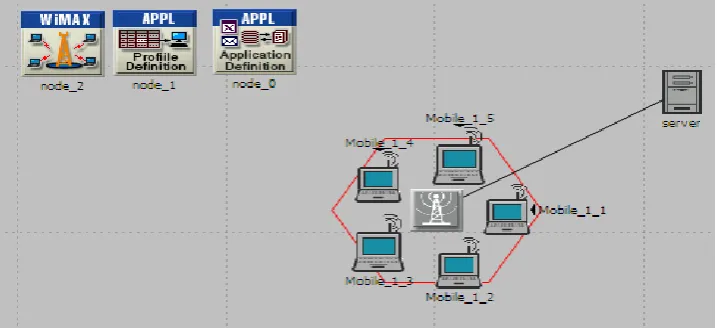
Creating a simulation scenario that is equivalent to real world scenario is the first step of simulation. In this study, OPNET Modeler is used as a simulator. The simulation scenario as shown in Fig. 7, consists of a single WiMAX cell with 5 subscriber stations. The scheduler applied is New MDRR(Modified Deficit Round Robin) and Point-to-multipoint WiMAX topology is used. The data packets have been generated using VoIP application. Applications have been defined using Application Configuration and configured using Profile Configuration. Further, the base station is connected to the server and the simulation is carried out for 30 minutes. Performance of the designed network is analyzed to study the influence of the proposed New MDRR scheduler.
Fig. 7 A Wimax Network
B. Simulation Parameters
The principal objective of this simulation is to analyse the performance of the improved scheduler. Accordingly, it is important to select appropriate WiMAX parameters and the network configuration. All the parameters used for performing experiments are presented in tabular form in Table I.
Q= [((mtu + n)/SlotSize)* SlotSize] + 512 * w; n = MRTR / FramesPerSecond;
w= (MRTR/ tsc) * 100 + cinrInt * 3; cinrInt = (cinr – 12/22) * 3.5 ; // tsc = Total System Capacity
// cinr = Carrier to Interference and Noise Ratio // MRTR = Minimum Reserved Traffic Rate // w = Weight
© 2014, IJCSMC All Rights Reserved
737
TABLE I
SIMULATION PARAMETERS
Parameters Values
Physical Layer OFDMA – TDD
System Bandwidth [MHz] 20
No. of Sub-channels UL: 70, DL: 80
No. of Data Subcarriers UL: 1120, DL: 1440
Minimum Power Density -110
Maximum Power Density -40
Maximum Transmission Power (Watts) 2.0
Symbol Duration 102.86
UL/DL boundary 50%/50%
Channel capacity [bps] UL: 5’299.200, DL: 6’336.000
Total: 11’635.000
Frame Duration [msec] 5
Symbol Duration [usec] 100.8
BW Req for Allocation [Kbps] 200, 150, 100, 75, 65, 50 and 20
ARQ and HARQ Disable
Type of Mapping PUSC, FUSC
Voice Codec G.711 and G.729
Slot Size [Symbols] 48
C. Results: The following graphs were obtained after running the above described simulation scenario.
© 2014, IJCSMC All Rights Reserved
738
Fig. 8 shows that that the overall WiMAX throughput achieved by the proposed algorithm is higher than the existing approach.
With the increase in time, the difference in throughput increases.Fig. 9 WiMAX Delay
Network delay is an important design and performance characteristic of a computer network. The delay of a network specifies how long it takes for a bit of data to travel across the network from one node or endpoint to another. Fig. 9 shows that New MDRR approach exhibits lower value in delay. This reduction leads to improved traffic capacity and QoS values.
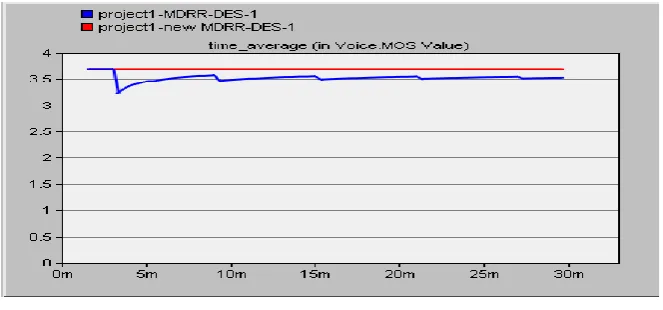
Fig. 10 Mean Opinion Score
MOS gives a numerical indication of the perceived quality of the media received after being transmitted and eventually compressed using codecs. MOS is expressed in one number, from 1 to 5, 1 being the worst and 5 the best. The MOS value shown in Fig. 10 for the proposed approach comes out to be 3.7 which is fairly good in comparison to that of default MDRR.
VI.CONCLUSION
In this paper, an efficient scheduling scheme for WiMAX network has been presented in order to improve the QoS provided in the IEEE 802.16 standard. The scheme is a modification to the existing MDRR scheduling scheme. An attempt has been made to incorporate AMC scheme in the MDRR scheduler. Also, certain techniques to reduce capacity wastage, conserve bandwidth and improve the link utilization have been implemented. At the process level, the quantum value assigned to the served queues has been redefined in terms of the prevailing channel conditions, the slot size in the subframe, frame duration and the minimum reserved traffic rate. Results from the simulations obtained in OPNET Modeler show that the designed algorithm works well with latency and throughput constraints as well as with the Quality of Service demands of the WiMAX standard.
© 2014, IJCSMC All Rights Reserved
739
ACKNOWLEDGEMENTWe would like to thank Dr. R.K Bawa for providing the necessary facilities for the successful completion of this study.
REFERENCES
[1] Ala'a Z. Al-Howaide, Ahmad S. Doulat and Yaser M. Khamayseh, "Performance Evaluation of Different Scheduling Algorithms in WIMAX", International Journal of Computer Science, Engineering and Applications (IJCSEA) , Vol. 1, No. 5, pp. 103-115, October 2011.
[2] Ashish Jain and Anil K. Verma, “Comparative Study of Scheduling Algorithms for WiMAX”, In Proc. National Conference on
Mobile and Pervasive Computing, pp. 10-13, 2008.
[3] Bo Li Yang Qin , Chor Ping Low and Choon Lim Gwee, “A survey on Mobile WiMAX [Wireless Broadband Access]”, IEEE
Communication Magazine , Vol. 45, Issue 12, pp. 70-75, December 2007.
[4] C.Cicconetti, L.Lenzini, E.Mingozzi, C.Eklund, “Quality of service support in IEEE 802.16 networks”, IEEE Network, Vol. 20, Issue 2, Mar./April 2006.
[5] Chakchai So-In, Raj Jain, and Abdel-Karim Tamimi, “Scheduling in IEEE 802.16e
mobile WiMAX networks : key issues and a survey”, IEEE Journal of Selected Areas in Communications, Vol. 27, pp. 156-171, February 2009.
[6] Chakchai So-In, Raj Jain, and Abdel-Karim Tamimi, ”Capacity Evaluation for IEEE 802.16e Mobile WiMAX”, Journal of Computer
Systems, Networks, and Communications (JCSNC), Vol. 1, No. 1, pp. 1-12, April 2010.
[7] C. Ravichandiran, P. Raj, and Vaithiyanathan, ”Analysis and Modification of Scheduling for IEEE 802.16e (Mobile WiMAX),
In Proc. Second International Conference on Communication and Networks (ICCSN), pp. 434-438, February 2010.
[8] E. Laias, I. Awan, and P. M. L. Chan, ”Fair and Latency Aware Uplink Scheduler in IEEE 802.16 Using Customised Deficit Round Robin”, In Proc. International Conference on Advanced Information Networking and Applications Workshops(WAINA), pp. 425-432, May 2009.
[9] German D.Castellano and Jamil Y.khan,"Performance of WiMAX packet schedulers for multi-class traffic", In Proc. IEEE LATINCOM, pp.1-6, Sept 2010.
[10] H. Javier and I. Patricia, "Evaluation of scheduling algorithms in WiMAX networks," In Proc. IEEE Andean Regional Conference
ANDESCON, pp. 1-4, 2010.
[11] ”IEEE Standard for Local and metropolitan area networks Part 16: Air Interface for Broadband Wireless Access Systems,” in IEEE Std 802.16- 2009 (Revision of IEEE Std 802.16-2004), pp. C1-2004, 2009.
[12] Kim Andrew, “Opnet Tutorial”, TECOMM LAB, March 2003.
[13] Luciano Lenzini, Enzo Mingozzi, and Giovanni Stea. ,”Performance Analysis of Modified Deficit Round Robin schedulers”, J. High
Speed Networks 16, Vol. 4, pp. 399-422 , 2007.
[14] M. Katevenis, S. Sidiropoulos and C. Courcoubetis, "Weighted round-robin cell multiplexing in a general purpose ATM switch chip",
IEEE Journal of Selected Areas in Communications , pp. 1265-1279, 1991.
[15] M.Shreedhar and G.Varghese, "Efficient Fair Queuing using Deficit Round Robin," IEEE/ACM Transactions on Networking, Vol. 1, pp. 375-385, June 1996.
[16] Nada M. El-Shennawy, Mostafa A. Youssef, Mohamed N. El-Derini, Mahmoud M. Fahmy,“A Dynamic Uplink Scheduling Scheme for WiMAX Networks”, In Proc. 8th International Conference on Computer Engineering & Systems (ICCES), pp. 111-115, Nov. 2013. [17] OPNET Technologies, Opnet modeler Software Package available: www.opnet.com.
[18] P. Dhrona, N.A Ali, H. Hassanein, “ A performance study of scheduling algorithms in Point-to-Multipoint WiMAX networks”, In Proc.
33rd IEEE Conference on Local Computer Networks(LCN), pp. 843 – 850, October 2008.
[19] Shaswar Baban ,”Design and Implementation of a Scheduling Algorithm for the IEEE 802.16e (Mobile Wimax ) Network”, Department of Electronics Systems, University of Westminster , Westminster , September 2008.
[20] Xinjie Chang, P. A. Farrington, H. B. Nembhard, D. T. Sturrock, and G. W. Evans, “Network Simulations With OPNET”, In Proc.
Winter Simulation Conference, December 1999.
[21] X. Perez-Costa, P. Favaro, A. Zubow, D. Camps, and J. Arauz, ”On the Challenges for the Maximization of Radio Resources Usage in WiMAX Networks,” In Proc. 5th IEEE Consumer Communications and Networking Conference(CCNC), pp. 890-896, 2008.
[22] Y. Ben-Shimol, I. Kitroser, and Y. Dinitz, ”Two-dimensional mapping for wireless OFDMA systems,” Broadcasting, IEEE
Transactions”, Vol. 52, pp. 388-396, 2006.