
Effect of exotic long-lived sub-strongly interacting massive
particles in big bang nucleosynthesis and a new solution to
the Li problem
Masahiro Kawasaki1,2and Motohiko Kusakabe1
1 Institute for Cosmic Ray Research, University of Tokyo, Kashiwa, Chiba 277-8582, Japan e-mail:
2 Institute for the Physics and Mathematics of the Universe, University of Tokyo, Kashiwa, Chiba
277-8582, Japan
Abstract. The plateau of7Li abundance as a function of the iron abundance by spec-troscopic observations of metal-poor halo stars (MPHSs) indicates its primordial origin. The observed abundance levels are about a factor of three smaller than the primordial 7Li abundance predicted in the standard Big Bang Nucleosynthesis (BBN) model. This discrepancy might originate from exotic particle and nuclear processes operating in BBN epoch. Some particle models include heavy (m 1 GeV) long-lived colored particles which would be confined inside exotic heavy hadrons, i.e., strongly interacting massive particles (SIMPs). We have found reactions which destroy7Be and7Li during BBN in the scenario of BBN catalyzed by a long-lived sub-strongly interacting massive particle (sub-SIMP,X). The reactions are non radiativeXcaptures of7Be and7Li which can be operative if theXparticle interacts with nuclei strongly enough to drive7Be destruction but not strongly enough to form a bound state with4He of relative angular momentum L =1. We suggest that7Li problem can be solved as a result of a new process beyond the standard model through which the observable signature was left on the primordial Li abundance.
1 Introduction
The standard big bang nucleosynthesis (BBN) model predicts primordial light element abundances considerably consistent with abundances inferred from astronomical observations. However, there is a discrepancy in7Li abundances predicted in the standard BBN (SBBN) model and inferred from ob-servations [1, 2]. Primordial lithium abundances are inferred from measurements in metal-poor halo stars (MPHSs). Observed abundances are roughly constant as a function of metallicity [3, 4, 1, 2, 5–7] at 7Li/H= (1−2)×10−10. The theoretical prediction of the SBBN model is, however, a factor of 2–4 higher, e.g.,7Li/H=(5.24+0.71
−0.67)×10
−10 [8], when its parameter, the baryon-to-photon ratioη,
de-termined from the observation with Wilkinson Microwave Anisotropy Probe (WMAP) of the cosmic microwave background (CMB) radiation [9] is used. This discrepancy may be caused by some astro-physical process to reduce7Li abundances in stellar surfaces. The gravitational settling in the model including a combination of the atomic and turbulent diffusion [10, 11] provides a possible explanation of the Li discrepancy. The precise trend of Li abundance as a function of effective temperature of stars in the metal-poor globular cluster NGC 6397 is, however, not reproduced theoretically [12]. Thus, a realistic astrophysical solution is not obtained yet.
Some particle models beyond the standard model include heavy (m1 GeV) long-lived colored particles. The scenarios include split supersymmetry [13, 14], weak scale supersymmetry with a long-lived gluino [15–17] or squark [18] as the next-to-lightest supersymmetric particles, and extended theories with new kinds of colored particles [19, 20]. The long-lived heavy colored particles would be
This is an Open Access article distributed under the terms of the Creative Commons Attribution-Noncommercial License 3.0, which permits unrestricted use, distribution, and reproduction in any noncommercial medium, provided the original work is properly cited. DOI: 10.1051/
C
confined at temperatures below the deconfinement temperatureTC ∼ 180 MeV inside exotic heavy hadrons, i.e., strongly interacting massive particles (SIMPs) which we callXparticles [21].
If the annihilation cross section is a typical value for strong interaction, i.e.,σ∼ O(GeV−1)2 the final abundance ofXparticles is estimated assuming that their abundances are fixed when the annihi-lation rate becomes smaller than the Hubble expansion rate of the universe [21]. The relic abundance is then given by
NX
nb
∼0.5×10−8
g∗
10.75
1/2 m
TeV
1/2 TB
180MeV
−3/2 σ
m−2 π
!−1
, (1)
where NX is the number density of theX particle,nb is the number density of baryons,g∗ is the total number of effective massless degrees of freedom in terms of number [22],mis the mass (m
1 GeV) of the heavy long-lived colored particles,TB is the temperature of the universe at which the
X-particles are formed,σis the annihilation cross section of the X particle, andmπ ∼ 140 MeV is the mass of pion. The thermal relic abundance depends on the annihilation cross section which is not known. A nonthermal production of long-lived colored particles might have added after the freezeout of annihilation to the freezeout abundance. We then consider theXabundance as a free parameter in this paper taking account of such uncertainties.
Observational constraints on hypothetical SIMPs have been studied [23–25]. Effects of exotic neu-tral stable hadrons on BBN were studied in Ref. [26]. The strong force between a nucleon and a exotic hadron (X) is assumed to be similar to that between a nucleonNand aΛhyperon. Another assump-tion is that new hadrons are captured in a bound state of4He plusXafter BBN. They then suggested that beryllium has the largest number fractionAX/Aof bound states with the hadrons among the light elements produced in BBN, where theAandAX are a nuclideAand a bound state ofAwith a hadron
X. Mohapatra and Teplitz [27] estimated the cross section ofXcapture by4He, and suggested that a large fraction of freeXparticles would not become bound into light nuclides and remain free contrary to the previous suggestion [26]. In both of the two studies, it has been assumed that exotic hadrons interact with normal nuclei by typical strengths of strong interaction and implicitly assumed that its mass is about that ofΛhyperon, i.e.,mX ∼1.116 GeV [28].
Effects on BBN of long-lived exotic hadrons ofm 1 GeV, such as a weak-scale mass, have been studied [29]. The interaction strength between an X particle and a nucleon is assumed to be similar to that between nucleons. Rates of many reactions involving theXparticle were estimated, and a network calculation of the nucleosynthesis including effects of theXwas performed. The constraint on the decay lifetime of such X particles, i.e.,τX . 200 s was then derived from a comparison of calculated abundances with observational abundance constraints.
The model [29] has two interesting predictions, i.e., signatures of theX particles on primordial abundances to be seen in future astronomical observations: 1)9Be and B can be produced in amounts more than predicted in the SBBN. 2) The isotopic ratio10B/11B tends to be very high. This is different from predictions of other standard models for boron production, i.e., the cosmic ray nucleosynthesis (10B/11B∼0.4 [30–32]) or the supernova neutrino process (10B/11B1 [33, 34]). They did not find a solution to the6Li or7Li problems under their assumption.
The strength of interaction between long-lived exotic hadrons X and a nucleon is not known. Their masses are also unknown. We, therefore, investigate effects of such particles in various cases of interaction strengths and masses. We found then a new possibility that reactions associated with theX
particle reduce7Be abundance and that the7Li problem is solved.
In this paper we show the destruction mechanism of7Be in the presence of the X particle. We perform a network calculation of BBN in the presence of a long-lived SIMP X0 of a zero charge taking the mass and the strength of interaction with a nucleon as characterizing parameters. In Sec. 2 assumptions on the X0 particle and estimations for binding energies between nuclei and an X0 are described (see Ref. [35] for our estimation for rates of important reactions). In Sec. 3 the destruction processes of7Be and7Li are described. With results of the network calculations of BBN, we delineate the parameter region in which the7Be and7Li destructions possibly operate. In Sec 4 we summarize conclusions of this work.
2 Model
The existence of a strongly interacting massive particle (SIMP)Xduring the BBN epoch is assumed. The spin is zero and charge is also zero. The mass is one parameter. Two types of nuclear potentials between an X0 and a nucleon (XN) are considered in Ref. [35]. In this paper we only consider the GaussianXNpotential given by
v(r)=v0δexp h
−(r/r0)2 i
, (2)
wherev0 =−72.15 MeV andr0 =1.484 fm, and the interaction strength is varied by changingδ, the second parameter. When theδequals unity then the binding energy of deuteron, i.e., 2.224 MeV is derived.
The potential between anX0and a nuclideA(XA) is given by
V(r)= Z
v(x)ρ(r0)dr0, (3)
whereris the radius from anXto the center of mass ofA,r0is the distance between the center of mass ofAand a nucleon inside the nuclideA,x=r+r0is the distance between theXand the nucleon, and ρ(r0) is the nucleon density of the nucleus which is generally distorted by potential of anX0from the density of normal nucleus [36]. Under the assumption of spherical symmetry in nucleon density, i.e., ρ(r), the potential is written in the form of
V(r)=πv0δ
r2 0
r
Z ∞
0
dr0r0ρ(r0) exp −
(r−r0)2
r2 0 −exp
−
(r+r0)2
r2 0 . (4)
As a crude assumption, the nucleon densityρ(r) is approximately given by the undistorted one for normal nucleus. The folding ofXNpotentials to deriveXApotential [equation (3)] does not exactly output the realXApotential. In order to derive precise results of nuclear structures or energy levels, many-body models for an X0 particle and nuclear clusters composing the nucleus should be used as were done in the case of hypernuclei [37].
The nucleon density of nuclei with mass numberA≥2 is assumed to be Gaussian, i.e,
ρ(r)=ρ(0) exph−(r/b)2i, (5)
whereρ(0)=Aπ−3/2b−3is the nucleon density atr=0 and satisfies the normalizationR
ρ(r)dr=A, withAthe mass number. The parameter for the width of density, i.e.,b, is related to the root mean square (RMS) nuclear matter radius determined from experiments, i.e.,b=√2/3rRMSm .
Our estimation for rates of nonradiative and radiative nuclear reactions andβ-decay as well as our nuclear reaction network are explained in detail in Ref. [35].
2.1 Nuclear Binding Energies
The BBN catalyzed by theXparticle is significantly sensitive to binding energies of nuclei to anX0
particle (X-nuclei). The binding toXparticles changes the relative energies of initial and final states, and may even change the sign of theQ-value. [29]. We calculate binding energies and eigenstate wave functions ofX-nuclei. We solve the two-body Shr¨odinger equation by a variational calculation using the Gaussian expansion method [38], and obtain binding energies. We assumed the spherical symmetry in the nuclear potential.
If the mass of theX0particle, i.e.,m
X, is much heavier than light nuclides, the reduced massµ approaches asymptotically to the mass of the nuclide. The binding energies, therefore, also approach to asymptotic values in the limit of largemX.
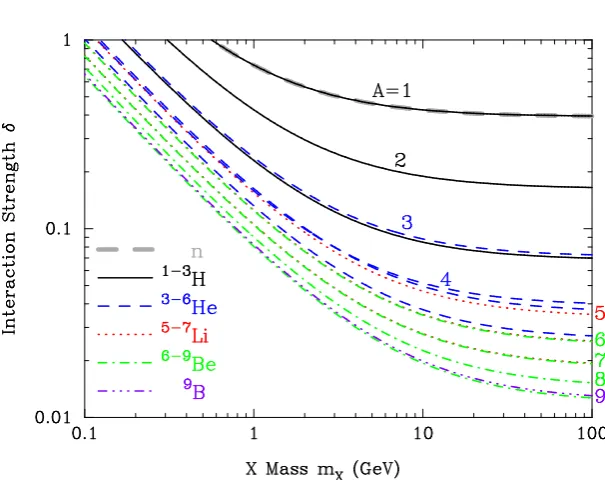
Fig. 1.Contours of binding energies between nuclei and anX0corresponding to 0.1 MeV for the case of the GaussianXNpotential. Numbers attached to the contours indicate mass numbers of nuclei. This figure is reprinted from Ref. [35]
also calculate binding energies of nuclear excited states of4He∗X and8Be∗X with relative angular mo-mentum ofL=1.
Figure 1 shows the contours of binding energies of ground stateX-nuclei of mass numbersA=1 to 9 in the case of the Gaussian typeXNpotential. The contours correspond to binding energy (BE) of BE=0.1 MeV. Since weakly boundX-nuclei of BE.O(0.1 MeV) tend to be photodisintegrated by background radiations, they do not work as effective paths for heavy element synthesis. In a parameter region located at right upper side from a contour, theX-nucleus can form during BBN epoch, and thus possibly affects BBN.
3 Results
Figure 2 shows results of the abundances of normal andX-nuclei as a function of temperature, i.e.,
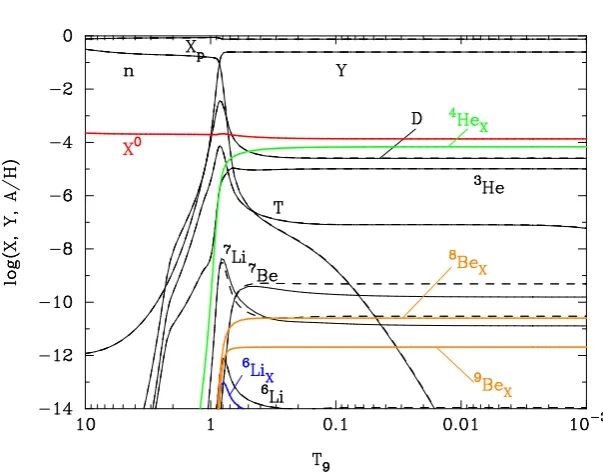
T9 ≡T/(109K), forδ=0.1. The mass of theX0was set to bemX =100 GeV. The initial abundance of theXisNX/nb=1.7×10−4(YX ≡NX/s=1.5×10−14), whereNX andnbare the number densities of theX0particles and baryons, respectively (sis the entropy density). The decay lifetime is assumed to be much longer than BBN time scale, i.e.,τX 200 s. We note that theX0particle is assumed to have been long extinct by now.
At high temperaturesT9 &1, theX0particles are in the free state since efficient photodisintegra-tions ofX-nuclei destroy the bound state. AtT9∼1 the4He synthesis occurs as in SBBN, and about one third ofX0 particles are captured by4He nuclei. 4He
X nuclei produced in this epoch react with normal nuclei, and affect abundances of7Li [by4HeX(t,7Li)X],6LiX [by4HeX(d, γ)6LiX], and8BeX [by4HeX(α, γ)8BeX]. Note that6LiX nuclei produced atT9 ∼1 experience a strong destruction pro-cess, i.e.,6Li(p,3Heα)X.9BeX is produced by8BeX(d,p)9BeX. At last, the most important processes operate. FreeX0particles which survived the capture by4He react with7Be [byX(7Be,3He)4He
X] and 7Li [byX(7Li,t)4HeX]. The abundances of7Be and7Li thus decrease.
Fig. 2.Calculated abundances of normal andX-nuclei (solid lines) as a function ofT9. The mass ofX0particle was assumed to bemX =100 GeV, and the interaction strength ofXNforce is 0.1 times that ofNNforce (δ=0.1). For this figure, we took theX0abundance to beNX/nb=1.7×10−4(YX≡NX/s=1.5×10−14), and its lifetime to be much longer than BBN time scale, i.e.,τX200 s. TheX0reaction rates are given as described in Ref. [35]. The dashed lines correspond to the abundances of normal nuclei in the standard BBN model. This figure is reprinted from Ref. [35]
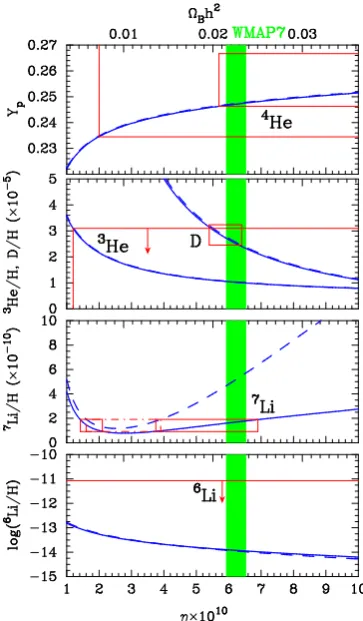
of the universe. The solid curves are the calculated result in this X catalyzed BBN for (mX,δ,YX, τX)=(100 GeV, 0.1, 1.5×10⁻¹⁴, ∞). The dashed curves are those in the SBBN. The boxes corre-spond to the adopted constraints on primordial abundances [35]. The vertical stripe is the 2σlimits on ΩBh2=0.02258+−00..0005700056provided by WMAP [9] for theΛCDM+SZ+lens model.
The decrease in the7Li abundance is found, while other nuclear abundances are not changed. A solution to the7Li problem is thus found in this model.
If the strength ofXN interaction is relatively weak, most strong reactions for the X0 particle to get bound to nuclei are non-radiativeX0-capture reactions which are found important in the present model.X(6Li,d)4He
X,X(7Li,t)4HeX, andX(7Be,3He)4HeXare important reactions in thisXcatalyzed BBN scenario.
Figure 4 shows contours in the parameter space (mX,δ) for critical binding energies ofX-nuclei (thin and thick smooth curves). Above the contours,Q-values for reactions [35] are positive. Zigzag curves show boundaries above which an excited state of4He∗withL =1 (upper line) and8Be∗with
L = 1 (lower) exist, respectively. When there is the excited state4He∗ (L = 1), the reaction rate of
X(4He,γ)4HeXincreases. The7Be and7Li destruction reactions are then not operative [35].
We delineate the parameter region which can be responsible for a reduction of the primordial7Li abundance. In Figure 4, it is found that the contours of the boundaries for existences of4He∗
Xare above the contours of the reactionX(7Be,3He)4HeX (the second lowest thin dashed lines). In the parameter region in right upper side from the curve of4He∗X, freeX0 particles are captured onto4He atT9 ∼1 before they can react with7Be to reduce its abundance.
Fig. 3.Abundances of4He (mass fraction), D,3He,7Li and6Li (by number relative to H) as a function of the baryon-to-photon ratioηor the baryon energy densityΩBh2of the universe. The solid curves are the calculated results in theXcatalyzed BBN for the case of (mX,δ,YX,τX)=(100 GeV, 0.1, 1.5×10⁻¹⁴,∞), while the dashed curves are those in the standard BBN. The boxes represent the adopted abundance constraints from Refs. [39, 40] for4He, [41] for D, [42] for3He, [4] for7Li, and [2] for6Li, respectively. The vertical stripe corresponds to the 2σ ΩBh2limits provided by WMAP [9]. This figure is reprinted from Ref. [35]
4 Conclusions and discussion
We have investigated effects of a long-lived strongly interacting massive particle (SIMP)X0on BBN for different massesmX and strengths ofXN interaction, i.e.,δ. Binding energies ofX-nuclei (bound states of nuclei and an X0 particle) are calculated for two types ofXN potentials, i.e., Gaussian and well types [35] although we showed the result of only the Gaussian case in this paper.
We compute the time evolution of light element abundances. We found that 7Be and 7Li can be destroyed by the nuclear capture reactions of free X0 particles. The destruction reactions are
X(7Be,3He)4HeX andX(7Li,t)4HeX. The lack of an excited state of4HeX with a relative angular mo-mentum L = 1 makes it possible that some fraction of theX0 particles escape capture by4He. We suggest that the7Li problem could be solved based upon a net work calculation of catalyzed BBN, and found the parameter region in the (mX,δ) plane where the7Li problem can be solved.
Fig. 4.Contours of binding energies between nuclei and anX0particle corresponding toQ=0 of reactions [35] (thin and thick smooth curves). Numbers attached to the contours indicate mass numbers of nuclei. Above the contours, reactionQ-values are positive. Zigzag curves correspond to boundaries above which an excited state of 4He∗
(upper line) and8Be∗
(lower) exist, respectively. In the shaded region, the7Li problem can be resolved. This figure is reprinted from Ref. [35]
in theX-catalyzed BBN, which stem from rough approximations we took, of one order of magnitude or so, we suggest that there is a possibility of7Li reduction in the BBN model including a long-lived sub-SIMP.
Acknowledgment
This work is supported by Grant-in-Aid for JSPS Fellows No.21.6817 (Kusakabe) and Grant-in-Aid for Scientific Research from the Ministry of Education, Science, Sports, and Culture (MEXT), Japan, No.22540267 and No.21111006 (Kawasaki) and also by World Premier International Research Center Initiative (WPI Initiative), MEXT, Japan.
References
1. J. Melendez and I. Ramirez. Astrophys. J.,615, (2004) L33
2. M. Asplund, D. L. Lambert, P. E. Nissen, F. Primas, and V. V. Smith. Astrophys. J.,644, (2006) 229–259
3. F. Spite and M. Spite. Astron. Astrophys.,115, (1982) 357–366
4. S. G. Ryan, T. C. Beers, K. A. Olive, B. D. Fields, and J. E. Norris. Astrophys. J.,530, (2000) L57–L60
5. P. Bonifacio, P. Molaro, T. Sivarani, R. Cayrel, M. Spite, F. Spite, B. Plez, J. Andersen, B. Barbuy, T. C. Beers, E. Depagne, V. Hill, P. Franc¸ois, B. Nordstr¨om, and F. Primas. Astron. Astrophys., 462, (2007) 851–864
6. J. R. Shi, T. Gehren, H. W. Zhang, J. L. Zeng, and G. Zhao. Astron. Astrophys., 465, (2007) 587–591
8. R. H. Cyburt, B. D. Fields, and K. A. Olive. JCAP,0811, (2008) 012 9. D. Larson et al. Astrophys. J. Suppl.,192, (2011) 16
10. O. Richard, G. Michaud, and J. Richer. Astrophys. J.,619, (2005) 538–548 11. A. J. Korn et al. Nature,442, (2006) 657–659
12. K. Lind, F. Primas, C. Charbonnel, F. Grundahl, and M. Asplund. Astron. Astrophys.,503, (2009) 545–557
13. N. Arkani-Hamed and S. Dimopoulos. JHEP,06, (2005) 073
14. N. Arkani-Hamed, S. Dimopoulos, G. F. Giudice, and A. Romanino. Nucl. Phys.,B709, (2005) 3–46
15. S. Raby. Phys. Lett.,B422, (1998) 158–162
16. S. Shirai, M. Yamazaki, and K. Yonekura. JHEP,06, (2010) 056
17. L. Covi, M. Olechowski, S. Pokorski, K. Turzynski, and J. D. Wells. JHEP1101, (2011) 033 18. U. Sarid and S. D. Thomas. Phys. Rev. Lett.,85, (2000) 1178–1181
19. J. Hisano, K. Nakayama, S. Sugiyama, T. Takesako, and M. Yamanaka. Phys. Lett.,B691, (2010) 46–55
20. K. Nakayama, F. Takahashi, and T. T. Yanagida. Phys. Lett.,B697, (2011) 275 21. J. Kang, M. A. Luty, and S. Nasri. JHEP,09, (2008) 086
22. E. W. Kolb and M. S. Turner.The early universe(Addison-Wesley, 1990) p64 23. S. Wolfram. Phys. Lett.,B82, (1979) 65
24. C. B. Dover, T. K. Gaisser, and G. Steigman. Phys. Rev. Lett.,42, (1979) 1117
25. G. D. Starkman, A. Gould, R. Esmailzadeh, and S. Dimopoulos. Phys. Rev.,D41, (1990) 3594 26. D. A. Dicus and V. L. Teplitz. Phys. Rev. Lett.,44(3), (1980) 218–221
27. R. N. Mohapatra and V. L. Teplitz. Phys. Rev. Lett.,81, (1998) 3079–3082
28. K. Nakamura and Particle Data Group. Journal of Physics G Nuclear Physics, 37(7), (2010) 075021
29. M. Kusakabe, T. Kajino, T. Yoshida, and G. J. Mathews. Phys. Rev.,D80, (2009) 103501 30. N. Prantzos, M. Casse, and E. Vangioni-Flam. Astrophys. J.,403, (1993) 630–643
31. R. Ramaty, B. Kozlovsky, R. E. Lingenfelter, and H. Reeves. Astrophys. J.,488, (1997) 730–748 32. M. Kusakabe. Astrophys. J.,681, (2008) 18–26
33. S. E. Woosley and T. A. Weaver. Astrophys. J. Suppl.,101, (1995) 181–235 34. T. Yoshida, T. Kajino, and D. H. Hartmann. Phys. Rev. Lett.,94, (2005) 231101 35. M. Kawasaki and M. Kusakabe, Phys. Rev. D83, (2011) 055011
36. E. Hiyama, this volume
37. E. Hiyama, M. Kamimura, T. Motoba, T. Yamada, and Y. Yamamoto. Phys. Rev., C66, (2002) 024007
38. E. Hiyama, Y. Kino, and M. Kamimura. Prog. Part. Nucl. Phys.,51, (2003) 223–307 39. Y. I. Izotov and T. X. Thuan. Astrophys. J.,710, (2010):L67–L71
40. E. Aver, K. A. Olive, and E. D. Skillman. JCAP,1005, (2010) 003
41. M. Pettini, B. J. Zych, M. T. Murphy, A. Lewis, and C. C. Steidel. MNRAS,391, (2008) 1499– 1510
](https://thumb-us.123doks.com/thumbv2/123dok_us/8087182.1349640/7.595.147.454.113.345/contours-binding-energies-nuclei-particle-corresponding-reactions-smooth.webp)
