Vol. 5, Issue 12, December 2017
Power Search Algorithm for Economic Load
Dispatch Problems Considering Valve Point
Loading Effects
Prakash A 1, Ravichandran C S2
Assistant Professor, Department of Electrical and Electronics Engineering, Sri Krishna College of Technology,
Coimbatore, Tamilnadu, India1
Professor, Department of Electrical and Electronics Engineering, Sri Ramakrishna Engineering College,
Coimbatore, Tamilnadu, India2
ABSTRACT: A novel Forward Search Approach (FSA) based Power Search Algorithm (PSA) (PSA-FSA) is proposed
in this article to solve various types of Economic Load Dispatch (ELD) problems. This algorithm is formulated in such a way that the search criterion takes place from the minimum to maximum, for finding the best optimum solution with reduced iterations. To validate the proposed PSA-FSA algorithm, a detailed analysis has been carried out for three standard test systems: 13, 38 and 40-unit system. Transmission losses are considered for 13 unit system, 38 and 40 unit system are considered neglecting losses. A comparative evaluation with various algorithms proves the overall performance of the PSA in terms of fuel cost and transmission loss reduction.
KEYWORDS: Economic Load Dispatch (ELD), Power Search Algorithm (PSA), Transmission losses, Valve Point
Loading (VPL).
I. INTRODUCTION
Generation of power at a minimum cost is the major expectation from the power utilities. Power system analysis combines extremely nonlinear and computationally troublesome surroundings with a necessity for optimality. In earlier days, the operating price for every generator has been roughly diagrammatic by a single quadratic function and is solved by using the mathematical programming based on the improvement techniques. These mathematical strategies need progressive or marginal fuel value curves that ought to be monotonically increasing to search out global optimum solution. The fuel point functions of generating units are modelled in an additional sensible fashion by merging with the valve-point effects. The impact of valve-point leads to the ripples within the fuel cost function; thereby the total number of optimal point is increased. From the above observations, it is clear that the solutions obtained by mathematical methods for the practical ELD problems are not challenging, since it consists of equality and inequality constraints.
II. RELATED WORK
Vol. 5, Issue 12, December 2017
and the count of neuron makes the method disadvantageous [6, 13, 14]. Depending on the scale of the system and its pathway to revisit the obtained suboptimal solutions, Genetic Algorithm needs an enormous run time [15]. Simulated Annealing technique got failed as it gets trapped in a single local optimal point [16]. For large problems, Evolutionary Programming discussed in [17], has very slow convergence rate. Improved Tabu Search method lowers the system efficiency due to its complicated objective function [18]. Moreover several parameters are to be optimized and it consumes longer time. The theoretical analysis of Ant Swarm optimization [19] is incredibly tough and once the iteration changes, the probability distribution changes. Particle Swarm Optimization [20, 21] shows partial optimism, inability to unravel the problem of optimization and scattering, those that fails to prove its potency. Gravitational Search Algorithm [22], despite the fact that proves to be more effective, attributable to the agents’ diversity, it predicts the poor performance of the algorithmic program. Galaxy-based Search Algorithm [23] has been formulated with the idea of modified Hill Climbing algorithm for the nearby search and spiral arms of positive galaxies. The idea of hybrid shuffled differential evolution [24] has been accomplished for big scale monetary dispatch problems. Hybrid differential evolution combining the biogeography based optimization [25] has been designed with the concept of migration and mutation. Improved Coordinated Aggregation based PSO [26] has been developed with the concept of retaining the best position for the solution obtained and attracted by other particles with better achievements. Hybrid EP-EPSO algorithm [27] was formulated for obtaining the optimal solution with the good convergent property. Flower Pollination Algorithm [28] has introduced with the concept of flowering plants’ pollination process, which includes the self pollination and cross pollination. Particle Swarm Optimization with vale-point effects [29] has been formulated for achieving the optimum solution for large generator systems neglecting losses. The chaotic differential evolution and quadratic programming [30] combined together for determining the complexity of the system described by the other way the chaotic sequences are replaced by randomization for improving the DE’s performance in terms of premature convergence. In this article, the projected algorithmic approach works by the formulation of forward search approach and it is portrayed that PSA-FSA outperforms various algorithms.
III.POWER SEARCH ALGORITHM
PSA is a direct search method for determining the power output and the fuel cost for ELD problems. Here the Forward Search Approach is implemented for obtaining the minimum fuel cost, reduction in total power, fuel cost and transmission loss. Unlike other optimization techniques, this algorithm, being a traditional approach for solving the various ELD problems, it travels through all the points in the search space and gives out the best optimal solution.
A. Forward Search Approach:
In this approach, the power output for the ith generator is given in following equation (1).
P = P ∗(1 +K+K ) (1)
where Pi is the power out of the ith generator P is the minimum power generation limit for the ith generator and ‘k’
is a numerical variable. The range for ‘k’ starts from 0 and it is incremented with 0.001. For maintaining the power
demand (PD), a power balance constraint is introduced. Equation 6 describes the power balance constraint.
IV.PSEUDO CODE
Step 1: Enter Pimin, Pimax ,PD and initialize k.
Step 2: Calculate Pi= Pimin* (1+k+k2)).
Step 3: Check the below condition if if Pi ≤ Pimin
then fix Pi = Pimin
end
if Pi≥ Pimax then fix Pi = Pimax
end Step 4: Redefine Pi Step 5: Increment ‘k’
Vol. 5, Issue 12, December 2017
V. SIMULATION RESULTS
A. Case Study 1:
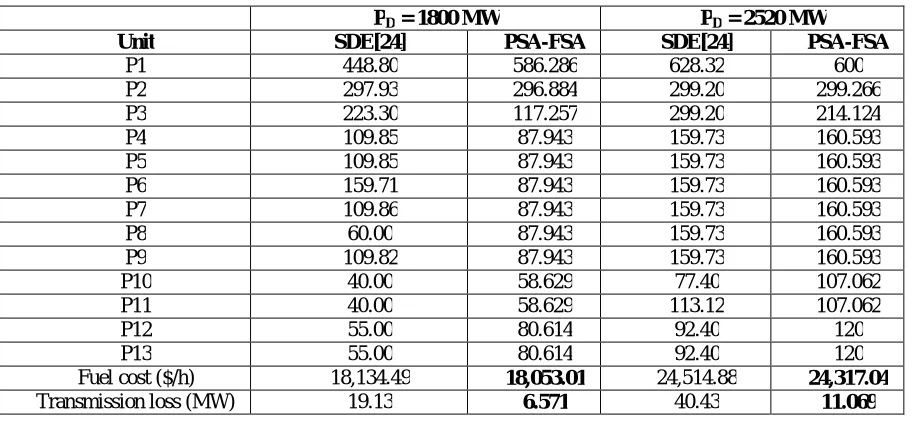
In this test system, 13 generators are chosen considering two different power demands considering transmission losses. The power demands are 1800 MW and 2520 MW. The input data for this test case is taken from [24]. The results obtained by the proposed approach seem to be better than SDE, as reported in the literature. The minimum cost obtained by the PSA-FSA was given by 18,053.01 $/hr for power demand of 1800 MW and 24,317.04 $/hr for power demand of 2520 MW. From table 1, it is observed that the PSA-FSA performs superior when compared to SDE. In terms of fuel cost, the proposed algorithm saves 81.48 $/hr for a power demand of 1800 MW and 197.84 $/hr for a power demand of 2520 MW. On the other side, the transmission loss is also reduced. For a power demand of 1800 MW, the PSA gives a loss of 6.571 MW and for a demand of 2520 MW, it is 11.069 MW.
Table 1 Comparison of various parameters with SDE for case study 1
PD = 1800 MW PD = 2520 MW
Unit SDE[24] PSA-FSA SDE[24] PSA-FSA
P1 448.80 586.286 628.32 600
P2 297.93 296.884 299.20 299.266
P3 223.30 117.257 299.20 214.124
P4 109.85 87.943 159.73 160.593
P5 109.85 87.943 159.73 160.593
P6 159.71 87.943 159.73 160.593
P7 109.86 87.943 159.73 160.593
P8 60.00 87.943 159.73 160.593
P9 109.82 87.943 159.73 160.593
P10 40.00 58.629 77.40 107.062
P11 40.00 58.629 113.12 107.062
P12 55.00 80.614 92.40 120
P13 55.00 80.614 92.40 120
Fuel cost ($/h) 18,134.49 18,053.01 24,514.88 24,317.04
Transmission loss (MW) 19.13 6.571 40.43 11.069
B. Case Study 2:
Here, a 38 generator system neglecting transmission losses is considered for analysis. The total power demand for the system is 6000 MW. The system data is referred from [25]. Table 2 outlines the results obtained by the proposed method compared with various algorithms. From table 2, it is depicted that the PSA-FSA performs better when compared to NEW-PSO, PSO-TVAC, BBO, DE-BBO and EP-EPSO. In terms of fuel cost, the proposed algorithm saves 35,13,914.3 $/hr - 34,44,913.731$/hr – 33,62,099.031 $/hr – 33,61,701.131 $/hr – 33,32,390.931 $/hr when compared with NEW-PSO – PSO-TVAC – BBO – DE-BBO – EP-EPSO. The results obtained with the help of the proposed algorithm prove its robustness when compared with other algorithms reported.
Table 2 Cost comparison for 38-generator system
Algorithms Fuel cost($/hr)
NEW-PSO [26] 95,96,448.3
PSO-TVAC [26] 95,00,448.3
BBO [25] 94,17,633.6
DE/BBO [25] 94,17,235.7
EP-EPSO [27] 93,87,925.5
Vol. 5, Issue 12, December 2017
C. Case Study 3:
The proposed FSA is tested on a 40 generator system. The robustness and the superiority of the proposed PSA-FSA is validated and from the results obtained, it is observed that the algorithm outperforms the other conventional methods. The total demand for the system is 10,500 MW. The input data for this system is taken from [28]. The losses are neglected for the simplicity of the system. Table 3 presents the results for 40 unit system. From the results, it is inferred that the suggested PSA-FSA achieves the lowest cost when compared to other algorithms, by satisfying the generator constraints. From the simulation results obtained, it is clearly observed that the PSA-FSA outperforms the reported algorithms in terms of fuel price. The proposed PSA-FSA saves 648 $/hr compared to PSO, 369 $/hr compared to APPSO, 113 $/hr compared to PPSO and 66 $/hr compared to CDE-SQP. The solution obtained with PSA-FSA is decided to be the most effective and best optimal solution.
Table 3 Simulation results for 40 generator system
Algorithms PSO [29] APPSO [29] PPSO [29] CDE-SQP [30] PSA-FSA
(Proposed method)
Fuel cost($/hr) 122323 122044 121788 121741 121675
VI.CONCLUSION AND FUTURE WORK
A novel algorithm referred as PSA-FSA has been presented in this paper to solve various problems in ELD. This algorithm works with the concept of forward search approach. This approach, as it travels through the entire search space, provides the best optimal solution with very less computational time. When compared with the various existing algorithms, it is evident that PSA suits well in reducing the fuel cost and transmission losses. The implementation of PSA for very large scale power systems is the future work.
REFERENCES
1. Mahor, V. P. and Rangnekar S., ‘Economic dispatch using particle swarm optimization: a review’, Renewable And Sustainable Energy Reviews, Vol. 13, pp. 2134-2141, 2009.
2. Kothari D. P. and Dhillon J. S., ‘Power System Optimization’, New Delhi, PHI Learning, (2006).
3. Aydin G., ‘Modeling of energy consumption based on economic and demo-graphic factors: the case of Turkey with projections’, Renewable And Sustainable Energy Reviews, Vol.35, pp. 382-389, 2014.
4. Dodu J.C. Martin P. Merlin A. and J. Pouget, ‘An optimal formulation and solution of short-range operating Problems for a power system with flow constraints’, Proceedings of the IEEE, Vol. 60, pp. 54–63, 1972.
5. Chen C. L. and Wang S.cC, ‘Branch and bound scheduling for thermal generating units’, IEEE Transactions on Energy Conservation, Vol. 8, pp. 184-189 (1993).
6. Aravindhababu P. and Nayar K.R., ‘Economic dispatch based on optimal lambda using radial basis function network’, International Journal of Electrical Power and Energy Systems (IJEPES), Vol. 24, pp. 551-556, 2002.
7. Parikh J. and Chattopadhyay D., ‘A multi-area linear programming approach for analysis of economic operation of the Indian power system, IEEE Transactions on Power Systems, Vol.11, pp. 52-58, 1996.
8. Fan J. Y. and Zhang L., ‘Real-time economic dispatch with line flow and emission constraints using quadratic Programming’, IEEE Transactions on Power Systems, Vol. 13, pp. 320–325, 1998.
9. Nanda J, Hari L, and Kothari M. L., ‘Economic emission dispatch with line flow constraints using a classical Technique’, IEEE Proceedings on Generation Transmission and Distribution, Vol. 141, pp. 1-10, 1994.
10. El-Keib A. A, Ma H. and Hart J. L., ‘Environmentally constrained economic dispatch using the Lagrangian Relaxation Method’, IEEE Transactions on Power Systems, Vol. 9, 1723–1729, 1994.
11. Attaviriyanupap P, Kita H, Tanaka E and Hasegawa J, ‘A fuzzy-optimization approach to dynamic economic dispatch considering uncertainties’, IEEE Transactions on Power Systems, Vol. 19, pp. 1299-1307, 2004.
12. Singh L and Dhillon L. S., ‘Fuzzy satisfying multiobjective thermal power dispatch based on surrogate worth trade-off method’, Electrical Power Components Systems, Vol.36, pp.93-108, 2008.
13. Abdelaziz A.Y, Mekhamer S. F, Badr M. A. L., and Kamh M. Z., ‘Economic dispatch using an enhanced hopfield neural network. Electrical Power Components Systems, Vol. 36, pp. 719-732, 2008.
14. Surekha P. and Sumathi S., ‘A self-adaptive fuzzy c-means based radial basis function network to solve economic load dispatch problems’, International Journal on Computing Applications (IJCA), Vol. 25, pp. 50-59, 2011.
15. Bouzeboudja H., Chaker A, Alali A. and Naama A., ‘Economic dispatch solution using a real coded genetic Algorithm’, Acta Electrotechnica Informatica (AEI), Vol. 5, pp. 1-5, 2005.
Vol. 5, Issue 12, December 2017
17. Sinha N., Chakrabarti R. and Chattopadhyay P. K., ‘Evolutionary programming techniques for economic load dispatch, IEEE Transactions on Evolutionary Computation, Vol. 7, pp. 83-94, 2003.
18. W. M. Lin, F. S. Cheng and M. T. Tsay, ‘An improved Tabu search for economic dispatch with multiple minima’, IEEE Transactions on Power Systems, Vol. 17, pp. 108-112, 2002.
19. Cai J., Ma X. Li L., Yang Y. Peng H. and Wang X., ‘Chaotic ant swarm optimization to economic dispatch’, Electrical Power Systems Research, Vol. 77, pp. 1373-1380, 2007.
20. Park J. B. Lee K. Shin J. and Lee K.Y., ‘A particle swarm optimization for economic dispatch with nonsmooth Cost Functions’, IEEE Transactions on Power Systems, Vol. 20, pp.34-42, 2005.
21. Coelho L. and Lee C., ‘Solving economic load dispatch problems in power systems using chaotic and Gaussian particle swarm optimization approaches’, International Journal on Electrical Power and Energy Systems (IJEPES), Vol. 30, pp. 297-307, 2008.
22. Dubey H. M. Pandit M. Panigrahi B. K. and Udgir M., ‘Economic load dispatch by hybrid swarm intelligence Based gravitational search algorithm’, International Journal on Intelligent Systems and Applications (IJISA), Vol. 5, pp. 21-32, 2013.
23. Hamza D. Zerigat L. Benasla A. Belmadani and Rahli M., ‘Solution of combined economic and emission dispatch problems using Galaxy-based Search Algorithm’, Journal on Electrical Systems (JES), Vol. 9, pp. 468-480, 2013.
24. Srinivasa Reddy A. and Vaisakh K., ‘Shuffled differential evolution for large scale economic dispatch,’ Electric Power Systems Research (EPSR), Vol. 96, pp. 237-245, 2013.
25. Bhattacharya A. and Chattopadhyay P. K., ‘Hybrid differential evolution with biogeography-based optimization for solution of economic load dispatch, IEEE Transactions on Power Systems, Vol. 25, pp. 1955-1964, 2010.
26. Vlachogiannis J. K. and Lee K. Y., ‘Economic load dispatch – A comparative study on heuristic optimization techniques with an improved coordinated aggregation-based PSO’, IEEE Transactions on Power Systems, Vol. 24, pp. 991-1001, 2009.
27. Muthu Vijaya Pandian S. and Thanushkodi K., ‘Considering transmission loss for an economic dispatch problem without valve-point loading using an EP-EPSO algorithm, Turkish Journal of Electrical Engineering & Computer Sciences (TJEECS), Vol. 20, pp. 1259-1267, 2012. 28. Abdelaziz A. Y. Ali E.S. and Abd Elazim S. M., ‘Flower pollination algorithm to solve combined economic and emission dispatch problems’, Engineering Science and Technology, an International Journal, Vol. 19, pp. 980-990, 2016.
29. Chen C. H. and Yeh S. N., ‘Particle Swarm Optimization for Economic Power Dispatch with Valve-Point Effects’, IEEE PES Transmission and Distribution Conference and Exposition Latin America, pp. 1-5, 2006.