OXENDINE, DAVID BRYAN. The Effects of Social Exclusion Threat and Justifications on Perceived Fairness of an Ethnic Validation Procedure: Implications for Lumbee Federal Recognition. (Under the direction of Rupert W. Nacoste.)
THE EFFECTS OF SOCIAL EXCLUSION THREAT AND JUSTIFICATIONS ON PERCEIVED FAIRNESS OF AN ETHNIC VALIDATION PROCEDURE:
IMPLICATIONS FOR LUMBEE FEDERAL RECOGNITION
by
DAVID BRYAN OXENDINE
A dissertation submitted to the Graduate Faculty of North Carolina State University
in partial fulfillment of the requirements for the Degree of
Doctor of Philosophy
PSYCHOLOGY
Raleigh
2004
APPROVED BY:
_________________________________ _________________________________
Craig C. Brookins, PhD James E. Luginbuhl, PhD
_________________________________ _________________________________
DEDICATION
BIOGRAPHY
David Bryan Oxendine is a Lumbee Indian doctoral student in the Psychology Department at North Carolina State University. He received his Bachelor of Arts degree in Drama with a minor in Speech from Catawba College in 1982. David earned a professional degree from the American Academy of Dramatic Arts in New York City in 1987. In 1995 he received his Master of Science degree in Counselor Education from North Carolina State University.
David is the younger of two children born to the late Grady G. Oxendine and Lettie Mae Harris Oxendine, both retired educators of Pembroke, North Carolina. His sister Donna Jean Locklear, also a retired educator lives in Pembroke with her husband Clyde. They have three children: Nicole is an educator, LaDonna is an undergraduate student in the Teacher Education Program at the University of North Carolina at Pembroke, and Brandon is a graduate of North Carolina State University and is a meteorologist at the National Weather Forecast Center in Raleigh, North Carolina.
David’s hobbies include photography in which he won a Life magazine contest in 1990. He was also commissioned to create an original photographic exhibit depicting Lumbee Indian values for the Mint Museum of Art in Charlotte, North Carolina. His photographs have also been used in several textbooks, Time-Life books and most recently the Smithsonian Institution’s Handbook of the North American Indian.
ACKNOWLEDGEMENTS
I would like to thank my advisory committee for their support and guidance: Dr. Craig C. Brookins, Dr. James E. Luginbuhl, Dr. Samuel S. Snyder and Dr. Rupert W. Nacoste.
Through the excellence of Dr. Craig C. Brookins I have come to truly understand how all peoples of color share a common history. His course Psychology of the African Experience has inspired me to design and create a similar course in the future concerning the Lumbee experience.
I also appreciate the straightforward manner of Dr. James E. Luginbuhl. I remember his course in Advanced Social Psychology with his discussions concerning juries and how it impacted me when I found myself in the jury box. Dr. Samuel S. Snyder was the only person I knew when I entered the Psychology doctoral program fresh from my Masters. I have always appreciated his dry, sharp wit. I am forever in both your debts.
This entire episode in my life would not have been a truly interdependent experience without the leadership and friendship of Dr. Rupert W. Nacoste. Our meetings at Border’s bookstore off Wake Forest road became a haven for us both. When the work with the dissertation was complete for each meeting, we would spend hours discussing any number of topics including politics, religion, and the social interdependence of life.
I would also like to thank Darnell Johnson who always greeted you with a smile. Whenever I needed to know something I could always email or make a phone to her.
TABLE OF CONTENTS
Page
LIST OF TABLES……….………..vii
LIST OF FIGURES………...……….………..xi
INTRODUCTION……….1
The Example Case……….……….…………1
LITERATURE REVIEW………..……….………...3
Self-Concept, Ethnic Identity and Group Identity………..………….…………3
Procedural Justice……….…..……….……….………...4
Decision and Process Control………..………..………..7
Truth and Justice……….…….……….….………..9
Group Conflict………..….……..…………..……..………..13
Group-Value Model………..………...……….………….14
Procedural Justice and Social Standing……….15
Interdependence Theory……….………...16
Social Status and Group Membership………...18
The Relational Model of Authority……….………..……19
The Dimensional Voice Model……….….………....22
Social Exclusion Theory……..……….……….24
Justifications……….………...…..…….……...25
The Current Research………..…..……….26
Hypothesis 1………..28 Hypothesis 2………..28 Hypothesis 3………..28 Hypothesis 4……….………….28 Hypothesis 5………..29 Hypothesis 6………..29 METHOD………..……….……….30 Participants……….………..…………..….………..30 Design……….……….………..30 Procedure………...32 Measures………39 RESULTS………..………..42 Data Analysis………...42
Positive Affect Negative Affect Schedule (PANAS)………..….…….…..…………46
Page Manipulation Checks……….…..……50 Procedural Fairness……….50 Procedural Satisfaction………55 Hypothesis Testing……….…..57 General Fairness………...57 True Voice………….……...……...……...……….……….…...58 Misvoice………..………...61 Forced Voice………....63
Positive and Negative Affect………...64
Subsidiary Analysis……….…72
Accuracy……….………..72
Procedural Process Control……….………….77
Procedural Agreement……….……….77
Procedural Information Control……….……..78
DISCUSSION……….……….80 Hypotheses………..82 Hypothesis 1………..82 Hypothesis 6……….……….84 Hypothesis 2………..85 Hypothesis 3………..87 Hypothesis 4………..89 Hypothesis 5………..90 Limitations……….….92 Internal Validity……….92 External Validity………93
Theoretical and Applied Implications………….………93
Social Exclusion Theory………….……….….……….95
Justifications………..………95
The Example Case: Lumbee Federal Recognition……….…………96
Implications for Future Research……….………...98
Conclusion……….……….……….…99
REFERENCES……….……….100
FOOTNOTES………117
APPENDICES………...………118
Appendix A Informed Consent Form……….………….……119
Appendix B Scenarios………...………...….………...………121
Appendix C Measures……….………….………..………..130
LIST OF TABLES
Page Table 1. Demographics of Sample across Age, Gender, and Ethnicity
by Frequency, Means, and Standard Deviation compared to Population……..……31 Table 2. Factor Loadings for Dimensional Voice Items……….….44 Table 3. Factor Loadings for Varimax Orthogonal Five-Factor Solution...………45 Table 4. Factor Loadings for PANAS. ………...46 Table 5. PANAS Factor Loadings for Varimax Orthogonal Five-Factor Solution………….48 Table 6. Procedural Fairness Means and Standard Deviations for
Procedure Main Effect………51 Table 7. Procedural Fairness Gender X Justification Interaction
Means and Standard Deviations……….52 Table 8. Procedural Fairness Means and Standard Deviations for Gender X
Justification X Procedure……….…..53 Table 9. Procedural Satisfaction Gender X Justification Interaction
Means and Standard Deviations……….56 Table 10.True Voice Means and Standard Deviations for
True Voice Main Effect………59 Table 11.True Voice Gender X Justification Interaction Means and
Standard Deviations……….….60 Table 12. Misvoice Means and Standard Deviations for Procedure Main Effect……….…..62 Table 13. Positive Affect Means and Standard Deviations for Procedure Main Effect……..64 Table 14. Anxiety Means and Standard Deviations for Gender X
Justification X Procedure……….66 Table 15.Troubled Means and Standards for Procedure Main Effect………..…….………..69 Table 16.Troubled Means and Standard Deviations for Gender X
Page Table17. Accuracy Justification X Procedure Interaction Means and
Standard Deviations………..…………73 Table 18. Accuracy Gender X Justification X Procedure Interaction Means
and Standard Deviations………..….……75 Table 19. Procedural Information Control Gender X Procedure Interaction Means
and Standard Deviations………..79 Table 20. Procedural Fairness and Group Difference Means and Standard
Deviations for Justification and Gender as a Function of Procedure………….…141 Table 21. Procedural Fairness and Group Analysis of Variance for Main Effect
and Interaction Effects of Gender, Justification and Procedure….………...142 Table 22. Factor 1 General Fairness Means and Standard Deviations for Justification
and Gender as a Function of Procedure……….…143 Table 23. Factor 2 True Voice Means and Standard Deviations for Justification
and Gender as a Function of Procedure……….144 Table 24. Factor 3 Misvoice Means and Standard Deviations for Justification
and Gender as a Function of Procedure………..…145 Table 25. Factor 4 Forced Voice Means and Standard Deviations for Justification
and Gender as a Function of Procedure………..………146 Table 26. Factor 5 Accuracy Means and Standard Deviations for Justification
and Gender as a Function of Procedure………..147 Table 27. Factor 1 PANAS Positive Means and Standard Deviations
for Justification and Gender as a Function of Procedure..………..……148 Table 28. Factor 2 PANAS Anxiety Means and Standard Deviations
for Justification and Gender as a Function of Procedure…………...…..………..149 Table 29. Factor 3 PANAS ShameMeans and Standard Deviations
for Justification and Gender as a Function of Procedure………150 Table 30. Factor 4 PANAS AntagonisticMeans and Standard Deviations
for Justification and Gender as a Function of Procedure………151 Table 31. Factor 5 PANAS TroubledMeans and Standard Deviations
Page Table 32. Procedural Fairness Manipulation Check Means and Standard Deviations
for Justification and Gender as a Function of Procedure……….…..153 Table 33. Procedural Satisfaction Means and Standard Deviations for
Justification and Gender as a Function of Procedure………….………154 Table 34. Procedural Fairness Analysis of Covariance Results for Main Effect
and Interaction Effects of Gender, Justification and Procedure………….………155 Table 35. Procedural Satisfaction Analysis of Covariance Results for Main Effect
and Interaction Effects of Gender, Justification and Procedure……….….…156 Table 36. Factor 1 PANAS PositiveAnalysis of Covariance Results for Main Effect
and Interaction Effects of Gender, Justification and Procedure……….157 Table 37. Factor 2 PANAS AnxietyAnalysis of Covariance Results for Main Effect
and Interaction Effects of Gender, Justification and Procedure……….158 Table 38. Factor 3 PANAS ShameAnalysis of Covariance Results for Main Effect
and Interaction Effects of Gender, Justification and Procedure……….159 Table 39. Factor 4 PANAS AntagonisticAnalysis of Covariance Results for Main Effect
and Interaction Effects of Gender, Justification and Procedure……….…160 Table 40. Factor 5 PANAS TroubledAnalysis of Covariance Results for Main Effect
and Interaction Effects of Gender, Justification and Procedure……….161 Table 41. Factor 1 General Fairness Analysis of Covariance Results for Main Effect
and Interaction Effects of Gender, Justification and Procedure……….162 Table 42. Factor 2 True Voice Analysis of Covariance Results for Main Effect
and Interaction Effects of Gender, Justification and Procedure………..………163 Table 43. Factor 3 Misvoice Analysis of Covariance Results for Main
Effect and Interaction Effects of Gender, Justification and Procedure…………..164 Table 44. Factor 4 Forced Voice Analysis of Covariance Results for Main Effect
and Interaction Effects of Gender, Justification and Procedure……….…………165 Table 45. Factor 5 Accuracy Analysis of Covariance Results for Main Effect
and Interaction Effects of Gender, Justification and Procedure……….…………166 Table 46. Procedural Process Control Means and Standard Deviations for
Page Table 47. Procedural Agreement Means and Standard Deviations for
Justification and Gender as a Function of Procedure……….168 Table 48. Procedural Information Control Means and Standard Deviations for
Justification and Gender as a Function of Procedure………...……..169 Table 49. Procedural Process Control Analysis of Covariance Results for Main Effect
and Interaction Effects of Gender, Justification and Procedure………….………170 Table 50. Procedural Agreement Analysis of Covariance Results for Main Effect
and Interaction Effects of Gender, Justification and Procedure……….…171 Table 51. Procedural Information Control Analysis of Covariance Results for
LIST OF FIGURES
Page
Figure 1. Truth and Justice Conflict.……….…….………..……..11
Figure 2. Procedural-Interdependence of Lumbee Federal Recognition….…...………17
Figure 3. 2 (Justification) X 3 (procedure) X 2 (gender) Factorial Experimental Design………...31
Figure 4. Scree Plot of Eigenvalues for Dimensional Voice………..…43
Figure 5. Scree Plot of Eigenvalues for PANAS………..………..49
Figure 6. Procedural Fairness Gender X Justification X Procedure Interaction……….54
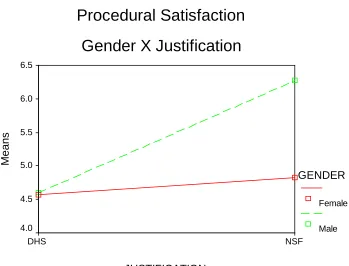
Figure 7. Procedural Satisfaction Gender X Justification Interaction………....57
Figure 8. True Voice Gender X Justification Interaction………..……..61
Figure 9. Anxiety Gender X Justification X Procedure Interaction………..……….67
Figure 10. Troubled Gender X Justification X Procedure Interaction……….71
Figure 11. Accuracy Justification X Procedure Interaction……….74
Figure 12. Accuracy Gender X Justification X Procedure Interaction………76
The Effects of Social Exclusion Threat and Justifications on Perceived Fairness of an Ethnic Validation Procedure: Implications for Lumbee Federal Recognition
Social psychologists have long held that human beings are social creatures and affiliative by nature, seeking to spend time in groups (Tyler, 1989, 1990; Van Prooijen, Van den Bos & Wilkes, 2004). As reported by Phinney (1990), one of the earliest conceptualizations of social identity theory was made by Kurt Lewin, who asserted that individuals need a firm sense of group identity in order to maintain a sense of well being.
What happens if this group affiliation was made not by choice, such as joining a political group or a certain church group, but a group affiliation that chose you by birth? What if this group affiliation is a racial or an ethnic group affiliation? In the society we live in today certain connotations are implied just by mentioning this type of group affiliation. Belonging to this type of group, group members not only have to deal with possible stereotypical and prejudicial attitudes toward them, but in order to receive certain benefits the government offers for membership in certain groups, some groups as a whole have to follow a very detailed and specific procedure in order to be “recognized” officially.
The Example Case
(Dial, 1993; Dial & Eliades, 1996; Knick, 1997, 2001; Sider, 1993, 2003; Wolfram et al., 2002).
Then as American society and the political motivations of the time changed, those changes created an atmosphere and an environment that required a people to “prove” from where and how they came to exist. Such was the case of the Lumbee people of Robeson County in southeastern North Carolina. Consequently, since 1885, through various procedures, the Lumbee have attempted to gain full Federal Recognition as an American Indian tribe but have continued to be unsuccessful (Wilkins, 1993, 2002).
threat. The point of this study is to demonstrate the logical and empirical links between validation procedures and its effects on group members.
Review of the Literature Self-Concept, Ethnic Identity and Group Identity
According to social identity theory (Phinney, 2003; Tajfel, 1978, 1981; Tyler & Blader, 2000), simply being a member of a group provides individual group members with a sense of belonging that contributes to a positive self-concept. This component of social identity is defined as that part of an individual’s self-concept, which derives from their knowledge of their membership in a social group, combined with the value and emotional significance afforded that membership (Brookins, 1996; Phinney, 1990, 2003; Phinney & Alipuria, 1990; Phinney & Chavira, 1992; Phinney, Chavira & Tate, 1993; Tajfel, 1978, 1981; Tyler & Blader, 2000).
Personal concept theories propose that self-esteem is a basic human need and that individuals react to threats to their identity in a variety of ways that enable them to continue to view themselves and their own reference group in a positive way thereby maintaining positive self-esteem (Brookins, 1996; Phinney, 2003; Phinney & Chavira, 1992; Phinney, et al., 1993; Tyler & Blader, 2000; Tyler & Blader, 2002). Much of the work on self-esteem and ethnic identity has been conducted within the framework of social identity by social psychologists.
and negative experiences. On the basis of social identity theory, ethnic identity is assumed to include the strength of one’s sense of belonging to an ethnic group and valence, or the degree to which attitudes toward one’s group membership are positive (Phinney, 2003; Tyler & Blader, 2000). For a healthy, functional and psychologically stable ethnic identity one needs a positive reference group orientation. According to Brookins (1996), in reference to African Americans, a positive reference group orientation would be associated with characteristics that would include; (a) knowledge of one’s ethnic history and culture; (b) positive esteem toward one’s ethnic group and culture; (c) belief in the strengths and abilities of the ethnic group; (d) adherence to one’s ethnic group’s value system that reflects positive principles of the group including the importance of human relationships; (e) competency and skills that are consistent with the principles that allow one to function adequately in the American system on a social and economic level; (f) and commitment to activities which promote the development of one’s ethnic group and its integration in the wider social system.
In order to achieve these goals, the basic problem to be solved via social cooperation is that everyone cannot have what they want at the same time. Social justice has evolved to regulate people’s efforts at cooperation within groups by specifying reasonable solutions to conflicts that arise among people trying to coordinate their values and behaviors (Tyler & Blader, 2000).
Procedural Justice
profoundly to the standard of equity. That standard is that rewards received should be proportional to the contributions of group members. In the event that outcomes are not proportional to the contributions applied, then members of the group will experience inequity distress, which produces a negative motivational state (Adams, 1963, 1965; Furby, 1986; Lind & Tyler, 1988).
Procedural justice is a systematic study of social decision-making that began with the work of John Thibaut, Laurens Walker, and their colleagues in the early 1970's (Lind & Tyler, 1988). When the term procedural justice was first used, it referred to the “social psychological consequences” of decision-making procedures on fairness judgments (Azzi & Jost, 1997; Cohen & Greenberg, 1982; Daly, 1995; Ebreo, Linn & Vining, 1996; Lind, Kanfer & Earley, 1990; Lind & Tyler, 1988; Makkai & Braithwaite, 1996; Musante, Gilbert, & Thibaut, 1983; Tata, 2000a, 2000b; Thibaut et al., 1974; Tyler, 1990, 1994; Tyler & Lind, 1994; Walker et al., 1974). Most of the research findings in the literature concerning procedural justice state that people react more favorably to decisions based on procedures believed to be fair than those believed to be unfair (Brockner, Ackerman, Greenberg, Gelfand, Francisco & Chen, Leung, Bierbrauer, Gomez, Kirkland & Shapiro, 2001).
courtroom proceedings of the allocation of scarce resources. It has been shown that perceptions of procedural fairness are not related to individual outcomes (Greenberg, 1986, 1987; Houlden et al, 1978; LaTour et al., 1976; Thibaut & Walker, 1978; Van den Bos, Vermunt & Wilke, 1997). This research has shown that procedural justice has strong effects on the attitudes about institutions or authorities, as opposed to attitudes about the specific outcome in question. Therefore, procedural justice may be more highly related to institutional evaluations that require a long-term perspective, such as organizational commitment, than it is with the outcome of specific decisions (Folger & Konovsky, 1989; Lind & Tyler, 1988).
Decision and Process Control
For example, Walker et al. (1974) suggested that all disputants involved in a conflict would prefer procedures that allowed them to present their cases fully to an impartial third party decision-maker. Participants when given the choice preferred an adversarial procedure to an inquisitorial procedure to settle disputes. It was found that participant satisfaction with an adversarial procedure was unrelated to the outcome or their beliefs about the crime.
Walker et al. (1974) investigated further these results to determine if these procedures were evaluated to be fair. Participants were asked to choose among five procedures with varying degrees of process and decision control and their preferred choice of conflict resolution procedure without knowing their perspective roles in the dispute, not knowing whether they would be the victim or defendant in an assault case. For both conditions, (with or without knowledge of role) participants still preferred an adversarial procedure to resolve the dispute.
the third party decision-maker would weigh evidence without bias and make the appropriate decision.
Numerous studies have suggested that disputants are willing to relinquish decision control to a third party who has the final decision as long they retain process control of the presentation of their case (Houlden et al., 1978; LaTour et al., 1976; Leung & Lind, 1986; Lind & Lissack, 1985; Lind & Tyler, 1988; Musante et al., 1983; Thibaut et al., 1974; Walker et al., 1974). According to Thibaut and Walker (1978), the “allocation of process control determines the essential character of the procedure” (p. 246). This evidence led to research that emphasized voice or value-expression for process control effects by arguing that merely experiencing an opportunity for expression was viewed as fair by disputants regardless of the outcome (Lind & Tyler, 1988; Lind et al., 1990). From a participants’ perspective, increases in perceptions of fairness and control (voice) are related to the value of the voice solicitation. If participants feel that a decision-maker fails to give adequate input consideration, or if the voice solicitation is perceived to be disingenuous, the outcome is likely to be frustration and resentment (Price, Hall, Van den Bos, Hunton, Lovett & Tippett, 2001). In summary, the best procedures based on this research are those “that allow each disputant to make a full and independent presentation of his case to an impartial third party who has final responsibility for rendering a decision on that matter” (LaTour et al., 1976; Price et al., 2001). From these and other studies, Thibaut and Walker (1978) developed their theory of procedure.
Truth and Justice
distribution of outcomes. Thibaut and Walker suggest in their theory a distinction between truth-disputes and justice-disputes in terms of a continuum.
One of the major features of the Thibaut and Walker (1978) theory of procedural justice literature is outcome correspondence (LaTour et al., 1976; Lind & Tyler, 1988; Musante el al., 1983; Thibaut & Walker, 1975, 1978). In a relationship that is correspondent, the outcomes of the participants are in harmony among the participants. On the other end of the continuum, outcomes are in conflict, or are noncorrespondent. In other words, when one of the participants gains, the other loses. When the nature of the relationship is correspondent, the outcomes are considered “cognitive” or noncompetitive, but when the outcome is noncorrespondent, the nature of the conflict is a material conflict of interest (LaTour et al., 1976; Thibaut & Walker, 1975, 1978). Thibaut and Walker (1978) distinguish these as conflicts of truth and justice. A cognitive conflict is considered to require a search for truth since both parties are seeking a common solution that is the correct or the best outcome for both parties. This may include how best to approach a task, among all available information, which information is the best to be used to solve the problem and if there are several approaches, which approach is the best. Conflicts such as these are normally very easily resolved as compared to conflicts of interest, or conflicts of noncorrespondence. Truth conflict disputes may be resolved quickly especially when there is some standard or measuring stick for measuring the proposed solution (LaTour et al., 1976; Lind & Tyler, 1988; Thibaut & Walker, 1975, 1978).
Walker (1978) term this a mixed-motive dispute. In mixed–motive disputes, what is important is to resolve cognitive disputes by choosing the best solution to the problem in addition to the conflict of interest where disputants are concerned with personal individual outcomes. Figure 1 demonstrates the mixed-motive dispute and how it fits in the truth and justice model. The upper left cell with the X represents situations where little or no situations of this type exists.
Conflict of Interest
High Low Cognitive Conflict Low
High Figure 1. Truth and Justice Conflict.
___________________________________________________________________________ Note. From A theory of procedure by Thibaut & Walker (1978), California Law Review, 66, p.560.
In those cases where mixed-motive disputes occur, Thibaut and Walker (1978) suggest that the most effective procedure will be hybrids that combine scientific inquiry and adversarial arbitration. In group situations where decisions have to be made before the meeting adjourns, members may have cognitive conflicts and conflicts of interest among themselves. Implementing adversarial procedures, participants will have an opportunity to present their own views on their own terms, thereby having input in the procedure. This suggests that having an opportunity to express their views and having input in the procedure before the decision is rendered, disputants view these procedures as more fair (LaTour et al., 1976; Lind & Tyler, 1988; Thibaut & Walker, 1978, Walker et al. 1974, Williams, 1999).
The majority of the literature focuses on situations in which the social environmental conditions of the relationship or dispute are that of a material conflict of interest where one
party maximizes their outcomes at the expense of the other (LaTour et al., 1976; Lind & Tyler, 1988; Thibaut & Walker, 1978). These disputes have strongly conflicting interests whereas any outcome that may satisfy one disputant is most likely to be strongly opposed by the other. For such disputes, the only standard for resolving these conflicts are general distributional prescriptions such as those in Adams’ (1963, 1965) equity theory where outcomes from relationships should be in consistent proportion to inputs across all members of the relationship. Therefore, the resolution of such a conflict of interest is viewed as something more than finding the truth as in the scientific endeavor. Thibaut and Walker (1978) suggest that this kind of conflict of interest since the time of Aristotle have been characterized as the objective of “justice.”
In a recent study by Forrest (2002), the effects of procedural fairness (fair and unfair) and type of conflict (cognitive vs. conflict of interest) suggested that fairness was found from a procedural fairness by conflict type interaction. In that case, fairness was more important to group members when accomplishing a task for which the members had a material conflict of interest.
Early research began to focus on legal scenarios in the experimental designs. These studies suggest that decision-making procedures play a large role in people’s evaluation of justice (Furby, 1986; LaTour et al., 1976; Lind & Tyler, 1988; Rasinski, 1992; Thibaut et al., 1974; Thibaut & Walker, 1978). Thibaut et al. (1974) found that the perceived fairness of decision-making procedures positively affects the satisfaction of the procedure independent of the outcome.
Group Conflict
Researchers have suggested that conflict within groups can postpone or even impede effective group decisions. The resulting intragroup conflict influences a member’s desire to associate with others of the group and may affect their desire to work in future groups (Gastil, 1990; Kessler & Mummendey, 2001; O’ Connor, Gruenfeld, & McGrath, 1993). Conflict within groups can be both positive and negative demonstrating an explanation and analysis of social change and progress and is not only a central and fundamental concept but can be positive (Coser, 1956). On the other hand, conflict within groups can be detrimental to the relationship whereas the goals, values and interests of the group do not contradict the basic assumptions upon which the relationship was established (Coser, 1956).
satisfied with the procedure and with the verdict than did those who were not allowed a choice. Musante et al. (1983) stated:
Participants who exercised control through their selection of a decision rule evaluated both a legal procedure and the unfavorable outcome resulting from that procedure more positively than their yoked counterparts who did not exercise control. (p. 236) Therefore, participants allowed having more control or choices over a decision rule felt more satisfied with the outcome of a dispute and the conflict resolution procedure than did participants that did not have a choice.
Group-Value Model
appropriateness of their attitudes and values. Additionally, groups provide emotional and material support as well as an important source of material resources (Tyler, 1990; Tyler & Blader, 2000; Tyler et al., 1996; Tyler & Lind, 1994).
Procedural Justice and Social Standing
According to Clay-Warner (2001), the group-value model states that people care about procedures beyond concern about outcome distribution. People wish to be treated in a procedurally fair manner because this treatment indicates high status. This concern about procedures reflects a desire for high status because such status in turn increases self-esteem (Clay-Warner, 2001).
The group-value model assumes that group membership is a powerful aspect of social life since humans are affiliative by nature. The identity of the group is an important feature and is deemed vital to individuals in the group. Therefore, group members will put aside their own self-interest in order to help the status of the group and their standing in the group (Lind & Tyler, 1988; Tyler, 1990; Tyler & Blader, 2000; Tyler et al., 1996).
standing are concerned with the relationship of the perceiver to the authorities using the procedure (Tyler & Lind, 1994), an issue of interdependence.
Interdependence Theory
Interdependence theory was first introduced in Thibaut and Kelley’s (1959) work in their attempt to outline the dynamics of the dyadic relationship. Initially the conceptualization of interdependence was of the dyad or two-person relationship. In essence, the basis of an interpersonal relationship is the interaction and its consequences in terms of costs and rewards to those in the relationship. The type of relationship affects how important costs and rewards are to each member of the dyad. The costs incurred from a certain behavior in the interaction are factors, which inhibit the viability of the relationship. The greater the inhibition is to overcome the greater the cost of this specific behavior. On the other hand, rewards are pleasures or satisfactions that result from behavior from the interaction. The greater this reward is perceived by the other member of the dyad, the more positive is the effect on the relationship and the likelihood the relationship will continue. The degree of the costs and rewards by members of the dyad depends on the needs, desires, and values, their abilities to carry out the behaviors and how compatible these behaviors are to the needs and values of the dyad (Harrison & McCallum, 1983; Kelley, 1979; Kelley & Thibaut, 1978; Nacoste, 1994, 1996).
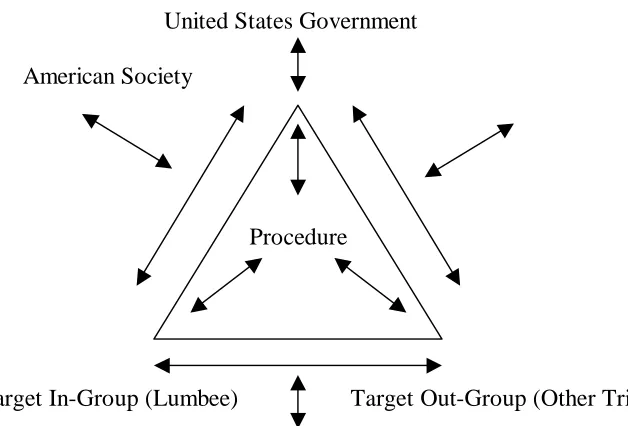
target out-group. As seen in Figure 2, the relationship between the Lumbee, the target in-group is in an interdependent relationship with the United States government and with other American Indian tribes, the target out-group in this case. Any action taken by any of the relevant participants transforms the given dimensions into effective dimensions. The government is under restraint from the American people and by other unrecognized tribes, who have entered the Federal Recognition process, along with recognized tribes who fear their funding may be in jeopardy.
United States Government American Society
Target In-Group (Lumbee) Target Out-Group (Other Tribes) Figure 2. Procedural-Interdependence of Lumbee Federal Recognition.
These restraints and pressures create psychological reactance by which the participants respond with behaviors that strive to reestablish their sense of freedom (Nacoste & Hummels, 1994). Recent studies concluded that unfair procedures directed at a fellow group member affect other group member’s perceptions of group process, performance and value in ways similar to those members excluded from the process (Forrest, 2002; Van den Bos & Lind, 2001). In other words, procedural-interdependence, an extension of interdependence theory, affects negatively both the in-group and out-group member
certain issues of Lumbee psychology have been in a state of psychological reactance behaving in ways to regain their freedom of self-definition (Sider, 1993, 2003).
Social Status and Group Membership
If the majority group in a society holds the traits and characteristics of an ethnic group in low esteem, then ethnic group members are faced with a negative social identity (Phinney, 1990, 2003). Identifying with a low-status group may result in low self-regard. There is an extensive literature dealing with the notion of “self-hatred” among disparaged ethnic group members concerning whether and to what extent membership or identification with a group of low-status relates to a poorer self-concept (Phinney, 1990, 1992, 2003; Phinney et al., 1993; Tajfel, 1978, 1981, 1982).
Tajfel (1978, 1981, 1982) suggested that members of low-status groups seek methods to improve their status. People’s views of themselves are linked to their views of the status of the groups to which they belong. This linkage to a high-status group supports a positive view of the self, increasing self-esteem (Tyler & Blader, 2000; Tyler et al., 1996). Individuals may try to disassociate themselves from the group and go more inline with the majority group. This effort to disassociate from one’s group may be considered by many group members as “selling out” thereby creating animosity within the group. It has been evidenced that in some ethnic groups this creates a split within the social structure of a community (Sider, 1993). This split can manifest itself at all levels of the social group. It can be found in the home, the neighborhood, the local government, a split into other social groups (different tribal affiliations), and in churches.
(Lind & Tyler, 1998), as mentioned previously, and the relational model of authority (Tyler & Blader, 2000; Tyler & Lind, 1992). The importance of this research is that it emphasizes that people evaluate their relationships with their groups based on the fairness of the procedures they experience in their contact with these groups (Tyler & Blader, 2002). These types of procedures are related to the self-interest model, whether it is a social group, a political system, or a work organization, people join and remain in such groups because they believe that the outcome will be in their best interest in the end (Lind & Tyler, 1988). Fair procedures communicate an important message regarding relational concerns, leading group members to think: (1) that their group is of high status and (2) that they are of high status within the group (Tyler & Blader, 2002; Tyler et al., 1996; Tyler, & Lind, 1992; Van den Bos et al., 1998; Van den Bos, 1999; Van Prooijen et al., 2002; Van Prooijen et al., 2004). Both of these evaluations are believed to play a major role in the construction and maintenance of a positive social identity, which is an important psychological objective (Tajfel, 1978, 1981, 1982).
The Relational Model of Authority
relation between status and procedural fairness. Research suggests that procedural fairness is associated with identity and compliance with authorities, whereby; individuals draw a sense of self-worth from group membership (Ambrose, 2002; Ambrose, Harland & Kulik, 1991). The relational model of justice offers individuals with an indication of their full membership in the group and whether that membership should be a source of pride. Thus, the group-value model and the relational model of authority may be a more accurate predictor of self-esteem and group pride that one gains from being valued by a respected authority rather than self-esteem and group pride gained from one’s accomplishments (Schroth & Shah, 2000). In sum, fair procedures by group authorities, those considered of high status, may indicate that one is valued and respected as a group member.
would identify more strongly with their subordinate role counterparts, female attorneys. It was concluded that female judges would recognize that their own status as a female judge in a male dominated environment would only improve when the status of female attorneys also improved (Clay-Warner, 2001). This suggests that when an individual has identities or memberships in both a high status and low status group, identification with the low status group may be more salient and therefore, more sensitive to bias or discrimination providing group members with a significant degree of value and emotional “connectiveness.”
Group membership provides clues for appropriateness for their attitudes, values and behaviors. Additionally, group membership provides emotional support, a sense of belonging and a source of material resources (Tyler, 1989, 1990; Tyler & Blader, 2000; Tyler et al., 1996). These are but a few of the reasons individuals seek to belong to groups and find them rewarding and very troubled if threatened by being rejected from the group.
According to the vulnerability hypothesis (Nacoste, 1994), procedures such as these could create four possible manifestations: (1) group members’ develop negative emotional reactions and self-doubt concerning their ethnicity, (2) group members’ expect that the majority group will negatively view ethnicity, (3) group members’ belief that the agency is not truly committed in carrying out the procedure “fairly,” and (4) group members’ will develop self-doubt in their ethnic authenticity based on the majority group’s qualifications. An environment such as this could create outcomes for the group member that would likely increase their vulnerability to negative feedback from the majority group.
Differing from affirmative action policies, tribal Federal Recognition is in place to police, to question the group member’s historical significance and therefore validate their identity as a legitimate member of their “alleged” ethnic group. A policy such as this on the surface may be about entitlement and acceptance, but it may also be both subtly demeaning. The implementation of such a policy may arouse negative emotional responses and self-doubt or identity self-doubt concerning their ethnicity (Sider, 1993, 2003).
The Dimensional Voice Model
Voice is the current notion of voice. The second and third dimension, Misvoice and Forced Voice identify those procedures that appear to provide voice, but actually restrict it (Bane, 1994, 1999).
True Voice is defined as when a procedure provides an opportunity for disputants to communicate their point-of-view or to provide information to a third party decision-maker. “True Voice” exists when the individual believes the information conveyed is (1) not distorted in any way (accurate and relevant to the decision being made), and (2) the information conveyed is voluntary (Bane, 1994, 1999). The procedure is considered not to allow for True Voice if either or both of these conditions are not met.
Misvoice is defined as the disputant having an opportunity to provide information, but considers the information used to make the decision to be distorted. This distortion occurs when the disputant feels their opinion is not genuinely represented (Bane, 1994, 1999). Misvoice also contains elements of Leventhal’s (1980) notions of accuracy of information, bias suppression, and correctability or the idea that there is some provision for correcting bad decisions. Additionally, Misvoice includes the perception of irrelevance.
Social Exclusion Theory
Social exclusion theory states that individuals experience high levels of negative affect when they think there is a threat that they may anticipate exclusion from a group (Baumeister & Tice, 1990; Leary, 1990; Nacoste, 1994; Van Beest, Wilke, & Van Dijk, 2003; Van Prooijen et al., 2004). This feeling of anxiety should arise at the moment the person is separated from the group or at the moment the individual discovers that such a separation has happened or is likely to happen (Baumeister & Tice, 1990; Leary, 1990; Twenge & Campbell, 2003; Van Beest et al., 2003). People may experience exclusion anxiety when they anticipate being judged and viewed as less valuable to their own group. Furthermore, this anxiety may heighten if they sense being judged negatively by the majority group.
have a self-defeating effect on tribal members that could affect their ambition to make a mark on the world.
Justifications
Whatever the nature of a procedure, its use is typically given some justification such as in the Lumbee Case, ethnic and cultural validation. Justifications or explanations have been shown to have a powerful influence on human behavior and have been offered as a relatively simple and effective human resource tool for promoting perceptions of fairness (Bies, 1987a, 1987b, 1989; Bies & Moag, 1986; Bies & Shapiro, 1987, 1988; Bies, Shapiro, & Cummings, 1988; Greenberg, 1990; Heilman, McCullough & Gilbert, 1996; Ployhart & Ryan, 1998; Ployhart, Ryan, & Bennett, 1999; Bobocel & Farrell, 1996; Shaw, Wild & Colquitt, 2003). Interactional justice involves interpersonal behavior conducted by those who implement procedures and make decisions, such as whether the decision-makers provide explanations for their decisions and if they treat all parties affected by the decision with dignity and respect (Bane, 1999; Beugre & Baron, 2001; Bies & Moag, 1986; Brockner et al., 2001; Skarlicki & Folger, 1997; Skarlicki et al., 2004; Tata, 2000a). There is substantial empirical support for the effect of fair interpersonal treatment on individual’s attitudes and behaviors through fair procedures (Beugre & Baron, 2001; Brockner et al., 2001; Skarlicki & Folger, 1997; Skarlicki et al., 2004; Tata, 2000a).
negative outcome (Heilman et al., 1996; Bobocel & Farrell, 1996). Much research has demonstrated how providing a reasonable justification or explanation for a decision has a generally positive effect on reactions to that decision, especially if the outcome is unfavorable (Heilman et al., 1996; Ployhart et al., 1999; Bobocel & Farrell, 1996; Shaw et al., 2003).
The Current Research
This study examines the perceived fairness of a procedure that is designed to validate a person’s ethnic group membership. From the literature of procedural justice, the dimensional voice model and social exclusion theory, we know that appears that reference to marital status, race, religion, gender, age, or handicapped status may be viewed as unfair, but applicants may feel under obligation to answer such questions in order to be considered for the particular outcome (Bane, 1994). Rosenbaum (1973) found that issues such as personal finances, religious topics (church membership, church attendance) family history, racial or ethnic background was considered an invasion of privacy when asked during a selection process. With that in mind, three separate procedural conditions will be implemented. The White American’s Participating (WAP) procedure respondents will read a scenario actually requiring a physical measurement and participation in the procedure. The White American’s Observing (WAO) procedure respondents will read a scenario that describes a procedure but does not require a physical measurement and participation. In other words, they are observers of this procedure. The Control group procedure does not mention ethnicity or physical measurement and participation.
deals with causal accounts or justifications given after the procedure and the decision has already been rendered. According to Thibaut and Walker (1978) and their theory of procedure, the immediacy and power of correspondent and noncorrespondent outcomes are central to the notion of justifications in the current study. In this study, justifications will be implemented as the rationale for the procedure, a priori, before respondents participate in or a decision is made from the procedure. When respondents participate in a procedure, the purpose or rationale for the particular procedure being used is expected to affect their perceptions of fairness. In other words, procedural justification is expected to effect respondent’s perceptions of fairness of the procedures. Therefore, in the present study, the Department of Homeland Security (DHS) and the National Science Foundation (NSF) as justifications are used as the rationale for the procedures.
Finally, although not a specified hypothesis, gender is expected to have an effect on perceptions of fairness of the procedures. The rationale for this is the nature of the conflict between correspondent and noncorrespondent outcomes. According to Gilligan (1982), female moral reasoning is through the lens of “the ethic of care” where the male view is through “the ethic of justice.” The National Science Foundation (NSF) represents a correspondent cognitive conflict and the Department of Homeland Security (DHS) represents the noncorrespondent material conflict of interest. It is expected that males will perceive procedures justified by the Department of Homeland Security (DHS) through the ethic of justice perspective, while females will perceive procedures justified by the National Science Foundation (NSF) through the ethic of care perspective.
Hypothesis 1: Participants involved in a procedure designed to validate one’s ethnic membership will evaluate the procedure as more unfair than a control group.
Social exclusion theory research has shown that when people think they will be excluded from a social group they may experience high levels of anxiety or negative affect (Baumeister & Tice, 1990; Leary, 1990; Nacoste, 1994; Van Beest, Wilke, & Van Dijk, 2003).
Hypothesis 2: Participants involved in the White American’s Observing (WAO)
procedure will perceive more True Voice than the White American’s Participating (WAP) or the Control group.
Previous research has shown that people perceive procedures that allow True Voice to be evaluated as fairer than procedures that do not allow True Voice (Bane, 1994, 1999; Lind et al., 1990; Lind & Tyler, 1988) which is when a procedure provides an opportunity for disputants to communicate their point-of-view or to provide information to a third party decision-maker.
Hypothesis 3: Participants involved in the Department of Homeland Security (DHS) justification will perceive a procedure designed to validate one’s ethnic membership to lead to Misvoice as compared to the National Science Foundation (NSF) or Control group.
Procedures that ask for information that are perceived as irrelevant to the outcome of the procedure in order to render that decision will be evaluated as unfair (Bane, 1994, 1999). According to Bane (1994) this use of irrelevant information is Misvoice
Forced Voice can be considered as an invasion of privacy or when procedures ask for information from individuals deemed inappropriate (Bane, 1994, 1999).
Hypothesis 5: Participants involved in the Department of Homeland Security (DHS) Justification White American’s Participating (WAP) procedure designed to validate one’s ethnic membership will result in negative affect more so than the National Science Foundation (NSF) White American’s Observing (WAO) procedure.
The idea is that a procedure designed to validate ethnic group membership based on Misvoice and Forced Voice both of which lead to feelings of social exclusion threat negative affect. Recent research on affirmative action reveals that individuals feel that procedures that give more weight to group membership than to qualifications are evaluated as unfair (Nacoste, 1990).
Hypothesis 6: Two types of justifications will be used: Department of Homeland
Security (DHS) and a National Science Foundation (NSF) Grant are the justifications for the procedure (see Appendix B). Using this method of operationalizing justifications, the situational circumstances, the 9/11 terrorist attacks, provide the justification for a procedure to be carried out even if viewed as a negative procedure (Bies, 1989; Bies & Moag, 1986; Bies & Shapiro, 1987, 1988; Bies et al., 1988; Heilman et al., 1996; Ployhart et al., 1999; Bobocel & Farrell, 1996; Shaw et al., 2003). Therefore:
Participants in the National Science Foundation (NSF) justification condition will perceive the procedure fairer than participants in the Department of Homeland Security (DHS) justification condition.
for the action procedure (Bies, 1989; Bies & Moag, 1986; Bies & Shapiro, 1987, 1988; Bies et al., 1989; Heilman et al., 1996; Ployhart et al., 1999; Bobocel & Farrell, 1996; Shaw et al., 2003). Studies have suggested that for most people fairness requires that decisions be justified so that the action might be understood and found acceptable (Bies, 1989; Bies & Moag, 1986; Bies & Shapiro, 1987, 1988; Bies et al., 1989). For the present study, the questionable action is the procedure and the justification is the rationale for the procedure.
Method Participants
The participants for the study were undergraduate students participating to fulfill a course requirement in introductory psychology. One hundred twenty participants were randomly assigned to the experimental conditions in small groups and all participants received full credit for participation and were debriefed on the nature of the study. Because of the nature of the study, only White participants were included in the study. There were 60 females (50%) and 60 males (50%) in the study. The ages ranged from 17 to 26 years of age with a mean age of 18.78. All other descriptive data are presented in Table 1.
Design
The present study is a 2 (Gender) X 2 (Justification) X 3 (Procedure) factorial between-groups design (see Figure 3). Procedural justification was operationalized in two ways: (a)
Procedure
Justification Gender WAP WAO Control
Female DHS
Male
Female NSF
Male
Figure 3. 2 (Gender) X 2 (Justification) X 3 (Procedure) Factorial Experimental Design. (a) White Americans’ Participating (WAP); (b) White Americans’ Observing (WAO); and (c) Control. The last two factors are gender: (a) female and (b) male.
Table 1
Demographics of Sample across Age, Gender, and Ethnicity by Frequency, Means, and Standard Deviation compared to Population
___________________________________________________________________________
n M SD Sample N M SD Population Percentage Percentage ___________________________________________________________________________ Age 17 years 2 18.78 1.45 1.7 4 19.04 1.93 2.5
18 71 59.2 85 52.1
19 26 21.7 35 21.5
20 9 7.5 16 9.8
21 6 5.0 12 7.4
22 2 1.7 3 1.8
23 1 .8 2 1.2
24 1 .8 2 1.2
25 1 .8 1 .6
26 1 .8 2 1.2
33 1 .6
Gender
Female 60 50.0 81 49.7
Table 1 (continued).
Demographics of Sample across Age, Gender, and Ethnicity by Frequency, Means, and Standard Deviation compared to Population
___________________________________________________________________________
n M SD Sample N M SD Population Percentage Percentage ___________________________________________________________________________ Ethnicity
African American 25 15.3
American Indian 1 .6
Asian American 11 6.7
Hispanic 2 1.2
White 120 100.0 120 73.6
Other 2.5
Arab American 1
East Indian 2
Iranian 1
___________________________________________________________________________ Note. n = 120 and N = 163.
Procedure
At the beginning of the session, once all participants were present, the experimenter said the following:
Good morning (afternoon). My name is David Oxendine. This is an experiment entitled Decision Making. Please read and sign the informed consent form and return it to me. Then read the scenario and complete several short questionnaires concerning the scenarios.
experimental conditions. One condition was the Department of Homeland Security (DHS) procedural justification manipulation. The participants in the White American’s Participating (WAP) condition will read the following scenario:
After hearing the scenario the participants actually participated physically in the experiment by having certain parts of their bodies measured to include the circumference of their skulls, the distance between their ears and nose, distance from ear lobes to fingertips will be measured. After the measurement session, the participants read the following:
After being measured, please complete the questionnaires.
The participants in the White American’s Observing (WAO) condition read the following:
government scientists and experts. Based on this research, certain physical attributes have been shown to determine individuals who are true White Americans. Some of these examinations will require you to be touched by the experimenter with such tasks as measuring your head, checking for cranial ridges and the like. Your permission will be required for these procedures. You will then be asked to take a series of questionnaires. Your cooperation will be greatly appreciated. Thank you for reading the scenario. Please take the time to answer the following questionnaires. Thank you again for your time.
This group only read the procedures and was not actually physically examined. At this point all participants completed the questionnaires.
The participants in the Control condition read the following scenario:
to protect ourselves. As one of 5 universities, we have been assigned the task of developing a method to determine who are true Americans. We need your help. You will be asked to answer several questionnaires. We are using research from government scientists and experts. You will then be asked to take a series of questionnaires asking your reflection of these scientific methods. Your cooperation will be greatly appreciated.
The participants then completed the questionnaires.
Participants randomly assigned to the National Science Foundation (NSF) procedural justification followed the same format as above. The only difference is the introduction to their scenarios. The scenarios for the first two experimental conditions is as follows:
be required for these procedures. You will then be asked to take a series of questionnaires. Your cooperation will be greatly appreciated.
The scenario for the second experimental condition is as follows:
You are asked to read the following scenario from a current research project. Please put yourself in this situation. After reading the scenario you will be asked to answer several questionnaires asking for your reactions to the research. What follows is the scenario: With a grant provided by the National Science Foundation, extensive research continues on social groups and ethnicity. This research is charged to develop methods to better identify people from different ethnic groups based on physical attributes. This university is one of 5 universities in the United States to be included in this research project. As one of 5 universities, we have been assigned the task of developing a method to determine who are true White Americans. The other universities will be working on other groups. We need your help. You will be asked to participate in a series of examinations and tests. We are using research from government scientists and experts. Based on this research, certain physical attributes have been shown to determine individuals who are true White Americans. Some of these examinations will require you to be touched by the experimenter with such tasks as measuring your head, checking for cranial ridges and the like. Your permission will be required for these procedures. You will then be asked to take a series of questionnaires. Your cooperation will be greatly appreciated.
The scenario for the control condition is as follows:
identify degrees of Americanism. This university is one of 5 universities in the United States to be included in this research project. As one of 5 universities, we have been assigned the task of developing a method to determine who are true Americans. We need your help. We are using research from government scientists and experts. You will be asked to answer several questionnaires. You will then be asked to take a series of questionnaires asking your reflection of these scientific methods. Your cooperation will be greatly appreciated.
At this point all participants completed the questionnaires.
Since there will be no screening of participants based on ethnicity, all participants’ that take part in the study will be utilized. Each participant’s ethnicity will be identified from his or her Informed Consent Form. For example, if a participant is For example, if a participant is other than White based on their self-disclosure from their informed consent form, their scenario will read, “we have been assigned the task of developing a method to determine who are true (White, Black, Asian, Hispanic, Other, Select one) Americans.” In this way, all participants regardless of their ethnicity will benefit by being allowed to participant in this process. After the debriefing and the study is complete, only the data from Caucasian participants will be used for data analysis.
After all participants completed reading the scenarios and the questionnaires, the experimenter debriefed the participants as follows:
of input you had in the procedure. I will use the information you provided today to test a model of how input people have in procedures affects their perceptions of its fairness and how the type of input makes a people feel the threat of exclusion. Any questions?
At this time participants were given research credit for their participation. Also participants were given an opportunity to ask questions or provide comments before dismissal.
Measures
Each justification condition, the White Americans’ Participating (WAP), the White Americans’ Observing (WAO), and the Control condition participants answered an Americanism questionnaire as part of the procedure (see Appendix C). This questionnaire consists of 20 randomly selected questions from the Immigration Guide website (http://www.immigrationguide.com/citq.htm). Sample questions include, “How many stars are there in our flag? What do the stars on the flag mean?, What color are the stripes?”
how fair was this procedure?” Each of the following items was rated on a 9-point Likert-type scale:
1. To what extent was the information you provided accurate? (OAR)
2. To what extent were you able to tell the experimenter your opinion about being an American? (DI)
3. To what extent did you feel pressured into providing information during the procedure? (SP)
4. To what extent was the information concerning you relevant? (OAR) 5. To what extent did you agree with the procedure? (SP)
6. To what extent did you believe the information used in the procedure was irrelevant? (SI)?
7. To what extent was the information not related to your status as an American? (OAR) 8. To what extent did you have the opportunity to share your opinions? (DI)
9. To what extent was the information you gave in the evaluation provided voluntarily? (DI)
10. To what extent was decision based on information provided by you? (DI)
11. To what extent did you feel forced to reveal your opinion to the experimenter? (SP) 12. How willing would you been to talk about your status as an American? (DI)
13. How much input did you have in the procedure? (DI)
14. How many opportunities did you have to tell your side of the story? (DI) 15. How satisfied are you with this procedure?
16. Using this procedure, how likely is it that a fair decision will be made? 17. In your opinion, how fair was this procedure?
18. If you had been the experimenter, how fair would you have thought the procedure was?
19. How serious do you take the Department of Homeland Security? 20. Most people would say this procedure is fair.
21. Evaluation procedures can be used for a variety of reasons. The evaluation procedure you just experienced or learned about was set up to identify what?
The choices for question 21 would be (A), Patriotism, (B) True White American, (C) Ethnicity, or (D) Group Identity. Item’s 16, 17, 18 and 20 are a procedural manipulation check. Item 19 is a manipulation check concerning the salience of the justification of the procedure.
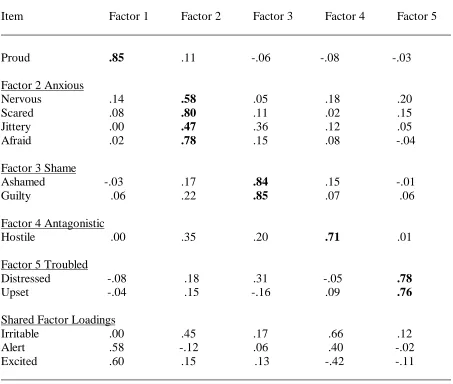
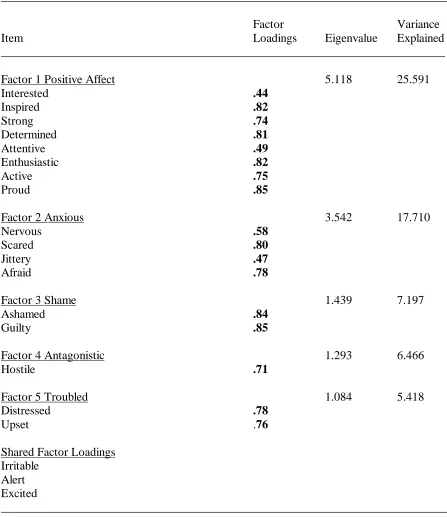
PANAS is the most frequently used measure of mood (Egloff, Schmukle, Burns, Kohlmann & Hock, 2003; Terracciano, McCrae & Costa, Jr., 2003). According to Baumeister et al. (2002), Twenge et al. (2002) and their work with social exclusion, this is a standard, respected, and frequently used measure of affective state dimensions. PA reflects the extent a person feels enthusiastic, active, and alert. High PA is a state of high energy, full concentration, and pleasurable engagement where low PA is a state sadness and lethargy. NA is a general dimension of subjective distress and unpleasurable engagement of aversive mood states including, anger, contempt, disgust, fear and nervousness where low NA is a state calmness and serenity (Watson & Tellegen, 1988). Internal consistency reliabilities with Cronbach’s alpha ranged from .86 to .90 for PA and from .84 to .87 for NA (Watson et al., 1988). The PANAS consists of a number of words that describe different feelings and emotions rated on 5-point Likert-type scale from 1(very slightly or not at all) to 5(extremely). The lists of words are as follows:
PA interested NA irritable
NA distressed PA alert
PA excited NA ashamed
NA upset PA inspired
PA strong NA nervous
NA guilty PA determined
NA scared PA attentive
NA hostile NA jittery
PA enthusiastic PA active
PA proud NA afraid
In the directions, Watson et al. (1988) tested the scale using various time instructions for participants to answer based on how they feel at this moment, today, past few days, week, past few weeks, year or in general. For the purpose of this study, the at this moment time frame will be used to determine how socially excluded the participants feel immediately after the experimental manipulation.
To gain credibility with the guise of determining patriotism, three items were used that tap into the core elements of the patriotism attachment: love of country and pride in the nation (Peña & Sidanius, 2002). The three items are (a) “I have great love for the United States”, (b) “ I am proud to be an American,” and (c) “ I find the sight of the American flag very moving.” All items were scored on a 5-point Likert-type scale ranging from 1 (strongly disagree) to 5 (strongly agree). The scoring is the higher the number, the stronger the patriotism. This was found to have a reliability estimate (Cronbach’s alpha) of .77 (Peña & Sidanius, 2002). The final form of the questionnaires can be found in Appendix C.
Results Data Analysis
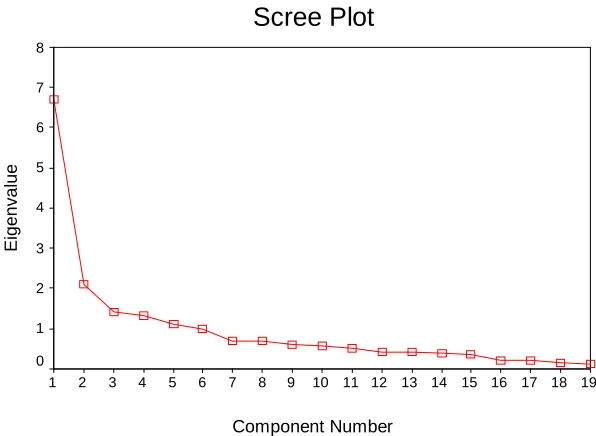
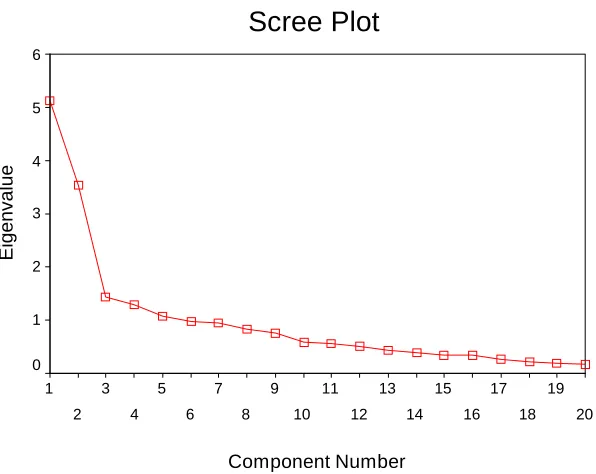
Scree Plot Component Number 19 18 17 16 15 14 13 12 11 10 9 8 7 6 5 4 3 2 1 Eigenvalue 8 7 6 5 4 3 2 1 0
Figure 4. Scree plot of eigenvalues for Dimensional Voice.
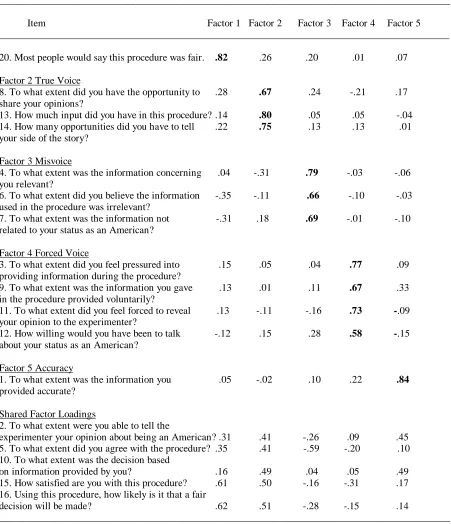
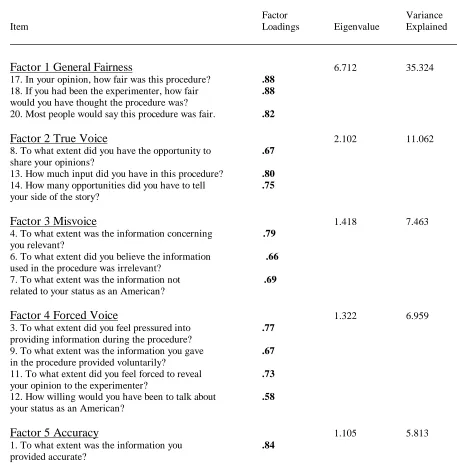
criterion is to retain all eigenvalues in the sharp descent part of the plot before the eigenvalues start to level off (Green & Salkind, 2003). Based on this criterion, five factors were retained. Variables with a factor weight of .40 or greater were included in the analysis as factors. The five factors were labeled Fairness, True Voice, Misvoice, Forced Voice and Accuracy. The items, factor loadings, eigenvalues and variance explained are presented in Tables 2 and 3. Means and standard deviations for each of the five factors are presented in Tables 14, 15, 16, 17, and 18 respectively in Appendix D. Items that shared loadings (items 2, 5, 10, 15, 16) were analyzed to be discussed later.
Table 2
Factor Loadings for Dimensional Voice Items
__________________________________________________________________________________________ Item Factor 1 Factor 2 Factor 3 Factor 4 Factor 5 __________________________________________________________________________________________ Factor 1 General Fairness