University of Windsor University of Windsor
Scholarship at UWindsor
Scholarship at UWindsor
Electronic Theses and Dissertations Theses, Dissertations, and Major Papers
2012
Solid-State NMR of Quadrupolar Nuclei for Structural Elucidation
Solid-State NMR of Quadrupolar Nuclei for Structural Elucidation
Marcel Hildebrand University of Windsor
Follow this and additional works at: https://scholar.uwindsor.ca/etd
Recommended Citation Recommended Citation
Hildebrand, Marcel, "Solid-State NMR of Quadrupolar Nuclei for Structural Elucidation" (2012). Electronic Theses and Dissertations. 305.
https://scholar.uwindsor.ca/etd/305
This online database contains the full-text of PhD dissertations and Masters’ theses of University of Windsor students from 1954 forward. These documents are made available for personal study and research purposes only, in accordance with the Canadian Copyright Act and the Creative Commons license—CC BY-NC-ND (Attribution, Non-Commercial, No Derivative Works). Under this license, works must always be attributed to the copyright holder (original author), cannot be used for any commercial purposes, and may not be altered. Any other use would require the permission of the copyright holder. Students may inquire about withdrawing their dissertation and/or thesis from this database. For additional inquiries, please contact the repository administrator via email
Solid-State NMR of Quadrupolar Nuclei for Structural Elucidation
by
Marcel P. Hildebrand
A Thesis
Submitted to the Faculty of Graduate Studies through Chemistry and Biochemistry in Partial Fulfillment of the Requirements for the
Degree of Master of Science at the University of Windsor
Windsor, Ontario, Canada 2012
iii Declaration of Co-Authorship
I acknowledge that my supervisor, Dr. Robert Schurko, has provided guidance
throughout the whole of this work and has edited this thesis.
Dr. Victor Terskikh and Dr. Eric Ye at the National Ultra-high Field NMR
Facility for Solids are acknowledged for providing data acquired at 21.1 T in Chapter 2.
Dr. Ivan Hung and Dr. Zhehong Gan at the National High Magnetic Field Laboratory are
acknowledged for providing the data acquired at 21.1 T in Chapter 3.
Senior members of our lab group trained me in the use of our NMR spectrometer
and supervised my usage of it. The main contributors in this regard were Dr. Aaron
Rossini (Chapter 2), Dr. Hiyam Hamaed (Chapter 3), and Bryan Lucier (Chapter 2 and
3). Other senior graduate students in the Department of Chemistry and Biochemistry
trained me in the use of some synthetic chemistry techniques. The main contributors are
Dr. Jillian Hatnean and Meghan Doster (Chapter 2).
I am aware of the University of Windsor Senate Policy on Authorship and I
certify that I have properly acknowledged the contribution of other researchers to my
thesis, and have obtained written permission from each of the co-author(s) to include the
above material(s) in my thesis. I certify that, with the above qualification, this thesis, and
the research to which it refers, is the product of my own work.
I declare that, to the best of my knowledge, my thesis does not infringe upon
anyone’s copyright nor violate any proprietary rights and that any ideas, techniques,
quotations, or any other material from the work of other people included in my thesis,
iv
referencing practices. Furthermore, to the extent that I have included copyright material
that surpasses the bounds of fair dealing within the meaning of the Canada Copyright
Act, I certify that I have obtained a written permission from the copyright owner(s) to
include such materials in my thesis.
I declare that this is a true copy of my thesis, including any final revisions, as
approved by my thesis committee and the Graduate Studies office, and that this thesis has
v Abstract
This thesis demonstrates that solid-state NMR (SSNMR) spectroscopy of
quadrupolar nuclei provides a powerful means of characterizing a diverse set of
materials. Complementary techniques such as pXRD and quantum chemical calculations
are also explored.
First, information on the structure and function of methylalumoxane (MAO) is
obtained via 27Al and 91Zr SSNMR experiments at two different magnetic field strengths.
In particular, 27Al NMR and accompanying first principles calculations reveal the nature
of the Al sites in the cage-like MAO structures, and lend insight into the interactions that
lead to the formation of the MAO/metallocene adducts.
Second, a series of hydrochloride (HCl) pharmaceuticals are characterized via
35
Cl SSNMR, and arrangements of close-contact hydrogen bonds are correlated to 35Cl
EFG tensor parameters. Plane-wave density functional theory calculations of these
parameters are in good agreement with experiment. 35Cl SSNMR is also shown to act as
vi Acknowledgements
Many thanks go to my supervisor, Dr. Robert Schurko, for providing guidance as
I undertook the study of solid-state NMR. This area of research is a difficult one and Rob
has guided me the entire way. I have not only learned about SSNMR, but more
importantly, I have learned how to be a critical thinker in addition to many other skills
that I will keep with me for a lifetime. For that I thank you.
Thanks also to Dr. Loeb and Dr. Rangan for being on my M.Sc. thesis committee
and agreeing to read through this work. Dr. Gauld is thanked for chairing my defense.
I also acknowledge all the members of the Schurko group past and present: Dr.
Karen Johnston, Dr. Kris Harris, Dr. Aaron Rossini (whom I expect to see in an academic
faculty position soon), Dr. Hiyam Hamaed, Dr. Luke O’Dell, Bryan Lucier, Stanislav
Veinberg, Andrew Namespetra, Zach Friedl, and Chris O’Keefe. Thanks for the help and
some great discussions.
Thanks to Karla Day. You have always been supportive of me and my decisions,
in spite of my ‘flaky’ and unpredictable behavior. You are my favorite person and I can
only hope to be there for you as you have been there for me. May you walk on warm
sands.
Lastly, I would like to thank my family. Your support and encouragement is
appreciated, despite living on opposite sides of the country. You have all taught me the
vii Contents
Declaration of Co-Authorship...iii
Abstract...v
Acknowledgements... vi
List of Tables... xi
List of Figures... xiv
List of Abbreviations... xxiii
List of Symbols... xxv
1 Introduction and Theory ...1
1.1 Introduction... 1
1.2 NMR Interactions...2
1.2.1 Zeeman Interaction...2
1.2.2 Response of Nuclear Spins to Radiofrequency Pulses...6
1.2.3 Relaxation Processes... 8
1.2.4 Nuclear Shielding and the Chemical Shift... 9
1.2.5 Quadrupolar Interaction...15
1.2.6 Euler Angles...21
1.2.7 Dipolar and Scalar Coupling... 22
1.3 NMR Acquisition and Signal Enhancement Techniques...25
1.3.1 Magic-Angle Spinning (MAS)...25
1.3.2 Echo Pulse Sequences... 28
1.3.3 Frequency-stepped SSNMR...30
viii
1.3.5 Cross Polarization...33
1.3.6 Multiple-Quantum Magic-Angle Spinning (MQMAS)...35
1.3.7 Quantum Chemical Calculations of NMR Tensor Parameters...38
1.4 Context of Research... 39
Bibliography...41
2 Multinuclear NMR Spectroscopy of Methylalumoxane: Solid Forms of the Co-catalyst and Metallocene Adducts...48
2.1 Introduction... 48
2.2 Experimental...56
2.2.1 Samples...56
2.2.2 Solid-State NMR... 56
2.2.3 Theoretical Calculations...59
2.3 Results and Discussion...60
2.3.1 General Overview...60
2.3.2 27Al SSNMR experiments, MAO...60
2.3.3 27Al SSNMR experiments, MAO and Cp2ZrMe2/MAO adducts...65
2.3.4 27Al MQMAS Experiments. MAO and Cp2ZrMe2/5MAO...74
2.3.5 First principles calculations of 27Al EFG tensors...78
2.3.6 91Zr SSNMR experiments, Cp2ZrMe2/MAO adducts... 80
2.4 Conclusions...84
ix
3 Combining 35Cl Solid-State NMR and First Principles DFT Calculations for the Study of HCl Pharmaceuticals and their
Polymorphs...96
3.1 Introduction... 96
3.2 Experimental...101
3.2.1 Samples...101
3.2.2 Solid-State NMR (9.4 T)...101
3.2.3 Solid-State NMR (21.1 T)...102
3.2.4 Powder XRD... 103
3.2.5 Theoretical Calculations...103
3.3 Results and Discussion...104
3.3.1 General Overview... 104
3.3.2 Reliability of Plane-Wave DFT Calculations...105
3.3.3 A system with one short H···Cl contact: Dicyclomine HCl (Dicy)...110
3.3.4 Systems with two short H···Cl contacts: Nylidrin HCl (Nyli), Scopolamine HCl (Scop) and Bromhexine HCl (Brom)... 112
3.3.5 Systems with three short H···Cl contacts: Alprenolol HCl (Alpr), Isoprenaline HCl (Isop), and Procainamide HCl (Proc)...115
3.3.6 Systems with four or more short H···Cl contacts: Dopamine HCl (Dopa) and Aminoguanidine HCl (Amin)...120
3.3.7 Correlation of chlorine environments and EFG tensor parameters...123
3.3.8 Application to polymorphism in HCl pharmaceuticals...125
3.4 Conclusions...135
x
4 General Conclusions and Future Work...145
Appendices A Supporting Information - Multinuclear NMR Spectroscopy of Methylalumoxane: Solid Forms of the Co-catalyst and Metallocene Adducts...148
A.1 Supporting Experimental Information...148
A.1.1 Experimental Parameters for SSNMR Experiments...148
A.1.2 DFT Calculations of 27Al EFG Tensor Parameters...156
A.1.3 Supplementary Figures and SSNMR Spectra...165
Bibliography...170
B Supporting Information - Combining 35Cl Solid-State NMR and First Principles DFT Calculations for the Study of HCl Pharmaceuticals and their Polymorphs... 171
B.1 Supporting Experimental Information...171
B.1.1 Experimental Polymorph Generation...171
B.1.2 Experimental Parameters for SSNMR Experiments...172
B.1.3 Experimental 35Cl EFG and CSA Tensor Parameters and Short Cl···H Contact Distances and Angles...179
B.1.4 Supplementary Figures... 182
Bibliography...201
xi List of Tables
Table 2.1. Experimentally determined 27Al EFG tensor NMR parameters
for MAO...62
Table 2.2. Experimentally determined 27Al NMR tensor parameters
for MAO...63
Table 2.3. Experimentally determined 27Al EFG tensor parameters for
Cp2ZrMe2/5MAO... 69
Table 2.4. Experimentally determined 27Al NMR tensor parameters for
Cp2ZrMe2/5MAO... 70
Table 2.5. Relative integrated intensities of Sites A, B and C in the
Cp2ZrMe2/MAO adducts at 9.4 T... 71
Table 2.6. Experimentally determined 27Al EFG tensor NMR parameters (21.1 T) for bulk MAO and Cp2ZrMe2/5MAO obtained from
MQMAS cross-sections... 77
Table 2.7. Experimentally determined 91Zr static EFG and CSA tensor NMR parameters for Cp2ZrMe2/5MAO, Cp2ZrMe2, and
[Cp2ZrMe][MeB(C6F5)3] (21.1 T)...83
Table 3.1. Experimental and theoretical 35Cl EFG and CS
tensor parameters...108
Table 3.2. Short H···Cl contacts and experimentally determined 35Cl SSNMR parameters for HCl pharmaceuticals with one and two
close H···Cl contacts...111
Table 3.3. Short H···Cl contacts and experimentally determined 35
Cl SSNMR parameters for HCl pharmaceuticals with three close
H···Cl contacts... 116
Table 3.4. Short H···Cl contacts and experimentally determined 35Cl SSNMR parameters for HCl pharmaceuticals with four or more close
H···Cl contacts... 121
Table 3.5. Short H···Cl contacts and experimentally determined 35Cl
xii
Table 3.6. Experimental and theoretical 35Cl EFG and CS tensor parameters
for HCl pharmaceutical polymorphs... 129
Table A1. Details of Compounds A – G...148
Table A2. SSNMR Acquisition parameters for static 27Al spectra (9.4 T)...149
Table A3. SSNMR Acquisition parameters for static 27Al spectra (21.1 T)...150
Table A4. SSNMR Acquisition parameters for MAS 27Al spectra (21.1 T)...151
Table A5. SSNMR Acquisition parameters for 1H →13C VACP spectra (9.4 T)...152
Table A6. SSNMR Acquisition parameters for MAS 1H spectra (9.4 T)...153
Table A7. SSNMR Acquisition parameters for static 91Zr spectra (21.1 T)...154
Table A8. SSNMR Acquisition parameters for 27Al MQMAS spectra (21.1 T)...155
Table A9. Calculated 27Al EFG tensor parameters for MAO (proposed structures)... 156
Table B1. SSNMR Acquisition parameters for static 35Cl spectra (9.4 T) of Proc, Dicy, Alpr, Isop, Nyli, Dopa, Brom...172
Table B2. SSNMR Acquisition parameters for static 35Cl spectra (9.4 T) of Scop, Amin, Chlo, IsoxI, MexiI, MexiII...173
Table B3. SSNMR Acquisition parameters for static 35Cl spectra (21.1 T) of of Proc, Dicy, Alpr, Isop, Nyli, Dopa, Brom... 174
Table B4. SSNMR Acquisition parameters for static 35Cl spectra (21.1 T) of Scop, Amin, Chlo, IsoxI, MexiI...175
Table B5. SSNMR Acquisition parameters for MAS 35Cl spectra (21.1 T) of Proc, Dicy, Alpr, Isop, Nyli, Dopa, Brom... 176
Table B6. SSNMR acquisition parameters for MAS 35Cl spectra (21.1 T) of Scop, Amin, Chlo, IsoxI, MexiI...177
xiii
Table B8. Experimental 35Cl EFG and CSA tensor parameters... 179
Table B9. Short Cl···H contact distances and angles for HCl
pharmaceuticals containing two hydrogen close contacts...180
Table B10. Short Cl···H contact distances and angles for HCl pharmaceuticals
xiv List of Figures
Figure 1.1. Depiction of nuclear spin angular momentum precessing
about the magnetic field... 4
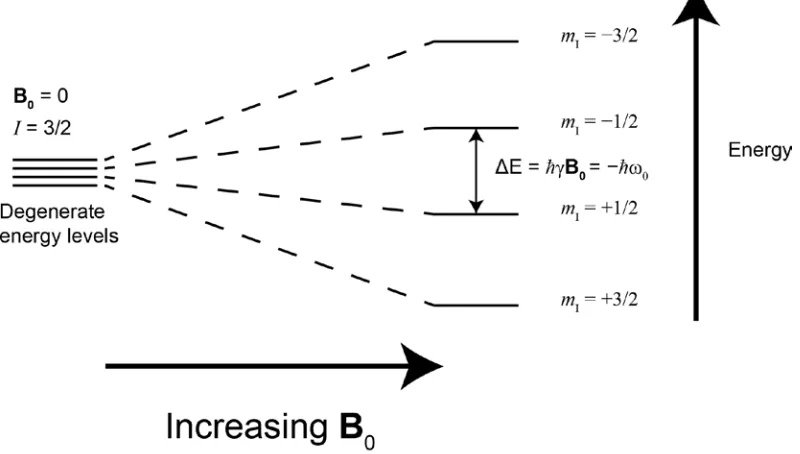
Figure 1.2. Quantization of the nuclear spin angular momentum for I = 3/2 nucleus in the presence of a magnetic field. Note the energy separation between adjacent spin states is equivalent, resulting in a single transition
frequency...5
Figure 1.3. (a) Vector model representation of the effect of a pulse applied along the x′-axis of the rotating frame on the bulk magnetization vector M.
(b) After B1 is turned off, the vector undergoes free precession about B0... 8
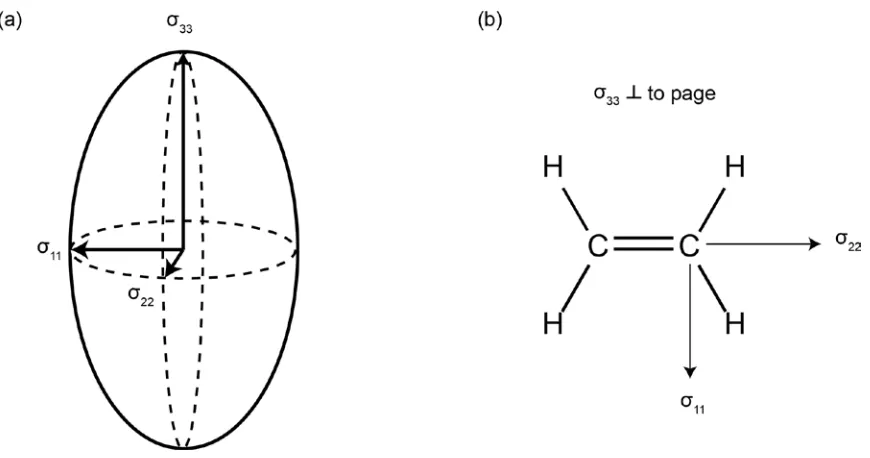
Figure 1.4. (a) Depiction of nuclear shielding tensor orientation with corresponding principal axis components. (b) Nuclear shielding tensor orientation for the carbon atom in ethene. Note the orientation dependence
of the nuclear shielding interaction... 13
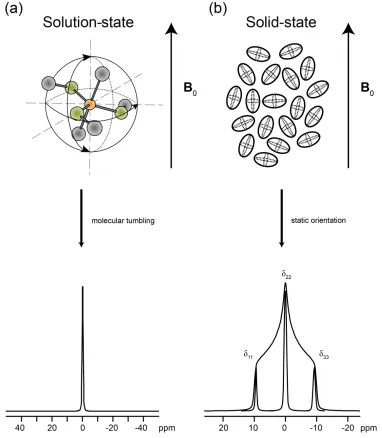
Figure 1.5. (a) Rapid molecular tumbling in solution serves to average the CSA to its isotropic value which, in turn, results in a sharp peak at the
isotropic frequency shift, δiso. (b) Simulated 13C (I = 1/2) static spectrum. The discontinuities correspond to the principal components of the CS tensor.
Note the sharp peaks corresponding to δ11, δ22and δ33, which illustrate how different orientations of the CS tensor, with respect to B0, give rise to distinct transition frequency shifts. In a powdered sample, all orientations
are present, giving rise to a powder pattern...16
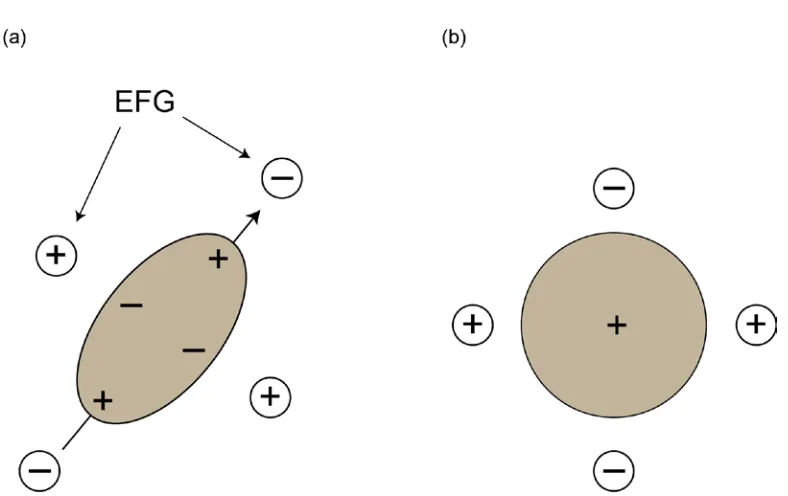
Figure 1.6. (a) Schematic representation of the asymmetric charge distribution for a quadrupolar nucleus and the associated preferential orientation, or interaction, with an electric field gradient. (b) Schematic representation of an I = 1/2 nucleus with a spherical charge distribution. Here there is no preferred orientation with respect to the electric field
gradient...17
Figure 1.7. Perturbation of the Zeeman energy levels arising from the quadrupolar interaction to a first- and second-order approximation for a spin I = 3/2 system. Although not broadened by the first-order quadrupolar interaction, the central transition is broadened by the second-order quadrupolar interaction. The satellite transitions are affected by both the first-and
second-order quadrupolar interaction...20
xv
ηQ ranging from 0.2 to 1.0. The broadening of the powder pattern due to the increased value of CQ, as well as the position of the discontinuities due to ηQ,
are illustrated... 21
Figure 1.9. Depiction of the Euler angle convention used to describe the relative orientation ofthe CS and EFG tensor by rotating the CS tensor from the fixed EFG tensor frame (denoted by the x, y, z frame) into the PAS of the
CS tensor (denoted by the X, Y, Z frame). Adapted from Tang (2008)... 22
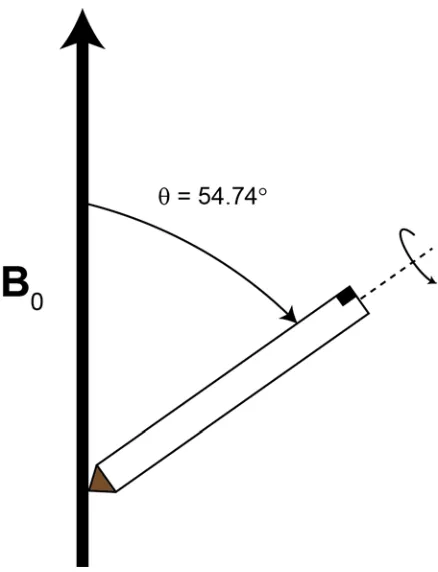
Figure 1.10. Schematic representation of a rotor at the magic-angle of
θ = 54.74° where θ is the angle of the rotor with respect to B0...26
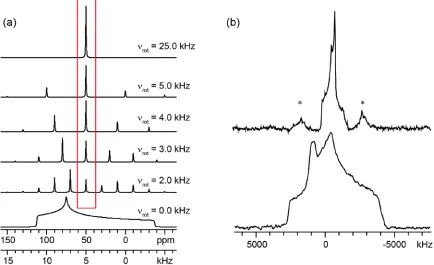
Figure 1.11. (a) Simulated spectra illustrating the effect of MAS on an I = 1/2 powder pattern at various spinning speeds. The isotropic peak is enclosed in the red box. Note the spinning sidebands are offset from the isotropic peak by an integer multiple of the spinning speed.
(b) I = 3/2 MAS (top) and static (bottom) spectra 35Cl SSNMR spectra
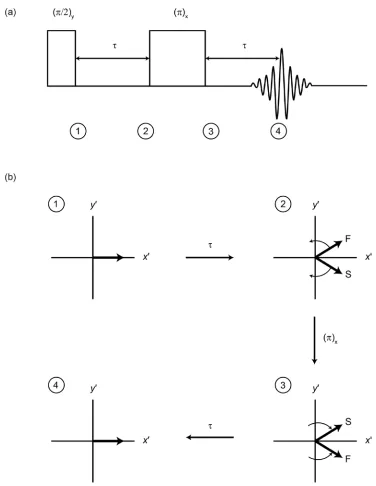
of dopamine HCl. νrot = 22 kHz. Spinning sidebands denoted by *... 27 Figure 1.12. (a) A schematic representation of the Hahn echo pulse
sequence and (b) a vector model illustrating the refocusing of two
representative spins... 29
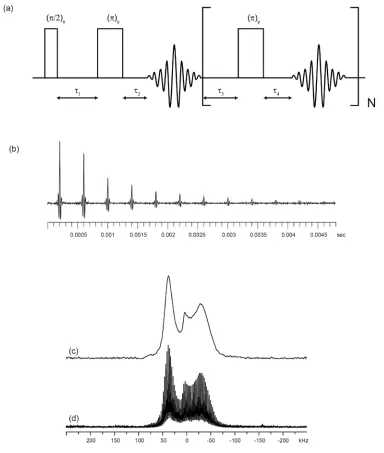
Figure 1.13. (a) A schematic representation of the QCPMG pulse sequence. The parameters τ1, τ2, τ3, and τ4 indicate interpulse delays. (b) An example of the spikelet FID obtained from a 27Al (I = 5/2) QCPMG experiment on methylaluminoxane. (c) Fourier transformation of the first spin echo gives a standard spin echo spectrum. (d) Fourier transformation of the QCPMG
echo train gives a spikelet spectrum...32
Figure 1.14. A schematic representation of the WURST-QCPMG pulse sequence. The parameters τ1, τ2, τ3, and τ4 indicate interpulse delays. The
excitation and refocusing pulses have identical lengths and phases... 33
Figure 1.15. A schematic representation of the cross-polarization pulse sequence. I corresponds to the nucleus with favorable NMR properties (abundant) and S corresponds to the nucleus with unfavorable
NMR properties (dilute)... 34
xvi
projections for RbNO3, recorded using the pulse sequence in (a).
This pulse sequence was not utilized in this study...35
Figure 1.17. Schematic representation of a spectrum resulting from an MQMAS experiment. Shown in (a) are a series of ridges aligned along a gradient equal to the MQMAS ratio, R. Shown in (b) is the spectrum
post shearing, exhibiting a series of ridges parallel to δ2. An isotropic
spectrum is then obtained from a projection onto δ1...36
Figure 1.18. (a) Pulse sequence and one possible coherence pathway diagram for the I = 3/2 phase modulated split-t1 MQMAS experiment. (b) Conventional 97Rb MAS NMR spectrum (14.1 T), triple-quantum MAS NMR spectrum, and corresponding isotropic projections for RbNO3, recorded
using the pulse sequence in (a)...37
Scheme 2.1. Proposed mechanism for the insertion of ethylene into
a cationic zirconocene and subsequent polymerization...49
Scheme 2.2. (a) Synthesized t-butyl analogues of MAO. The t-butyl groups have been omitted for clarity. (b) Proposed MAO cage structure
depicting a latent Lewis acidic site, as suggested by Barron and co-workers...51
Scheme 2.3. Selected cage structures of MAO predicted by Zurek et al.
using DFT calculations.30 All methyl groups have been omitted for clarity...52
Scheme 2.4. Active polymerization catalysts, as predicted by DFT calculations. (a) Cp2ZrMe2/MAO•TMA, (b) Cp2ZrMe2/MAO, (c)
Cp2ZrMe2/MAO (deactivated product unable to initiate polymerization)...54
Figure 2.1. (a) Experimental static 27Al WURST-QCPMG SSNMR spectrum of MAO acquired at 9.4 T and analytical simulation for (b) co-addition of spectra for Sites A, B and C, (c) spectrum for Site A, (d) spectrum for Site B, and (e) spectrum for Site C. (f) Experimental 27Al MAS SSNMR spectrum of MAO acquired at 21.1 T and analytical simulation for (g) co-addition of spectra for Sites A, B and C, (h) spectrum for Site A,
(i) spectrum for Site B, and (j) spectrum for Site C. * indicate spinning side bands.
νrot = 31.25 kHz. (k) Experimental static 27Al SSNMR spectrum of MAO acquired at 21.1 T and analytical simulation for (l) the co-addition of spectra for Sites A, B and C, (m) spectrum for Site A, (n) spectrum for Site B, and
(o) spectrum for Site C... 61
Figure 2.2. Static 27Al WURST-QCPMG spectra (9.4 T) of (a) bulk
xvii
(e) Cp2ZrMe2/20MAO and (f) MAO exposed to ambient atmosphere. Static 27Al WURST-QCPMG spectra (9.4 T) of (g) Cp2ZrMe2/5MAO
acquired 10/20/2010 and (h) Cp2ZrMe2/5MAO acquired 03/29/2011...67
Figure 2.3. (a) Experimental static 27Al WURST-QCPMG SSNMR spectrum of Cp2ZrMe2/5MAO acquired at 9.4 T and analytical simulations for (b) the co-addition of spectra for Sites A, B and C (c) spectrum for Site A,
(d) spectrum for Site B, and (e) spectrum for Site C...68
Figure 2.4. 27Al MAS NMR spectra (21.1 T) of (a) bulk MAO, (b) Cp2ZrMe2/5MAO, (c) Cp2ZrMe2/10MAO, (d) Cp2ZrMe2/15MAO, (e)
Cp2ZrMe2/20MAO and (f) Cp2ZrMe2/5MAO exposed to ambient atmosphere. (g) Experimental 27Al MAS SSNMR spectrum of MAO acquired at 21.1 T and analytical simulation for (h) the co-addition of spectra for Sites A, B and C, (i) spectrum for Site A, (j) spectrum for Site B, and (k) spectrum for Site C.
* indicate spinning side bands. νrot = 31.25 kHz... 72
Figure 2.5. Static 27Al spectra acquired at 21.1 T of (a) bulk MAO, (b) Cp2ZrMe2/5MAO, (c) Cp2ZrMe2/10MAO, (d) Cp2ZrMe2/15MAO, (e)
Cp2ZrMe2/20MAO and (f) Cp2ZrMe2/5MAO exposed to ambient atmosphere. (g) Experimental static 27Al SSNMR spectrum of Cp2ZrMe2/5MAO acquired at 21.1 T and analytical simulation for (h) the co-addition of spectra for Sites A, B and C, (i) spectrum for Site A, (j) spectrum for Site B, and (k)
spectrum for Site C...73
Figure 2.6. Conventional 27Al (21.1 T) MAS NMR spectrum,
triple-quantum MAS NMR spectrum, and corresponding isotropic projections of (a) MAO. Also shown are lineshapes of (b) Site A, (c) Site C, and (d) Site B for MAO. Conventional 27Al (21.1 T) MAS NMR spectrum,
triple-quantum MAS NMR spectrum, and corresponding isotropic projections of (e) Cp2ZrMe2/5MAO. Also shown are lineshapes of (f) Site A, (g) Site C, and (h) Site B for Cp2ZrMe2/5MAO. The lineshapes were obtained by taking
cross sections parallel to δ2 corresponding to each site. Simulations of each respective site are shown in red. Each spectrum was acquired using a phase modulated rotor-synchronized split-t1 shifted echo pulse sequence.
νrot = 31.25 kHz... 75
xviii
and (c) the average values of CQ for the different geometries surrounding the aluminum nucleus. Also highlighted in (c) are regions containing one or less, and two or more square faces surrounding the Al nucleus. The calculated values of CQ are given as absolute values. Refer to the experimental section
for details on computational methods... 79
Figure 2.8. Static 91Zr spectra (21.1 T) of (a) Cp2ZrMe2/5MAO, (b) Cp2ZrMe2, and (c) [Cp2ZrMe][MeB(C6F5)3]. Corresponding spectral simulations are shown in red. * denotes spectral interference. Chemical structures of (d) Cp2ZrMe2 and (e) [Cp2ZrMe][MeB(C6F5)3]. Proposed molecular structures of active polymerization catalysts involving Cp2ZrMe2/MAO are shown in Schemes 2.3(a) and 2.3(b). See
ref 87 for experimental details for (b) and (c)...81
Scheme 3.1. Schematic representations of (a) procainamide HCl (Proc), (b) dicyclomine HCl (Dicy), (c) alprenolol HCl (Alpr), (d) isoprenaline HCl (Isop), (e) nylidrin HCl (Nyli), (f) dopamine HCl (Dopa), (g) bromhexine HCl (Brom), (h) isoxsuprine HCl (Isox), (i) scopolamine HCl (Scop), (j)
aminoguanidine HCl (Amin), and (k) mexiletine HCl (Mexi)...100
Figure 3.1. Correlation between experimental and calculated values of (a,b) CQand (c, d) ηQ. All calculations were completed using CASTEP. Calculations in (a) and (c) were performed post geometry optimization of the hydrogen positions. Calculations in (b) and (d) were performed post geometry optimization of the whole structure. The solid line is the line of
best fit for the plotted points and the dashed line represents perfect correlation... 109
Figure 3.2.35Cl SSNMR spectra of Dicy shown in black, corresponding
analytical simulations are shown in red. Spinning sidebands denoted by *... 112
Figure 3.3.35Cl SSNMR spectra of (a) Nyli, (b) Scop, and (c) Brom. Experimental spectra shown in black, corresponding analytical simulations
are shown in red. Spinning sidebands denoted by *... 113
Figure 3.4. 35Cl EFG tensor orientations of (a) Scop and (b) Brom. The short (< 2.6 Å) chlorine-hydrogen contacts are shown in red, and longer contacts are marked with dashed lines. Hydrogen atoms greater than 3.0 Å
from the chlorine anion have been deleted for clarity...114
Figure 3.5. 35Cl SSNMR spectra of (a) Alpr, (b) Isop and (c) Proc. Experimental spectra shown in black, corresponding analytical simulations are shown in red.
xix
Figure 3.6. 35Cl EFG tensor orientations of (a) Alpr, (b) Isop and (c) Proc. The short (< 2.6 Å) chlorine-hydrogen contacts are shown in red, and longer contacts are marked with dashed lines. Hydrogen atoms greater than 3.0 Å
from the chlorine anion have been deleted for clarity...118
Figure 3.7. 35Cl SSNMR spectra of (a) Dopa and (b) Amin. Experimental spectra shown in black, corresponding analytical simulations are shown in red.
Spinning sidebands denoted by *... 122
Figure 3.8. 35Cl EFG tensor orientations of (a) Dopa and (b) Amin. The short (< 2.6 Å) chlorine-hydrogen contacts are shown in red, and longer contacts are marked with dashed lines. Hydrogen atoms greater than 3.0 Å from the chlorine anion have been deleted for clarity... 123
Figure 3.9. 35Cl SSNMR spectra of (a) Isox and, (b) IsoxI. Experimental spectra shown in black, corresponding analytical simulations are shown in red.
Spinning sidebands denoted by *... 128
Figure 3.10. 35Cl EFG tensor orientations of (a) Isox, (b) IsoxI site 1, and (c) IsoxI site 2. The short (< 2.6 Å) chlorine-hydrogen contacts are shown in red, and longer contacts are marked with dashed lines. Hydrogen atoms greater than 3.0 Å from the chlorine anion have been deleted for clarity... 130
Figure 3.11. 35Cl MAS NMR spectra of (a) Mexi and (b) MexiI.
Experimental spectra shown in black, corresponding analytical simulations
are shown in red... 131
Figure 3.12. Static 35Cl NMR spectra (9.4 T) of MexiII... 133
Figure 3.13. 35Cl EFG tensor orientations of (a) Mexi site 1 and (b) Mexi site 2. The short (< 2.6 Å) chlorine-hydrogen contacts are shown in red, and longer contacts are marked with dashed lines. Hydrogen atoms greater
than 3.0 Å from the chlorine anion have been deleted for clarity... 134
Figure A1. Cage structure of (AlOMe)6•TMA predicted by DFT calculation.
Methyl groups not relevant to this study have been omitted for clarity...165
Figure A2. 27Al WURST-QCPMG SSNMR spectra of MAO (9.4 T) generated using (a) Fourier transformation of the QCPMG echo train in the time
domain and (b) co-addition of the individual echoes in the time domain
followed by Fourier transformation... 166
xx
(A) MAO, 9.5 kHz (B) Cp2ZrMe2/5MAO, 9.5kHz (C) Cp2ZrMe2/10MAO, 9.5 kHz (D) Cp2ZrMe2/15MAO, 9.5 kHz (E) Cp2ZrMe2/20MAO, 10.5 kHz (F) MAO exposed to an ambient atmosphere, 5 kHz. Bold, underlined
text indicates 13C resonance assignment... 167
Figure A4. 1H MAS spectra of compounds A – F at 9.4 T. Asterisks denote spinning sidebands. Samples and spinning speeds are:
(A) MAO, 9.5 kHz (B) Cp2ZrMe2/5MAO, 10 kHz (C) Cp2ZrMe2/10MAO, 10 kHz (D) Cp2ZrMe2/15MAO, 10 kHz (E) Cp2ZrMe2/20MAO, 12.5 kHz (F) MAO exposed to an ambient atmosphere, 12.5 kHz. Bold, underlined
text indicates 1H resonance assignment...168
Figure A5. A depiction of the Gaussian distribution utilized in Quadfit...169
Figure B1. Correlation between experimental and calculated values of (a) CQ, and (b) ηQ. All calculations were performed prior to geometry optimization of the structure using CASTEP. The solid line is the line of best fit for the plotted points and the dashed line represents perfect
correlation...182
Figure B2. Correlation between experimental and calculated values of δiso. In (a) values were calculated post geometry optimization of the hydrogen atom positions, in (b) values were calculated post full geometry
optimization of the structure and, in (c) values were calculated prior to geometry optimization. All calculations were performed using CASTEP. The solid line is the line of best fit for the plotted points and the dashed
line represents perfect correlation... 183
Figure B3. Correlation between experimental and calculated values of Ω. In (a) values were calculated post geometry optimization of the hydrogen atom positions, in (b) values were calculated post full geometry optimization of the structure and, in (c) values were calculated prior to geometry
optimization. All calculations were performed using CASTEP. The solid line is the line of best fit for the plotted points and the
dashed line represents perfect correlation... 184
Figure B4. Correlation between experimental and calculated values of κ. In (a) values were calculated post geometry optimization of the hydrogen atom positions, in (b) values were calculated post full geometry optimization of the structure and, in (c) values were calculated prior to geometry
optimization. All calculations were performed using CASTEP. The solid line is the line of best fit for the plotted points and the dashed line represents
xxi
Figure B5. Correlation between experimental CQ and H···Cl bond distance for APIs for which the closest H···Cl contact involves an oxygen containing
moiety (Trig, Nyli, Scop, Isop, Aceb, Treo and Dopa)...186
Figure B6. Experimental powder X-ray diffraction patterns of (a) Isox and, (b) IsoxI measured at room temperature. Corresponding simulations
are shown in red... 187
Figure B7. 1H → 13C VACP SSNMR spectra (9.4 T) of (a) Isox and,
(b) IsoxI. νrot = 13 kHz. Spinning sidebands denoted by *... 188
Figure B8. Experimental powder X-ray diffraction patterns of (a) Mexi, (b) MexiI, and (c) MexiII measured at room temperature. The
corresponding simulation is shown in red...189
Figure B9. Simulation of the static 35Cl SSNMR spectrum of MexiI (9.4 T) with (a) no CSA contribution and (b) with CSA contribution. Note the splitting of the low frequency horn due to CSA. (c) Experimental static 35Cl SSNMR spectrum of MexiI at 9.4 T. (d) Simulation of the 35Cl MAS SSNMR spectrum of MexiI (21.1 T). (e) Experimental 35Cl MAS SSNMR
spectrum of MexiI at 21.1 T...190
Figure B10. 1H → 13C VACP SSNMR spectra (9.4 T) of (a) Mexi,
(b) MexiI and, (c) MexiII. νrot = 9.5 kHz. Spinning sidebands
denoted by *... 191
Figure B11. (a) Simulated powder pattern of Proc calculated from previously determined single crystal X-ray diffraction structure and (b) experimental
powder X-ray diffraction pattern of Proc measured at room temperature... 192
Figure B12. (a) Simulated powder pattern of Dicy calculated from previously determined single crystal X-ray diffraction structure and (b) experimental
powder X-ray diffraction pattern of Dicy measured at room temperature...193
Figure B13. (a) Simulated powder pattern of Alpr calculated from previously determined single crystal X-ray diffraction structure and (b) experimental
powder X-ray diffraction pattern of Alpr measured at room temperature... 194
Figure B14. (a) Simulated powder pattern of Isop calculated from previously determined single crystal X-ray diffraction structure and (b) experimental
powder X-ray diffraction pattern of Isop measured at room temperature...195
xxii
powder X-ray diffraction pattern of Nyli measured at room temperature... 196
Figure B16. (a) Simulated powder pattern of Dopa calculated from previously determined single crystal X-ray diffraction structure and (b) experimental
powder X-ray diffraction pattern of Dopa measured at room temperature...197
Figure B17. (a) Simulated powder pattern of Brom calculated from previously determined single crystal X-ray diffraction structure and (b) experimental
powder X-ray diffraction pattern of Brom measured at room temperature... 198
Figure B18. (a) Simulated powder pattern of Scop calculated from previously determined single crystal X-ray diffraction structure and (b) experimental
powder X-ray diffraction pattern of Scop measured at room temperature... 199
Figure B19. (a) Simulated powder pattern of Amin calculated from previously determined single crystal X-ray diffraction structure and (b) experimental
powder X-ray diffraction pattern of Amin measured at room temperature... 200
xxiii List of Abbreviations
ADF Amsterdam Density Functional
API active pharmaceutical ingredients
Cp cyclopentadienyl
CP cross-polarization
CS chemical shift
CSA chemical shift anisotropy
CT central transition
DAS dynamic angle spinning
DFT density functional theory
DOR double rotation
EFG electric field gradient
FID free induction decay
GGA generalized gradient approximation
GIAO gauge including atomic orbitals
GIPAW gauge-including projector augmented wave algorithm
HF Hartree Fock
LLA latent Lewis acidity
MAO methylalumoxane
MAS magic-angle spinning
MQMAS multiple-quantum magic-angle spinning
NMR nuclear magnetic resonance
NS nuclear shielding
PAS principal axis system
pXRD powder X-ray diffraction
xxiv
QI quadrupolar interaction
RAMPCP ramped amplitude cross-polarization
RHF restricted Hartree-Fock
rPBE revised Perdew, Burke and Ernzerhof
SHARCNET Shared Hierarchical Academic Research Computing
Network
S/N signal to noise ratio
SOLA Solids Line Shape Analysis
SSNMR solid-state nuclear magnetic resonance
ST satellite transition
TMA trimethylaluminum
TPPM two pulse phase modulated
TZ2P triple-ζ double-polarized
VACP variable-amplitude cross-polarization
xxv List of Symbols
α, β, γ Euler Angles
B0 static applied magnetic field
B1 alternating magnetic field applied in the form of a pulse
CQ quadrupolar coupling constant
δiso isotropic chemical shift
δ11, δ22, δ33 principal components of the chemical shielding tensor
e charge of an electron
γ gyromagnetic ratio
h Planck’s constant
ħ Planck’s constant divided by 2π
HZ Zeeman Hamiltonian
HNS nuclear Shielding Hamiltonian
HQ quadrupolar Hamiltonian
HDD dipolar Coupling Hamiltonian
HJ J-coupling Hamiltonian
HRF radiofrequency Hamiltonian
I nuclear spin angular momentum vector
I nuclear spin quantum number
κ skew
μ magnetic dipole moment
M macroscopic magnetization
ηQ EFG asymmetry parameter
PQ quadrupolar product
xxvi
R MQMAS ratio
σ total nuclear shielding
σ11, σ22, σ33 principal components of the magnetic shielding tensor
σD diamagnetic shielding
σP paramagnetic shielding
τ time delays within pulse sequences
T1 longitudinal relaxation time constant
T2 transverse relaxation time constant
V11, V22, V33 principal components of the EFG tensor
ω0 Larmor frequency in radians per second
ωTx frequency of applied fields in radians per second
ωQ quadrupolar frequency in radians per second
ω1 nutation frequency of applied fields in radians per second
1 Chapter 1
1 Introduction and Theory
1.1 Introduction
The phenomenon of nuclear magnetic resonance (NMR) was first reported
independently and simultaneously by the research groups of Bloch and Purcell in 1946.1, 2
The importance of this work was highlighted in 1952 when Bloch and Purcell were
awarded the Nobel prize for their contribution to the field of NMR. Since the initial
discovery of NMR, intense research, coupled with advances in hardware and software,
has made this a ubiquitous technique for the solution-state, molecular-level structural
characterization of chemical compounds, in both industry and academia. Solid-state
NMR (SSNMR) has also benefitted from relatively recent technological advances and
has, subsequently, been an area of intense research over the past several decades,3-7
including studies on proteins,8 polymers,9 inorganic materials,10, 11 as well as clays and
minerals,12to name but a few categories of solid materials. In the following sections the
interactions responsible for the phenomena observed in NMR spectroscopy are discussed,
along with the techniques utilized in this work for the acquisition of SSNMR spectra.
The following sections are not meant to be a complete treatment of the interactions that
govern the NMR experiment; for a more complete description of the theoretical aspects
2 1.2 NMRInteractions
NMR is a consequence of the interaction of the nuclear spin, which has an
associated magnetic dipole moment, µ, with an external magnetic field, B0. The
Hamiltonian describing the principal interactions of NMR, which include interactions of
nuclear spins with both external and internal magnetic fields, can be written as
Htotal = HZ + HNS + HQ + HDD + HJ + HRF, (1)
where HZ describes the Zeeman interaction, HNS represents the nuclear shielding
interaction, HQ the quadrupolar interaction, HDD the direct dipolar coupling, HJ the
indirect coupling, and HRF the interaction with radiofrequency fields. These NMR
interactions, all of which affect the appearance of the resulting NMR spectrum, will be
discussed in detail in the following sections.
1.2.1 Zeeman Interaction
Manynuclei possess an intrinsic spin angular momentum, I, and a corresponding
spin quantum number I. I is proportional to the nuclear magnetic dipole moment, μ, such
that:
3
where γ is the gyromagnetic ratio, an intrinsic property of each nuclide. Those nuclei for which the nuclear spin quantum number, I, is equal to zero do not possess spin angular
momentum, nor a nuclear magnetic dipole moment.
Classically, when a nuclear magnetic dipole moment is placed in an external
magnetic field, it precesses about an axis defining the direction of this field. Quantum
mechanically, the nuclear spin can only adopt certain fixed orientations as defined by its
spin quantum number mI; hence the spin angular momentum is said to be quantized, such
that the z-component of I is given as:
Iz = mIħ (3)
where the magnetic quantum number mI = I, I − 1, …, −I, represents the spin state of a given spin. The energy of the interaction between μ and B0, along the z-axis,can be
written as:
Em = μ · B0= μzB0 = γIzB0 =mIħγB0 = mIħω0 (4)
The rate of precession of the nucleus about an external magnetic field, ω0, is
known as the Larmor frequency:
4
The Larmor frequency, as written above, uses the sign convention of Levitt.22 This
precession, in units of rad s−1, follows a conical path as shown in Figure 1.1. Nuclei with
spin I have 2I + 1 energy levels which are degenerate in the absence of a magnetic field.
However, when B0 is applied, the degeneracy is broken, and a splitting of the nuclear
ground state into 2I + 1 energy levels is observed, as depicted in Figure 1.2 for an I = 3/2
nucleus. These energy levels differ in energy by ΔE = ħγB0 , and the Hamiltonian describing the interaction of the nucleus with B0 can be written as:14
Hz = IzħγB0 (6)
and is known as the Zeeman interaction. Solely under the influence of the Zeeman
interaction, all energy level separations are equivalent and, consequently, there is only
5 one observed transition frequency.
Thus far we have only considered a single nucleus, or spin, when in reality, a real
sample is best described by an ensemble of spins. In the presence of a magnetic field, for
a I = 1/2 nucleus with positive γ, the spin states are populated according to the Boltzmann distribution:
kT
ΔE
e N N
β
α = (7)
where Nα refers to the number of nuclei populated the lower energy nuclear spin state (mI
= 1/2), and Nβ signifies the population of the higher energy spin state (mI = −1/2). Hence
6
for a γ > 0 nucleus at any temperature, there are more spins in the lower energy α state,
giving rise to a net magnetization vector, M, parallel to B0. Increasing the magnetic field
or lowering sample temperature, leads to an increase in Nα/Nβ, and consequently, a larger
M.
1.2.2 Response of Nuclear Spins to Radiofrequency Pulses
Prior to discussion of the internal NMR interactions, we must first discuss the
effect of radiofrequency (rf) pulses on an ensemble of nuclei in the presence of a
magnetic field. In an NMR experiment, the sample is placed inside a coil (generally
solenoid type), usually on a probe head, inside the static applied magnetic field. An
alternating current is passed through the coil oscillating at a frequency, called the
transmitter frequency, ωTx, which is equal to or near the similar to the nuclear Larmor
frequency, ω0. This oscillating current produces a magnetic field, B1, along the axis of the coil (arbitrarily designated along the x-axis in the lab frame), perpendicular to B0. If a
pulse, B1, is applied through the coil such that ωTx≈ ω0, then we are able to direct the magnetization away from B0, which is parallel to the z-axis. That the small B1 field can
‘tip’ M away from the much larger B0 is best understood when one considers the rotating
frame which is a reference frame (denoted x′y′z′)that rotates at a frequency equal to ωTx about the z-axis (i.e., z′ = z). If ωTx= ω0 (on resonance), then the individual magnetic moments comprising M appear to be stationary with respect to the rotating frame. This
gives the appearance that B0 is absent and the B1 field, which now appears stationary, is
7
magnetization vector M precesses about B1at the nutation frequency, ω1 = −γB1. The nutation frequency is dependent upon γ as well as the magnitude of B1 produced by the rf pulse.
If a pulse is introduced with a magnitude B1and duration τp, then the net magnetization vector Mis rotated at angle θp away from the z-axis such that:
θp= τpγB1 = −τpω1 (8)
Therefore, M is ‘tipped’ into the x′y′-plane of the rotating frame when τp and ω1 are set
such that θpis equal to π/2, according to the vector model illustrated in Figure 1.3(a).
The orientation of M within the xy-plane is dictated by the right-hand rule (i.e., a pulse
applied along the x-axis will direct M onto the −y-axis). When B1 is removed, by turning the pulse off, the magnetic moments are free to precess about B0 at the Larmor frequency
(Figure 1.3(b)) which, in turn, induces a current in the coil. This current is recorded as a
time domain signal, commonly referred to as a free induction decay (FID), and is
subsequently Fourier transformed to produce the frequency domain NMR spectrum.
If there is a large separation between ωTxand ω0, then the efficacy of the pulse at generating transverse magnetization is reduced. The magnetic moments no longer appear
to be stationary in the rotating frame and, as such, contributions from both the B0 and B1
field are present. The resulting effective magnetic field, Beff, which has both z and x′
8
Beff = (B0 – ωTx/γ)·z + B1/2·x (9)
If (B0 – ωTx/γ) >> Beff (i.e., the offset Δω = ω0 – ωTx is large), then the magnetization does not ‘tip’ into the x′y′-plane and there is not any resultant signal. This is a crucial aspect in the consideration of ultra-wideline SSNMR spectra, which are typically greater than 250
kHz broad, and uniform excitation of the entire frequency range with a single, short
rectangular pulse becomes impossible.
1.2.3 Relaxation Processes
There are two types of NMR relaxation processes: longitudinal (or spin-lattice)
relaxation and transverse (or spin-spin) relaxation. When a sample is initially placed in a
magnetic field, the nuclear spins will gradually change their orientations until there is an
excess of spins populating the lower energy Nα nuclear spin state. Eventually, the bulk
Figure 1.3. (a) Vector model representation of the effect of a pulse applied along the x′-axis of the rotating frame on the bulk magnetization vector M. (b) After B1 is turned off, the vector undergoes free
9
magnetization M reaches thermal equilibrium (Mmax) predicted from the Boltzmann
distribution. The longitudinal relaxation time, described by the T1 relaxation time
constant, is the time required for the bulk magnetization, M, to return to thermal
equilibrium (M = Mmax). In order for M = Mmax, one must wait approximately 5 T1 time
periods. The value of T1 governs the time interval between scans and is dependent on the
nucleus of study, and can range from μs to days. Hence, the amount of time required to obtain a NMR spectrum is greatly influenced by T1. It is possible to measure T1
experimentally via the inversion recovery pulse sequence.13
Transverse magnetization generated by an applied pulse will also undergo
relaxation. After a pulse is applied the transverse magnetization precesses in the x′y′ -plane, however, its magnitude decreases over time and eventually decays to zero. This is
due to individual nuclear spins acquiring random orientations in the x′y′-plane. This process is known as tranverse relaxation and is described by the time constant T2 which
can be measured using the Carr-Purcell-Meiboom-Gill (CPMG) pulse sequence (vide
infra).23, 24 A detailed discussion on relaxation mechanisms is beyond the scope of this
introduction, and the reader is referred to other, more detailed, descriptions.25-27
1.2.4 Nuclear Shielding and the Chemical Shift
In 1951, while acquiring the 1H NMR spectrum of ethanol, three distinct 1H
resonances were observed corresponding to the methyl, methylene, and alcohol protons.28
The different frequencies of the proton resonances were dubbed as chemical shifts (CS)
10
The interaction of the nuclear magnetic moment with the surrounding magnetic
field consists of two components: the external magnetic field B0 and an internal magnetic
field that arises from the sample, Bint (we neglect magnetic susceptibility in this
discussion). The applied field, B0, induces motion of electrons in molecules, which in
turn generates a very small local field, Bint, known as nuclear shielding (NS), which acts
as a small perturbation on B0. This nuclear shielding, which can be treated as a
perturbation on the much larger Zeeman interaction, allows for the differentiation of
nuclear environments in a molecule. The local field at a nucleus is therefore the sum of
these two fields:
Bloc = B0 + Bint (10)
Hence, the small induced field acts to alter the Larmor frequency of the nucleus, such that
there is a new, shifted Larmor frequency given by:
γBloc =γB0 + γBint (11)
or ωloc =ω0+ ωint (12)
According to the formal treatment of Ramsey,29-31 the total nuclear shielding, σ,
has two contributions: diamagnetic, σD, and paramagnetic, σP, shielding:
11
The diamagnetic shielding contribution usually results in shielding of the nucleus (i.e.,
production of Bint which opposes B0, thereby reducing the effective Larmor frequency)
and arises due to circulation of ground state electrons induced by the external magnetic
field, B0. This induced current creates a small local molecular magnetic field, Bint, on a
very small, but detectable, scale. Paramagnetic shielding, which usually deshields the
nucleus (i.e., production of Bint in the same direction as B0, thereby increasing the
effective Larmor frequency), originates from the magnetic-field induced mixing of
ground state orbitals with low-lying excited electronic state orbitals. Nuclear shielding
can be described by the Hamiltonian:
HNS = −γћIz·σ·B0 (14)
where Iz representsthe spin angular momentum of the nucleus and σ is a 3 × 3 (a
second-rank) tensor that describes the nuclear shielding in the molecular frame:
σ = σ σ σ σ σ σ σ σ σ zz zy zx yz yy yx xz xy xx (15)
The tensor is not traceless. However, it is anti-symmetric which can be separated into
12
to observable chemical shifts which are represented by a symmetric-second rank tensor in
its own principal axis system (PAS), a reference frame where the second-rank tensor is
defined such that all the off-diagonal elements are zero:
PAS σ = σ σ σ 33 22 11 0 0 0 0 0 0 (16)
The principal components (σ11, σ22, σ33) are assigned such that σ33≥ σ22≥ σ11(i.e., σ33
and σ11 are said to be the most and least shielded component, respectively). One possible
way of visualizing the tensor is as a three-dimensional ellipsoid (Figure 1.4) which
illustrates that the degree of chemical shielding is dependent upon the orientation of the
molecule; that is, different orientations of the NS tensor, with respect to B0, arising from
distinct molecular orientations give rise to a distribution of nuclear shielding values, as
shown in Figure 1.4 for ethene. The isotropic nuclear shielding is the average of the
three principal components:
σiso = (σ11+ σ22+ σ33) / 3 (17)
Nuclear shielding values are described with respect to a bare nucleus (i.e., no electrons)
which is completely deshielded (σbare = 0 ppm). However, it is not practical to measure the NS of a bare nucleus, though one can calculate theoretical NS values with respect to
13
against a reference standard. The chemical shift (CS) is the shielding of a nucleus,
σsample, with respect to that of a reference standard, σref. This involves measuring the
Larmor frequency of a reference standard, ωref, and assigning it an arbitrary shift, usually 0 ppm. If the Larmor frequency of the sample, ωsample is known, the isotropic chemical shift, δiso, can be determined:
δiso = 6
ref sample ref
10 )
(ω ×
ω − ω
=
ref sample ref
1−σ
σ − σ
≈ σref – σsample (18)
Now the NS tensor can be written equivalently in terms of chemical shift:
14 PAS δ = δ δ δ 33 22 11 0 0 0 0 0 0 (19)
The principal components are assigned such that δ11≥ δ22≥ δ33, where δ11 represents the
highest chemical shift and, conversely, δ33 is the lowest chemical shift (still the lowest
and highest nuclear shielding, respectively).
The CS interaction is anisotropic, as discussed above. There are numerous
conventions utilized in the description of chemical shift anisotropy (CSA), but herein, the
Herzfeld-Berger convention is used.32, 33 The isotropic shift, δiso, is found at the center of gravity of the powder pattern of I = 1/2 nuclides. This describes the average chemical
shift of the nucleus:
δiso =
3
33 22 11+δ +δ δ
(20)
The span (Ω) indicates the breadth of the powder pattern and is given by:
Ω = δ11 – δ33 (21)
The skew, κ, is a dimensionless value, and describes the axial symmetry of the chemical
15
κ = 3(δ22 – δiso) / Ω (22)
where −1 ≤ κ ≤ 1. There are alternative CSA definitions, and the reader is referred to the article outlining these definitions for a comprehensive description.34
The effects of CSA have profound effects on NMR spectra. In solution, where
small molecules rapidly tumble in an isotropic fashion, the isotropic chemical shift, δiso, is observed as a sharp peak (Figure 1.5(a)) and the CSA is said to be “averaged to zero”.
In the solid state, broad powder patterns are often observed due to CSA, where all
possible tensor orientations are present with respect to the magnetic field, and all of the
orientation-dependant chemical shifts are seen (Figure 1.5(b)). The large number of
tensor orientations give rise to a large number of resonant frequencies, which are
superimposed to give the resulting powder pattern (i.e., the response of the CS tensor for
every possible orientation of the crystallite is observed); the shape of the powder pattern
is dictated by the CS tensor parameters. This is not restricted to microcrystalline
samples, as amorphous and disordered samples also have an enormous number of tensor
orientations present, resulting in representative powder patterns. However, these patterns
may be somewhat broadened due to a lack of long-range order.
1.2.5 Quadrupolar Interaction
The quadrupolar interaction (QI) is restricted to quadrupolar nuclei, for which I >
1/2. Quadrupolar nuclei contain an asymmetric charge distribution about the nucleus
16
intrinsic property of the nucleus, represented in units of m2. The nuclear quadrupole
moment interacts with the electric field gradient (EFG) surrounding the nucleus. A
non-Figure 1.5. (a) Rapid molecular tumbling in solution serves to average the CSA to its isotropic value which,
in turn, results in a sharp peak at the isotropic frequency shift, δiso. (b) Simulated 13C (I = 1/2) static
spectrum. The discontinuities correspond to the principal components of the CS tensor. Note the sharp peaks corresponding to δ11, δ22and δ33, which illustrate how different orientations of the CS tensor, with
respect to B0, give rise to distinct transition frequency shifts. In a powdered sample, all orientations are
17
spherical distribution of charge surrounding the nucleus, from electrons and atoms, gives
rise to a non-zero EFG.36, 37 The EFG at a nuclear site can be described by a symmetric,
second rank, 3 × 3 tensor,V:
V =
zz zy zx yz yy yx xz xy xx V V V V V V V V V (23)
which can be diagonalized to transform the EFG into its principal axis system:
18
PAS
V =
33 22 11 0 0 0 0 0 0 V V V (24)
where the principal components are ordered such that |V33| ≥ |V22| ≥ |V11|. In addition, the tensor is also traceless such that V33 + V22 + V11 = 0. Like the CS tensor, this can be
visualized as an ellipsoid. The quadrupolar interaction is not a magnetic interaction, but
rather, an electric interaction that originates solely from the ground state electron
distribution of the molecule or system in question.
The magnitude of the quadrupolar interaction is typically described by the
quadrupolar coupling constant, CQ:
CQ =
h eQV33
(25)
The value of CQ, typically reported in units of kHz or MHz, describes the spherical
symmetry of the ground-state electronic environment surrounding the nucleus: as the
spherical symmetry increases, the magnitude of CQ decreases.12 Alternatively, the
magnitude of the QI is sometimes reported as the quadrupolar frequency, ωQ:
ωQ =
19
A measure of the axial symmetry of the EFG tensor is described by the dimensionless
asymmetry parameter, ηQ:
ηQ =
33 22 11
V V
V −
, 0 ≤ ηQ≤ 1 (27)
Axially symmetric tensors are found when ηQ = 0 (V11 = V22).
The Hamiltonian describing the quadrupolar interaction can be written:
HQ = I⋅V⋅I −1) 2
(
2I I
eQ
(28)
Under the high-field approximation, where ω0>> ωQ, the quadrupolar interaction may be treated as a perturbation of the Zeeman interaction and the quadrupolar Hamiltonian is
expanded into as series:
HQ = HQ[1] + HQ[2] + ….. (29)
where HQ[1] and HQ[2] are the first- and second-order quadrupolar Hamiltonians,
respectively.
Considering an I = 3/2 quadrupolar nucleus under the influence of HQ[1], there are
2I + 1 = 4 energy levels and three observable transitions: a central transition (CT, m =
20
↔ 3/2 transitions (Figure 1.7). Although HQ[1] serves to perturb the individual spin states
associated with the Zeeman interaction, the central transition is not affected, however the
satellite transitions are perturbed, as depicted in Figure 1.7. For large values of ωQ, HQ[2] perturbs energy levels with ± mI by the same magnitude, but opposite in sign which, in
turn, perturbs both the CT and the ST’s (Figure 1.7). However, in most cases of
moderate to large CQ values only the CT is observed in SSNMR spectra, as the ST are
broadened beyond detection by HQ[1]. The orientation dependence of HQ[2] is much more
complex than HQ[1] as well as all other first-order NMR interactions.12, 38 For a powdered
sample, as in the case of CS tensors, all EFG tensor orientations are present which give
rise to characteristic powder patterns, as shown in Figure 1.8 and, based upon their
shapes, the EFG parameters CQand ηQ can be determined.
21 1.2.6 Euler Angles
The SSNMR spectra of quadrupolar nuclei may be influenced by both CS and
EFG tensor parameters providing that their magnitudes are comparable. As a result, the
relative orientations of the EFG and CS tensors can have a profound effect on the
resulting SSNMR spectrum.39, 40 The Euler angles (α, β, and γ) describe how these tensors are oriented with respect to one another and are defined as follows: the two
tensors are aligned such that, in a standard xyz Cartesian coordinate axis system, V33 and
σ33 are along the z-axis, V22and σ22 are along the y-axis, and V11and σ11 are along the x
-axis. Initially, the CS tensor is rotated about the z-axis by angle α. This creates a new CS reference frame labeled x′, y′, z′ with σ11, σ22, and σ33 directed along x′, y′, and z′,
Figure 1.8. (a) Simulated spectra (I = 3/2) with ηQ = 0.0 and values of CQ ranging from 1.0 to 4.0 MHz.
(b) Simulated spectra with CQ= 3.0 MHz and ηQ ranging from 0.2 to 1.0. The broadening of the
powder pattern due to the increased value of CQ, as well as the position of the discontinuities due to ηQ,
22
respectively. A rotation about the y′-axis by angle β produces another CS reference frame (x′′, y′′, z′′), again with σ11, σ22, and σ33 directed along x′′, y′′, and z′′, respectively. Finally, a rotation about z′′ by angle γ results in the final orientation of the CS tensor in
its own PAS (coincident with the X, Y, Z coordinate system), with respect to the EFG
tensor, as shown in Figure 1.9.41
1.2.7 Dipolar and Scalar Coupling
Direct dipole-dipole coupling, described by a traceless second-rank tensor, results
from the mutual interaction of the magnetic moments of two nuclei. A nuclear spin
Figure 1.9. Depiction of the Euler angle convention used to describe the relative orientation of the CS and EFG tensor by rotating the CS tensor from the fixed EFG tensor frame (denoted by the x, y, z
23
generates a magnetic field in the surrounding space with respect to the direction of the
spin magnetic moment. This magnetic field perturbs the magnetic field of a second
nuclear spin in a through space interaction known as direct spin-spin coupling or dipolar
coupling. By a mutual interaction, it is meant that the first nuclear spin also experiences
the effects of the field from the second nuclear spin. In addition, the magnetic fields
propagate directly through space with no involvement of the electron clouds (i.e.,
bonding).
The total Hamilitonian describing dipolar coupling for two spins j and k can be
written:14
HDDjk = RDDjk(3(Ij·ejk)( Ik·ejk) − Ij· Ik) (30)
where ejk is a vector parallel to the shortest, straight line path connecting the centers of
the two nuclei. RDDjk is known as the dipolar coupling constant, which describes the
magnitude of the dipolar interaction and is given by (in Hz):
RDDjk = − 3
0 ) (
4 jk
k j r
π γ γ
µ
(31)
where rjkis the internuclear distance between spins j and k, μ0 is the permeability of free
space, and the γ’s are the gyromagnetic ratios. Therefore, dipolar couplings are very
24
interaction is usually only observed in the solid state, as rapid isotropic molecular motion
averages dipolar couplings to zero in solution.42 In SSNMR, the effects of the dipolar
interaction can be removed through the use of decoupling schemes and magic-angle
spinning (MAS), which is the case for many of the spectra acquired in this thesis. No
further detail on the usage of dipolar couplings in SSNMR experiments is given, except
to mention that dipolar couplings are of immense importance when one applies
cross-polarization NMR experiments (vide infra).
Scalar coupling, also referred to as J-coupling or indirect spin-spin coupling, also
occurs between two nuclear spins; however, the interaction is mediated by the bonding
electrons in a molecule.43 Therefore, scalar coupling is primarily an intramolecular
interaction and is described by:
HJ jk = 2πIj ·Jjk·Ik (32)
where Jjk is a second-rank anti-symmetric tensor with a non-zero trace and is dependent
on molecular orientation. In solution, rapid molecular tumbling averages the coupling to
its isotropic value, denoted as Jiso, in Hz. J-coupling of nucleus k (spin I) to nucleus j
(spin S) results in 2(S + 1/2) peaks in the spectrum of k and 2(I + 1/2) peaks in the
spectrum of j. The separation between the peaks is equal to Jiso, in most cases. In
solution-state NMR, J-couplings and chemical shifts complement each other in terms of
information that can be obtained: chemical shifts provide information on the local
25
concerning the bonding environment. However, isotropic J-couplings are typically
observed in SSNMR when MAS experiments are utilized (vide infra). Anisotropies in J
tensors can only be observed under special conditions, and for certain pairs of heavier
nuclides.44
1.3 NMRAcquisition and Signal Enhancement Techniques
The power of NMR spectroscopy becomes apparent when one considers the
variety of techniques that can be employed to enhance the NMR signal and improve
spectral resolution.45 In addition, NMR is used to probe molecular dynamics, structure,
disorder, bonding, and interatomic distances.46-49 Some of the techniques used employ
special hardware, but many involve specially designed pulse sequences that manipulate
the nuclear spins. In this thesis, we are concerned with techniques for enhancing
signal-to-noise (S/N) at the sacrifice of resolution, specifically in the case of acquiring UW
SSNMR spectra.
1.3.1 Magic-Angle Spinning (MAS)
Isotropic molecular motion in solution serves to average anisotropic NMR
interactions to their isotropic values, giving rise to high-resolution NMR spectra. In
solids, this effect can also be achieved by employing magic-angle spinning (MAS)
experiments, in which the sample container (i.e., rotor) is rapidly spun at a constant rate
(ca. 2 – 70 kHz) at an angle of 54.74° with respect to the magnetic field,50, 51 as depicted
26
dependence described by a 3cos2θ – 1 term, where θ is the angle between the largest component of the interaction tensor and the magnetic field (the term 3cos2θ – 1 is equal
to zero when θ = 54.74°). Therefore, when a sample is spun at this angle, known as the
magic angle, the largest component of the interaction tensor possesses an average
orientation of <3cos2θ – 1>. This mechanical rotation effectively orients the largest component of the interaction tensor at 54.74°, with respect to the magnetic field, for
every crystallite. The result is solution-like spectra for I = 1/2 nuclei.
MAS is most effective when the sample is spun at a rate greater than the
anisotropy of the interaction to be removed. When an MAS experiment is performed on
a I = 1/2 nucleus, the resulting NMR spectrum contains a sharp, isotropic peak (Figure