1
Various Optimization Techniques for Cluster Head
Selection in Wireless Sensor Network
1
Bindiya Jain, 2Gursewak Brar, 3Jyoteesh Malhotra,
1
Research Scholar, IKG Punjab Technical University, Jalandhar (Pb.) 2
BBSBEC,Fatehgarh Sahib 3
Guru Nanak Dev University, Jalandhar 1
E-mail:[email protected] 2
E-mail: [email protected] 3
E-mail: [email protected]
Abstract- Cluster head (CH) plays an important role in aggregating and forwarding data in a Wireless sensor
networks (WSNs). The major challenge in WSNs is an appropriate selection of cluster heads for gathering data from nodes. In this paper, we present various optimization approaches for the selection of cluster heads (CHs). It is revealed after study that cluster head selection using optimization approaches is more effective than simple Low-energy Adaptive Cluster Hierarchy (LEACH) protocol which results in increasing the Energy Efficiency and prolonging the network lifetime.
Index Terms- Optimization, WSN, PSO, ACO, TOPSIS, Cluster Head
1. INTRODUCTION
Optimization in sensor networks is the method of making the best and most effective use of a network.
Optimization plays a key role in wireless sensor networks. The optimization in WSNs can be broadly categorized into single and multi-objective optimization problem. In single objective optimization, the main aim of the optimizer is to minimize or maximize one objective under various constraints whereas; in multi-objective optimization multiple objectives are simultaneously optimized. Most of the real-world problems involve multiple objectives, where all objectives need to be optimized simultaneously. This condition makes the multi-objective optimization (MOO) a challenging task and undoubtedly a very hot topic of research for theorists and engineers [1–6].
Researchers have proposed and adopted various algorithms in order to utilize the resource constrained WSNs efficiently [7–11]. These algorithms play an effective role in solving such problems by optimizing the different metrics such as coverage rate and energy consumption of the networks. Many optimization algorithms have been developed based on nature-inspired concepts. Evolutionary algorithms (EA) and swarm optimization algorithms are two categories of nature inspired algorithms. EA attempts to simulate the phenomenon of natural evolution. In natural evolution, each species search for beneficial adaptations in an ever changing environment. Genetic algorithms (GA) and differential evolution (DE) algorithms are the example of EA. Swarm optimization algorithms includes Particle Swarm
Optimization, Ant Colony optimization and Bee Colony Optimization, TOPSIS.
2. CLUSTERING IN WSN
Clusters can be defined as high density regions in the feature space separated by low density regions. Clustering plays an effective role in utilization and saving of the limited energy resources of the deployed sensor nodes, where nodes are grouped into clusters and one node, called the cluster head is responsible for collecting data from other nodes, aggregates them and sends them to the BS, where data can be retrieved later. Algorithms following this notion of clusters directly search for connected dense regions in the feature space. Different algorithms use different definitions of connectedness. The main objectives in clustering are
i. Load balancing and Maximum Network
Lifetime: Load Balancing is critical issues in WSN
where the cluster heads are picked from currently available sensors. For load balancing equal sized clusters are important which extend Network lifetime .This prevents exhaustion of energy of a subset of cluster heads at high rate and prevents their premature failure.
ii. Fault Tolerance: Re Clustering is needed to avoid
the loss of important data in case of cluster head failure .Rotating the role of cluster heads among all the nodes in the cluster can be means of attaining fault tolerance.
2 energy needed for communication, inter cluster head
connectivity is needed. The
clustering protocol LEACH is a hierarchical protocol and more extensive than the other types of protocols. It generally contains two steps: one is forming the cluster and the other is transmitting the data. Main objective of clustering are equal distribution of energy and equal distribution of nodes in space so that less energy is consumed and early death of nodes can be delayed. In LEACH both of these objectives cannot be achieved lead to computationally efficient solutions. In this paper various Optimization Techniques for Cluster Head Selection in Wireless Sensor Network is proposed.
3. OPTIMIZATION TECHNIQUES FOR WSN
The main constraints in WSN are network connectivity, interference, QoS constraints; transmit energy, distance, coverage and topology. The main objective of optimization is maximize energy efficiency, maximize fairness, maximize network lifetime, maximize reliability, maximum spectrum utilization maximize throughput, minimum interference, minimize packet error rate.
3.1 Particle Swarm Optimization to find the best Cluster Head
Particle swarm optimization (PSO) is a popular bio-inspired algorithm which is applied to solve various optimization problems in many areas including machine intelligence, data mining robotics and computer networks.
Particle Swarm Optimization simulates the behavior of the flock of birds to find out the optimal path. Flock of bird uses their intelligence to find the shortest path to reach at food based on population. Swarm intelligence was firstly devised by Kennedy and Eberhart in 1995. Swarm intelligence principle used in many areas to find the optimal path. In wireless sensor networks swarm intelligence principle used in Particle Swarm Optimization (PSO) or as a random optimization technique. PSO has developed by stimulating the social activities of fish instruction or bird groups for finding the optimal path. In PSO, researchers have tried to form a solution of multifaceted hard-NP optimization problem by the behavior of flock of birds and also develop the function to optimize the concept of random cluster or group.
PSO or swarm intelligence is a computational technique that optimizes an solution by using a series of iterations to enhance the candidate solution by each iteration about given quality measure or application. PSO optimizes an problem based on number of nodes or data generated objects in the space in with the help of mathematical formula. PSO covers all the nodes in the networks or called as swarm particles. In general, each and every particle determined by position in the
search space. The nodes or object's quality is generally being shown by the fitness of each particle or node. PSO is generally initialized with randomly placed particles as shown in figure 1. Searching for optimal solution by means of updating the values of objects in every iteration. Every particle or nodes is being updated by the maximum values after every iteration referred as fitness value of particle. Maximum value of the search space by a node accomplished so far is known as pbest. The best value tracked by the particle swarm optimizer so far in the whole swarm population could be referred to as gbest i.e. global best. Likewise, when a particle assumes in the population of swarm as its topological neighbors or clustered among small groups then the best value among the cluster or topological neighbors known as lbest i.e. local best.
Proposed algorithm for cluster head selection using PSO
Algorithm 1: To find the number of cluster Heads Required in WSN.
1. Calculate the number of alive nodes in Network. 2. For every alive node in WSNs Repeat steps3 & 4. 3. If the number of clusters are equal to zero:
I.a Find the node with maximum face value and assign that as Cluster Head.
4. If Distance of node is greater than or equal to threshold Distance and energy of nodes is greater than the threshold energy level, assign that node as a Cluster heads and execute steps 5 & 6.
5. Compare Cluster head with all the neighboring nodes.
6. If associated value of node is greater than associated value of Cluster head and distance is less then threshold limit then change the Cluster head with given node.
Algorithm2 : To find the optimal node for Cluster Head in Cluster
1. Calculate the average energy of neighbor for alive nodes in network.
2. If energy of Cluster heads is less then certain limit calculate with average energy parameter. execute steps 3 & 4.
3. Compare Cluster head with all the neighbor nodes.
4. If associated value of node is greater than associated value of Cluster head and distance is less then threshold limit then change the Cluster head with given node.
3 rounds that node become doesn't act as cluster head
[image:3.595.334.514.100.304.2]and remaining energy of node effecting exponentially on the face value these parameters are effecting face value by following way.
Figure 1: Cluster pattern of proposed algorithm
) ). ( ( ^
max
(
).
(
).
)
(
(
).
(
Si E EavgP
i
S
d
i
S
D
N
fvalue
i
S
S(i). fvalue : face value of node
N : Number of Alive nodes in neighbor/number of alive nodes
DMAX : Maximum distance between base station to
node
S(i).d : Distance between node and base station S(i).P : number of rounds that node become non cluster head
S(i).E : remaining energy of node. Eavg : average energy of neighbor nodes
3.2 Ant Colony optimization to find the best nodes in the shortest path
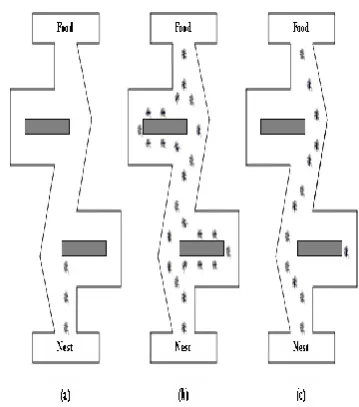
Ant Colony Optimization (ACO) is a paradigm for designing Meta heuristic algorithms for combinatorial optimization problems. The basic idea of the ant colony optimization (ACO) is taken from the food searching behavior of real ants. Ant agents can be divided into two sections: • FANT (Forward Ants) and BANT (Backward Ants) The main purpose of this subdivision of these agents is to allow the BANTs to utilize the useful information gathered by FANTs on their trip time from source to destination. Based on this principle, no node routing information updates are performed by FANT, whose only purpose in life is to report n/w delay conditions to BANT. When ants are on the way to search for food, they start from their nest and walk toward the food. When an ant reaches an intersection, it has to decide which branch to take next as shown in Figure 2. While walking, ants deposit pheromone, which marks the route taken. The concentration of pheromone on a certain path is an indication of its usage. With time the concentration of pheromone decreases due to diffusion effects. This property is important because it is integrating dynamic into the path Searching process.
Figure 2: Route discovery phase in Ant colony routing
[image:3.595.327.520.373.621.2]The following fig. 3 elaborates the Workflow of Basic Ant Colony Routing Algorithm as mentioned above in form of flowchart.
Figure 3: Flow chart of Ant colony optimization
4
3.3 Topsis Optimization
Every problem has number of alternative solutions hence decision making always remains an important issue while selecting the best solution among the alternatives. Apart from having different types of protocols, a common problem lies in the same that how effectively a best solution is to be found among the alternative solutions. So the researchers implemented different optimization techniques to solve the complex problems. The objective of all the above mentioned optimization techniques is the selection of cluster head but they do not consider the shortest path routing
.
3.3.1 Description of TOPSIS
The TOPSIS method is one of the most widely used MCDM methods. The basic principle of TOPSIS method is that the best alternative should have the shortest distance from the positive ideal solution and the farthest distance from the negative ideal solution. Figure 2 shows the flow chart of our method. The detailed description of the proposed method is as follows:
Step-1- Creating the matrix
n nodes with m attributes are represented in the form of a matrix as follows:
mn m m m n n n ix
x
x
x
x
x
x
x
x
x
x
x
x
x
x
x
D
...
...
...
...
3 2 1 3 33 32 31 2 23 22 21 1 13 12 11 ijx Represents the value of
j
thattribute for thei
th node, where{i=1,2,3 ... n},{j=1,2,3…m}.
Step -2 Normalize the decision matrix
The normalization of the decision matrix is done using the below transformation for each rij.
)
1
...(
...
...
1 2
n i ij ij ijx
x
r
Each Attribute in the matrix is assigned a weightwj
then the weights will be multiplied to normalized matrix.
ij j
ij w r
v * Where
)
2
...(
...
...
...
1
1
n j jw
Step -3 Determine the positive and negative ideal alternatives
The Positive ideal Solution and negative ideal Solution are defined according to weighted decision matrix as follows:
n v v v
A { 1 , 2... }
)
3
..(
}...
...
2
,
1
),
...
...
2
,
1
|
{(max
v
i
m
j
n
A
ij
Positive attribute: The one which has the best attribute
values (more is better) and
} ... ... ,
{ 1 2
n v v v A
)
4
..(
}...
...
2
,
1
),
...
,...
2
,
1
|
{(min
v
i
m
j
n
A
ij
Negative attribute: The one which has the worst attribute values (less is better).
Step-4 Obtain the separation measure (based on Euclidean distance) of the existing alternatives from ideal and negative one
2
1
)
(
j ij nj
v
v
S
i =
1, 2…m, j=1, 2…n ……… (5)
2
1
)
(
j ij nj
v
v
S
i
= 1, 2…m, j=1, 2…n ……… (6)
Step-5 Rank the alternatives
TOPSIS rank indices are estimated as:
i i i iS
S
S
CC
)
7
...(
...
1
0
CC
i
The TOPSIS algorithm is applied to select the best node to identify shortest path in the wireless sensor network from the node in outer ring to the sink. The procedure is repeated for locating the next more energy efficient node with shortest distance from the base station.
3.3.2 To find best cluster head using TOPSIS
optimization
5 criteria: Maximum Residual Energy, minimum
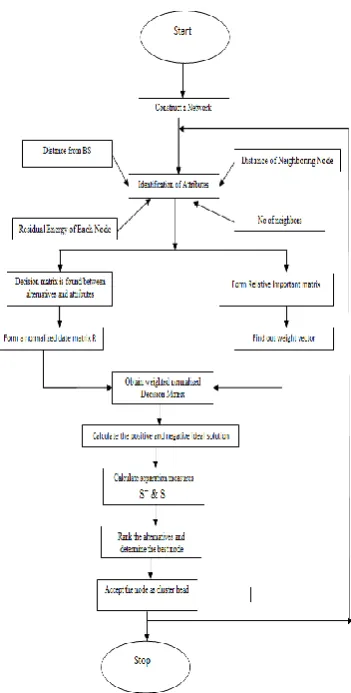
[image:5.595.106.282.287.634.2]Euclidean distance between mth selected node and next nth node in the transmission range, Minimum distance of the nodes in the next ring from the base station and number of neighboring nodes. This method by taking various criteria of nodes causes that the best node be selected as the CH. This choice toward the previous algorithms reduces the overhead associated with the CH. This method uses technique for Order Preference by Similarity to Ideal Solution (TOPSIS) in two levels, which caused the best value for each node in the WSN is selected. This method causes that the CH selection be done with higher accuracy, and the network lifetime increase significantly compared to the previous methods.
Figure 4: TOPSIS algorithm for cluster head
Selection
4. CONCLUSION
Cluster head is responsible to provide Communication Bridge between members and the base station. Ideal cluster head is one which is selected on multiple criteria. In this paper, effectively used optimization Techniques for Cluster Head Selection in Wireless Sensor Network is proposed. These algorithms select the CH with higher accuracy and the network lifetime
increase significantly compared to the previous methods. In these proposed algorithms it is further revealed that cluster head selection using optimization techniques selects better cluster head as compared to randomly selected cluster head Low-Energy Adaptive Cluster Hierarchy (LEACH) and results in better Network lifetime and Energy efficiency.
REFERENCES
[1] Guliashki, V.; Toshev, H.: Korsemov. (2009): Survey of evolutionary algorithms used in multiobjective optimization. Probl. Eng. Cybern. Robot, 60, pp. 42–54.
[2] Zitzler, E.; Laumanns, M.; Bleuler. (2004): A tutorial on evolutionary multiobjective optimization. n Metaheuristics for Multiobjective Optimisation; Springer: Berlin, Germany, pp. 3– 37.
[3] Marler, R.T.; Arora, J.S. (2004): Survey of multi-objective optimization methods for engineering. Struct. Multidiscip. Optim. 26, pp. 369–395. [4] Coello, C.A. (2000): An updated survey of
GA-based multi objective optimization techniques.ACM Comput. Surv., 32, pp.109–143. [5] Zhou, A.; Qu, B.Y.; Li, H.; Zhao, S.Z.; Suganthan,
P.N.; Zhang, Q (2011): Multi objective evolutionary algorithms: A survey of the state of the art. Swarm Evol. Comput., 1, pp.32–49.
[6] Coello (1999):A comprehensive survey of evolutionary-based multi objective optimization techniques. Knowl. Inf. Syst., 1, pp. 269–308. [7] Younis, M.; Akkaya, K. (2008): Strategies and
techniques for node placement in wireless sensor networks: A survey. Ad Hoc Netw, 6, pp.621–655. [8] Kulkarni, R.V.; Venayaga moorthy, G.K. (2011):
Particle swarm optimization in wireless-sensor networks .A brief survey. IEEE Trans. Syst. Man Cybern. Part C Appl. Rev., 41, pp. 262– 267. [9] Rault, T.; Bouabdallah, A.; Challal, Y. (2014):
Energy efficiency in wireless sensor networks: A top- down survey. Comput. Netw., 67, pp. 104– 122.
[10] Martins, F.V.; Carrano, E.G.; Wanner, E.F.; Takahashi, R.H.; Mateus, G.R. (2011): A hybrid Multi objective evolutionary approach for improving the performance of wireless sensor networks. IEEE Sens. J. 11, pp. 545–554.