www.ijiset.com
596
Secure Data Transmission Through Relay Node in Wireless
Sensor Network (WSN).
Ravi Shankar H S *, Mr. Ramakrishna Prasad A L**
* Student M.Tech, Dept. of CSE Visvesvaraya Institute of Advanced Technology, Bengaluru, India. **Asst. Professor M.Tech, Dept. of MCA, Visvesvaraya Technological University (VTU), Bengaluru, India.
Abstract
— Energy savings optimization becomes one of the major concerns in the wireless sensor network (WSN) routing protocol design, due to the fact that most sensor nodes are equipped with the limited nonrechargeable battery power. this paper focus on minimizing energy consumption, maximizing network lifetime and provied security for data tramission. principle of opportunistic routing theory, relay decision to optimize the network energy efficiency is made based on the differences among sensor nodes, in terms of both their distance to sink and the residual energy of each other. In this paper we use a energy saving– Opportunistic routing (ENS-OR) algorithm which can’t give any security for the data, so this paper proposes a security for the data while transmitting.Keywords- Energy Efficiency ,Opportunistic Routing, Relay Node, Residual Energy, Key Based Security, Wireless Sensor Network (WSN).
I. INTRODUCTION
Wireless sensor network provide a more number of application in different areas such as health care monitoring, traffic control monitoring, area monitoring, environmental monitoring. The efficient wireless communication and improvement in electronics has make possible to the development of cost, low-power and multifunctional wireless sensor nodes. In WSNs, thousands of sensor nodes distributed, it is very difficult to replace the energy via batteries. The main task of sensor node is to collecting and transmitting the data. It is known that transmitting data consume more energy than collecting data. To achieve energy efficiency in transmitting data, most of existing routing protocols try to find out the minimum energy path between a source node and a sink node to achieve energy efficiency.
The task of design an energy efficient routing protocols, in case of wireless sensor network is complex, since it involve not only find the minimizing energy path from source node to destination ,it also balancing the residual
energy of the complete network. In addition, the unreliable links and network division in wireless sensor network causes packet loss and more number of retransmission in preselected path. Therefore, it is necessity making an suitable trade-off between minimizing energy consumption and maximize network lifetime.
Energy saving optimization is one of the important concepts in wireless sensor network, most sensor node having non rechargeable battery power. This project focusing to minimize energy consumption also, amplify the life time of the entire network. Principle of opportunistic routing theory is selection of relay node to improve the energy efficiency among all sensor nodes in the network, in terms of distance between the source to sink and residual energy among all the nodes. Energy saving via opportunistic routing algorithms is creating to minimize power cost and protect the nodes against low residual energy.
Energy saving via opportunistic routing adopts a new concept called energy equivalent node which selecting relay nodes based on opportunistic routing theory, Since sensor nodes are generally static, every sensor's special data , for example, the separation of the sensor hub to the source and the lingering vitality of every hub. Are critical to decide the ideal transmission separate in this manner, it is important to consider these variables together for opportunistic routing decision. ENS_OR chooses a forwarder set and sorts out centers in it, as showed by their virtual perfect transmission separation and residual energy level.
2. RELATED WORK
www.ijiset.com
597
paper is as per the following: The sender hub basically shows the parcel alongside its own particular area and destination area. All the listening hub in the neighbor will get the parcel and in view of the own separation from the destination, they organize themselves to go about as transfer hub. The transferred bundle is then sent to a TV location which likewise contains the transmitter and last destination area in this manner giving a geographic course without keeping up directing table.
Consequently this paper portrays the sending approach in view of the geographic area and the arbitrary choice of the hand-off hub through the dispute at the beneficiary side. The investigation of the multihop execution is done as far as the quantity of jumps to reach to the destination as a component of separation and the quantity of hubs in the neighbor hubs.
Biswas and Morris [2] propose the principal most essential convention which for all intents and purposes executed the Opportunistic Routing in the remote systems. ExOR utilizes bunches to send the bundles. The source hub gathers the parcels which are expected to the same destination and gatherings them into a group. Every cluster has its own particular Batch ID. The source hub picks the Batch ID and the forwarder rundown organized in view of the ETX metrics3 : shorter the separation of hub from target hub higher the need. Just the hubs having higher need are incorporated into the forwarder rundown. Every hub in the forwarder rundown keeps up a neighborhood cluster map. The hub includes the parcel into the bundle cradle for the comparing bunch. The hub looks at the passage for every clump map in the parcel with comparing section in the nearby bunch map and if the higher need passage is distinguished, it replaces the section in the neighborhood cluster map. ExOR executes planned transmission of parcels to guarantee that one and only hub sends the bundle at one time.
ExOR accomplishes higher throughput than the conventional steering yet it has taking after downsides. 1.ExOR doesn't react to the no overhauled estimations. It just considers the data accessible at the season of transmission. Along these lines, the off base estimations may corrupt its execution furthermore may bring about bundle duplication. 2. It generally looks for the coordination among every one of the hubs which causes overhead if there should arise an occurrence of extensive system. It doesn't reuse the data.
Yanhua,Wei Chen, and Zhi-Li Zhang [3] proposes MTS calculation for selecting sending list which minimizes the normal transmission rate under the perfect ACK condition. The supposition made here is that the low need hubs can simply here the show of the high need hub hence there will be no copy transmission of bundles. Under this supposition the creator proposes the
Minimum Transmission Scheme calculation, which registers the ideal sending list. While utilizing this calculation as a part of ExOR2 rather than the ETX3 , the MTS based ExOR gives less transmissions than that of the ETX based ExOR. Hence the throughput of the MTS based ExOR is superior to that of the ETX based ExOR. However in certain situations when the ideal ACK condition is not fulfilled, the ETX based ExOR performs well than the MTS based ExOR.
Goo Yeon Lee and Zygmunt J. Haas[4] proposes the powerful artful directing plan for short pull multi-jump remote systems. This changed Opportunistic directing calculation executes the plan of sending the ACK in the wake of getting parcel. In this calculation the main the destination can shrewdly get the parcel by catching the transmission of the hubs in the conventional systems. After the destination hub gets the parcel from the priori hub it sends the ACK to the various hubs in the way. The hub will just retransmit the bundle on the off chance that it didn't get the parcel from either destination or next hub in the way. Consequently, the destination hub can without much of a stretch dispose of any copy bundles. Subsequently this calculation diminishes the parcel duplication rate. Additionally it builds the throughput than that of other entrepreneurial calculations. It is straightforward and can be incorporated with the other Opportunistic calculation. Shih-Chun Lin and Kwang-Cheng[5] Chen proposes the SAOR i.e. Range Aware Opportunistic Routing for Cognitive Radio Network (CRN). The calculation proposed by the creators utilizes the ideal connection transmission (OLT) as a cost metric for organizing the hubs in the sent rundown. The OLT metric is considered in the deferral perspective. Two more measurements specifically ideal way metric and hub measurements further expounds the quantity of jumps in the way and the deferral status inside every way separately to the destination.
Due these measurements SAOR gives QoS ensures like better throughput and enhanced end to end delay exhibitions than the conventional directing calculations for CN.
www.ijiset.com
598
transmission and getting information. the normal size of the sending rundown of the EEOR is a great deal not as much as that of the ExOR. If there should be an occurrence of the aggregate vitality utilization, EEOR performs superior to anything EXOR. Contrasting both the conventions for the bundle misfortune rate and end to end delay EEOR performs superior to anything ExOR.
Angela Sara Cacciapuoti, Marcello Caleffi and Luigi Paura[7] proposes the general system to demonstrate artful directing. It considers conveyance proportions and the need request among the hubs to choose the following bounce for the bundle sending. It concentrates on giving a shut structure expression for normal transmission number. This model investigates the execution parameters, for example, bundle dropping rate, parcel transmission number, end to end bundle delay and so on.
3.PROPOSEDSOLUTION
In the proposed system, Opportunistic Routing Algorithm fined the relay node path based on the residual energy and distance between the nodes. In proposed solution ,1P
st
P
based on distance path will select from source node to the destination node by calculating distance between the source node and neighbors nodes using a Euclidian distance formula. Among all neighbors node which node having less distance that node is chosen for further relay node selection. This process continues up to the sink node. Once distance based path find, source node sends a hello packet to the all selected nodes. Next based on residual energy path will select, once based on residual energy path will select , source node sends a hello packet to the all selected nodes
.
Using ENS_OR Algorithm relay nodes is selected, ENS_OR Algorithm find the relay node based on priority between distance based path and residual energy based path which one get a highest priority that node selected as a relay node.
Once relay nodes are selected, source node send a request packet to the all the selected relay node. This request packet contains key values. Source node generates key values for the all selected relay node. These key values randomly generated, for each time data transmission these key values are get changed. If and only if selected node having key values then only data will transfer otherwise data will drop. This way we provide the security for the data transmission. This
proposed solution prevents the data from the hacker.
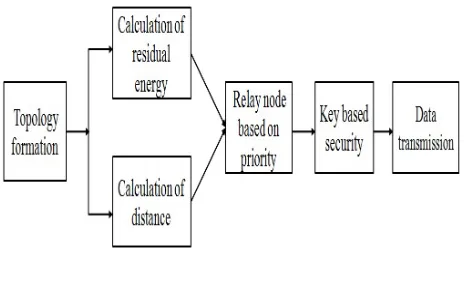
Fig 3.1 System Architecture Proposed solution contains following 4 modules
A . Node initialization --- Topology formation
This include node configuration, topology formation , and environmental setting .
B. Selection of Source and Destination --- Distance Calculation
Before transmitting the data need to choose the source and destination node. Source node is one that ready to send the data. Destination node is nothing but a node that receives the data from the source. In our project before transmitting the data we have to choose the best optimized path by selecting the relay node among the whole network, for selection of relay node, first we have to calculate the distance between the source node distance nodes by calculating the distance between the neighbor nodes based on the Euclidean distance formula.
To calculate distance:
D(n, m) =
�
(n1
−
m1)
2+ (n2
−
m2)
2Where, n and m are two neighbor nodes, d(n,m) is distance between the nodes, n1 and n2 are the x and y ordinates respectively,m1 and m2 are the x and y co-ordinates respectively.
C .Residual Energy Calculation —Find path
www.ijiset.com
599
highest-priority. priority is energy saving– Opportunistic routing (ENS-OR) algorithm. That path is the best path for transmitting the data. The below formula is used to calculate the residual energy of the nodes
To calculate residual energy:
E
Remaining (n)=
E
total(n)- (
E
s(n)+
E
r(n))
Where, ERemaining (n)is residual energy of the node n
, Etotal(n) is initial energy of the node before
transmitting, Es(n)is the amount of energy consumed by node n to send all outgoing packet . Er(n)is the amount of energy consumed by node n to receive all incoming packet.
D. Providing security while data transmission
Once we find the best and optimized path between the sources and sink node based on the relay node we have to provide security for our data to prevent hacking from hacker’s node. For to provide the security we have to send a request packet from source node to destination by assigning the key values for all selected relay node. these key values are generated using random number generating algorithm. So that hacker’s not possible to hack the data because request packet contains the key value. Once we done all above procedure source node sends a data to the destination , once the destination node receive a data it send a ACK message to the source node .
Algorithm
1. Node Initialization.
2. Selection of source and sink node 3. Distance calculation
4. Hello packet transmission 5. Residual energy calculation 6. Check the priority
7. If lower priority 8. Data will drop 9. If high priority 10. Selected as relay node 11. Generate a key values
12. Send request packet containing key values 13. Start transmitting the data
14. If key values matched 15. Send data
16. Else data drop 17. END
18.
4. SIMULATION
A. Simulation Platform
For Evaluating and analyzing the performance of selecting the relay nodes using Opportunistic Routing Algorithm NS2 simulator is used. NS2 is application level simulator. NS2 uses c ++ libraries as backend and OTCI interpreter as a front-end. NS2 can simulate both types of networks wired and wireless andNS2 can simulate various types of communication protocol like UDP, TCP and multicast routing.
B. Performance Parameters
Three Different parameters are used to analyzing the performance of selecting the relay nodes using Opportunistic Routing Algorithm protocols are as follow:
• Packet Delivery Ratio (PDR): It defines Ratio Between number of packet sent from source to destination and number of packet actually received at destination.
PDR = (Total number of packet sent by source /number of packet received by destination).
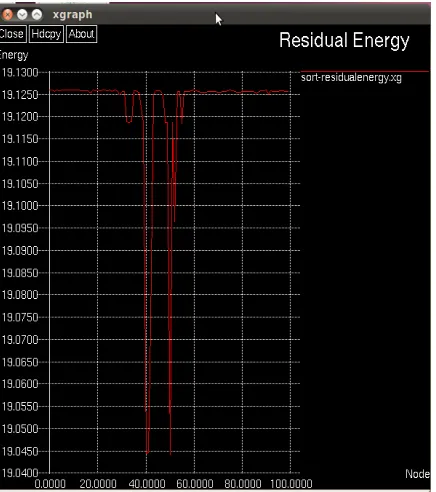
• Residual energy: residual energy defines the number of nodes having high residual energy over the whole network.
• Throughput: Throughput defines the rate of successful packet delivery over a communication channel.
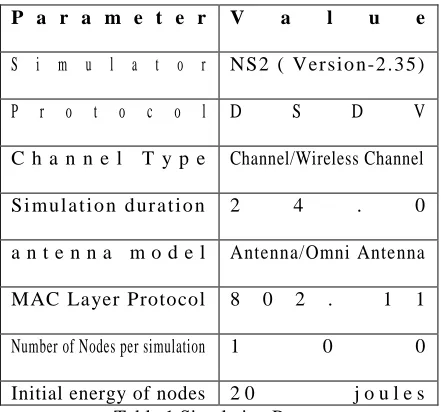
P a r a m e t e r V a l u e
S i m u l a t o r NS2 ( Versio n-2 .3 5 )
P r o t o c o l D S D V
C h a n n e l T y p e Channel/Wireless Channel
S i mu l a t i o n d u r a t i o n 2 4 . 0
a n t e n n a m o d e l Antenna/Omni Antenna
MAC Layer Protocol 8 0 2 . 1 1
Number of Nodes per simulation 1 0 0
www.ijiset.com
600
5. RESULTS AND ANALYSIS
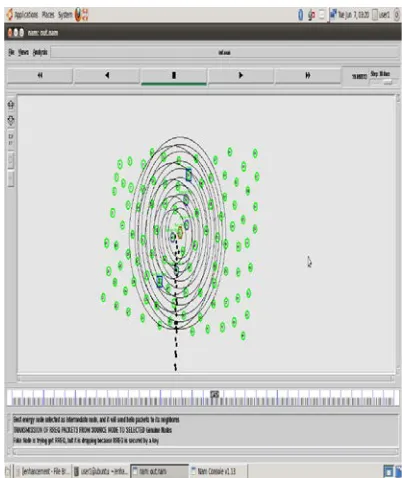
A. Selecting the nodes based on distance and residual energy
Fig5.1 selecting the nodes based on residual energy
B. Transmission of REQ packets
Fig 5.2 transmission of REQ packets
C. facke node is dropping because REQ packets contines key.
Fig5.3 facke node is dropping because REQ packets contines key.
RESULT GRAPHS
A .Throughput
www.ijiset.com
601
B. packet-Delivery-Ratio
Fig 5.5 graph plotted against time v/s PDR. C. Residual Energy
Fig 5.6 graph plotted against Node v/s Energy
6. CONCLUSION
In this paper focus on minimizing energy consumption, maximizing network lifetime and provide a security. Opportunistic routing theory to optimize the network energy efficiency by considering the inferences among sensor nodes in terms of both their distance to sink and residual energy of each other. Hence, main objective is to design an energy-efficient opportunistic routing strategy that ensures minimum power is cost and protects the nodes with relatively low residual energy. Simulation results show that the proposed solution makes significant improvements in energy saving ,security and network partition as compared with other existing system
ACKNOWLEDGMENT
I thank to my guide Mr. Ramakrishna Prasad A L Professor, Dept. of MCA, VTU-CPGS, Bangalore Region, VIAT, Muddenahalli, for his valuable guidance throughout this research work.
REFERENCES
[1]. M. Zorzi and R.R. Rao, “Geographic Random Forwarding (GeRaF) for Ad Hoc and Sensor Networks: Energy and Latency Performance,”IEEE Trans. Mobile Computing, vol. 2, no. 4, Oct.-Dec. 2003.
[2]. S. Biswas and R. Morris, “ExOR: Opportunistic multi-hop routing for wireless networks,” in Assoc. Comput. Mach. SIGCOMM Comput. Commun. Rev., 2005, vol. 35, no. 4, pp. 133–144.
[3]. Yanhua Li , Wei Chen, and Zhi-Li Zhang,” Optimal Forwarder List Selection in Opportunistic Routing” Mobile Ad hoc and Sensor Systems. IEEE 6th international conference..
[4]. Goo Yeon Lee and Zygmunt J. Haas,”Simple, Practical, and Effective Opportunistic Routing for Short-Haul Multi-Hop Wireless Networks”, IEEE Transaction on Wireless Communication, VOL. 10, NO. 11, Nov 2011.
[5]. Shih-Chun Lin and Kwang-Cheng Chen”Spectrum Aware Opportunistic Routing in Cognitive Radio Networks”. IEEE Globecom 2010 proceedings.
www.ijiset.com
602
[7]. Angela Sara Cacciapuoti, Marcello Caleffi and Luigi Paura “A theoretical model for opportunistic routing
in ad hoc networks”Ultra Modern Telecommunications & Workshops, 2009. ICUMT '09.
[8] P. Piret, “On the connectivity of radio networks,” IEEE Trans. Inf. Theory, vol. 37, no. 5, pp. 1490–1492, Sep. 1991.
[9] P. Santi and D. M. Blough, “The critical transmitting range for connectivityin sparse wireless ad hoc networks,” IEEE Trans. Mobile Comput., vol. 2, no. 1, pp. 25–39, Jan./Mar. 2003.
[10] V. Ramaiyan, A. Kumar, and E. Altman, “Optimal hop distance and power control for a single cell, dense, ad hoc wireless network,” IEEETrans. Mobile Comput., vol. 11, no. 11, pp. 1601–1612, Nov. 2012.
[11] S. Dulman, M. Rossi, P. Havinga, and M. Zorzi, “On the hop count statistics for randomly deployed wireless sensor networks,” Int. J. Sensor Netw., vol. 1, no. 1, pp. 89–102, 2006.
[12] Y. Keshtkarjahromi, R. Ansari, and A. Khokhar, “Energy efficient decentralized detection based Wireless Days (WD), 2013, pp. 1–8.
[13] H. Liu, B. Zhang, H. T. Mouftah, X. Shen, and J. Ma, “Opportunistic routing for wireless ad hoc and sensor networks: Present and future directions,” IEEE Commun. Mag., vol. 47, no. 12, pp. 103–109, Dec. 2009.
[14]