Improved Load Balanced & Energy Efficient
Ad hoc on demand routing Algorithm
Madhvi Saxena Student, Dept. of CEA
NITTTR Bhopal Bhopal, India
K.J. Mathai Associate Prof., Dept. of CEA
NITTTR Bhopal Bhopal, India
Abstract - With increasing deployment of unmanned and energy-constrained sensor devices in large-scale mobile ad hoc networks; the aspect of an energy efficient network lifetime have become the key consideration in designing ad hoc routing protocols. Routing protocols are required in network todeliver packets from source to destination. The multipath routing provides the concept of load balancing for efficient data transfer. In this paper, an improved routing algorithm is proposed for Mobile Ad hoc Network; modifying the existing ad hoc on demand distance vector routing (AODV) by calculating the load on different routes based on the parameters like minimum hop count, remaining energy in nodes and node mobility. To effectively use the energy of the network path and sharing the load on multipath, the concept of ‘first come first serve’ is proposed to be implemented.
Keywords – Mobile ad hoc network, routing protocol, Ad hoc on demand distance vector routing (AODV) , multipath routing, load balancing
I. INTRODUCTION
Wireless network is becoming popular day by day. There are two types of wireless networks- infrastructure network and infrastructure less networks. When communications among terminals or nodes are established and maintained through central controllers also known as
base stations, then this type of network comes under
infrastructure network and when no central station is present it known as mobile ad hoc network, where terminals are capable of establishing connections by themselves and are able to communicate with other nodes in a multi-hop manner without any fixed infrastructures. This infrastructure less property helps the ad hoc network, to get quickly deployed in a given area and to provide robust operation [1]. The mobile nodes of which can change their locations and topology of the network frequently and in unpredictable manner over time [2]. The network is localized, where all activities such as discovering the topology of a network and message delivery are performed by the nodes themselves, i.e., devices act as both hosts and routers [3]. In recent years, mobile ad hoc network has found its applications in the areas of Environment Monitoring and Forecasting, Health and Medical Care, Underwater Communications, Smart Energy, and Building and Home Automation industries. But the mobile nature of Ad hoc network posses many issues as challenges such as Lack of centralized management, Resource availability, Dynamic topology, Limited power supply, Bandwidth constraint etc. These challenges have generated great interests within the
research community and many new algorithms and protocols have therefore been proposed [4]. According to routing strategy, routing protocols in mobile ad hoc network can generally be classified in three main categories-
• Table driven/Proactive routing protocol (Optimized
Link State Routing (OLSR), Destination-Sequenced
Distance-Vector Routing (DSDV)
• On demand/Reactive routing protocol (ad hoc on
demand distance vector (AODV) routing, Dynamic Sequence Routing (DSR)
• Hybrid routing protocol (Zone routing Protocol (ZRP)
The performance comparison of these protocols reveals that on demand routing protocols performs better than the proactive and hybrid routing protocols due to reduction in memory consumption and low control overhead. Moreover, proactive and hybrid schemes do not perform well in dynamic topologies due to periodically maintain the routes. AODV [6] is a well-known on-demand protocol. Although it outperforms many other routing protocols, it is a single path routing, which needs discovery of new route whenever a path breaks. To overcome such inefficiency, several research studies [7], [8], [9], [10] have been done to compute multiple paths. If the first feasible path breaks, then for it these studies provide an alternative path to send data packets but without searching for an energy efficient load balanced route. This paper proposes the effective use the energy of the network path and sharing of network load on multipath, using the concept of ‘first come first serve’. This paper is organized as follows: In Section II, related work is overviewed. Section III describes the improved AODV. Section IV, presents the proposed scheme and Section V presents conclusion.
II. RELETED WORK
A. Multipath based protocol
Multipath based protocols selects number of all possible paths to the destination and split the load and transmits to the destination, but while in the single path it will identify the smallest path and alternate paths also but use only one path at a session to transmit the data, if any failure occurs it will choose the alternate path [14]. The multipath based protocols are classified into three categories -
• Disjoint path
• Braided path
• N-to-1 multipath Discovery
B. Shortest Multipath Labeled Distance Routing
SMLDR discovers multiple loop free paths to the
destination and employs LDR asthe underlying single path
routing protocol. SMLDK differs from LDK in the route
reset mechanism aswell. In SMLDK a new distance metric
termed limiting distance is introduced which the minimum distance to the destination is known at each node in the network. This concept provides a filtering technique to select shortest multipath for data forwarding. SMLDR uses alternate path routing and does not maintain disjoint paths [15].
C. Load Balancing
Load balancing is a method to distribute workload across multiple paths, to maximize throughput, packet delivery ratio (PDR), minimize end-to-end delay, and reduce routing overhead. Most of the existing routing protocols that do not have multi path from source to destination balance their load by just transferring the packets from the overloaded nodes to other unloaded nodes or idle nodes, which results in routing delay. In order to determine the quality of path before conveying load, the existing Ad hoc protocols can’t predict whether the nodes in that path are overloaded or not during route discovery phase. Hence, these protocols can’t balance the load on different routes [16]. The proactive protocols such as DSDV and reactive protocols such as DSR and AODV choose the path which has smallest number of hops from source to destination. The Load Balancing algorithms that consider traffic load as the parameter to choose a route to destination, results in more traffic or congestion. In order to achieve good communication and to make the routing protocols more efficient even in presence of node movement, there may be need of Route maintenance and Bandwidth reservation. Multipath routing can be a very good solution to reduce congestion in the network, thereby increasing packet delivery ratio, reducing average end-to-end delay and routing overhead. In multipath routing, even if one path drop, packet can still be routed through another alternative route without rediscovering new paths. The major issues with these load balancing algorithms are like node pick up, high remaining energy, etc [17].
D. Energy Aware Routing
Most commonly used ad hoc routing protocols such as Destinations Sequenced Distance Vector (DSDV), Ad hoc On Demand Distance Vector (AODV) and DSR use hop count metric for route selection, which does not take into account of energy cost for utilizing a particular link. As many ad hoc devices are energy constrained, energy
consumption has become a key consideration when evaluating routing protocols. Proposals have been made by incorporating energy cost for individual links. A metric based on minimum transmission energy is proposed in [18]; in [19], an effective total transmission energy metric that takes into consideration of link reliability and retransmission is presented; and a more accurate energy model that accounts for total energy consumption of data packets, control packets and retransmissions is described in [20]. Energy efficiency in these variations of energy aware routing protocols has improved [21].
E. Maximum lifetime routing
There is another class of routing algorithms that aims to maximize network lifetime. This needs linear programming model. Linear programming model is a centralized algorithm which requires full network information, including sequence of flows ahead of time which is not possible in real networks[22]. However, the implementation and interaction of the algorithm with routing protocols has not been done Conditional Max-Min Battery Capacity Routing (CMMBCR) algorithm, using a different combination of power consumption and node residual power, is proposed in [23]. Selection of route in this scheme is conditioned on the minimum battery capacity of the nodes along the paths between a source and a destination. A path with minimum total transmission power is selected if routes with the minimum battery capacity above a threshold value exist; otherwise, a path with maximum battery capacity will be selected.
F. On Demand ad hoc routing
AODV is an improvement on DSDV (Destination Sequenced Distance Vector)[24] because it typically minimizes the number of required broadcasts by creating routes on an on-demand basis, as refuse to maintaining a total list of routes as in the DSDV algorithm. When source wants to send a data packet to some destination and does not have a direct route to that destination, it starts a path discovery process to discover the destination. It broadcasts a RREQ (route request) packet to its neighbor nodes; if destination node is not present then these nodes forward the request to their neighbors, and so on, until the destination is reachable. During the process of forwarding the RREQ, intermediate nodes record in their route tables the addresses of neighbors from which the RREQ was received, thereby establishing a reverse path. When the RREQ has reached the destination or an intermediate node with a “fresh enough” route, the destination/ intermediate node responds by unicasing a RREP (route reply) packet back to the neighbor from which it first received the RREQ. As the RREP is routed back along the reverse path, nodes along this path set up forward route entries in their route tables that point to the node from which the RREP came. Then, the source node can send its packets to the destination via the established path.
III. IMPROVED AODV FOR MULTIPATH
neighboring nodes that send the RREQ message. And when RREQ a message reaches to the destination node, a Forward path is generated. When the RREQ message arrives at its destination node, a RREP Message is transmitted through the created Reverse Path for the construction of a Forward Path. In the proposed modified AODV routing protocol, the load is distributed uniformly by using the information available in the network. The main goal is to select a routing path that consists of nodes with higher remaining energy and hence longer life span in order to reduce routing overhead and also reduce the average end-to-end delay by routing the packets over the path which is less utilized.
The routing process involved in any routing protocol is mainly classified into three main divisions:
• Route Discovery
• Route Selection
• Route Maintenance
The Route Discovery and Route Selection processes are modified for effectively implementing the load balancing features in our modified AODV routing protocol.
A. Route Discovery
The route discovery procedure in modified
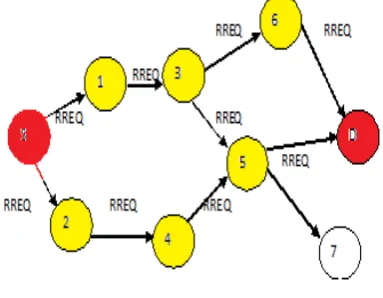
AODV is similar to that of Ad hoc On-demand Distance Vector (AODV) routing protocol. Whenever a node wants to send data packets to other nodes, it first determines whether there is any route available to that destined node in its routing table. If there is no route establish between source and destination, it starts the route discovery process by broadcasting Route Request (RREQ) packets to all the neighboring nodes. (ref.fig.1)
Fig. 1 Route Request in AODV
Then the intermediate node checks whether there is any reverse route to the requesting node. If there is no reverse route, then the intermediate nodes update the reverse route in their routing table. The intermediate nodes verify the destination IP address field in the Route Request packets with their own IP and if the IP address matches, then that particular intermediate node is the destination node for which a route is required by the source node to send data packets. The destination node then sends the Route Reply Packets (RREP) in the same reverse route. Normally, in AODV the RREP packet contains information like HOP Count, Sequence number but in the proposed modified AODV to distribute the traffic load uniformly, the author
have added two more information and they are Route Energy and Stability (node mobility) in the route path. Initially the destination node adds its remaining energy in the Route Reply (RREP) packet and forwards the RREP to the intermediate node
B. Route Selection
The route selecting parameters used in the modified AODV are defined as follows:
1. Minimum Hop count:
There are many intermediate nodes possible between source and destination, which route has minimum number of hop count or nodes between sources to destination select that path as a best path (ref fig.2)
Fig. 2 Hop Count in AODV Route 1: S-1-2-3-4-D (4 hop count) (3 preferable) Route 2: S-5-6-D (2 hop count) (1 preferable path) Route 3: S-7-8-9-D (3 hop count) (2 preferable path)
2. Route Energy:
The Route Energy is the sum of energy possessed by nodes falling on a route from destination to source node. If route energy is high, then the probability of route failure due to exhausted nodes will be less (ref fig.3).
Fig. 3 Route energy
Route 1: 233J (1 preferable path) Route 2: 131J (3 preferable path) Route 3: 219J (2 preferable path)
3. Stability:
The route has low rate of nodes mobility, if the mobility of nodes is less than the stability of route is higher.
C. Route Maintenance
In MANET, mobility of nodes is very high and
hence link failure is a common phenomenon since mobile
nodes moves out of its transmission range. Whenever link
failure isdepicted by an intermediate node, it broadcasts a
Route Error (RERR) packet to other mobile nodes. When
the source node receives the route error (RERR) packet, it
IV. ROUTE SELECTION CASES
1. Directly connected path
For direct source-destination connected path P (ref fig.4),there is no intermediate node. Provision is made in the algorithm to select the direct path since direct path is the shortest path, if direct path is not available then move on the second condition.
Fig. 4 Direct path
2. Equal hop count path
In this case, if hop count of path (S-1-2-D) and (S-3 4-D) is same (ref fig-5) then it goes for the maximum energy of a path.
Fig. 5 Same Number Of Hop Count
3. Equal energy paths
In this case, if the energy of more than one path is same (ref fig.6). Then consider the next parameter ‘stability’ for selecting the route as stated below.
Fig. 6 Same Energy Level
4. Stability
It’s a very important parameter in mobile ad hoc network, because due to the nature of mobility topology of network frequently change, it’s a very crucial issue for path drop i.e. in this case choose that path which has high stability rate and minimum path drop out ratio.
V. LOAD BALANCING
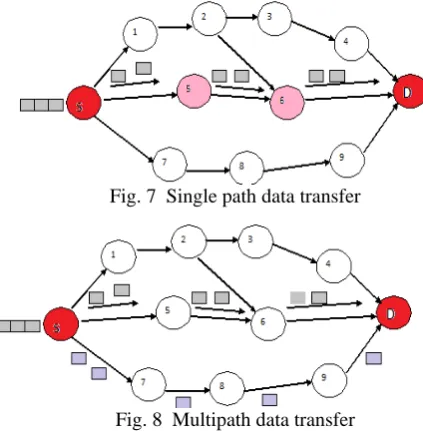
After the selection of multipath the important question is how to distribute the load to the different paths. In this proposed concept load is balanced with the help of First Come First Serve technique. In this proposed work; initially choose the best path with the help of route selection and transfer data packet on that path (ref fig.7). When load or data packet increases in this path and average end to end delay is increases or throughput is decreased then check the conjunction value of that path. If conjunction comes near to the threshold value then multipath technique of AODV is used (ref fig.8). It means that data packets are transferred on more than one selected
path with the help of First Come First Serve technique. It means that the packet which comes first in the queue should be transferred on the first best path, and when conjunction in the route comes then data packets should be transferred on another selected path. With this load balancing technique we can easily share load on different paths on the basis of their sequence number or in the position of waiting queue.
Fig. 7 Single path data transfer
Fig. 8 Multipath data transfer
VI. CONCLUSION
In this paper, we have addressed the problem of energy efficiency in mobile ad hoc networks caused by unbalanced distribution of data traffic. The authors have proposed a multipath Energy-balanced on demand routing with the help of systematic load sharing on selected energy efficient and more stable paths on the network, which may improve the performance of on demand routing as well as network lifetime.
REFERENCES
[1] Shivshankar et al. “designing Energy routing protocol with power consumption optimization in manet” IEEE Transactions.
[2] Mrinal Kanti Deb Barma et.al. “Enhancing the Performance of AODV using Node Remaining Energy and Aggregate Interface Queue Length”2013.
[3] YuHua Yuan,et al.”An Adaptive Load-balancing Approach for Ad Hoc Networks” (IEEE 2005).
[4] Kuching, Sarawak, Kok-Poh Ng et al. “Energy-Balanced Dynamic Source Routing Protocol for Wireless Sensor Network” IEEE Conference on Wireless Sensors (ICWiSe2013).
[5] Nidhi s kulkarni et al. “On demand routing protocols for mobile ad hoc network: a review” 2009 IEEE international advance computing conference.
[6] Perkins, C., Belding-Royer, E., and Das, S., “Ad hoc On-Demand Distance Vector (AODV) Routing,” rfc3561.txt (2003).
[7] Fatiha Djemili, “A mixed approach load balancing and efficient energy for multi path routing in mobile ad hoc networks” (IEEE 2013).
[8] Jin seok yang et al, “Power aware multi path routing protocol for a wireless ad hoc network” (IEEE 2008).
[9] Zhimu Huang et al, “A multipath energy efficient probability routing protocol in ad hoc networks” (ICACT 2014).
[10] Jawade Nilima R et al, “QOS improvement by load balancing using nodal and neighboring load in multipath routing” (NCIPET- 2012) [11] Higaki, H. and Umeshima, S., “Multiple-Route Ad hoc On-Demand
Internation Parallel and Distributed Processing Symposium (IPDPS’ 04).
[12] Pham, P. and Perreau, S., “Multi-Path Routing Protocol with Load Balancing Policy in Mobile Ad Hoc Routing,” IEEE, pp. 48-52 (2002).
[13] Zhang, L. F., and etc, “Load Balancing of Multipath Source Routing in Ad Hoc Networks,” IEEE, pp. 3197-3201 (2002).
[14] S.P. Y amunadevi “Efficient Comparison of Multipath Routing Protocols in WSN” 2012 International Conference on Computing, Electronics and Electrical Technologies [ICCEET]
[15] Chandramouli Balasubramanian “Shortest Multipath Routing Using Labeled Distances” 2004 IEEE International Conference on Mobile Ad-hoc and Sensor Systems
[16] Hassanein, and A. Zhou, “Load-aware Destination- controlled Routing for MANETs” , Elsevier Computer Communications, pp. 1551-1559, 26(2003).
[17] Mrinal Kanti Deb Barma “Enhancing the Performance of AODV using Node Remaining Energy and Aggregate Interface Queue Length” 2013 International Symposium on Computational and Business Intelligence.
[18] S. Doshi, S. Bhandare, and T. X. Brown, “An on-demand minimum energy routing protocol for a wireless ad hoc network,” SIGMOBILE
[19] Mob. Comput. Commun. Rev., vol. 6, no. 3, pp. 50–66, Jun. 2002. [20] S. Banerjee and A. Misra, “Minimum energy paths for reliable
communication in multi-hop wireless networks,” in Proceedings of the 3rd ACM international symposium on Mobile ad hoc networking & computing, New York, NY, USA, 2002, pp. 146–156.
[21] J. Zhu, C. Qiao, and X. Wang, “On Accurate Energy Consumption Models for Wireless Ad Hoc Networks,” Trans. Wireless. Comm., vol.5, 2006.
[22] Kok-Poh Ng,et.al,” Energy-Balanced Dynamic Source Routing Protocol for Wireless Sensor Network” 2013 IEEE Conference on Wireless Sensors (ICWiSe2013).
[23] J.-H. Chang and L. Tassiulas, “Routing for Maximum System Lifetime in Wireless Ad-hoc Networks,” in 37th Annual Allerton Conference on Communication, Control, And Computing, 1999 [24] C.-K. Toh, “Maximum Battery Life Routing to Support Ubiquitous
Mobile Computing in Wireless Ad Hoc Networks,” IEEE Communications Magazine, Jun-2001.