Proving Correctness and Security of Two-Party Computation
Implemented in Java in Presence of a Semi-Honest Sender
?Florian B¨ohl1, Simon Greiner1, and Patrik Scheidecker2 1
[email protected] Karlsruhe Institute of Technology Institute of Theoretical Informatics
2
FZI Research Center for Information Technology
Abstract. We provide a proof of correctness and security of a two-party-computation protocol based on garbled circuits and oblivious transfer in the presence of a semi-honest sender. To achieve this we are the first to combine a machine-assisted proof of correctness with advanced cryptographic primitives to prove security properties of Java code. The machine-assisted part of the proof is conducted with KeY, an interactive theorem prover.
The proof includes a correctness result for the construction and evaluation of garbled circuits. This is particularly interesting since checking such an implementation by hand would be very tedious and error-prone. Although we stick to the secure two-party-computation of ann-bit AND in this paper, our approach is modular, and we explain how our techniques can be applied to other functions.
To prove the security of the protocol for an honest-but-curious sender and an honest receiver, we use the framework presented by K¨usters et al. for the cryptographic verification of Java programs. As part of our work, we add oblivious transfer to the set of cryptographic primitives supported by the framework. This is a general contribution beyond our results for concrete Java code.
1
Introduction
Motivation and overview Protocols for secure two-party computation allow two parties to evaluate a function f such that both parties provide a part of the input. Neither of the parties must learn more about the input of the other than can be inferred by its own input, the functionf and the computed output. Since first solutions for two-party computation protocols have been presented by Yao [33, 34], the problem has received a lot of attention (e.g., [12, 7, 23, 24, 27]).
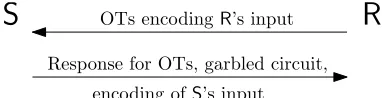
Yao’s approach Following the initial ideas of Yao, one can construct a two-party computation protocol from garbled circuits [33, 34] and oblivious transfer [30] (see Figure 1). The basic idea is to first encode the function f as a circuit consisting of gates and wires. Such a circuit can then be transformed into a garbled circuit by one of the parties, say the senderS. Instead of a bitstring, the garbled circuit takes an encoding for each bit as input. These encodings are initially only known to the creator of the garbled circuit (S here). When the receiver R wants to evaluate the garbled circuit on a given input x ∈ {0,1}n, it needs to know the
corresponding encoding for each input bit.
The encodings for the input bits of R are transmitted via oblivious transfer from S to R. The oblivious transfer protocol guarantees thatRlearns exactly one encoding for each of its own input bits and thatSremains oblivious to which encodingsRlearned. Subsequently,Stransmits the garbled circuit and the encodings of its own input bits toR. These encodings don’t tellRanything about S’s input bits. Finally,Rcan evaluate the garbled circuit. Note thatRonly knows the corresponding encoding for one bitstring x∈ {0,1}n and hence
can only use the garbled circuit to computef(x).
From theory to practice While they have always been of theoretical interest, two-party computation protocols seemed far away from being applicable to practical problems for a long time. Beginning with Fairplay [26], methods to construct (garbled) circuits for generic functions have drastically improved (e.g., [18, 14]). This inspired various protocols for practical problems [17, 10, 28, 15]. As performance of garbled circuits is going to increase, we are going to see more practical applications of garbled circuits in the future.
?
S
OTs encodingR’s inputR
Response for OTs, garbled circuit, encoding ofS’s input
Fig. 1.Yao’s protocol for two-party computations.
Mind the gap Although all of those protocols come equipped with security proofs of abstractions of the protocol, there remains a gap between the security of the specification in a theoretical model and a real world implementation, e.g., in Java. There are aspects of actual implementations, which have no counterpart in the abstract world. For example, even if a protocol itself is secure, minor mistakes in its realization can completely break security as the recent Heartbleed bug in the OpenSSL library shows. Under this point of view it is important not only to prove the security and correctness of a protocol in the abstract world but also to verify its actual implementation. This can be achieved by using machine-based verification techniques, and in this work we present a first step to close this gap. We chose Java for being a widely used programming language in the real world, unlike e.g. EasyCrypt [2], which offers verification in its own specific language.
Our contributions We use the KeY tool[3], a deductive verification tool for Java programs, to show the correctness of a two-party computation protocol implemented in Java. KeY was previously used for verification of functional properties[31], non-interference properties[13], and security properties of programs making use of public key encryption[20]. Our first contribution is to extend this body of work by using KeY to prove correctness of an implementation that uses symmetric encryption for garbled circuits. The machine-assisted proof is done for a concrete functionf, namely ann-bit AND. While this might seem limited at first glance, the proof is modular, i.e., it uses the correctness of the implementation of garbled gates in a black-box way. Additionally, we explain how correctness proofs for other functions can be conducted in the same fashion. As a proof of concept, we also prove the correctness of a XOR gate. The correctness of our implementation of an n-bit AND can be used in a black-box way to show the correctness of more complicated circuits. This is the first paper that presents a security and correctness proof of an implementation in a real-world programming language. Alternative tools for languages like Java, C, and C#, are, for example, Spec# [1], Krakatoa [11] or VCC [32]. Another tool using symbolic execution for Java and C programs is the VeriFast system [16].
Our second contribution is to show the security of the implementation in presence of a passive adversary for corrupted sender S and honest receiver R; independently of the function f. To achieve this, we add oblivious transfer as a cryptographic building block to the framework for Cryptographic Verification of Java-like programs by K¨usters et al. [19, 21]. That is, we provide an ideal interface in Java for oblivious transfer following the ideal OT functionality of [7] for Canetti’s UC-framework [5]. We show that this ideal interface can be implemented by any UC-secure oblivious transfer protocol (e.g., [29, 9, 8]).
On our restrictions. We would like to point out that – although we only consider honest-but-curious security in this paper – our work is a necessary step towards proving security of implementations of adaptively secure protocols based on garbled circuits (like [25] for example). Every security argument for these protocols assumes that the actual implementation is correct; this is where our result is needed. Furthermore, we would like to point out that it is sufficient that the output is only learned byRas explained in [24].
Outline The structure of this paper is as follows. In the next section we introduce some preliminaries, in particular we introduce the framework for the Cryptographic Verification of Java Programs by K¨usters et al. [19]. Furthermore, we briefly introduce cryptographic building blocks used in this paper, the specification languageJava Modelling Language and the interactive theorem proverKeY.
Subsequently, in Section 3, we describe the protocol we analyze in this work. In Section 4 we present details on an abstraction for the secret key encryption scheme, followed by a description of the modular implementation for the cryptographic building blocks introduced earlier. We then show two lemmas stating the correctness of the implementation with respect to the specification.
2
Preliminaries
2.1 The CVJ framework
In this section we briefly review the parts of the CVJ (Cryptographic Verification of Java Programs) framework by K¨usters et al. required for our results. We refer the reader to [19] for a full description of the framework. The CVJ framework is formulated for the language Jinja+ which comprises a rich fragment of Java. Our implementation is not only a Java program, but a Jinja+ program. Hence we can make use of the framework.
Systems, runs, interfaces, and environments A Jinja+ program orsystem is a set of class declarations, just like common Java code restricted to the syntax of Jinja+. Programs may call a functionrandomBit. They are called randomized if they do and deterministic otherwise. An interface is a system without method bodies and static field initializers (see Figure 12 for example). Dropping all method bodies and field initializers from a systemSyields an interfaceIthat we consequently callthe interface ofS. If we additionally drop all private fields and methods from I, we call the result the public interface of S. Our concept of interfaces is not to confuse with the interface key word in Java. Basically, interfaces will be used to define what parts of a system other systems may utilize. For two interfacesIandI0 we say thatI0is asubinterface ofIif it can be obtained from I by dropping whole classes (with their method and field declarations), dropping methods and fields, droppingextendsclauses, and/or adding the finalmodifier to class declarations. Two interfaces are called
disjoint if the set of class names declared in these interfaces are disjoint. We call themcompatible if there exists an interfaceI they are both subinterfaces of.
A systemSimplements an interfaceI ifI is a subinterface of the public interface ofS. A systemuses an interfaceI if, besides its own classes S uses at most classes, methods, and fields declared in I. We say that a system iscomplete if it uses the empty interface, i.e., the system does not have any external dependencies. We say that two systems arecomposable if they use compatible interfaces (see [19] for details).
Anenvironment is a program that declares a private static variable resultof typeboolean with initial valuefalse. We implicitly assume throughout the paper that the variableresultis unique in every program and is always declared by what is the environment for a given context. For an interfaceI an environmentE is calledI-environment for a programS if
1. S implementsI andE usesI,
2. there is an interfaceIE such thatE implements IE andS usesIE,
3. and eitherS orE containsmain.
ThenE andS are composable and E·S is a complete program. For finite runs ofE·S the value ofresult
at the end of the run is the output of E·S. For infinite runs, we define the output to be false. If E·S is deterministic, we write E·S false and E·S true for the two possible outputs respectively. For randomized programs we writePr[E·S false] andPr[E·S true] to denote the probabilities for the respective outputs. Finally, we say that two systemsS1 andS2use the same interface ifS1 usesIiffS2 uses Ifor all interfaces I.
Indistinguishability of systems We quantify the run time of programs w.r.t. a given security parameter λto use computational assumptions in a meaningful way. We say that
1. a programP isalmost bounded if there exists a polynomialpsuch that the probability that a run ofP(λ) exceedsp(λ) is negligible,
2. an environment E is bounded if there exists a polynomial psuch that for every programP that is com-posable with E the number of steps performed in the code of E does not exceed p(λ) for every run of (E·S)(λ), and
3. a system S isenvironmentally I-bounded, if S implements I and for each bounded I-environment ofS, the programE·S is almost bounded.
Computational indistinguishability Let I be an interface and S1 and S2 be two environmentally I-bounded systems. Then S1 and S2 are computationally indistinguishable w.r.t. I, denoted S1
I
Definition 1 (Strong Simulatability).LetIout, Iin, IE, IS be disjoint interfaces. LetF andRbe systems. ThenRrealizes F w.r.t. the interfacesIout,Iin,IE, andIS written R≤(Iout,Iin,IE,IS)F if
1. R usesIin∪IE and implementsIout, 2. F uses Iin∪IE∪IS and implementsIout,
3. either Rand F both contain themain method, or none of them, 4. R is an environmentally Iout-bounded system, and
5. there is a system S (the simulator) such that
(a)S does not contain main (b)S usesIE and implementsIS
(c) (S·F)is environmentally Iout-bounded (d)andR
Iout
≈ S·F
Intuitively,Iout is the interface for the service provided byRandF. They may use trusted external services
specified byIin or untrusted external servicesIE which will be implemented by the environment. IS is the
interface of the simulator used by the functionalityF.
2.2 Cryptographic building blocks
SKE A secret key encryption scheme (SKE scheme) with keyspace K and message spaceM features three probabilistic-polynomial-time algorithms:
– Gentakes the security parameter λand generates a key k∈ K,
– Etakes a keyk∈ Kand a messageM ∈ Mand outputs a ciphertext, and
– Dtakes a keyk∈ Kand a ciphertextC and outputs the plaintext if decryption works and⊥otherwise. We say that an SKE scheme iscorrectif for allk∈ Kand allM ∈ Mwe haveD(k,E(k, M)) =M. Furthermore, we stipulate for SKE schemes throughout the paper thatPr[D(k0,E(k, M))6=⊥:k, k0 ←Gen(λ)] is negligible inλ. Note that this already implies that two honestly generated keys are equal only with negligible probability independent of the security of the SKE scheme.
1public final classKey{
public final intident ;
3 publicKey(intid);
}
5public final classSKE{
public staticKey GenKey();
7 public staticCipher Encrypt(Key k, Object m);
public staticObject Decrypt(Key key, Cipher c);
9}
10public final classCipher{
public final intident ;
12 publicCipher(intid);
}
14public final classGCnBitAND{
publicGCnBitAND(Key[] in0, Key[] in1,
16 Key out0, Key out1);
publicKey evaluate(Key[] in);
18}
Fig. 2.InterfacesISKEfor secret key encryption andIGC forn-bit AND garbled circuit.
The algorithmsGen,EandDcan be provided in many ways; in our implementation they are provided by the interfaceISKE as shown in Figure 2. The methodsGenKey,Encrypt andDecryptprovide the respective
functionality. The classes Keyand Cipher provide a constructor, which we do not further specify and the identifierident which represents the numerical representation of a byte array. An implementation can use theidentfield to store an arbitrary representation of the object. We use this concept throughout the paper for all abstract objects we have. Although identifiers are defined here as of data typeint, these fields can hold arbitrary natural numbers during verification. Hence, they are merely a placeholder and an actual represen-tation would not be bounded by a 32 or 64 bit integer size. The methodGenKeycreates a key which is unique but not efficiently distinguishable from a random number.
TheEncryptmethod provides encryption functionality. An object is encrypted with a key into a cipher. The cipher returned has an identifier, which is also indistinguishable from a random number forSandR.
The Decrypt method takes as input a cipher and a key. If the key has the same identifier as the key originally used for encryption, the encrypted object is returned. If the provided key has a different identifier, the method returnsnull.
Circuits A circuit consists of input pins, output pins, gates and wires. Each gate has two input pins and one output pin. Each wire connects exactly two pins and each pin is connected to exactly one wire. Furthermore, each wire connects an input pin of the circuit to an input pin of a gate. An output pin of a gate is connected to an input pin of a gate or an output pin of the circuit. If the gates, the input pins, and the output pins of the circuits are viewed as nodes of a graph and the wires are viewed as the edges, a circuit must be a directed acyclic graph. Each wire can take a value from{0,1} and each gate resembles an arbitrary binary function g:{0,1}2→ {0,1}.3Toevaluate a circuit havingninput wires for an inputx∈ {0,1}n, we assignx
i to the
wire connected to theith input pin and then evaluate gate after gate in a straightforward way. Obviously, for every functionf :{0,1}n→ {0,1}mwe can find a circuit encodingf, i.e., evaluating the circuit forx∈ {0,1}n
yieldsf(x).
Garbled Circuits Given a circuit, the idea behind garbling is basically to obfuscate the function encoded by it to some extend. Using an SKE scheme, we cangarble a circuit as follows: First, we generate two keysk0,k1 for each wire. These keys represent the two possible values the wire can take. The input of each gate are now two keysl∈ {l0, l1}andr∈ {r0, r1}. The output must be a keyout∈ {out0,out1}. Forlb andrb0 we compute
E(lb,E(rb0,outg(b,b0))) which yields a list of four ciphertexts (as above,g{0,1}2→ {0,1}is the binary function
describing the functionality of the gate). A random permutation of that list, also referenced as evaluation table later, is the description of the gate. To evaluate a garbled gate, one can, given the input keys l and r, try all ciphers and see which one decrypts correctly to retrieve the output key. In this manner, the garbled circuit can be evaluated gate by gate.
We provide an implementation of a concrete garbled circuit for n-bit AND. While the inner workings of the code are explained in depth in Section 4 we already present the interface in Figure 2 here.
Oblivious Transfer The protocol we describe uses a cryptographic primitive called oblivious transfer (OT), introduced by [30]. More concretely, we use a 2-1 oblivious transfer for two parties. One party (S) has two secrets of which another party (R), may learn exactly one.Smust not learn the choice ofRwhileRmust learn only one of the secrets.
In our Java code, we use an interface resembling an abstraction of a two message OT protocol (we refer the interested reader to Figure 12 in the appendix for the complete interface): The receiverRstarts by generating some secret informationOTKey. This is used to prepare the requestOTReq which is then sent toS. From the requestScan generate a response by providing to inputsin0andin1. IfRreceives the response, it can extract
in0or in1depending on the value of choiceused for generating the request.
2.3 The Verification Setup
We useJML*, an extension of the Java Modelling Language (JML) for specification of Java programs and the
KeY-toolas a prover. A full account of JML can be found in [22]. Specifications are given as annotations in the source code of a program. The main concept follows a design-by-contract approach, whose central specification artefacts aremethod contracts andclass invariants.
A method contract is indicated by the keywordnormal_behaviourand consists of a precondition, indicated by the keywordrequiresand a postcondition indicated byensures. In this paper we do not consider contracts which argue about exceptions thrown by a method but prove that all methods terminate without throwing an exception. A method satisfies its contract if for all states satisfying the method’s precondition it terminates in a state that satisfies the postcondition. A class invariant describes a global state which has to be preserved by all methods, unless the method is annotated by the keywordhelper.
Pre-, postconditions and invariants are boolean valued JML expressions. A JML expression can be almost any side-effect free Java expression. Besides the built-in operators in Java, some additional operators can be used. One we frequently use is the all-quantifier\forall T x; guard; body, whereTis the type over which the expression ranges, x is a variable of this type, andguardandbodyare boolean expressions. The operator
\old can be used in the postcondition of a contract, taking an expression as input and evaluates to the value the expression evaluates to in the prestate of a method call. A special variable is\result which refers to the return value of a method.
3
We frequently make use ofghost variables, which are variables that can be used for specifications. They do not influence the actual behaviour of a program, but allow us to perform bookkeeping of information during execution of a program and we use them during proofs. Ghost variables cannot be referred to by Java code.
We use the tool [3] for proofs for Java programs. The interactive theorem prover built-in in the KeY-tool can is based on a generalization of Hoare logic. During a KeY proof, a program issymbolically executed, i.e., transformed into a set of logical constraints representing the behavior of the program. Using first-order reasoning, the KeY tool evaluates the postcondition, given the constraints.
3
The protocol
In this section we describe the concrete protocol we analyze and present the interfaces of sender and receiver. We model a two-party computation of an n-bit AND between a sender S and a receiverR following Yao’s initial construction (see Figure 1). During a normal run of a protocol, both parties send exactly one message (we omit distributing the output computed by the receiver).
Intuitively, the protocol works as follows:Rstarts by preparing oblivious transfers (OTs) according to its own input. E.g., ifR’sith input bit is 1, it will prepare the OT such that it will learn the second input ofSto this OT later.Rthen sends the OTs toS.Sgenerates a garbled circuit. For each input and each output wire of the circuitS generates a pair of keys that corresponds to the possible bit-value of the wire (0 or 1). For the input wires that belong toR’s input,S fills the OTs received fromRwith the corresponding key pairs.R will receive only the corresponding key (and, by the security of the OT,R’s choice remains hidden fromS).S then sends the garbled circuit, the keys corresponding to its own input, the filled OTs and the key pairs for the output wires to R. R extracts the keys corresponding to its inputs from the OTs, evaluates the garbled circuit and can – using the key pairs for the output wires – interpret the resulting keys as a bitstring. This bitstring is the result of the two-party computation.
We now describe our implementation of this protocol in Java. The interfaces of sender and receiver are given in Figure 3 and Figure 4 respectively. They both contain a wrapper class for the message. The sender program uses the receiver interface and the other way round. Both use the interfaces for oblivious transfer from Figure 12, secret key encryption Figure 2, and garbled circuits Figure 2.
Figure 5 shows a main method as it could be provided by the environment. The protocol starts with a message by the receiver which containsnR OT requests (classOTReq) wherenR is the bit length ofR’s input.
When the sender receives this message it generates a garbled circuit (using the interfacesIGC andISKE) and
prepares the responseSenderMessageas follows: – gccontains the garbled circuit.
– sender_keys containsnS keys corresponding to the firstnS input bits of the garbled circuit wherenS is
the bit length ofS’s input.
– otscontainsnROT responses. Responseicontains the two keys corresponding to the (nS+i)th input bit
of the garbled circuit.
– out0and out1contain the key corresponding to a 0 and to a 1 output respectively.
Finally, the methodgetOutput, given theSenderMessage, evaluates the garbled circuit: First,Rretrieves thenRkeys matching its input from the oblivious transfers.Rthen calls theevaluatefunction of the garbled
circuit which yields the output key. Depending on whether the output key is out0or out1, it outputstrue
orfalse.
4
Correctness of our protocol
In this section we describe the proof of correctness for our implementation. We provide a formal specification for the interfacesIKey,ICipherandISKE. Further, we provide a realization of the interfaceIGCin Java using the
interfaces of the cryptographic primitives and a formal specification of invariants for the realization. Finally, we proof the correctness of our implementation with respect to method contracts, which yields correctness of the realization of the interfaceIGC.
We will present in this paper only the core of the specification and implementation for a compact presen-tation. The complete implementation and machine-assisted proofs are available online4.
4
1public final classSenderMessage{
GarbledCircuit gc;
3 Key[] sender keys;
OTResp[] ots;
5 Key out0, out1;
}
7public final classSender{
publicSender(boolean[] input);
9 publicSenderMessage
getMessage(Receiver r, ReceiverMessage m);
11}
Fig. 3.Interface for sender in our protocol.
1public final classReceiverMessage{
OTReqt[] ots;
3}
5public final classReceiver{
publicReceiver(boolean[] input);
7 publicReceiverMessage getMessage();
public boolean
9 getOutput(Sender s, SenderMessage m);
}
Fig. 4.Interface for receiver in our protocol.
public static voidmain(String[] args){
2 boolean[] sender in ={true,true};
boolean[] receiver in ={false,true};
4
Sender s =newSender(sender in);
Receiver r =newReceiver(receiver in);
6 ReceiverMessage m1 = r.getMessage();
SenderMessage m2 = s.getMessage(m1);
8 booleanout = r.getOutput(m2);
}
Fig. 5.Example for amainmethod utilizing sender and receiver.
A word on modularity and re-usability One of the most tedious tasks during the verification of a program is finding a correct and sufficient specification. This is especially true in the case of garbled gates and circuits, because a lot of information is given implicitly by the code and the interworking of methods following after another. In order to prove correctness, we have to make this information explicit in the form of class invariants. Our implementation is modular in the way that only the contracts of other objects are used for verification, not their actual implementation. In order to implement binary gates with different algorithms the same functionality the specification provided can be re-used. Also, when binary gates realizing a different function are implemented, our specification can be reused, by only changing the specification of the truth table and fixing two lines in the postcondition of one method. As a proof of concept, we implemented and verified an additional garbled gate with XOR-functionality, which can be found in the online sources. The proof process for the new gate is essentially the same for both gates.
A circuit is built by wiring gates (which are used in a black-box fashion but may again be circuits them-selves) in a certain way. The way gates are wired is called the topology of the circuit. In our work we use something one could call a linear topology for the circuit that then forms then-bit AND. Our specification can easily be re-used for other circuits with a linear topology. For example, realizing ann-bit OR would only require straightforward changes in two lines of the postcondition of the evaluate method. Realizations ofn-bit AND andn-bit OR are particularly interesting to us because they are the basis for disjunctive and conjunctive normal forms. Further research is necessary in order to identify and specify a practical set of topologies for circuits which allow an effective realization of arbitrary formulas.
4.1 Encryption Abstraction
Instead of using a real implementation for the interfacesISKEfrom Figure 2 we provide an abstract specification
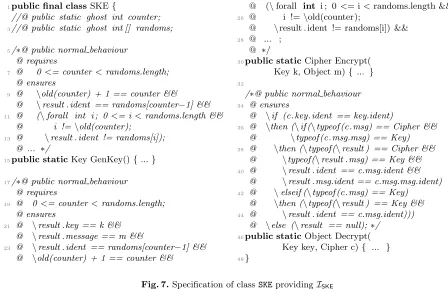
of this cryptographic primitive following the design-by-contract paradigm. Figure 6 shows the specification of the classesCipherandKey.
ACipherhas two ghost fields we use for specifying the encryption information. The ghost fieldkeyholds the key, which was used for encryption of a message. We call two objects of typeKeycorresponding, if they
have the sameident value. The ghost fieldmsgholds the message that is encrypted in the cipher by a key corresponding to the value of key.
Instead of directly using constructors or methods provided byKeyorCipher, we encapsulate this function-ality in a secret key encryption scheme, providing the interfaceISKE. The specification used for verification is
TheSKEclass has two static ghost fields. The fieldrandomsholds a collection of random numbers, which represent random byte arrays. The content of randoms can be seen as a stream of random numbers from which elements can be drawn. This way, we make execution of the methods provided by SKE deterministic and we can treat randomisation independent from execution of our actual code.
The fieldcounteris a pointer to the element inrandomswhich is drawn the next time a random number is needed. The management of this pointer is ensured by the methods provided bySKE. To create a new key, we use the methodGenKey. It returns a newKeyobject, where the identifier has the same value as the next element inrandoms. Line 11 expresses the assumption that each time a random number is drawn, it is different to all random numbers drawn earlier bySKE. This assumption is justified since the probability of a collision has to be be negligible for any polynomial number of generated keys.
The methodSKE.Encrypt encapsulates the encryption functionality in our program. TheCipher object returned by the method has a fresh random number as identifier. The ghost field key remembers the key which was used for encryption, while the ghost fieldmsgremembers the clear text information.
The methodSKE.Decryptprovides decryption functionality, which ensures that anullobject is returned, if the key passed as parameter does not correspond to the key originally used for encryption of the message. In the case of a corresponding key being provided, we consider two situations. First, we state in lines 36ff the expected behaviour for the case when the encrypted message is of typeCipher, which encrypts aKeyobject. In this case, the method returns a cipher corresponding to the originally encrypted one, which also encrypts aKeyobject corresponding to the key originally encrypted twice.
Second, we specify on lines 42ff that if the encrypted message is of typeKey, theDecryptmethod returns a key corresponding to the originally encryptedkeyobject. So the object structure is preserved by decryption. For other cases, we leave the behaviour ofDecryptunderspecified.
4.2 Implementation Details
Our realization of a garbled circuit consists of two classes. The classGarbledANDGate implements a garbled gate with binary AND functionality. TheGCnBitAND makes use of the classGarbledANDGate to realize the
interfaceIGC.
GarbledANDGate The class GarbledANDGate defines the field Cipher[] eT, representing the evaluation table as explained in Section 2.2. We introduce several ghost variables for bookkeeping of the state of a
GarbledANDGateshown in Figure 8 to explicitly store information given by the structure of the evaluation
table.
The variableskl0andkl1store an object of typeKeywhich represents the keys expected as 0- or 1-valued input on the left pin. The variableskr0andkr1do the same for the right pin. The variablesout0 andout1
hold the objects representing the keys used as 0- and 1-valued output.
The evaluation table holds on each position an encryption either of out0 or out1, first encrypted by one of the input keys for the right pin and then encrypted by one of the input keys for the left pin. As explained in Section 2.2, the evaluation table contains a random permutation the ciphers and we use the ghost variables
ci0, ci1, ci2, ci3 to store the indices of the ciphers after permutation.For example, the encryption of
out0with the keyskr0andkl0is stored at positioneT[ci0]. A more detailed definition of the invariant can be found in the Appendix in Figure 13, for a full account, the reader may be referred to implementation.
Further, we provide a method contract for the constructor and the methodevaluateprovided by the gate. These contracts ensure that the gate does realize a garbled AND functionality, assuming some preconditions. The correctness of the implementation according to the contract is used as a lemma during the proof of correctness of the garbled circuit.
1public final classKey{
public final intident ;
3 ...
}
public final classCipher{
6 //@ public ghost Key key;
//@ public ghost Object msg;
8 public final intident ;
... }
1public final classSKE{
//@ public static ghost int counter;
3//@ public static ghost int [] randoms;
5/∗@ public normal behaviour
@ requires
7 @ 0<= counter<randoms.length;
@ ensures
9 @ \old(counter) + 1 == counter &&
@ \result . ident == randoms[counter−1] &&
11 @ (\forall int i ; 0 <= i<randoms.length &&
@ i !=\old(counter);
13 @ \result . ident != randoms[i]);
@ ... ∗/
15public staticKey GenKey(){...}
17/∗@ public normal behaviour
@ requires
19 @ 0<= counter<randoms.length;
@ ensures
21 @ \result .key == k &&
@ \result .message == m &&
23 @ \result . ident == randoms[counter−1] &&
@ \old(counter) + 1 == counter &&
@ (\forall int i ; 0 <= i<randoms.length &&
26 @ i !=\old(counter);
@ \result . ident != randoms[i]) &&
28 @ ... ;
@ ∗/
30public staticCipher Encrypt(
Key k, Object m){ ... }
32
/∗@ public normal behaviour
34 @ ensures
@ \if (c.key.ident == key.ident)
36 @ \then (\if (\typeof (c.msg) == Cipher &&
@ \typeof (c.msg.msg) == Key)
38 @ \then (\typeof(\result ) == Cipher &&
@ \typeof(\result .msg) == Key &&
40 @ \result . ident == c.msg.ident &&
@ \result .msg.ident == c.msg.msg.ident)
42 @ \elseif (\typeof (c.msg) == Key)
@ \then (\typeof(\result ) == Key &&
44 @ \result . ident == c.msg.ident)))
@ \else (\result == null);∗/
46public staticObject Decrypt(
Key key, Cipher c){ ... }
48}
Fig. 7.Specification of classSKEprovidingISKE
public final classGarbledANDGate{
2 Cipher[] eT;
/∗@ ghost Key kl0, kl1, kr0, kr1,
4 @ out0, out1;
@ ghost int ci0 , ci1 , ci2 , ci3 ;∗/
6 publicGarbledANDGate(Key kl0, kl1,
kr0, k1, out0, out1 ){...}
8 publicKey evaluate(Key inl, inr ){...} }
Fig. 8.Definition ofGarbledANDGateincluding Ghost variables.
public final classGCnBitAND{
2 GarbledANDGate[] gates;
/∗@ ghost Key[] in0, in1;
4 @ ghost Key out0, out1;∗/
}
Fig. 9.Definition of GCnBitANDincluding ghost vari-ables.
Garbled n-bit AND circuit The class GCnBitAND, realizing IGC, defines the field gates as an array of type GarbledANDGate[]. The gates stored in this array are responsible for the functionality implemented by the circuit. The correct wiring of the circuit is indirectly ensured by the constructor and theevaluatemethod.
We define four ghost variables as shown in Figure 9. The keys expected by the circuit as 0-valued input are stored in the arrayin0, those representing a 1-valued input are stored in the array in1. The ghost variables
out0andout1store the keys representing the respective 0- and 1-valued outputs.
The invariant of GCnBitAND ensures a well-definedness property and can be found in Figure 14 in the appendix. First, it is ensured that the expected input of a gate on the left pin corresponds to the output of the previous gate, i.e. the circuit implements a linear structure. Second, it is ensured that the keys expected as an input on the right pin by the gates correspond to the keys expected as input by the circuit. A spacial case here is the first gate, for which both inputs come from the user. Finally, the invariant ensures that the output of the last gate corresponds to the output the circuit is supposed to provide.
4.3 Correctness of the Implementation
1/∗@ requires
@ inkeys0. length == inkeys1.length &&
3@ inkeys0. length >= 2 &&
@ (\forall int i ; 1<= i<inkeys0.length;
5@ \distinct (inkeys0[ i−1], inkeys1[ i−1],
@ inkeys0[ i ], inkeys1[ i ]. ident)) &&
7@ \distinct (outkey0, outkey1); ∗/
@ ensures
9@ (\forall int i ; 0 <= i<in0.length;
@ inkeys0[ i ]. ident == in0[i]. ident &&
11@ inkeys1[ i ]. ident == in1[i]. ident) &&
@ outkey0.ident == out0.ident &&
13@ outkey1.ident == out1.ident;
publicGarbledNBitANDCircuit(Key[] inkeys0,
15 inkeys1; Key outkey0, outkey1){...}
Fig. 10.Contract of constructor of GCnBitAND.
1/∗@ requires
@ in.length == in0.length &&
3@ (\forall int i ; 0 <= i<in.length;
@ in [ i ]. ident == in0[i].ident ||
5@ in [ i ]. ident == in1[i].ident );
@ ensures
7@ \if (\forall int i ; 0<= i<in.length;
@ in [ i ]. ident == in1[i].ident)
9@ \then (\result . ident == out1.ident)
@ \else (\result . ident == out0.ident);∗/
11publicKey evaluate(Key[] in) {...}
Fig. 11.Contract of evaluateforGCnBitAND.
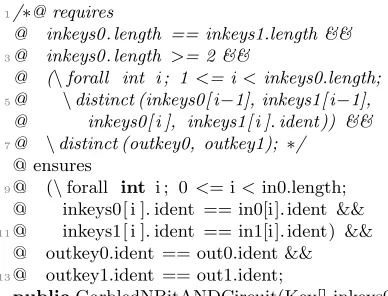
Figure 10 shows the contract for the constructor of GCnBitAND. It requires in line 2 that as many keys provided as 0-valued input are also provided as 1-valued input. The amount of keys provided determines the number of pins provided by the circuit. At least two keys have to be provided for each value, which expresses the circuit to be built provides at least two pins.
The quantifier at line 4 states that the keys used as possible input for each pin do not correspond, neither do the keys used as possible input on two subsequent gates. The predicate distinct used here indicates that its arguments have pairwise unequal values of the respective identfields. Both of these conditions are
necessary for the correctness of the gates, which are built during execution of the constructor. Line 7 states that the possible output keys do not correspond, i.e. it can be distinguished between a 0- and a 1-valued output.
The postcondition in line 9 states that the identifier representing expected input keys in the ghost fields
in0and in1 are the same as the identifiers of the keys used as input to the constructor. Additionally, the
invariant is required to hold after termination of the constructor, which is an implicit postcondition for the constructor.
Theorem 1 states the correctness of the constructor ofIGC, since its implementation is correct with respect
to its specification.
Theorem 1. LetGCnBitANDbe the realization ofIGC; letin0andin1be arrays of keys, such that the length of
in0equals the length ofin1, all elements inin0andin1 are notnullandin0 contains at least two elements; let out0 and out1 be keys that are not null and let all keys in in0, in1 and the keys out0 and out1 have pairwise different identifier.
Then a callIGC.GCnBitAND(in0, in1, out0, out1) returns an objectgcrealizingIGCsuch that the invariant ofgc holds and; for all i∈ {0 .. length of in0 − 1} the keys expected bygc as input on pinn representing a 0-valued input corresponds to the key in0[n] and the key expected by gc as input on pin n representing a
1-valued input corresponds to the key in1[n] and the key provided by gc as output representing a 0-valued output corresponds toout0and the key provided bygcas output representing a1-valued output corresponds to
out1.
Proof. The conditions stated as preconditions in Theorem 1 imply the preconditions as stated in Figure 10. The postconditions stated in Theorem 1 are equivalent to the postcondition in Figure 10. The realization of IGCis given by the classGCnBitAND.
The postcondition states in line 7 that a correct implementation of evaluatereturns a key corresponding to the 1-valued output key, if all input keys correspond to 1-valued input. If at least one input key does not correspond to a 1-valued input, the circuit returns a 0-valued output (line 10). It is easy to see that the postcondition expresses an-bit AND functionality.
Theorem 2 states the correctness of methodevaluateofIGC, since the implementation of the constructor
is correct due to its specification.
Theorem 2. LetGCnBitANDbe the realization ofIGC; letgcbe the object giving access toIGC; let the invariant ofgc hold; letin be an array of keys with the same length as the amount of expected input keys bygc and let
in[i] correspond to the0-valued or1-valued input key expected bygc.
Then a call IGC.evaluate(in) returns a key o such that o represents a 1-valued output if all keys in in represent1-valued inputs ando represents a0-valued output if not all keys ininrepresent 1-valued inputs. Proof. The conditions stated in Theorem 2 are equivalent to the precondition as stated in Figure 11. The postcondition stated in Theorem 2 are equivalent to the postcondition as stated in Figure 11. The realization ofIGCis given by the classGCnBitAND.
We proved with the KeY-tool that the methodevaluateof classGCnBitANDsatisfies its contract. Therefore Theorem 2 holds.
5
Security of our protocol
In this section we prove that our protocol (see Section 3) is secure against an honest-but curious adversary if the senderSis corrupted. Security in this setting means, that the inputs of the receiverRremain secret. This follows from the correctness of the protocol and the UC-security of oblivious transfer.
Figure 15 describes the interface of the two-party computation in presence of a corrupted sender to the environment. In addition to what a passive adversary can usually observe during a run of the protocol, it now gets access to methods getSenderInput and getSenderKeys which leak S’s secrets. In particular,
getSenderKeysreturns the list of all encryption keys generated by S to construct the garbled circuit. Note that the adversary cannot change the behavior ofS.
We now introduce two implementations of the interfaceI(Sˆ,R).
– The real implementation2PC(ˆrealS,R)runs the two-party protocol in the constructor on the given inputs and
saves the exchanged messages, generated encryption keys, etc. for later retrieval by the adversary through the corresponding getters.
– The ideal implementation2PC(ˆidealS,R)doesn’t run the protocol but uses a simulator implementing the interface
from Figure 16 to provide the output of all getters exceptgetOutput. It resembles a wrapper for the ideal functionality (for corruptedSand honestR) running in parallel with a simulator. Note that the simulator is only given the input of the sender and the length of the receiver’s input.
OTideal is an ideal implementation of the interface for oblivious transfer from Figure 12 resembling the
ideal functionality FOT. Internally, OTideal maintains a list of tuples (OTKey k, boolean choice, OTResp r, Object in0, Object in1) each representing one OT instance. Constructing an OT request creates a new entry in that list withr,in0andin1set tonull. UpongenResponsefor anOTKeythe correspondingr,
in0andin1are set according to the given values (which must not benulland the length of their serialization must not exceed a fixed maximum). On getOutput for OTResp r and OTKey k, depending on the value of
choice, in0 or in1 is returned. Theident attributes of keys, responses and requests are set to uniformly random values on object creation.5 As usual throughout the paper, these idents are placeholders that can be used for data by a real implementation.
Theorem 3. Let 2PC(ˆrealS,R), 2PCideal(ˆS,R) and OTideal be the programs introduced above and SKEreal be a correct implementation ofISKE, then we have
SKEreal·OTideal·2PC
(ˆS,R)
real ≤
(Iout,∅,∅,ISim)SKE
real·OTideal·2PC
(ˆS,R)
ideal
5
whereIout:=I(ˆS,R)∪ IOT∪ ISKE andISim the interface from Figure 16.
Proof. The simulator can successfully fake getReceiverMessage because the OT keys are random handles independent ofchoicein OTideal. It createsinR_length OTs and returns the corresponding OT requests on
a call ofgetReceiverMessage. To simulate the sender, it generates a garbled circuit as an honestSwould do and prepares the OT responses accordingly to assemble the sender response. The correctness of the garbled circuit (see Theorem 1, Theorem 2) guarantees that the output in the real world actually matches that in the ideal world.
What remains to do is to show that we can replace the ideal implementation for oblivious transfer by a real one.
Security of Oblivious Transfer We first describe the simplified functionality for oblivious transfer [7]. FOT
interacts with a senderSand a receiver R.
– Upon receiving a message (in0,in1) fromS, store (in0,in1).
– Upon receiving a messagebfromR, check if a (in0,in1) message was previously sent byS. If yes, sendinb
toR. If not, send nothing toR(but continue running).
LetOTrealbe a system that implements the OT interface from Figure 12. We show that the systemOTideal
can safely be replaced by OTreal if OTreal suitably implements a two-party-two-message realization of FOT.
Such realizations exists under standard cryptographic assumptions, e.g., decisional Diffie-Hellman, quadratic residuosity, or learning with errors [29].6
Theorem 4. If OTreal implements a realization RofFOT, then OTreal≤(IOT,∅,∅,∅)OTideal
Proof. The basic idea is that, since R realizes FOT, there is a simulator S such that R and S · FOT are
indistinguishable for every environment in the computational UC model (for a suitable composition·in that model). The output ofS is independent from the original inputs of the partiesSandR(it doesn’t get those values fromFOT). As output distribution forOTidealwe can hence pick that ofS. Since we can simulate Turing
machines with Jinja+ programs, simulatability in the CVJ framework in the sense of Definition 1 follows.
6
Future work
This work provides the proof of security of a two-party computation implemented in Java against a semi-honest sender. In particular, we prove correctness of the implementation of a garbled circuit using cryptographic primitives via a formally specified interface.
One obvious direction for future work is to prove security for the two remaining scenarios, i.e., security against a corrupted receiver and security if both parties are honest (all in presence of a passive adversary).
One interesting challenge towards this goal is to prove at code level that the evaluation of a garbled circuit does not leak more than the encoded functionf and the outputf(x).7For this, implementation details of the garbled circuit (e.g., that the evaluation table is randomized) will become important.
Since the security against a corrupted receiver will also depend on the security of the used encryption scheme, a suitable functionality for secret key encryption will be necessary. This functionality should be realizable in the sense of strong simulatability and sufficient for the construction of garbled circuits.
Finally, it would be interesting to build a compiler from functions to (garbled) circuits that automatically outputs Java code that is verifiably correct. E.g., if we have the description of a function in conjunctive normal form (one multi-bit AND, a number of multi-bit ORs and NOTs) we can use the modularity of our correctness proof as explained in Section 4. However, more work would be needed to get from the proof for a conjunctive normal form to a high-level description of the function like “addition of two integers given as bitstrings”.
6 These realizations need a common reference string functionality [6] which can be part ofOT real. 7
Bibliography
[1] Mike Barnett, Rustan Leino, and Wolfram Schulte. The spec# programming system: An overview. In Gilles Barthe, Lilian Burdy, Marieke Huisman, Jean-Louis Lanet, and Traian Muntean, editors, Con-struction and Analysis of Safe, Secure, and Interoperable Smart Devices, volume 3362 of Lecture Notes in Computer Science, pages 49–69. Springer Berlin Heidelberg, 2005. ISBN 978-3-540-24287-1.
[2] Gilles Barthe, Benjamin Gr´egoire, Sylvain Heraud, and SantiagoZanella B´eguelin. Computer-aided secu-rity proofs for the working cryptographer. In Advances in Cryptology – CRYPTO 2011, Lecture Notes in Computer Science, pages 71–90. Springer Berlin Heidelberg, 2011.
[3] Bernhard Beckert, Reiner H¨ahnle, and Peter H. Schmitt. Verification of Object-oriented Software: The KeY Approach. Springer-Verlag, Berlin, Heidelberg, 2007. ISBN 3-540-68977-X, 978-3-540-68977-5. [4] Mihir Bellare, Viet Tung Hoang, and Phillip Rogaway. Foundations of garbled circuits. In Ting Yu,
George Danezis, and Virgil D. Gligor, editors,ACM CCS 12, pages 784–796. ACM Press, October 2012. [5] Ran Canetti. Universally composable security: A new paradigm for cryptographic protocols. In 42nd
FOCS, pages 136–145. IEEE Computer Society Press, October 2001.
[6] Ran Canetti and Tal Rabin. Universal composition with joint state. In Dan Boneh, editor,CRYPTO 2003, volume 2729 of LNCS, pages 265–281. Springer, August 2003.
[7] Ran Canetti, Yehuda Lindell, Rafail Ostrovsky, and Amit Sahai. Universally composable two-party and multi-party secure computation. In34th ACM STOC, pages 494–503. ACM Press, May 2002.
[8] Seung Geol Choi, Jonathan Katz, Hoeteck Wee, and Hong-Sheng Zhou. Efficient, adaptively secure, and composable oblivious transfer with a single, global CRS. In Kaoru Kurosawa and Goichiro Hanaoka, editors,PKC 2013, volume 7778 ofLNCS, pages 73–88. Springer, February / March 2013. doi: 10.1007/ 978-3-642-36362-7 6.
[9] Ivan Damg˚ard, Jesper Buus Nielsen, and Claudio Orlandi. Essentially optimal universally composable oblivious transfer. In Pil Joong Lee and Jung Hee Cheon, editors,ICISC 08, volume 5461 ofLNCS, pages 318–335. Springer, December 2008.
[10] Zekeriya Erkin, Martin Franz, Jorge Guajardo, Stefan Katzenbeisser, Inald Lagendijk, and Tomas Toft. Privacy-preserving face recognition. In Privacy Enhancing Technologies, pages 235–253, 2009.
[11] Jean-Christophe Filliˆatre and Claude March´e. The why/krakatoa/caduceus platform for deductive pro-gram verification. In Werner Damm and Holger Hermanns, editors,Computer Aided Verification, volume 4590 of Lecture Notes in Computer Science, pages 173–177. Springer Berlin Heidelberg, 2007. ISBN 978-3-540-73367-6.
[12] Oded Goldreich, Silvio Micali, and Avi Wigderson. How to play any mental game or A completeness theorem for protocols with honest majority. In Alfred Aho, editor, 19th ACM STOC, pages 218–229. ACM Press, May 1987.
[13] S. Greiner, P. Birnstill, E. Krempel, B. Beckert, and J¨urgen Beyerer. Privacy preserving surveillance and the tracking-paradox. In M. (Ed.) Lauster, editor, 8th Future Security. Security Research Conference. Proceedings., pages 296–302, Berlin, September 2013. Fraunhofer Verlag.
[14] Yan Huang, David Evans, Jonathan Katz, and Lior Malka. Faster secure two-party computation using garbled circuits. InUSENIX Security Symposium, 2011.
[15] Yan Huang, Lior Malka, David Evans, and Jonathan Katz. Efficient privacy-preserving biometric iden-tification. InNDSS, 2011.
[16] Bart Jacobs, Jan Smans, Pieter Philippaerts, Fr´ed´eric Vogels, Willem Penninckx, and Frank Piessens. Ver-ifast: A powerful, sound, predictable, fast verifier for c and java. InProceedings of the Third International Conference on NASA Formal Methods, NFM’11, pages 41–55, Berlin, Heidelberg, 2011. Springer-Verlag. ISBN 978-3-642-20397-8.
[17] Somesh Jha, Louis Kruger, and Vitaly Shmatikov. Towards practical privacy for genomic computation. In2008 IEEE Symposium on Security and Privacy, pages 216–230. IEEE Computer Society Press, May 2008.
[19] Ralf K¨usters, Tomasz Truderung, and J¨urgen Graf. A framework for the cryptographic verification of java-like programs. InCSF 2012, pages 198–212. IEEE, 2012.
[20] Ralf K¨usters, Tomasz Truderung, Bernhard Beckert, Daniel Bruns, J¨urgen Graf, and Christoph Scheben. A hybrid approach for proving noninterference and applications to the cryptographic verification of Java programs. In Christian Hammer and Sjouke Mauw, editors,Grande Region Security and Reliability Day 2013, Luxembourg, 2013.
[21] Ralf K¨usters, Enrico Scapin, Tomasz Truderung, and Juergen Graf. Extending and applying a framework for the cryptographic verification of java programs. IACR Cryptology ePrint Archive, 2014:38, 2014. [22] Gary T. Leavens, Albert L. Baker, and Clyde Ruby. Preliminary design of jml: A behavioral interface
specification language for java. SIGSOFT Softw. Eng. Notes, 31(3):1–38, May 2006. ISSN 0163-5948. [23] Yehuda Lindell and Benny Pinkas. A proof of yao’s protocol for secure two-party computation.Electronic
Colloquium on Computational Complexity (ECCC), (063), 2004.
[24] Yehuda Lindell and Benny Pinkas. An efficient protocol for secure two-party computation in the presence of malicious adversaries. In Moni Naor, editor,EUROCRYPT 2007, volume 4515 ofLNCS, pages 52–78. Springer, May 2007.
[25] Yehuda Lindell, Benny Pinkas, and Nigel P. Smart. Implementing two-party computation efficiently with security against malicious adversaries. In Rafail Ostrovsky, Roberto De Prisco, and Ivan Visconti, editors,
SCN 08, volume 5229 ofLNCS, pages 2–20. Springer, September 2008.
[26] Dahlia Malkhi, Noam Nisan, Benny Pinkas, and Yaron Sella. Fairplay - secure two-party computation system. InUSENIX Security Symposium, pages 287–302, 2004.
[27] Jesper Buus Nielsen and Claudio Orlandi. LEGO for two-party secure computation. In Omer Reingold, editor, TCC 2009, volume 5444 ofLNCS, pages 368–386. Springer, March 2009.
[28] Margarita Osadchy, Benny Pinkas, Ayman Jarrous, and Boaz Moskovich. SCiFI - a system for secure face identification. In2010 IEEE Symposium on Security and Privacy, pages 239–254. IEEE Computer Society Press, May 2010.
[29] Chris Peikert, Vinod Vaikuntanathan, and Brent Waters. A framework for efficient and composable oblivious transfer. In David Wagner, editor, CRYPTO 2008, volume 5157 of LNCS, pages 554–571. Springer, August 2008.
[30] Michael O. Rabin. How to exchange secrets with oblivious transfer. InTechnical Report TR-81. Harvard University, 1981.
[31] Peter H. Schmitt and Isabel Tonin. Verifying the mondex case study. In SEFM, pages 47–58. IEEE Computer Society, 2007. ISBN 978-0-7695-2884-7.
[32] Wolfram Schulte, Xia Songtao, Jan Smans, and Frank Piessens. A glimpse of a verifying c compiler. In
C/C++ Verification Workshop 2007, 2007.
[33] Andrew Chi-Chih Yao. Protocols for secure computations (extended abstract). In 23rd FOCS, pages 160–164. IEEE Computer Society Press, November 1982.
Appendix
1public final classOTKey{
public final intident ;
3 publicOTKey(intid);
}
5public final classOTReq{
public intident;
7 publicOTReq(OTKey key,booleanchoice);
publicOTResp
9 genResponse(Object in0, Object in1);
}
public final classOTResp{
12 public intident;
publicOTResp(OTReq request,
14 Object in0, Object in1);
publicObject getOutput(OTKey key);
16}
Fig. 12.InterfaceIOTfor oblivious transfer.
/∗@ invariant
2 @ eT[ci0].key.ident == kl0.ident &&
@ eT[ci0].msg.key.ident ==
4 @ kr0. ident &&
@ eT[ci0].msg.msg.ident ==
6 @ out0.ident &&
@ eT[ci1].key.ident == kl0.ident &&
8 @ eT[ci1].msg.key.ident ==
@ kr1. ident &&
10 @ eT[ci1].msg.msg.ident ==
@ out0.ident &&
12 @ eT[ci2].key.ident == kl1.ident &&
@ eT[ci2].msg.key.ident ==
14 @ kr0. ident &&
@ eT[ci2].msg.msg.ident ==
16 @ out0.ident &&
@ eT[ci3].key.ident == kl1.ident &&
18 @ eT[ci3].msg.key.ident ==
@ kr1. ident &&
20 @ eT[ci3].msg.msg.ident ==
@ out1.ident ; ∗/
Fig. 13. Invariant for GarbledANDGate including ghost variables.
1/∗@ invariant
@ (\forall int i ; 0 <= i<gates.length−1;
3@ gates [ i ]. out0 == gates[i+1].kl0 &&
@ gates [ i ]. out1 == gates[i+1].kl1) &&
5@ (\forall int i ; 0 <= i<gates.length;
@ gates [ i ]. kr0 == in0[i+1] &&
7@ gates [ i ]. kr1 == in1[i+1]) &&
@ gates [0]. kl0 == in0[0] &&
9@ gates [0]. kl1 == in1[0] &&
@ gates[gates . length−1].out0 == out0 &&
11@ gates[gates . length−1].out1 == out1;
1public final classProtoCS{
publicProtoCS(boolean[] inS,boolean[] inR);
3 publicReceiverMessage getReceiverMessage();
public boolean[] getSenderInput();
5 publicKey[] getSenderKeys();
publicSenderMessage getSenderMessage();
7 public booleangetOutput();
}
Fig. 15.InterfaceI(Sˆ,R)for a passive adversary in case of a corrupted sender.
public final classSimulator {
2 publicSimulator(boolean[] inS,intinR length);
publicReceiverMessage getReceiverMessage();
4 public boolean[] getSenderInput();
publicKey[] getSenderKeys();
6 publicSenderMessage getSenderMessage();
public booleangetOutput();
8}
Fig. 16.InterfaceISim for simulator.
public final classProtoCS{
2 private finalSimulator sim;
publicProtoCS(boolean[] inS,boolean[] inR){
4 sim =newSimulator(inS, inR.length)
}
6 publicReceiverMessage getReceiverMessage(){
returnsim.getReceiverMessage();
8 }
...
10 public booleangetOutput(){
returnAND(inS, inR);// AND of all input bits
12 }
}