© 2017, IRJET | Impact Factor value: 5.181 | ISO 9001:2008 Certified Journal
| Page 1217
PROACTIVE POPULATION-RISK BASED DEFENSE AGAINST DENIAL OF
CYBER-PHYSICAL SERVICE ATTACKS
*1
M.Phil Research Scholar, Department of Computer Science Adhiparasakthi Arts and Science College
(Autonomous), Kalavai, TamilNadu, India
*2
Assistant Professor, Department of Computer Science Adhiparasakthi Arts and Science College (Autonomous),
Kalavai, TamilNadu, India
---***---Abstract- Emergency management is increasinglydependent on networks for information gathering, coordination and Physical system control, and consequently is increasingly vulnerable to network failures. cyber attack could cause such network failures intentionally, so as to impede the work of first responders and maximize the impact of a Physical emergency believe that they can be used to facilitate collaboration between EM practitioners and researchers of different disciplines, from information security and control systems to a “Physical” denial-of service attack (PDoS) in which IoT devices overflow the “Physical bandwidth” of a CPS. In this paper, we quantify the population based risk to a group of IoT devices targeted by malware for a PDoS attack. There are two main process based on the security concern. 1) Defenders can bound botnet activity and 2) legislating a minimum level of security has only a limited effect, while incentivizing active defense can decrease botnet activity arbitrarily. Anomaly detection for the minimum user of the network DoS attack model to refer by intrusion identified possible steps to mitigate the identified DoS attacks, and evaluate the applicability of these solutions for teleoperated risk control. The broader goal of our paper is to raise awareness, and increase understanding of emerging cyber-security threats against teleoperated security Risk systems.
Key Words: CPS, Physical denial-of service attack. DoS attack model, security thread.
I. INTRODUCTION
It is notoriously hard to debug networks. Every
day, network engineers wrestle with router
misconfigurations, fiber cuts, faulty interfaces, mislabelled cables, software bugs, intermittent links, and a myriad other reasons that cause networks to misbehave or fail completely. Network engineers hunt down bugs using the most rudimentary tools (e.g., Ping, trace route, tcpdump, SNMP, and ) and track down root causes using a combination of accrued wisdom and intuition. Debugging networks is only becoming harder as networks are getting bigger (modern data centers may contain 10 000 switches, a campus network may serve 50 000 users, a 100-Gb/s
long-haul link may carry 100 000 flows) and are getting more complicated (with over 6000 RFCs, router software is based on millions of lines of source code, and network chips often contain billions of gates). It is a small wonder
that network engineers have been labelled “masters of
complexity”. Consider two examples. Example 1: Suppose a router with a faulty line card starts dropping packets silently. Alice, who administers 100 routers, receives a ticket from several unhappy users complaining about connectivity.
It is not an easy task to debug a network. The
network engineers face problems like router
[image:1.595.309.570.528.692.2]misconfigurations, Fiber cut, mislabeled cables, software bug, Faulty interfaces etc. Network engineers try to solve these issues using mostly used tools such as ping and trace route. Debugging networks is getting more and more complex as not only size of networks but also their level of complexity is increasing day by day. Physical DOS produces a model which is not dependent on devices after reading configuration from routers. Another advantage of Physical DOS system is that it covers each link and every rule in network with minimum number of test packets.
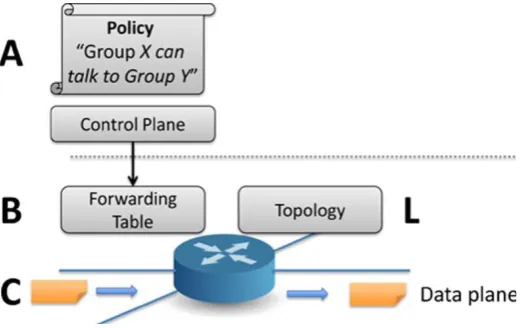
Figure 1.1 Static versus dynamic checking
Fig. 1 is a simplified view of network state. At the bottom of the figure is the forwarding state used to forward each packet, consisting of the L2 and L3 forwarding information base (FIB), access control lists, etc.
*1
Ms. Vijayalakshmi. R,
*2Mr. Hari
h
aran. P
© 2017, IRJET | Impact Factor value: 5.181 | ISO 9001:2008 Certified Journal
| Page 1218
The forwarding state is written by the control plane (thatcan be local or remote as in the SDN model [32]) and should correctly implement the network administrator’s policy. Examples of the policy include: “Security group X is isolated from security Group Y,” “Use OSPF for routing,” and “Video traffic should receive at least 1 Mb/s.” We can think of the controller compiling the policy (A) into device-specific configuration files (B), which in turn determine the forwarding behavior of each Positive (C).
1.1 Problem Definition
Most common causes of network failure
1) Hardware failures
2) Software bugs
Others failures include reach ability failures and throughput/latency degradation.
Our goal is to Cyber Security System ally detect these types of failures.
1.2 Objective
Project is concerned with analyzing all packets
across LAN
Here filtering of packets is carried out by means of
filtering rules
In first rule filtering is carried out by means of IP
address.
In second rule filtering is by means of size of the
packet.
In third rule filtering is carried out by means of data inside the packet.
1.3 Goals
Cyber Security System ally generate test packets
to test the network state, faults before being noticed by application.
Augment human wisdom and intuition.
Reduce the downtime.
Save money.
II. RELATED WORK
2.1 Network Tomography of Binary Network Performance Characteristics
In network performance tomography,
characteristics of the network interior, such as link loss and Positive latency, are inferred from correlated end-to-end measurements. Most work to date is based on exploiting Positive level correlations, e.g., of multicast packets or unicast emulations of them. However, these methods are often limited in scope-multicast is not widely deployed or requires deployment of additional hardware or software infrastructure.
Some recent work has been successful in reaching a less detailed goal: identifying the lossiest network links using only uncorrelated end-to-end measurements. In this paper we abstract the properties of network performance that allow this to be done and exploit them with a quick and simple inference algorithm that, with high likelihood, identifies the worst performing links. We give several examples of real network performance measures that exhibit the required properties. Moreover, the algorithm is sufficiently simple that we can analyze its performance explicitly.
Advantage:
Tomographic methods are that they require no
participation from network elements other than the usual forwarding of packets.
This distinguishes them from well-known tools,
such as trace route and ping, that require ICMP responses from routers in order to function. In practice, ICMP response is restricted by some
network administrators
Identifying the lossiest network links using only uncorrelated end-to-end measurements
Disadvantages
The disadvantage of high complexity.
Needing to probe individual routers
2.2 Inferring Link Loss Using Striped Unicast Probes
© 2017, IRJET | Impact Factor value: 5.181 | ISO 9001:2008 Certified Journal
| Page 1219
Advantage: Measurements provide good evidence that a
Positive pair to distinct receivers introduces considerable correlation which can be further increased by simply considering longer stripes.
Disadvantages:
These measurements do not rely on
administrative access to internal nodes since the inference can be calculated using only information recorded at the end hosts.
The key intuition for inferring Positive loss is that
the arrival of a Positive at a given internal node can be directly inferred
III. ALGORITHMS AND TECHNIQUES USED
3.1 Algorithm:
We have a tendency to assume a collection of take a look at terminals within the network will send and receive take a look at packets. Our goal is to come up with a collection of take a look at packets to exercise each rule each switch perform, in order that any fault are determined by a minimum of one take a look at packet. This can be analogous to software package take a look at suites that attempt to take a look at each potential branch in a very program. The broader goal will be restricted to testing each link or each queue. Once generating take a look at packets, Physical DOS should respect 2 key constraints:
a) Port: Physical DOS should solely use take a look at terminals that square measure available;
b) Header: Physical DOS should solely use headers that every take a look at terminal is allowable to transfer. For instance, the network administrator might solely enable employing a specific set of VLANs.
3.2 Fault Localization Algorithm
Fault Model:
A rule fails if its observed behavior differs from its expected behavior. PHYSICAL DOS keeps track of where rules fail using a result function. For a rule, the result function is defined as
R(r, pk) = {0, if pk fails at rule r R(r, pk) = {1, if pk succeeds at rules r
Thus divide faults into two categories: action faults and match Faults. An action fault occurs when every Positive matching the rule is processed incorrectly. Action
faults include unexpected Positive loss, a missing rule, congestion, and miswiring. On the other hand, match faults are harder to detect because they only affect some packets matching the rule: for example, when a rule matches a header it should not, or when a rule misses a header it should match.
We will only consider action faults because they cover most likely failure conditions and can be detected using only one test Positive per rule.
Problem 2 (Fault Localization): Given a list of (pk0, (R (pk0), (pk1, (R (pk1) tuples, find all that satisfies pki,R (pki,r)=0.
Step 1: Consider the results from sending the regular test packets. For every passing test, place all rules they exercise into a set of passing rules, P. Similarly, for every failing test, place all rules they exercise into a set of potentially failing rules F.
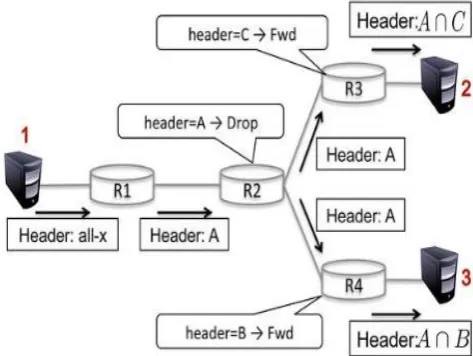
Step 2: Physical DOS next trims the set of suspect rules by weeding out correctly working rules. PHYSICAL DOS does this using the reserved packets (the packets eliminated by Minset-cover). PHYSICAL DOS selects reserved packets whose rule histories contain exactly one rule from the suspect set and sends these packets.
[image:3.595.318.555.478.656.2]Step 3: In most cases, the suspect set is small enough after Step 2, which Physical DOS can terminate and report the suspect set.
© 2017, IRJET | Impact Factor value: 5.181 | ISO 9001:2008 Certified Journal
| Page 1220
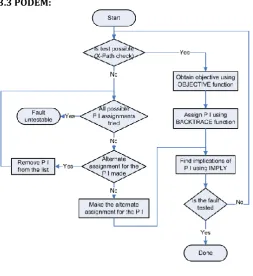
3.3 PODEM:Fig 3.2 PODEM
IV. PHYSICAL DOS SYSTEM
Based on the network model, PHYSICAL DOS generates the minimal number of test packets so that every forwarding rule in the network is exercised and covered by at least one test packet. When an error is detected, Physical DOS uses a fault localization algorithm to determine the failing rules or links.
Fig. 4.1 Physical DOS system block diagram.
Physical DOS is one in every of the systematic approach uses for debugging network. PHYSICAL DOS generates stripped variety of take a look at packets in order that each forwarding rule the network is exercised and coated by a minimum of 1 take a look at packet.
4.1 Physical DOS Methods and Algorithm
Step1: Physical DOS enables testers to distinguish between the correct circuit behavior and the faulty circuit behavior based on inputs patters
Step2: The generated patterns are used to test
semiconductor devices for defects after
manufacturing
Step3: A defect is an error introduced into a device during the manufacturing process
The effectiveness of Physical DOS is measured by
the amount of modeled defects, or fault models, that are detected and the number of generated patterns.
The effectiveness of ATGP gives an estimate of
test quality
A fault model is a mathematical description of
how a defect alters design behavior
A fault is aid to be detected by a test pattern if, the faulty circuit output differs from the original circuit output
There are two steps that Physical DOS should lake to detect fault.
Fault activation: Establishes a signal value at the fault model site that is opposite of the value produced by the fault model
Fault propagation: Moves the resulting signal value, or fault effect, forward by sensitizing a path from the fault site to a primary output.
4.2CPS: D-Algorithm
• Step1: An error is observed due to differing values at a line in the circuit with or without failure. Such a divergence is denoted by values or to mark differences 1/0 or 0/1, respectively.
• Step2: Instead of oolean values, the set , 1, , is used to evaluate gates and carry out implications.
• Step3: A gate that is not on a path between the error and any output does never have a D-value.
• Step4: A necessary condition for testability is the existence of a path from the error to an output, where all intermediate gates either have a D-value or are not assigned yet. Such a path is called a potential D-chain.
4.3 CPS Algorithm Types
Exhaustive Algorithm: For n-input circuit, generate all 2n input patterns. Infeasible, unless circuit is partitioned into cones for logic, with < 15 inputs.
[image:4.595.40.284.508.668.2]© 2017, IRJET | Impact Factor value: 5.181 | ISO 9001:2008 Certified Journal
| Page 1221
is necessary in order to select useful patterns. Weightedrandom patterns: 0 and 1 are not equally likely.
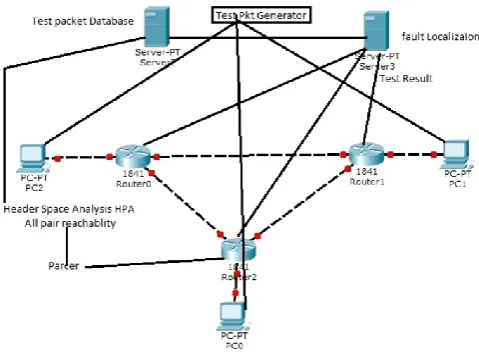
4.4 Cyber Security System Test Positive generation and fault localization
Cyber Security System take a look at Positive Generation (PHYSICAL DOS ) structure that consequently produces a negligible arrangement of bundles to check the basic's livener’s topology and also the coinciding between data plane state and style determinations. The equipment will likewise naturally produce bundles to check execution affirmations, for instance, parcel dormancy. It will likewise be specific to provide a negligible arrangement of parcels that solely take a look at every association for system liveners.
• A survey of network operators revealing common
failures and route causes take a look at Positive generation algorithmic program.
• A fault localization algorithmic program to isolate
faulty device and rules.
• PHYSICAL DOS use cases for useful &
performance testing
[image:5.595.45.285.445.622.2]Evaluation of an example Physical DOS system victimization rule sets collected from the Stanford and internet2 backbones.
Fig 4.2 Cyber Security System Test Positive generation and fault localization
V. NETWORKING
Networking is the word basically relating to computers and their connectivity. It is very often used in the world of computers and their use in different connections. The term networking implies the link between two or more computers and their devices, with the vital purpose of sharing the data stored in the computers, with each other. The networks between the
computing devices are very common these days due to the launch of various hardware and computer software which aid in making the activity more convenient to build and use.
Figure 5.1: Structure of Networking
When computers communicate on a network, they send out data packets without knowing if anyone is listening. Computers in a network all have a connection to the network and that is called to be connected to a network bus. What one computer sends out will reach all the other computers on the local network. Above diagrams show the clear idea about the networking functions.
5.1 Characteristics of Networking
The following characteristics should be
considered in network design and ongoing maintenance:
1. Availability is typically measured in a percentage
based on the number of minutes that exist in a year. Therefore, uptime would be the number of minutes the network is available divided by the number of minutes in a year.
2. Cost includes the cost of the network components,
their installation, and their ongoing maintenance.
3. Reliability defines the reliability of the network
components and the connectivity between them. Mean time between failures (MTBF) is commonly used to measure reliability.
4. Security includes the protection of the network
components and the data they contain and/or the data transmitted between them.
5. Speed includes how fast data is transmitted between network end points (the data rate).
6. Scalability defines how well the network can adapt to
new growth, including new users, applications, and network components.
7. Topology describes the Physical cabling layout and the
© 2017, IRJET | Impact Factor value: 5.181 | ISO 9001:2008 Certified Journal
| Page 1222
5.2 Advantages of Networking Easy Communication
Ability to Share Files, Data and Information
Sharing Hardware
Sharing Software
Security
Speed
5.3 NETWORK DESIGN
As mentioned in the last section, the Cyber Security System test Positive generation system makes use of geometric model of header space analysis. This section explains some of the key terms associated with geometric framework of header space analysis.
5.3.1 Packet
Positive in a network can be described as a tuple of the form (port, header) in such a way that, it is the job of port to show position of Positive in a network at instantaneous time. Each one of the port is allotted with one and only one unique number.
5.3.2 Switch
Another term used in geometric model of header space analysis is switches. It is the job of switch transfer Function T, to model devices in a network. Example of devices can be switches or routers. There is a set of forwarding rules contained in each device, which decides how the packets should be processed.
5.3.3 Rules
Piece of work for rules is generation of list of one or more output packets associated with those output ports to which the Positive is transferred, and explain how fields of port are modified. In other words, rules explains how the region of header space at entrance in changed into region of header space at exit
5.3.4 Rule History
At any moment, every Positive has its own rule history, which can be described as ordered list of rules Positive have matched up to that point as it covers the network. Rule history provides necessary and important unprocessed material for Cyber Security System test Positive generation (Physical DOS ). That is the reason why it is fundamental to Physical DOS .
5.3.5 Topology
The network topology is modeled by topology transfer function. The topology transfer function gives the
specification about which two ports are joined by links. Links are nothing but rules that forwards a Positive from source to destination with no modification.
5.3.6 Life of a Packet
One can see life of a Positive as carrying out or executing switch transfer function and topology transfer function at length. When a particular Positive comes in a network port p, firstly a switch function is applied to that packet.
EVALUATION RESULT
In this section, three experiments were designed to evaluate the performance of the improved clustering algorithm. The simulating program was developed by our team using NS2. In the following experiments, Most of studies only consider that wireless sensor networks are equipped with only Omni-directional antennas, which can cause high collisions. It is shown that the per node throughput in such networks is decreased with the increased number of nodes. Thus, the transmission with multiple short - range hops is preferred to reduce the interference. However, other studies show that the transmission delay increases with the increased number of hops. Found that using directional antennas not only can increase the throughput capacity but also can decrease the delay by reducing the number of hops.
© 2017, IRJET | Impact Factor value: 5.181 | ISO 9001:2008 Certified Journal
| Page 1223
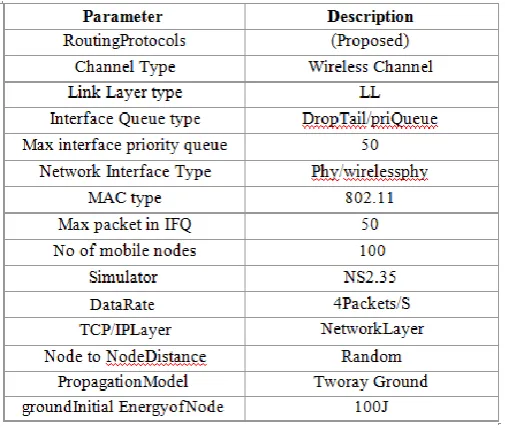
Positive Redundancy check [image:7.595.38.290.99.227.2]For the experimental results presented in this section, a network of sensors randomly distributed in a 1000m * 1000m field is considered. The number of sensors in the network, i.e. the network size, is kept at 100, 200, 300 and so on. Each sensor has an initial energy of 1.Joule and the base station is located at (250, 330). Each sensor generates packets of size 1000 bits. The energy model for the sensors is based on the first order radio model
Table: Simulation Table
X- Axis :Maximum number of retransmission
Y- AXIS :Success Rate End-to-end reliability achieved by options. Each line represents number of redundant code words for 8 original messages. RF means route fix is use Above graph shows the reliability each option (link-level retransmission, erasure code, and route fix) achieves. The x-axis shows the number of retransmissions and whether
route fix isused. Each curve represents how many redundant.
Fig : X- Axis :Maximum number of retransmission
[image:7.595.312.560.186.341.2]Above graph shows the normalized overhead for each option with same x-axis andlegends.First observation is that link level retransmissions should be used in any case. With no transmissions, the reliability is so low that the effect of redundancy is negligible (in spite of adding overhead, as in graph 2). The low number (less than 30%) seen in graph1, is close to the expected for a five hop transmission over links with 26.28% loss rate. When using at most 1 per-link retransmission, not only does the success rate go substantially up, but also does the effect of adding redundancy increase.
[image:7.595.36.289.368.582.2]© 2017, IRJET | Impact Factor value: 5.181 | ISO 9001:2008 Certified Journal
| Page 1224
CONCLUSIONIn thesis mainly focused on denial-of-service (DoS) attacks, based on the observation that these attacks cannot be mitigated using available cryptographic solutions. Using the Raven II, we experimentally investigated the impact of DoS attacks of varying severity. Our experimental results indicate there exists a learning effect across the given sequence of experimental trials, implying that human operators are capable of adapting to unfavorable network conditions. This observation, while positive for system defenders, does not imply that DoS attacks are not a problem for teleoperated robotic systems. On the contrary, it urges us to quickly develop efficient DoS mitigation methods, while indicating that in disastrous scenarios, where communication networks may
inadvertently be clogged or even Dosed,
teleoperatedrobotic systems will remain functional and capable of providing the necessary services. Next steps in preventing and mitigating DoS attacks on teleoperated robotic systems include investigating the feasibility of the established DoS mitigation methods, including black holing and sinkholing, as well as pipe cleaning, and assessing their impact on teleoperated procedures. Paper caution, however, that there exist tensions between cyber security, safety and usability requirements of teleoperated robotic systems which may render some these solutions infeasible. The feasibility of using a monitoring system to prevent DoS attacks against teleoperated security risk control systems.
REFERENCES:
1. “Physical DOS code repository,” [Online].
Available: http://eastzone.github. com/Physical DoS /
2. “Cyber Security System Test Pattern Generation,”
2013
[Online].Available:http://en.wikipedia.org/wiki/C yber Security System _test_pattern_generation 3. P. Barford, N. Duffield, A. Ron, and J. Sommers,
“Network performance anomaly detection and localization,” in Proc. IEEE INFOCOM, Apr. , pp. 1377–1385.
4. Y. ejerano and R. Rastogi, “Robust monitoring of
link delays and faults in IP networks,” IEEE/ACM Trans. Netw., vol. 14, no. 5, pp. 1092–1103, Oct. 2006.
5. C. Cadar, . unbar, and . Engler, “Klee:
Unassisted and Cyber Security System generation of high-coverage tests for complex systems programs,” in Proc. OS I, erkeley, CA, USA, 2 8, pp. 209–224.
6. M. Canini, D.Venzano, P. Peresini, D.Kostic, and J. Rexford, “A NICE way to test Open Flow applications,” in Proc. NS I, 2 12, pp. 10–10.
7. [8] A. Dhamdhere, R. Teixeira, C. Dovrolis, and C.
iot, “Netdiagnoser: Troubleshooting network unreachabilities using end-to-end probes and routing data,” in Proc. ACM CoNEXT, 2 7, pp. 18:1–18:12..
8. N. uffield, “Network tomography of binary
network performance characteristics,” IEEE Trans. Inf. Theory, vol. 52, no. 12, pp. 5373–5388, Dec. 2006.
9. N. Duffield, F. L. Presti, V. Paxson, and D. Towsley,
“Inferring link loss using striped unicast probes,” in Proc. IEEE INFOCOM, 2001, vol. 2, pp. 915–923. 10. N. G. uffield and M. Grossglauser, “Trajectory
sampling for direct traffic observation,”
IEEE/ACM Trans. Netw., vol. 9, no. 3, pp. 280–292, Jun. 2001.
11. P. Gill, N. Jain, and N. Nagappan, “Understanding network failures in data centers: Measurement, analysis, and implications,” in Proc. ACM SIGCOMM, 2011, pp. 350–361.
12. “Hassel, the Header Space Library,” [Online].
Available:
https://bitbucket.org/peymank/hassel-public/
13. Internet2, Ann Arbor, MI, USA, “The Internet2
observatory data collections,” [Online]. Available: http://www.internet2.edu/observatory/archive/ data-collections.html
14. M. Jain and C. ovrolis, “End-to-end available
bandwidth: Measurement methodology,