5
IV
April 2017
Technology (IJRASET)
Performance and Emission Test on Chlorella Algae
Oil Blend with Diesel
S. Naveeth Ahamed1, S. Muthuraja2, R. Pradeep Kumar3, S. Pazhanivel4, G. Luke Justin Johnson5 1,2,3,4
Mechanical engineering, 5Assistant Professor(Mechanical engineering), M.A.M.S.E, Anna University
Abstract: This study discusses performance and exhaust emission of the vehicle fueled with low content chlorella algae oil (property of the algae oil is similar to the property of diesel) blend with pure diesel in CI engine. The vehicle tests were performed at wide open throttle and at constant speed. The result obtained with the use of chlorella algae oil-diesel blend B10, B20, B30 and also tested emission such as oxides of carbon, hydro carbon, nitrogen oxide and smoke. We have done chlorella algae as the alternative fuel to reduce the consumption of diesel in CI engine.
Key words: Chlorella algae oil , Performance , Bio diesel , Hydro carbon , Emission.
I. INTRODUCTION
The country's energy demand is expected to grow at an annual rate of 6.8% in the last twenty years. The fossil fuel like coal, natural gas and biodeiesel are satisfying the current requirement in automobile field . In these circumstances bio fuels are going to play an important role in meeting India’s growing energy needs. . Chlorella vulgaris is one of the most attractive algae species for producing biofuels owing to its fast growth and easy cultivation. While the CO2 levels were higher, the nitrous oxide (NOx) emissions were
lower than that of diesel. Experimental evaluation of diesel engine performance and emissions of diesel fuel and bio diesel .The huge demand of the fuel is reduced by the algae oil cultivation on the less land resource .The water used for the algae oil cultivation is less than the land crops .The chlorella algae oil with diesel in different blends have been studied Biofuels are not only the best and reliably available fuels attained from renewable sources but they are absolutely pollution free, abundantly available in locals, easily accessible and highly sustainable. The high range of cultivation of chlorella algae is done on open ponds. Open ponds can be built and operated very economical. Algae ponds are built in the well suited location for the wastewater treatment process. One of the largest of this type of algal pond is Melbourne’s Worrigee wastewater treatment plant spanning 11,000 ha. The marginal land, fresh water or sea water is the best place for algae cultivation. Innovations to algae production allow it to become more productive while consuming resources that would otherwise be considered waste. The algae oil can be extracted from bio diesel by the transesterification process. 18 ml of methanol, 1.5 gm of potassium hydroxide was added with one litre of algae oil in the reactor. Acid catalyzed transesterification method was carried out in round two-neck flask. Flask was heated to reaction temperature by using a constant temperature water bath. A standard reaction mixture consists of 1:10 ratio of algal oil. Methanol and 1% of concentrated sulfuric acid was used. The reaction mixture was heated at 65 °C without stirring. Then the chlorella algae oil which is produced are tested for the performance and emission analysis.
II. LITERATURE SURVEY
Saddam H. Al-lwayzy, Talal Yusaf 1 and Raed A. Al Juboori [1]. describe that, This work is aim to investigate bio fuels for diesel engines produced on a lab-scale from the fresh water microalgae Chlorella vulgaris (FWM-CV). The impact of growing conditions on the properties of biodiesel produced from FWM-CV was evaluated.
Muhammad Aminul Islam , Marie Magnusson , Richard J. Brown , Godwin A. Ayoko , Md. Nurun Nabi and Kirsten Heimann [2]. Describe that, This study investigated if microalgae fatty acid profiles are suitable for biodiesel characterization and species selection through Preference Ranking Organization method for Enrichment Evaluation (PROMETHEE) and Graphical Analysis for Interactive Assistance
R.Velappan1, S. Sivaprakasam and M. Kannan [3]. Describe that, it has been reported that the use of biodiesel considerably reduced emission and increase the performance of the engine. The most promising method for the production of biodiesel is transesterification process. The result of experimental investigation reported that the change in injection pressure with AME20 shows the better performance in the diesel engine as well as reduced the emission characteristics.
Technology (IJRASET)
(purchased from dealer) by adding concentrate caustic soda solution in appropriate temperature range. Crude sample was washed, dried and several parameter such as %yield, TFM value, Total Alkali Content ,Free Caustic Alkali Content ,pH ,Solubility ,CMC Value and Antimicrobial Activity were determined.
G Lakshmi, Narayana Rao, SSampath, K Raja [5]. Describe that, Transesterified vegetable oils (biodiesel) are promising alternative fuel for diesel engines .Used vegetable oils are disposed from restaurants in large quantities. But higher viscosity restricts their direct use in diesel engines.
A.Muthukumar, S. Elayaraja, T. Ajithkumar, S. Kumaresan and T. Balasubramanian [6]. Describe that, the aim of the study was to obtain high quality biodiesel from microalgae Chlorella marina and Nannochloropsis salina through transesterification. Growth studies revealed that maximum cell growth rate was obtained at 15th day of the culture.
Bilal M. McDowell Bomani et.al [7]. Describe that, we investigate the use of ethanol, cellulosic ethanol, biodiesel (palm oil, algae, and halophytes), and synthetic fuel blends that can potentially be used as fuels for aviation and non aerospace applications.
F. Halek, A. Kavousi, and M. Banifatemi et.al [8]. Describe that, there is growing interest in biodiesel (fatty acid methyl ester or FAME) because of the similarity in its properties when compared to those of diesel fuels. Diesel engines operated on biodiesel have lower emissions of carbon monoxide, unburned hydrocarbons, particulate matter, and air toxics than when operated on petroleum-based diesel fuel.
III. METHODOLOGY
The material is made by blending the diesel and chlorella algae oil Diesel is taken as base material.
Chlorella algae oil, magnetic stirrer, diesel and emission engine. Diesel and chlorella algae oil is blended at the ratio of B5, B15, B25. Performance test is done on the single cylinder four stroke diesel engine. AVL 444 gas analyzer is used for emission test.
Diesel: Specific gravity: 0.824, calorific value: 43989 KJ/Kg Cetane number: 51, fire point:130°
Chlorella algae oil: Specific gravity: 0.830, calorific value: 41000 KJ/Kg Cetane number: 43, fire point: 152°
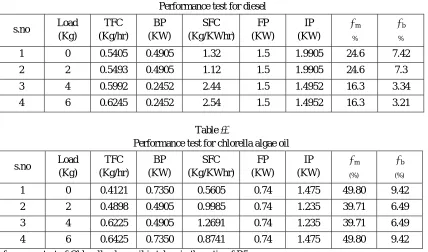
Table І
Performance test for diesel
s.no Load
(Kg) TFC (Kg/hr) BP (KW) SFC (Kg/KWhr) FP (KW) IP (KW) ήm % ήb %
1 0 0.5405 0.4905 1.32 1.5 1.9905 24.6 7.42
2 2 0.5493 0.4905 1.12 1.5 1.9905 24.6 7.3
3 4 0.5992 0.2452 2.44 1.5 1.4952 16.3 3.34
4 6 0.6245 0.2452 2.54 1.5 1.4952 16.3 3.21
Table ІІ
Performance test for chlorella algae oil
s.no Load
(Kg) TFC (Kg/hr) BP (KW) SFC (Kg/KWhr) FP (KW) IP (KW) ήm (%) ήb (%)
1 0 0.4121 0.7350 0.5605 0.74 1.475 49.80 9.42
2 2 0.4898 0.4905 0.9985 0.74 1.235 39.71 6.49
3 4 0.6225 0.4905 1.2691 0.74 1.235 39.71 6.49
4 6 0.6425 0.7350 0.8741 0.74 1.475 49.80 9.42
[image:3.612.95.523.457.709.2]Technology (IJRASET)
TFC: Total fuel consumption, BP: Brake power, SFC: Specific fuel consumption
FP: Frictional power, IP: Indicated power, ήm: Mechanical efficiency, ήb: brake thermal efficiency.
Table III Emission test for diesel
s.no Load (Kg) CO (%) HC (%) CO2 (%) O2 (%) NOX (%)
1 0 0.03 11 0.8 19.93 12
2 2 0.03 10 0.7 19.84 20
3 4 0.02 9 0.9 19.70 24
[image:4.612.95.524.132.399.2]4 6 0.02 10 1.1 19.36 32
Table IV
Emission test for chlorella algae oil
s.no Load (Kg) CO (%) HC (%) CO2 (%) O2 (%) NOX (%)
1 0 0.03 20 1 19.38 21
2 2 0.03 18 0.3 19.04 28
3 4 0.03 15 1.6 18.54 49
4 6 0.03 19 2 17.90 75
IV. RESULT AND DISCUSSION
A. Performance Test
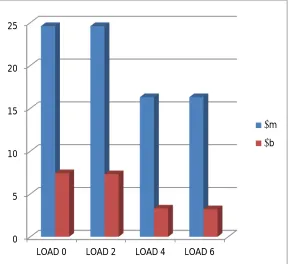
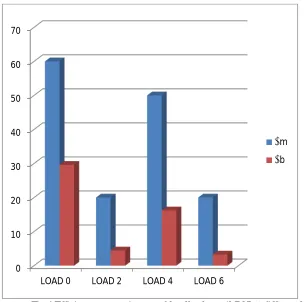
[image:4.612.163.452.440.704.2]The performance test of the diesel and chlorella algae oil blend B5, B15, B25 is done on single cylinder four stroke diesel engine is calculated and plotted as bar diagram. These bar diagram are given below,
Fig 1.Efficiency comparision on diesel at different load 0
5 10 15 20 25
LOAD 0 LOAD 2 LOAD 4 LOAD 6
ήm
Technology (IJRASET)
Fig 2.Efficiency comparison on chlorella algae oil B5 at different load Fig 3.Efficiency comparison on chlorella algae oil B15 at different load
Fig 4.Efficiency comparison on chlorella algae oil B25 at different load
The result shows that the mechanical and brake thermal efficiency of chlorella algae oil at blend 15 is higher than the diesel.Particularly, At load 0 and load 2 the effiency is better than diesel.
B. Emission Test
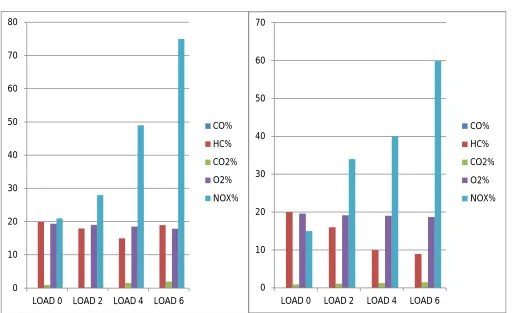
The emission test of the diesel and chlorella algae oil blend B5, B15, B25 is done on single cylinder four stroke diesel is calculated and plotted as bar diagram.The bar diagram is given below,
0 5 10 15 20 25 30 35 40 45 50
LOAD 0 LOAD 2 LOAD 4 LOAD 6
ήm
ήb
0 10 20 30 40 50 60 70
LOAD 0 LOAD 2 LOAD 4 LOAD 6
ήm
ήb
0 10 20 30 40 50 60 70
LOAD 0 LOAD 2 LOAD 4 LOAD 6
ήm
Technology (IJRASET)
[image:6.612.123.495.67.363.2]Fig 5. Emission comparison on diesel at different load
Fig 6.Emission comparison on chlorella algae oil B5 Fig 7.Emission comparison on chlorella algae oil B15 at different load at different load
0 5 10 15 20 25 30 35
LOAD 0 LOAD 2 LOAD 4 LOAD 6
CO%
HC%
CO2%
O2%
NOX%
0 10 20 30 40 50 60 70 80
LOAD 0 LOAD 2 LOAD 4 LOAD 6
CO%
HC%
CO2%
O2%
NOX%
0 10 20 30 40 50 60 70
LOAD 0 LOAD 2 LOAD 4 LOAD 6
CO%
HC%
CO2%
O2%
[image:6.612.58.570.378.691.2]Technology (IJRASET)
Fig 8.Emission comaprison on chlorella algae oil B25 at different load
The resut shows that the emission of chlorella algae oil is slightly lower than the diesel.Especially, at the load 0 and 2. The emission of algae oil is very low.
C. Test Comparison
The comparsion is done on both of the fuel to find the best alternative fuel for the single cylinder four stroke diesel engine.The comparision of diesel and chlorella algae oil at various load is given in bar diagram.
[image:7.612.202.430.72.279.2] [image:7.612.67.549.401.701.2]The perforamce and emission comparision is plotted in bar diagram at load 4 and load 6 respectively for both the fuel.
Fig 9.Performance comparision of both fuel at load 4 Fig 10.Emission(HC) comparision of both fuel at load 6 0
10 20 30 40 50 60 70 80
LOAD 0 LOAD 2 LOAD 4 LOAD 6
CO%
HC%
CO2%
O2%
NOX%
0 10 20 30 40 50 60
ήm
ήb
0 2 4 6 8 10 12 14 16 18 20
DIESEL BLEND 5 BLEND 15 BLEND 25
HC
Technology (IJRASET)
D. Summary
Table V summary table
Parameters Taken Test taken on diesel Test taken on
chlorella algae oil blend 5
Test taken on chlorella algae oil blend 15
Test taken on chlorella algae oil
blend 25
R. Velappan et.al High Low Low High
Rangwala et.al High - High Low
G.Lakshmi et.al Low High High -
A.Muthukumar et.al - Low High High
F.Halek et.al High High - High
OUR WORK High High Low High
V. CONCLUSION
Based on the experimental investigations carried out on the single cylinder four stroke diesel engine with neat diesel fuel and B5,B15,B25 algae fuel at constant speed the following conclusion is drawn .The mechanical and thermal efficiency of the chlorella algae oil are higher than the diesel. In the algae oil, the mechanical efficiency at load 6 is greater which is 50.02%.And the thermal efficiency is higher at load 6 which is 16.22%. the comparison is made on the HC gas. The chlorella algae oil is moreover similar to the diesel .Finally we concludethat performance of chlorella algae oil is higher than the diesel. Emission of chlorella algae oil is lower than the diesel particular HC emission.
VI. REFERENCES
[1] Saddam H. Al-lwayzy, Talal Yusaf 1 and Raed A. Al-Juboori, 2014.. Biofuels from the Fresh Water Microalgae Chlorella vulgaris (FWM-CV) for Diesel Engine. Energies, 7, 1829-1851; doi: 10.3390/en7031829.
[2] Muhammad Aminul Islam , Marie Magnusson , Richard J. Brown , Godwin A. Ayoko , Md. Nurun Nabi and Kirsten Heimann.,2013. Microalgal Species Selection for Biodiesel Production Based on Fuel Properties Derived from Fatty Acid Profiles, Energies,6, 5676-5702; doi:10.3390/en6115676.
[3] R.Velappan1, S. Sivaprakasam and M. Kannan., 2015. “Study the Performance of Algae Oil in Diesel Engine with Various Injection Pressure, International Research Journal of Engineering and Technology (IRJET), Volume: 02 Issue: 05.
[4] Rangwala, Juzer Ali, Sarasan Geetha.., 2014. Synthesis of Medicinal Soap from Non Edible(Jatropha Oil)and Study of its Quality Parameters including Antimicrobial Activity, Indian Journal of Chemical Technology, Vol. 20.
[5] G Lakshmi, Narayana Rao, SSampath, K Raja ., 2015. Experimental Studies on the Combustion and emission Characteristics of a Diesel Engine Fuelled with Used Cooking Oil MethylEster and its Diesel Blends, International Academy of Ecology and Environmental Sciences.
[6] A.Muthukumar, S. Elayaraja, T. Ajithkumar, S. Kumaresan and T. Balasubramanian ., 2012. Biodiesel production from marine microalgae Chlorella marina
and Nannochloropsis salina , Journal of Petroleum Technology and Alternative Fuels Vol. 3(5), pp. 58-62.
[7] Bilal M. McDowell Bomani, Dan L. Bulzan, Diana I. Centeno-Gomez, and Robert C. Hendricks Glenn Research Center, Cleveland, Ohio., 2009. Biofuels as an Alternative Energy Source for Aviation—A Survey, nasa/tm—2009-215587.