Deposited research article
The genetic structure of recombinant inbred mice:
High-resolution consensus maps for complex trait analysis
Robert W Williams*†, Jing Gu*, Shuhua Qi* and Lu Lu*†
Address: *Center of Genomics and Bioinformatics, *Center for Neuroscience, †Department of Anatomy and Neurobiology, University of Tennessee Health Science Center, College of Medicine, Memphis, TN 38163, USA.
Correspondence: Robert W Williams. E-mail: [email protected]
comment reviews reports deposited research interactions information refereed research .deposited research
AS A SERVICE TO THE RESEARCH COMMUNITY, GENOME BIOLOGY PROVIDES A 'PREPRINT' DEPOSITORY TO WHICH ANY PRIMARY RESEARCH CAN BE SUBMITTED AND WHICH ALL INDIVIDUALS CAN ACCESS FREE OF CHARGE. ANY ARTICLE CAN BE SUBMITTED BY AUTHORS, WHO HAVE SOLE RESPONSIBILITY FOR THE ARTICLE'S CONTENT. THE ONLY SCREENING IS TO ENSURE RELEVANCE OF THE PREPRINT TO
GENOME BIOLOGY'S SCOPE AND TO AVOID ABUSIVE, LIBELLOUS OR INDECENT ARTICLES. ARTICLES IN THIS SECTION OF THE JOURNAL HAVE NOTBEEN PEER REVIEWED. EACH PREPRINT HAS A PERMANENT URL, BY WHICH IT CAN BE CITED. RESEARCH SUBMITTED TO THE PREPRINT DEPOSITORY MAY BE SIMULTANEOUSLY OR SUBSEQUENTLY SUBMITTED TO GENOME BIOLOGY OR ANY OTHER PUBLICATION FOR PEER REVIEW; THE ONLY REQUIREMENT IS AN EXPLICIT CITATION OF, AND LINK TO, THE PREPRINT IN ANY VERSION OF THE ARTICLE THAT IS EVENTUALLY PUBLISHED. IF POSSIBLE, GENOME
BIOLOGYWILL PROVIDE A RECIPROCAL LINK FROM THE PREPRINT TO THE PUBLISHED ARTICLE. Posted: 18 July 2001
GenomeBiology2001, 2(8):preprint0007.1-0007.44
The electronic version of this article is the complete one and can be found online at http://genomebiology.com/2001/2/6/preprint/0006 © BioMed Central Ltd (Print ISSN 1465-6906; Online ISSN 1465-6914)
Received: 25 June 2001
Research
The genetic structure of recombinant inbred mice: High-resolution
consensus maps for complex trait analysis
Robert W Williams
*
†, Jing Gu
*
, Shuhua Qi
*
and Lu Lu
*
†Address:*Center of Genomics and Bioinformatics, *Center for Neuroscience, †
Department of Anatomy and Neurobiology, University of Tennessee Health Science Center, College of Medicine, Memphis, TN 38163, USA
E-mail: [email protected]; [email protected]; [email protected]; [email protected]
Correspondence: Robert W Williams
All authors: TELE: (901) 448-7018, FAX (901) 448-7193
ABSTRACT
Background: Recombinant inbred (RI) strains of mice are an important resource used to map
and analyze complex traits. They have proved particularly effective in multidisciplinary genetic studies. Widespread use of RI strains has been hampered by their modest numbers and by the difficulty of combining results derived from different RI sets.
Results: We have increased the density of typed microsatellite markers 2- to 5-fold in each of
several major RI sets that share C57BL/6 as a parental strain (AXB, BXA, BXD, BXH, and CXB). A common set of 490 markers was genotyped in just over 100 RI strains. Genotypes of another ~1100 microsatellites were generated, collected, and error checked in one or more RI sets. Consensus RI maps that integrate genotypes of ~1600 microsatellite loci were assembled.
The genomes of individual strains typically incorporate 45–55 recombination breakpoints. The
collected RI set—termed the BXN set—contains approximately 5000 breakpoints. The
distribution of recombinations approximates a Poisson distribution and distances between breakpoints average about 0.5 cM. Locations of most breakpoints have been defined with a precision of < 2cM. Genotypes deviate from Hardy-Weinberg equilibrium in only a small number of intervals.
Conclusions: Consensus maps derived from RI strains conform almost precisely with theoretical
expectation and are close to the length predicted by the Haldane-Waddington equation (X3.6 for
a 2–3 cM interval between markers). Non-syntenic associations among different chromosomes
introduce predictable distortions in QTL data sets that can be partly corrected using two-locus correlation matrices.
BACKGROUND
main advantage in this context is that the complex genetic and epigenetic correlations between interconnected parts of the brain can be explored using complementary molecular,
developmental, structural, pharmacological, and behavioral techniques. Gene effects can also be tested under a spectrum of environmental perturbations and experimental conditions. RI strains can be exploited to expose gene-environment interactions and gene pleiotropy. These important facets of genetics can only be explored with difficulty using conventional mapping populations in which each genome is unique.
A third advantage of RI strains is that genotypes generated by different groups using a variety of methods can be pooled to generate high-density linkage maps. As a result, loci that segregate in RI sets can often be mapped with impressive precision without genotyping. This attribute was a significant advantage before the advent of efficient and easy PCR genotyping methods [15]. Unfortunately, over the last decade databases of RI genotypes have accumulated many typing errors. Each error expands distances between marker loci and degrades linkage, inevitably blurring associations between genotypes and phenotypes and making it difficult to map traits, whether they are Mendelian or quantitative in nature. The accumulation of false recombinations has become extreme in common RI sets. For example, the map of Chr 1 in the complete BXD data set (Mouse Genome Informatics Release 2.5:
www.informatics.jax.org/searches/riset_form.shtml) is based on 160 linked marker loci and is an astonishing 1305 cM long. This map is approximately 12 times the length of an F2 map of Chr 1, and just over 3 times the length expected of an RI map of Chr 1. The accumulation of typing errors has led to efforts to reconstitute maps using curated subsets of markers for which genotypes can be adequately and independently verified. Sampson and colleagues [16]
assembled maps for the AXB and BXA recombinant inbred strains that improved the utility of this set. Similarly, Taylor and colleagues [17] assembled comparable high quality maps for the complete set of 36 BXD strains that are based almost entirely on easily typed and verified microsatellite markers.
made between pairs of RI strains and 5050 unique isogenic but non-inbred RIX genometypes can be constructed from 101 RI strains. Selected subsets of this huge pool of recombinant F1
genomes can be made by crossing those RI strains with breakpoints in intervals thought to harbor QTLs. These interval-specific RIX progeny are phenotyped and used to refine the genetic
analysis of complex traits. Knowing the precise location of breakpoints in RI lines also makes it possible to map modifier loci of mutations by simply making a series of F1 crosses between inbred carrier stock (for example a knockout carried on a C57BL/6 background) and fully typed RI lines. These F1 crosses have a genetic structure similar to a conventional N2 backcross, but they will not need to be genotyped and they have the major advantage that groups of isogenic backcross progeny can be typed to obtain much more reliable scores.
Our second aim has been to describe the recombination characteristics of typical RI strains and their chromosomes in a more theoretical context. We empirically tested the Haldane-Waddington equation of map expansion in sib-mated RI strains. We also tested relatedness among RI lines,
and measured deviations from Hardy-Weinberg equilibrium associated with 10–30 years of
inbreeding, genetic drift, mutation, and selection.
Our third aim has been to help resolve a serious but unrecognized problem in QTL mapping that arises from non-syntenic genetic correlations within mapping panels. Genetic correlations between intervals on different chromosomes can be high in RI sets and this can result in spurious results and false positive QTLs. We provide detailed correlation matrices that can be used to detect and control for non-syntenic association.
RESULTS
The results are divided into two sections. The first summarizes the RI consensus map and genotypes of individual strains. The second section considers the structure of the multiple generation meiotic recombination maps of RI strains. We highlight the problem of non-syntenic association that is a feature of these maps and we outline a solution to minimize the risk of type I and type II error in QTL mapping studies.
RI consensus maps of mouse chromosomes
number of well defined and correctly positioned SDPs of marker loci. We therefore concentrated genotyping efforts on those intervals with comparatively low densities of fully typed
microsatellite markers or those intervals that harbored large numbers of recombinations between neighboring markers. One goal in generating dense maps for each chromosome was to discover and verify as many recombination breakpoints and SDPs as possible using available
microsatellite primer pairs. Ideally, in high density genetic maps the number of markers should exceed the number of SDPs, and all recombination breakpoints in an set RI would be defined with subcentimorgan precision. We have worked with more than 1600 microsatellite markers, a number that is still insufficient to reach a subcentimorgan goal. However, the density of markers on most chromosomes is sufficient to locate the majority of recombination breakpoints within ±2 cM.
Fewer than 25 common microsatellite markers had been typed on all major RI sets when we began this work. This number has been increased to 490 common makers (Table 1). These
markers were used to assemble the consensus BXN maps—B for the C57BL/6 allele that all sets
have in common and N for the not-B6 parental allele that differ among the four RI sets (A/J in
AXB-BXA, DBA/2J in BXD, C3H/HeJ in BXH, and BALB/cByJ in CXB). The set of 490 shared markers are supported by an additional 1089 MIT markers that we or other groups have typed in at least one RI set (Table 2). In the BXN database summarized in Table 1 any pair of RI sets shares between 500 and 600 fully genotyped markers. The two largest RI sets, AXB-BXA and BXD, have been typed at 591 common markers. The composite BXN maps are based on a total of just under 1600 microsatellite makers and just over 100 RI strains (Tables 1 and 2).
Undiscovered recombinations and SDPs. The number of recombinations in RI sets still significantly exceeds the number of SDPs that have been unequivocally defined. Based on current marker density we estimate that we have defined from 37% (AXB/BXA) to 59% (CXB) of the total set of SDPs (Table 3). The entire BXN set contains approximately 4800 known recombination breakpoints (Tables 3 and 4). There are likely to be another 400 breakpoints that we have not yet detected. To discover 623 (41%) of the 1492 SDPs in the BXD set required 936 selected markers. Recovering the majority of the remaining SDPs could require an additional 1000 to 1500 well placed marker loci. The density of informative microsatellite markers is not yet dense enough to define many more SDPs in the BXN set, but once SNP and microsatellite maps have been fully integrated into chromosome sequence databases, it will be straightforward
Error checking. To minimize genotyping errors we retyped many markers, particularly those that were associated with unusually large numbers of recombination events. We were
particularly interested in minimizing the number of genotypes that appeared to be associated
with two closely located recombination events—what are sometime referred to as double
recombinant haplotypes. These haplotypes appear to be the result of two separate crossover events, one of which is just proximal to a particular marker and the other of which is just distal to
the same marker. For example, the haplotype of a short chromosome interval, -B-B-B-N-B-B-B-,
is associated with two recombinations that flank the central marker with the N genotype. Because
of interference, the occurrence of two recombinations within 10 cM is highly improbable in an F2 intercross, and consequently, double recombinants are often used as a measure of genotyping error or incorrect marker order. However, in RI strains recombination events accumulate over many generations, and two or more recombinations can therefore be extremely close to each other and can produce true double recombinant haplotypes. It is therefore necessary to verify, rather than discard, all apparent double recombinants in RI strains. We checked our own marker genotypes and the majority of microsatellite markers typed by other investigators genotypes they were associated with double recombination events in one of more RI strain. When two or more strains contributed to double recombinants we usually retyped all strains. Approximately 150 double recombinant haplotypes (and 300 false recombinations) were eliminated in the process of error checking. Our genotypes therefore differ from those of many microsatellites reported in
original publications and listed in the MGI release 2.5 (www.jax.org). In a few instances, our
revisions have generated new (but verified) double recombinant haplotypes.
We discovered unexpected polymorphisms at several loci in a few lines and all were scored as unknown (U) (Table 5). The clustering of aberrant products in AXB13 and AXB14 is consistent with the common origin of these strains from a partly inbred progenitor line. However the genotypes of the other three sets of strains (e.g., AXB1 and AXB3) are generally completely independent.
PCR primer pairs in several intervals gave two bands consistent with a genuine heterozygous haplotype. Heterozygous loci are rare among the fully inbred RI strains but they are fairly common among new BXH strains that were genotyped at the tenth to 16 generation of
inbreeding. In scoring recombination frequency we treated all heterozygous loci and intervals as if they had not been typed. Mutations in microsatellite loci may be responsible for some
Changed locus order. The order of loci of the BXN consensus maps generally conforms to that of the chromosome committee reports (CCR) and the MIT-Whitehead genetic maps (Table 2). In about 130 instances we have changed the order of loci over short intervals. For example,
D1Mit276 and D1Mit231 on proximal Chr 1 do not recombine in the MIT F2 cross, but in the BXN set there is a single recombination between these markers in BXA11 that is most consistent with a reversal of order relative to the CCR (compare the columns labeled CCRcM, MITcM, and BXNcM in Table 2). The only non-trivial discrepancy was on proximal Chr 15. We reordered approximately 32 loci on Chr 15 to improve linkage statistics. We have not attempted to integrate the BXN data with numerous other mapping panels, and it is likely that original CCR order will often be well supported by other large mapping panels or rapidly improving physical maps. Full sequence data will soon resolve these minor inconsistencies.
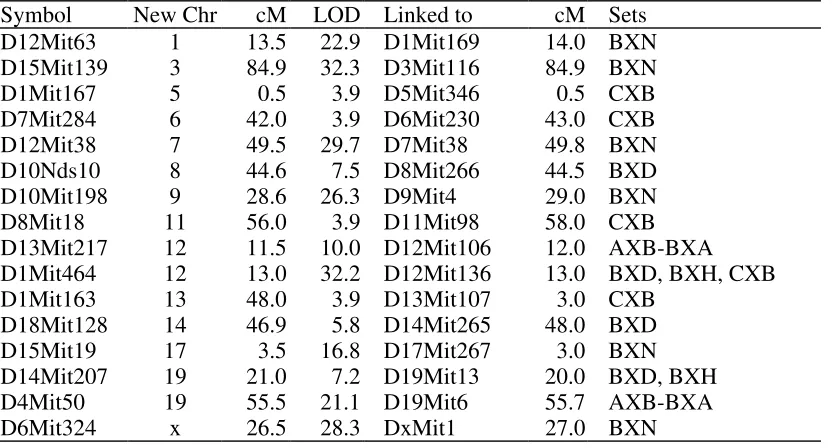
Reassigned microsatellite loci. A number of microsatellite loci were reassigned to locations on chromosomes other than those expected on the basis of their original assignments (Table 6). Mapping data in one or more of the RI sets is consistent with a reassignment of 16 microsatellite loci to different chromosomes. All of these reassignments are provisional, particularly those with
LOD scores of less than 10. In several cases, (e.g., D10Nds10) we have reassigned microsatellite
loci typed by other investigators that now are linked to new and firmly mapped markers. All
primers used to amplify these microsatellites (except D10Nds10) were resynthesizing to confirm
that they are identical to those originally specified by Dietrich and colleagues [19].
Individual maps are based on genotypes of as few as 37 markers (Chr X) to as many as 129 makers (Chr 1) per chromosome (Table 1). The mean separation between markers is
approximately 1 cM (0.95 cM using CCR maps as a reference and 0.87 cM using the RI maps themselves). When the 577 markers that do not have unique SDPs are excluded from the analysis, the average separation increases to 1.2 cM using CCR maps and 1.4 cM using the RI
data. Typical resolution of the BXN set for mapping a Mendelian trait is 1–2 cM. Approximately
90% the mouse genome is currently less than 2 cM from a typed microsatellite marker in the RI set. The asymptotic resolution of the set of BXN strains given infinitely dense maps in which
every possible SDP has been characterized would average about 0.3–0.4 cM. There are currently
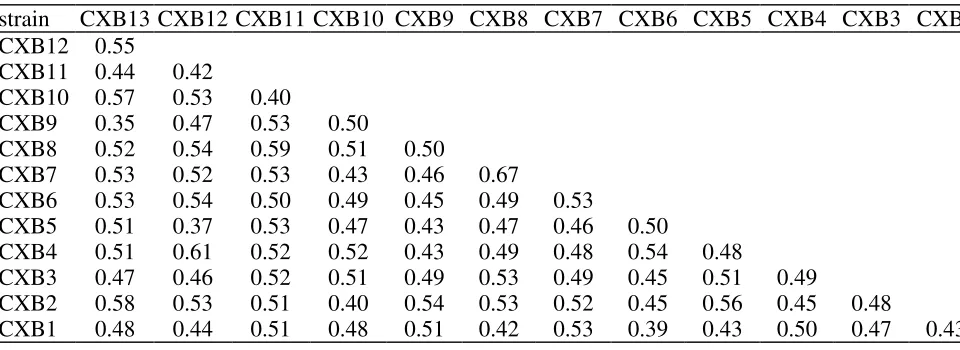
Strain independence. Several RI strains share common haplotypes and recombination breakpoints. This non-independence of RI lines will distort genetic maps. To systematically search for and eliminate partial duplicate RI lines we constructed a genotype similarity matrix for all strains using the QTL analysis program Qgene [20]. An example of a small part of this matrix is illustrated in Table 7 for the CXB set.
As already noted by Sampson et al. [16], three sets of AXB and BXA strains show high genetic similarity, and genotypes of four strains should be excluded from most genome-wide mapping panels. Phenotype data obtained from members of the three groups listed below should often be collapsed and treated as a single strain.
1. BXA8 and BXA17: 99.8% genetic identity. Only two markers are known to be
polymorphic, D3Mit392 and D6Mit108. The polymorphism at D6Mit108 has been
verified using independent DNA samples from these two strains. BXA17 is actually a
direct derivative of BXA8 separated in 1996–1997 [16]. Any divergence in genotypes or
phenotypes is due to the recent generation and fixation of new mutations in these two separately maintained lines.
2. AXB18, AXB19, and AXB20: 97% to 99% identity among any of the three pairs. 3. AXB13 and AXB14: 92% identity.
These three sets of strains were treated as three single strains when analyzing recombination frequencies.
The mean allele similarity of the remaining strains averages almost precisely 50%. The distribution of values is symmetrical about the mean (Fig. 2) with the great majority of strain pairs falling in the range of 30% to 70% similarity. The highest remaining similarities within RI sets are between BXD13 and BXD41 (74%), AXB6 and AXB17 (73%), BXHB2 and BXH9 (71%), AXB6 and AXB12 (70%), BXD28 and BXD33 (69%), BXD19 and BXD29 (68%), and AXB11 and AXB14 (67%). These values are not significantly higher than the similarity scores typically noted across RI sets.
Residual heterozygosity. In theory a set of 75,000 genotypes generated across the genome of
100 RI strains should detect only a single residual heterozygous loci at generation F55 of inbreeding (Fig. 2, fine line; the inbreeding coefficient at F55 is 0.99998812). DNA from most lines was extracted in the 1990s at F generations between F20 and F70 (see Methods and
to D1Mit490; AXB21 from D2Mit102 to D2Mit420, AXB24 at D3Mit62, BXA23 at D5Mit95,
AXB3 and BXA16 at D12Mit167, BXA20 from D13Mit224 to D13Mit254; BXD31 at
D9Mit243, BXD34 at D7Mit281, BXD37 at D1Mit83; BXH12 at D1Mit417, BXH10 at
D12Mit167; CXB8 from D1Mit361 to D1Mit291). DNA samples were taken from single animals of each strain and for this reason these estimates of residual heterozygosity underestimate the total heterozygosity about twofold.
The central part of Chr 1 is interesting because it is heterozygous in three strains (BXD37, BXH12, and BXA20). There is also an interval that is approximately 2.5-cM-long that is apparently maintained in heterozygosity in AXB21 on Chr 2. Such maintenance should be accompanied by reduced fecundity in this line if homozygotes are lethal or sublethal. This would account for poor breeding performance. It is also possible the heterozygosity is the result of a mutation, but if this were the case we would expect novel length polymorphisms, and the two alleles were usually the expected parental lengths.
Structure of RI genomes
RI mean map lengths. The mean frequency of recombinations, CRI,between two linked markers
in an RI strain generated by breeding siblings is approximately 4c/(1+6c) where c is the recombination fraction per meiosis [21, 22]. An infinitely dense RI map should average four times the length of the conventional one-generation F2 map. Most expansion is achieved in the first few generations, and by F7 the genetic map is approximately three times the length of an F2 map (Fig. 3). The expectation is that a map based on loci that are spaced at intervals of 1 cM (c = 0.01 in an intercross) will be expanded approximately 3.66-fold. Similarly, a low-density map based on markers that are spaced at 16 cM intervals will be expanded 2-fold. F2 and N2 maps generated using uniform typing procedures typically have a cumulative length of 1300 to 1400 cM. Five conventional crosses that we generated (four F2s and one N2, each genotyped at 91 to 148 loci) average 1320 ± 50 (SEM) cM in length. In comparison the fully error-checked native BXN map is approximately 3.6- to 3.7-fold longer, or a total of 4786 cM. The expansion
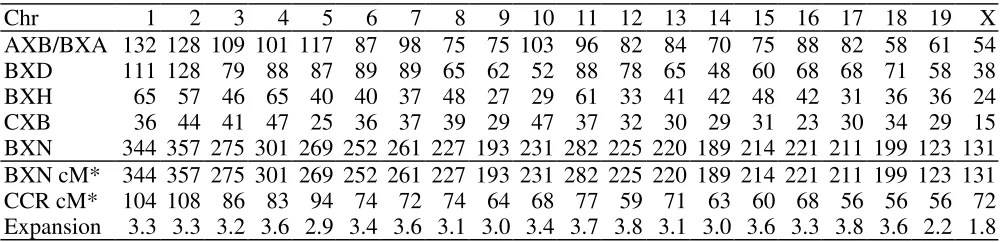
averages approximately 3.4-fold when the comparison is made to the CCR consensus maps (Fig. 4, Table 4). The expansion between common proximal and distal markers ranges from 2.8 in Chr 5 to 3.8 in Chr 12. In general, the expansion estimate of 3.6-fold agrees well with the
chromosome only recombines with half the frequency of the autosomes, and for this reason its expansion is only 1.8 fold.
Comparison to other maps. The summed length of all chromosomes is approximately 1413 cM
when values are converted from RI recombination frequencies to those expected of typical single-generation meiotic maps. The corresponding CCR maps have a cumulative length of 1494 cM between the same markers. The MIT-Whitehead microsatellite maps have a cumulative length of approximately 1384 cM. The agreement is excellent.
Recombination density per RI strain. Individual RI strains contain an average of 47
recombinations with a range that typically lies between 40 and 60 (Fig. 4). The 13 CXB strains are associated with a total of 671 recombinations, an average of 52 per strain. The BXD strains are associated with approximately 1500 recombinations, an average of about 42 per strain, and approximately one recombination per centimorgan on a standard genetic map (Tables 3 and 4). There is considerable variation in the total load of recombinations and map expansion per strain: from a low expansion of 2.24 in BXD40 (the RI strain with the fewest recombinations) to a high of about 6 in BXH6 (Fig. 4). These estimates are systematically deflated by a failure to discover recombinations in sparsely mapped regions (regions where the recombination fraction c is as high as 0.1) but are inflated by residual typing errors and errors of marker order.
Recombination density per chromosome. Single chromosomes in RI strains accumulate as
many as 12 recombinations, but across the whole set the recombination density averages about 2.4 recombinations per chromosome. The mean extends from 3.47 recombinations for Chr 1 to 1.88 for Chr 9. A Poisson model fits the distribution of recombination events per chromosome
reasonably well and most chromosomes have insignificant .2 values. High .2 for individual
chromosomes are generally due to a small number of apparently highly recombinant chromosomes in particular strains. These highly recombinant chromosomes are probably associated with residual typing errors or incorrect marker order.
Segregation distortion and Hardy-Weinberg equilibrium expectation of allele fixation in RI
sets. In the absence of selection, approximately 50% of the strains should have inherited B alleles at each marker. A chi-square statistic can be used to assess whether the segregation ratio of a particular marker differs significantly from expectation. Only the 11 intervals listed in Table 8 have chi-squared values that are significant at the 0.01 level. Eight of 11 intervals are biased in
twice as many strains with B alleles as N alleles. The opposite pattern is seen on chromosomes 9, 11, and 12. Given the large number of comparisons, many instances of segregation distortion may be type I statistical errors. In collaboration with the Mammalian Genotyping Service (http://research.marshfieldclinic.org/genetics/Genotyping_Service/mgsver2.htm), we recently genotyped a tenth-generation advanced intercross between C57BL/6J and DBA/2J (genotype
data for this cross are available at www.nervenet.org. It is therefore possible to test whether
similar segregation distortion patterns are present in this related multigeneration cross. The short answer is that the segregation distortions noted in the BXN RI strains are replicated in 6 of 11
intervals. The correlation between ratios of alleles (logarithm of B:N) in these intervals was
positive (r = 0.41). It is therefore likely that several of the intervals marked in Table 8 with
asterisks represent regions that harbor loci that affect fitness.
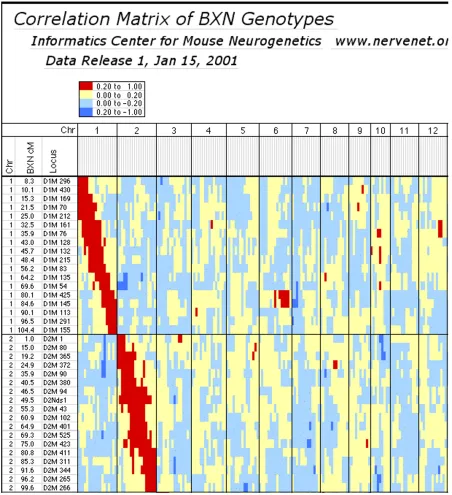
Non-syntenic associations. One important issue in using RI strains for mapping complex traits is that intervals on different chromosomes can become tightly associated in a statistical sense. This non-syntenic association can arise either as a result of random fixation of alleles on
different chromosomes during the production of RI strains or can arise as a result of selection for particular combinations of alleles on different chromosomes. Similar patterns of non-syntenic disequilibrium are common in recently admixed human populations and often lead to false positive signals when mapping complex traits. In mice even a modest selection coefficient expressed over 10 generations of inbreeding can generate positive and negative non-syntenic
disequilibrium throughout the genome. For example, if the combination of B alleles on distal Chr
1 and B alleles on proximal Chr 19 is favorable for fitness, then these two intervals will
effectively be in linkage disequilibrium in the final RI set. Disequilibrium can also take on the
form of strong negative correlations and B alleles may be associated strongly with the group of N
alleles.
We searched for marked deviations from the expected Hardy-Weinberg two-locus equilibrium by making a series of large correlation matrices of SDPs of marker pairs. This was done for the entire BXN set and for the constituent RI sets. Table 9 summarizes the most extreme positive and negative correlations among the composite set of 102 independent BXN RI strains. Whether due to chance fixation, selection and epistasis, non-syntenic associations of the sort illustrated in Table 9 are a major source of both false positive and negative results in using RI sets for
provisionally mapped to see how summed effects of single or multiple QTLs might produce spurious QTLs in regions not actually associated with trait variance.
Controlling for non-syntenic association. Non-syntenic associations among loci and intervals can be computed in advance of QTL mapping. It is therefore possible to statistically control for
genetic correlations. For example, in Table 9 the genotypes at marker D1Mit83 can be partly
predicted by genotypes at markers on Chr 7 and Chr 10. If the genotype at D1Mit83 is treated
statistically as a dependent variable and markers on Chr 7 and 10 are used as predictors, then one
can compute the residual genotype, or independent contribution of D1Mit83 and any other
marker or interval to the quantitative trait. Unlike composite interval mapping, the set of controlled loci will vary for each marker and interval. This procedure will reduce Type I error, but there will be a regional loss of power. The correction will introduce blind spots in a genome scan. In extreme cases (usually small RI sets), intervals that can be perfectly predicted by small numbers of other non-syntenic intervals will effectively be eliminated from a mapping study and QTLs in those intervals will be missed. For this reason, it is essential to perform each genome-wide scan both with and without control for non-syntenic association. Single QTLs may occasionally be assigned to two or more physically unlinked intervals.
DISCUSSION
Synopsis
Recombinant inbred strains are currently one of the best genetic resources for exploring phenotypic variance modulated by complex mixtures of genetic and environmental factors. Having a renewable resource of genetically defined genomes is a tremendous advantage in exploring gene pleiotropy, genetic correlation, epistasic interactions, and reaction norms. However, their modest numbers have impeded the widespread adoption of RI strains by mammalian geneticists. To improve the utility and power of complex trait analysis and to provide a better basis for community-based QTL mapping we have increased marker density in several of the major sets of RI lines and have merged data from over 100 mouse RI strains using a framework based on 490 shared markers. Approximately 1000 unique strain distribution
patterns (SDPs)—an average of about one per 1.5 cM were defined and mapped in the collected
equation, the RI maps have a cumulative length of 1400 cM, perfectly consistent with those of chromosome committee reports.
Making better RI resources
The usefulness of RI strains for mapping is largely a function of the number of known recombination breakpoints that they harbor. By genotyping and selectively breeding the most highly recombinant F2 animals it should be possible to generate RI strain sets that significantly exceed the map expansion predicted by the Haldane-Waddington equation; an equation that
assumes random mating of sibs. A 6x to 8x map should be attainable, particularly if
recombinations are tracked during the inbreeding process (Fig 3). Recombination density could be further increased by starting RI strains using either advanced intercross progeny or
heterogeneous stock (Fig. 3).
Use of the BXN set
Most mapping software applications used by mouse geneticists are adapted for diallele crosses of various types. The BXN data set has therefore been formatted in a way that collapses all
non-B6 alleles into a single N class so that the collected set of just over 100 strains can be used
without complication with software such a Map Manger QTX [23]. There are obvious
limitations that follow from the collapse of all non-B alleles (A/J, DBA/2J, C3H/HeJ, and
BALB/cByJ) into a single category. Geneticists using the BXN set should begin virtually all studies of non-Mendelian traits by mapping with the individual component RI sets (AXB-BXA, BXD, BXH, and CXB) to maximize power and to detect possible levels of allele effects. Because the BXN set includes 490 common marker loci and a consistent alignment and integration of the component RI maps, it is now much easier to combine linkage likelihood
ratios from the component RI sets. A simple method based on Fisher’s method is described by
Williams and colleagues [8] in a study that pooled data from BXD and BXH sets. More sophisticated methods to automatically extract and combine linkage statistics from the multi-allele BXN sets will require modification of mapping application programs. Pooling data will require judicious and well justified statistical procedures. Combining data across the BXN sets can easily degrade a linkage analysis. The statistical exploration of different combinations of RI sets provides new degrees of freedom that may generate false positive results, but that may also generate interesting hypotheses regarding QTL action.
BXD database includes only microsatellite loci and excludes hundreds of potentially informative polymorphic loci, many in interesting genes. We regret having to employ this procrustean approach, but because of the difficulty of verifying genotypes and because numerous loci introduce improbable double-recombinant haplotypes, we have used exclusive criteria to ensure high quality maps. Those investigators interested in recovering some of these lost data should certainly refer to the comprehensive lists of genotypes maintained by the Mouse Genome
Database (www.informatics.jax.org/searches/riset_form.shtml). However, genotypes of any
marker or gene that introduce new double-recombinants into the BXN map should be regarded with a high level of suspicion.
Maximizing RI resources by the RIX method
The most common criticisms leveled at QTL mapping using RI strains is that the small number of lines limits both precision and power and that only those QTLs with very large effects can be detected reliably. The BXN set provides a partial solution to this problem by expanding the set of RI strains that can be treated statistically as a complex cross. A second objection to using RI strains to map traits is that fully inbred strains may provide unrepresentative trait values precisely because they are inbred. The abnormal genetic architecture of inbred strains and the fixation of multiple alleles that affect fitness will almost inevitably produce unusual pleiotropic and epistatic effects on a range of complex traits.
There is a surprisingly simple solution to these problems; namely to map QTLs using a set of F1 intercrosses between RI strains ([24], Threadgill DW, Williams RW and Manly KF personal comm). QTLs mapped using RI sets can be quickly verified and positionally refined by
role of parental effects (e.g., a BXD1 mother crossed to a AXB2 father, or vice versa). Like RI strains many isogenic individuals can be typed to reduce the non-genetic variance.
F1 and F2 crosses among any of the RI strains can also be used to verify the original assignment. Once QTLs have been mapped to candidate intervals, the subset of strains with recombinations within those intervals become an important resource for confirming and refining QTL location [25]. This is especially the case if one exploits the RIX method. For example, if a
QTL maps between 10 and 25 cM on Chr 1 in the BXD set (that is between D1Mit430 and
D1Mit375), and if B alleles in this interval are associated with high phenotypes, then the cross of
BXD15 by BXD20 may be particularly informative because the F1 hybrid is an obligatory B
homozygote on a short interval between 15 cM and 17 cM and is also an obligatory D
homozygote proximal to 13 cM and distal to 18 cM. A set of isogenic F1 RIX progeny made by crossing several RI lines with recombinations in a critical interval can be used to refine the probable position of a QTL. Map Manger QTX has now been updated to automatically generate the genotypes of the RIX progeny produced by a one-generation cross of RI parents
(http://mapmgr.roswellpark.org/mmQTX.html). Given this huge sample of unique F1 genomes, even modest quantitative differences between C57BL/6 and other strains should be readily mapped (or confirmed) using the BXN and RIX mapping.
Information content of RI strain sets
Despite the accumulation of genotypes in RI strains, these genetic resources have often not been typed with sufficient density to accurately define the frequency and positions of recombination breakpoints. For example, in the venerable set of 13 CXB strains only 11 unique SDPs had been assigned to Chr 1 prior to our work. With a more dense map of Chr 1 that is now based on
approximately 60 markers we have recovered at total of 38 recombinations on Chr 1—
approximately 3 recombinations per strain. The positions of these recombinations has been defined with a precision that ranges from 0.5 to 6.0 cM intervals (2.3 cM average) as referenced to standard CCR maps. Twenty-one of the 38 SDPs are represented by one or more of the marker genotype, but at least 17 SDPs remain to be defined and these SDPs unfortunately cannot be
predicted unambiguously. For example, if two adjacent markers P and D have genotypes
BBCCC and CCCCC, then there must be at least one unrecovered SDP between P and D.
Unfortunately, until we actually type markers in the P-D interval, we do not know whether the
intercalated SDP is BCCCC or CBCCC. To discover the missing SDP may require considerable
unrecovered SDPs lower the information content of an RI set. Their absence can significantly reduce linkage of both Mendelian and quantitative traits that are unlucky enough to be controlled by loci in the intervals with ambiguous SDPs.
How dense should a marker map be to define more than 90% of the total number of SDPs? With 862 markers, we were able to define approximately 60% of all likely SDPs among the 13 CXB strains. However, in the collected set of BXN RI strains, only 23% of the estimated 5000
possible SDP have be confidently defined with MIT microsatellites. We can estimate the density of the marker map that would be necessary to define 95% of the SDPs. For example, for the BXD set if one assumes a random and independent distribution of breakpoints across strains and a random distribution of markers, it would take a map with about 2,700 markers to define 95% of the 1,536 SDPs.
Power and precision of 100 RI strains
A set of 100 conventional RI strains will have twice the genetic variance as a matched set of 100 F2 progeny and four times that of 100 backcross progeny. This increased genetic variance comes at some cost: 100 F2 animals represent 200 meioses and contain almost 200 unique haplotypes per chromosome (the non-recombinant chromosomes reduce this number somewhat). RI strains are fully inbred and 100 lines represent almost 100 unique haplotypes per
chromosome. A set of 100 RI strains therefore has approximately twice the load of recombinations as 100 F2s. For a semidominant Mendelian trait or marker, 100 RI strains therefore provide twice the precision of 100 F2 progeny and four times the precision of 100 N2 progeny. When both genetic variance and recombination load are considered together, a set of 100 RI strains should be approximately four times as effective (precise) for mapping complex traits as an F2, and 8 times as effective as a backcross. This estimate assumes that only a single RI animal is sampled per line; a strategy that is appropriate for mapping marker loci and other Mendelian loci. The gain for mapping quantitative trait will be greater and will depend strongly on the heritability and to a lesser extent on the degree of dominance at each locus. Belknap [3] has compared the relative power of RI strains and F2 intercrosses under several models and assuming different levels of heritability. For morphometric traits such as brain weight, with narrow sense heritabilities of around 0.5, 100 RI strains will provide a level of precision and
power that is conservatively equivalent to that of 600–1000 F2 intercross progeny. The
BXN and sequencing efforts
Five of the widely used sets of RI strains that we have typed and analyzed share C57BL/6 as a parental strain. The genome of C57BL/6J is currently being sequenced as part of a public effort [26] and for this reason, the utility of the BXN set for converting QTLs to strong candidate genes will increase significantly in the next few years [27]. It will become far easier to generate
complete lists of positional candidate genes and then to obtain data on gene and protein
expression patterns. The two other major strains incorporated into the BXN set—A/J and
DBA/2J—are also being sequence by Celera Genomics, and in principle, it will be possible to
compare sequences of these three major strains to generate lists of possible allelic variants in
positional candidate genes. The recent cloning of the Sac QTL, a locus controlling sugar and
saccharin preference on distal Chr 4, provides a fine example of the increased power of QTL analysis. This QTL was initially mapped using 20 BXD stains [28, 29]. In the absence of
high-resolution mapping, but with astute analysis of human and mouse sequence data, Sac has been
identified almost simultaneously by several groups as the T1R3 receptor gene [30-34]. In a few
years, the cloning of Sac will probably be no more of a special exception than the cloning of
huntingtin was in the early 1990s [35].
MATERIALS AND METHODS
Strains and DNA
Genomic DNA from most recombinant inbred and parental strains was purchased from the Jackson Laboratory (www.jax.org). DNA was obtained from 40 of 41 AXB and BXA strains and
35 of 36 BXD strains, 13 CXB strains, and 12 BXH strains—100 strains total. For visual clarity
in this paper we have dropped hyphens and substrain designations from RI strain names. For example, strain BXD-1/Ty is referred to as BXD1. Databases and web-accessible data tables at www.nervenet.org also use this simplified nomenclature.
Philadelphia) was extracted from the spleen using a high salt procedure [36]. The new BXH
strains were generated by crossing C57BL/6J-c2J/c2J albino males with C3H/HeJ females and their
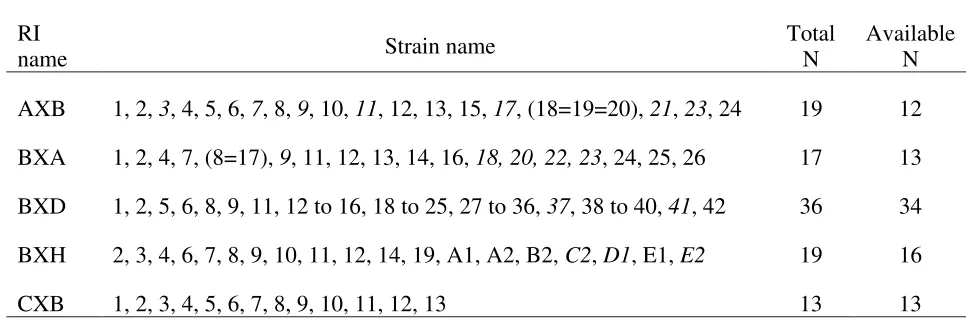
production and genotyping will be described in detail elsewhere (L Siracusa and RW Williams, personal comm). Three of the new BXH albino strains are no longer available (C2, D1, and E2). We genotyped 107 of RI strains. Several sets of strains share haplotypes (Table 10). We deleted redundant strains (AXB18, ABX20 and BXA17).
Strains BXHD1, BXHE1, BXHE2 were backcrossed to C57BL/6J for one generation before sib matings were begun. There is therefore a pronounced increase in the number chromosomal segments inherited from C57BL/6J. These N2-derived RI strains were dropped from most aspects of the analysis of RI genome structure. BXD41 has been extinct for several years and was never complete inbred. Although we have DNA for this strain our sample is from a F12 generation male. We did not genotype BXD41 in this study.
We refer to the collected RI set as the BXN set because each of the strains includes C57BL/6 (B6
or B) as one of the parental strains—the common substrain C57BL/6J in the case of AXB, BXA,
BXD, and BXH; and the substrain C57BL/6By in the case of CXB. The other parental strain in
the BXN set is not B6-derived: A/J in both AXB and BXA sets, DBA/2J in BXD, C3H/HeJ in
BXH, and BALB/cBy in CXB.
PCR
Microsatellite loci distributed across all autosomes and the X chromosome were typed using a modified version of the protocol of Love and colleagues [37] and Dietrich and colleagues [19] described in detail at www.nervenet.org/papers/pcr.html. A total of 1773 primer pairs (MapPairs) that selectively amplify polymorphic MIT microsatellite loci were purchased from Research
Genetics (www.resgen.com). Each 10 2l PCR reaction mixture contained 1X PCR buffer, 1.92
mM MgCl2, 0.25 units of Taq DNA polymerase, 0.2 mM of each deoxynucleotide, 132 nM of the
primers, and 50 ng of genomic DNA. Reactions were set up using a 96-channel pipetting station. A loading dye (60% sucrose, 1.0 mM cresol red) was added to the reaction before the PCR [38]. PCRs were carried out in 96-well microtiter plates. We used a high-stringency touchdown
protocol in which the annealing temperature was lowered progressively from 60 °C to 50 °C in 2
°C steps over the first 6 cycles [39]. After 30 cycles, PCR products were run on cooled 2.5%
Metaphor agarose gels (FMC Inc., Rockland ME), stained with ethidium bromide, and
Eighteen primer pairs were resynthesized at our request by Research Genetics using the original sequence data (Whitehead/MIT SSLP Release 8) to verify that our chromosome reassignments of microsatellite loci were not due to the use of incorrect primer sequences.
Common Markers
When we began this work fewer than 25 MIT markers had been typed on each of the four major RI sets. We were able to increase to 489 markers. We relied on these loci to assemble consensus RI maps. The additional 986 MIT markers were typed by us and other groups in at least one set of RI strains. The BXN genotype database includes 1578 markers. Any pair of RI sets share
between 500 and 600 fully genotyped markers. For example, the two largest RI sets—AXB/BXA
and BXD—have been typed at 591 common microsatellite markers.
Databases
Relational database files were assembled from the 1998–2000 chromosome committee reports,
the Portable Dictionary of the Mouse Genome [40] and the MIT/Whitehead SSLP database Release 8. These files contain a summary of information on chromosomal positions of 6332 MIT microsatellite markers and information on an additional 15000 genes and markers. We have included Nuffield Department of Surgery (Nds) microsatellite markers for which primer sequences are available. Additional databases devoted to each RI set were assembled from text files downloaded from the Mouse Genome Database (www.jax.org). New and corrected genotypes were entered directly into these files.
Additional data
Additional data files available with the online version of this article include Excel, FileMaker Pro, Map Manager QTX, and text files (Informatics Center fore Mouse Neurogenetics
[http://www.nervenet.org/papers/bxn.html]).
Acknowledgements
This research project was support by a Human Brain Project/Neuroinformatics program project (Informatics Center for Mouse Neurogenetics) funded jointly by the National Institute of Mental Health, National Institute on Drug Abuse, and the National Science Foundation (P20-MH
62009). The authors thank Dr. Xiyun Peng for her assistance in genotyping CXB and BXH mice. The authors thank Research Genetics Inc. (Invitrogen) and Ms. Felisha Scruggs for
Resource for information on the generation numbers of RI DNA samples. We thank Drs. David Threadgill, Gary Churchill, and Kenneth Manly for comments on this paper .
REFERENCES
1. Taylor BA: Recombinant inbred strains. In (Lyon ML, Searle AG, eds) Genetic variants and
strains of the laboratory mouse 2nd Ed Oxford UP, Oxford. pp 773–796, 1989.
2. Bailey DW: Strategic uses of recombinant inbred and congenic strains in behavior genetics research. In Genetic research strategies for psychogiology and psychiatry. Gershon ES,
Matthysse S, Breakefield XO, Ciaranello ED, eds. Plenum NY pp 189–198, 1981.
3. Belknap JK: Effect of within-strain sample size on QTL detection and mapping using
recombinant inbred strains of mice. Behav Genet 1998, 28:29–38.
4. Crabbe JC, Wahlsten D, Dudek BC: Genetics of mouse behavior: interactions with laboratory
environment. Science 1999, 284:1670–1672.
5. Toth LA, Williams RW: A quantitative genetic analysis of slow-wave sleep in influenza-infected CXB recombinant inbred mice. Behav Genet 1999, 29:339-348.
6. Hain HS, Crabbe JC, Bergeson SE, Belknap JK: Cocaine-induced seizure thresholds: quantitative trait loci detection and mapping in two populations derived from the C57BL/6
and DBA/2 mouse strains. J Pharmacol Exp Ther 2000, 293:180–187.
7. Williams RW: Neuroscience meets quantitative genetics: Using morphometric data to map genes that modulate CNS architecture. In: Morrison J, Hof P (eds) Short course in
quantitative neuroanatomy. Society of Neuroscience, Washington DC, pp 66–78, 1998.
<http://www.nervenet.org/papers/shortcouerse98.html>
8. Williams RW, Strom RC, Goldowitz D: Natural variation in neuron number in mice is linked
to a major quantitative trait locus on Chr 11. J Neurosci 1998a, 18:138–146.
<http://www.nervenet.org/papers/nnc1.pdf>
9. Strom RC, Williams RW Cell production and cell death in the generation of variation in
neuron number. J Neurosci 1998, 18:9948–9953.
10. Williams RW: Mapping genes that modulate mouse brain development: a quantitative
genetic approach. In: Mouse brain development. (Goffinet A, Rakic P, eds), pp 21–49.
Berlin: Springer, 2000. <http://www.nervenet.org/papers/brainrev99.html>
11. Williams RW, Airey DC, Kulkarni A, Zhou G, Lu L: Genetic dissection of the olfactory bulb of mice: QTLs on chromosomes 4, 6, 11, and 17 modulate bulb size. Behav Genet 2001, 31:61-77. <http://www.nervenet.org/papers/ob/ob2000.html>
12. Lu L, Airey DC, Williams RW: Complex trait analysis of the hippocampus: Mapping and biometric analysis of two novel gene loci with specific effects on hippocampal structure in
mice. J Neurosci 2001, 21:3503–3514. <http://www.nervenet.org/papers/hipp2000.html>
13. Airey DC, Lu L, Williams RW: Genetic control of the mouse cerebellum: localization of quantitative trait loci modulating size and architecture. J Neurosci 2001, 21 (in press). <http://www.nervenet.org/papers/cerebellum2000.html>
14. Rosen GD, Williams RW: Complex trait analysis of the mouse striatum: independent QTLs modulate volume and neuron number. BMC Neurosci 2001, 2:5.
<http://www.biomedcentral.com/1471-2202/2/5>
15. Weber JL, Broman KW: Genotyping for human whole-genome scans: past, present, and
future. Adv Genet 2001, 42:77–96.
16. Sampson SB, Higgins DC, Elliot RW, Taylor BA, Lueders KK, Koza RA, Paigen B: An edited linkage map for the AXB and BXA recombinant inbred mouse strains. Mamm Gen
1998, 9:688–694.
17. Taylor BA, Wnek C, Kotlus BS, Roemer N, MacTaggart T, Phillips SJ: Genotyping new BXD recombinant inbred mouse strains and comparison of BXD and consensus maps.
Mamm Gen 1999, 10:335–348.
18. Jeffreys AJ, Wilson V, Kelly R, Taylor BA, Bulfield G: Mouse DNA “fingerprints”:
Analysis of chromosome localization and germ-line stability of hypervariable loci in
recombinant inbred strains. Nuclei Acids Res 1987, 15:2823–2836.
19. Dietrich WF, Katz H, Lincoln SE: A genetic map of the mouse suitable for typing in
20. Nelson JC: QGENE: software for maker-based genomics analysis and breeding. Molec
Breeding 1997, 3:239–245. <http://www.qgene.com>
21. Haldane JBS, Waddington CH: Inbreeding and linkage. Genetics 1931, 16:357–374.
22. Lynch M, Walsh B: Genetics and analysis of quantitative traits. Sinauer Associates, Inc. Sunderland, MA. 1998.
23. Manly KF, Olson JM: Overview of QTL mapping software and introduction to map manager
QT. Mamm Gen 1999, 10:327–334. see <http://mapmgr.roswellpark.org/mmQTX.html>.
24. Williams RW, Threadgill DW, Airey DC, Gu J, Lu L: RIX Mapping: A demonstration using CXB RIX hybrids to map QTLs modulating brain weight in mice. Soc Neurosci Abstr 2001, 27 (in press).
25. Darvasi A: Experimental strategies for the genetic dissection of complex traits in animals.
Nat Genet 1998, 18:19–24.
26. Marshall E: Celera assembles mouse genome; public labs plan new strategy. Science 2001,
292:822–823.
27. Belknap JK, Crabbe JC, Phillips TJ, Hitzemann R, Buck KJ, Williams RW: Quantitative trait loci and genome-wide mutagenesis: two phenotype-driven approaches to the dissection of
complex murine traits. Behav Genet 2001, 31:5–15.
<http://www.nervenet.org/papers/belknap2001.html>.
28. Belknap JK, Crabbe JC, Plomin R, McClearn GE, Sampson KE, O'Toole LA, Gora-Maslak G: Single-locus control of saccharin intake in BXD/Ty recombinant inbred (RI) mice: some methodological implications for RI strain analysis. Behav Genet 1992, 22:81-100.
29. Phillips TJ, Crabbe JC, Metten P, Belknap JK: Localization of genes affecting alcohol
drinking in mice. Alcohol Clin Exp Res 1994. 18:931–941.
30. Li X, Inoue M, Reed DR, Huque T, Puchalski RB, Tordoff MG, Ninomiya Y, Beauchamp GK, Bachmanov AA: High-resolution genetic mapping of the saccharin preference locus (Sac) and the putative sweet taste receptor (T1R1) gene (Gpr70) to mouse distal
31. Montmayeur JP, Liberles SD, Matsunami H, Buck LB: A candidate taste receptor gene near
a sweet taste locus. Nat Neurosci 2001, 4:492–498.
32. Max M, Shanker YG, Huang L, Rong M, Liu Z, Campagne F, Weinstein H, Damak S, Margolskee RF: Tas1r3, encoding a new candidate taste receptor, is allelic to the sweet
responsiveness locus Sac. Nat Genet 2001, 28:58–63.
33. Sainz E, Korley JN, Battey JF, Sullivan SL: Identification of a novel member of the T1R
family of putative taste receptors. J Neurochem 2001, 77:896–903.
34. Kitagawa M, Kusakabe Y, Miura H, Ninomiya Y, Hino A: Molecular genetic identification of a candidate receptor gene for sweet taste. Biochem Biophys Res Commun 2001, 283:236-242.
35. Bates GP, MacDonald ME, Baxendale S, Sedlacek Z, Youngman S, Romano D, Whaley WL, Allitto BA, Poustka A, Gusella JF, et al.: A yeast artificial chromosome telomere clone spanning a possible location of the Huntington disease gene. Am J Hum Genet 1990, 46:762-775.
36. Laird PW, Zijderveld A, Linders K, Rudnicki M, Jaenisch R, Berns A: Simplified mammalian DNA isolation procedure. Nucleic Acids Res 1991, 19:4293.
37. Love JM, Knight AM, McAleer MA, Todd JA: Towards construction of a high resolution map of the mouse genome using PCR-analyzed microsatellites. Nucleic Acids Res 1990,
18:4123–4130.
38. Routman E, Cheverud J: A rapid method of scoring simple sequence repeat polymorphisms
with agarose gel electrophoresis. Mamm Gen 1994, 5:187–188.
39. Don RH, Cox PT, Wainwright BJ, Baker K, Mattick JS: "Touchdown" PCR to circumvent spurious priming during gene amplification. Nucleic Acids Res 1991, 19:4008.
FIGURE LEGENDS
Figure 1. Histogram of interval length in centimorgan between neighboring microsatellite markers in the BXN set.
Figure 2. Genetic similarity of RI strains. The percentage of identical genotypes was computed for all two-way combinations of 108 RI strains. Those pairs of strains for which the percentage of shared genotypes was greater than 75% (see text) were flagged and one member of the pair was eliminated from the BXN set.
Figure 3. Progressive expansion of RI genetic maps during inbreeding. The middle series of
points (red) that start at generation 2 shows the addition of map length—and the
proportional increase in the numbers of recombination breakpoints—relative to a
standard one meiotic generation F2 map. For example, at generation 7, approximately 2 map lengths have been added to the initial map. By F24 the total RI map is almost precisely 4 times as long as a standard F2 map. This same addition characterizes other diallele crosses that start near Hardy-Weinberg equilibrium, including advanced intercrosses. A two-strain G8 advanced intercross with a 6000 cM map length would ultimately produce a G8 RI set with map length of 6000 + 3x1400 cM = 10200 cM. The upper series of points (blue) illustrate the accumulation in map length in a four-strain intercross at Hardy-Weinberg equilibrium at generation 0. This cross will gain up to 3.75 map equivalents. The lowest set of point is the inbreeding coefficient at each generation. For a tabulation of these data and methods for calculating two- and
four-strain expansion values see www.nervenet.org/papersBXN.html.
Figure 4. Mean expansion of the genetic map in RI strains. The average is approximately 3.7 for 100 independent RI lines. The X axis can also be considered the mean number of recombinations per 100 cM in different RI strains. The X axis can be transformed into the total number of recombinations per strain by multiplying by the genetic length of
the mouse genome in morgans (approximately 14 morgans; 2.25x = 31.5
recombinations/strain, 3.00x = 42 recombinations/strain, 4.0xx = 56 recombinations per
strain; and 6.00x = 84 recombinations per strain).
particular distribution assumes all 19 autosomes have a length of about 70 cM and this
simplification accounts for the high .2 (125, P <<0.001, 10 df). Two hundred and fifty
Table 1. Number of marker per chromosome*
Chr 1 2 3 4 5 6 7 8 9 10 11 12 13 14 15 16 17 18 19 X
AXB/BXA 80 68 54 53 46 56 70 43 50 46 61 44 52 36 34 35 49 26 39 24
BXD 84 68 45 58 46 58 67 44 55 32 66 39 32 39 41 34 46 32 32 20
BXH 58 49 37 44 38 38 53 41 50 28 44 33 33 31 45 30 37 28 30 21
CXB 62 50 46 49 44 49 72 49 51 30 55 42 41 38 34 32 36 32 32 22
common BXN
36 34 28 32 27 28 29 32 39 17 27 18 21 18 13 15 22 17 23 13
total BXN 129 104 80 83 76 93 107 69 75 65 115 75 71 65 90 68 70 53 53 37
*Table 1 summarizes the number of microsatellite markers for which we generated or collected genotypes for each set of RI strains on each chromosome. In the case of the AXB-BXA strains we pooled our genotypes with those generated by Sampson and colleagues (1998). Our new BXD data were pooled with genotypes of Taylor and colleagues (1999), and CXB genotypes were pooled with the genotypes of Panoutsakopoulou and colleagues (1997). All data were eventually transferred to Map Manager QT and QTX. Both individual RI databases and the composite BXN database are available as text files formatted for used with Map Manager QTX files at
*The full table 2 is available online at www.nervenet.org/papers/bxn.html in several formats (graphic, text, and Map Manager QTX). Column definitions from left to right: Chr: chromosome assignment based on BXN data set. Our assignments differ in a number of cases from those of the Chromosome Committees Reports. Locus: an abbreviated version of the locus symbol. To improve legibility we have truncated D1MitNN to D1M NN. CCR cM: the position of the locus given in the most recent chromosome committee reports (2000 or 2001), MIT: the position of the locus given in databases at the Whitehead Institute, BXN: The position computed from the current RI data set adjusted for map expansion, UTM: whole genome position in morgans with a 5 cM buffer (0.05 M) between chromosomes. This UTM column can be used to construct whole-genome LOD score plots. Opening the GIF version of this file in Photoshop requires
Table 3. Comparison of recombination characteristics of RI sets
N N Total New Total Total % % R
RI set strains* typed** markers markers† SDPs R SDP DR DR Per strain
AXB-BXA 37 (28) 37 (41) 965 577 669 1775 37.3% 114 12.8% 43.3
BXD 35 (34) 36 936 551 623 1492 41.2% 95 12.7% 41.4
BXH 16 (16) 19 768 739 436 848 50.2% 82 19.3% 44.6
CXB 13 (13) 13 867 687 406 671 58.8% 63 18.8% 51.6
BXN 104 (91) 109 1575 1575 1220# 4786 25.4% 354 14.8% 43.9
Column definitions: Total SDPs is the total number of unique strain distribution patterns identified in each set. Total R is our estimate of the total number of independent recombinations
represented in each complete set of RI strains including members of RI sets that are now extinct. This number will underestimate true numbers of recombination breakpoints by about 7.5% due to the limited number of available markers on some chromosome regions. % SDP is our estimate of the percentage of the total number of SDPs that have actually been identified in association with particular markers. DR is the sum of recombinations associated with double recombinant haplotypes (see text) in each RI set. % DR is the percentage of recombinations associated with these double recombinant haplotypes. R per strain is the estimate of the average number of recombination events accumulated by individual RI strains.
*Total number of genetically independent strains per RI set genotyped in this study. The numbers in parentheses are numbers of strains available as live stock from the Jackson Laboratory.
**Total number of strains per RI set genotyped in all studies. We genotyped 107 of these 109 strains (BXA9 and BXD41 were not genotyped). Four of the AXB-BXA strains are not genetically independent and the effective number of genotyped strains is actually 37 rather than 41.
† This number includes both newly genotyped markers and makers for which genotypes were changed as a result of retyping.
Table 4. Recombinations per chromosome
Chr 1 2 3 4 5 6 7 8 9 10 11 12 13 14 15 16 17 18 19 X
AXB/BXA 132 128 109 101 117 87 98 75 75 103 96 82 84 70 75 88 82 58 61 54
BXD 111 128 79 88 87 89 89 65 62 52 88 78 65 48 60 68 68 71 58 38
BXH 65 57 46 65 40 40 37 48 27 29 61 33 41 42 48 42 31 36 36 24
CXB 36 44 41 47 25 36 37 39 29 47 37 32 30 29 31 23 30 34 29 15
BXN 344 357 275 301 269 252 261 227 193 231 282 225 220 189 214 221 211 199 123 131
BXN cM* 344 357 275 301 269 252 261 227 193 231 282 225 220 189 214 221 211 199 123 131
CCR cM* 104 108 86 83 94 74 72 74 64 68 77 59 71 63 60 68 56 56 56 72
Expansion 3.3 3.3 3.2 3.6 2.9 3.4 3.6 3.1 3.0 3.4 3.7 3.8 3.1 3.0 3.6 3.3 3.8 3.6 2.2 1.8 *The distance in centimorgans between the most proximal and the most distal markers on each
chromosome. The mean number of strains typed at each marker is approximately 100 and thus
distances in centimorgans match the actual number of recombination events per chromosome. In
the case of the CCR maps we have truncated map lengths to match the most proximal and distal
Table 5. Novel or unexpected PCR products of microsatellite loci
Marker cM Strains N* B* observed*
D6Mit61 53.0 AXB13, AXB14 146 136 142
D6Mit116 6.0 AXB13, AXB14 114 123 108
D15Mit175 6.7 AXB1, AXB3 164 178 140
D6Mit264 3.2 CXB6, CXB12 116 124 120
D9Mit162 28.5 BXH2, BXH3, BXH6, BXH8 122 140 118
*Product length (±2 bp) of PCR products generated with standard MIT
primer pairs. N=not-B6 allele (A/J or BALB/cByJ, or C3H/HeJ), B =
Table 6. Loci mapped to unexpected chromosomes
Symbol New Chr cM LOD Linked to cM Sets
D12Mit63 1 13.5 22.9 D1Mit169 14.0 BXN
D15Mit139 3 84.9 32.3 D3Mit116 84.9 BXN
D1Mit167 5 0.5 3.9 D5Mit346 0.5 CXB
D7Mit284 6 42.0 3.9 D6Mit230 43.0 CXB
D12Mit38 7 49.5 29.7 D7Mit38 49.8 BXN
D10Nds10 8 44.6 7.5 D8Mit266 44.5 BXD
D10Mit198 9 28.6 26.3 D9Mit4 29.0 BXN
D8Mit18 11 56.0 3.9 D11Mit98 58.0 CXB
D13Mit217 12 11.5 10.0 D12Mit106 12.0 AXB-BXA
D1Mit464 12 13.0 32.2 D12Mit136 13.0 BXD, BXH, CXB
D1Mit163 13 48.0 3.9 D13Mit107 3.0 CXB
D18Mit128 14 46.9 5.8 D14Mit265 48.0 BXD
D15Mit19 17 3.5 16.8 D17Mit267 3.0 BXN
D14Mit207 19 21.0 7.2 D19Mit13 20.0 BXD, BXH
D4Mit50 19 55.5 21.1 D19Mit6 55.7 AXB-BXA
Table 7. Sample of the strain similarity matrix*
strain CXB13 CXB12 CXB11 CXB10 CXB9 CXB8 CXB7 CXB6 CXB5 CXB4 CXB3 CXB2
CXB12 0.55
CXB11 0.44 0.42
CXB10 0.57 0.53 0.40
CXB9 0.35 0.47 0.53 0.50
CXB8 0.52 0.54 0.59 0.51 0.50
CXB7 0.53 0.52 0.53 0.43 0.46 0.67
CXB6 0.53 0.54 0.50 0.49 0.45 0.49 0.53
CXB5 0.51 0.37 0.53 0.47 0.43 0.47 0.46 0.50
CXB4 0.51 0.61 0.52 0.52 0.43 0.49 0.48 0.54 0.48
CXB3 0.47 0.46 0.52 0.51 0.49 0.53 0.49 0.45 0.51 0.49
CXB2 0.58 0.53 0.51 0.40 0.54 0.53 0.52 0.45 0.56 0.45 0.48 CXB1 0.48 0.44 0.51 0.48 0.51 0.42 0.53 0.39 0.43 0.50 0.47 0.43 *The fraction of identical genotypes was computed for all two-way combinations of 109 RI
Table 8. Hardy-Weinberg deviations in the BXN
Proximal Distal Genotypes BXN AI
marker cM marker cM BB NN L(B:N) L(B:N)
D1Mit14 75 D1Mit455 92 71 38 0.27 0.54*
D2Mit343 86 D2Mit343 86 69 40 0.24 -0.12
D3Mit28 45 D3Mit28 45 66 39 0.23 -0.14
D9Mit4 29 D9Mit289 38 38 71 -0.27 -0.41*
D10Mit42 44 D10Mit42 44 68 41 0.22 0.43*
D11Mit2 2 D11Mit296 10 38 71 -0.27 0.02
D12Mit110 22 D12Mit89 24 37 71 -0.28 0.00
D15Mit180 14 D15Mit105 42 71 36 0.29 -0.26
D16Mit125 30 D16Mit47 42 70 39 0.25 0.09*
D19Mit68 3 D19Mit68 3 67 40 0.22 0.37*
DXMit114 41 DXMit5 67 67 32 0.32 0.27*
Table 9. Correlation of genotypes illustrating non-syntenic associations for 102 strains*
*This sample from the complete correlation matrix of the BXN set illustrates both the expected syntenic correlations (the large red diagonal region extending down to the right) and several unexpected regions of high non-syntenic correlation between different chromosomes. Red regions are linked with positive correlation between 0.20 and 1.0 (p < .05). Darker blue regions are linked with negative
correlation of between –0.20 and –0.40 (p < .05). Beige and light blue regions are
regions with intermediate correlation that are not statistically different from zero
with 100 degrees of freedom. For example, the region of Chr 1 near D1Mit425
and negatively to proximal Chr 7. The full table 9 is available online in several
Table 10. The strains that have been genotyped in this study*
RI
name Strain name
Total N
Available N
AXB 1, 2, 3, 4, 5, 6, 7, 8, 9, 10, 11, 12, 13, 15, 17, (18=19=20), 21, 23, 24 19 12
BXA 1, 2, 4, 7, (8=17), 9, 11, 12, 13, 14, 16, 18, 20, 22, 23, 24, 25, 26 17 13
BXD 1, 2, 5, 6, 8, 9, 11, 12 to 16, 18 to 25, 27 to 36, 37, 38 to 40, 41, 42 36 34
BXH 2, 3, 4, 6, 7, 8, 9, 10, 11, 12, 14, 19, A1, A2, B2, C2, D1, E1, E2 19 16
CXB 1, 2, 3, 4, 5, 6, 7, 8, 9, 10, 11, 12, 13 13 13
* Several sets of strains in parentheses share haplotypes. Strains printed in italic are extinct or are
0 20 40 60 80 100 120 140 160
0.25 0.75 1.25 1.75 2.25 2.75 3.25 3.75 4.25 4.75
Interval length (cM)
1598 intervals
17
N of inter
v
als
0.50 1.00 1.50 2.00 2.50 3.00 3.50 4.00 4.50
> 5.0
0
350
300
250
200
150
100
50
0
30 35 40 45 50 55 60 65 70
N of pairs
0.0 0.5 1.0 1.5 2.0 2.5 3.0 3.5 4.0
0 2 4 6 8 10 12 14 16 18 20 22 24 26 28 30 32
Generation
Two strain F2-RI Four strain HS RI
Inbred Coefficient x 2
0 2 4 6 8 10 12 14 16
2.0 2.5 3.0 3.5 4.0 4.5 5.0 5.5 6.0
Expansion factor
N of str
ains
0
100
200
300
400
500
600
0
1
2
3
4
5
6
7
8
9
10
Real Poisson