Technology (IJRASET)
©IJRASET 2015: All Rights are Reserved
856
VLSI Hardware Modelling Of Multifunction GF
Architecture for Cryptographic Devices
Ramya P, keerthi. N.
Abstract — this paper presents a hardware structure for polynomial binary-to-residue number system (PRNS) conversion using parallel field structures. This structure is based only on polynomial multipliers along with GF architecture. This concise work is motivated by the existing RNS binary-to-RNS converters, which are particular inefficient for larger values of n. The experimental results obtained for a given dynamic range suggest that the projected conversion structures are able to drastically progress the forward conversion efficiency, with greater successful hardware modeling. And GF (Galois Field) can highly increase proper selection and utilization of the polynomial functions for high end applications like Cryptography. The proposed logistic technique is simulated and verified by Xilinx tools along with Virtex – 5 FPGA board.
Index Terms — RNS, Polynomial multifunction, cryptography, Xilinx tools and Virtex -5 FPGA.
I. INTRODUCTION
In general advanced and high speed digital system designs includes an application of cryptography, error correction coding, computer arithmetic and logic, DSP and many more which depends on the competent insight of arithmetic over finite fields of the form which is represented as GF(2n) such that n is an integer. Also it is very familiar that Cryptographic applications as per security reason they are of special kind of digital entities and they necessitate huge integer operands. Competent field multiplication with large operands is crucial for achieving a gratifying cryptosystem performance, since multiplication is the most time- and area-consuming operation. As a result, there is a require for increasing the speed of cryptosystems along with the implementation of modular arithmetic with the least possible area consequence. An understandable approach to achieve this would be during parallelization of their operations.
It is very familiar that the Residue Number System (RNS) has modular nature by means whit offers the prospective for swift, parallel reckoning since that it is a carry-free calculation system, also it is to be noted that RNS is a non-weighted number system, which uses remainders to represent numbers. The basic arithmetic operations (add, subtract, and multiply) are easily implemented in RNS and data computations are implemented over operands that are extensively shorter than the resulting RNS Dynamic Range. Typical applications for RNS are in VLSI Digital Signal Processing (DSP), Cryptography, Network Security, High end filtering, convolutions, correlations, and Fast Fourier Transform computations etc.
Basically the RNS modulus set is set up by defining the moduli of (mi) relatively positive prime integers. A number P is represented in RNS by its residues pi = <X>mi, where piis the remainder of the division of X by mi. and then to implement
complete RNS system Conversion from weighted number system to RNS (binary to-RNS or forward conversion), and vice versa (RNS-to-binary or reverse conversion) is required. At the very beginning the development of proposed system on RNS was mainly persistent on the three modulus set {2n− 1, 2n, 2n+ 1}, but today the research has been extended to dynamic range of prime integers also such as {2n− k, 2n, 2n+ k}, k ɛ Z+ such that the implementation of such method can drastically improves the circuit performance.
The literature survey reveals the fact that various techniques are already proposed like serial method, full parallel method or serial-parallel technique etc, to reduce the weight representation of the number systems, which is the root cause of occupying lot of system memory and consumes un wanted power consumption and finally the architectures for high end process applications becomes much more slower. Therefore a new memory-less standard forward conversion structure for a DR of m = qn-bit, using {2n +/- k} moduli, is proposed, considering n ≥ 2. The projected approach divides the qninput bits into q input sets, and computes the particular residue value using modular additions and constant multiplications so that the idea of constant multipliers does not lead to any excess memory consumption. A novel method for integrating residue arithmetic in a dual-field Montgomery modular multiplication algorithm for integers and for polynomials in GF (2n) presented in this paper. The mathematical circumstances that need to be satisfied for a valid RNS/PRNS amalgamation are verified. The plagiaristic architecture is extremely parallelizable and adaptable, as it supports binary-to-RNS/PRNS and RNS/PRNS-to-binary conversions, Mixed Radix Conversion (MRC) for integers and polynomials, field Montgomery multiplication, and dual-field modular exponentiation and inversion in the same hardware.
II. DESIGN DEVELOPMENT
International Journal for Research in Applied Science & Engineering
Technology (IJRASET)
[image:3.612.66.295.547.613.2]VLSI architectures developed as follows. The VLSI architecture proposed with this article for use of RNS is to reduce on chip memory consumption adopts the macro selection condition which results in to dynamic implementation of major techniques. The literature survey revealed that various state of work has been proposed fir polynomial based multiplication for Cryptography to overcome the limitations of RNS systems. Montgomery’s algorithm is one of the fields of art for dual-field implementations. The Montgomery architectures perform well for RSA key word lengths, by processing word-size data, since RSA key sizes (512, 1024, 2048, etc.) are always multiples of word size. However, in Error Correction Code technique, key sizes are not integer multiples of word size, it sense that, if these architectures were to be used in Error Correction Code techniques, they would require more clock cycles for their implementation thus more power consumption. The above mentioned problem can be over ruled with suggesting as architecture configured at bit-level entity. The above technique are modeled and implemented by targeting the area and power consumption, the next proceeding section will conclude all about proposed scheme. This proposal is also realized into field programmable gate array (FPGA) prototyping system using Xilinx Viitex-5 unit. The maximum operating frequency of this design is more than 500 MHz.
TABLE 1
SUMMARY OF DESIGN CONSIDERATIONS Sno Design consideration Selection
1 Compiler Xilinix14.4Vivado
2 Programming Language Verilog
3 FPGA Virtex -5
4 Interface USB
III. MODELINGOFGF(2N)MULTIFUNCTIONRNSTECHNIQUES
A. RNS Representation
An RNS is defined by a set of relatively prime integers called the moduli. The moduli-set is denoted as {m1, m2… mn} where mk is the kth modulus. Each integer can be represented as a set of smaller integers called the residues. The residue-set is denoted as {r1, r2 , …,rn } where rk is the k
th
residue. The residue rk is defined as the least positive remainder when is divided by the modulus. This relation can be symbolically written based on the congruence: X mod mk = rk The same congruence can be written in an alternative notation as: │X│ mk = rk The RNS is capable of uniquely representing all integers that lie in its dynamic range. The dynamic range {m1, m2… mn} is determined by the moduli-set and denoted as
The RNS provides exceptional depiction for all integers in the range between 0 and. If the integer is greater than , the RNS representation repeats itself. Therefore, more than one integer might have the same residue representation. It is important to accentuate that the moduli have to be relatively prime to be able to exploit the full dynamic range
B. Mathematical Modeling Of RNS Conversion
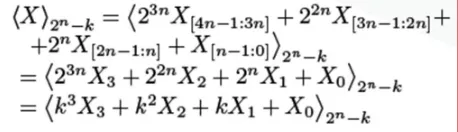
Allowing for a binary representation of X, with 4n-bit of Dynamic Range, it is required to compute in order to attain the residue modulo {2n − k} of X.
Where X [k: l] represents the bits l to k of the integer X.
Technology (IJRASET)
Taking into deliberation the meticulous cases of modulo {2n − 1} and {2n + 1}, conversion from binary-to-RNS can be performed as per given calculation.
C. PRNS Representation
Analogous to RNS, a PRNS is definite through a set of a finite pair-wise relatively prime polynomial which can be denoted by the dynamic range of the PRNS. In PRNS each and every polynomial has a unique PRNS representation:
IV. MONTGOMERY MULTIPLICATION
A. GF (p) Arithmetic
Field elements in GF (p) are integers in the range of 0 to p-1 and modulo arithmetic is performed the relevant algorithm is as shown in figure1 which do not contain any division process.
Figure1: Montgomery Multiplication process
B. GF (2n) Arithmetic
Field elements in GF (2n) are polynomials represented as binary vectors of a predefined and fixed dimension, relative to a given polynomial basis the algorithm will work as shown in the figure2.
Figure2: Polynomial Multiplication Process
C. The Proposed Dual-Field Montgomery Multiplication
Algorithm
International Journal for Research in Applied Science & Engineering
Technology (IJRASET)
additions/subtractions and multiplications are replaced by polynomial ones. And also the degree of input and output polynomials are both less than n the reason it allows the construction of a modular exponentiation algorithm.
Figure3: Proposed embedded algorithm
Proposed architecture for dual field polynomial modular multiplication presumptuous conversion is based on a parallel technique. In this technique both technique i and ii are embedded into each This architecture exhibits the modular reduction of each calculation with integrating GF(2n) and GF(p) modulo unit, instead of adding all terms and reducing then iteratively at the conclusion. The suggested architecture is as shown in figure4.
Figure4: proposed architecture
The key design of this architecture that the dual field i.e., embedded of GF(2n) and GF(p) in to single architecture and are associated in the design description which facilitates the logic transfer from one stage to other for example one bit length to other bit length can be easily avail without changing the complete architecture. The implementation of dual field lead to this proposed system. As shown in figure4.
D. Front-End Modeling
This phase of implementation contains the following stages simulation using Xilinx 14.4 Vivado suite, synthesis using Xilinx 14.4 XST and verifying on Virtex – 5 FPGA board.
V. SIMULATIONANDSYNTHESISRESULTS
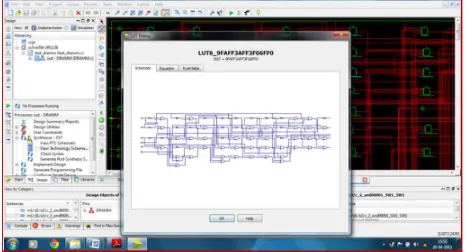
The Verilog RTL Description of the above article is simulated and synthesized using Xilinx14.4 (ISE-Simulator), implementation of all the above macro encoding techniques are successfully synthesized and verified on Virtex -5 FPGA board and the results are shown in figure5, figure6.
Technology (IJRASET)
Figure6: Synthesis output
[image:6.612.190.424.72.198.2]The Synthesized report is summarized in the following Table2. TABLE 2
SUMMARY OF SYNTHESIS REPORT S.No Parameter Quantification 1 Slice Logic utilization < 5%
2 Slice logic Distribution88% 3 IO utilization 12% 4 Specific feature Factor 3% 5 Total Logic Delay(nS) 12.646 6 Total Offset Delay(nS)25.577 7 Total path Delay(nS) 27.577 8 Real time Compilation(S)34 9 Total memory (KB) 394220
VI. CONCLUSION
In this paper, we have presented VLSI hardware modeling of dual field GF architecture for high speed application like Cryptography. In addition, their part is usual to increase in potential technology of power and area usage. This paper has realized with Xilinx tools along with Virtex -5 FPGA. Such designs are suggested to exhibits a competitive performance with current work.
VII. ACKNOWLEDGMENT
We would like to thank Dr.V.THRIMURTHULU, for his outstanding support and also we would like to especially express gratitude EDUPLUS-IERC team for their technical advices.
REFERENCES
[1] Multifunction Residue Architectures for Cryptography Dimitrios Schinianakis, Member, IEEE, and Thanos Stouraitis, Fellow, IEEE [2] D. Hankerson, A. Menezes, and S. Vanstone, Guide to Elliptic Curves
Cryptography. New York, NY, USA: Springer-Verlag & Hall/CRC, 2004. [3] J.-P. Deschamps, Hardware Implementation of Finite-Field Arithmetic. New York, NY, USA: McGraw-Hill, 2009.
[4] R. Lidl and H. Niederreiter, Introduction to Finite Fields and Their Applications. New York, NY, USA: Cambridge Univ. Press, 1986. [5] R. Rivest, A. Shamir, and L. Adleman, “A method for obtaining digital
signatures and public-key cryptosystems,” Commun. ACM, vol. 21, pp. 120–126, Feb. 1978.
[6] S. Kawamura, M. Koike, F. Sano, and A. Shimbo, “Cox-Rower architecture for fast parallel Montgomery multiplication,” in EUROCRYPT’ 00: Proc. 19th Int. Conf. Theory and Application of Cryptographic Techniques, 2000, pp. 523–538.
[7] J.-C. Bajard and L. Imbert, “Brief contributions: A full RNS implementation of RSA,” IEEE Trans. Comput., vol. 53, no. 6, pp. 769–774, Jun. 2004. [8] D. Schinianakis, A. Fournaris, H. Michail, A. Kakarountas, and T. Stouraitis, “An RNS implementation of an elliptic curve point multiplier,” IEEE Trans. Circuits Syst. I, vol. 56, no. 6, pp. 1202–1213, Jun. 2009.
[9] A. Halbutoğullari and Ç. K. Koç, “Parallel multiplication in using polynomial residue arithmetic,” Design, Codes and Cryptography, vol. 20, no. 2, pp. 155– 173, Jun. 2000.
[10] M. G. Parker and M. Benaissa, “ multiplication using polynomial residue number systems,” IEEE Trans. Circuits Syst. II, vol. 42, no. 11, pp. 718–721, Nov. 1995.
International Journal for Research in Applied Science & Engineering
Technology (IJRASET)
Int.Workshop on Cryptographic Hardware and Embedded Systems (CHES ’01), 2001.
[12] J.-C. Bajard, L. Imbert, and G. A. Jullien, “Parallel Montgomery multiplication in using Trinomial Residue Arithmetic,” in IEEE Symp. Computer Arithmetic, 2005, vol. 0, pp. 164–171.
[13] N. Guillermin, “A high speed coprocessor for elliptic curve scalar multiplications over ,” in Cryptographic Hardware and Embedded Systems, CHES 2010, 2010, pp. 48–64, Lecture Notes in Computer Science 6225.
[14] F. J. Taylor, “Residue arithmetic: A tutorial with examples,” IEEE Computer, vol. 17, pp. 50–62, May 1988.
[15] J. Omura and J. Massey, “Computational method and apparatus for finite field arithmetic,” U.S. Patent 4,587,627, May 6, 1986.
[16] R. Mullin, I. Onyszchuk, S. Vanstone, and R. Wilson, “Optimal normal bases in ,” Discrete Applied Mathematics, vol. 22, pp. 149–161, 1988. [17] G. Agnew, R. Mullin, and S. Vanstone, “An implementation of elliptic
curve cryptosystems over ,” IEEE J. Select. Areas Commun., vol. 11, no. 5, pp. 804–813, Jun 1993. [18] R. Schroeppel, H. Orman, S. W. O’Malley, and O. Spatscheck, “Fast key exchange with elliptic curve systems,” in CRYPTO ’95: Proc. 15th Annu. Int. Cryptology Conf. Advances in Cryptology, 1995, pp. 43– 56.
[19] Ç. K. Koç and T. Acar, “Montgomery multiplication in ,” Design, Codes and Cryptography, vol. 14, no. 1, pp. 57–69, Apr. 1998.
[20] D. Schinianakis,A.Kakarountas, T. Stouraitis, and A. Skavantzos, “Elliptic curve point multiplication in using Polynomial Residue Arithmetic,” in Proc. IEEE Int. Conf. Electronics, Circuits, and Systems (ICECS 2009), 2009, pp. 980–983.
P.Ramya received her B.Tech degree in Electronics & Communication Engineering from kkc Institute Of Technology & engg. For women, chittoor (A.P), India, in the year 2012.Currently pursuing her M.Tech degree in VLSI System Design at Chadalawada Ramanamma Engineering College, Tirupati (A.P), India. Her area of research includes low power VLSI design.