ABSTRACT
Content-Based Image Retrieval (CBIR) systems are required to effectively extract information from ubiquitous image collections. Retrieving images from a large and highly varied image data set based on their visual contents is extremely challenging. CBIR has been studied for decades and many good approaches have been proposed. But they do have some drawbacks. Texture and color are the significant features of CBIR systems. This paper gives a novel method of CBIR, in which images can be retrieved using color-based, texture-based and color and texture-based. Auto color correlogram and correlation for extracting color based images, Gaussian mixture models for extracting texture based images are the algorithms used here. For Relevance Feedback, Query Point Movement technique is used. Thus the proposed method achieves better performance and accuracy in retrieved images along with iteration reduction.
Keywords
Image retrieval, Texture, Auto Color Correlogram (ACC), Gaussian Mixture Models (GMM), Query Point Movement, Content-Based Image Retrieval (CBIR).
1.
INTRODUCTION
Digital images are used in field of medicine, science (medical and scientific images), military and security purposes, not to mention the personal photo albums. It will be a logistical nightmare to organize and search large volumes of images in databases, as most of the current commercial database systems are designed for textual data, it is not much applicable and/or compatible for digital images. To cater the need for a more efficient way for image retrieval, researchers have tried extending the current information retrieval (IR) techniques that are used in text retrieval to the area of the image retrieval. A CBIR system is popular because of their objective means of assessing image content. CBIR system is required to effectively harness information from digital image repositories. CBIR is characterized by the ability of the system to retrieve relevant images based on the visual and semantic contents of images. Interest in CBIR research had started well over a decade ago [2] and ever since has grown exponentially. This research is truly interdisciplinary in nature.
There are four major categories of problems related to CBIR: technical, semantic, content, and relativity. Technical problems are related to practical aspects such as image file formats and sizes, compression standards, resolution variables, and bandwidth of image transmission channels. However, recent technological advances in these areas have significantly eased many these issues. Semantic or concept-based problems deal with consistency and subjectivity issues in indexing images and subsequent matching of images with user queries. Controlled vocabularies and standards in the form of thesauri and ontologies are used. Projects such as the Art and Architecture Thesaurus can
be retrieved by (http://www.getty.edu/), Iconclass as retrieved by (http://www.iconclass.nl/), The Thesaurus Graphic Materials I (http://www.loc.gov/rr/print/tgm1/) , II (http://www.loc.gov/rr/print/tgm2/), the Consortium for the Computer Interchange of Museum Information (http://www.cimi.org/) and the Art Museum Image Consortium as retrieved by (http://www.amico.org/) are attempting to standardize the indexing language and retrieval mechanisms for CBIR.[4].
There are different ways to retrieve the images in CBIR. The oldest method is text annotation to images in the database. Image annotation is an improbable task. It is not practically feasible to annotate all the images in the databases. It is also very tough to label the same annotations to the same image by different users. To get over these significant limitations, researchers have turned their interest to CBIR. In CBIR systems, low level image features are extracted based on visual content such as color, shape and texture. However, huge challenge in CBIR is the semantic gap between the low level features and high level concepts. In order to decrease the gap between the low level features and high level concepts, relevance feedback was introduced into CBIR [5],[6] Recently, many researchers began to believe the RF as a classification or learning problem. For example, a user provides positive and/or negative examples, and the systems learn from such examples to separate all data into relevant and irrelevant groups. Therefore many classical machine learning schemes may be applied to the RF such as, decision tree learning, Bayesian learning, support vector machines, boosting and so forth. Another challenge in CBIR systems is multidimensional indexing. In CBIR systems, the visual content of image features is high-dimensional numerical data. Therefore it is difficult to manage these data with traditional database systems, because these systems are intended for text data and low-dimensional numerical data. Thus many researchers have proposed systems for indexing high-dimensional data in CBIR systems.[3].
Color is the most extensively used visual content for image retrieval. Its three-dimensional values make its discrimination potentiality superior to the single dimensional gray values of images. Before selecting an appropriate color description, color space must be determined first. There are many color spaces used to represent the image (RGB, HSV, CIE, etc.), and many approaches used for representation, such as histograms, binary sets and correlogram. The proposed method uses auto color correlogram for color illustration. [9, 13].
Texture refers to the visual patterns that have properties of homogeneity. It is not a result from the presence of only a single color or intensity. It is an instinctive property of virtually all surfaces of real-world objects such as clouds and fabrics. Texture containsinformation about the structural arrangement of surfaces and their relationship to the surrounding environment. Popular texture representations include co-occurrence matrix, Tamura
A Efficient Content based Image Retrieval System using
GMM and Relevance Feedback
Ramadass Sudhir
Capt. S. Santhosh Baboo,
Ph.DResearch Scholar Reader, PG & Research,
Manonmaniam Sundaranar University Department of Computer Applications
texture, and Wavelet texture. The proposed method uses Gaussian mixture models for texture representation.
Relevance Feedback (RF) is the process of automatically modifying an existing query using the information feedback by the user about the relevance of previously retrieved objects such that the adjusted query. The key issue in relevance feedback is how to effectively utilize the feedback information to improve the retrieval performance. (Jing Xin and Jesse S.Jin, 2003) After obtaining the retrieval results, user provide the feedback as to whether the results are relevant or non relevant. If the results are non-relevant the feedback loop is repeated many times until the user is satisfied. In the proposed method Relevance feedback technique can be done using decision trees. [14].
The paper can be organized as follows: Section II describes the related works involved in content based image retrieval, Section III describes the methodology used to retrieve the images, and
Section IV describes Experimental results obtained by using proposed methodology.
2.
RELATED WORKS
[image:2.595.111.506.250.575.2]Keller, Stappers, and Vroegindeweij (2004) [10] report that current interfaces for CBIR are rather limited for browsing and storytelling. They describe an alternative interface based on a study of how home users use traditional ways of storing and organizing personal photo collections, but leveraging new possibilities enabled by digital media. Simple interfaces coupled with intuitive methods of interacting with image collections to understand the essence of collections is studied by Chang et al. (2004) [8]. The intuitive methods employed include Streaming Collage, Ambient Slideshow, and Gridded Thumbnails.
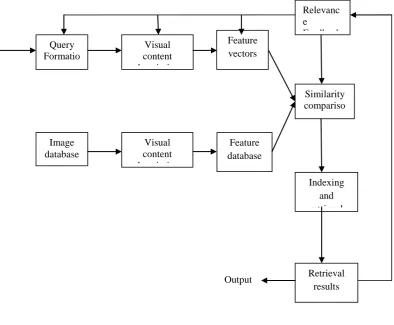
Fig .1 Processes involved in Content Based Image Retrieval
Jeon, Lavrenko, and Manmatha (2003) [11] describe automatic image annotation using crossmedia relevance models. The approach requires a training set of images, whose Regions/blobs are annotated with text. Using probabilistic models, annotations are automatically generated for new images.
Gudivada [12] discussed an approach to improve retrieval effectiveness via relevance feedback in text retrieval systems. He also showed how these relevance feedback techniques have been adopted to CBIR context and their effect on retrieval effectiveness. The need for test collections in advancing CBIR research is also discussed in his work. Latika Pinjarkar et al.,[13] discussed various methodologies used in the research area of CBIR techniques using Relevance Feedback. To improve the retrieval performance of the CBIR, the Relevance Feedback
technique can be incorporated in CBIR system to obtain the higher values of the standard evaluation parameters used for evaluation of the CBIR system which may lead to better results of retrieval performance. He also discussed various relevance feedback techniques for Content Based Image Retrieval systems, the various parameters used for experimental evaluation of the systems and the analysis of these techniques on the basis of their results.
Patil et al., [15] provides an overview of the technical achievements in the research area of relevance feedback (RF) in CBIR. It also covers the current state of art of the research in relevance feedback in CBIR, various relevance feedback techniques and issues in relevance feedback. Samuel Rota Bulo et al., [16] proposed a novel approach to content-based image
Query Formatio
n
Similarity compariso
n
Feature database Visual
content description Image
database
Visual content description
Feature vectors
Relevanc e
Feedback
Indexing and retrieval
retrieval with relevance feedback, which is based on the random walker algorithm introduced in the context of interactive image segmentation. The idea is to treat the relevant and non-relevant pictures tagged by the user for each feedback iteration as \seed" nodes for the random walker problem. The ranking score for each unlabeled image is computed as the probability that a random walker starting from that image will reach a relevant seed before encountering a non-relevant one.
3.
METHODOLOGY
The Feature Vectors can be extracted based on multi-dimensional or single dimensional process. Here by multi-dimensional feature vectors are followed to extract visual contents of the images from the database. The feature vectors of the images in the database form a feature database. The users provide the retrieval system with example images or sketched figures to retrieve images. The system then changes these examples into its internal representation of feature vectors. The similarities /distances between the feature vectors of the query example or sketch and those of the images in the database are then calculated and retrieval is performed with the aid of an indexing scheme. The COREL Database divided 10,800 images from the Corel Photo Gallery into 80 concept groups, e.g., autumn, aviation,
bonsai, castle, cloud, dog, elephant, iceberg, primates, ship, stalactite, steam-engine, tiger, train, and waterfall. This dataset consists of these several types of images which can be much suitable for CBIR evaluation process.
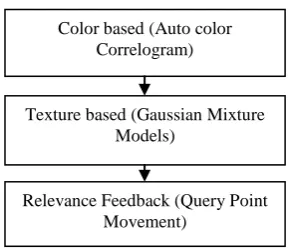
The proposed method comprises three types of techniques to retrieve the content based images. They are as follows:
1. Color- based Image Retrieval 2. Texture- based Image Retrieval
[image:3.595.65.211.455.580.2]3. Color and Texture based Image Retrieval
Fig 2. Algorithms used in the proposed method
3.1
Color-based Image Retrieval
Color feature is one of the most widely used features for image retrieval. A new color feature for image retrieval called color correlogram. This feature characterized how the spatial correlation of pairs of color changes with distance in an image. Normally, because the size of color correlogram is quite large, the color auto correlogram is often used as an alternative. This feature only captures spatial correlation between identical colors. The main contributions of this paper proposed a proposed method uses auto color correlogram for color based image retrieval.
3.1.1. Auto Color Correlation Algorithm:
An auto color correlation defines how to compute the mean color of all pixels of color Cjat a distance k-th from a pixel of color Ci
in the image. [16] Formally, the ACC of image {I(x, y), x =
1,2, … , M, y = 1,2, … , N } is defined as
𝐴𝐶𝐶 𝑖, 𝑗, 𝑘 = 𝑀𝐶𝑗𝑌𝐶 𝑘 𝑖𝐶𝑗 𝐼
= 𝑟𝑚𝑐𝑗𝛾𝐶 𝑘 𝑖𝐶𝑗 𝐼 , 𝑔𝑚𝑐𝑗𝛾𝐶 𝑘 𝑖𝐶𝑗 𝐼 , 𝑏𝑚𝑐𝑗𝛾𝐶 𝑘 𝑖𝐶𝑗 𝐼 𝑐𝑖 ≠ 𝑐𝑗
where the original image I(x, y) is quantized to m colors
C1, C2, … , Cm and the distance between two pixels k ∈
[min{M, N} ] is fixed a priori. Consider MCj be the RGB value of color m in an image I. The mean colors are defined as follows:
𝑟𝑚𝑐𝑗𝛾𝐶 𝑘 𝑖𝐶𝑗 𝐼 =
𝐼
𝑘 𝑐𝑖,𝑟𝑐𝑗
𝐼
𝑘 𝑐𝑖,𝑐𝑗
|𝑐𝑖 ≠ 𝑐𝑗 (2)
𝑔𝑚𝑐𝑗𝛾𝐶 𝑘 𝑖𝐶𝑗 𝐼 =
(𝐼)
(𝑘) 𝑐𝑖,𝑔𝑐𝑗
(𝐼)
(𝑘) 𝑐𝑖,𝑐𝑗
|𝑐𝑖≠ 𝑐𝑗 (3)
𝑏𝑚𝑐𝑗𝛾𝐶 𝑘 𝑖𝐶𝑗 𝐼 =
(𝐼)
(𝑘) 𝑐𝑖,𝑏𝑐𝑗
(𝐼)
(𝑘) 𝑐𝑖,𝑐𝑗
|𝑐𝑖 ≠ 𝑐𝑗 (4)
Where denominator (𝑘)𝑐𝑖,𝑥𝑐𝑗(𝐼)is the total of pixels values of color
𝐶𝑗 at distance 𝑘 from any pixel of color 𝐶𝑖 when 𝑥 is RGB color space and denoted𝐶𝑗 ≠ 0 . N represents the number of accounting color 𝐶𝑗 from color 𝐶𝑖 at distance 𝑘 is
computed as follows:
𝑁 = 𝑘 𝐼
𝑐𝑖,𝑐𝑗
= 𝑃(𝑥1, 𝑦1) ∈ 𝐶𝑖|𝑃(𝑥2, 𝑦2) ∈ 𝐶𝑗; 𝑘 =MIN{ 𝑥1− 𝑥2 , |𝑦1− 𝑦2|;
(5)
Color based (Auto color Correlogram)
Texture based (Gaussian Mixture Models)
By reducing the size of color correlogram from O(m2d) to O(3md), ACC can be able to find the local spatial correlation between color. To decrease the storage space required and increase the speed of retrieval, the size of ACC can be reduced from O(3md) to O(m). By using this algorithm, dominant RGB peaks values in any color bins are captured. The dominant elements are compared in order to reduce the feature storage amount and speed of retrieval while processing similarity calculation of the two images.
For every K distance { For every X position For every Y position {
𝐶𝑖← 𝑐𝑢𝑟𝑟𝑒𝑛𝑡 𝑝𝑖𝑥𝑒𝑙 While 𝐶 𝑗 ←
𝐺𝑒𝑡 𝑛𝑒𝑖𝑔𝑏𝑜𝑟𝑠 𝑝𝑖𝑥𝑒𝑙 𝑜𝑓 𝐶𝑖 𝑎𝑡 𝑑𝑖𝑠𝑡𝑎𝑛𝑐𝑒 𝐾 {
For every color 𝐶𝑚 { If (𝐶𝑚 = 𝐶𝑖and 𝐶𝑖≠ 𝐶𝑗){
countColor++
colorR[𝐶𝑚 ] = colorR[𝐶𝑚 ] + colorRCj colorG[𝐶𝑚] = colorG[𝐶𝑚]+ colorGCj colorB[𝐶𝑚] = colorB[𝐶𝑚] + colorBCj
} } }
}
meanColorR = sum ( colorR[𝐶𝑚 ])/countColor meanColorG = sum ( colorG[𝐶𝑚 ])/countColor meanColorB = sum ( colorB[𝐶𝑚 ])/countColor }
The similarity of binary codes for auto color correlation can be measured using intersection technique. It measures the similarity of binary codes for the same color between the query and model images. Consider
𝐵𝑐𝑚 𝐼 = 𝑏1𝑟, 𝑏2𝑟, … . , 𝑏𝑚𝑟; 𝑏1𝑔, 𝑏2𝑔, … . , 𝑏𝑚𝑔; 𝑏1𝑏, 𝑏2𝑏, … . , 𝑏𝑚𝑏; represents the binary code of auto color correlation colors to color Cm in RGB space of query image I, then the intersection result of query image and model image concerning color Cm should be calculated.
The proposed method first computes the mean pixel value of the whole small block (4x4) and it compares each pixel to the block mean. If the pixel value is greater than or equal to the block mean, respective pixel position of the bitmap will have the value 1, otherwise it will be assigned as 0. When the RGB values in a color bin of ACC exceed a given threshold, then the bin is classified as effective, else it is classified as non-effective. Binary “1” is assigned to effective bin and, binary “0” is assigned to non-effective bin.
Thus by using feature vector of ACC in RGB color space, the accuracy of retrieval process can be improved. This can also be used to address the object searching problem.
3.2 Texture-based Image Retrieval
Texture is an important property for the characterization and recognition of images. An image texture is described by the number and types of its primitives and the spatial organization or layout of its primitives [1]. There are several approaches for extracting texture from an image. The proposed method uses Gaussian mixture models to retrieve texture images.
3.2.1. Gaussian Mixture Models
Gaussian mixture models is a type of density models which includes a amount of Gaussian function components. These functions are combined with different weights to form a
multi-modal density. Gaussian mixture models are a semi-parametric which can be used as an alternative of non-parametric histograms (which can also be used to approximate densities). It has high flexibility and precision in modeling the underlying distribution of sub-band coefficients.
Consider N texture classes labeled by 𝑛 ∈ 𝑁 ≅ {1, … . 𝑁} related to different entities. In order to classify a pixel, neighborhood of that pixel must be considered. Then S × S sub-images blocks features can be computed assign classes to these blocks. [17]The set of blocks is represented by B. The neighborhood of a block b is called patch P(b). It should be defined as the set of blocks in a larger T × T sub-image with b at its centre. Db is denoted as the data associated to that block and 𝑉𝑏∈ 𝑁 be the classification of b. The classification can be done based on the following rule.
𝑣
𝑏= arg max
𝑛∈ 𝑁′
Pr(𝐷𝑏
′
|𝑣𝑏
′= 𝑛
𝑏′∈𝑃(𝑏))
(6)Thus, all the blocks in P(b) which has class n maximizes the probability of the data in P(b). It reduces computation time to classify the texture. The data Db associated with each block is denoted by the vector of features𝑥 . For each and every texture class, a probability distribution that represents the feature statistics of a block of that class must be selected. Thus the probability that obtained 𝑥 will be a convex combination of M Gaussian densities:
𝑃 𝑥 { 𝑝𝑖, 𝜇 }) = 𝑝𝑖, 𝑖𝑏( 𝑀
𝑖=1
𝑖 𝑥 , 𝜇 )𝑖, 𝑖 (7)
Where is 𝑏(𝑥 , 𝜇 )𝑖, 𝑖 a Gaussian of mean 𝜇 𝑖and covariance The parameters for a given class are thus { 𝑝𝑖, 𝜇 |𝑖 ∈ 𝑀 }𝑖, 𝑖 . A GMM is the usual model which can be if a texture class contains a amount of distinct subclasses. Thus by using Gaussian mixture model to retrieve the texture properties of the image gives desired accuracy.
3.3 Color and Texture-based Image Retrieval
By combining both the proposed algorithms such as Auto color correlation and Gaussian mixture models, color and texture properties can be retrieved.3.3.1. Relevance Feedback
In relevance feedback-based approaches, a CBIR system learns from feedback provided by the user. Relevance feedback on the image retrieved in response to the initial query. This feedback is used subsequently in improving the retrieval effectiveness. The proposed method uses Query point movement for relevance feedback.
3.3.1.1. Query Point Movement
In CBIR systems with relevance feedback, the user can mark returned images as positive or negative, which are fed back into the system as a new, refined query for the next round of retrieval. The process is repeated until the user is satisfied with the query result.
𝑞𝑛+1= 𝛼𝑞𝑛+
𝛽
𝑁 + (𝑛) 𝑋𝑗 −
𝐽𝑟𝑒 𝑙
𝑗 =1
𝛾
𝑁 − (𝑛) 𝑌𝑗
𝑗𝑛𝑜𝑛 _𝑟𝑒𝑙
𝑗 =1
(8)
Where qnis the query point for nth round of the search cycle. Parameters α, β and γ are the suitable constants denoted as the weight parameters ; J rel is the number of relevant images in X j and Jnon_rel is the total number of non-relevant images in Y j . The parameters β and γ can be adjusted to be more biased towards one sample group depending on the nature of the data samples,. If variable γ is set to zero, then the negative sample may totally ignored, and by setting variable α to zero the history of the query point can be ignored [15].
4.
EXPERIMENTAL RESULTS
The experiment is evaluated by using COREL Image Dataset [17] to find the relevant images for the given input query with reduced number of iterations. The accuracy of the image can be calculated by the following formula:
𝐴𝑐𝑐𝑢𝑟𝑎𝑐𝑦 =𝑁−𝑋𝑁 ∗ 100
Where N is number of relevant images in the database which are known to the user and X is the number of irrelevant images in the database which are known to the user.
4.1. Color based Image Retrieval
The input query image is provided by the user. Then the image is searched automatically in the database based on the color and searched images will be displayed. The relevance feedback is given by the user and this process is repeated until all relevant images are obtained.
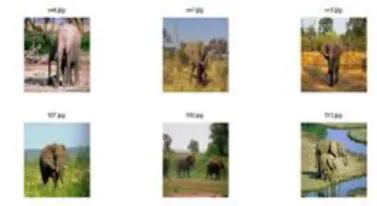
[image:5.595.62.291.71.111.2]The input query is shown in the Figure 3. For example consider elephant as an input query given by the user.
Fig 3. Input Query
Iteration 1 (Before Relevance Feedback):
Fig 4. Output image before relevance feedback using color-based image retrieval
Figure 4 reveals the output images based on the user’s input
query image elephant. Here images are searched based on the color of the given input. In the given example the last image is an irrelevant image. Therefore according to the user’s feedback, the system searches the images again in the database. The accuracy of the output images in the first iteration is 84%.
[image:5.595.325.514.154.257.2]Iteration 2 (After Relevance Feedback):
Fig 5. Output image after relevance feedback using color-based image retrieval
Figure 5 shows the output images after relevance feedback. since all the relevant images are obtained in the second iteration, the system stops searching images in the database. The accuracy of images obtained in the second iteration is 100%. If all the output images are not relevant, the database will repeatedly proceed up to nth iteration until all relevant images are obtained and it stops while the accuracy once reached nearly 100%. Thus the proposed approach obtains maximum accuracy in retrieving color based images in reduced iteration than the existing color based method.
4.2. Texture based Image Retrieval
Here the system is search’s images based on the texture given by user’s input query image. The query image is searched in the database based on the texture and system displays the output images. Based on the relevance feedback, the system search images in the database and displays the images. The input query is shown in the Figure 3.
Iteration 1 (Before Relevance Feedback):
[image:5.595.106.242.450.573.2]
Fig 6. Output image before relevance feedback using texture-based image retrieval
Figure 6 illustrates the output images based on the user’s input query. Based on the texture of the given input query, the images will be searched in the database. In the given example, the last three images is an irrelevant image. The system searches the images again in the database according to the user’s feedback. The accuracy of the output images obtained in the first iteration is 50%.
[image:5.595.309.517.480.613.2] [image:5.595.80.265.606.708.2]output image, it will be repeatedly processed up to nth iteration until maximum accuracy is once obtained.
Iteration 2 (After Relevance Feedback):
Fig 7. Output image 1 after relevance feedback using texture-based image retrieval.
Iteration 3 (After Relevance Feedback):
Fig 8. Output image 2 after relevance feedback using texture-based image retrieval
Figure 8 shows the images after third iteration. The accuracy obtained in the third iteration is 99%. Since maximum accuracy is reached in the third iteration it stops searching images in the database.
4.3. Color and texture based Image Retrieval
Based on the user’s input query, the image will be searched in the database. Here images are searched by both color and texture and the output is shown to the user. The user verifies whether the images are relevant and sends feedback to the system. The system is process according to the user’s feedback and displays the images. The same Figure 3 is used as an input query to find the images based on color and texture.Iteration 1 (Before Relevance Feedback):
Fig 9. Output image before relevance feedback using both color and Texture-based image retrieval
Figure 9 reveals the output images based on the user’s input query. The system searches image based on color and texture in the image database. There is an irrelevant image in the output. Hence the system performs the image search again as per user’s feedback. The accuracy of the output images obtained in the first iteration is 66%.
Iteration 2 (After Relevance Feedback):
Fig 10. Output image after relevance feedback using color and texture-based image retrieval.
Figure 10 shows the images obtained in the second iteration based on both the color and texture. It achieves very close to maximum accuracy in the second iteration. Thus the proposed method performs well in retrieving the images with maximum accuracy.
4.4. Performance Evaluation
The dataset consists of six different images. The corresponding accuracy of the query images are to display these images before and after relevance feedback has been observed for color-based, Texture-based and color and texture-based image retrieval. The accuracy before and after relevance feedback for the color based image retrieval is shown in the Table 1.
Table 1: Accuracy and Time Comparison of Color-based Image Retrieval Before and After Relevance Feedback
Query Image
Accuracy before RF
Accuracy after RF
Number of Iterations
Beaches 52 97 3
Building 68 98 3
Dinosaur 51 90 4
Elephant 84 99 2
Trees 83 96 3
Tiger 35 87 5
Average 62 94 4
Table 1 illustrates that the average number of iteration for the six datasets is 3 and nearly maximum accuracy after relevance feedback is achieved.
Table 2:Accuracy and Time Comparison of Texture-based Image Retrieval Before and After Relevance Feedback
Query Image
Accurac y before
RF
Accurac y after RF
Numbe r of Iteratio
ns
Beaches 68 95 3
Building 67 91 3
Dinosaur 82 89 2
Elephant 53 99 3
Trees 66 95 5
Tiger 52 86 6
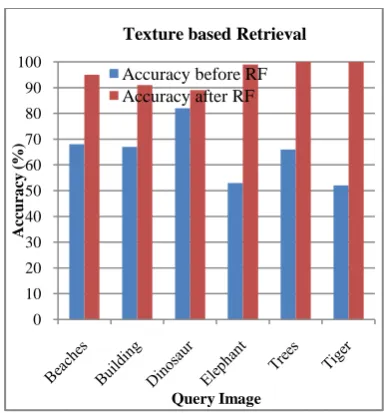
The accuracy before and after relevance feedback for the texture based image retrieval is shown in the table 2. It is clear that average accuracy before relevance feedback for the texture is 64%. The total no. of iterations is 4 and nearly maximum accuracy after relevance feedback is achieved.
Table 3:Accuracy and Time Comparison of Color & Texture-based Image Retrieval Before and After Relevance
Feedback
Query Image
Accuracy before RF
Accuracy after RF
Number of Iterations
Beaches 50 96 4
Building 67 93 5
Dinosaur 83 90 3
Elephant 67 99 2
Trees 67 93 4
Tiger 33 90 5
Average 61 93 4
[image:7.595.72.273.169.274.2]Table 3 represents the accuracy obtained for color & Texture based image retrieval before and after relevance feedback is 61 and 93%. The average no. of iterations is 4 and nearly maximum accuracy after relevance feedback is achieved.
Fig 11. Accuracy Comparison of the color based image retrieval before and after relevance feedback
Figure 11 represents the Accuracy comparison of the Color based image retrieval before and after relevance feedback. From the figure it gives that after relevance feedback, the maximum accuracy is obtained 2-4 iterations. Thus the proposed approach obtains maximum accuracy with relevance feedback in color based image retrieval.
Figure 12 indicates the Accuracy comparison of the Texture based image retrieval before and after relevance feedback. Nearly maximum accuracy after relevance feedback is achieved within 2-6 iterations after relevance feedback. Thus the proposed method obtains utmost accuracy with relevance feedback for texture based image retrieval with reduced iterations.
Fig 12. Accuracy Comparison of the texture based image retrieval before and after relevance feedback
The Accuracy comparison of the Color & Texture based image retrieval before and after relevance feedback is exposed in figure 13. Within 2-5 iterations the utmost maximum accuracy is obtained after relevance feedback. Thus the maximum accuracy is obtained with relevance feedback for Color & texture based image retrieval with reduced iterations.
Fig 13. Accuracy Comparison of the color & texture based image retrieval before and after relevance feedback
The experimental outcome proved that the proposed method achieves maximum accuracy with the help of relevance feedback in retrieving all the relevant images according to the query image provided by the user. Hence proposed method gives better performance in retrieving all the relevant images in the database.
5.
CONCLUSION
This paper proposed method uses three approaches such as Color, Texture, both Color and Texture to retrieve the relevant images from the database. The proposed method follows the algorithms of auto color correlogram to retrieve color based images, Gaussian mixture models to retrieve texture based
0 10 20 30 40 50 60 70 80 90 100
A
cc
u
ra
cy
(
%
)
Query Image
Color based Retrieval
Accuracy before RF Accuracy after RF
0 10 20 30 40 50 60 70 80 90 100
A
cc
u
ra
cy
(
%
)
Query Image
Texture based Retrieval
Accuracy before RF Accuracy after RF
0 10 20 30 40 50 60 70 80 90 100
A
cc
u
ra
cy
(
%
)
Query Image
Color &Texture based Retrieval
[image:7.595.74.271.364.574.2] [image:7.595.326.520.379.598.2]images and Query point movement for relevance feedback. The algorithm of Correlogram and GMM, are more appropriate for the retrieval of image with reduced iteration. The experimental results revels that the proposed method gives maximum accuracy in the three approaches. As a future work, this method can be implemented by combining other effective algorithms for other image features in order to improve effectiveness for many types of images with very lesser iterations.
6.
REFERENCES
[1] Ot´avio A. B. Penatti, Eduardo Valle, Ricardo da S. Torres, “Comparative Study of Global Color and Texture Descriptors for Web Image Retrieval, Journal of Visual Communication and Image RepresentationSeptember 16, 2011
[2] V. Gudivada and V. Raghavan. Content-based image retrieval systems. IEEE Computer, 28(9):18 – 22, September 1995.
[3] Pushpa B. Patil, Manesh B. Kokare, " Relevance Feedback in Content Based Image Retrieval: A Review," Journal of Applied Computer Science & Mathematics, no. 10 (5) /2011, Suceava
[4] Samantha K. Hastings. Evaluation of image retrieval systems: Role of user feedback Library Trends, 48(2):422 – 436, 1999.
[5] Rui, Y., Huang, T.S., and Mehrotra,S. “Content-based Image Retrieval with Relevance Feedback in MARS”, in Proc. IEEE Int. Conf. on Image proc., 1997
[6] Rui, Y.; Huang, T.; Ortega, M.; Mehrotra,S. “Relevance Feedback : A Power Tool In Interactive Content-Based Image Retrieval,” IEEE Transactions on Circuits and Systems for Video Technology , Vol. 8(5), pp. 644-655, 1998.
[7] Monika Jain, S.K. Singh, “A Survey On: Content Based Image Retrieval Systems Using Clustering Techniques For Large Data sets”, International Journal of Managing
Information Technology (IJMIT) vol.3, no.4, November 2011.
[8] Michelle Chang et al. Collection understanding. In JCDL ’04: Proceedings of the 4th
ACM/IEEE-CS Joint conference on Digital libraries, pages 334–342, New York, NY, USA, 2004. ACM Press. ISBN: 1-58113-832-6.
[9] G.Pass, and R. Zabith, "Comparing images using joint histograms," Multimedia Systems, vol.7, pp.234-240, 1999. [10]Ianus Keller, Pieter Jan Stappers, and Sander
Vroegindeweij. Supporting informal collection of digital images: organizing, browsing and sharing. In Proceedings of the conference of Dutch directions in HCI, page 17, New York, NY, USA, 2004. ACM Press. ISBN: 1-58113- 944-6.. [11]J. Jeon, V. Lavrenko, and R. Manmatha. Automatic image annotation and retrieval using crossmedia relevance models. In SIGIR ’03: Proceedings of the 26th annual international ACM SIGIR conference on Research and development in informaion retrieval, pages 119–126, New York, NY, USA, 2003.
[12]Venkat N Gudivada, “Relevance Feedback in Content-Based Image Retrieval”, International Journal of Computer Science and Engineering, vol. 3,no.1, 2010.
[13]Alberto Del Bimbo. Visual Information Retrieval. Morgan Kaufmann Publishers, Inc., 2001.
[14]Jing Xin and Jesse S. Jin “Relevance Feedback for Content-Based Image Retrieval Using Bayesian Network” Workshop on Visual Information Processing (VIP), Sydney, 2003. [15]Pushpa B. Patil, Manesh B. Kokare, “Relevance Feedback
in Content Based Image Retrieval: A Review”, Journal of Applied Computer Science & Mathematics, vol.5, no. 10 ,2011.
[16]Samuel Rota Bulo, Massimo Rabbi and Marcello Pelillo, “Content-Based Image Retrieval with Relevance Feedback using Random Walks”, Pattern Recognition, June 6, 2011. [17]