Department of Computer science and Engineering, Sathyabama Institute of Science and Technology, Chennai, India E-Mail: [email protected]
ABSTRACT
Now-a-days segmentation of images has become a challenging task. In this paper, ToZero method and ToZero inverse methods are used for segmenting optical images which gives better results compared to existing methods. Edge detection is done by using ratio of averages (ROA), Laplacian method, Sobel filter and canny filter. Edge information is used to estimate the threshold values required for image segmentation. Image segmentation is done by using multilevel thresholding techniques which consists of Truncate, Tozero and Tozero inverse techniques to get a better output and to overcome the limitations present in singe level thresholding. The input data is acquired by the Pleiades sensor from the Paris region in 2017. Segmenting input images using the proposed method was very satisfactory and the obtained results are very promising.
Keywords: edge detection, ROA, image segmentation, multi-level thresholding.
INTRODUCTION
Image segmentation is a technique in which an image is processed into group of non-overlapping regions which are based on either a homogeneous or heterogeneous rule [9]. Edge-based and region-based are the two different types of segmentation techniques. [1] A coarse-to-fine coastline detection method is proposed to detect the coast edges. A fast edge based snake model is used in high-resolution images to refine the coarse result. Failed to explain the loss of small coastline branches in the
final detected coastline because the coarse coastline is
extracted in low-resolution image.
[2] A robust edge enhancement in the wavelet transformed domain and a decision step based on the application of a geodesic active contour algorithm is proposed. More over there is a chance of detecting an false edge [3] Proposed an algorithm with edge detection and fuzzy clustering in the translation-invariant second-generation bandelet transform (TIBT) domain for effectively preserving the edges of a synthetic aperture radar (SAR) image when despeckling. The combination of TIBT and fuzzy clustering leads to long calculations and it consumes more time to detect an edge.
[4] Proposed an edge detection algorithm based on dynamic mode decomposition, which is used to detect edges of art images. It mainly deals with images of high sparseness. Failed to explain about the images with low sparseness and to explain about the noise caused by the eight gradient operator for low contrast images. [5] Proposed an edge detection method based on generalized type-2 fuzzy logic. Optimal parameter values which are found by using optimization technique in the membership functions are not explained. [5] Applied the prevalent CNNs to sea-land segmentation and proposed a SeNet.
They proposed a local smooth regularization which makes segmentation results spatially consistent. By integrating edge network with Deconvnet, more accurate edge results are obtained.
[6] Biologically visual saliency modelling is proposed for high resolution SAR data to detect the river networks automatically. The results for some images are unsatisfactory because the number of the scale spaces are limited in the multi-scale segmentation. [7] A span-driven adaptive (SDA) filter is utilized for detecting the edges in polarimetric synthetic aperture radar (PolSAR) images. The time cost of the proposed method is longer than that of other methods, since it takes more time to construct the SDA filter than fixing-shape filters and the SIRV distance is time consuming in computation. [8] Proposed a method for Edge detection for high-spatial-resolution imagery with image object detection and multi scale segmentation (MSS). Failed to explain the detection of false edges in the output image. [9] Proposed a method for the structure present in local image patches to learn both an accurate and computationally efficient edge detector and then formulate the problem of predicting local edge masks in a structured learning framework applied to random decision forests. Failed to explain about the unstructured forests.
STUDY AREA AND DATA SET USED
Figure-1. Location of the study area.
Table-1. Specifications of the input image.
Sensor Image
type Resolution
Sensed date
Pleiades Optical 50 *50 cm 19-06-2017
detection techniques are applied. Laplacian, ROA, Sobel and Canny filters are used for detecting edges from the image. In the edge detection process the image is pre-processed even to remove the unwanted noise. Edge information is used in-order to estimate the threshold values required for image segmentation.
ROA is used to determine the accurate and localized edges without any additional gradient information calculations or edge thinning operations. ROA is the ratio based edge detector which makes effective use of edge orientation. Ratio based edge detectors estimate the edge strength at any pixel of interest in an image by calculating the ratios between the pixel values. Edge strength can be increased by using ROA.
The image segmentation is the one of the most key factor in image processing. Image segmentation is used to locate the boundaries like curves and the lines in an image. A digital image can be partitioned into pixels by using this method. Analysis of an image can be made in an easier way by using image segmentation.
of multiple values that are selected. Thresholding is used to segment an image by setting all pixels whose intensity value above a threshold is set to a foreground value and all the remaining pixels to a background value.
First level of multilevel thresholding is achieved applying truncate technique.In this technique the image enhancement is done by adding the pixel values of an image to a constant Truncate matrix. The resultant pixel values changes the image by increasing the color of an image.
The second level in the multilevel thresholding done using Tozero thresholding technique. By using the Tozero technique we can highlight the background part of an image. The edges of the object are detected. The third level in the multilevel thresholding is Tozero inverse thresholding technique. By using this technique we can highlight the objects present in the input image. The edge of the region is detected.
RESULTS AND DISCUSSIONS
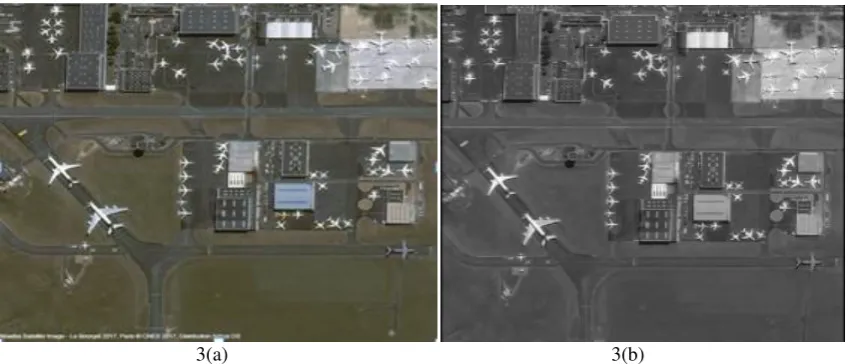
[image:3.595.87.512.392.574.2]3(a) 3(b)
Figure-3. (a) & (b). Input image and grey scale image.
The above Figures 3(a) shows the input image and 3(b) shows the converted grey scale image. The converted grey scale image is applied with the edge detection techniques. Zero crossings in an image are found by using laplacian method in order to find edges. Sobel and Canny filters are used for the purpose of edge detection. A mask is generated using the canny edge detector and minimum error rate can be obtained. Good localization and minimal response are achieved by using
this method. 4(a) 4(b) Figure-4. (a) & 4(b). greyscale image; using
Laplacian method.
5(a) 5(b)
Figure-5. (a) & (b): Using sobel-x method and using sobel-y method.
The above Figures 5(a) and 5(b) shows processed image using the sobel-x method and sobel-y methods. The horizontal edges are detected by using sobel-x and the vertical edges are detected by using sobel-y.
6(a) 6(b)
Figure-6. (a) & (b) Grey scale image and canny edge detector ouptput
The canny edge detector is used to convert the grey scale in to binary image as shown in the above Figures 6(a) and 6(b). Later multilevel thresholding is applied in-order to segment the image. In multilevel thresholding, Truncate, ToZero and ToZero inverse thresholding methods are used. By using these methods the image can be analysed in an efficient manner and well refined edges can be detected.
Truncate thresholding technique increases the enhancement of an image and the Tozero thresholding technique detects the foreground part of the input image. The Tozero inverse thresholding technique is used to detect the objects present in the image.
7(a) 7(b) 7(c)
7(d) 7(e) 7(f)
Figure-7. (a), (b), (c), (d), (e) & (f). grey scale image, using binarizaion technique, using binary inverse methos, using truncate method ,using Tozero method, using Tozero inverse method.
The Figures 7(a), (b), (c), (d), (e) & (f) shows the comparison between of output generated using existing techniques like binarization technique, inverse binarization technique. And it clearly shown that the proposed method
Truncate, Tozero and Tozero inverse thresholding techniques. The edges of the input image can be obtained accurately. Multilevel thresholding can overcome the drawbacks of single level thresholding. The result obtained by multilevel thresholding is very satisfactory. Programming is done using OpenCV and python.
CONFLICT OF INTEREST
There is no conflict in our proposed system.
ACKNOWLEDGEMENT
The authors would like to thank DLR Portal for providing the input images for the study.
REFERENCES
[1] Chun Liu, Yingying Xiao and Jian Yang. 2017. A Coastline Detection Method in Polarimetric SAR Images Mixing the Region-Based and Edge-Based Active Contour Models. IEEE Trans, on Geoscience and Remote Sensing. 55(7).
[2] MarivíTello Alonso, Carlos López-Martínez, Jordi J. Mallorquí. 2011. Edge Enhancement Algorithm Based on the Wavelet Transform for Automatic Edge Detection in SAR Images. IEEE Trans, on Geoscience and Remote Sensing. 49(1).
[3] Wenge Zhang, Fang Liu, Senior Member, IEEE, Licheng Jiao, Senior Member, IEEE, Biao Hou, Member, IEEE, Shuang Wang, Member, IEEE and Ronghua Shang. 2010. SAR Image Despeckling Using Edge Detection and Feature Clustering in Bandelet Domain. IEEE Trans, Geoscience and Remote Sensing Letters. 7(1).
[4] Chongke Bi, Ye Yuan, Ronghui Zhang, Yiqing Xiang, Yuehuan Wang. 2017. A Dynamic Mode Decomposition Based Edge Detection Method for Art Images. IEEE Trans. 9(6).
[5] Patricia Melin, Senior Member, IEEE, Claudia I. Gonzalez, Juan R. Castro, Olivia Mendoza and Oscar Castillo, Senior Member, IEEE. 2014. Edge Detection Method for Image Processing based on Generalized Type-2 Fuzzy Logic. IEEE trans, on Fuzzy Systems. 22(6).
[6] Dongcaicheng, Gaofengmeng, Guangliangcheng, Chunhong pan. 2017. SeNet: Structured edge network
2017. Visual Saliency Modeling for River Detection in High-resolution SAR Imagery. IEEE trans. Vol. 6.
[8] Wei Wang, Jianping Ou, Jun Zhang, Jianwei Wan. 2017. Edge Detection for Polarimetric SAR Images Using Span-Driven Adaptive Filter. IEEE trans.
[9] Yongyue Hu, Jianyu Chen, Member, IEEE, Delu Pan, and Zengzhou Hao. 2016. Edge-Guided Image Object Detection in Multiscale Segmentation for High-Resolution Remotely Sensed Imagery. IEEE Trans, On Geo science and remote sensing. 54(8).