Influence of Additive on The Performance of
Energy Conversion Solar Cell
Nur Munirah Abdullah
1, a, Anika Zafiah M. Rus
2, b, M.F.L Abdullah
3, cSustainable Polymer Engineering,
Advanced Manufacturing and Material Center (AMMC), Faculty of Mechanical and Manufacturing Engineering,
3Department of Communication Engineering,
Faculty of Electrical and Electronic Engineering, Universiti Tun Hussein Onn Malaysia, 86400 Parit Raja, Batu Pahat, Johor, MALAYSIA.
a[email protected], b[email protected], c[email protected]
Keywords: Anthocyanin, Dye sensitizer, Ultrasonic, Titanium Dioxide, Electrolyte additive,
Abstract. Dye-sensitized solar cell (DSSC) of natural dyes from local fruits which consist of the carbonyl and hydroxyl groups of anthocyanin molecule influences the performance of photosensitized effect due to high interaction on the surface of filler. The study is based on Titanium Dioxide, TiO2;
U1and U2 (without and with additive respectively), treated TiO2 with ultrasonic; U3 and U4 (without
and with additive respectively). The additive for electrolyte, KI3 gives effects on the rate of electron
injection to the oxidized dye sensitizer. Of treated TiO2 with ultrasonic was reduced the particle size
agglomeration from 0.37 µm down to 0.15 µm. This contributes to a better ‘sponge like’ with high porosity in order to absorb more anchorage dye sensitizer. Treated U4 with addition of additive for electrolyte gives, Voc=0.74228 V, Isc=0.36 mA, FF=57.0124 gives 0.039% of efficiency.
Introduction
The issues of sustainable energy source has aroused public awareness significantly for the past few decades especially in high demand or developing countries. As the energy usage keeps on increasing, so do the climatic disruption such as Greenhouse effects. One of the promising renewable energy which makes used of free source of energy, the sun (3 X 1024 J per year), is solar cells. Unlike silicon solar cells, an innovative thinking by Gratzel, M. runs the light absorption and charge carrier separately [1]. The absorption spectrum of the dye and the interlocking group of the dye to the surface of metal oxide are important parameters in determining the efficiency of the cell [2]. The sensitization [3] of wide band gap semiconductors using natural pigments is usually ascribed to anthocyanin, found in fruits, flowers and leaves of plants which have advantages over chlorophyll as dye solar cell sensitizer [4-7]. Meanwhile, for better dye absorption into the thin film, manipulating the physical and chemical properties of metal oxide can leads to higher solar cell performance [8, 9]. In this paper, the technique of preparing dye solar cell using engineering grade of TiO2 (>99% purity) with undergo
ultrasonic process and natural dyes extracted from Melastoma Malabathricum as sensitizer (with and without additive) are reported.
Experimental
The extraction process of dye from the plant material was carried out in lab scale quantity was adopted from K.E. Lee et al., [10] and Agarwal and K.K.Ghaziabad, [11]. Engineering grade; 99% purity of TiO2 was grinded in a mortar and pestle with few drops of surfactant resultant uniform and lump free
paste namely U1 and U2. The TiO2 mixture was placed uniformly over a slide in a rapid motion. The
filled with sensitizing dye for a few minutes [7]. Meanwhile for the treated metal oxide, U3 and U4, the ultrasonic process was carried out using clamp-on tubular reactor (trial frequency at 18.520 kHz). The U3 and U4 electrodes preparation method goes the same as U1 and U2 slides. Then, counter electrode were prepared using carbon black. The cells were assembled by sandwiching the glass together. Then 2-3 drops of an electrolyte is place between the two electrodes for capillary action. The sandwiching of the electrodes is offset so that each one has a small exposed portion as shown in Fig. 1.
Figure 1. Single cell of assembled dye solar cell.
The surface morphology of the TiO2 thin film was observed using Field Emission Scanning
Electron Microscope (FESEM), surface profiler and Atomic Force Microscope (AFM). The assembled solar cell was tested upon 1 Sun of light illumination using Solar Simulator for I-V characteristic to calculate the cell efficiency.
Results and Discussion
Film Morphology. FESEM images of TiO2 revealed both micro and nanoscale surface morphology.
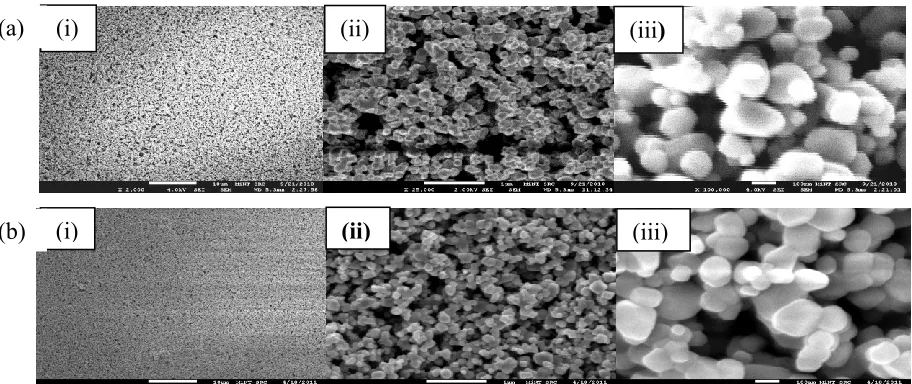
Fig. 2(a)(i) and Fig. 2(b)(i) shows an average gross view of TiO2 thin film surface -sponge like, while,
Figure 2(a)(ii) and Figure 2(b)(ii) displays a clear view of the TiO2 which gives a range between 100 –
300 nm of particle size.
Figure 2. Film morphology with magnification of (i) 2000, (ii) 25000, & (iii) 100000 for (a) untreated and (b) treated TiO2.
Fig. 2(b) shows denser and smoother structure as compared to Fig. 2(a). Smaller particle size or less large particle agglomerates known to contribute a slightly higher in surface area, thus faster reaction time, and improved phase purity, creating ‘sponge like’ high porosity structure. Therefore, more dye sensitizer will be absorbed to the TiO2 film and enhanced the performance of photovoltaic solar cell.
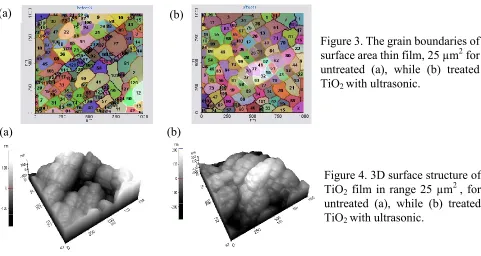
The grain boundaries of surface area thin film equivalent to 25 µm2 for untreated and treated TiO2
with ultrasonic as in Fig. 3 revealed more uniform size distribution, contributed to higher surface area, faster reaction time, and improved phase purity. According to Ahmad, M. K. et al., (2010), when the grain size becomes larger, electron movement from particles to other particles improves [12]. Fig. 4 also shows the surface morphology of both films (untreated and treated with ultrasonic) in a 3D form
(i) (ii) (iii)
(ii) (iii)
(i)
a – Conductive glass b – Carbon black c – Iodide layer
d – Coated TiO2 with dye
(a)
(b) +
[image:2.595.61.517.434.626.2]Namely: U1 (without ultrasonic process and no additive) U2 (without ultrasonic process and additive) U3 (ultrasonic process and no additives) U4 (ultrasonic process and additive)
Figure 5. Graph of I-V characteristic of photovoltaic solar cell
by using Atomic Force Microscope, AFM. It is observed that there is large gap in between those higher and lower particles for treated TiO2 with ultrasonic coated film that has smaller particle size
with large surface area to volume ratio and this is where the detrapping and trapping of electrons in TiO2 film takes place.
However, as the porosity of a film gets smaller and deeper, the electron diffusion gets slower and simultaneously jeopardize the photovoltaic performance. Hence, the optimum particle size shall be examined and should not be reduced indefinitely due to the influences of the TiO2 porosity layer.
As the particle size decreases, the pores also get smaller. The electrolyte has to be able to penetrate the pores and be present where there is absorbed dye. In addition, larger particles scatter light more effectively, and this has been found to have a positive effect on the performance of the cell [13].
(a) (b)
Electrical characteristic. Three parameters (short-circuit current, Isc, open-circuit voltage, Voc, and fill factor FF) are usually used to characterize solar cell outputs. Fig. 5 shows the I-V measurement for all the prepared samples using the Solar Simulator. It is predicted that both of the photovoltaic solar cell that has undergo the ultrasonic process would perform the best. However, based on the graph below, results show that the photovoltaic solar cell with treated TiO2 with ultrasonic process in
addition of 4-tert-butylpyridine as additive, U4 have the highest current performance while the one without additive, U3 have the lowest current. The open circuit voltage, (Voc) for each photovoltaic cell presents interesting values from, 0.74228 V for U4, 0.73161 V for U1, 0.69790 V for U2 and the lowest 0.33501 V for U3. This voltage order follows their respective efficiency, 0.039 %, 0.033 %, 0.031 % and 0.015 %.
Noted that TiO2 particle size in the range of 0.37-0.15 µm and the new natural dye proposed, extracted
from Melastoma Malabathricum’s fruit, are used in this research, where the data shows a comparable
(a) (b)
Figure 3. The grain boundaries of surface area thin film, 25 µm2 for untreated (a), while (b) treated TiO2 with ultrasonic.
Figure 4. 3D surface structure of TiO2 film in range 25 µm2 , for
[image:3.595.297.528.631.749.2](a) (b)
value with TiO2 nanocrystals DSSC using blackberry dye as reported [14]. The data recorded 0.196 %
as highest efficiency and then decreased to 0.018 % efficiency within less than 30 minutes in which compared to this research, the efficiency is between 0.039 % to 0.015 %. Due to the grade of the particle TiO2 and imperfect sealant (using only clipper to assemble both electrode and counter
electrode) and the cell being exposed in a period of time under the light beam before the first data been recorded. Therefore, in summary the photovoltaic solar cell proposed in this research had achieved an acceptable efficiency compared to the standard materials.
Outdoor Stability. Preliminary test on the stability of Melastoma Malabathricum’s fruit photovoltaic solar cell for four sample (U1, U2, U3 and U4) were carried out upon sunlight illumination, at noon (12- 1 pm) and afternoon (3- 4 pm) for several days. Based on the bar chart as shown in Fig. 6, it is obvious that there is a typical decreasing pattern of average potential (V) values for each photovoltaic cell from day one to day ten. However, the average potential (V) values for U4 stand in its own class either at noon or afternoon where the values is slightly higher and stable due to its characteristic of addition additive.
Figure 6. Graph of the average values of Potential (V) at (a) noon (12- 1 pm) and (b) afternoon (3- 4 pm) upon sunlight illumination for ten days where respective cell; TiO2; U1and U2 (without and with
additive respectively), treated TiO2 with ultrasonic; U3 and U4 (without and with additive
respectively).
Obviously, the performance of photovoltaic solar cell was related to the weather condition and due to imperfect sealant. Knowing that Malaysia is a equator country, where sunny and rainy weather throughout the year with high humidity and cloudy, the photovoltaic solar cell performance can be easily affected- usually little or no direct sunlight. As the sunlight blocked by the clouds or reflects off of other objects, it is experienced as diffused light, which causes variation in colors and intensity [15]. This makes a calculation of photovoltaic solar cell efficiency slightly different from the theory as both cells have different particle sizes with different advantages. Explaining the electrons detrap and trap event, under low light intensity, the electrons which trapped deep inside the TiO2 film will take longer
time to detrap by thermal activation and to reach the ITO glass where else influencing electron diffusion and lifetime and it goes vice versa for high light intensity.
In most research of DSSC, typical sealants being used are Surlyn and glass frit. However, due to its high cost fabrication, a clipper was used to assemble electrode and counter electrode together in this research. Noted that the electrolyte KI3 plays an important role in the process of
photon-convert-electricity in DSSC, therefore, there is a need to be added as the performance of the cell decreased. As for intrinsic factor, aforementioned that the air consist of high humidity where directly jeopardized the catalyst, dye sensitizer, liquid electrolyte and overall organic solar cell performance and this is due to impurities. Impurities also occur during fabrication, either while mixing, sintering, or assembling. Theoretically, instead of impurities, defects such as oxygen and metal vacancies inside the TiO2 film are always come into picture.
Conclusion
The performance of photovoltaic solar cell is related to the grade of TiO2 and due to imperfect sealant.
Therefore, this photovoltaic solar cell facing stability problems caused by KI3 electrolyte, such as the
for electrolyte, KI3 is between 0.039 % to 0.015 %, whilst with high purity of TiO2 nanocrystals gives
0.196 % decreases to 0.018 % efficiency within less than 30 minutes. Therefore, the ultrasonic treatment and addition of additive for electrolyte is reliable to be used for further application.
Acknowledgements
The authors would like to thank Universiti Tun Hussein Onn Malaysia (UTHM), Johor, and Malaysian Government for supporting this research under Fundamental Research Grant Scheme (Phase 1/2012), vot 1047. Extending the gratitude to Microelectronics and Nanotechnology – Shamsuddin Research Center (MiNT-SRC), UTHM.
References
[1] M. Gratzel: Solar Energy Conversion by Dye-Sensitized Photovoltaic Cells, Lausanne Switzerland, Inorg. Chem., 44 (2005), p. 6841-6851
[2] K. Tennakone, G.R.R.R.A. Kumara, A.R. Kumarasinghe, P.M. Sirimanne, and K.G.U.
Wijayantha: J.Photochem. Photobiol. A 94 217. (1996)
[3] L. Han, T. Obata, and Y. Inoue: Photoelectric Material Using Organic Photosensitising Dyes and Manufacturing Method Thereof, U.S. Patent; 6, 043, 428. (2000)
[4] S. Hao, J. Wu, Y. Huang, and J. Lin: Natural dyes as photosensitizers for dye-sensitized solar cell, Sol. Ener. 80 (2006), p. 209-214
[5] A.R.H. Martinez, E. Miriam, V. Susana, Q. Fracisco, and R. Rogelio: New Dye-Sensitized
Solar Cells Obtained from Extracted Bracts of Bougainvillea Glabra and Spectabilis Betalain Pigments by Different Purification Processes, Int. J. Mol. Sci. 2011, 12, p. 5565-5576
[6] G. Calogero, , G. D. Marco, S. Cazzanti, S. Caramori, R. Argazzi, A.D. Carlo, and C. A. Bignozzi: Efficient Dye-Sensitized Solar Cells Using Red Turnip and Purple Wild Sicilian Prickly Pear Fruits, Int. J. Mol. Sci. 2010, 11, p. 254-267
[7] M.R. Anika Zafiah, N.M. Abdullah,and M.F.L. Abdullah: Characterization and Treatment of
Titanium Dioxide via Ultrasonic Process with Melastoma Malabathricum as Sustainable Sensitizer for Photovoltaic Solar Cell, J. Chem., Vol.2013, Article ID 251741.
[8] H.B. Jin, and K.S. Suslick: Applications of Ultrasonic to The Synthesis of Nanostructured Materials, Adv. Mater., 22 (2010), p. 1039-1059
[9] H.S. Cho., J.Y. Eum., J.M. Hwang, J.M. Kim., G.B. Kim, and C.S. Park: Method and apparatus for production of dssc, U.S. Patent; US20120220074 A1 (2012)
[10] K.E. Lee, C. Charbonneau, S. Guobin, P.D. George, and G. Raynald: Nanocrystalline TiO2
Thin Film Electrodes for Dye-Sensitized Solar Cell Applications (2009)
[11] K. Agarwal, and K. Ghaziabad, Euro.Patent App. EP0754734A1 (2009)
[12] M.K. Ahmad, M.L.M. Halid, N.A. Rasheid, A.Z. Ahmed, S. Abdullah, and M. Rusop: Effect
of Annealing Temperatures on Surface Morphology and Electrical Properties of Titanium Dioxide Thin Films Prepared by Sol Gel Method, Journal of Sustainable Energy & Environment 1 (2010), p. 17-20
[13] K. Kalyanasundaram, and M. Gratzel: Application of functionalized of transition metal complexes in photonic and optoelectronic devices, Coor. Chem. Rev. 77. (1988)
[14] S.L. Tanihaha, H.P. Uranus, and J. Darma: Fabrication and Characterization of Dye-sensitized Solar Cell using Blackberry Dye and Titanium Dioxide Nanocrystals, Second International Conference on Advances in Computing, Control, and Telecommunication Technologies (2010).