ISSN Online: 2164-2796 ISSN Print: 2164-2788
Diffusion Tensor Imaging without Complex
Statistical Analysis Could Be
Helpful for Diagnosis
Duzgun Yildirim
1, Deniz Alis
2*, Cesur Samanci
2, Fethi Emre Ustabasioğlu
2, Onur Tutar
2, Atilla Ersen
31Department of Radiology, Acibadem Taksim Hospital, Istanbul, Turkey
2Department of Radiology, Cerrahpasa Medical Faculty, Istanbul University, Istanbul, Turkey 3Department of Pediatrics, Kasımpasa Military Hospital, Istanbul, Turkey
Abstract
Objective: Thanks to fast developing technology, visualization of fiber tracts at brain is possible. But with the new developments, data processing and interpretation are becoming more difficult. Actually interpretations in these fields are mostly in-group analysis and are generally not useful on the basis of individual patient evaluations. In these regards, we investigated our cases with diffusion tensor imaging (DTI) and tried to show if the data could be interpreted simply by radiologist’s eye or not. Ma-terial: Our study consisted of 31 cases that were evaluated in our center with 3 Tesla Magnetic Resonance Imaging (MRI) units. Cranial DTI studies performed for ische-mia, posttraumatic axonal injury, congenital malformation, neoplasia, autism, mental retardation and epilepsy. Cranial DTI was performed to demonstrate effected fiber tracts in neoplasia and ischemia cases and was applied to identify any gross anomaly in microstructural anatomy beside normal conventional MRI in other cases. DTI images were evaluated, along with fused conventional T1 weighted 3D high-resolution images and FA maps. DTI were performed at the first administration of the patients. Re-sults: In addition to chronic ischemic focuses in patients with ischemia, DTI-FA im-ages showed us relevant signal changes secondary to Wallerian degeneration in two cases. In traumatic brain injury cases, though being isointense on conventional se-quences, FA values showed decreased values at the levels of the axonal discontinuity. Major abnormalities of association and projection fibers in congenital malformation cases were visualized at both 3D-DTI fused images and FA map images. Displace-ment, infiltration, destruction fibers were clearly visualized in neoplasia cases. How-ever, any objective abnormality wasn’t reported at any cases diagnosed with motor mental retardation, epilepsy or neuropsychiatric diseases. Conclusion: Colored DTI images and FA maps are helpful in the way of diagnosis in most cases with organic How to cite this paper: Yildirim, D., Alis,
D., Samanci, C., Ustabasioğlu, F.E., Tutar, O. and Ersen, A. (2016) Diffusion Tensor Imaging without Complex Statistical Analy-sis Could Be Helpful for DiagnoAnaly-sis. Open Journal of Medical Imaging, 6, 93-101. http://dx.doi.org/10.4236/ojmi.2016.63009
Received: July 6, 2016 Accepted: September 26, 2016 Published: September 29, 2016
Copyright © 2016 by authors and Scientific Research Publishing Inc. This work is licensed under the Creative Commons Attribution International License (CC BY 4.0).
pathologies; it is possible to obtain diagnostic information by vivacious images.
Keywords
Central Nervous System, DTI, FA, MRI
1. Introduction
Thanks to fast developing technology, visualization of fiber tracts at brain is possible. The capability of diffusion tensor imaging (DTI) to reliably display secondary altera-tions of the white matter tracts caused by the primary pathology has the potential to be of great utility for treatment planning and follow-up in near future. With the advance-ments in diffusion-weighted imaging during the past decade, DTI can now show neu-ronal tracts in the brain and spine and better characterize the structural integrity of neural tissue [1]. This progress led to new clinical applications of this technique for di-agnosis and surgical follow-up protocols of central nervous system pathologies [2] [3].
Interpretations in the fields are more quantitative such as in-group analysis, but they are composed of information out of medical field, and are generally not useful on the basis of individual patient evaluations. In these regard, we investigated our cases’ DTI images and tried to show if the data could be interpreted simply with radiologist’s eye or not.
2. Material and Methods
The local ethics committee of Istanbul University Cerrahpasa Medical Faculty approved the study protocol. Written informed consent was obtained from all patients. In this study, 31 cases requiring advanced imaging with magnetic resonance imaging (MRI) and DTI were evaluated in our center with 3 Tesla MRI. Cranial DTI studies were per-formed for ischemia (5 cases), posttraumatic axonal injury (4 cases), congenital mal-formation (5 cases), neoplasia (7 cases), autism (2 cases), mental retardation (2 cases), epilepsy (3 cases). Cervical DTI investigations were performed for mass (2 cases) and syrinx formation (1 case). DTI images were evaluated, along with fused conventional T1 weighted 3D high-resolution images and FA maps. Basic demographic characteris-tics of the patients were summarized in Table 1.
3. Results
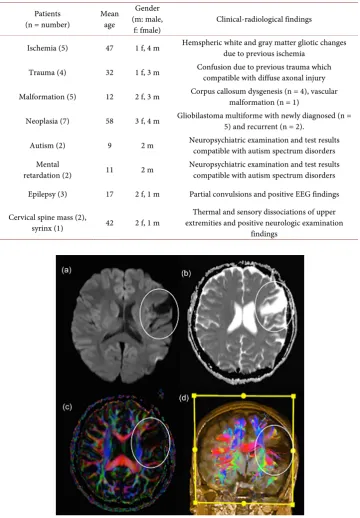
All patients in ischemic group with chronic ischemic focuses who were identified by clinical history and conventional images showed us decreased FA values especially thorough the affected areas. Additionally, DTI-FA images showed relevant signal changes secondary to Wallerian degeneration in two cases (Figure 1).
Table 1. Basic demographic characteristics of the patients.
Patients
(n = number) Mean age
Gender (m: male,
f: fmale) Clinical-radiological findings
Ischemia (5) 47 1 f, 4 m Hemspheric white and gray matter gliotic changes due to previous ischemia
Trauma (4) 32 1 f, 3 m Confusion due to previous trauma which compatible with diffuse axonal injury
Malformation (5) 12 2 f, 3 m Corpus callosum dysgenesis (n = 4), vascular malformation (n = 1)
Neoplasia (7) 58 3 f, 4 m Gliobilastoma multiforme with newly diagnosed (n = 5) and recurrent (n = 2).
Autism (2) 9 2 m Neuropsychiatric examination and test results compatible with autism spectrum disorders Mental
retardation (2) 11 2 m Neuropsychiatric examination and test results compatible with autism spectrum disorders Epilepsy (3) 17 2 f, 1 m Partial convulsions and positive EEG findings
Cervical spine mass (2),
syrinx (1) 42 2 f, 1 m
Thermal and sensory dissociations of upper extremities and positive neurologic examination
findings
Figure 1. A case with encephalomalasic changes due to old ischemia. (a) b-1000 image, (b) ADC
map, (c) colored FA map, (d) three dimensional fused images of tractography maps show the ab-sence of fibers without any displacement or infiltrative changes (encircled area).
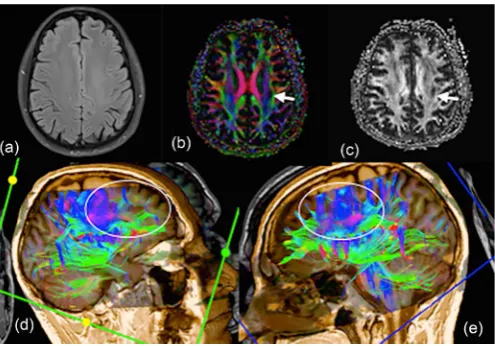
Figure 2. In cases with traumatic brain injury (TBI). (a) At high resolution axial FLAIR image, in coloured (b) and gray scale (c) FA maps; at the levels of axonal discontinuity where FA values decreased as darkened focus (arrows) seen objectively. No other any sequence showed these old posttraumatic abnormalities in this case. Abnormal side generally has reduced frontal association fibers compared to normal side at 3D-T1 fusion color tractography maps.
Major abnormalities of association and projection fibers in congenital malformation cases could be visualized at both 3D-DTI fused images and FA map images. DTI se-quences were able to identify abnormal connectivity in anomalies, which mainly ef-fected corpus callosum.
However, any objective anatomical pathology weren’t reported at cases with motor mental retardation, epilepsy or neuropsychiatric diseases in DTI evaluations. Only some minor changes were identified (as uncinate fascicilus asymmetry or decreased FA values in corpus callosum etc.) which were consistent with literatures (Figure 3).
Displacement, infiltration, destruction of U fibers, major association and projection fibers could be clearly visualized in intracranial neoplasia cases (Figure 4). It was possi-ble to differentiate malign lesions from benign ones according effected fibers.
Cervical spinal cord DTI was performed in 3 cases, mass or syrinx localization and its association with fiber tracts could clearly be visualized. These cases were diagnosed as syringomyelia rather than hydromyelia. Clinical and neurological findings of these cas-es were compatible with advanced radiological findings.
As commonly described, follow-up data and clinical data were correlated with these advanced radiological evaluations and compatibility with clinical data was investigated. Special images for each group were processed separately.
4. Discussion
Figure 3. A young man with autism spectrum disorders (a) though to normal callosal anatomy at sagittal T1 weighted image, (b) crossing fibers were very sparked at fused, colored tractography image.
Figure 4. Displacement, infiltration and destruction of U fibers, major association and projection
fibers could be clearly visualized in intracranial neoplasia cases. (a) A case with left frontobasal cortical capillary malformation (at smaill picture, enhanced area, arrow) shows only thinned short association fibers in FA maps (at background picture, short arrow) compared with normal right side (at background picture, long arrow). (b) At three dimensional fiber tract map, the or-ganization of the fibers is protected without any obvious deformation (encircled area). However in a case with right basal ganglionic GMB; pathological rim enhancement and central necrosis is seen on T1 weighted axial image (c). In this case, colored FA map (d) and fused three dimension-al fiber tractography image (e) show deformation and destruction of insular “u” fibers, interndimension-al and external capsules (arrows) compared with left side.
There are many signs and demonstrative abnormalities defined by DTI protocol. New techniques are currently being developed based on DTI as DSI (diffusion spec-trum imaging), kurtosis, Q-ball imaging etc., since his area is subject of ongoing re-searches.
[image:5.595.248.500.262.484.2]complexity is getting problem, the need for enhanced evolution methods are also acce-lerating with the new developments in this area; for instance while the number of the vectors are increasing, capacity and speed of the processors should increase to excep-tional levels.
In simple terms, complex operation mechanism of DTI consist of appliance of at least 6 different directions of diffusion gradient and determination of varying degrees of movement limitations water molecules undergo along fiber tracts in their microenvi-ronments [2].
The last range of parameters that can be extracted from the DTI concept relates to the mapping of tissue structure orientation in space. Here gathered data are quantified and mapped as mean diffusivity and fractional anisotrophy and organized as gray scale and colored maps. Roi measurements and calculations can be done using these maps [3]. It is important to notice that diffusion imaging is a truly quantitative method, be-cause diffusion coefficient calculated is a parameter that directly reflects the physical properties of the tissues. Chan et al. investigated the affects of hypoxic ischemic ence-phalopathy on visual pathways and found retinocollicular and retino geniculate path-ways were more vulnerable to anterograde degeneration from eye injury than retro-grade, trans synaptic degeneration from visual cortex injury [4].
Nael et al. showed in hyper acute ischemic stroke while all sequence values could be in normal limits. FA values could increase suddenly and as process becoming chronic FA values diminished [5].
TBI cases in our study showed decreased FA values. Robert et al. with a mata- analysis showed in the same patient group that FA increased and ADC decreased in most white matter tracts in the short-term, and FA decreased and ADC increased in medium to long-term [6].
In a study, relationship between mild TBI and mental state was showed clearly with in vivo DTI examination [7].
Congenital anomalies, variations and a large variety of diseases changing from simple callosal dysgenesis to otism could be diagnosed by showing fiber course anomalies, agenesis and aberrations in great detail when compared with conventional sequences [8]-[11].
Choudhri et al. showed in their article the effectiveness and success of the commisur-al dissection could be tested by DTI at postoperative stage and commisur-also DTI could be used to show displacement, infiltration, destruction of U fibers, major association and pro-jection fibers in intracranial benign or malignant neoplasms. Even post-op course and possible complications of these neoplasms may be estimated through their association with critical association and projection fibers [12].
Literatures and our cases showed examination of intramedullary lesions with DTI provided detailed information about the exact localizations, adjacent fiber tract rela-tions of these lesions [12]-[16].
Furthermore, early period damage of spinal cord by non-neoplastic pathologies like disc herniation and possible systemic disorders could be obtained by DTI [17] [18]. Evaluations in this study were made relatively, but data in groups which represent main pathologies were assessed by a single researcher, FA-ROI measurements were not done in most of the cases. Findings were not tested with detailed, inter-group statistical tests, so quantification with some evaluations was not achieved and this may hamper the ob-jectivity. Beside this main restriction, data were presented in consideration with visual evaluations needed for every radiologist without deviation from main aim of the article and usage of the technique and parametric details [19].
On the other hand, this case based article which lacks detailed statistical analysis did not present any specific data about cognitive disorders and neuropsychiatric diseases. However, prominent and promising findings about this group of disorders appear con-tinuously throughout the literatures and numbers of related articles are progressively increasing [20] [21]. Some articles showed degree of hazards in central nervous system disorders by inflammatory intestinal diseases, SLE and Hepatitis B virus infections could be evaluated by some metric and statistical measurements of DTI [22]-[26]. We believed that if methods like tract based analysis might be simplified in the future, these methods could be very valuable for the detection of microstructural anomalies, which is unable to be detected visually.
5. Conclusion
In conclusion, although it doesn’t provide concrete and case-specific valuable informa-tion to radiologists, especially in cases with microstructural anomalies like neurop-sychiatric disorders, epilepsy and motor-mental retardation; in most cases with organic pathologies, it is possible to obtain diagnostic information by DTI-FA maps and 3D-trac- tography’s vivacious images. Indeed, currently used statistical analysis programs could show microstructural anomalies as well as growing steadily and this area is the subject of ongoing research.
References
[1] Lerner, A., Mogensen, M.A., Kim, P.E., Shiroishi, M.S., Hwang, D.H. and Law, M. (2014) Clinical Applications of Diffusion Tensor Imaging. World Neurosurgery, 82, 96-109. http://dx.doi.org/10.1016/j.wneu.2013.07.083
[2] de Carvalho Rangel, C., Hygino Cruz Jr., L.C., Takayassu, T.C., Gasparetto, E.L. and Do-mingues, R.C. (2011) Diffusion MR Imaging in Central Nervous System. Magnetic Reson-ance Imaging Clinics of North America, 19, 23-53.
http://dx.doi.org/10.1016/j.mric.2010.10.006
[4] Chan, K.C., Kancherla, S., Fan, S.J. and Wu, E.X. (2014) Long-Term Effects of Neonatal Hypoxia-Ischemia on Structural and Physiological Integrity of the Eye and Visual Pathway by Multimodal MRI. Investigative Ophthalmology & Visual Science, 56, 1-9.
http://dx.doi.org/10.1167/iovs.14-14287
[5] Nael, K., Trouard, T.P., Lafleur, S.R., Krupinski, E.A., Salamon, N. and Kidwell, C.S. (2015) White Matter Ischemic Changes in Hyperacute Ischemic Stroke: Voxel-Based Analysis Us-ing Diffusion Tensor ImagUs-ing and MR Perfusion. Stroke, 46, 413-418.
http://dx.doi.org/10.1161/STROKEAHA.114.007000
[6] Roberts, R.M., Mathias, J.L. and Rose, S.E. (2014) Diffusion Tensor Imaging (DTI) Findings Following Pediatric Non-Penetrating TBI: A Meta-Analysis. Developmental Neuropsycholo-gy, 39, 600-637. http://dx.doi.org/10.1080/87565641.2014.973958
[7] Xiong, K., Zhu, Y., Zhang, Y., Yin, Z., Zhang, J., Qiu, M. and Zhang, W. (2014) White Mat-ter Integrity and Cognition in Mild Traumatic Brain Injury Following Motor Vehicle Acci-dent. Brain Research, 23, 86-92. http://dx.doi.org/10.1016/j.brainres.2014.10.030
[8] Eshetu, T., Meoded, A., Jallo, G.I., Carson, B.S., Huisman, T.A. and Poretti, A. (2014) Dif-fusion Tensor Imaging in Pediatric Chiari Type I Malformation. Developmental Medicine & Child Neurology, 56, 742-748.
[9] Beckett, J.S., Brooks, E.D., Lacadie, C., et al. (2014) Altered Brain Connectivity in Sagittal Craniosynostosis. Journal of Neurosurgery: Pediatrics, 13, 690-698.
http://dx.doi.org/10.3171/2014.3.PEDS13516
[10] Oishi, K., Faria, A.V., Yoshida, S., Chang, L. and Mori, S. (2013) Quantitative Evaluation of Brain Development Using Anatomical MRI and Diffusion Tensor Imaging. International Journal of Developmental Neuroscience, 3, 512-524.
http://dx.doi.org/10.1016/j.ijdevneu.2013.06.004
[11] Poretti, A., Meoded, A., Rossi, A., Raybaud, C. and Huisman, T.A. (2013) Diffusion Tensor Imaging and Fiber Tractography in Brain Malformations. Pediatric Radiology, 43, 28-54. http://dx.doi.org/10.1007/s00247-012-2428-9
[12] Choudhri, A.F., Whitehead, M.T., McGregor, A.L., Einhaus, S.L., Boop, F.A. and Wheless, J.W. (2013) Diffusion Tensor Imaging to Evaluate Commissural Disconnection after Cor-pus Callosotomy. Neuroradiology, 55, 1397-1403.
http://dx.doi.org/10.1007/s00234-013-1286-y
[13] Ulmer, J.L., Klein, A.P., Mueller, W.M., De Yoe, E.A. and Mark, L.P. (2014) Preoperative Diffusion Tensor Imaging: Improving Neurosurgical Outcomes in Brain Tumor Patients.
Neuroimaging Clinics of North America, 24, 599-617. http://dx.doi.org/10.1016/j.nic.2014.08.002
[14] Jiang, R., Du, F.Z., He, C., Gu, M., Ke, Z.W. and Li, J.H. (2014) The Value of Diffusion Tensor Imaging in Differentiating High-Grade Gliomas from Brain Metastases: A Syste-matic Review and Meta-Analysis. PLoS ONE, 9, e112550.
http://dx.doi.org/10.1371/journal.pone.0112550
[15] Inano, R., Oishi, N., Kunieda, T., Arakawa, Y., et al. (2014) Voxel-Based Clustered Imaging by Multiparameter Diffusion Tensor Images for Glioma Grading. NeuroImage: Clinical, 5, 396-407. http://dx.doi.org/10.1016/j.nicl.2014.08.001
[16] Potgieser, A.R., Wagemakers, M., van Hulzen, A.L., de Jong, B.M., Hoving, E.W. and Groen, R.J. (2014) The Role of Diffusion Tensor Imaging in Brain Tumor Surgery: A Re-view of the Literature. Clinical Neurology and Neurosurgery, 124, 51-58.
http://dx.doi.org/10.1016/j.clineuro.2014.06.009
Imaging to Guide Surgical Planning in Intramedullary Spinal Cord Tumors in Children.
Neuroradiology, 56, 169-174. http://dx.doi.org/10.1007/s00234-013-1316-9
[18] Liu, X., Germin, B.I. and Ekholm, S. (2011) A Case of Cervical Spinal Cord Glioblastoma Diagnosed with MR Diffusion Tensor and Perfusion Imaging. Journal of Neuroimaging, 21, 292-296. http://dx.doi.org/10.1111/j.1552-6569.2009.00459.x
[19] El Mendili, M.M., Cohen-Adad, J., Pelegrini-Issac, M., et al. (2014) Multi-Parametric Spinal Cord MRI as Potential Progression Marker in Amyotrophic Lateral Sclerosis. PLoS ONE, 9, e95516. http://dx.doi.org/10.1371/journal.pone.0095516
[20] Banaszek, A., Bladowska, J., Szewczyk, P., Podgórski, P. and Sąsiadek, M. (2014) Usefulness of Diffusion Tensor MR Imaging in the Assessment of Intramedullary Changes of the Cer-vical Spinal Cord in Different Stages of Degenerative Spine Disease. European Spine Jour-nal, 23, 1523-1530. http://dx.doi.org/10.1007/s00586-014-3323-x
[21] Cheng, Y., Xu, J., Yu, H., Nie, B., et al. (2014) Delineation of Early and Later Adult Onset Depression by Diffusion Tensor Imaging. PLoS ONE, 9, e112307.
http://dx.doi.org/10.1371/journal.pone.0112307
[22] Knöchel, C., Stäblein, M., Storchak, H., et al. (2014) Multimodal Assessments of the Hip-pocampal Formation in Schizophrenia and Bipolar Disorder: Evidences from Neurobeha-vioral Measures and Functional and Structural MR. NeuroImage: Clinical, 26, 134-144. http://dx.doi.org/10.1016/j.nicl.2014.08.015
[23] Teipel, S.J., Walter, M., Likitjaroen, Y., Schönknecht, P. and Gruber, O. (2014) Diffusion Tensor Imaging in Alzheimer’s Disease and Affective Disorders. European Archives of Psy-chiatry and Clinical Neuroscience, 264, 467-483.
http://dx.doi.org/10.1007/s00406-014-0496-6
[24] Nakaaki, S., Sato, J., Torii, K., et al. (2013) Decreased White Matter Integrity before the Onset of Delusions in Patients with Alzheimer’s Disease: Diffusion Tensor Imaging. Neu-ropsychiatric Disease and Treatment, 9, 25-29.
[25] Hughes, M., Sundgren, P.C., Fan, X., Foerster, B., et al. (2007) Diffusion Tensor Imaging in Patients with Acute Onset of Neuropsychiatric Systemic Lupus Erythematosus: A Prospec-tive Study of Apparent Diffusion Coefficient, Fractional Anisotropy Values, and Eigenva-lues in Different Regions of the Brain. Acta Radiologica, 48, 213-222.
http://dx.doi.org/10.1080/02841850601105825
Submit or recommend next manuscript to SCIRP and we will provide best service for you:
Accepting pre-submission inquiries through Email, Facebook, LinkedIn, Twitter, etc. A wide selection of journals (inclusive of 9 subjects, more than 200 journals)
Providing 24-hour high-quality service User-friendly online submission system Fair and swift peer-review system
Efficient typesetting and proofreading procedure
Display of the result of downloads and visits, as well as the number of cited articles Maximum dissemination of your research work